REVIEW 3 major objections 5 minor 2 cited by
Constraining new physics from Higgs measurements with Lilith: update to LHC Run 2 results
T0 review · 3 major / 5 minor · reviewed 2026-08-14 · deepseek-v4-flash
Pith's one-line read Lilith-2.0 turns LHC Run 2 Higgs measurements into a reusable global likelihood, with validated fits pinning the Higgs couplings to better than 10 percent.
desk verdict Genuinely useful software update with an honest but imperfect validation: the limit-to-Gaussian conversions in H→ZZ* and H→μμ are the soft spot; the headline global-fit numbers are safe. read the letter →
The pith
A machine-rendered reading of the paper's core claim, the machinery that carries it, and where it could break.
The reading
What carries the argument
The carrying object is the signal-strength likelihood: each measured production-and-decay rate, mu(X,Y), is defined as the ratio of the observed to the Standard-Model rate, and the product of per-measurement likelihoods forms the global likelihood used for fits. The upgrade to version 2.0 lies in the shapes allowed for each piece: a variable Gaussian, whose width grows or shrinks with the parameter value to absorb asymmetric errors; a generalised Poisson, a count-based form with a free shape parameter tuned to the quoted uncertainties; and multi-dimensional Gaussians with arbitrary correlation matrices. The translation from rates to physics is made through reduced couplings CX and CY that scale Standard-Model production and decay amplitudes, which the paper identifies with the kappa framework, with the option to profile over invisible and undetected decay widths. This machinery converts the narrow-width, SM-tensor-structure assumption into concrete intervals on coupling combinations, which is what makes a wide class of new-physics models testable with a single downloaded tool.
What would settle it
Extract the true profile likelihoods for the ATLAS H->ZZ* VH and ttH channels from the collaboration's public material and compare them with the database's two-sided Gaussian entries, mu(VH,ZZ*) = 0 +/- 1.89 and mu(ttH,ZZ*) = 0 +/- 3.83; if those true likelihoods are markedly one-sided, the conversion used in DB 19.09 biases the global fits, and the paper's reliability claim would be falsified.
Extended reading notes
Core claim
On the paper's own terms, the result is that Lilith-2.0 can reconstruct the likelihoods of the current ATLAS and CMS Run 2 Higgs measurements with enough fidelity that its global fits track the official coupling contours, and that the accompanying database DB 19.09 is ready for general use. Combining the ATLAS and CMS Run 2 data, the global fit of the fermionic and vector reduced couplings gives CF = 1.045+0.064-0.063 and CV = 1.068 +/- 0.030, with the two experiments agreeing at about the 1 sigma level. In the same framework, the visible signal strengths alone already constrain the invisible decay branching fraction to about 5 percent at 95% CL for Standard-Model-like couplings. The slight preference for a vector coupling above one, if taken at face value, pushes two-Higgs-doublet models, where CV is bounded by one, deeper into the alignment limit.
Load-bearing premise
The load-bearing premise is that the simplified likelihood shapes stored in the database, built from published best-fit values, uncertainties, and correlations, capture the real experimental likelihoods closely enough that approximate entries, such as H->ZZ* limits converted from 95% CL bounds, do not bias the global fit.
Editorial extensions
If this is right
- Any new-physics model that only rescales Standard-Model Higgs couplings can be tested immediately against the full Run 2 Higgs dataset by running Lilith-2.0, without re-implementing the experimental likelihoods.
- The roughly 3-4 percent determination of CV and sub-10 percent determinations of the fermion and vector couplings put concrete pressure on scenarios predicting percent-level coupling deviations.
- The invisible branching fraction bound of about 5 percent at 95% CL for Standard-Model-like couplings directly restricts Higgs-portal dark-matter models, and tightens to about 4 percent when Run 1 data are added.
- The preference for CV slightly above one strengthens the case that two-Higgs-doublet models live in the alignment limit, disfavouring large deviations in tan(beta) and cos(beta-alpha).
- Because the database format now supports arbitrary correlation matrices, the same machinery can be extended with future full-Run-2 and HL-LHC measurements as they are published.
Reading between the lines
- Extension: the accuracy of the DB 19.09 parametrisations will get a natural stress test when ATLAS and CMS release their full 139 fb^-1 Run 2 combinations; if the official profile likelihoods for CV and BR(H->inv) shift markedly from Lilith's, the simplified shapes should be revised.
- Extension: the paper's own complaints about digitizing plots and hand-typing correlation matrices suggest the next natural step is direct ingestion of STXS-binned data or machine-readable likelihood files, eliminating the lossy reconstruction step.
- Extension: the same validation-then-fit pattern used here is transferable to other LHC observables where experiments publish only summary statistics, so the methodology is a template beyond Higgs physics.
- Extension: the headline '5 percent bound' on invisible Higgs decays is conditional on Standard-Model-like couplings; theorists with fermion or vector coupling freedom should quote the roughly 15-16 percent bound instead of the headline value.
Editorial analysis
A structured set of objections, weighed in public.
Referee Report
Summary. The paper presents Lilith-2.0, a public Python library for constraining new physics from Higgs signal-strength measurements, together with an updated XML database (DB 19.09) that incorporates ATLAS and CMS Run 2 results at 36 fb^-1. The main technical novelties are the extension from ordinary Gaussian likelihoods to variable-Gaussian and generalized-Poisson parametrizations, the support of arbitrarily large correlation matrices, and the addition of new production modes (ggZH, tH, bbH). The authors document each experimental input, show validation plots against official ATLAS/CMS contours where available, and give updated global fits for reduced couplings, 2HDM Types I and II, and invisible Higgs decays, finding e.g. C_V = 1.068 +/- 0.030 and BR(H -> inv) < 5% at 95% CL for SM-like couplings. The central claim is that Lilith-2.0 with DB 19.09 is ready for use in constraining a wide class of new physics scenarios.
Significance. If the database is reliable, this is a valuable community resource: it is lightweight, Python-based, publicly available, and it makes efficient use of the best public Higgs measurements, including the full 24x24 CMS correlation matrix. The paper is generally transparent about its approximations, explicitly flagging, for instance, the LO treatment of tHW, the assumed WW/ZZ composition of the ttH VV final state, and the fact that the paper updates rather than replaces the Lilith-1.1 manual. The global-fit results are plausible and consistent with the SM. The chief risk is not the statistical formalism but the fidelity of the reconstructed likelihoods for entries that are digitized from plots or converted from limits; those entries feed the global fits and exclusions, so the 'ready to be used' claim rests on their accuracy.
major comments (3)
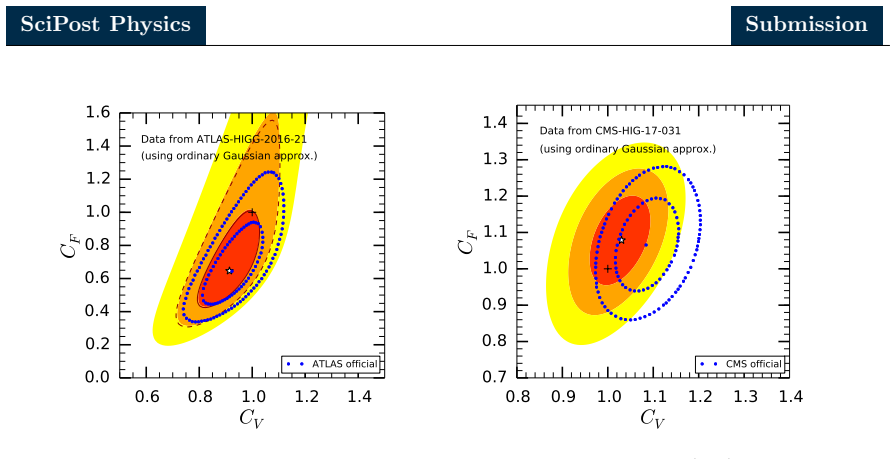
- [Section 5.1, H->WW and H->tau tau; Fig. 3] The conversion of the ATLAS 95% CL upper limits for mu(VH,ZZ*) and mu(ttH,ZZ*) into two-sided Gaussians with sigma = L/1.96 (implemented as 0 +/- 1.89 and 0 +/- 3.83) makes the effective 95% upper bound 1.64 sigma = 0.84 L rather than the published L; if the limits are one-sided, the appropriate Gaussian width would be sigma = L/1.64, so the database is about 16% tighter for positive signal strengths. The authors state that this normalization was chosen because a one-sided assumption gives a less good match to the official C_F vs. C_V contour, which is a tuning against the validation target rather than an independent test. Since these two entries enter all global fits in Section 6, the central claim that DB 19.09 is ready to be used needs a sensitivity study showing how the quoted constraints (C_V = 1.068 +/- 0.030, C_F = 1.045 +/- 0.064, BR(H->inv) < 5%) change when the entries are instead implemented as one-sided Gaussians or with alternative asymmetric widths.
- [Section 5.1, H->mu mu] For several ATLAS Run 2 entries the validation is partly circular: the parameters of the approximating likelihood are fitted directly to the experimental 95% CL contour, and the validation plot then compares the Lilith reconstruction with that same contour (e.g., Fig. 3, top-right and bottom panels). This demonstrates internal consistency but not that the parametrization is accurate away from the fitted region or in the tails used for 95% CL exclusions. For these channels no official coupling fit is available, so I ask for an independent cross-check, such as a comparison with the underlying category-level likelihood or a coverage test of the reconstructed likelihood.
- [Section 5.1, H->mu mu] The same one-sided/two-sided ambiguity affects the H->mu mu entry: ATLAS reports mu = -0.1 +/- 1.5 with a CLs 95% upper limit of 3.0, and the database implements mu = 0 +/- 1.53. Under a one-sided Gaussian interpretation this corresponds to a 95% upper bound of 1.64 x 1.53 = 2.51, which is more restrictive than the published limit rather than less restrictive. If the intention is to avoid over-constraining, the width should be larger (sigma ~ 1.83 if matching the one-sided limit), or the two-sided interpretation should be explicitly stated and justified.
minor comments (5)
- [Section 2] The text 'This does does not always allow' contains a duplicated 'does' and should read 'This does not always allow'.
- [Section 5.1, H->tau tau] In the sentence describing the H->tau tau likelihood, 'mu(VBF,WW) ~ 1.20+0.62-0.56' should read 'mu(VBF,tau tau) ~ 1.20+0.62-0.56'.
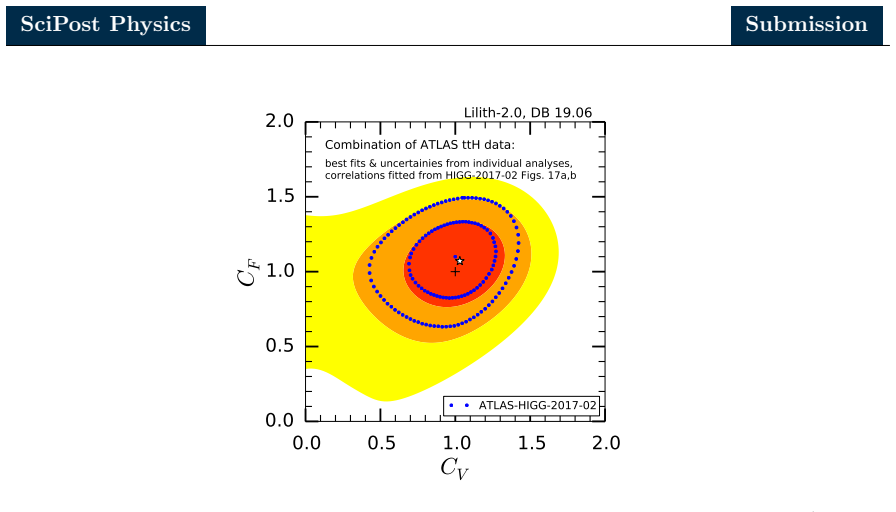
- [Section 5.1, ttH combination] The caveat that the HIGG-2017-02 XML file should not be used when C_Z != C_W is important; the code should ideally issue an explicit warning when this file is loaded under assumptions that violate that condition.
- [Section 4] The statement that 8 TeV cross sections are used for sqrt(s) = 7 TeV because differences are negligible would be more helpful if accompanied by a quantitative estimate or a reference for that estimate.
- [Appendix A, Fig. 14] The text notes that even with the Poisson form the 95% CL contour for H->ZZ* is still 'quite off' before the auxiliary profile likelihoods are used; this reinforces the sensitivity concerns raised in the major comments and should be discussed in the main text rather than only in the appendix.
Circularity Check
No circular derivation of the physics constraints; the only mild circularity is that one H→ZZ* likelihood parametrization was chosen by matching the official ATLAS contour that is then used for validation.
-
other
[Section 5.1, H→ZZ* (HIGG-2016-22), validation Fig. 2]
"For the VH and ttH production modes, lacking more information, we convert the given 95% CL limits into µ(VH, ZZ∗) = 0± 1.89 and µ(ttH, ZZ∗) = 0 ± 3.83 using a 2-sided Gaussian (assuming 1-sided limits gives a less good agreement with the ATLAS CF vs. CV fit)."
The one-sided versus two-sided conversion of the published 95% CL upper limits is selected by requiring better agreement with the official ATLAS CF vs. CV contour, and the same contour is then used as the validation target in Fig. 2. Thus the validation of this database entry is partly self-consistent: the parametrization was tuned toward the very curve it is compared against. This does not make the global coupling fits circular, because the fitted constraints still depend on external ATLAS/CMS measurements, but it weakens the independence of the validation for these two ZZ* limit-derived entries.
full rationale
Lilith-2.0 is a likelihood-reimplementation tool: its inputs are signal strengths, uncertainties, correlations, and likelihood grids taken from ATLAS and CMS publications, and its outputs are global constraints on Higgs coupling modifiers, 2HDM parameters, and invisible branching ratios. The core derivations are therefore self-contained in the sense that the fitted quantities are not defined in terms of the outputs, and the numerical results quoted in Section 6 (e.g., CV = 1.068 ± 0.030, BR(H→inv) < 5%) come from evaluating external measurements through the model relation in Eq. (2). No equation in the paper reduces a predicted quantity to an input by construction, and no load-bearing claim rests solely on a self-citation: the citations to earlier Lilith papers and to the authors' previous global-fit papers provide background and methodology but not the uniqueness or validity of the Run 2 database. The only noteworthy circularity-adjacent step is in Section 5.1, where the choice to represent ATLAS VH and ttH H→ZZ* limits as two-sided Gaussians is justified by better agreement with the official ATLAS CF vs. CV contour, and the same contour is used for validation. This is a tuning of the approximation to the validation target, so the validation is not fully independent for those entries. However, it is a localized implementation choice, not a circular derivation of the paper's physics conclusions; the rest of the database is built from published best-fit values, uncertainties, and correlation matrices. Overall, the central claim that Lilith-2.0 can constrain new physics from Run 2 Higgs data has substantial independent content, and the paper deserves only a low circularity score reflecting the partially self-consistent validation procedure.
Assumptions & free parameters
free parameters (7)
- rho(H->ZZ ggH,VBF) =
-0.41
- rho(H->WW ggH,VBF) =
-0.08
- rho(H->WW ZH,WH) =
-0.08
- rho(ttH bb,VV) =
0.04
- rho(ttH tau,VV) =
-0.35
- WW fraction in ttH VV =
0.95
- H->mu mu production composition =
ggH 90%, VBF 7%, VH 3%
assumptions (7)
- domain assumption New physics is assumed to affect the 125 GeV Higgs only through scalings of SM-like production and decay amplitudes (same Lorentz structure as the SM); the signal strength framework further relies on the narrow-width approximation.
- domain assumption Loop-induced couplings Cg and Cgamma are computed from tree-level reduced couplings assuming no new particles in the loops, unless taken as free parameters.
- domain assumption The total width is modified only via a multiplicative factor (1 - BR(H->inv) - BR(H->undet)), i.e., new invisible or undetected decays do not alter the kinematics.
- ad hoc to paper For sqrt(s)=7 TeV, the 8 TeV cross section values are used; differences are claimed negligible.
- ad hoc to paper The tHW cross section is computed at leading order with MadGraph, with the given scale choice, because an NLO definition is not straightforward.
- ad hoc to paper The profile likelihood for Cg vs Cgamma treats BR(H->inv) and BR(H->undet) as free but individually capped at 50% to enforce the physical sum constraint.
- domain assumption The Higgs mass is fixed to mH = 125.09 GeV.
Cite this review
Pith. "Pith review of Constraining new physics from Higgs measurements with Lilith: update to LHC Run 2 results." pith.science (2026). https://pith.science/paper/MIDH7RVE
@misc{pith2026190803952,
  author       = {Pith},
  title        = {Pith review of: Constraining new physics from Higgs measurements with Lilith: update to LHC Run 2 results},
  year         = {2026},
  howpublished = {\url{https://pith.science/paper/MIDH7RVE}},
  note         = {Machine review of arXiv:1908.03952}
}
read the original abstract
Lilith is a public Python library for constraining new physics from Higgs signal strength measurements. We here present version 2.0 of Lilith together with an updated XML database which includes the current ATLAS and CMS Run 2 Higgs results for 36/fb. Both the code and the database were extended from the ordinary Gaussian approximation employed in Lilith-1.1 to using variable Gaussian and Poisson likelihoods. Moreover, Lilith can now make use of correlation matrices of arbitrary dimension. We provide detailed validations of the implemented experimental results as well as a status of global fits for reduced Higgs couplings, Two-Higgs-doublet models of Type I and Type II, and invisible Higgs decays. Lilith-2.0 is available on GitHub and ready to be used to constrain a wide class of new physics scenarios.
Figures


Figures from the paper (12 more)




Forward citations
Cited by 2 Pith papers
-
Agentic Re-Casting using Agentic Re-Simulations
An agentic AI system with a physicist in the loop re-casts an ATLAS ttZ measurement into a global top-quark SMEFT fit and recovers injected coloron Wilson coefficients in a repeatable benchmark.
-
Renormalisation group evolution effects on global SMEFT analyses
Including RGE effects in a global SMEFT fit improves bounds on poorly constrained four-quark operators but weakens limits on modified Z q qbar couplings by up to a factor of ten.
Reference graph
Works this paper leans on
-
[1]
J. Bernon and B. Dumont, Lilith: a tool for constraining new physics from Higgs measurements, Eur. Phys. J. C75(9), 440 (2015), doi:10.1140/epjc/s10052-015-3645- 9, arXiv:1502.04138
arXiv 2015
-
[2]
Status of Higgs couplings after Run-1 of the LHC using Lilith 1.0
J. Bernon, B. Dumont and S. Kraml, Status of Higgs couplings after run 1 of the LHC , 24 SciPost Physics Submission Phys. Rev. D90, 071301 (2014), doi:10.1103/PhysRevD.90.071301, arXiv:1409.1588
work page Pith review arXiv 2014
-
[3]
On the presentation of the LHC Higgs Results
F. Boudjema et al. , On the presentation of the LHC Higgs Results , In Workshop on Likelihoods for the LHC Searches Geneva, Switzerland, January 21-23, 2013 (2013), arXiv:1307.5865
work page Pith review arXiv 2013
-
[4]
P. Bechtle, S. Heinemeyer, O. St˚ al, T. Stefaniak and G. Weiglein, HiggsSignals : Confronting arbitrary Higgs sectors with measurements at the Tevatron and the LHC , Eur. Phys. J. C74(2), 2711 (2014), doi:10.1140/epjc/s10052-013-2711-4, https: //higgsbounds.hepforge.org/, arXiv:1305.1933
arXiv 2014
-
[5]
J. R. Andersen et al. , Les Houches 2015: Physics at TeV Colliders Standard Model Working Group Report , In 9th Les Houches Workshop on Physics at TeV Colliders (PhysTeV 2015) Les Houches, France, June 1-19, 2015 (2016), arXiv:1605.04692
arXiv 2016
-
[6]
de Florian et al., Handbook of LHC Higgs Cross Sections: 4
D. de Florian et al., Handbook of LHC Higgs Cross Sections: 4. Deciphering the Nature of the Higgs Sector (2016), doi:10.23731/CYRM-2017-002, arXiv:1610.07922
arXiv 2016
-
[7]
G. Belanger, B. Dumont, U. Ellwanger, J. F. Gunion and S. Kraml, Global fit to Higgs signal strengths and couplings and implications for extended Higgs sectors , Phys. Rev. D88, 075008 (2013), doi:10.1103/PhysRevD.88.075008, arXiv:1306.2941
arXiv 2013
-
[8]
Higgs Couplings at the End of 2012
G. Belanger, B. Dumont, U. Ellwanger, J. F. Gunion and S. Kraml, Higgs Couplings at the End of 2012 , JHEP 02, 053 (2013), doi:10.1007/JHEP02(2013)053, arXiv:1212.5244
work page Pith review arXiv 2013
Show all 52 references
-
[9]
J. R. Andersen et al., Handbook of LHC Higgs Cross Sections: 3. Higgs Properties (2013), doi:10.5170/CERN-2013-004, arXiv:1307.1347
2013 arXiv
-
[10]
Aad et al
G. Aad et al. , Measurements of the Higgs boson production and decay rates and con- straints on its couplings from a combined ATLAS and CMS analysis of the LHC pp col- lision data at √s = 7 and 8 TeV, JHEP 08, 045 (2016), doi:10.1007/JHEP08(2016)045, arXiv:1606.02266
2016 arXiv
-
[11]
Barlow, Asymmetric statistical errors , In Statistical Problems in Particle Physics, Astrophysics and Cosmology (PHYSTAT 05): Proceedings, Oxford, UK, September 12- 15, 2005, pp
R. Barlow, Asymmetric statistical errors , In Statistical Problems in Particle Physics, Astrophysics and Cosmology (PHYSTAT 05): Proceedings, Oxford, UK, September 12- 15, 2005, pp. 56–59 (2004), arXiv:physics/0406120
2004 arXiv
-
[12]
A. M. Sirunyan et al., Combined measurements of Higgs boson couplings in proton–proton collisions at√s = 13 TeV, Eur. Phys. J. C79(5), 421 (2019), doi:10.1140/epjc/s10052- 019-6909-y, https://cms-results.web.cern.ch/cms-results/public-results/ publications/HIG-17-031/, arXiv:1...
2019 arXiv
-
[13]
Berkhout and E
P. Berkhout and E. Plug, A bivariate Poisson count data model using conditional prob- abilities, In Statistica Neerlandica, pp. 349–364 (2004)
2004
-
[14]
https://twiki.cern.ch/twiki/bin/view/LHCPhysics/CERNYellowReportPageAt8TeV
-
[15]
https://twiki.cern.ch/twiki/bin/view/LHCPhysics/CERNYellowReportPageAt13TeV
-
[16]
Aaboud et al., Measurements of Higgs boson properties in the diphoton decay channel with 36 fb −1 of pp collision data at √s = 13 TeV with the ATLAS detector , Phys
M. Aaboud et al., Measurements of Higgs boson properties in the diphoton decay channel with 36 fb −1 of pp collision data at √s = 13 TeV with the ATLAS detector , Phys. Rev. D98, 052005 (2018), doi:10.1103/PhysRevD.98.052005, https://atlas.web.cern.ch/ Atlas/GROUPS/PHYSICS/PAP...
2018 arXiv
-
[17]
Alwall, R
J. Alwall, R. Frederix, S. Frixione, V. Hirschi, F. Maltoni, O. Mattelaer, H. S. Shao, T. Stelzer, P. Torrielli and M. Zaro,The automated computation of tree-level and next-to- leading order differential cross sections, and their matching to parton shower simulations, JHEP 07, ...
2014 arXiv
-
[18]
R. D. Ball et al. , Parton distributions for the LHC Run II , JHEP 04, 040 (2015), doi:10.1007/JHEP04(2015)040, arXiv:1410.8849
2015 arXiv
-
[19]
Demartin, B
F. Demartin, B. Maier, F. Maltoni, K. Mawatari and M. Zaro, tWH associated production at the LHC , Eur. Phys. J. C77(1), 34 (2017), doi:10.1140/epjc/s10052-017-4601-7, arXiv:1607.05862
2017 arXiv
-
[20]
https://twiki.cern.ch/twiki/bin/view/LHCPhysics/LHCHXSWG2KAPPA
-
[21]
Aaboud et al
M. Aaboud et al. , Measurement of the Higgs boson coupling properties in the H → ZZ ∗→ 4𝓁 decay channel at √s = 13 TeV with the ATLAS detector , JHEP 03, 095 (2018), doi:10.1007/JHEP03(2018)095, https://atlas.web.cern.ch/Atlas/GROUPS/ PHYSICS/PAPERS/HIGG-2016-22/, arXiv:1712.02304
2018 arXiv
-
[22]
Aaboud et al
M. Aaboud et al. , Measurements of gluon-gluon fusion and vector-boson fusion Higgs boson production cross-sections in the H → WW ∗ → eνµν decay channel in pp collisions at √s = 13 TeV with the ATLAS detector , Phys. Lett. B789, 508 (2019), doi:10.1016/j.physletb.2018.11.064, ...
2019 arXiv
-
[23]
Aaboud et al
M. Aaboud et al. , Cross-section measurements of the Higgs boson decaying into a pair of τ-leptons in proton-proton collisions at √s = 13 TeV with the ATLAS detector , Phys. Rev. D99, 072001 (2019), doi:10.1103/PhysRevD.99.072001, https://atlas. web.cern.ch/Atlas/GROUPS/PHYSIC...
2019 arXiv
-
[24]
Aaboud et al
M. Aaboud et al. , Search for the dimuon decay of the Higgs boson in pp colli- sions at √s = 13 TeV with the ATLAS detector , Phys. Rev. Lett. 119(5), 051802 (2017), doi:10.1103/PhysRevLett.119.051802, https://atlas.web.cern.ch/Atlas/ GROUPS/PHYSICS/PAPERS/HIGG-2016-10/, arXiv...
2017 arXiv
-
[25]
Aaboud et al., Search for Higgs bosons produced via vector-boson fusion and decaying into bottom quark pairs in √s = 13 TeV pp collisions with the ATLAS detector , Phys
M. Aaboud et al., Search for Higgs bosons produced via vector-boson fusion and decaying into bottom quark pairs in √s = 13 TeV pp collisions with the ATLAS detector , Phys. Rev. D98(5), 052003 (2018), doi:10.1103/PhysRevD.98.052003, https://atlas.web. cern.ch/Atlas/GROUPS/PHYS...
2018 arXiv
-
[26]
Aaboud et al
M. Aaboud et al. , Combination of searches for invisible Higgs boson de- cays with the ATLAS experiment , Phys. Rev. Lett. 122(23), 231801 (2019), doi:10.1103/PhysRevLett.122.231801, arXiv:1904.05105
2019 arXiv
-
[27]
Aad et al
G. Aad et al. , Measurement of the production cross section for a Higgs boson in as- sociation with a vector boson in the H → WW ∗ → 𝓁ν𝓁ν channel in pp collisions at√s = 13 TeV with the ATLAS detector (2019), https://atlas.web.cern.ch/Atlas/ GROUPS/PHYSICS/PAPERS/HIGG-2017-14/...
2019 arXiv
-
[28]
Aaboud et al
M. Aaboud et al. , Evidence for the H → bb decay with the ATLAS detector , JHEP 12, 024 (2017), doi:10.1007/JHEP12(2017)024, https://atlas.web.cern.ch/Atlas/ GROUPS/PHYSICS/PAPERS/HIGG-2016-29, arXiv:1708.03299. 26 SciPost Physics Submission
2017 arXiv
-
[29]
Aaboud et al
M. Aaboud et al. , Search for an invisibly decaying Higgs boson or dark matter candidates produced in association with a Z boson in pp collisions at √s = 13 TeV with the ATLAS detector , Phys. Lett. B776, 318 (2018), doi:10.1016/j.physletb.2017.11.049, https://atlas.web.cern.c...
2018 arXiv
-
[30]
Aaboud et al
M. Aaboud et al. , Evidence for the associated production of the Higgs boson and a top quark pair with the ATLAS detector , Phys. Rev. D97(7), 072003 (2018), doi:10.1103/PhysRevD.97.072003, https://atlas.web.cern.ch/Atlas/ GROUPS/PHYSICS/PAPERS/HIGG-2017-02, arXiv:1712.08891
2018 arXiv
-
[31]
Aaboud et al
M. Aaboud et al. , Search for the standard model Higgs boson produced in association with top quarks and decaying into a b¯b pair in pp collisions at√s = 13 TeV with the ATLAS detector , Phys. Rev. D97(7), 072016 (2018), doi:10.1103/PhysRevD.97.072016, https://atlas.web.cern.c...
2018 arXiv
-
[32]
A. M. Sirunyan et al. , Search for invisible decays of a Higgs boson pro- duced through vector boson fusion in proton-proton collisions at √s = 13 TeV (2018), doi:10.1016/j.physletb.2019.04.025, https://cms-results.web.cern.ch/ cms-results/public-results/publications/HIG-17-02...
2018 arXiv
-
[33]
A. M. Sirunyan et al. , Search for the associated production of the Higgs boson and a vector boson in proton-proton collisions at √s = 13 TeV via Higgs bo- son decays to τ leptons, JHEP 06, 093 (2019), doi:10.1007/JHEP06(2019)093, https://cms-results.web.cern.ch/cms-results/pu...
2019 arXiv
-
[34]
A. M. Sirunyan et al. , Measurements of Higgs boson properties in the diphoton de- cay channel in proton-proton collisions at √s = 13 TeV , JHEP 11, 185 (2018), doi:10.1007/JHEP11(2018)185, arXiv:1804.02716
2018 arXiv
-
[35]
A. M. Sirunyan et al. , Measurements of properties of the Higgs boson decaying into the four-lepton final state in pp collisions at √s = 13 TeV, JHEP 11, 047 (2017), doi:10.1007/JHEP11(2017)047, arXiv:1706.09936
2017 arXiv
-
[36]
A. M. Sirunyan et al. , Measurements of properties of the Higgs boson decaying to a W boson pair in pp collisions at √s = 13 TeV, Phys. Lett. B791, 96 (2019), doi:10.1016/j.physletb.2018.12.073, arXiv:1806.05246
2019 arXiv
-
[37]
A. M. Sirunyan et al., Observation of the Higgs boson decay to a pair of τ leptons with the CMS detector , Phys. Lett. B779, 283 (2018), doi:10.1016/j.physletb.2018.02.004, arXiv:1708.00373
2018 arXiv
-
[38]
A. M. Sirunyan et al. , Evidence for the Higgs boson decay to a bottom quark–antiquark pair, Phys. Lett. B780, 501 (2018), doi:10.1016/j.physletb.2018.02.050, arXiv:1709.07497
2018 arXiv
-
[39]
A. M. Sirunyan et al. , Inclusive search for a highly boosted Higgs boson decay- ing to a bottom quark-antiquark pair , Phys. Rev. Lett. 120(7), 071802 (2018), doi:10.1103/PhysRevLett.120.071802, arXiv:1709.05543. 27 SciPost Physics Submission
2018 arXiv
-
[40]
A. M. Sirunyan et al. , Search for the Higgs boson decaying to two muons in proton-proton collisions at √s = 13 TeV, Phys. Rev. Lett. 122(2), 021801 (2019), doi:10.1103/PhysRevLett.122.021801, arXiv:1807.06325
2019 arXiv
-
[41]
A. M. Sirunyan et al. , Evidence for associated production of a Higgs boson with a top quark pair in final states with electrons, muons, and hadronically decaying τ leptons at√s = 13 TeV, JHEP 08, 066 (2018), doi:10.1007/JHEP08(2018)066, arXiv:1803.05485
2018 arXiv
-
[42]
A. M. Sirunyan et al. , Search for ttH production in the H→ bb decay channel with leptonic tt decays in proton-proton collisions at √s = 13 TeV, JHEP 03, 026 (2019), doi:10.1007/JHEP03(2019)026, arXiv:1804.03682
2019 arXiv
-
[43]
A. M. Sirunyan et al. , Search for ttH production in the all-jet final state in proton- proton collisions at√s = 13 TeV, JHEP 06, 101 (2018), doi:10.1007/JHEP06(2018)101, arXiv:1803.06986
2018 arXiv
-
[44]
Sanz and J
V. Sanz and J. Setford, Composite Higgs Models after Run 2 , Adv. High Energy Phys. 2018, 7168480 (2018), doi:10.1155/2018/7168480, arXiv:1703.10190
2018 arXiv
-
[45]
Chowdhury and O
D. Chowdhury and O. Eberhardt, Update of Global Two-Higgs-Doublet Model Fits, JHEP 05, 161 (2018), doi:10.1007/JHEP05(2018)161, arXiv:1711.02095
2018 arXiv
-
[46]
Ellis, C
J. Ellis, C. W. Murphy, V. Sanz and T. You, Updated Global SMEFT Fit to Higgs, Diboson and Electroweak Data , JHEP 06, 146 (2018), doi:10.1007/JHEP06(2018)146, arXiv:1803.03252
2018 arXiv
-
[47]
Biek¨ otter, T
A. Biek¨ otter, T. Corbett and T. Plehn, The Gauge-Higgs Legacy of the LHC Run II , SciPost Phys. 6, 064 (2019), doi:10.21468/SciPostPhys.6.6.064, arXiv:1812.07587
2019 arXiv
-
[48]
P. M. Ferreira, J. F. Gunion, H. E. Haber and R. Santos, Probing wrong-sign Yukawa couplings at the LHC and a future linear collider , Phys. Rev. D89(11), 115003 (2014), doi:10.1103/PhysRevD.89.115003, arXiv:1403.4736
2014 arXiv
-
[49]
Belanger, B
G. Belanger, B. Dumont, U. Ellwanger, J. F. Gunion and S. Kraml, Status of invis- ible Higgs decays , Phys. Lett. B723, 340 (2013), doi:10.1016/j.physletb.2013.05.024, arXiv:1302.5694
2013 arXiv
-
[50]
Bernon, J
J. Bernon, J. F. Gunion, H. E. Haber, Y. Jiang and S. Kraml, Scrutinizing the alignment limit in two-Higgs-doublet models: m h=125 GeV , Phys. Rev. D92(7), 075004 (2015), doi:10.1103/PhysRevD.92.075004, arXiv:1507.00933
2015 arXiv
-
[51]
Bernon, J
J. Bernon, J. F. Gunion, H. E. Haber, Y. Jiang and S. Kraml, Scrutinizing the alignment limit in two-Higgs-doublet models. II. m H=125 GeV, Phys. Rev. D93(3), 035027 (2016), doi:10.1103/PhysRevD.93.035027, arXiv:1511.03682
2016 arXiv
-
[52]
Barducci, G
D. Barducci, G. Belanger, J. Bernon, F. Boudjema, J. Da Silva, S. Kraml, U. Laa and A. Pukhov, Collider limits on new physics within micrOMEGAs 4.3, Comput. Phys. Commun. 222, 327 (2018), doi:10.1016/j.cpc.2017.08.028, arXiv:1606.03834. 28
2018 arXiv
Reviewed August 14, 2026 · model on record in the stance chip above.
Discussion (0). Continue with ORCID to comment.