REVIEW 4 major objections 5 minor 3 references
Enhanced Seismic Imaging with Predictive Neural Networks for Geophysics
T0 review · 4 major / 5 minor · reviewed 2026-08-14 · deepseek-v4-flash
Pith's one-line read A neural network's salt-probability map can initialize and regularize full-waveform inversion, producing sharper subsalt images.
desk verdict A plausible DL-regularized FWI workflow for salt bodies, but the paper under-delivers on validation and has a definitional inconsistency in the key equation. read the letter →
The pith
A machine-rendered reading of the paper's core claim, the machinery that carries it, and where it could break.
The reading
What carries the argument
The load-bearing object is the 3D salt probability cube $P$ generated by an ensemble of neural networks built from 3D convolutional, deconvolutional, and max-pooling layers, trained with GAN-based augmentation, batch normalization, and a weighted loss on sparsely annotated slices. The step that carries the argument is the linear conversion $R(P)=v_{\text{salt}}P+v_{\text{sed}}(1-P)$, which maps a probability into a velocity field. The same map is used in two distinct ways: it sets the initial model $m_0=R(P_0)$, and it supplies the regularization term $\lambda\|m-R(P)\|^2$ inside the FWI objective, steering the nonlinear data-fit toward the network's salt interpretation while the velocity model is updated.
What would settle it
Build a synthetic salt model with a known true velocity field, generate seismic data from it, and run the proposed workflow with and without the neural-network prior: if the prior-based inversion ends up farther from the true salt geometry than the conventional inversion, the claim that the probability cube improves velocity estimation is wrong.
Extended reading notes
Core claim
The central claim is that the salt probability cube produced by an ensemble of 3D convolutional and deconvolutional networks is accurate enough to act as both a prior and a starting point for full waveform inversion. Concretely, the paper defines a prior velocity function $R(P)=v_{\text{salt}}P+v_{\text{sed}}(1-P)$ and initializes the inversion at $m_0=R(P_0)$, then augments the FWI objective with $\lambda\|m-R(P)\|^2$ at every iteration. The field result, from real Gulf of Mexico data, is that this workflow yields a high-resolution velocity model with an accurate salt geometry and a sharper subsalt image, with the network's spatially consistent salt surface providing information that complements the data-fitting procedure.
Load-bearing premise
The load-bearing premise is that the neural network's predicted map of where salt is located is accurate enough to trust: if the network places a salt boundary in the wrong place or misses an inclusion, the starting model and the regularizer will both pull the inversion toward that wrong geometry, and the final image can be worse than a conventional run.
Editorial extensions
If this is right
- Starting FWI from $m_0=v_{\text{salt}}P_0+v_{\text{sed}}(1-P_0)$ reduces the risk of converging to a local minimum, because the initial model already contains the sharp salt-sediment boundaries.
- Adding $\lambda\|m-R(P)\|^2$ as a regularizer confines the three-dimensional velocity search to models consistent with the network's salt probability, which should speed convergence and stabilize updates near salt boundaries.
- Because the network consumes standard amplitude volumes, the workflow can be inserted into existing velocity-model-building pipelines without changing acquisition or preprocessing requirements.
- The output of seismic migration can be fed back into the 3D neural network in later iterations, closing an iterative loop between interpretation and inversion.
- In the field example, the resulting subsalt image shows more continuous reflections than the conventional image, which is the practical payoff for exploration targets below salt.
Reading between the lines
- The paper does not test this, but the regularization weight $\lambda$ could be annealed over iterations, letting the waveform data dominate once the model approaches convergence and reducing the influence of any salt-boundary error in the prior.
- If the same workflow were applied to a synthetic salt model with known velocities, the difference between the inverted salt boundary and the true boundary would quantify how much the probability prior, rather than the data, controls the final model.
- Because the same probability cube drives both initialization and regularization, a systematic network bias (for example, smoothing thin salt flanks or missing small inclusions) would be amplified rather than corrected by the inversion; an uncertainty map from the ensemble could be used to down-weight those regions.
- The linear blend uses empirical values for $v_{\text{salt}}$ and a depth-dependent $v_{\text{sed}}$, so applying the method to a different basin would likely require recalibration of those velocities before the prior becomes trustworthy.
Signed reviews
Editorial analysis
A structured set of objections, weighed in public.
Referee Report
Summary. The paper proposes a workflow in which a 3D convolutional neural network predicts a salt-body probability cube from seismic amplitude data, and this cube is used in two ways to assist full waveform inversion (FWI): first, as an initial velocity model via m0 = v_salt*P0 + v_sed*(1-P0), and second, as a regularization term in the FWI objective, min_m sum_i ||F_i(m)-d_i||^2 + lambda*||m - R(P)||^2, where R(P) = v_salt*P + v_sed*(1-P). The authors claim that on a Gulf of Mexico field example the approach yields a high-resolution velocity model with accurate salt geometry and a sharper subsalt image. The manuscript also describes network architecture elements (3D convolutions, deconvolutions, max-pooling, GAN-based augmentation, weighted loss, batch normalization, ensemble prediction) and presents a workflow chart.
Significance. If the claims are substantiated, the idea of using a learned salt-probability prior to initialize and regularize FWI is of genuine interest to the seismic imaging community; it offers a concrete way to inject interpretation knowledge into an otherwise data-driven inversion. The paper is also commendable for proposing a specific initialization formula and a regularized objective rather than only a qualitative framework. However, the evidence presented is far weaker than the claims: the only field-data comparison is an absent figure, no quantitative metrics are given, and a notational inconsistency in the definition of the probability cube makes the method difficult to reproduce. The potential significance is therefore conditional on substantially stronger validation.
major comments (4)
- [Regularization] The convergence remark states that when the velocity converges, the predicted probability approaches 0 inside the salt dome and 1 outside the salt dome. This is the opposite of what Eq. (1) requires: if P is the salt probability, then inside the salt dome one would need P approximately 1 so that m0 = v_salt, and outside salt one would need P approximately 0 so that m0 = v_sed. Taken literally, the stated convention would initialize the salt body with sediment velocity and the sediment with salt velocity. Please define P consistently as either salt probability or sediment probability and correct all equations and the convergence statement so that the formulas are reproducible.
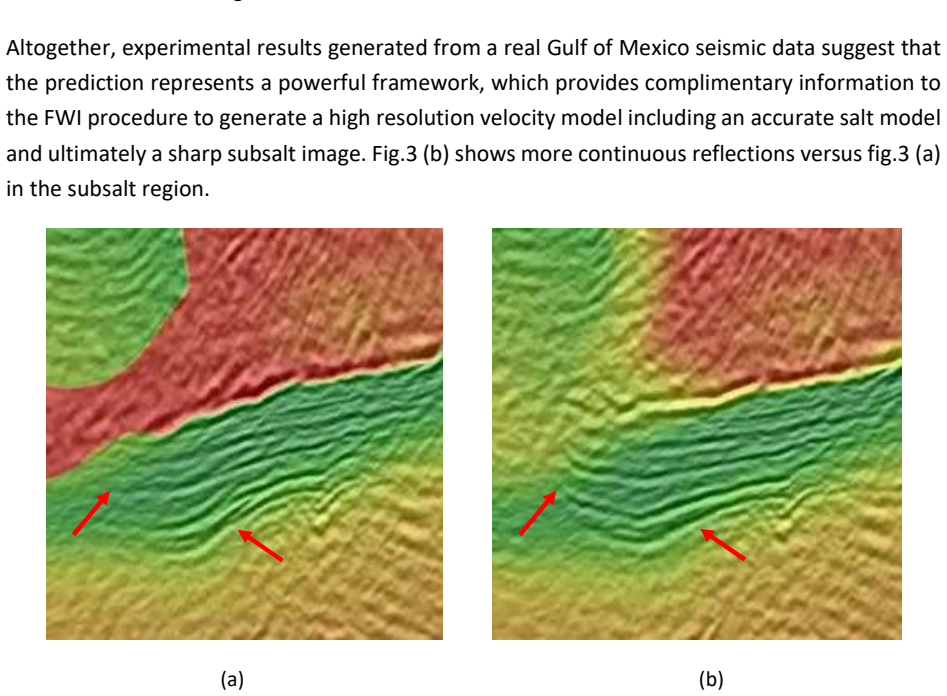
- [Applications with a Field Example] The central claim of improved subsalt imaging rests solely on Figure 3, but the figure is not present in the manuscript, and the associated text gives no quantitative measure. The sentence 'Fig.3 (b) shows more continuous reflections versus fig.3 (a) in the subsalt region' is an unsupported visual assertion without a baseline comparison: it is not stated whether (a) is a conventional FWI result or what parameter settings were used. Please include the figure, specify the baseline method, and provide quantitative metrics such as image-gather flatness, well ties, or salt-boundary error to support the claim.
- [Regularization] The regularization weight lambda is introduced as an 'empirical' parameter, but the value used in the field example is never stated and no sensitivity analysis is performed. Because the regularization term actively pulls the velocity model toward R(P), the purported improvement could be a direct consequence of an arbitrarily chosen lambda dominating the data misfit. Please report the value of lambda used and show that the result is stable across a range of lambda values, or otherwise demonstrate that the improvement is not an artifact of the regularization weight.
- [Proposed Methods] The entire workflow assumes that the neural-network-predicted probability cube P is sufficiently accurate to serve as a trustworthy prior. The paper provides no quantitative assessment of the network's segmentation accuracy on the field data: no Dice score, boundary-distance error, well-tie comparison, or comparison against an independent manual interpretation is reported. Given that the initialization and the regularization both depend on P, an inaccurate prediction can bias the final velocity model in the wrong direction. Please provide an independent validation of the predicted salt mask for the field example.
minor comments (5)
- [Regularization] The phrase 'object function' should be 'objective function' in the Regularization subsection.
- [Introduction] The phrase 'assisting convergences of the velocity model' contains a typo; 'convergences' should likely be 'convergence'.
- [Applications with a Field Example] Figures 2 and 3 are referenced in the text but no actual figure content appears in the manuscript; please ensure the final version includes all figures with clear captions and axis labels.
- [Proposed Methods] The equations are not numbered, which makes it difficult to refer to them; please number the initialization equation, the original objective function, and the regularized objective.
- [Applications with a Field Example] The details of the neural network training for the field example are missing: the number of annotated slices, the ensemble size, the data augmentation procedure, and the network training time are not reported, which limits reproducibility.
Circularity Check
No significant circularity: the DL salt-probability prior is an external input, and the FWI initialization/regularization are explicit functions of it, not fitted targets.
full rationale
The paper's central workflow uses the neural-network salt probability cube P as an external prior. The initialization m0 = v_salt*P0 + v_sed*(1-P0) and the regularized objective min_m sum_i ||F_i(m)-d_i||^2 + lambda*||m - R(P)||^2 are explicit, stated functions of P; they do not re-define P in terms of the FWI output or the final image. The claimed imaging improvement is an empirical assertion supported by a field-data comparison in Figure 3, not a quantity forced by construction. No fitted parameter is renamed as a prediction: the network is trained on sparse annotations, and lambda is an unspecified empirical weight, which is an under-reporting issue rather than circularity. The only self-citation (Lu et al., 2018) is an introductory reference on deep learning in geophysics and is not load-bearing; no uniqueness theorem or prior-work ansatz is imported to forbid alternatives. A separate consistency issue exists: the convergence remark states P≈0 inside salt and P≈1 outside, which appears inverted relative to the formula m = v_salt*P + v_sed*(1-P); however, that is a reproducibility/correctness concern, not a circular reduction of the claim to its inputs.
Assumptions & free parameters
free parameters (1)
- lambda (regularization weight)
assumptions (3)
- domain assumption The neural network's predicted salt probability cube P is an accurate representation of the true salt geometry.
- domain assumption FWI forward modeling operator F_i is accurate enough that the data misfit minimization is meaningful.
- domain assumption The depth-dependent sediment velocity profile v_sed is a reasonable background model.
Cite this review
Pith. "Pith review of Enhanced Seismic Imaging with Predictive Neural Networks for Geophysics." pith.science (2026). https://pith.science/paper/FJFZ4BYD
@misc{pith2026190803973,
  author       = {Pith},
  title        = {Pith review of: Enhanced Seismic Imaging with Predictive Neural Networks for Geophysics},
  year         = {2026},
  howpublished = {\url{https://pith.science/paper/FJFZ4BYD}},
  note         = {Machine review of arXiv:1908.03973}
}
read the original abstract
We propose a predictive neural network architecture that can be utilized to update reference velocity models as inputs to the full waveform inversion. Deep learning models are explored to augment velocity model building workflows during processing the 3D seismic volume in salt-prone environments. Specifically, a neural network architecture, with 3D convolutional, de-convolutional layers, and 3D max-pooling, is designed to take standard amplitude 3D seismic volumes as an input. Enhanced data augmentations through generative adversarial networks and a weighted loss function enable the network to train with few sparsely annotated slices. Batch normalization is also applied for faster convergence. A 3D probability cube for salt bodies and inclusions is generated through ensembles of predictions from multiple models in order to reduce variance. Velocity models inferred from the proposed networks provide opportunities for FWI forward models to converge faster with an initial condition closer to the true model. In addition, in each iteration step, the probability cubes of salt bodies and inclusions inferred from the proposed networks can be used as a regularization term within the FWI forward modelling, which may result in an improved velocity model estimation while the output of seismic migration can be utilized as an input of the 3D neural network for subsequent iterations.
Figures

Reference graph
Works this paper leans on
-
[1]
Chen, J., Sixta, D., Raney, G., Mount, V., Riddle, E., Nicholson, A., . . . Peng, C. (2018). Improved sub-salt imaging from reflection full waveform inversion guided salt scenario interpretation: A case history from deep water Gulf of Mexico. SEG Technical Program Expanded Abstracts, (pp. 3773-3777)
work page 2018
-
[2]
Lu, P., Morris, M., Brazell, S., Comiskey, C., & Xiao, Y. (2018). Using generative adversarial networks to improve deep-learning fault interpretation network. The Leading Edge, 578-583
work page 2018
-
[3]
Wang, P., Zhang, Z., Mei, J., Lin, F., & Huang, R. (2019). Full-waveform inversion for salt: A coming of age . The Leading Edge, 204-213
work page 2019
Reviewed August 14, 2026 · model on record in the stance chip above.
Discussion (0). Continue with ORCID to comment.