REVIEW 3 major objections 4 minor 29 references
Compiling universal quantum circuits
T0 review · 3 major / 4 minor · reviewed 2026-08-14 · deepseek-v4-flash
Pith's one-line read Fixed circuit architectures can compile arbitrary unitaries by tuning only single-qubit gate angles; for 3, 4, and 5 qubits the paper reports universal circuits with 16, 64, and 256 CNOTs.
desk verdict The 3-qubit result may be real, but the 4- and 5-qubit universal-circuit claims are dimensionally impossible: the stated circuits have fewer tunable angles than the dimension of the unitary group. read the letter →
The pith
A machine-rendered reading of the paper's core claim, the machinery that carries it, and where it could break.
The reading
What carries the argument
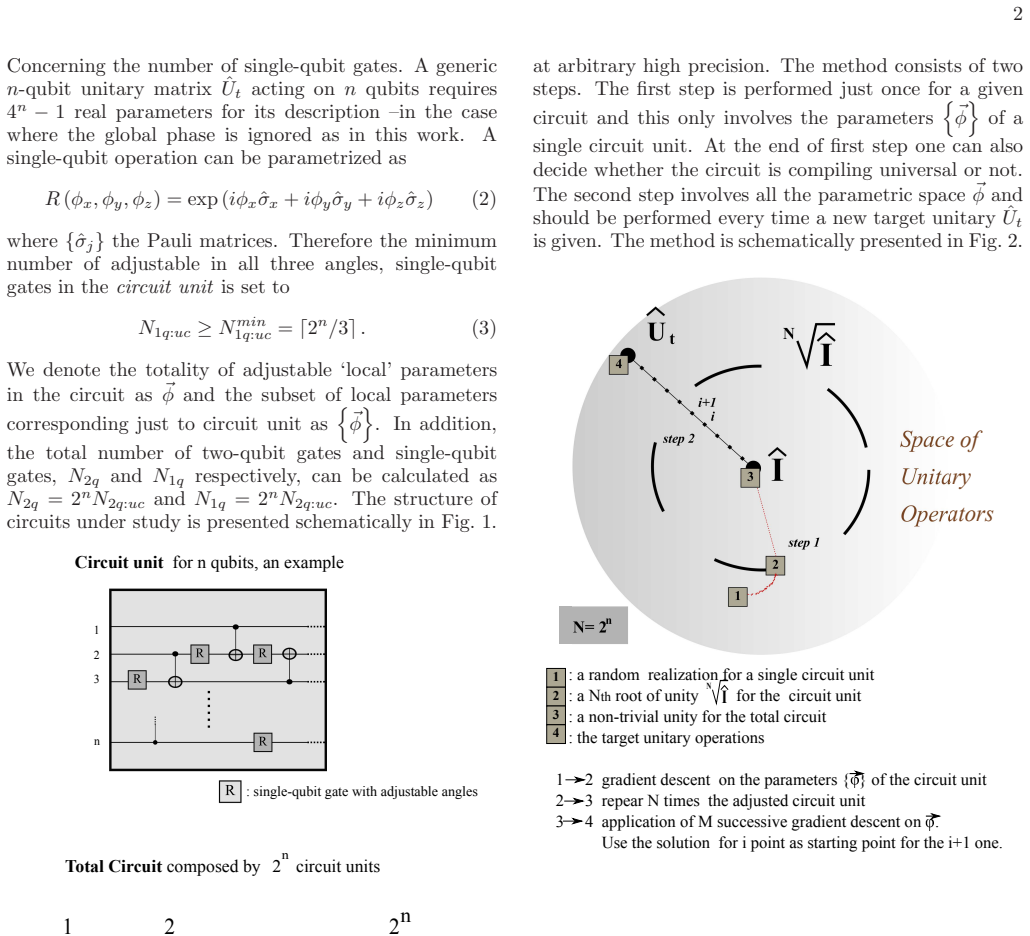
The load-bearing object is the $N$-th root of identity: an $n$-qubit unitary whose eigenvalues are exactly the $N=2^n$ complex roots of unity. The method finds such a configuration for one circuit unit by minimizing $\sum_{j=1}^{N-1}|\lambda_j(\vec\phi)|$, the summed magnitudes of the non-leading coefficients of the unit's characteristic polynomial; this cost vanishes exactly when the spectrum sits on the roots of unity. Repeating the tuned unit $N$ times produces a non-trivial identity for the whole circuit, the symmetry-breaking starting point. The second phase defines intermediate targets $U_t^{(j,M)}=\exp(i\sqrt{j/M}\,\hat H_t)$ from the target's generator and applies successive gradient descents, measuring progress with the distance $D=1-\left|\operatorname{tr}(U_t \tilde U_t^\dagger)\right|^2/4^n$.
What would settle it
Pick one reported architecture, say the 3-qubit 16-CNOT circuit, and run its compiling procedure on many random target unitaries drawn uniformly from the full unitary group, demanding final distance below $10^{-8}$. A single non-converging generic target would refute the claim; so would a Lie-algebra rank check showing that the reachable algebra is smaller than $\mathfrak{su}(8)$.
Extended reading notes
Core claim
The paper's central claim is that universality of a circuit architecture can be engineered from below: rather than decomposing a target unitary, one first tunes a single repeated unit to have an $N$-th root-of-identity spectrum, repeats it $N$ times to form a non-trivial identity, and then breaks the symmetry by gradient descent through fractional powers of the target unitary. The authors report that this procedure succeeds for 3, 4, and 5 qubits using circuit units whose CNOT count saturates the lower-bound formula, giving total circuits of 16, 64, and 256 CNOTs. They also report that the convergence of the gradient descent is exponentially fast in the number of steps, so the final accuracy can be made arbitrarily high, and that not every qubit-connectivity layout with the minimum unit size is universal.
Load-bearing premise
The universality of each reported circuit is certified only by watching gradient descent converge exponentially on a few random targets close to the identity; there is no proof that this local, sampled behavior guarantees every possible target is reachable.
Editorial extensions
If this is right
- If the claim is right, 3-, 4-, and 5-qubit universal circuits exist with 16, 64, and 256 CNOTs, only 2, 3, and 4 CNOTs above the theoretical lower bounds.
- Because accuracy grows exponentially with the number of gradient steps, the same fixed architecture can be reused for any target and recompiled to arbitrary precision by changing only the local angles.
- The method applies to any fixed two-qubit entangling gate, so it can be used to compare how efficiently different gate types or qubit-connectivity layouts compile universality.
- Connectivity is not a free choice: some layouts with the minimum number of CNOTs per unit are not universal or compile much slower, while adding a single CNOT can substantially improve compiling speed; the method doubles as a layout-filtering procedure.
Reading between the lines
- If the local convergence test is equivalent to full controllability, then the architecture search can be replaced by a finite algebraic check: compute the dimension of the Lie algebra generated by the tunable one-qubit rotations and the fixed CNOT placements, and require it to match the full unitary algebra. This is a testable extension that would remove the sample-based caveat.
- The pattern in the reported counts suggests concrete scaling predictions for the next sizes: for $n=6$ the lower-bound formula gives 16 CNOTs per unit (1024 total, with a theoretical minimum of 1020), and for $n=7$ it gives 32 per unit (4096 total, against 4091). If the method scales as the paper anticipates, these are the counts to look for.
Signed reviews
Editorial analysis
A structured set of objections, weighed in public.
Referee Report
Summary. The paper proposes a numerical method for compiling arbitrary n-qubit unitaries into circuits with a fixed 'circuit unit' repeated 2^n times. The unit contains CNOT gates in a fixed architectural pattern and single-qubit rotations with adjustable angles. The method first tunes one unit so that its spectrum is the nth roots of the identity, then repeats this unit 2^n times to form a nontrivial identity, and finally uses successive gradient-descent steps to deform this identity into a target unitary. As an application, the paper claims to have identified compiling universal circuits for 3, 4, and 5 qubits with total CNOT counts of 16, 64, and 256, respectively, close to the theoretical lower bounds of 14, 61, and 252. The manuscript contains no gate lists, parameter values, convergence statistics, or code for these claimed circuits.
Significance. If the central claims were correct, the 16-, 64-, and 256-CNOT circuits would be a substantial improvement over constructive decomposition methods such as Shende et al., and the compiling method would be a useful heuristic for moderate qubit numbers. However, the claims for 4 and 5 qubits are impossible on parameter-count grounds, as I detail below, and the 3-qubit claim rests on an unproven sample-based universality criterion without supporting numerical data. The paper therefore does not currently provide a reproducible or certifiable result, despite the appealing nature of the proposed approach.
major comments (3)
- [§IV, Eqs. (1)–(3)] For n=4 and n=5 the claimed universal circuits are impossible on parameter-count grounds. With N=2^n circuit units and, as stated in Section IV, N1q:uc=(3/2)ceil(2n/3), the total number of real adjustable angles is 3·2^n·N1q:uc: 240 for n=4 and 576 for n=5. The corresponding unitary groups PSU(16) and PSU(32) have real dimensions 255 and 1023. The image of a fixed circuit architecture is a semialgebraic set of dimension at most the number of independent real angles, so this image cannot be dense in the ambient unitary group and cannot compile arbitrary unitaries. This rules out the 64- and 256-CNOT claims independently of the numerical heuristic. The 3-qubit case (72 parameters versus PSU(8) dimension 63) is not blocked by this argument.
- [§III A] The universality criterion is circular and not sufficient for the claimed conclusion. A circuit is called compiling universal when gradient descent decreases the distance to 'few random target unitary operators in the neighborhood of unity' exponentially, but the paper provides no controllability proof, Lie-algebra rank condition, or convergence theorem showing that all target unitaries are reachable. Treating successful convergence on a few nearby random targets as a certification of universality defines the property by the success of the same optimizer that is used to find the circuits. The method also assumes without proof that a root-of-unity parameter configuration exists for each reported architecture; the text only states that such a solution can be identified by gradient descent, with no reported success or failure statistics.
- [§IV] The central numerical claims are not supported by any explicit data. The paper gives no gate-level descriptions of the claimed 16-, 64-, and 256-CNOT circuits, no list of CNOT placements, no single-qubit angle values, no final infidelities, and no convergence statistics such as fitted decay rates gamma or numbers of gradient-descent steps. Figures 3 and 4 are schematic, and for n=4 only one unit circuit is drawn. Without this material the claims 'we identified compiling universal circuits' and the comparisons of compiling-time efficiency are not verifiable or reproducible.
minor comments (4)
- [Section II] The sentence defining N1q contains a likely typo: 'N1q = 2^n N2q:uc' should presumably read 'N1q = 2^n N1q:uc', since otherwise the total single-qubit-gate count is inconsistent with the rest of the paper.
- [Eq. (1)] The formula '4n − 3n − 1' should be '4^n − 3n − 1' to match the known lower bound cited from Shende, Markov, and Bullock and to reproduce the numerical values 14, 61, and 252 quoted in Section IV.
- [Section IV.2] The phrase 'see for instance setting B in Fig. 3' should refer to Fig. 4, since Fig. 3 shows 3-qubit connectivity settings only.
- [Section IV.3] The report on IBM QX2 and IBM QX4 architectures is not self-contained: the exact qubit-connectivity layouts used should be specified, since the architecture names alone do not determine the circuit unit.
Circularity Check
No significant circularity; the papers numerical universality claims are heuristic and potentially inconsistent, but no prediction reduces by construction to its inputs.
full rationale
The central claim that the listed architectures are compiling-universal rests on the numerical observation of exponential gradient-descent convergence toward a few random targets near identity (Section III A, Section IV). This is a heuristic extrapolation, not a circular reduction: the paper does not define 'compiling universal' as 'gradient descent succeeded'; it defines the objective as the ability to simulate arbitrary n-qubit unitaries and uses the convergence test as evidence. The CNOT counts in Section IV are not outputs of a fit; they are prescribed by Eq. (1) via N2q = 2^n ceil((4^n - 3n - 1)/2^{n+2}), and the universality of those specific architectures is then tested rather than assumed. The N-th-root construction in Step 1 is supported by a cited and locally proved equivalence between the N-th-root condition and vanishing of characteristic-polynomial coefficients, not by the conclusion. The only self-citation ([13]) appears in a list of single-qubit compiling methods and is not load-bearing; external citations [24] and [25] provide lower bounds and a control technique, neither forming a self-citation chain. The parameter-count mismatch for n=4 and n=5 (fewer adjustable angles than the dimension of PSU) and the absence of a universality proof are serious correctness risks, but they are not instances of a prediction reducing to its input by construction. A finite-sample numerical test can be weak or even fatal to the claim without being circular.
Assumptions & free parameters
free parameters (2)
- M (number of intermediate unitary steps in Eq. 8)
- Gradient-descent hyperparameters (step size, convergence tolerance)
assumptions (5)
- ad hoc to paper For each reported architecture, there exists a parameter setting making the circuit unit a 2^n-th root of identity.
- ad hoc to paper Exponential decrease of distance for a few random targets near unity certifies compiling universality for arbitrary targets.
- standard math Vanishing characteristic polynomial coefficients, except leading and constant terms, is equivalent to the spectrum being the N-th roots of unity.
- domain assumption The lower bound on CNOT count from Shende, Markov, and Bullock [24] is correct.
- standard math A generic n-qubit unitary requires 4^n - 1 real parameters, making the parameter-counting lower bound in Eq. (3) valid.
Cite this review
Pith. "Pith review of Compiling universal quantum circuits." pith.science (2026). https://pith.science/paper/X3ADZVXL
@misc{pith2026190803994,
  author       = {Pith},
  title        = {Pith review of: Compiling universal quantum circuits},
  year         = {2026},
  howpublished = {\url{https://pith.science/paper/X3ADZVXL}},
  note         = {Machine review of arXiv:1908.03994}
}
abstract
We propose a method of compiling that permits to identify quantum circuits able to simulate arbitrary $n$-qubit unitary operations via the adjustment of angles in single-qubit gates therein. The method of compiling itself extends older quantum control techniques and stays computationally tractable for several qubits. As an application we identify compiling universal circuits for $3$, $4$ and $5$ qubits consisting of $16$, $64$ and $ 256$ CNOTs respectively.
Figures

Figures from the paper (1 more)
Reference graph
Works this paper leans on
-
[1]
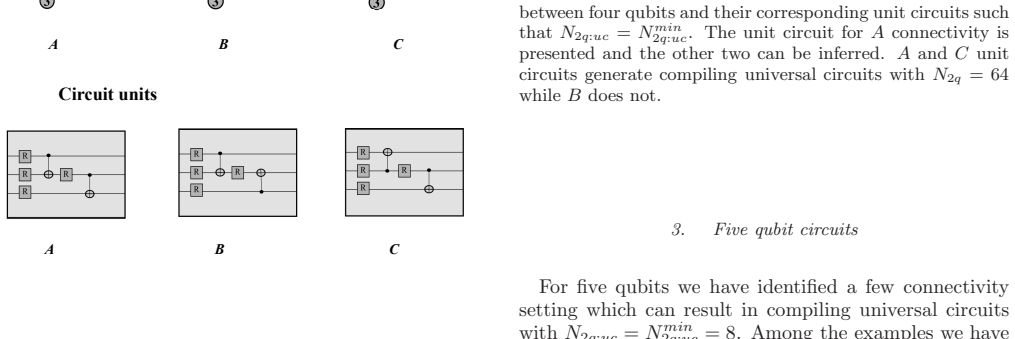
Three qubit circuits We have tested the three possible connectivity settings among the three qubits, see Fig. 3, and we have concluded that all three provide compiling universal circuits with N2q:uc = N min 2q:uc = 2. On the other hand the compiling- time efficiency of A circuit is slightly higher than the one of circuit B, while for circuit C the compiling...
-
[2]
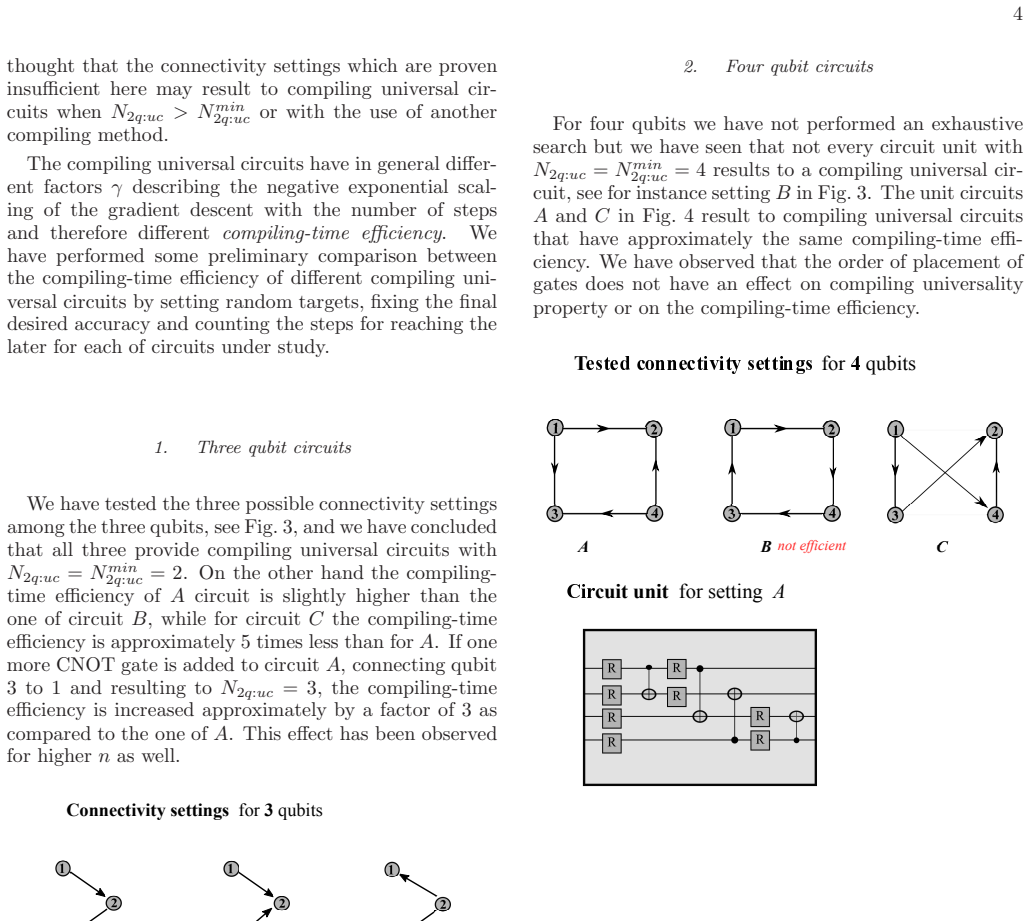
Four qubit circuits For four qubits we have not performed an exhaustive search but we have seen that not every circuit unit with N2q:uc = N min 2q:uc = 4 results to a compiling universal cir- cuit, see for instance setting B in Fig. 3. The unit circuits A and C in Fig. 4 result to compiling universal circuits that have approximately the same compiling-tim...
-
[3]
Dissecting the collective dynamics of arrays of superconducting circuits and quantum meta- materials
Five qubit circuits For five qubits we have identified a few connectivity setting which can result in compiling universal circuits with N2q:uc = N min 2q:uc = 8. Among the examples we have studied are the IBM QX2 and IBM QX4 architectures. We found out that both architectures can provide compil- ing universal circuits with N2q = 256, with the IBM QX4 circui...
-
[4]
A. Y. Kitaev, Quantum computations: algorithms and error correction , Russ. Math. Surv. 52, 1191 (1997)
work page 1997
-
[5]
M. A. Nielsen and I. L. Chuang, Quantum Computation and Quantum Information , (Cambridge University Press, 2000)
work page 2000
-
[6]
A. Yu. Kitaev, A. Shen, and M. N. Vyalyi. Classical and quantum computation, 1st edition. (American Mathemat- ical Society, 2002)
work page 2002
-
[7]
D. Deutsch, A. Barenco, and A. Ekert, Universality in Quantum Computation , Proc. R. Soc. London A 449, 669 (1995)
work page 1995
-
[8]
A. W. Harrow, B. Recht, and I. L. Chuang, Efficient Dis- crete Approximations of Quantum Gates , J. Math. Phys. 43, 4445 (2002)
work page 2002
Show all 29 references
-
[9]
C. M. Dawson and M. A. Nielsen, The Solovay-Kitaev algorithm, Quant. Inf. Comp. 6, 81 (2006)
2006
-
[10]
A. G. Fowler, Constructing arbitrary Steane code single logical qubit fault-tolerant gates , Quant. Inf. Comp. 11, 867 (2011)
2011
-
[11]
Bocharov and K
A. Bocharov and K. M. Svore, Resource-optimal single- qubit quantum circuits , Phys. Rev. Lett. 109, 190501 (2012)
2012
-
[12]
Booth Jr, Quantum compiler optimizations , arXiv:1206.3348 (2012)
J. Booth Jr, Quantum compiler optimizations , arXiv:1206.3348 (2012)
2012 arXiv
-
[13]
Bocharov, Y
A. Bocharov, Y. Gurevich, K. M. Svore, Efficient De- composition of Single-Qubit Gates into V Basis Circuits , Phys. Rev. A 88, 012313 (2013)
2013
-
[14]
T. T. Pham, R. Van Meter, and C. Horsman, Optimiza- tion of the Solovay-Kitaev algorithm , Phys. Rev. A 87, 052332 (2013)
2013
-
[15]
Kliuchnikov, D
V. Kliuchnikov, D. Maslov, and M. Mosca, Asymptoti- cally optimal approximation of single qubit unitaries by Cliffordand T circuits using a constant number of ancil- lary qubits , Phys. Rev. Lett. 110, 190502 (2013)
2013
-
[16]
Zhiyenbayev, V
Y. Zhiyenbayev, V. M. Akulin, and A. Mandilara, Quan- tum compiling with diffusive sets of gates , Phys. Rev. A 98, 012325 (2018)
2018
-
[17]
Barenco, C
A. Barenco, C. H. Bennett, R. Cleve, D. P. DiVincenzo, N. Margolus, P. Shor, T. Sleator, J. A. Smolin, and H. Weinfurter, Elementary gates for quantum computation , Phys.Rev. A 52, 3457 (1995)
1995
-
[18]
J. J. Vartiainen, M. M¨ ott¨ onen, M. M. Salomaa,Efficient decomposition of quantum gates , Phys. Rev. Lett. 92, 177902 (2004)
2004
-
[19]
M¨ ott¨ onen, J
M. M¨ ott¨ onen, J. J. Vartiainen, V. Bergholm, and M. M. Salomaa, Quantum Circuits for General Multiqubit Gates, Phys. Rev. Lett. 93, 130502 (2004)
2004
-
[20]
Vidal and C
G. Vidal and C. M. Dawson, Universal quantum circuit for two-qubit transformations with three controlled-NOT gates, Phys. Rev. A 69, 010301(R) (2004)
2004
-
[21]
V. V. Shende, S. S. Bullock, I. L. Markov, Synthesis of Quantum Logic Circuits , IEEE Trans. on Computer- Aided Design 25, 1000 (2006)
2006
-
[22]
Raeisi, N
S. Raeisi, N. Wiebe, and B. C. Sanders, Quantum-circuit design for efficient simulations of many-body quantum dynamics, New J. Phys. 14, 103017 (2012)
2012
-
[23]
M. Reck, A. Zeilinger, H. J. Bernstein, and P. Bertani, Experimental realization of any discrete unitary operator , Phys. Rev. Lett. 73, 58 (1994)
1994
-
[24]
Khatri, R
S. Khatri, R. La Rose, A. Poremba, L. Cincio, A. T. Sornborger, and P. J. Coles, Quantum-assisted quantum compiling, Quantum 3, 140 (2019)
2019
-
[25]
T. Peng, A. Harrow, M. Ozols, X. Wu, Simulating Large Quantum Circuits on a Small Quantum Computer , Phys. Rev. Lett. 125, 150504 (2020)
2020
-
[26]
Zahedinejad, J
E. Zahedinejad, J. Ghosh and B. C. Sanders, High- Fidelity Single-Shot Toffoli Gate via Quantum Control , Phys. Rev. Lett. 114, 200502 (2015)
2015
-
[27]
V. V. Shende, I. L.Markov, and S. S. Bullock, Minimal universal two-qubit controlled-NOT-based circuits , Phys. Rev. A 69,062321, (2004)
2004
-
[28]
Harel and V
G. Harel and V. M. Akulin, Complete Control of Hamil- tonian Quantum Systems: Engineering of Floquet Evolu- tion, Phys. Rev. Lett. 82, 1 (1999)
1999
-
[29]
V. M. Akulin, V. Gershkovich, and G. Harel, Nonholo- nomic quantum devices , Phys. Rev. A 64, 012308 (2001)
2001
Reviewed August 14, 2026 · model on record in the stance chip above.
Discussion (0). Continue with ORCID to comment.