REVIEW 3 major objections 4 minor 42 references
Temporally Discounted Differential Privacy for Evolving Datasets on an Infinite Horizon
T0 review · 3 major / 4 minor · reviewed 2026-08-14 · deepseek-v4-flash
Pith's one-line read Discounted differential privacy relaxes the definition enough that an infinite stream of noisy reports can be released with bounded noise, whereas standard differential privacy forces noise to grow without bound.
desk verdict The bounded-noise result is mathematically correct under the paper's own definition, but the definition's normative discounting premise is what does the work, and the paper should be clearer about what it does and does not guarantee. read the letter →
The pith
A machine-rendered reading of the paper's core claim, the machinery that carries it, and where it could break.
The reading
What carries the argument
The load-bearing object is the discounted privacy loss, which replaces the uniform sum of per-report privacy losses with a weighted sum in which older losses count less. The privacy-loss decomposition $p(Y(t)|X(t))=\prod_{k=1}^t p(y(k)|X(k))$, inherited from standard differential privacy, turns the definition into the inequality $\sum_{k=1}^t \alpha^{t-k}\rho(k)\le \epsilon$. Because the geometric series $\sum_{j=0}^{\infty}\alpha^j = 1/(1-\alpha)$ is finite, a constant per-report privacy loss of $\epsilon(1-\alpha)$ fits inside the budget for every $t$, which is exactly why the Laplace scale $b=\Delta f/(\epsilon(1-\alpha))$ works. Hyperbolic discounting gives a divergent series, which is why its noise must still grow, but the slower divergence yields only $\sqrt{k}$ growth.
What would settle it
Run a controlled study in which people state how much compensation they would demand for releasing a sensitive reading from 1, 10, or 100 days ago; if the demanded compensation does not decline roughly like $\alpha^{t-k}$ or $1/(1+\beta(t-k))$, the normative premise that justifies bounded noise does not describe actual privacy preferences.
Extended reading notes
Core claim
The paper's central claim is that a time-dependent weighting of privacy losses converts an impossibility into a feasibility result: an infinite sequence of reports can be protected with noise of constant magnitude if old losses are allowed to count for less. Formally, for reports $y(t)=f_t(X(t))+w(t)$ with i.i.d. Laplace noise, standard $\epsilon$-differential privacy requires $\sum_{k=1}^t \Delta f_k/b_k \le \epsilon$, so with constant query sensitivity $\Delta f$ the noise scale $b_k$ must diverge. The paper defines discounted privacy loss, $\rho(k,t)=\alpha^{t-k}\rho(k)$, and proves that $(\epsilon,\alpha)$-exponentially discounted differential privacy holds for all $t$ with the constant choice $b_k=\Delta f/(\epsilon(1-\alpha))$. Hyperbolic discounting, with weight $1/(1+\beta(t-k))$, gives a slower-growing scale proportional to $\sqrt{k}$. These are relaxations: setting $\alpha=1$ or $\beta=0$ recovers standard differential privacy, so the bounded-noise conclusion is bought precisely by the decision to forget.
Load-bearing premise
The load-bearing premise is that an individual's concern about a privacy leak decays with the time since the leak, so old losses can be down-weighted; if every past leak matters as much as today's, the total privacy loss of an infinite release remains unbounded despite the relaxation.
Editorial extensions
If this is right
- Under exponentially discounted differential privacy, a curator can publish an endless stream of noisy answers without ever increasing the noise, so reports do not become meaningless over time.
- Standard $\epsilon$-differential privacy on the same problem forces the noise scale to grow without bound; the paper gives the explicit choice $b_k = \Delta f \pi^2 k^2 / (6\epsilon)$ as one valid schedule.
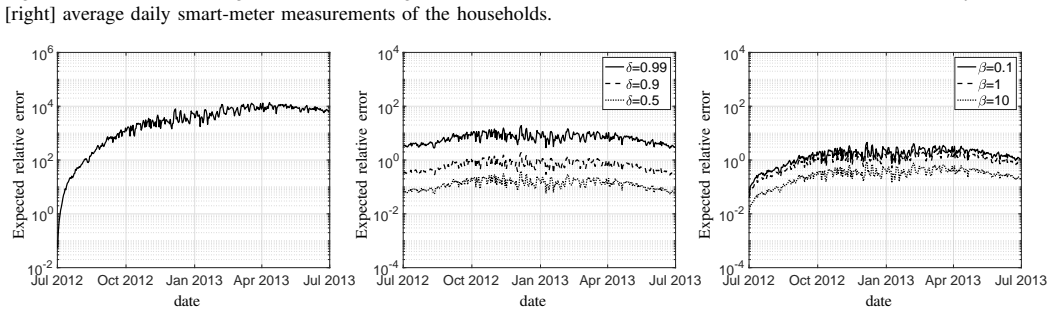
- Hyperbolic discounting still requires growing noise, but only as $\sqrt{k}$, which is slow enough that on a one-year smart-meter horizon the degradation is barely visible.
- The results apply to any sequence of queries with bounded sensitivity when reports are generated by adding i.i.d. Laplace noise, not only to averaging queries.
Reading between the lines
- One could calibrate the discount factor to a measured 'privacy half-life' from behavioral studies and check whether the resulting noise level matches what people accept in real data-sharing decisions.
- The same reweighting of per-time privacy losses could be applied to other definitions that compose over time by summing a privacy-loss measure, potentially yielding bounded-noise analogues for privacy-loss random variables with finite moments.
- If a legal retention period is known in advance, a curator could set $\alpha$ so that the discounted weight of any record falls below a chosen threshold by the end of the period; discounted differential privacy would then formalize forgetting without deleting data.
Signed reviews
Editorial analysis
A structured set of objections, weighed in public.
Referee Report
Summary. This paper defines discounted differential privacy for evolving datasets: at evaluation time t, the privacy loss incurred at time k is weighted by α^(t−k) (exponential discounting) or by 1/(1+β(t−k)) (hyperbolic discounting). For additive i.i.d. Laplace noise, it shows that exponential discounting allows a constant noise scale b=Δ_f/(ε(1−α)) over an infinite horizon, whereas ordinary ε-differential privacy forces the noise scale to grow without bound (e.g., quadratically, Corollary 8). A hyperbolic variant yields b_k=O(√k). The mechanisms are evaluated on real smart-meter data from Ausgrid, comparing expected relative error under the three definitions.
Significance. If the discounted privacy definition is accepted, the paper is a useful contribution: it makes the implicit temporal weighting in privacy loss explicit, gives elementary sufficient conditions for additive Laplace mechanisms, and demonstrates a clear utility advantage on a real dataset. The core calculations in Theorems 6 and 11 are standard and correct, and the paper is self-contained. The main caveat, which the paper does not address, is that the relaxation is normative: it assumes that old leaks are less sensitive, and it does not bound the undiscounted cumulative privacy loss of the transcript. The practical significance therefore hinges on whether the discounted-loss premise is appropriate for the application.
major comments (3)
- [§III-A, Definition 10 and Corollary 12] The central claim that bounded noise gives a meaningful relaxation of differential privacy over an infinite horizon is not supported as stated. Definition 10 bounds only the discounted sum ∑_{k=1}^t α^{t−k}ρ(k); it does not bound the undiscounted privacy loss of the full transcript. To see the gap, take f_t(X(t))=x_1(1) for all t (each report is the same first measurement of individual 1) with sensitivity Δ_f=Δ and b=Δ/(ε(1−α)). Corollary 12 applies and the mechanism is (ε,α)-exponentially discounted DP for every t, since ∑_{k=1}^t α^{t−k}Δ/b ≤ ε. However, the worst-case log-likelihood ratio between neighboring datasets differing in x_1(1) is tΔ/b = tε(1−α), which grows linearly in t, and an adversary who averages the t independent Laplace reports obtains a standard error of order b/√t, so confidence about the fixed secret improves over time. The bounded noise scale is thus purchased by discounting repeated leaks of the same secret. I recommend that the paper either prove an additional guarantee on undiscounted transcript leakage under reasonable conditions (e.g., each individual's data changes over time, or queries are distinct), or explicitly state this limitation in the abstract and conclusions and temper the claim that this is a meaningful relaxation of differential privacy.
- [§II-B, Theorem 5] Theorem 5 is stated without the conditional independence assumption that its proof requires. The decomposition p(Y(t)|X(t)) = ∏_{k=1}^t p(y(k)|X(k)) is valid only if the reports are conditionally independent given X(t), together with causality; without such an assumption the theorem is false. Please add this assumption explicitly to the statement of Theorem 5 (and clarify whether Definitions 9–14 inherit it). Note that the specific mechanism (5) with i.i.d. Laplace noise does satisfy the assumption, so the later results are not affected.
- [§III-B, Corollary 16] The proof of Corollary 16 is not fully justified. The integral approximations used to bound the two parts of the sum are not accompanied by error analysis: the first inequality integrates over [0,t0−1] instead of [0,t0], and the second integrates over [t0+1,t]. Because Corollary 16 is a central contribution (bounded-noise variant for hyperbolic discounting), please supply a complete proof or state the approximation error explicitly.
minor comments (4)
- [§IV-A] The sentence 'smart meter measurements of of households' contains a duplicated preposition; also, 'The individuals in both these datasets' refers to only one dataset.
- [§IV-B] The phrase 'avrage expected relative error' should be 'average expected relative error'.
- [§II-A, Corollary 7] The statement 'lim_{k→} b_k = +∞' is missing the target of the limit; it should read lim_{k→∞} b_k = +∞.
- [§III-B, Eq. (14)] The argument of atanh in the displayed formula should be √(β/(1+β)) rather than √β/(1+β), to match the derivation in the proof.
Circularity Check
Definitional discounting is explicit, and all privacy-guarantee derivations are self-contained sufficient conditions; no circularity found.
full rationale
The paper's contribution is a new privacy definition (Definitions 9, 10, 13, and 14) plus sufficient conditions for bounded-noise Laplace reports (Theorem 11, Corollary 12, Theorem 15, and Corollary 16). The derivation chain is self-contained: Theorem 5 factors the likelihood ratio under the mechanism's conditional independence; Theorem 6 computes the per-step privacy loss as rho(k) = Delta_f / b_k; Definition 10 substitutes rho(k) into the discounted sum; Corollary 12 then solves for the constant noise scale b = Delta_f / (epsilon * (1 - alpha)). The only free inputs are the user-chosen discount factor alpha and the data-independent sensitivity Delta_f; nothing is fitted to the Ausgrid data to obtain the privacy guarantee. The numerical section uses the real data only to report expected relative error, not to set b. There is no load-bearing self-citation: the paper cites external sources such as Dwork and Roth, Bolot et al., and the economics discounting literature, and no prior work by the same author is invoked to establish the central theorem. The hyperbolic case follows from the same substitution plus an integral bound, again without fitting. The normative premise that privacy loss in the distant past matters less is an explicit definitional choice, not a hidden equivalence: the paper never claims to derive discounting from differential privacy; it defines discounted differential privacy and proves sufficient conditions that satisfy that definition. The skeptical concern that undiscounted privacy loss can still grow without bound for a query that repeats the same secret is a limitation of the definition's semantics, not circular reasoning within the paper's derivation chain.
Assumptions & free parameters
free parameters (3)
- alpha (discount factor)
- beta (hyperbolic discounting coefficient)
- Delta_f (query sensitivity) =
200/300 kWh
assumptions (4)
- domain assumption Reports Y(k) are conditionally independent given X(t).
- ad hoc to paper Privacy losses in the distant past can be discounted via alpha^(t-k) or 1/(1 + beta (t - k)).
- domain assumption The evolving dataset has a fixed set of rows per individual (with placeholder symbol for absent times).
- domain assumption Query sensitivity Delta_f_k is known and bounded.
Cite this review
Pith. "Pith review of Temporally Discounted Differential Privacy for Evolving Datasets on an Infinite Horizon." pith.science (2026). https://pith.science/paper/3JNBSNLR
@misc{pith2026190803995,
  author       = {Pith},
  title        = {Pith review of: Temporally Discounted Differential Privacy for Evolving Datasets on an Infinite Horizon},
  year         = {2026},
  howpublished = {\url{https://pith.science/paper/3JNBSNLR}},
  note         = {Machine review of arXiv:1908.03995}
}
read the original abstract
We define discounted differential privacy, as an alternative to (conventional) differential privacy, to investigate privacy of evolving datasets, containing time series over an unbounded horizon. We use privacy loss as a measure of the amount of information leaked by the reports at a certain fixed time. We observe that privacy losses are weighted equally across time in the definition of differential privacy, and therefore the magnitude of privacy-preserving additive noise must grow without bound to ensure differential privacy over an infinite horizon. Motivated by the discounted utility theory within the economics literature, we use exponential and hyperbolic discounting of privacy losses across time to relax the definition of differential privacy under continual observations. This implies that privacy losses in distant past are less important than the current ones to an individual. We use discounted differential privacy to investigate privacy of evolving datasets using additive Laplace noise and show that the magnitude of the additive noise can remain bounded under discounted differential privacy. We illustrate the quality of privacy-preserving mechanisms satisfying discounted differential privacy on smart-meter measurement time-series of real households, made publicly available by Ausgrid (an Australian electricity distribution company).
Figures


Reference graph
Works this paper leans on
-
[1]
Security and privacy cha llenges in the smart grid,
P . McDaniel and S. McLaughlin, “Security and privacy cha llenges in the smart grid,” IEEE Security & Privacy , vol. 7, no. 3, pp. 75–77, 2009
work page 2009
-
[2]
Multimedia conten t identification through smart meter power usage profiles,
U. Greveler, B. Justus, and D. Loehr, “Multimedia conten t identification through smart meter power usage profiles,” Computers, Privacy and Data Protection, vol. 1, no. 10, 2012
work page 2012
-
[3]
Non- intrusive load monitoring through home energy management s ystems: A comprehensive review,
S. S. Hosseini, K. Agbossou, S. Kelouwani, and A. Cardena s, “Non- intrusive load monitoring through home energy management s ystems: A comprehensive review,” Renewable and Sustainable Energy Reviews , vol. 79, pp. 1266–1274, 2017
work page 2017
-
[4]
Smart metering and privacy in Europe: lessons from the Dutch case,
C. Cuijpers and B.-J. Koops, “Smart metering and privacy in Europe: lessons from the Dutch case,” in European data protection: Coming of age, pp. 269–293, Springer, 2013
work page 2013
-
[5]
The algorithmic foundations of dif ferential privacy,
C. Dwork and A. Roth, “The algorithmic foundations of dif ferential privacy,” F oundations and Trends in Theoretical Computer Science , vol. 9, no. 3–4, pp. 211–407, 2014
work page 2014
-
[6]
Calibrat ing noise to sensitivity in private data analysis,
C. Dwork, F. McSherry, K. Nissim, and A. Smith, “Calibrat ing noise to sensitivity in private data analysis,” in Theory of Cryptography Conference, pp. 265–284, Springer, 2006
work page 2006
-
[7]
C. Dwork, “Differential privacy,” in Proceedings of the 33rd Interna- tional Conference on Automata, Languages and Programming - V olume Part II , ICALP’06, (Berlin, Heidelberg), pp. 1–12, Springer-V erl ag, 2006
work page 2006
-
[8]
Local dif ferential pri- vacy for evolving data,
M. Joseph, A. Roth, J. Ullman, and B. Waggoner, “Local dif ferential pri- vacy for evolving data,” in Advances in Neural Information Processing Systems, pp. 2375–2384, 2018
work page 2018
Show all 42 references
-
[9]
Differ ential privacy under continual observation,
C. Dwork, M. Naor, T. Pitassi, and G. N. Rothblum, “Differ ential privacy under continual observation,” in Proceedings of the 42nd ACM Symposium on Theory of Computing , pp. 715–724, ACM, 2010
2010
-
[10]
Private and continua l release of statistics,
T.-H. H. Chan, E. Shi, and D. Song, “Private and continua l release of statistics,” ACM Transactions on Information and System Security (TISSEC), vol. 14, no. 3, p. 26, 2011
2011
-
[11]
Private contin ual release of real-valued data streams,
V . Perrier, H. J. Asghar, and D. Kaafar, “Private contin ual release of real-valued data streams,” in Proceedings of the Network and Distributed System Security Symposium (NDSS) , 2019
2019
-
[12]
Differen- tial privacy for growing databases,
R. Cummings, S. Krehbiel, K. A. Lai, and U. Tantipongpip at, “Differen- tial privacy for growing databases,” in Advances in Neural Information Processing Systems, pp. 8864–8873, 2018
2018
-
[13]
The complexity of differential privacy,
S. V adhan, “The complexity of differential privacy,” i n Tutorials on the F oundations of Cryptography, pp. 347–450, Springer, 2017
2017
-
[14]
Differentially private kalma n filtering,
J. Le Ny and G. J. Pappas, “Differentially private kalma n filtering,” in 2012 50th Annual Allerton Conference on Communication, Con trol, and Computing (Allerton) , pp. 1618–1625, IEEE, 2012
2012
-
[15]
Differentially private filter ing,
J. Le Ny and G. J. Pappas, “Differentially private filter ing,” IEEE Transactions on Automatic Control , vol. 59, no. 2, pp. 341–354, 2013
2013
-
[16]
Differential privacy in control and network systems,
J. Cort´ es, G. E. Dullerud, S. Han, J. Le Ny, S. Mitra, and G. J. Pappas, “Differential privacy in control and network systems,” in 2016 IEEE 55th Conference on Decision and Control (CDC) , pp. 4252–4272, IEEE, 2016
2016
-
[17]
Differe ntial privacy in linear distributed control systems: Entropy minimizing mechanisms and performance tradeoffs,
Y . Wang, Z. Huang, S. Mitra, and G. E. Dullerud, “Differe ntial privacy in linear distributed control systems: Entropy minimizing mechanisms and performance tradeoffs,” IEEE Transactions on Control of Network Systems, vol. 4, no. 1, pp. 118–130, 2017
2017
-
[18]
Privacy in control and dynamica l systems,
S. Han and G. J. Pappas, “Privacy in control and dynamica l systems,” Annual Review of Control, Robotics, and Autonomous Systems , vol. 1, pp. 309–332, 2018
2018
-
[19]
Differentially private MIMO filtering for event streams,
J. Le Ny and M. Mohammady, “Differentially private MIMO filtering for event streams,” IEEE Transactions on Automatic Control , vol. 63, no. 1, pp. 145–157, 2017
2017
-
[20]
Differentially priv ate distributed constrained optimization,
S. Han, U. Topcu, and G. J. Pappas, “Differentially priv ate distributed constrained optimization,” IEEE Transactions on Automatic Control , vol. 62, no. 1, pp. 50–64, 2016
2016
-
[21]
Different ially private average consensus with optimal noise selection,
E. Nozari, P . Tallapragada, and J. Cort´ es, “Different ially private average consensus with optimal noise selection,” IF AC-PapersOnLine, vol. 48, no. 22, pp. 203–208, 2015
2015
-
[22]
Privacy preserving average cons ensus,
Y . Mo and R. M. Murray, “Privacy preserving average cons ensus,” IEEE Transactions on Automatic Control , vol. 62, no. 2, pp. 753–765, 2016
2016
-
[23]
Different ially private average consensus: Obstructions, trade-offs, and optimal algorit hm design,
E. Nozari, P . Tallapragada, and J. Cort´ es, “Different ially private average consensus: Obstructions, trade-offs, and optimal algorit hm design,” Automatica, vol. 81, pp. 221–231, 2017
2017
-
[24]
Discounting of delayed reward s: Models of individual choice,
J. Myerson and L. Green, “Discounting of delayed reward s: Models of individual choice,” Journal of the Experimental Analysis of Behavior , vol. 64, no. 3, pp. 263–276, 1995
1995
-
[25]
Intertemp oral choice– toward an integrative framework,
G. S. Berns, D. Laibson, and G. Loewenstein, “Intertemp oral choice– toward an integrative framework,” Trends in Cognitive Sciences, vol. 11, no. 11, pp. 482–488, 2007
2007
-
[26]
A mathematical theory of saving,
F. P . Ramsey, “A mathematical theory of saving,” The Economic Journal, vol. 38, no. 152, pp. 543–559, 1928
1928
-
[27]
A note on measurement of utility,
P . A. Samuelson, “A note on measurement of utility,” The Review of Economic Studies , vol. 4, pp. 155–161, 02 1937
1937
-
[28]
Specious reward: A behavioral theory of im pulsiveness and impulse control,
G. Ainslie, “Specious reward: A behavioral theory of im pulsiveness and impulse control,” Psychological Bulletin, vol. 82, no. 4, p. 463, 1975
1975
-
[29]
Impulse control in pigeons,
G. W. Ainslie, “Impulse control in pigeons,” Journal of the Experimental Analysis of Behavior , vol. 21, no. 3, pp. 485–489, 1974
1974
-
[30]
Preference reversal a nd delayed reinforcement,
G. Ainslie and R. J. Herrnstein, “Preference reversal a nd delayed reinforcement,” Animal Learning & Behavior , vol. 9, no. 4, pp. 476–482, 1981
1981
-
[31]
Bidding on the future: Evidence against no rmative discounting of delayed rewards,
K. N. Kirby, “Bidding on the future: Evidence against no rmative discounting of delayed rewards,” Journal of Experimental Psychology: General, vol. 126, no. 1, p. 54, 1997
1997
-
[32]
Hyperbolic temporal discounting in social drinkers and problem drinkers,
R. E. Vuchinich and C. A. Simpson, “Hyperbolic temporal discounting in social drinkers and problem drinkers,” Experimental and Clinical Psychopharmacology, vol. 6, no. 3, p. 292, 1998
1998
-
[33]
Privacy and self-discl osure in social relationships,
V . J. Derlega and A. L. Chaikin, “Privacy and self-discl osure in social relationships,” Journal of Social Issues , vol. 33, no. 3, pp. 102–115, 1977
1977
-
[34]
Australian so cial trends December 2010: Moving house,
Australian Bureau of Statistics (ABS), “Australian so cial trends December 2010: Moving house,” 2010. https://www.ausstats .abs.gov. au/ausstats/subscriber.nsf/LookupAttach/4102.0Publication14.12.104/ $File/41020 housingmobility2010.pdf
2010
-
[35]
Privacy attitudes and p rivacy behavior,
A. Acquisti and J. Grossklags, “Privacy attitudes and p rivacy behavior,” in Economics of Information Security , pp. 165–178, Springer, 2004
2004
-
[36]
The right to be forgotten,
J. Rosen, “The right to be forgotten,” Stanford Law Review , vol. 64, p. 88, 2011
2011
-
[37]
Personalization versus p rivacy: An empirical examination of the online consumer’s dilemma,
R. K. Chellappa and R. G. Sin, “Personalization versus p rivacy: An empirical examination of the online consumer’s dilemma,” Information Technology and Management , vol. 6, no. 2, pp. 181–202, 2005
2005
-
[38]
E-priv acy in 2nd generation e-commerce: Privacy preferences versus actual behavior,
S. Spiekermann, J. Grossklags, and B. Berendt, “E-priv acy in 2nd generation e-commerce: Privacy preferences versus actual behavior,” in Proceedings of the 3rd ACM conference on Electronic Commerc e, pp. 38–47, ACM, 2001
2001
-
[39]
Private decayed predicate sums on streams,
J. Bolot, N. Fawaz, S. Muthukrishnan, A. Nikolov, and N. Taft, “Private decayed predicate sums on streams,” in Proceedings of the 16th Inter- national Conference on Database Theory , pp. 284–295, ACM, 2013
2013
-
[40]
Differentially private event sequences over infinite streams,
G. Kellaris, S. Papadopoulos, X. Xiao, and D. Papadias, “Differentially private event sequences over infinite streams,” Proceedings of the VLDB Endowment, vol. 7, no. 12, pp. 1155–1166, 2014
2014
-
[41]
Peg asus: Data- adaptive differentially private stream processing,
Y . Chen, A. Machanavajjhala, M. Hay, and G. Miklau, “Peg asus: Data- adaptive differentially private stream processing,” in Proceedings of the 2017 ACM SIGSAC Conference on Computer and Communicatio ns Security, pp. 1375–1388, ACM, 2017
2017
-
[42]
Solar home electricity data,
Ausgrid, “Solar home electricity data,” 2014. https:/ /www. ausgrid.com.au/Industry/Innovation-and-research/Data-to-share/ Solar-home-electricity-data
2014
Reviewed August 14, 2026 · model on record in the stance chip above.
Discussion (0). Continue with ORCID to comment.