REVIEW 3 major objections 5 minor 31 references
Multi-Frame Content Integration with a Spatio-Temporal Attention Mechanism for Person Video Motion Transfer
T0 review · 3 major / 5 minor · reviewed 2026-08-14 · deepseek-v4-flash
Pith's one-line read The paper claims that person video motion transfer is improved by fusing multiple source frames through a spatio-temporal attention mechanism, yielding more photorealistic and temporally consistent videos than single-frame methods.
desk verdict Multi-frame fusion is a real and ablated gain, but the paper's 'general motion transfer' claim is bounded by its explicit static-camera assumption; worth reviewing with a request to properly scope claims and add comparisons. read the letter →
The pith
A machine-rendered reading of the paper's core claim, the machinery that carries it, and where it could break.
The reading
What carries the argument
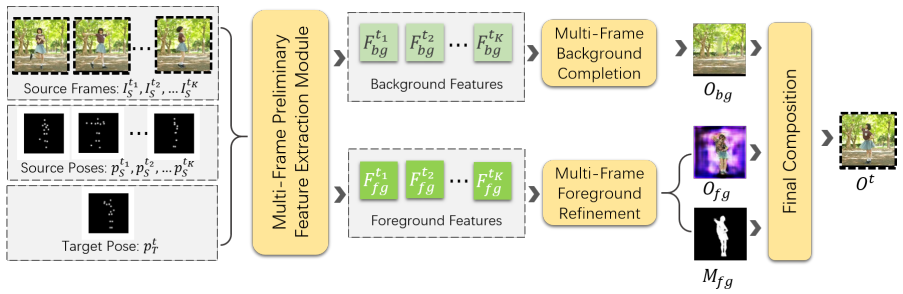
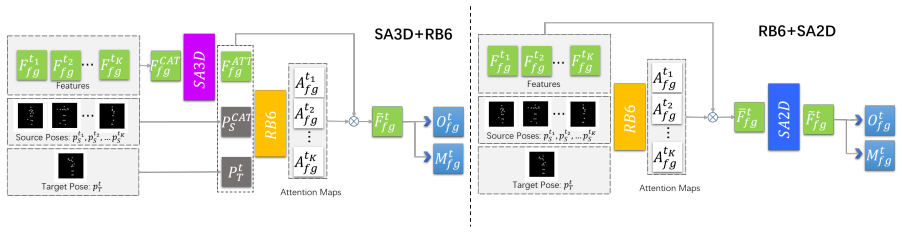
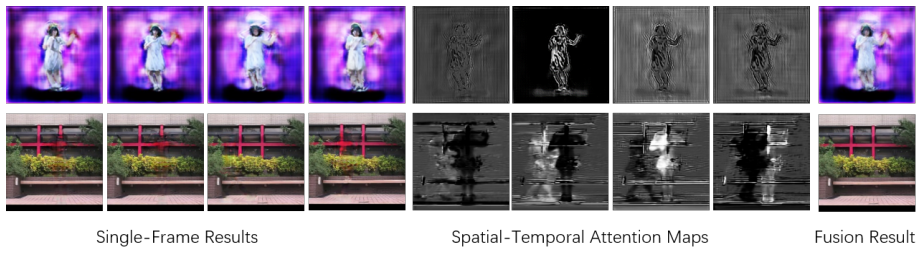
The load-bearing object is the spatio-temporal attention map: a set of K per-pixel weights, each indicating how much the foreground or background feature map from source frame k should contribute to the synthesized frame at target time t. The map is produced either by six residual blocks over the concatenated source features, poses, and target pose ('RB6'), optionally preceded by a non-local 3D self-attention step ('SA3D+RB6') or followed by a spatial self-attention step ('RB6+SA2D'). Fused features are formed by a weighted sum of the K feature maps, and a prediction layer turns the fused map into the synthetic foreground image, foreground mask, or completed background. The second load-bearing object is the multi-range temporal discriminator: a set of discriminators, one for each clip length n=3,5,7, that receive n consecutive generated or real frames plus their optical flow and judge whether the clip's temporal dynamics are real.
What would settle it
Run the trained model on a source-target pair where the camera pans or the background has moving elements (e.g., a person walking past). If the background branch smears, the foreground misaligns with the background, or temporal flicker returns to the level of the single-frame baseline, then the claimed general-person, temporally consistent motion transfer holds only under the static-camera assumption. A quantitative version: measure VFID on such moving-camera clips and compare it with the VFID reported on the static Dance-500 test set.
Extended reading notes
Core claim
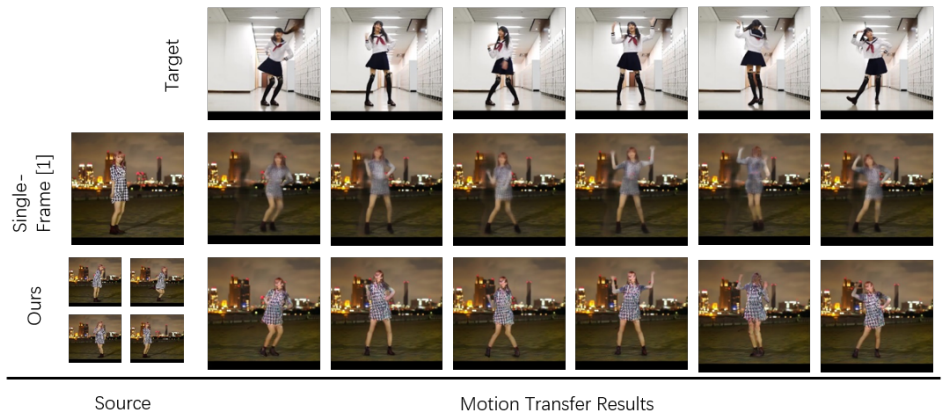
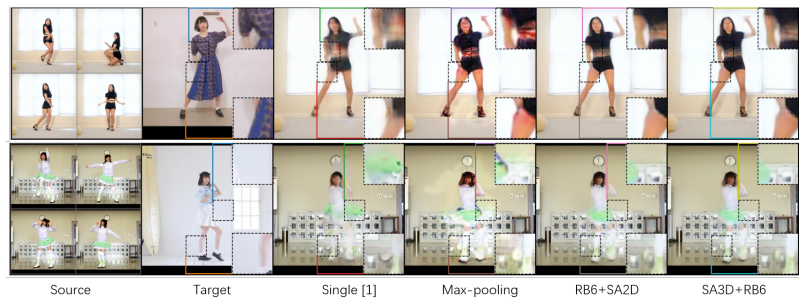
The central discovery is that fusing K=4 randomly sampled source frames with learned attention maps—computed jointly from spatial positions and temporal frame indices—produces sharper foregrounds and more accurate background completion than any single source frame, because the attention can locate each frame's 'comfort zone' and suppress occluded or uninformative regions. On top of this, training with temporal discriminators that look at clips of length 3, 5, and 7 frames plus optical flow enforces temporal consistency across multiple time scales. The paper shows that this combination beats the single-frame baseline on VFID, PSNR, and user preference, and that a two-stage fusion variant ('RB6+SA2D') nearly matches a full 3D self-attention variant at lower computational cost. The paper also demonstrates that the separated foreground and background branches permit replacing the background with a third video's background while keeping the transferred motion.
Load-bearing premise
The load-bearing premise is that the camera and background are static in both source and target videos; if the videos contain camera motion, parallax, or a moving background, the model has no mechanism to represent or correct for that motion.
Editorial extensions
If this is right
- A single trained model can transfer any target pose sequence to any source person, removing the need to train a separate network per source video.
- Background substitution becomes a side effect of the two-branch design: the background branch can accept a third video's frames while the foreground branch transfers the motion.
- Multi-frame fusion at K=4 is already enough for large gains, suggesting richer source sampling strategies are a promising direction.
- Multi-range temporal adversarial training with length 3, 5, and 7 clips improves temporal consistency more than a single fixed-range discriminator.
- The Dance-500 dataset supplies a challenging benchmark for general person video motion transfer with complex, unpredictable motions in the wild.
Reading between the lines
- The same spatio-temporal attention fusion could transfer to other multi-view synthesis tasks, such as novel-view human rendering or avatar animation from multiple camera views, since the mechanism is agnostic to the specific pose representation.
- The static-camera assumption is the first thing to lift; a natural extension is to feed optical flow or camera pose into the background completion branch so that moving cameras, parallax, and dynamic backgrounds can be modeled.
- The attention maps themselves are interpretable 'comfort zones,' which could be used to automatically select the most informative source frames rather than sampling them uniformly at random.
- A testable corollary of the paper's argument is that increasing K beyond 4 should improve quality only up to a point, after which redundant frames add computation without new appearance information.
Signed reviews
Editorial analysis
A structured set of objections, weighed in public.
Referee Report
Summary. The paper proposes a person-video motion transfer method that uses multiple source frames rather than a single frame. The method extracts preliminary foreground and background features from K source frames with a fixed single-frame pose-transfer network, fuses them through a learned spatio-temporal attention module, and composites foreground and background via a predicted mask. A multi-range temporal discriminator over n=3,5,7 frames with optical flow is used for temporal adversarial training. The authors introduce the Dance-500 dataset of about 500 dancing clips and report VFID and PSNR on a Same-Video subset plus a small user study, comparing mainly to the single-frame baseline and to various fusion/temporal-discriminator variants.
Significance. If the claims were fully supported, the method would provide a single model for appearance-preserving, temporally consistent motion transfer between arbitrary person videos, with a flexible background substitution application. The paper's strengths include the explicit multi-frame content integration idea, the new Dance-500 dataset, and a systematic ablation of fusion variants and temporal discriminators showing consistent gains on the same-video evaluation. However, the significance is bounded by the explicit static-camera/static-background assumption and by the absence of quantitative comparison to the strongest video-to-video baselines.
major comments (3)
- [§3; Abstract/Introduction] The opening of Section 3 states: 'To simplify the problem, we assume that both the camera and the background are static, which is already a very challenging setting remaining unsolved.' This assumption is not reflected in the abstract or introduction, which claim 'general person video motion transfer' and 'transfer complex and unpredictable motions between any pair of person videos.' The multi-frame foreground and background fusion modules (Sections 3.2 and 3.3) perform a weighted combination of features from different source frames with no alignment, warping, or camera-motion model; the background completion branch in particular relies on occluded background being observable in other frames, which only holds for a fixed viewpoint. Because Dance-500 is collected with 'camera and background static at most of the time' (Section 4), the experiments do not exercise the unqualified setting. The authors should either restrict the central claim to static-camera/static-background videos or add an explicit alignment mechanism and evaluate on videos with camera or background motion. As it stands, the abstract's generality claim is not supported by the method or the experiments.
- [§4.1, Table 1] The only quantitative evaluation (VFID and PSNR, Table 1) is reported on the Same-Video subset, where the source and target come from the same video. The paper states that VFID cannot be computed on the Cross-Video subset because appearance also affects I3D features, but the central contribution is cross-video transfer; the only quantitative cross-video evidence is the user study of Table 2, which compares only to the single-frame method [1]. No comparison is reported against video-to-video baselines such as Everybody Dance Now [3] or vid2vid [26], which are the relevant prior methods for the temporal-consistency claim. This gap is load-bearing: the conclusion that the method 'produces more photo-realistic and temporally consistent person videos than previous methods' is not substantiated against the strongest prior video methods. Please add quantitative comparisons on the Same-Video subset to those baselines, or restrict the comparison claim accordingly.
- [§3.2 (SA3D variant)] The description of the 'SA3D' variant states that 'a non-local attention map of size (K×H×W)×(K×H×W) is computed for the spatial-temporal feature fusion.' With the stated feature size C×H×W and H=W=256 (Section 3.1) and K=4, this attention map has approximately 2.6e5 × 2.6e5 ≈ 6.9e10 entries, which is computationally prohibitive for standard training on current hardware. Table 1 nevertheless reports results for 'FusionSA3D+RB6'. Please clarify whether the attention is computed on downsampled features, whether an approximation is used, or whether the reported size is a typo; otherwise the reported result cannot be reproduced from the description.
minor comments (5)
- [§4.1] In the first paragraph, 'pretrained video classificatoin network I3D' contains a typo: 'classification'.
- [§3.2] In the description of the fusion operation, '⊙ means the element-wise production' should read 'element-wise product'.
- [§4] The sentence 'Both the camera and background are static at most of the time' is ambiguous; please specify whether 'static in most clips' or 'static for most frames within each clip' is intended.
- [§4.1, Table 2] The user study reports averages over 20 participants and 5 videos per setting but no confidence intervals or significance tests; adding these would strengthen the preference claim.
- [§4.1, Table 1] The number of source frames K is fixed to 4, but no ablation over K is reported; a small ablation would help substantiate the effect of the multi-frame mechanism.
Circularity Check
No circularity found: the training and evaluation setup measures genuine transfer performance, and the static-camera assumption is a stated scope limitation rather than a definitional reduction.
full rationale
The paper's central derivation chain is self-contained and empirically grounded. The proposed network takes K non-overlapping source frames plus a target pose and generates an output frame, supervised by ground-truth frames from the same video with non-overlapping source/target splits (Section 3.5: 'we use the same video to provide the source frames and the target frames for the training phase. We make sure that the source frames and target frames have no overlap'). Quantitative evaluation uses held-out Same-Video subsets with real VFID and PSNR measurements (Section 4.1), and the Cross-Video setting is qualitatively assessed. No fitted parameter is relabeled as a prediction, and no load-bearing claim is justified by a self-citation: the method builds on external baselines [1, 26] and evaluates against them, rather than importing an assumption from the authors' own prior work. The explicit assumption that 'both the camera and the background are static' (Section 3) is an honest scope restriction, not a circular step; it weakens the generality of the abstract's claim but does not make any result equivalent to its inputs by construction. Therefore no circularity is present.
Assumptions & free parameters
free parameters (4)
- Loss weights lambda_VGG, lambda_GI, lambda_GV =
0.2, 0.2, 0.1
- Source frame count K =
4
- Consecutive target frame window L =
8 frames per training sample
- Temporal discriminator ranges n =
{3, 5, 7}
assumptions (5)
- domain assumption Both camera and background are static during generation.
- domain assumption Pose sequences extracted by a pretrained 2D pose estimator with M=14 keypoints are sufficient to represent dance motion for transfer.
- domain assumption Training with the same video as both source and target, with non-overlapping frames, transfers to arbitrary source-target video pairs at test time.
- ad hoc to paper The fixed pretrained single-frame pose transfer model [1] provides preliminary features, at its second-to-last layer, that are rich enough for multi-frame fusion.
- domain assumption Optical flow from FlowNet2 and features from VGG19 and I3D are adequate perceptual and motion measures.
invented entities (1)
-
Dance-500 dataset
Cite this review
Pith. "Pith review of Multi-Frame Content Integration with a Spatio-Temporal Attention Mechanism for Person Video Motion Transfer." pith.science (2026). https://pith.science/paper/P4MZX6ZF
@misc{pith2026190804013,
  author       = {Pith},
  title        = {Pith review of: Multi-Frame Content Integration with a Spatio-Temporal Attention Mechanism for Person Video Motion Transfer},
  year         = {2026},
  howpublished = {\url{https://pith.science/paper/P4MZX6ZF}},
  note         = {Machine review of arXiv:1908.04013}
}
read the original abstract
Existing person video generation methods either lack the flexibility in controlling both the appearance and motion, or fail to preserve detailed appearance and temporal consistency. In this paper, we tackle the problem of motion transfer for generating person videos, which provides controls on both the appearance and the motion. Specifically, we transfer the motion of one person in a target video to another person in a source video, while preserving the appearance of the source person. Besides only relying on one source frame as the existing state-of-the-art methods, our proposed method integrates information from multiple source frames based on a spatio-temporal attention mechanism to preserve rich appearance details. In addition to a spatial discriminator employed for encouraging the frame-level fidelity, a multi-range temporal discriminator is adopted to enforce the generated video to resemble temporal dynamics of a real video in various time ranges. A challenging real-world dataset, which contains about 500 dancing video clips with complex and unpredictable motions, is collected for the training and testing. Extensive experiments show that the proposed method can produce more photo-realistic and temporally consistent person videos than previous methods. As our method decomposes the syntheses of the foreground and background into two branches, a flexible background substitution application can also be achieved.
Figures

Figures from the paper (5 more)


Reference graph
Works this paper leans on
-
[1]
G. Balakrishnan, A. Zhao, A. V . Dalca, F. Durand, and J. Guttag. Synthesizing images of humans in unseen poses. In CVPR, 2018. 1, 2, 3, 4, 6, 7, 8
work page 2018
- [30]
-
[26]
T.-C. Wang, M.-Y . Liu, J.-Y . Zhu, G. Liu, A. Tao, J. Kautz, and B. Catanzaro. Video-to-video synthesis. In NeurIPS,
-
[3]
C. Chan, S. Ginosar, T. Zhou, and A. A. Efros. Everybody dance now. arXiv preprint arXiv:1808.07371, 2018. 2, 3
arXiv 2018
-
[2]
J. Carreira and A. Zisserman. Quo vadis, action recognition? a new model and the kinetics dataset. In CVPR, 2017. 6, 7
work page 2017
-
[4]
H.-S. Fang, S. Xie, Y .-W. Tai, and C. Lu. RMPE: Regional multi-person pose estimation. In ICCV, 2017. 3
work page 2017
-
[5]
C. Feichtenhofer, A. Pinz, and A. Zisserman. Convolutional two-stream network fusion for video action recognition. In CVPR, 2016. 1
work page 2016
-
[6]
R. A. G ¨uler, N. Neverova, and I. Kokkinos. Densepose: Dense human pose estimation in the wild. In CVPR, 2018. 1
work page 2018
Show all 31 references
-
[7]
E. Ilg, N. Mayer, T. Saikia, M. Keuper, A. Dosovitskiy, and T. Brox. Flownet 2.0: Evolution of optical flow estimation with deep networks. In CVPR, 2017. 6
2017
-
[8]
Isola, J.-Y
P. Isola, J.-Y . Zhu, T. Zhou, and A. A. Efros. Image-to-image translation with conditional adversarial networks. In CVPR,
-
[9]
Johnson, A
J. Johnson, A. Alahi, and L. Fei-Fei. Perceptual losses for real-time style transfer and super-resolution. InECCV, 2016. 6
2016
-
[10]
D. P. Kingma and J. Ba. Adam: A method for stochastic optimization. In ICLR, 2015. 6
2015
-
[11]
Kocabas, S
M. Kocabas, S. Karagoz, and E. Akbas. Multiposenet: Fast multi-person pose estimation using pose residual network. In ECCV, 2018. 1
2018
-
[12]
Ledig, L
C. Ledig, L. Theis, F. Husz ´ar, J. Caballero, A. Cunningham, A. Acosta, A. P. Aitken, A. Tejani, J. Totz, Z. Wang, et al. Photo-realistic single image super-resolution using a genera- tive adversarial network. In CVPR, 2017. 6
2017
-
[13]
J. Liu, B. Ni, Y . Yan, P. Zhou, S. Cheng, and J. Hu. Pose transferrable person re-identification. In CVPR, 2018. 1
2018
-
[14]
L. Ma, X. Jia, Q. Sun, B. Schiele, T. Tuytelaars, and L. Van Gool. Pose guided person image generation. In NeurIPS, 2017. 1, 2, 3
2017
-
[15]
L. Ma, Q. Sun, S. Georgoulis, L. Van Gool, B. Schiele, and M. Fritz. Disentangled person image generation. In CVPR,
-
[16]
X. Mao, Q. Li, H. Xie, R. Y . Lau, Z. Wang, and S. P. Smol- ley. Least squares generative adversarial networks. In ICCV,
-
[17]
Neverova, R
N. Neverova, R. Alp Guler, and I. Kokkinos. Dense pose transfer. In ECCV, 2018. 1, 2
2018
-
[18]
Newell, Z
A. Newell, Z. Huang, and J. Deng. Associative embedding: End-to-end learning for joint detection and grouping. In NeurIPS, 2017. 1
2017
-
[19]
Pumarola, A
A. Pumarola, A. Agudo, A. Sanfeliu, and F. Moreno-Noguer. Unsupervised person image synthesis in arbitrary poses. In CVPR, 2018. 1, 2
2018
-
[20]
Siarohin, E
A. Siarohin, E. Sangineto, S. Lathuili `ere, and N. Sebe. De- formable gans for pose-based human image generation. In CVPR, 2018. 1, 2
2018
-
[21]
Simonyan and A
K. Simonyan and A. Zisserman. Two-stream convolutional networks for action recognition in videos. In NeurIPS, 2014. 1
2014
-
[22]
Simonyan and A
K. Simonyan and A. Zisserman. Very deep convolutional networks for large-scale image recognition. In ICLR, 2015. 6
2015
-
[23]
Tulyakov, M.-Y
S. Tulyakov, M.-Y . Liu, X. Yang, and J. Kautz. MoCoGAN: Decomposing motion and content for video generation. In CVPR, 2018. 1, 6
2018
-
[24]
Villegas, J
R. Villegas, J. Yang, S. Hong, X. Lin, and H. Lee. Decom- posing motion and content for natural video sequence pre- diction. In ICLR, 2017. 1, 2
2017
-
[25]
Villegas, J
R. Villegas, J. Yang, Y . Zou, S. Sohn, X. Lin, and H. Lee. Learning to generate long-term future via hierarchical pre- diction. In ICML, 2017. 1, 2
2017
-
[27]
L. Wei, S. Zhang, W. Gao, and Q. Tian. Person transfer gan to bridge domain gap for person re-identification. In CVPR,
-
[28]
Y . Xiu, J. Li, H. Wang, Y . Fang, and C. Lu. Pose Flow: Efficient online pose tracking. In BMVC, 2018. 3
2018
-
[29]
C. Yang, Z. Wang, X. Zhu, C. Huang, J. Shi, and D. Lin. Pose guided human video generation. In ECCV, 2018. 2
2018
-
[31]
L. Zhao, X. Peng, Y . Tian, M. Kapadia, and J. Metaxas, Dimitris. Learning to forecast and refine residual motion for image-to-video generation. In ECCV, 2018. 3
2018
Reviewed August 14, 2026 · model on record in the stance chip above.
Discussion (0). Continue with ORCID to comment.