REVIEW 3 major objections 6 minor 23 references
A Study of NaI(Tl) crystal Encapsulation using Organic scintillators for the Dark Matter Search
T0 review · 3 major / 6 minor · reviewed 2026-08-14 · deepseek-v4-flash
Pith's one-line read Direct organic wrapping of NaI(Tl) works: 7.7σ pulse separation
desk verdict A credible feasibility study of NaI(Tl) encapsulation with organic scintillators, with real new data but a dark matter motivation that is not yet tested and two under-documented claims. read the letter →
The pith
A machine-rendered reading of the paper's core claim, the machinery that carries it, and where it could break.
The reading
What carries the argument
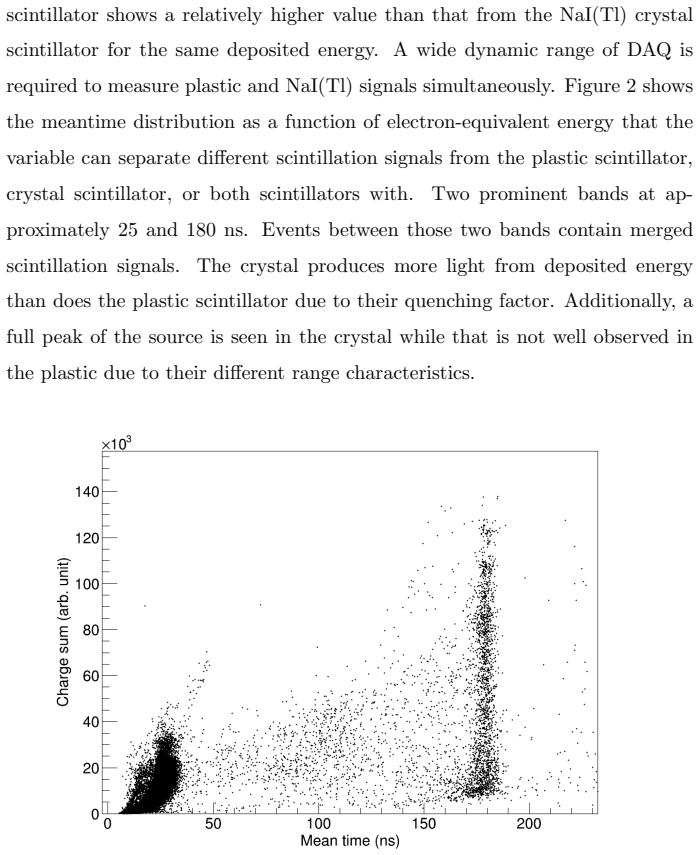
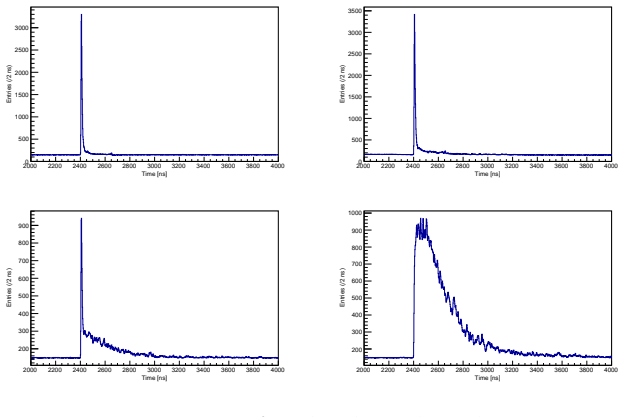
The load-bearing object is the phoswich geometry: a bare NaI(Tl) crystal (230 ns decay time) directly coupled to a fast organic scintillator (LAB-based liquid or a commercial plastic, ~3 ns decay) with a single photomultiplier readout. The discrimination observable is the 'meantime', the amplitude-weighted average time of each pulse as defined in Eq. (1), which places crystal events around 180 ns and organic events around 25 ns. Because the meantime uses only pulse shape, it has minimal energy dependence, and events that fire both scintillators appear as merged waveforms between the two bands. The paper's other key element is the low-temperature protocol: operating the liquid-scintillator assembly at -35 °C freezes residual moisture, preventing the surface degradation that otherwise reduces light yield by about 30% per month.
What would settle it
Place a known 210Po alpha source at the crystal-organic boundary, run the assembly underground or with low background, and count how often the coincident alpha-plus-recoil pairs appear as identified merged pulses in the WIMP search energy window (roughly 2–100 keV electron-equivalent); if the tagging efficiency there is too low to reject the surface alpha population while retaining signal acceptance, the central claim fails.
Extended reading notes
Core claim
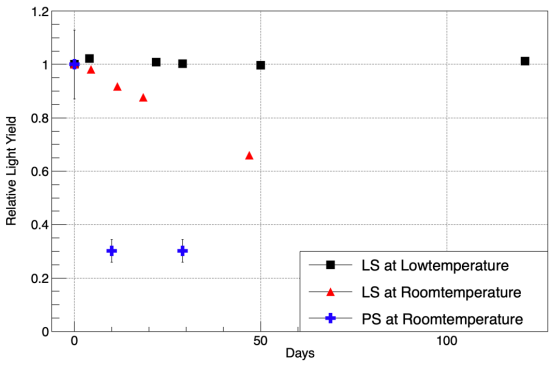
The central claim is that direct encapsulation works as an active veto: a bare NaI(Tl) crystal placed in optical contact with a liquid or plastic organic scintillator functions as a phoswich detector in which crystal events, organic events, and coincident mixed events can be told apart by the meantime observable (amplitude-weighted average pulse time). The paper demonstrates 7.7σ separation between organic and crystal signals at 400 keV, identifies merged waveforms from interactions in both scintillators, and reports that at -35 °C the liquid-scintillator encapsulation maintains a stable NaI(Tl) light yield of 11.3 ± 1.0 photoelectrons/keV over four months, compared with a ~30% reduction at ambient temperature in one month. The intended payoff, which the authors state explicitly, is the ability to tag 210Po alpha particles depositing in the organic veto while the coincident 206Pb recoil deposits in the crystal, moving a dominant surface background out of the WIMP search region.
Load-bearing premise
The paper's case rests on treating gamma-induced merged signals as a faithful proxy for the surface alpha-recoil events (an alpha in the organic scintillator plus a 206Pb recoil in the crystal) that the detector is meant to tag; if the separation does not transfer to those low-energy coincident events, the dark-matter background advantage is lost.
Editorial extensions
If this is right
- A NaI(Tl) dark-matter module built this way needs no separate hermetic enclosure: the organic scintillator is the encapsulation and the veto at once.
- External gamma rays that penetrate from outside the crystal are identified by their organic-scintillator pulse shape, so they can be removed in analysis rather than only by passive shielding.
- Surface 210Po decays — alpha in the organic veto plus 206Pb recoil in the crystal — produce merged pulse shapes, so the paper's identification of merged signals is the step that lets this background be tagged.
- Operating the detector at -35 °C removes the humidity-driven light-yield decline, making long stable runs possible for a liquid-scintillator-encapsulated crystal.
- The plastic-scintillator version, though lower in light yield (1.2 ± 0.2 pe/keV), shows the same separation bands, so a rigid encapsulation is also feasible.
Reading between the lines
- If the merged-signal identification is reliable at low energies, the same phoswich idea could be exported to other hygroscopic scintillation crystals where surface alpha contamination limits rare-event sensitivity.
- A natural test is to measure how the meantime separation degrades below 100 keV electron-equivalent; the dark-matter region of interest sits there, and the paper's 7.7σ figure is at 400 keV.
- The freezing protocol suggests that the dominant damage mechanism is chemical or moisture-driven surface degradation rather than bulk ageing; if so, a simpler vacuum or dry-gas encapsulation might achieve the same stability without the veto.
- The room-temperature measurement was performed in a non-underground environment, so a dedicated low-background run with a surface alpha source would be needed to confirm that the same PSD persists under dark-matter-search conditions.
Signed reviews
Editorial analysis
A structured set of objections, weighed in public.
Referee Report
Summary. The paper reports a technical development for rare-event experiments: a bare NaI(Tl) crystal is directly encapsulated in either liquid or plastic organic scintillator, forming a phoswich-type detector. The authors claim that pulse shape discrimination (using the amplitude-weighted meantime) separates organic-scintillator and NaI(Tl) signals, that merged events from interactions in both scintillators can be identified, and that the liquid-scintillator encapsulation shows stable light yield over four months at -35 C while losing about 30% light yield over one month at room temperature. The stated motivation is to address both the hygroscopicity of NaI(Tl) and the surface-alpha background relevant to dark matter searches.
Significance. If the quantitative claims are fully supported, this is a useful engineering contribution to low-background NaI(Tl) detectors: it proposes a single-module design that simultaneously provides a moisture barrier and an active veto. The use of the meantime estimator is standard, the direct experimental approach avoids circularity, and the raw two-band structure in Figure 2 is visually encouraging. However, the headline 7.7-sigma separation is not documented, the transfer from gamma-induced merged events to the motivating alpha-recoil signature is not established, and the moisture-stability interpretation lacks a control. These are load-bearing issues for the stated dark-matter motivation, so the current version is not yet publication-ready.
major comments (3)
- [Section 4 (Results), Figure 2] The claim of '7.7σ at 400 keV' PSD separation is not quantitatively defined anywhere in the manuscript. The text does not state what quantity the 7.7σ refers to (centroid separation divided by combined width? a discrimination power with statistical and systematic errors?), how the 400 keV point is selected, or what uncertainties are included. Without this definition and the corresponding error analysis, the central quantitative result is unverifiable. Please provide the exact definition, the selection criteria, and the numerical values for the separation and its uncertainty.
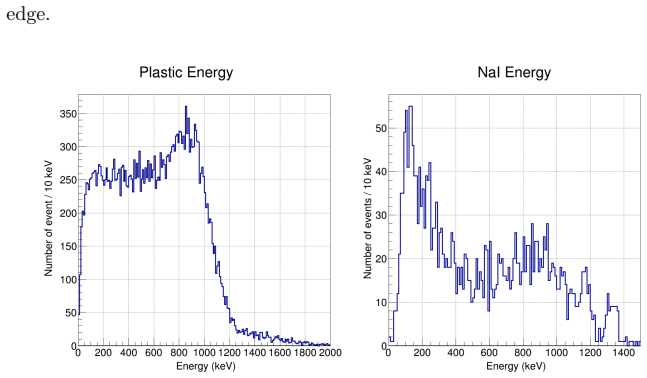
- [Sections 3.3 and 5] The merged-signal demonstration uses 60Co gamma rays in the 200–400 keV electron-equivalent range. The motivating dark-matter background is a surface 210Po decay in which an alpha deposits energy in the organic veto and a 206Pb recoil deposits energy in the NaI(Tl) crystal. These two cases are in different quenching and timing regimes: the organic component from a heavily quenched alpha is much smaller and the crystal component from a heavy recoil is also quenched relative to electron-equivalent gamma interactions. The paper itself defers the 210Po study to future work, yet the Conclusions state that the setup can identify such events. As written, the extrapolation from gamma-induced merged signals to alpha-recoil merged signals is unsupported; the conclusion should be either demonstrated with data/simulation or explicitly limited to the gamma case.
- [Sections 3.4 and 4] The long-term stability test at −35 C is interpreted as evidence that moisture effects on the crystal surface are reduced below freezing, but no control measurement or direct moisture indicator is reported. The observed stability at low temperature could also result from reduced chemical reaction rates, changes in liquid-scintillator properties, improved optical coupling, or the absence of temperature cycling. Conversely, the 30% room-temperature light-yield loss is not uniquely attributable to humidity. The moisture-protection conclusion therefore goes beyond what the present data can establish; a control experiment with measured humidity or a direct surface-characterization probe is needed.
minor comments (6)
- [Section 1] The sentence 'Continued light yield improvement has made the crystals usable to a low energy dark matter experiment since the early 1900s' contains an obvious typo: it should read '1990s' or another appropriate recent decade, not 'early 1900s'.
- [Section 2.1] The footnote 'magasampling per second' should be 'mega-sampling per second'; also the footnote marker appears after '400 MSPS 1 fast analog-to-digital converter', which is awkwardly placed.
- [Section 2.2] In the sentence 'This, LAB-LS, includes a few percents of 2,5-diphenyloxazole dissolved in the solvent for fluorescence and a trace amount of 1,4-bis[2- methylstyryl]benzene (bis-MSB) to improve the light properties', the phrase 'which has becomes' appears later and should be corrected to 'which has become'.
- [Section 3.4] The units for light yield are inconsistent: Section 3.4 quotes '11.3 ± 1.0 ph/keV' while Section 4 quotes '(11.3 ± 1.0) and (1.2 ± 0.2) pe/keV'. Please standardize on one notation (photoelectrons per keV) and define it clearly.
- [Figure 5 caption] The caption 'Single photoelectron relative outcomes over meansurement' contains a typo ('measurement') and does not clearly explain what 'relative outcomes' means; please describe the plotted quantity and its physical relevance.
- [Section 5] The phrase 'used propoesd setup' should read 'used the proposed setup'; several other typographical errors (e.g., 'propoesd', 'identification', 'which has makes') should be corrected throughout the text.
Circularity Check
No significant circularity: the PSD separation, merged-signal identification, and low-temperature stability are direct experimental measurements, and self-citations do not carry the argument.
full rationale
This paper reports a detector-construction study, not a derivation. The main claims — PSD separation of organic and NaI(Tl) pulses, identification of merged waveforms, and four-month light-yield stability at -35 C — are direct experimental measurements, calibrated against external 60Co full-energy peaks and a Compton edge. Equation (1) defines the meantime observable from the waveform; the two observed bands in Figure 2 are data, not outputs forced by inputs. No fitted parameter is relabeled as a prediction: the energy calibrations are standard, and the 7.7-sigma separation is a measured separation of event populations. Citations to prior COSINE/KIMS work (refs. [8], [9], [14]-[17], [21]) supply crystal properties, facility description, and the meantime method, but none is invoked to prove a uniqueness claim or to substitute for the measurement. The only extrapolation, from gamma-induced merged signals to surface alpha-recoil tagging, is a physical-transferability assumption and is explicitly identified as future work; it may be a limitation, but it is not circular.
Assumptions & free parameters
assumptions (3)
- domain assumption NaI(Tl) and organic scintillators have sufficiently different decay times (about 230 ns vs under 10 ns) that the meantime observable separates their signals.
- domain assumption The room-temperature light yield decline is caused by moisture or humidity effects on the crystal surface, and freezing suppresses that mechanism.
- domain assumption The plastic scintillator (EJ-290) can be cast around a bare NaI(Tl) crystal without chemical damage that invalidates the detector.
Cite this review
Pith. "Pith review of A Study of NaI(Tl) crystal Encapsulation using Organic scintillators for the Dark Matter Search." pith.science (2026). https://pith.science/paper/YC5VI5BQ
@misc{pith2026190804022,
  author       = {Pith},
  title        = {Pith review of: A Study of NaI(Tl) crystal Encapsulation using Organic scintillators for the Dark Matter Search},
  year         = {2026},
  howpublished = {\url{https://pith.science/paper/YC5VI5BQ}},
  note         = {Machine review of arXiv:1908.04022}
}
read the original abstract
Scintillating NaI(Tl) crystals are used for various rare decay experiments, such as dark matter searches. The hygroscopicity of NaI(Tl) crystal makes the construction of crystal detectors in these experiments challenging and requires a tight encapsulation to prevent from air contact. More importantly, in a low radioactivity measurement, identification of external radiations and surface contamination is crucial to characterize the origin of total crystal radioactivities. Studies for NaI(Tl) crystal encapsulation with active organic scintillator vetoes have been performed to mitigate the above-mentioned issues simultaneously. A bare crystal is directly coupled with liquid and plastic scintillators to tag external radiations that penetrate from the outer part of the crystal. We report the pulse shape discrimination for organic scintillator pulses from those of the crystal scintillator in a single detector setup which makes external gammas identifiable and long-term stability tests of the detector setup.
Figures

Figures from the paper (2 more)
Reference graph
Works this paper leans on
- [1]
-
[2]
I. Holl and E. Lorenz and G. Mageras IEEE Transactions on Nuclear Sci- ence, 35 (1988) 105
work page 1988
- [3]
- [4]
- [5]
- [6]
-
[7]
D. S. Akerib et al., Phys. Rev. Lett., 112 (2014) 091303
work page 2014
-
[8]
K. W. Kim et al., Astropart. Phys., 62 (2015)
work page 2015
Show all 23 references
-
[9]
K. W. Kim et al., Astropart. Phys., 102 (2018)
2018
-
[10]
White and William H
Travis L. White and William H. Miller, Nucl. Inst. Meth. A , 422 (1999)
1999
-
[11]
Stauss et al., Eur
R. Stauss et al., Eur. Phys. J. C , 75 (2015) 352
2015
-
[12]
J. S. Park, et al., Nucl. Inst. Meth. A , 851 (2017). 10
2017
-
[13]
Radioanal
Ba Ro Kim et al., J. Radioanal. Nucl. Chem. , 310, (2016) 1
2016
-
[14]
Adhikari et al., The Eur
G. Adhikari et al., The Eur. Phys. J. C , 78 (2018) 107
2018
-
[15]
Adhikari et al., The Eur
P. Adhikari et al., The Eur. Phys. J. C , 76 (2016) 185
2016
-
[16]
Adhikari et al., The Eur
G. Adhikari et al., The Eur. Phys. J. C , 77 (2017) 437
2017
-
[17]
Lee et al., Nucl
H.S. Lee et al., Nucl. Inst. Meth. A , 571 (2007) 3
2007
-
[18]
Bernabei et al., Il Nuovo Cimento A , 112 (1999) 6
R. Bernabei et al., Il Nuovo Cimento A , 112 (1999) 6
1999
-
[19]
Gioacchino Rauncci, Augusto Goretti, and Paolo Lombardi, Nucl. Inst. Meth. A, 412 (1998) 2-3
1998
-
[20]
Knoll, Radiation Detection and Measurement, 4 th Edition, John Wi- ley & Sons, Inc
G.F. Knoll, Radiation Detection and Measurement, 4 th Edition, John Wi- ley & Sons, Inc. 2010
2010
-
[21]
H. S. Lee et al., Phys. Rev. Lett., 108 (2012) 181301
2012
-
[22]
https://eljentechnology.com/products/plastic-scintillators/ej-290
-
[23]
Moszy´ nskiet al., Nucl
M. Moszy´ nskiet al., Nucl. Inst. Meth. A , 568 (2006). 11
2006
Reviewed August 14, 2026 · model on record in the stance chip above.
Discussion (0). Continue with ORCID to comment.