REVIEW 3 major objections 4 minor 41 references
Many-body localization in XY spin chains with long-range interactions: An exact diagonalization study
T0 review · 3 major / 4 minor · reviewed 2026-08-14 · deepseek-v4-flash
Pith's one-line read A disordered XY spin chain with interactions decaying as $1/r^\alpha$ stops being many-body localized below $\alpha_c \simeq 1.16$.
desk verdict A solid, honest ED study whose qualitative conclusion—no MBL at sufficiently small alpha—holds up, but the headline alpha_c is an extrapolated power-law fit, not a measured divergence. read the letter →
The pith
A machine-rendered reading of the paper's core claim, the machinery that carries it, and where it could break.
The reading
What carries the argument
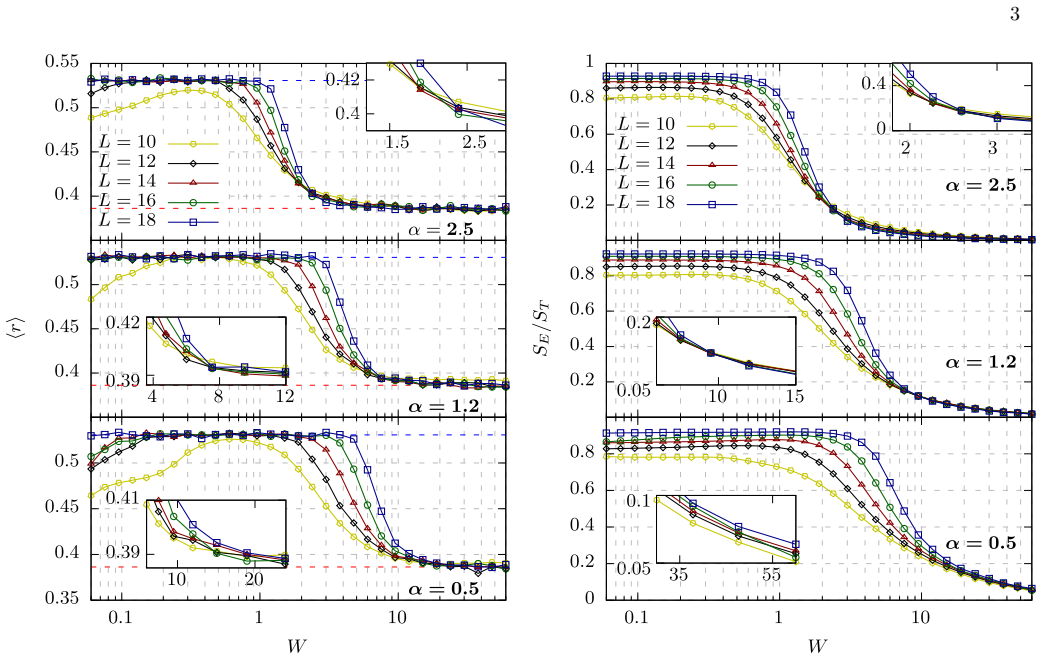
The load-bearing object is the finite-size scaling collapse of the normalized half-chain entanglement entropy $S_E/L$ through the ansatz $S_E(L,W)=L f[(W-W_c)L^{1/\nu}]$, where the correlation length behaves as $\xi(W)\propto |W-W_c|^{-\nu}$. For each exponent $\alpha$, the paper locates the transition by collapsing data at chain lengths $L=12,14,16,18$; the same $W_c$ and $\nu$ also collapse the averaged gap ratio $\langle r\rangle$. The extrapolated $W_c(\alpha)$ and $\nu(\alpha)$ are then fitted to a power-law divergence $\eta=A_\eta(\alpha-\alpha_{c,\eta})^{-\gamma_\eta}$, with the lower cutoff $\alpha_f$ chosen by minimizing fitting error and uncertainties handled by bootstrap resampling. This two-stage machinery turns finite-size crossing data into a critical interaction exponent $\alpha_c$.
What would settle it
Compute $W_c(\alpha)$ and $\nu(\alpha)$ with exact diagonalization or tensor-network methods for larger chains and for $\alpha=1.0,1.1,1.15,1.2$: if the scaling-collapse estimates saturate or fail to keep increasing, the inferred $\alpha_c$ is a fitting artifact. A direct time-evolution probe at $\alpha=1.1$ with strong disorder on a chain comparable to trapped-ion experiments would also settle the matter, since persistent density imbalance or logarithmic entanglement growth would indicate MBL below the claimed threshold.
Extended reading notes
Core claim
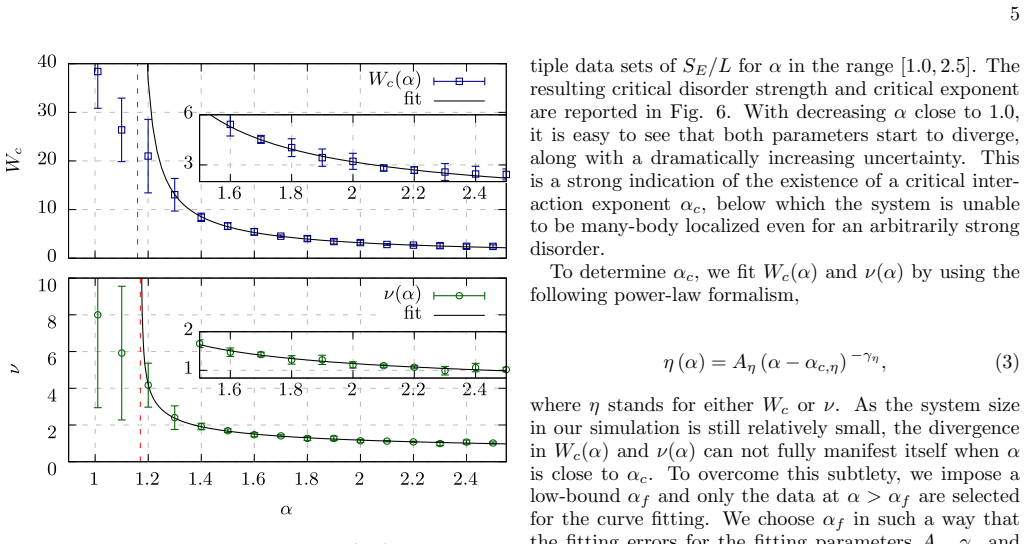
Using the finite-size scaling ansatz $S_E(L,W)=L f[(W-W_c)L^{1/\nu}]$ for the normalized half-chain entanglement entropy, together with matching collapses for the spectral gap ratio, the authors obtain $W_c$ and $\nu$ for interaction exponents from $\alpha=1.0$ to $2.5$. Fitting those results to $\eta(\alpha)=A_\eta(\alpha-\alpha_{c,\eta})^{-\gamma_\eta}$, with a lower cutoff on the fitted range chosen to minimize errors, gives $\alpha_{c,W_c}=1.16\pm 0.17$ and $\alpha_{c,\nu}=1.17\pm 0.14$; the paper reports these conservatively as $\alpha_c=1.16\pm 0.17$. It finds no singular behavior at $\alpha=3/2$ and concludes that below $\alpha_c$ the system cannot be many-body localized at any disorder strength in the limit $L\to\infty$.
Load-bearing premise
The load-bearing premise is that $W_c(\alpha)$ and $\nu(\alpha)$ truly diverge according to the fitted power law down to $\alpha_c\simeq 1.16$, even though every measured point has $\alpha\ge 1.0$ and the fits use only data above $\alpha_f=1.3$ (for $W_c$) or $1.2$ (for $\nu$).
Editorial extensions
If this is right
- If the central claim is right, a disordered one-dimensional XY chain with $1/r^\alpha$ interactions has no MBL phase in the thermodynamic limit for any disorder strength when $\alpha<\alpha_c\simeq 1.16$.
- The predicted $\alpha_c=3/2$ from resonant spin-pair arguments is ruled out, since the paper sees $W_c(\alpha)$ and $\nu(\alpha)$ vary smoothly across $\alpha=1.5$.
- The earlier quantum-dynamics estimate $\alpha_c\approx 1$ is supported by an independent equilibrium, spectrum-based exact-diagonalization method.
- At large $\alpha$ the extracted exponent $\nu\approx 1$ matches finite-size studies of short-range MBL, suggesting the long-range transition lies in the same universality class.
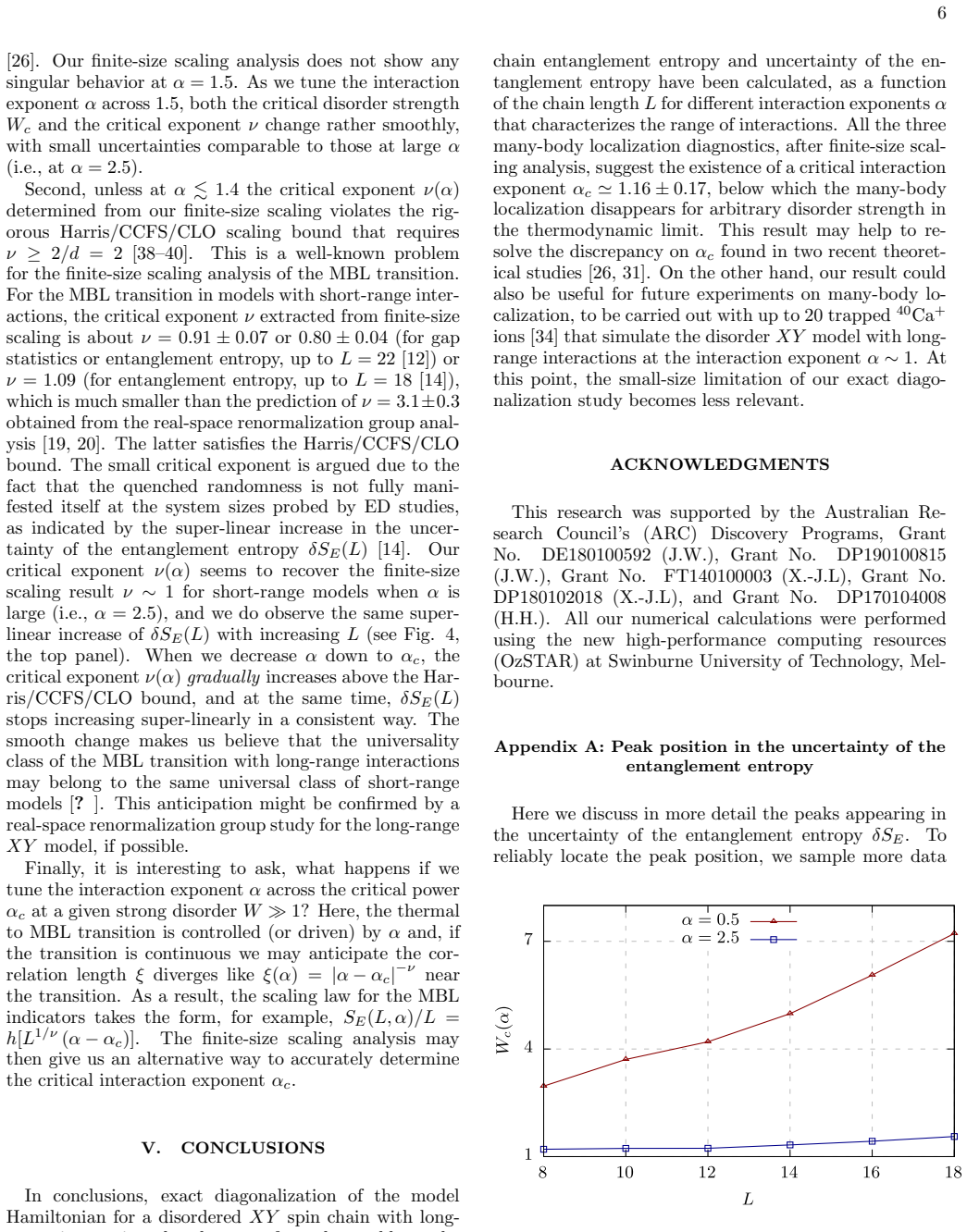
- At small $\alpha$ (for example $\alpha=0.5$) the peak of the entropy uncertainty grows at least linearly with system size, pointing to $W_c\to\infty$ and hence no MBL transition.
Reading between the lines
- The divergence of $W_c$ and $\nu$ is inferred from fitted data with $\alpha\ge 1.2$; if larger-system calculations find that $W_c(\alpha)$ bends over instead of diverging below $\alpha\approx 1.2$, the true threshold could be lower or absent altogether.
- A direct scaling collapse in $\alpha$ at fixed strong disorder, using the form $S_E/L = h[L^{1/\nu}(\alpha-\alpha_c)]$, would provide a second, independent route to $\alpha_c$ that does not rely on the power-law fit to $W_c$.
- The same finite-size scaling pipeline could be applied to Heisenberg chains with power-law interactions, where a separate prediction sets $\alpha_c=2$, testing whether the mechanism behind $\alpha_c\simeq 1.16$ is specific to the XY symmetry.
- Trapped-ion experiments at $\alpha\sim 1$ could test the thermodynamic-limit claim directly: observing persistent density imbalance or slow entanglement growth at strong disorder would contradict the predicted absence of MBL below $\alpha_c$.
Signed reviews
Editorial analysis
A structured set of objections, weighed in public.
Referee Report
Summary. The manuscript reports exact diagonalization results for a disordered one-dimensional XY spin chain with power-law interactions V_ij ∝ |i-j|^{-α}, for chain lengths up to L=18. Using three diagnostics (gap statistics, half-chain entanglement entropy, and its uncertainty), the authors perform finite-size scaling to extract the critical disorder W_c(α) and correlation-length exponent ν(α). They then fit these quantities to a power-law divergence, Eq. (3), obtaining a common critical interaction exponent α_c = 1.16 ± 0.17, and conclude that for α < α_c many-body localization is absent for any disorder strength. This result is presented as resolving a discrepancy between a perturbative prediction α_c = 3/2 and a recent dynamics simulation suggesting α_c ≈ 1.
Significance. If correct, the result would provide the first exact-diagonalization-based determination of α_c for the long-range XY chain and would support the dynamics-based value α_c ≈ 1 over the perturbative 3/2. The paper's strengths are its systematic use of three independent diagnostics, the transparent description of the finite-size scaling and the bootstrap error analysis in Appendix C, and the honest discussion of the difficulties at small α (e.g., the lack of a crossing for α=0.5). The main weakness is that the headline quantity α_c is not measured directly but is an extrapolated zero of a power-law fit over a restricted range, so the load-bearing assumption must be tested more thoroughly before the thermodynamic claim can be considered established.
major comments (3)
- [Sec. IV, Eq. (3)] The central result α_c = 1.16 ± 0.17 is obtained by fitting the assumed power-law form η(α) = A_η (α - α_c)^{-γ_η} to W_c(α) and ν(α). This fit cannot by itself establish that a divergence occurs at a finite α_c, since the functional form already contains a divergence as an input. The authors should present a comparison with alternative models (e.g., an exponential divergence, a divergence at α=1, or a sharp crossover to a finite W_c) and demonstrate that α_c is robust, or alternatively soften the conclusion that MBL is absent for all α < α_c.
- [Sec. IV and Appendix B] The fit is performed only over the data with α > α_f, with α_f chosen to minimize fitting errors (α_f = 1.3 for W_c and 1.2 for ν). This choice excludes the α = 1.2 point for W_c (W_c = 21 ± 8) and means that no measured point lies within the fitted range of the inferred α_c ≈ 1.16. The divergence is therefore an extrapolation beyond the data, not a direct observation. The authors should show the sensitivity of α_c to the choice of α_f and discuss whether the excluded points are consistent with the fitted form.
- [Appendix C] The bootstrap resampling propagates the statistical errors in W_c(α) and ν(α) through the assumed power-law form, but it does not test the validity of that form or the systematic errors in the finite-size scaling at marginal parameters such as α = 1.2, where W_c = 21 ± 8 and ν = 4.2 ± 1.1. The very large uncertainties near the putative α_c should be interpreted as a warning that the data are nearly insensitive to the divergence; the discussion should explicitly acknowledge that the bootstrap errors do not include model-form uncertainty.
minor comments (4)
- [Sec. IV, paragraph on universality class] The citation placeholder '[ ? ]' is unresolved and should be replaced with a proper reference.
- [Sec. III, text near Eq. (2)] The word 'Poisson' is misspelled as 'Possion' in the phrase defining the localized limit.
- [Ref. [30]] The word 'enegenstates' should be 'eigenstates'.
- [Appendix C] The notation α_{c,W} and α_{c,ν} is inconsistent with the main text's α_{c,Wc} and α_{c,ν}; please use a uniform notation.
Circularity Check
No circularity: alpha_c is a transparently fitted extrapolation of finite-size scaling data, not a self-referential prediction.
full rationale
The derivation chain is data-driven and self-contained: exact-diagonalization eigenstates feed gap statistics and entanglement indicators, finite-size scaling collapse (Eq. 2) yields Wc(alpha) and nu(alpha), and a power-law fit (Eq. 3) yields alpha_c. No load-bearing step is defined in terms of the target conclusion. The paper openly states that it fits Wc(alpha) and nu(alpha) with eta(alpha) = A_eta (alpha - alpha_c,eta)^(-gamma_eta), and it reports alpha_c = 1.16 +/- 0.17 as the fitted central result. The claim that Wc and nu diverge as alpha approaches alpha_c is an extrapolation of the assumed scaling form, not an independent measurement; the paper explicitly concedes that the divergence 'can not fully manifest itself' and therefore restricts the fit to alpha > alpha_f with alpha_f = 1.3 for Wc and 1.2 for nu. This is a robustness or correctness caveat about extrapolating beyond the fitted range, but it is not circularity: the data are not constructed from the fitted pole, and the bootstrap (Appendix C) only propagates the stated uncertainties through the same assumed form. The finite-size scaling values Wc and nu are genuine outputs of the ED analysis, and no measured quantity is simultaneously used as input and output. Self-citations (Refs. [8], [13], [28]) are peripheral to the central argument and are not load-bearing. The agreement with the independent dynamics simulation (Ref. [31]) is presented as corroboration, not as the source of the result. The central alpha_c value is thus an extrapolated empirical estimate whose validity could be tested by future studies with larger L or alternative functional forms, but the paper's reasoning does not reduce to its own inputs by construction.
Assumptions & free parameters
free parameters (4)
- Critical disorder Wc(alpha) =
e.g., 2.4 ± 0.3 at alpha=2.5; 21 ± 8 at alpha=1.2
- Critical exponent nu(alpha) =
e.g., 1.0 ± 0.1 at alpha=2.5; 4.2 ± 1.1 at alpha=1.2
- Power-law coefficients and exponents (A, gamma, alpha_c) =
gamma_Wc=0.78 ± 0.06, alpha_c,Wc=1.16 ± 0.03; gamma_nu=0.38 ± 0.02, alpha_c,nu=1.17 ± 0.01
- Lower cutoff alpha_f =
1.3 for Wc, 1.2 for nu
assumptions (5)
- domain assumption Eigenstates near zero energy represent the infinite-temperature properties of the model.
- domain assumption The r-ratio, normalized half-chain entanglement entropy, and entropy uncertainty are valid MBL diagnostics with GOE and Poisson limits.
- domain assumption The scaling ansatz SE(L,W)=L f[(W-Wc)L^(1/nu)] holds for L=12-18 at alpha in [1.0, 2.5].
- ad hoc to paper Wc(alpha) and nu(alpha) diverge as a power law with a single critical alpha_c.
- standard math Bootstrap resampling with normally distributed noise around each data point measures the statistical uncertainty.
Cite this review
Pith. "Pith review of Many-body localization in XY spin chains with long-range interactions: An exact diagonalization study." pith.science (2026). https://pith.science/paper/F7AIKOSI
@misc{pith2026190804031,
  author       = {Pith},
  title        = {Pith review of: Many-body localization in XY spin chains with long-range interactions: An exact diagonalization study},
  year         = {2026},
  howpublished = {\url{https://pith.science/paper/F7AIKOSI}},
  note         = {Machine review of arXiv:1908.04031}
}
abstract
We investigate the transition from the many-body localized phase to the ergodic thermalized phase at an infinite temperature in an $XY$ spin chain with $L$ spins, which experiences power-law decaying interactions in the form of $V_{ij}\propto1/\left|i-j\right|^{\alpha}$ ($i,j=1,\cdots,L$) and a random transverse field. By performing large-scale exact diagonalization for the chain size up to $L=18$, we systematically analyze the energy gap statistics, half-chain entanglement entropy, and uncertainty of the entanglement entropy of the system at different interaction exponents $\alpha$. The finite-size critical scaling allows us to determine the critical disorder strength $W_{c}$ and critical exponent $\nu$ at the many-body localization phase transition, as a function of the interaction exponent $\alpha$ in the limit $L\rightarrow\infty$. We find that both $W_{c}$ and $\nu$ diverge when $\alpha$ decreases to a critical power $\alpha_{c}\simeq1.16\pm0.17$, indicating the absence of many-body localization for $\alpha<\alpha_{c}$. Our result is useful to resolve the contradiction on the critical power found in two previous studies, $\alpha_{c}=3/2$ from scaling argument in Phys. Rev. B \textbf{92}, 104428 (2015) and $\alpha_{c}\approx1$ from quantum dynamics simulation in Phys. Rev. A \textbf{99}, 033610 (2019).
Figures


Figures from the paper (3 more)

Reference graph
Works this paper leans on
-
[1]
P. W. Anderson, Absence of Diffusion in Certain Ran- dom Lattices, Phys. Rev. 109, 1492 (1958)
1958
-
[2]
Fleishman and P
L. Fleishman and P. W. Anderson, Interactions and the Anderson transition, Phys. Rev. B 21, 2366 (1980)
1980
-
[3]
I. V. Gornyi, A. D. Mirlin, and D. G. Polyakov, Interact- ing Electrons in Disordered Wires: Anderson Localiza- tion and Low-T Transport, Phys. Rev. Lett. 95, 206603 (2005)
work page 2005
- [4]
-
[5]
R. Nandkishore and D. A. Huse, Many-body localiza- tion and thermalization in quantum statistical mechanics, Annu. Rev. Condens. Matter Phys. 6, 15 (2015)
work page 2015
-
[6]
E. Altman and R. Vosk, Universal dynamics and renor- malization in many body localized systems , Annu. Rev. Condens. Matter Phys. 6, 383 (2015)
work page 2015
-
[7]
D. A. Abanin, E. Altman, I. Bloch, and M. Serbyn, Col- loquium: Many-body localization, thermalization, and en- tanglement, Rev. Mod. Phys. 91, 021001 (2019)
2019
-
[8]
J. Wang, X.-J. Liu, and H. Hu, Time evolution of quan- tum entanglement of an EPR pair in a localization envi- ronment, New J. Phys. 20, 053015 (2018)
work page 2018
Show all 41 references
-
[9]
M. V. Feigel’man, L. B. Ioffe, and M. M´ ezard, Superconductor-insulator transition and energy localiza- tion, Phys. Rev. B 82, 184534 (2010)
2010
-
[10]
Oganesyan and D
V. Oganesyan and D. A. Huse, Localization of interacting fermions at high temperature , Phys. Rev. B 75, 155111 (2007)
2007
-
[11]
Pal and D
A. Pal and D. A. Huse, Many-body localization phase transition, Phys. Rev. B 82, 174411 (2010)
2010
-
[12]
D. J. Luitz, N. Laflorencie, F. Alet, Many-body local- ization edge in the random-field Heisenberg chain , Phys. Rev. B 91, 081103(R) (2015)
2015
-
[13]
Hu, A.-B
H. Hu, A.-B. Wang, S. Yi, and X.-J. Liu, Fermi polaron in a one-dimensional quasi-periodic optical lattice: the simplest many-body localization challenge , Phys. Rev. A 93, 053601 (2016)
2016
-
[14]
Khemani, D
V. Khemani, D. N. Sheng, D. A. Huse, Two Universality Classes for the Many-Body Localization Transition, Phys. Rev. Lett. 119, 075702 (2017)
2017
-
[15]
Monthus and T
C. Monthus and T. Garel, Many-body localization transi- tion in a lattice model of interacting fermions: Statistics of renormalized hoppings in configuration space , Phys. Rev. B 81, 134202 (2010)
2010
-
[16]
Pekker, G
D. Pekker, G. Refael, E. Altman, E. Demler, and V. Oganesyan, Hilbert-Glass Transition: New Universality of Temperature-Tuned Many-Body Dynamical Quantum Criticality, Phys. Rev. X 4, 011052 (2014)
2014
-
[17]
A. C. Potter, R. Vasseur, and S. A. Parameswaran, Uni- versal Properties of Many-Body Delocalization Transi- tions, Phys. Rev. X 5, 031033 (2015)
2015
-
[18]
S. P. Lim and D. N. Sheng, Many-body localization and transition by density matrix renormalization group and exact diagonalization studies , Phys. Rev. B 94, 045111 (2016)
2016
-
[19]
P. T. Dumitrescu, R. Vasseur, and A. C. Potter, Scaling Theory of Entanglement at the Many-Body Localization Transition, Phys. Rev. Lett. 119, 110604 (2017)
2017
-
[20]
Zhang and H
S.-X. Zhang and H. Yao, Universal Properties of Many- Body Localization Transitions in Quasiperiodic Systems , Phys. Rev. Lett. 121, 206601 (2018)
2018
-
[21]
Y. B. Lev and D. R. Reichman, Dynamics of many-body localization, Phys. Rev. B 89, 220201(R) (2014)
2014
-
[22]
Prelovˇ sek and J
P. Prelovˇ sek and J. Herbrych, Self-consistent approach to many-body localization and subdiffusion, Phys. Rev. B 96, 035130 (2017)
2017
-
[23]
Pekker, B
D. Pekker, B. K. Clark, V. Oganesyan, and G. Refael, Fixed Points of Wegner-Wilson Flows and Many-Body Localization, Phys. Rev. Lett. 119, 075701 (2017)
2017
-
[24]
A. L. Burin, Energy Delocalization in Strongly Disordered Systems Induced by the Long-Range Many-Body Interac- tion, arXiv:cond-mat/0611387
-
[25]
N. Y. Yao, C. R. Laumann, S. Gopalakrishnan, M. Knap, M. M¨ uller, E. A. Demler, and M. D. Lukin, Many-Body Localization in Dipolar Systems , Phys. Rev. Lett. 113, 243002 (2014)
2014
-
[26]
A. L. Burin, Localization in a random XY model with long-range interactions: Intermediate case between single-particle and many-body problems, Phys. Rev. B92, 104428 (2015)
2015
-
[27]
Hauke and M
P. Hauke and M. Heyl, Many-body localization and quan- tum ergodicity in disordered long-range Ising models , Phys. Rev. B 92, 134204 (2015)
2015
-
[28]
H. Li, J. Wang, X.-J. Liu, and H. Hu, Many-body localiza- tion in Ising models with random long-range interactions, Phys. Rev. A 94, 063625 (2016)
2016
-
[29]
R. M. Nandkishore, and S. L. Sondhi, Many-Body Lo- calization with Long-Range Interactions, Phys. Rev. X 7, 041021 (2017)
2017
-
[30]
These nice predictions, un- fortunately, have not been rigorously examined by exten- sive numerical calculations
for a Heisenberg chain. These nice predictions, un- fortunately, have not been rigorously examined by exten- sive numerical calculations. This seems necessary, as the breakdown of perturbation expansion is not equivalent to the breakdown of localization [29]. In a recent quant...
1908 arXiv
-
[31]
K. S. Tikhonov and A. D. Mirlin, Many-body localiza- tion transition with power-law interactions: Statistics of engenstates, Phys. Rev. B 97, 214205 (2018)
2018
-
[32]
Safavi-Naini, M
A. Safavi-Naini, M. L. Wall, O. L. Acevedo, A. M. Rey, and R. M. Nandkishore, Quantum dynamics of disordered spin chains with power-law interactions, Phys. Rev. A99, 033610 (2019)
2019
-
[33]
N. Roy, A. Sharma, and R. Mukherjee, Quantum simu- lation of long-range XY quantum spin glass with strong area-law violation using trapped ions , Phys. Rev. A 99, 052342 (2019)
2019
-
[34]
J. Z. Imbrie, Diagonalization and Many-Body Localiza- tion for a Disordered Quantum Spin Chain , Phys. Rev. Lett. 117, 027201 (2016)
2016
-
[35]
Brydges, A
T. Brydges, A. Elben, P. Jurcevic, B. Vermersch, C. Maier, B. P. Lanyon, P. Zoller, R. Blatt, and C. F. Roos, Probing R´ enyi entanglement entropy via random- ized measurements, Science 364, 260 (2019)
2019
-
[36]
Serbyn, Z
M. Serbyn, Z. Papi´ c, and D. A. Abanin,Local Conserva- 9 tion Laws and the Structure of the Many-Body Localized States, Phys. Rev. Lett. 111, 127201 (2013)
2013
-
[37]
D. N. Page, Average Entropy of a Subsystem , Phys. Rev. Lett. 71, 1291 (1993)
1993
-
[38]
J. A. Kj¨ all, J. H. Bardarson, and F. Pollmann, Many- Body Localization in a Disordered Quantum Ising Chain , Phys. Rev. Lett. 113, 107204 (2014)
2014
-
[39]
A. B. Harris, Effect of random defects on the critical be- haviour of Ising models , J. Phys. C 7, 1671 (1974)
1974
-
[40]
J. T. Chayes, L. Chayes, D. S. Fisher, and T. Spencer, Finite-Size Scaling and Correlation Lengths for Disor- dered Systems, Phys. Rev. Lett. 57, 2999 (1986)
1986
-
[41]
Chandran, C
A. Chandran, C. R. Laumann, and V. Oganesyan, Fi- nite Size Scaling Bounds on Many-Body Localized Phase Transitions, arXiv:1509.04285
Reviewed August 14, 2026 · model on record in the stance chip above.
Discussion (0). Continue with ORCID to comment.