REVIEW 4 major objections 5 minor 38 references
Converting quantum coherence to genuine multipartite entanglement and nonlocality
T0 review · 4 major / 5 minor · reviewed 2026-08-14 · deepseek-v4-flash
Pith's one-line read Any nonzero quantum coherence can be converted, under incoherent operations, into genuine multipartite entanglement and Bell nonlocality.
desk verdict A genuinely new coherence-to-nonlocality conversion result with clean bipartite theorems and a real but fixable gap in the tripartite mixed-state proof. read the letter →
The pith
A machine-rendered reading of the paper's core claim, the machinery that carries it, and where it could break.
The reading
What carries the argument
The load-bearing object is the family of incoherent controlled unitaries that copy computational-basis labels from the source into each ancilla. For two qubits this is the CNOT gate; for three qudits the explicit unitary is $U = \sum_{i,j,k}|i\rangle\langle i| \otimes |\mathrm{mod}(i+j,d)\rangle\langle j| \otimes |\mathrm{mod}(i+k,d)\rangle\langle k|$, which maps $\rho_s \otimes |0\rangle\langle 0|_A \otimes |0\rangle\langle 0|_B$ to $\sum_{ij}\rho^s_{ij}\,|i\rangle\langle j|^{\otimes 3}$. Because $U$ is incoherent, it cannot create coherence from nothing; instead it transports the source's off-diagonal amplitudes $\rho^s_{ij}$ into multipartite off-diagonal terms. The proofs then identify quantitative signatures of those transported amplitudes: for two qubits the CHSH criterion $M(\Lambda(\rho))=1+4|\rho^s_{01}|^2$; for genuine tripartite entanglement the concurrence formula $C_{\mathrm{gme}}=2\sqrt{\sum_{k\neq l}\rho^s_{kk}\rho^s_{ll}}$; and for Svetlichny nonlocality the singular value $\lambda_1 = 2\sqrt{2}\,|\rho^s_{01}| = \sqrt{2}\,C_{\ell_1}(\rho_s)$.
What would settle it
Compute the genuine multipartite concurrence of $U(p|0\rangle\langle 0|+(1-p)|+\rangle\langle +| \otimes |0\rangle\langle 0| \otimes |0\rangle\langle 0|)$ for a range of $0<p<1$; if any coherent such source yields a biseparable output, Theorem 4's iff claim is false, while universal positivity would support the mixed-state step.
Extended reading notes
Core claim
The central discovery is a set of conversion theorems built on incoherent operations, i.e., operations whose Kraus operators cannot create coherence in the computational basis. Theorem 1 shows that for a two-qubit state $\rho = \rho_s \otimes |0\rangle\langle 0|$, applying the CNOT gate produces $\Lambda(\rho) = \sum_{jk}\rho^s_{jk}|jj\rangle\langle kk|$, whose CHSH violation is governed by $M(\Lambda(\rho)) = 1+4|\rho^s_{01}|^2$; hence $\Lambda(\rho)$ is Bell-nonlocal exactly when $\rho_s$ has nonzero coherence. For qudit sources, Theorem 2 and the Corollary give a sufficient threshold $|\rho^s_{ij}| > \sqrt{1-(\rho^s_{ii}+\rho^s_{jj})^2}/2$, reducing to a necessary-and-sufficient statement for rank-two sources. Theorem 4 extends the result to three qudits: with the incoherent unitary $U = \sum_{i,j,k}|i\rangle\langle i|\otimes|\mathrm{mod}(i+j,d)\rangle\langle j|\otimes|\mathrm{mod}(i+k,d)\rangle\langle k|$, the output $U(\rho_s\otimes|0\rangle\langle 0|_A\otimes|0\rangle\langle 0|_B)$ has nonzero genuine multipartite concurrence precisely when $\rho_s$ is coherent. Theorem 5 shows that $C_{\ell_1}(\rho_s) > 1/\sqrt{2}$ suffices for the output to violate Svetlichny's inequality, i.e., to be genuinely three-qubit nonlocal, while nonzero coherence already suffices for the NS inequality and $|a| > (\sqrt{2}-1)/2$ suffices for the T inequality. Throughout, the comparisons use the relative-entropy coherence bound of Theorem 3, which limits any correlation generated from a source by its coherence.
Load-bearing premise
For mixed source states, the proof that the converted three-qudit state is genuinely tripartite entangled assumes that if at least one pure component of the source is coherent, then every decomposition of the converted mixed state has positive genuine multipartite concurrence; the written argument does not rule out an alternative biseparable decomposition of that mixed state.
Editorial extensions
If this is right
- Any nonzero coherence in a single qubit is already enough to produce Bell-nonlocal two-qubit correlations through a single incoherent CNOT, making coherence a strictly stronger resource than previous coherence-to-entanglement conversions.
- In three qudits, the equivalence is exact: coherence of the source is both necessary and sufficient for conversion to genuine tripartite entanglement under incoherent operations.
- Coherence above the Svetlichny threshold $C_{\ell_1}(\rho_s) > 1/\sqrt{2}$ yields genuinely three-qubit nonlocal states, while weaker notions of genuine nonlocality, such as the NS and T inequalities, can be violated with smaller coherence.
- The general bound $Q(\Lambda(\rho_s\otimes|0\rangle\langle 0|_A)) \leq C_r(\rho_s)$ says that no incoherent protocol can convert a source into more distance-based correlation than the source's own relative-entropy coherence.
- The construction extends to $n$-qubit states, where the same controlled operation gives $C_{\mathrm{gme}} = 2|\rho^s_{01}|$, so a single qubit's coherence converts to genuine $n$-partite entanglement for any $n$.
Reading between the lines
- Editorial inference: The proof pattern suggests that the essential role of the incoherent operation is to broadcast the source's off-diagonal phase into many parties; if so, the same construction should work for a single source coherent in any basis and for arbitrary numbers of parties, not just three.
- Editorial inference: Theorem 5's threshold $1/\sqrt{2}$ is sufficient but may not be tight; optimizing over incoherent operations rather than using the fixed unitary could lower the coherence needed to reach genuine Svetlichny nonlocality, and numerical searches could test this.
- Editorial inference: If Theorem 4's mixed-state step is repaired, the result would imply that any coherent state, no matter how weak, is a universal seed for genuine multipartite entanglement under a fixed family of incoherent operations, strengthening the resource-theoretic reading of coherence as a parent resource.
Signed reviews
Editorial analysis
A structured set of objections, weighed in public.
Referee Report
Summary. The paper studies the conversion of single-particle quantum coherence into bipartite Bell nonlocality, genuine tripartite entanglement, and genuine tripartite nonlocality via incoherent operations. Theorem 1 states that a qubit source state with nonzero coherence can be converted by a CNOT gate into a two-qubit state violating the CHSH inequality, and conversely that an incoherent source cannot produce such nonlocality. Theorem 2 extends this to qudit sources under a sufficient condition on an off-diagonal element, with a rank-two corollary giving an iff statement. Theorem 3 bounds the bipartite correlation generated by any incoherent operation by the relative entropy of coherence of the source. Theorem 4 claims that a qudit source can be converted to a genuinely tripartite entangled state under incoherent operations if and only if the source is coherent, using a unitary copy operation. Theorem 5 gives a sufficient threshold, Cl1(ρs) > 1/√2, for converting the source to a genuinely three-qubit Svetlichny nonlocal state. Numerical illustrations for T and NS inequalities are also provided.
Significance. The paper addresses a natural and timely question in the resource theory of coherence: whether single-system coherence can be converted, under strictly incoherent operations, into nonlocal and genuinely multipartite correlations. Theorems 1 and 2 contain explicit, checkable constructions, and Theorem 3 is a clean application of relative-entropy monotonicity. If the gaps in Theorems 4 and 5 are repaired, the paper would make a solid contribution by sharpening earlier coherence-to-entanglement results and by providing explicit thresholds for nonlocality conversion. The constructive nature of the CNOT and copy operations is a clear strength, as is the parameter-free character of the main criteria. The central claims are plausible, but as written the proofs of the two multipartite theorems are not fully established.
major comments (4)
- [Section III, Theorem 4, mixed-state proof] The sufficiency direction for mixed source states is not proven. The text writes Cgme(U(ρs⊗|0⟩⟨0|⊗|0⟩⟨0|)) = min_{p_k,|ψ_k⟩} Σ_k p_k Cgme(U(|ψ_k⟩⟨ψ_k|⊗|0⟩⟨0|⊗|0⟩⟨0|)) > 0 merely because some spectral component is coherent. The convex roof is the minimum over all pure-state decompositions, not over the particular spectral decomposition; an alternative decomposition into biseparable pure states could yield zero even when a spectral component is coherent. The necessity direction also misapplies Theorem 3, which bounds bipartite correlations and does not by itself imply anything about genuine tripartite entanglement. Both directions can be repaired—necessity follows from the fact that incoherent operations preserve incoherent states, and sufficiency follows from a support argument on span{|iii⟩}—but the stated proof does not establish the theorem as written.
- [Section III, Theorem 4, pure-state formula] The displayed formula Cgme(U(ρs⊗|0⟩⟨0|⊗|0⟩⟨0|)) = 2√(Σ_{k≠l} ρs_kk ρs_ll) is incorrect. For the pure state |Ψ⟩ = Σ_i α_i |iii⟩ the genuine multipartite concurrence is 2√(Σ_{k<l} |α_k|²|α_l|²), which for the GHZ state equals 1, whereas the manuscript's formula gives √2. Positivity is unaffected, but the equality stated in the proof is false and should be corrected.
- [Section III, Theorem 5 proof] The proof that Cl1(ρs) > 1/√2 suffices for genuine Svetlichny nonlocality is logically incomplete. The paper shows that the maximal Svetlichny value satisfies max |⟨S⟩| ≤ 4λ1 and then asserts that because λ1 = 2√2|ρs01|, the state is genuinely nonlocal when λ1 > 1. An upper bound that exceeds the local bound does not imply that the state actually violates the inequality; one needs either an explicit measurement achieving a value above 4 or a tightness result valid for this family. In addition, the equality λ1 = 2√2|ρs01| needs a side condition: for mixed sources with imbalanced populations, the maximum singular value can instead be |ρs00−ρs11|, although the stated threshold regime does guarantee the claimed equality. The proof should be made explicit.
- [Section II, Theorem 2 proof] The step that lifts the CHSH operator from the projected two-qubit state to the full space via ~BCHSH = P†BCHSHP is not justified. Since P is a projection rather than a local unitary, the operator P†BCHSHP is not a tensor product of local observables with eigenvalues ±1, and the local bound of the resulting Bell inequality may differ from 2. The proof should either specify a valid extension of the measurements to the orthogonal complement or invoke a known criterion that avoids this issue.
minor comments (5)
- [Title and throughout] The title contains a typo: 'enta nglement' should be 'entanglement'.
- [Section III, Theorem 4 operator definition] The unitary U used in Theorem 4 should be explicitly identified as an incoherent operation; since it permutes computational basis vectors, this is immediate but should be stated.
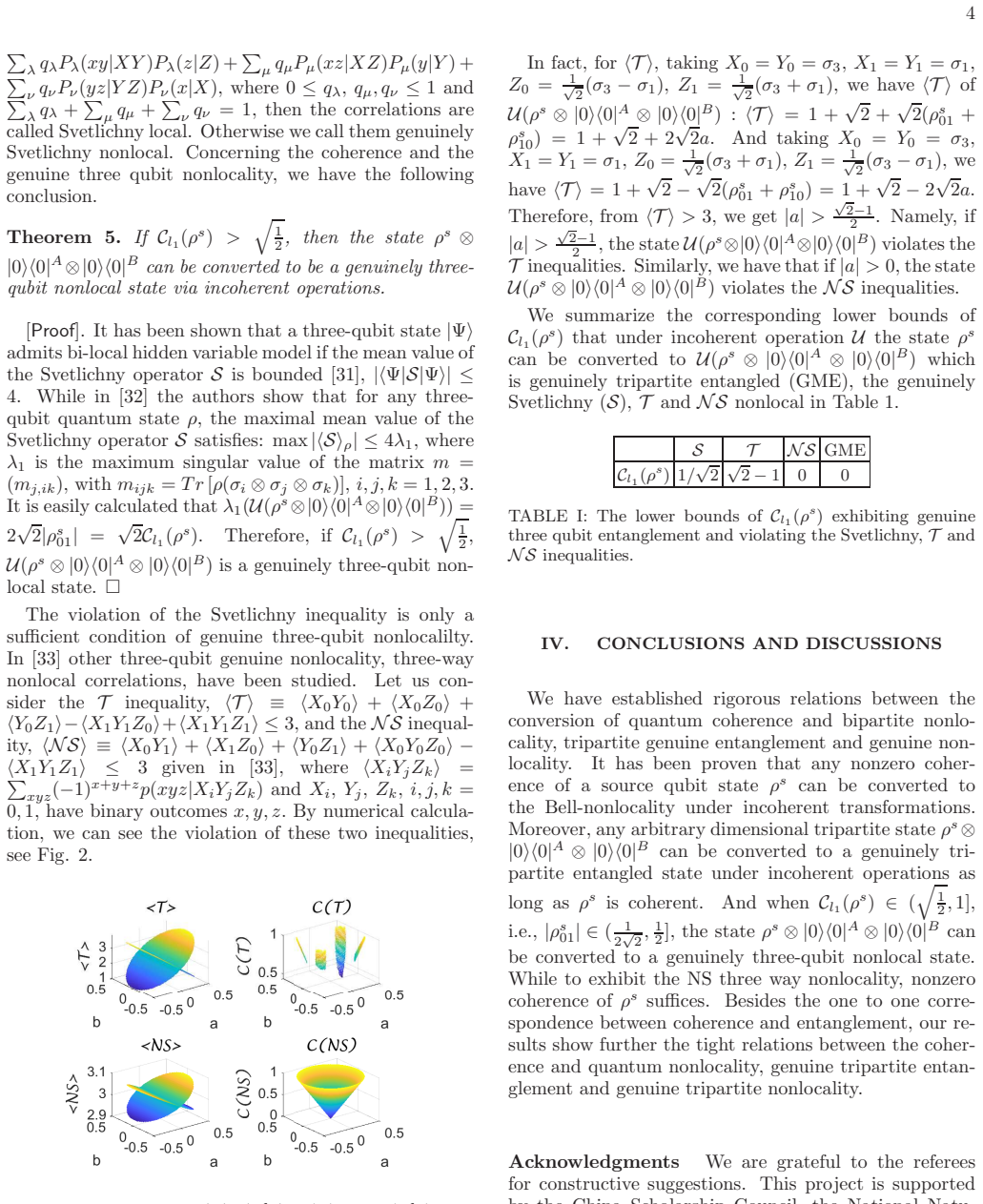
- [Figure 2] Figure 2 is referenced but not described in the text; the reader cannot tell what surfaces are plotted or how C(T) and C(NS) are defined. Please label axes and explain the numerical procedure.
- [Section III, Remark 2] The bound Cl1(ρs) ≤ 1 used in Remark 2 is correct for qubits, but the chain of inequalities should explicitly note that ρs00 + ρs11 ≤ 1 for a valid qubit density matrix.
- [Section IV, Conclusions] The concluding paragraph states the threshold interval for Cl1(ρs) as (1/√2, 1] and then gives |ρs01| ∈ (1/(2√2), 1/2]; these are equivalent for qubits, but the equivalence should be stated.
Circularity Check
No significant circularity: the derivations are explicit constructions using independent external criteria, not self-referential inputs.
full rationale
The paper's main claims are derived by direct calculation and by applying standard external criteria, not by assuming the target conclusions. Theorem 1 explicitly constructs a CNOT incoherent operation and computes M(Λ(ρ)) = 1 + 4|ρ01|^2, invoking the Horodecki CHSH criterion as an independent necessary-and-sufficient condition for two-qubit Bell violation; the coherence variable is an input, not the definition of nonlocality, so the claimed equivalence is a genuine derivation rather than a renaming. Theorem 2 and the Corollary similarly reduce a projected two-qubit CHSH violation to an explicit inequality on |ρij|, with no fitted quantity being relabeled as a prediction. Theorem 3 is self-contained: it uses monotonicity of relative entropy and the nesting of incoherent, classically correlated, separable, unsteerable, and local sets, and the bound Q ≤ Cr(ρs) is not an input that contains the later GME or nonlocality conclusions. Theorem 4's pure-state computation uses an external formula for genuine multipartite concurrence and computes Cgme for the copied state directly; the mixed-state convex-roof step in the written proof is logically incomplete because positivity of one spectral component does not by itself rule out an alternative biseparable decomposition of the mixed output, but this is a proof gap, not a circular reduction: the conclusion is not assumed in the premise, nor does the argument define Cgme or coherence in terms of each other. The necessity direction of Theorem 4 misapplies Theorem 3, which is a bipartite bound, to a tripartite conclusion; again this is a correctness concern rather than circularity. Theorem 5 relies on a bound from a prior paper with overlapping authors, but that cited bound is a general statement about the maximal Svetlichny value of arbitrary three-qubit states; it does not encode the present paper's coherence-to-nonlocality result, and the subsequent inference from the upper bound to a violation is questionable as logic, but it is not a self-referential input. No parameter is fitted to data and then presented as a prediction, and no uniqueness claim is imported solely through self-citation. Therefore the derivation chain is not circular, notwithstanding several nontrivial proof gaps that belong to correctness review rather than to circularity analysis.
Assumptions & free parameters
assumptions (5)
- standard math The Horodecki criterion: a two-qubit state violates CHSH iff M(ρ)>1, with M the sum of the two largest eigenvalues of T^T T.
- domain assumption The tight upper bound max |⟨S⟩|_ρ ≤ 4λ1 for Svetlichny operators, with λ1 the maximum singular value of the correlation tensor m.
- domain assumption The convex-roof definition of genuine multipartite concurrence and the formula Cgme(|Ψ⟩)=2√(Σ_{k≠l} ρs_kk ρs_ll) for GHZ-like pure states.
- standard math Set inclusions I ⊂ CC ⊂ S ⊂ U ⊂ L for incoherent, classically correlated, separable, unsteerable, and local states, and monotonicity of relative entropy under completely positive trace-preserving maps.
- standard math For a positive semidefinite density matrix, a nonzero off-diagonal element |ρs_ij| implies ρs_ii>0 and ρs_jj>0.
Cite this review
Pith. "Pith review of Converting quantum coherence to genuine multipartite entanglement and nonlocality." pith.science (2026). https://pith.science/paper/J7WXCYXH
@misc{pith2026190804035,
  author       = {Pith},
  title        = {Pith review of: Converting quantum coherence to genuine multipartite entanglement and nonlocality},
  year         = {2026},
  howpublished = {\url{https://pith.science/paper/J7WXCYXH}},
  note         = {Machine review of arXiv:1908.04035}
}
read the original abstract
We study the relations between quantum coherence and quantum nonlocality, genuine quantum entanglement and genuine quantum nonlocality. We show that the coherence of a qubit state can be converted to the nonlocality of two-qubit states via incoherent operations. The results are also generalized to qudit case. Furthermore, rigorous relations between the quantum coherence of a single-partite state and the genuine multipartite quantum entanglement, as well as the genuine three-qubit quantum nonlocality are established.
Figures

Reference graph
Works this paper leans on
-
[1]
R. Horodecki, P. Horodecki, M. Horodecki and K. Horodecki, Quantum entanglement, Rev. Mod. Phys. 81, 865 (2009)
work page 2009
-
[2]
For arbitrary ρs and incoherent operation U, it is impossible that U(ρs ⊗ | 0⟩⟨0|A ⊗ | 0⟩⟨0|B) is the state |W ⟩ = ( |001⟩ + |010⟩ + |100⟩)/ √
-
[3]
The reason is that Cl1(U(ρs ⊗ |0⟩⟨0|A ⊗ |0⟩⟨0|B)) ≤ Cl1(ρs ⊗ |0⟩⟨0|A ⊗ |0⟩⟨0|B) = Cl1(ρs), but Cl1 (|W ⟩⟨W |) = 2 > Cl1(ρs), where Cl1(ρs) = 2 |ρs 01| ≤ 2√ ρs 00ρs 11 ≤ 2 √ (ρ s 00+ρ s 11 2 )2 = 1 by the fact that ρs is semipositive definite with trace one. In particular, by the similar method with Theorem 4, it is direct to get that the state ρs can be co...
-
[4]
It is easily calculated that λ1(U(ρs ⊗|0⟩⟨0|A ⊗|0⟩⟨0|B)) = 2 √ 2|ρs 01| = √ 2Cl1 (ρs)
While in [32] the authors show that for any three- qubit quantum state ρ, the maximal mean value of the Svetlichny operator S satisfies: max |⟨S⟩ρ | ≤ 4λ1, where λ1 is the maximum singular value of the matrix m = (mj,ik ), with mijk =Tr [ρ(σi ⊗σj ⊗σk)],i,j,k = 1, 2, 3. It is easily calculated that λ1(U(ρs ⊗|0⟩⟨0|A ⊗|0⟩⟨0|B)) = 2 √ 2|ρs 01| = √ 2Cl1 (ρs). T...
-
[5]
Therefore, from ⟨T ⟩> 3, we get |a|> √ 2−1 2
= 1 + √ 2 − 2 √ 2a. Therefore, from ⟨T ⟩> 3, we get |a|> √ 2−1 2 . Namely, if |a|> √ 2−1 2 , the state U(ρs⊗|0⟩⟨0|A⊗|0⟩⟨0|B) violates the T inequalities. Similarly, we have that if |a|> 0, the state U(ρs ⊗ |0⟩⟨0|A ⊗ |0⟩⟨0|B) violates the N S inequalities. We summarize the corresponding lower bounds of Cl1(ρs) that under incoherent operation U the state ρs...
-
[6]
A.S. Srensen and K. Mlmer, Entanglement and Extreme Spin Squeezing, Phys. Rev. Lett. 86, 4431 (2001)
work page 2001
-
[7]
G¨ uhne and G
O. G¨ uhne and G. T´ oth, Entanglement detection, Phys. Rep. 474, 1 (2009)
2009
-
[8]
H.J. Briegel, D.E. Browne, W. D¨ ur, R. Raussendorf and M. Van den Nest, Measurement-based quantum compu- tation, Nat. Phys. 5, 19 (2009)
work page 2009
Show all 38 references
-
[9]
Gisin, G
N. Gisin, G. Ribordy, W. Tittel and H. Zbinden, Quan- tum cryptography, Rev. Mod. Phy. 74, 145 (2002)
2002
-
[10]
And taking X0 = Y0 = σ3, X1 =Y1 =σ1, Z0 = 1√ 2 (σ3 +σ1), Z1 = 1√ 2 (σ3 −σ1), we have ⟨T ⟩ = 1 + √ 2 − √ 2(ρs 01 +ρs
= 1 + √ 2 + 2 √ 2a. And taking X0 = Y0 = σ3, X1 =Y1 =σ1, Z0 = 1√ 2 (σ3 +σ1), Z1 = 1√ 2 (σ3 −σ1), we have ⟨T ⟩ = 1 + √ 2 − √ 2(ρs 01 +ρs
-
[11]
Hillery, V
M. Hillery, V. Buˇ zek and A. Berthiaume, Quantum secret sharing, Phys. Rev. A 59, 1829 (1999)
1999
-
[12]
Brukner, M
ˇC. Brukner, M. ˙Zukowski and A. Zeilinger, Quantum communication complexity protocol with two entangled qutrits, Phys. Rev. Lett. 89, 197901 (2002)
2002
-
[13]
Buhrman, R
H. Buhrman, R. Cleve, S. Massar and R. de Wolf, Nonlo- cality and communication complexity, Rev. Mod. Phys. 82, 665 (2010)
2010
-
[14]
Scarani and N
V. Scarani and N. Gisin, Quantum Communication be- tween Partners and Bell’s Inequalities, Phys. Rev. Lett. 87, 117901 (2001); A. Ac ´ ın, N. Gisin and V. Scarani, Security bounds in quantum cryptography using d-level systems, Quantum Inf. Comput. 3, 563-580 (2003)
2001
-
[15]
Ekert, Quantum cryptography based on Bells the- orem, Phys
A.K. Ekert, Quantum cryptography based on Bells the- orem, Phys. Rev. Lett. 67, 661 (1991); J. Barrett, L. Hardy and A. Kent, No Signaling and Quantum Key Distribution, Phys. Rev. Lett. 95, 010503 (2005); A. Ac ´ ın, N. Brunner, N. Gisin, S. Massar, S. Pironio and V. Scarani, ...
1991
-
[16]
Hillery, Coherence as a resource in decision problem s: The Deutsch-Jozsa algorithm and a variation, Phys
M. Hillery, Coherence as a resource in decision problem s: The Deutsch-Jozsa algorithm and a variation, Phys. Rev. A 93, 012111 (2016)
2016
-
[17]
Matera, D
J.M. Matera, D. Egloff, N. Killoran and M.B. Plenio, Co- herent control of quantum systems as a resource theory, Quantum Science and Technology 1, 01LT01 (2016)
2016
-
[18]
Giovannetti, S
V. Giovannetti, S. Lloyd and L. Maccone, Quantum- Enhanced Measurements: Beating the Standard Quan- tum Limit, Science 306, 1330 (2004)
2004
-
[19]
Escher, R.L
B.M. Escher, R.L. de Matos Filho and L. Davidovich, General framework for estimating the ultimate precision limit in noisy quantum-enhanced metrology, Nat. Phys. 7, 406 (2011)
2011
-
[20]
Marvian and R.W
I. Marvian and R.W. Spekkens, How to quantify coher- ence: Distinguishing speakable and unspeakable notions, Phys. Rev. A 94, 052324 (2016)
2016
-
[21]
Asb´ oth, J
J.K. Asb´ oth, J. Calsamiglia and H. Ritsch, Computable Measure of Nonclassicality for Light, Phys. Rev. Lett. 94, 173602 (2005)
2005
-
[22]
Streltsov, U
A. Streltsov, U. Singh, H.S. Dhar, M.N. Bera and G. Adesso, Measuring Quantum Coherence with Entangle- ment, Phys. Rev. Lett. 115, 020403 (2015)
2015
-
[23]
Zhu, Z.H
H.J. Zhu, Z.H. Ma, Z. Cao, S.M. Fei and V. Vedral, Op- erational one-to-one mapping between coherence and en- tanglement measures, Phys. Rev. A 96, 032316 (2017)
2017
-
[24]
J.J. Ma, B. Yadin, D. Girolami, V. Vedral and M. Gu, Converting Coherence to Quantum Correlations, Phys. Rev. Lett. 116, 160407 (2016)
2016
-
[25]
K.C. Tan, S. Choi, H. Kwon and H. Jeong, Coherence, Quantum Fisher Information, Superradiance and Entan- glement are Interconvertible Resources, Phys. Rev. A 97, 052304 (2018)
2018
-
[26]
Mukhopadhyay, S
C. Mukhopadhyay, S. Sazim and A.K. Pati, Coherence makes quantum systems magical, J. Phys. A: Math. Theor. 51, 414006 (2018)
2018
-
[27]
Baumgratz, M
T. Baumgratz, M. Cramer and M.B. Plenio, Quantifying Coherence, Phys. Rev. Lett. 113, 140401 (2014)
2014
-
[28]
Horodecki, P
R. Horodecki, P. Horodecki and M. Horodecki, Violating Bell inequality by mixed spin-12 states: necessary and sufficient condition, Phys. Lett. A 200, 340 (1995)
1995
-
[29]
Zhang, H
T. Zhang, H. Yang, X.Q. L-Jost and S.M. Fei, Uniform quantification of correlations for bipartite systems, Phys . Rev. A 95, 042316 (2017)
2017
-
[30]
S. Rana, P. Parashar and M. Lewenstein, Trace-distance measure of coherence, Phys. Rev. A 93, 012110 (2016)
2016
-
[31]
Sen(De) and U
A. Sen(De) and U. Sen, Quantum advantage in commu- nication networks, Phys. News 40, 17-32 (2010)
2010
-
[32]
˙Zukowski, A Zeilinger, M.A
M. ˙Zukowski, A Zeilinger, M.A. Horne and H Weinfurter, Quest for GHZ states, Acta Phys. Pol. A 93, 187 (1998); R. Demkowicz-Dobrza´ nski, A. Sen(De), U. Sen and M. Lewenstein, Entanglement enhances security in quantum communication, Phys. Rev. A 80, 012311 (2009)
1998
-
[33]
Cleve, D
R. Cleve, D. Gottesman and H.-K. Lo, How to share a quantum secret, Phys. Rev. Lett. 83, 648 (1999); A. Karlsson, M. Koashi and N. Imoto, Quantum entangle- ment for secret sharing and secret splitting, Phys. Rev. A 59, 162 (1999)
1999
-
[34]
Z-H. Ma, Z-H. Chen, J-L. Chen, C. Spengler, A. Gabriel and M. Huber, Measure of genuine multipartite entangle- ment with computable lower bounds, Phys. Rev. A 83, 062325 (2011)
2011
-
[35]
Hashemi Rafsanjani, M
S.M. Hashemi Rafsanjani, M. Huber, C.J. Broadbent and J.H. Eberly, Genuinely multipartite concurrence of N- qubit X matrices, Phys. Rev. A 86, 062303 (2012)
2012
-
[36]
Svetlichny, Distinguishing three-body from two-bo dy nonseparability by a Bell-type inequality, Phys
G. Svetlichny, Distinguishing three-body from two-bo dy nonseparability by a Bell-type inequality, Phys. Rev. D 35, 3066 (1987)
1987
-
[37]
M. Li, S.Q. Shen, N.H. Jing, S.M. Fei and X.Q. Li-Jost, Tight upper bound for the maximal quantum value of the Svetlichny operators, Phys. Rev. A 96, 042323 (2017)
2017
-
[38]
Bancal, J
J.-D. Bancal, J. Barrett, N. Gisin and S. Pironio, Defini - tions of multipartite nonlocality, Phys. Rev. A 88, 014102 (2013)
2013
Reviewed August 14, 2026 · model on record in the stance chip above.
Discussion (0). Continue with ORCID to comment.