REVIEW 4 major objections 5 minor 22 references
Evaluating Tag Recommendations for E-Book Annotation Using a Semantic Similarity Metric
T0 review · 4 major / 5 minor · reviewed 2026-08-14 · deepseek-v4-flash
Pith's one-line read Hybrid tag recommendation that merges editor tags with reader search terms improves e-book annotation.
desk verdict A useful empirical comparison of hybrid tag recommenders for e-book annotation, but the headline result rests on a possible train/test leakage that the paper never addresses. read the letter →
The pith
A machine-rendered reading of the paper's core claim, the machinery that carries it, and where it could break.
The reading
What carries the argument
The machinery has three parts. First, several popularity-based, similarity-based, and hybrid recommenders are built from two data sources, editor tags and Amazon search terms. Second, the cross-source algorithm $W_{t_i}=|S_{t_i}|\cdot\sum_{s_{t_i}\in S}W_{s_{t_i}}$ weights tags by the number of similar e-books that produced them, which is what lets hybrid combinations favor tags supported by multiple sources. Third, the paper's semantic similarity metric trains a Doc2Vec model, a document-embedding model that maps text into vectors, on e-book descriptions, titles, editor tags, and search terms, then compares the inferred vector of the recommended tags with the vector of the expected review keywords using cosine similarity; the same embeddings define tag diversity as average pairwise dissimilarity.
What would settle it
Ask professional editors to tag a sample of the same 2,896 e-books and compare their tags with the Amazon review keywords: if the two sets diverge in granularity or focus beyond synonymy, the test labels do not represent the annotation task and the metric rankings lose their meaning.
Extended reading notes
Core claim
The central claim is that combining the two vocabularies, editor tags and reader search terms, in hybrid recommenders improves tag quality for e-book annotation. On a test set of Amazon review keywords for 2,896 e-books, the best hybrid HYBBest reaches nDCG@10 = 0.0972, outperforming the best single-source similarity approach, SIMDescriptionEditor, at nDCG@10 = 0.0961. The paper also proposes a semantic similarity metric built on Doc2Vec embeddings that measures whether a recommended tag list is close in meaning to the expected review keywords even when the exact strings differ. By that metric, search-term-only approaches look weak in exact-match accuracy but still deliver semantically relevant and diverse tags, which the authors interpret as complementary value for the annotation task.
Load-bearing premise
The whole evaluation rests on treating Amazon review keywords as a valid ground truth for the tags an editor should assign, yet the paper offers no independent evidence that review keywords really match editorial annotation needs.
Editorial extensions
If this is right
- Editors can deploy hybrid recommenders that use author and BISAC context together with search-term data to get tags that match reader vocabulary.
- Search-term-only recommenders should not be discarded on accuracy alone; their high semantic similarity and diversity make them useful complementary annotation sources.
- The semantic similarity metric offers a way to evaluate tag recommenders when exact-match labels are scarce or drawn from a different vocabulary than the training data.
- The reported ranking by semantic similarity correlates strongly with the ranking by nDCG, with Kendall's tau of 0.743, so the new metric is more than an unrelated separate view.
- Hybrid combinations that merge the best popularity-based and best similarity-based recommenders deliver the highest accuracy in this setting.
Reading between the lines
- One extension the paper leaves implicit: the same hybrid design and semantic-similarity evaluation apply to any domain where professional metadata and consumer search logs coexist, such as scientific articles or video platforms.
- Because Doc2Vec is trained on the same book corpus, high semantic similarity may partly reflect corpus-specific associations; a human study comparing recommended tags with editor judgments would test whether those near-miss tags are practically useful.
- Only 497 e-books in the data carry both editor tags and search terms, so the measured hybrid advantage is based on sparse overlap; a testable prediction is that hybrid gains grow with denser dual-source coverage.
Signed reviews
Editorial analysis
A structured set of objections, weighed in public.
Referee Report
Summary. This manuscript addresses tag recommendation for e-book annotation. The authors use two data sources, editor-assigned tags (48,705 e-books) and Amazon search query terms (21,243 e-books), and evaluate 19 tag recommendation algorithms grouped into popularity-based, similarity-based, and hybrid approaches. The evaluation set consists of Amazon review keywords for 2,896 e-books from four publishers. Recommendation quality is measured with nDCG@k, a proposed Doc2Vec-based semantic similarity metric, and diversity. The central claim is that combining both data sources, especially in the HYBBest hybrid, improves tag recommendation accuracy and beyond-accuracy quality.
Significance. If the reported results were valid, this paper would provide a useful application study for a practical digital-publishing task, a reasonably broad comparison of 19 algorithms, and a semantic similarity metric that could be adopted by other tag-recommendation evaluations. The strengths include the use of a third annotation source (review keywords) to avoid favoring either input vocabulary, and the joint consideration of accuracy, semantic similarity, and diversity. However, as detailed below, the evaluation as presented does not establish the central claim because of target leakage and the post-hoc selection of HYBBest; the significance is therefore contingent on a corrected experimental protocol.
major comments (4)
- [Section 3.1, in conjunction with Sections 2.1 and 2.2] The test e-books are not removed from the data used to generate recommendations. The 2,896 e-books with review keywords come from publishers Kiwi, Rowohlt, Fischer, and Droemer, all of which are among the 13 publishers in the editor-tag source, and the paper never states that these books are excluded. In the similarity-based methods, the target e-book's own description or title is in the corpus, so it can be retrieved as one of the top-N similar e-books, and Eq. (1) can then recommend the target's own editor tags or search terms. Since the same book's metadata will often contain words that also occur in its review keywords, HYBBest's nDCG@10 = 0.0972 may substantially overstate performance for unseen e-books. The authors must report results after explicitly holding out all test e-books from the editor-tag corpus, the search-term corpus, and the Doc2Vec training data.
- [Section 4.1, HYBBest definition] HYBBest is constructed as the hybrid of the best performing popularity-based and similarity-based approaches, chosen after inspecting the test-set results in Figure 1. This is a post-hoc model selection on the test set, so the reported accuracy of HYBBest is a selected maximum over the evaluated configurations rather than an unbiased estimate. Moreover, the difference to the best single-source similarity approach is small (nDCG@10 = 0.0972 vs. 0.0961 for SIMDescriptionEditor) and the paper provides no confidence intervals or significance tests. The claim that combining both data sources enhances recommendation quality requires either a validation split for selecting HYBBest or a statistical comparison over repeated splits.
- [Section 2.1] The ground-truth assumption that Amazon review keywords 'describe both the content and the users' opinions on the e-books (i.e., the readers' vocabulary)' is asserted without supporting evidence. All accuracy, semantic similarity, and diversity results are relative to this test set, so if review keywords are not the type of annotation that editors should produce, the accuracy, semantic similarity, and diversity rankings in Section 4 do not support the paper's conclusions. The authors should provide descriptive statistics on the overlap between review keywords, editor tags, and search terms, and they should justify why reader vocabulary, rather than editor vocabulary, is the appropriate target for an annotation-support tool.
- [Section 3.2] The semantic similarity metric is trained on the description text, title, editor tags, and Amazon search terms from the same dataset used to generate recommendations, and the manuscript does not state that the test e-books are excluded. The metric therefore shares training data with the evaluated algorithms, and the reported Kendall's tau (tau = 0.743) between accuracy and semantic similarity rankings does not independently validate the metric. In addition, the paper does not describe how vectors are inferred for review keywords that may be out of the Doc2Vec vocabulary. Please clarify the exact inference procedure and report the metric under a clean train/test split.
minor comments (5)
- [Equation (2)] Equation (2) contains notation errors: the summation bound appears as '|r k b|' and the text says 'position i' while the formula uses T(k); these should be corrected.
- [Section 2.2] The notation for algorithm names (e.g., MP Aut hor, SI MDescr ipt ion) is hard to read in several places; consistent subscripts would improve clarity.
- [Section 2.2] The description of the round-robin combination strategy is too brief; please specify how ties are broken and how lists of different lengths are merged.
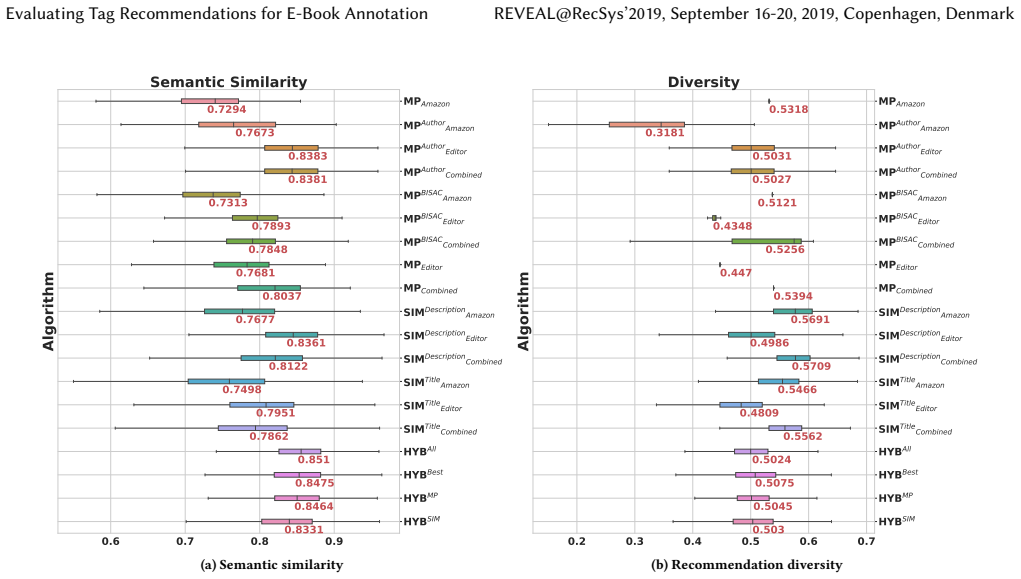
- [Section 3.2 and Figure 2] Figure 2 reports boxplots but no statistical tests; given the small differences, claims such as higher diversity for Amazon-based approaches should be supported by significance testing or effect sizes.
- [Section 2.1 and Conclusion] The data are not publicly available, and the future-work section plans to validate on another dataset; a reproducibility appendix with anonymized data or code, and a discussion of the limited test-set size, would strengthen the paper.
Circularity Check
Evaluation is partially circular: test e-books are never held out of the editor-tag/search-term corpora, so similarity-based and hybrid 'predictions' can retrieve each book's own tags; the proposed semantic-similarity metric is also trained on the same source vocabularies.
-
fitted input called prediction
[Section 2.1 dataset overlap; Section 2.2 similarity-based approaches and Eq. (1); Section 3.1 evaluation protocol]
"For editor tags, we collect data of 48,705 e-books from 13 publishers, namely Kunstmann, Delius-Klasnig, VUR, HJR, Diogenes, Campus, Kiwi, Beltz, Chbeck, Rowohlt, Droemer, Fischer and Neopubli. ... we collect Amazon review keywords for 2,896 e-books (publishers: Kiwi, Rowohlt, Fischer, and Droemer) ... we first employ a content-based filtering approach [1] based on TF-IDF [18] to find top-N similar e-books. For each of the similar e-books, we then either extract the assigned editor tags ..."
All 2,896 test books come from four publishers (Kiwi, Rowohlt, Fischer, Droemer) that are included in the 13-publisher editor-tag corpus, and the paper never states that these books are removed from the recommendation-generation data. In the SIM approaches, TF-IDF finds top-N similar e-books (N=20); a book is identical to itself, so every test book is in its own neighbor set. Eq. (1) then aggregates tags extracted from those neighbors, so the book's own editor tags enter the recommended list. The paper's own assumption that Amazon review keywords are 'a good mixture of editor tags and search terms' means the system is scored against labels that are partly derived from the same metadata it was allowed to retrieve for the target book.
-
self definitional
[Section 3.2, Semantic similarity]
"we first extract the textual content in the form of the description text, title, editor tags and Amazon search terms of e-books from our dataset. We then train a Doc2Vec [12] model on the content. Then, we use the model to infer the latent representation for both the complete list of recommended tags as well as the list of expected tags from the test set."
The proposed semantic similarity measure is not an external benchmark: its Doc2Vec model is trained on the same editor tags and Amazon search terms that the Section 2.2 algorithms are built to output. A recommended tag list composed of popular editor tags or search terms is therefore compared in a vector space learned from those exact vocabularies. Since the paper also assumes review keywords are a mixture of editor tags and search terms, the high semantic-similarity scores for search-term-only approaches partly reflect the metric's own training vocabulary rather than an independent semantic judgment. Thus the metric is partially self-referential for the very systems it is used to validate.
full rationale
The paper does not rely on a load-bearing self-citation chain: the citations to the authors' own prior work (Kowald & Lex) are for standard evaluation practice and a tag-recommendation framework, not for the central claim. The main circularity is structural rather than citation-based. The test e-books are drawn from the same publishers as the editor-tag generation corpus, and no holdout split is described, so the similarity-based recommendation step can—by construction of Eq. (1) and the TF-IDF self-neighbor—recover each target book's own editor tags. Because the paper defines the test labels (Amazon review keywords) as a mixture of editor tags and search terms, the headline nDCG and semantic-similarity results for hybrid methods are partially self-prediction rather than prediction for unseen books. Additionally, the proposed semantic similarity metric is trained on the same source vocabularies that the recommendation algorithms output, making it a partially self-referential evaluation instrument. There is independent content in the popularity-based comparisons and in the exact-match nDCG formulation, so the paper is not wholly circular, but the central claim that combining sources improves recommendation quality is materially affected by target leakage and by the self-trained metric. This warrants a score of 6.
Assumptions & free parameters
free parameters (7)
- N (number of similar e-books) =
20
- Minimum document frequency =
10
- Minimum word length =
5
- Doc2Vec vector size =
50
- Doc2Vec negative sampling =
10
- Doc2Vec learning rate =
0.025
- Doc2Vec training epochs =
10
assumptions (4)
- domain assumption Amazon review keywords are a valid proxy for the e-book annotation ground truth.
- domain assumption Cosine similarity in Doc2Vec space measures semantic similarity of tag lists.
- domain assumption TF-IDF similarity between e-book descriptions or titles identifies similar e-books for tag extraction.
- domain assumption The cross-source relevance weighting in Eq. 1 correctly aggregates tags from similar e-books.
Cite this review
Pith. "Pith review of Evaluating Tag Recommendations for E-Book Annotation Using a Semantic Similarity Metric." pith.science (2026). https://pith.science/paper/ZIA6JNE3
@misc{pith2026190804042,
  author       = {Pith},
  title        = {Pith review of: Evaluating Tag Recommendations for E-Book Annotation Using a Semantic Similarity Metric},
  year         = {2026},
  howpublished = {\url{https://pith.science/paper/ZIA6JNE3}},
  note         = {Machine review of arXiv:1908.04042}
}
read the original abstract
In this paper, we present our work to support publishers and editors in finding descriptive tags for e-books through tag recommendations. We propose a hybrid tag recommendation system for e-books, which leverages search query terms from Amazon users and e-book metadata, which is assigned by publishers and editors. Our idea is to mimic the vocabulary of users in Amazon, who search for and review e-books, and to combine these search terms with editor tags in a hybrid tag recommendation approach. In total, we evaluate 19 tag recommendation algorithms on the review content of Amazon users, which reflects the readers' vocabulary. Our results show that we can improve the performance of tag recommender systems for e-books both concerning tag recommendation accuracy, diversity as well as a novel semantic similarity metric, which we also propose in this paper.
Figures

Reference graph
Works this paper leans on
-
[1]
M. Balabanovic and Y. Shoham. Fab: content-based, collaborative recommenda- tion. Communications of the ACM, 40(3):66–73, 1997
work page 1997
- [2]
-
[3]
S. Bostandjiev, J. O’Donovan, and T. Höllerer. Tasteweights: a visual interactive hybrid recommender system. In Proc. of RecSys’12, pages 35–42. ACM, 2012
work page 2012
-
[4]
I. Cantador, A. Bellogín, and D. Vallet. Content-based recommendation in social tagging systems. In Proc. of RecSys’10, pages 237–240. ACM, 2010
work page 2010
-
[5]
R. Jäschke, L. Marinho, A. Hotho, L. Schmidt-Thieme, and G. Stumme. Tag recommendations in folksonomies. In European Conference on Principles of Data Mining and Knowledge Discovery , pages 506–514. Springer, 2007
work page 2007
-
[6]
M. G. Kendall. A new measure of rank correlation. Biometrika, 30(1/2), 1938
work page 1938
-
[7]
T. Kenter and M. De Rijke. Short text similarity with word embeddings. In Proc. of CIKM’15, pages 1411–1420. ACM, 2015
work page 2015
- [8]
Show all 22 references
-
[9]
Kowald and E
D. Kowald and E. Lex. Evaluating tag recommender algorithms in real-world folksonomies: A comparative study. In Proc. of RecSys’15. ACM, 2015
2015
-
[10]
Kowald and E
D. Kowald and E. Lex. The influence of frequency, recency and semantic context on the reuse of tags in social tagging systems. In Proc. of ACM HT’16 , 2016
2016
-
[11]
M. Lapata. Automatic evaluation of information ordering: Kendall’s tau. Compu- tational Linguistics, 32(4):471–484, 2006
2006
-
[12]
Le and T
Q. Le and T. Mikolov. Distributed representations of sentences and documents. In Proc. of ICML’14
-
[13]
P. Lops, M. De Gemmis, G. Semeraro, C. Musto, and F. Narducci. Content-based and collaborative techniques for tag recommendation: an empirical evaluation. Journal of Intelligent Information Systems , 40(1):41–61, 2013
2013
-
[14]
Lu, S.-I
Y.-T. Lu, S.-I. Yu, T.-C. Chang, and J. Y.-j. Hsu. A content-based method to enhance tag recommendation. In Twenty-First International Joint Conference on Artificial Intelligence, 2009
2009
-
[15]
L. B. Marinho and L. Schmidt-Thieme. Collaborative tag recommendations. In Data Analysis, Machine Learning and Applications . Springer, 2008
2008
-
[16]
Mikolov, I
T. Mikolov, I. Sutskever, K. Chen, G. S. Corrado, and J. Dean. Distributed rep- resentations of words and phrases and their compositionality. In Advances in neural information processing systems , pages 3111–3119, 2013
2013
-
[17]
Parra and S
D. Parra and S. Sahebi. Recommender systems : Sources of knowledge and evaluation metrics. In Advanced Techniques in Web Intelligence-2: Web User Browsing Behaviour and Preference Analysis, pages 149–175. Springer, 2013
2013
-
[18]
Ramos et al
J. Ramos et al. Using tf-idf to determine word relevance in document queries. In Proc. of first instructional conference on machine learning , volume 242, 2003
2003
-
[19]
Smyth and P
B. Smyth and P. McClave. Similarity vs. diversity. In Proc. of ICCBR ’01 , pages 347–361. Springer-Verlag, 2001
2001
-
[20]
J. Vig, S. Sen, and J. Riedl. Tagsplanations: explaining recommendations using tags. In Proc. of IUI’09, pages 47–56. ACM, 2009
2009
-
[21]
Zhao and J
L. Zhao and J. Callan. Term necessity prediction. In Proc. of CIKM’2010), 2010
2010
-
[22]
Zubiaga, C
A. Zubiaga, C. Körner, and M. Strohmaier. Tags vs shelves: from social tagging to social classification. In Proc. of HT’11 , pages 93–102. ACM, 2011
2011
Reviewed August 14, 2026 · model on record in the stance chip above.
Discussion (0). Continue with ORCID to comment.