REVIEW 2 major objections 4 minor 55 references
Top quark mass effects in $gg\to ZZ$ at two loops and off-shell Higgs interference
T0 review · 2 major / 4 minor · reviewed 2026-08-14 · deepseek-v4-flash
Pith's one-line read The paper claims that conformal-mapped Padé approximants built from large-mass and threshold expansions reconstruct the two-loop top-quark mass dependence of the $gg\to ZZ$ box form factors that enter off-shell Higgs interference, giving…
desk verdict New two-loop threshold coefficients for gg->ZZ with a credible but not yet externally validated Padé reconstruction; the axial-vector dominance rescue of the interference prediction is reasonable. read the letter →
The pith
A machine-rendered reading of the paper's core claim, the machinery that carries it, and where it could break.
The reading
What carries the argument
The central object is the conformal-map Padé reconstruction: the variable $z=M_{ZZ}^2/(4m_t^2)+i0$ is mapped by $z=4\omega/(1+\omega)^2$ onto the unit disc, where the amplitude, after subtraction of threshold logarithms and separation into a constant part and a part proportional to $\ln(-4z)$, is analytic and can be approximated by rational functions $[n/m](\omega)$. The Padé coefficients are fixed by matching the known large-mass expansion through $1/m_t^{12}$ and the new threshold coefficients through $\bar z^4$ (order $\bar z^5$ for the massless-cut logarithm), and a rescaling factor $(1+a_{R,i}z)$ imposes the small-quark-mass asymptotic behavior required by chirality conservation. The uncertainty estimate comes from varying the rescaling parameters and the polynomial degrees and taking the mean and standard deviation of the approximant variants.
What would settle it
A direct numerical evaluation of the two-loop $gg\to ZZ$ box amplitude with full top-quark mass dependence at representative phase-space points above the top threshold (for example $M_{ZZ}=400$–$600$ GeV at small and large transverse momentum) would settle the claim: if the real or imaginary part of either reconstructed form factor deviates from the Padé uncertainty band by more than the quoted error, the reconstruction is not reliable in that region.
Extended reading notes
Core claim
The central claim is that the full top-quark mass dependence of the one- and two-loop box form factors in $gg\to ZZ$ can be recovered from two local expansions: the large-mass expansion already known to $1/m_t^{12}$ and a new expansion around the top-pair threshold in $\bar z=1-z$ with $z=M_{ZZ}^2/(4m_t^2)+i0$, computed through $\bar z^4$ (and one order higher for the logarithm from massless cuts). The two expansions are combined with the conformal map $z=4\omega/(1+\omega)^2$ into Padé approximants $[n/m](\omega)$, with subtraction functions that remove the threshold logarithms and a small-mass rescaling that enforces the correct $z\to\infty$ behavior. The authors show that at one loop the approximants agree with the full analytic amplitude over the whole $M_{ZZ}$ range, and at two loops they give a new prediction for the NLO interference form factor with small uncertainties at small and moderate $M_{ZZ}$. Because the axial-vector form factor dominates the interference, they argue the interference prediction remains trustworthy up to large $M_{ZZ}$ even though the vector form factor alone is reliable only below about 500 GeV.
Load-bearing premise
The reconstruction's load-bearing premise is that the unknown analytic-in-$\bar z$ terms dropped from the threshold expansion, together with the known large-mass coefficients through $1/m_t^{12}$, are sufficient for the conformal-map Padé ansatz to determine the full two-loop amplitude; this is checked only against the exact one-loop result and by agreement between approximants of different order.
Editorial extensions
If this is right
- At NLO, the top-quark contribution to the off-shell Higgs interference form factor can now be evaluated with realistic top-mass dependence instead of relying on a large-mass expansion that breaks down above the top threshold.
- The new form factors combine directly with the known massless-loop virtual corrections and the one-loop real corrections to produce a complete NLO prediction for the interference in $gg\to ZZ$.
- The convergence checks show the reconstruction improves systematically as higher orders in the threshold expansion are included, so the large-$M_{ZZ}$ region should be refinable by adding more expansion terms rather than by a full analytic two-loop calculation.
- The same large-mass-plus-threshold Padé construction can be applied to the remaining $gg\to ZZ$ form factors that do not interfere with the Higgs signal, and to off-shell Z-boson production where the large-mass expansion is already known.
Reading between the lines
- Extending beyond the paper: if the reconstruction is as reliable as the internal convergence suggests, the same threshold-coefficient-plus-Padé strategy should transfer directly to other two-loop amplitudes (for example $gg\to ZH$ or off-shell $gg\to ZZ$) once the relevant threshold expansions are computed, because no new conceptual machinery is needed.
- Extending beyond the paper: the paper's large-$M_{ZZ}$ trustworthiness argument rests on the numerical dominance of the axial-vector form factor; a dedicated check of the reconstructed vector form factor against the full numerical two-loop amplitude would be the most direct stress test of that argument.
- Extending beyond the paper: a robust NLO interference with genuine top-mass dependence could shift indirect Higgs-width determinations by more than the current parametric uncertainty, since the off-shell region above the top threshold is where the width constraint is most sensitive.
Editorial analysis
A structured set of objections, weighed in public.
Referee Report
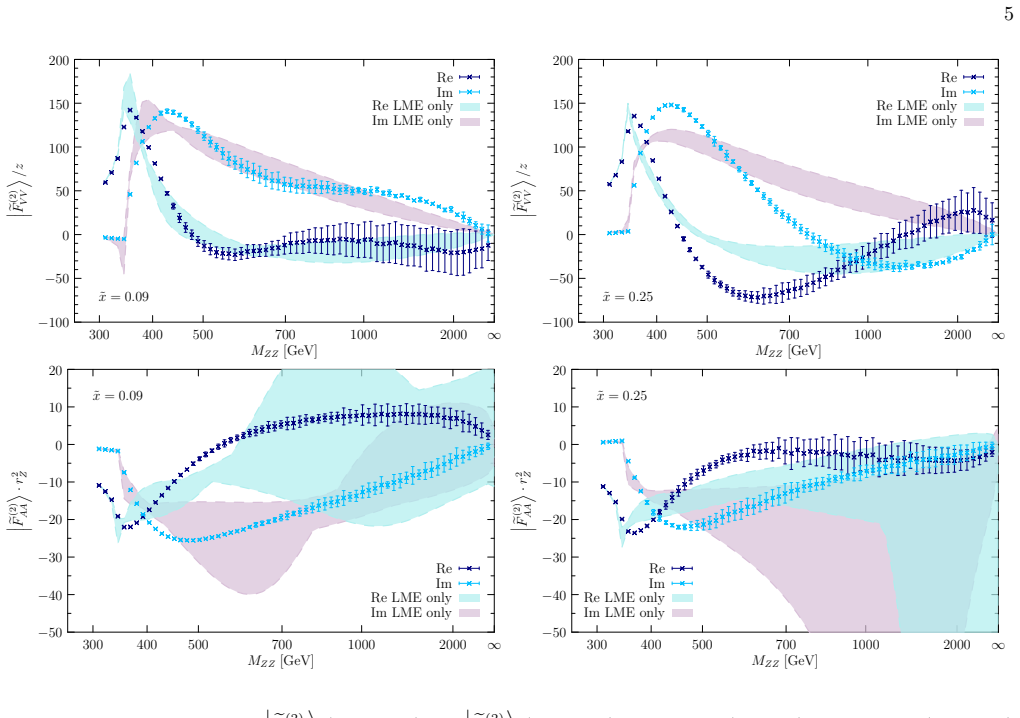
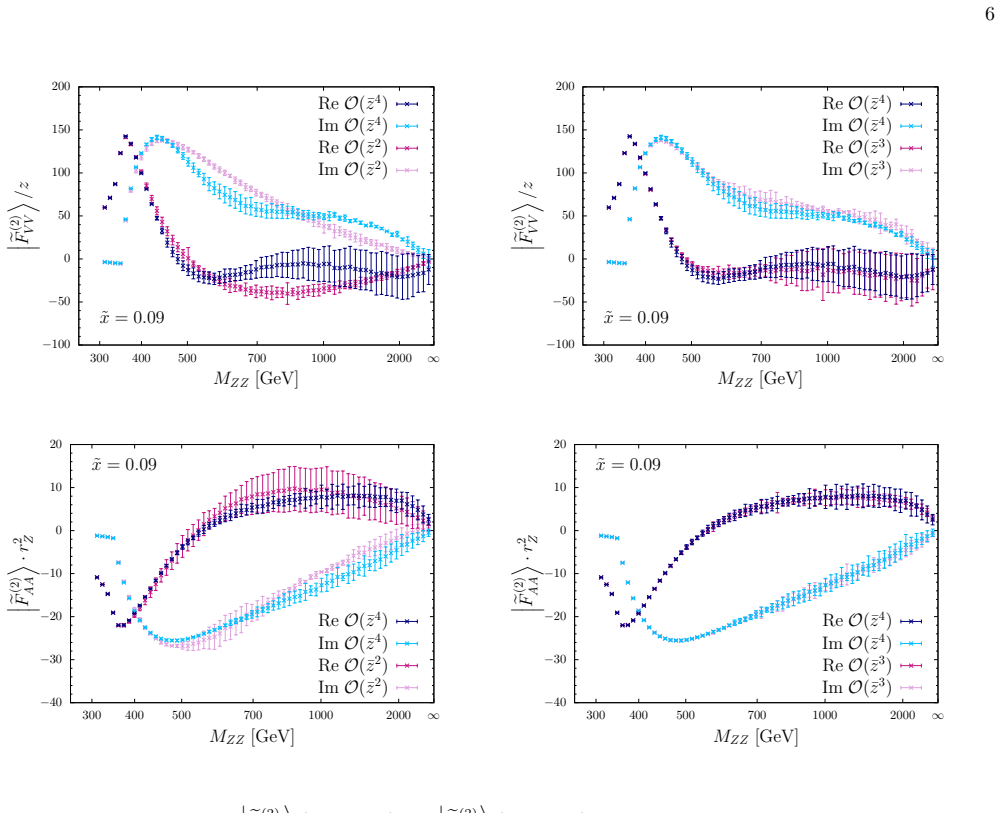
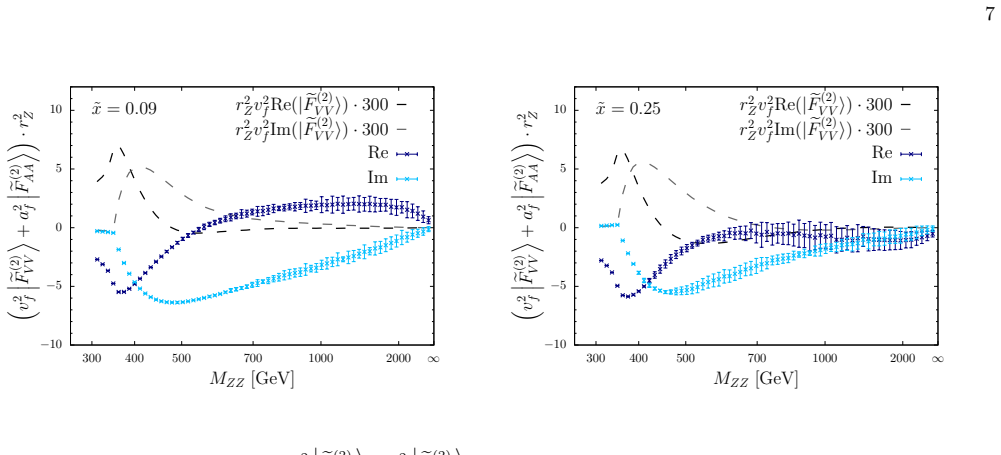
Summary. The paper studies the two-loop top-quark mass dependence of the continuum gg->ZZ box form factors that enter the interference with off-shell Higgs production. The authors compute new non-analytic threshold-expansion coefficients for the one- and two-loop vector and axial-vector form factors (Appendix A), and combine those with the known large-mass expansion through 1/m_t^12 in a conformal-mapping/Padé reconstruction with the small-mass rescaling of eq. (9). At one loop, they check the reconstruction against the exact analytic form factors and find good agreement over the whole plotted invariant-mass range (Fig. 2). At two loops, no independent numerical result is available; the validation is limited to the spread of a family of Padé approximants (eq. (14) and the discussion in Section IV) and to comparisons among approximants built from threshold expansions truncated at O(zbar^2), O(zbar^3) and O(zbar^4) (Fig. 4). The reconstruction of the vector form factor is explicitly reliable only up to about 500 GeV; the paper argues that the interference combination is nevertheless trustworthy to larger MZZ because the axial-vector form factor dominates the combination (Fig. 5). The paper concludes that it provides a new NLO prediction with small uncertainties at small and moderate MZZ.
Significance. If the two-loop reconstruction is accurate, this is a useful step for the LHC off-shell Higgs-width program: it provides a practical way to retain top-quark mass effects in gg->ZZ above the top threshold, where the LME alone fails. The concrete new threshold coefficients in Appendix A, the successful one-loop benchmark, the prior validation of the method against exact two-loop results for gg->HH [28], and the availability of a numerical implementation are clear strengths. The main limitation is the absence of an independent two-loop cross-check for the gg->ZZ form factors. The paper's central claim therefore rests on an internal consistency argument, and the quoted error bands do not directly cover the unknown analytic terms dropped in eq. (5). This is a serious but addressable concern: an external benchmark or a more conservative and clearly characterized uncertainty would settle it.
major comments (2)
- [Section III, eqs. (9)-(11); Section IV, eq. (14)] The quoted uncertainty is obtained as the mean and standard deviation of a family of Padé approximants whose input data are the same LME coefficients and the same threshold coefficients of Appendix A. This measures sensitivity to the free parameters a_R and to the polynomial degrees, but not the systematic error from the analytic-in-zbar terms that are dropped in eq. (5) and never computed. Because every member of the family shares the same missing information, a common bias in those terms would not show up in the scatter. The one-loop benchmark in Fig. 2 validates the procedure in a setting where the exact answer is known; it does not validate the two-loop reconstruction. Since the abstract and Section V claim a two-loop prediction with very small uncertainties, this gap is load-bearing. I recommend either providing an independent two-loop benchmark (e.g., comparing with an exact or numeric full-mass calculation, which the paper itself notes may be feasible in refs. [51,52]) or enlarging the uncertainty estimate to cover the dropped analytic terms and restating the NLO claim accordingly.
- [Section IV, Fig. 4 and Fig. 5] The convergence study of the vector form factor shows that the O(zbar^2) approximant does not overlap with the O(zbar^3) and O(zbar^4) approximants on a significant part of the phase space, and the text agrees that F_VV should be distrusted above about 500 GeV. The argument that the interference combination is still trustworthy to arbitrarily large MZZ because F_VV is numerically tiny (Fig. 5) is only valid if the axial-vector form factor is reliable in that region. However, the axial-vector form-factor error bands in Fig. 3 also increase with MZZ, and no quantitative uncertainty is quoted for the interference combination at large MZZ. The sentence in Section IV stating that the interference prediction is trustworthy up to MZZ->infinity therefore goes beyond the error analysis shown. Please quote uncertainty estimates for the combination at representative high-MZZ points, or restrict the claim to the invariant-mass range where the error is under control.
minor comments (4)
- [Fig. 5 caption and the paragraph introducing Fig. 5] In the displayed combination, the second term should be a_t^2 |F_AA>; as printed both terms are labelled |F_VV>. The same typo appears in the text sentence before Fig. 5.
- [Section IV, eq. (13)] The pole criterion removes approximants with poles in a region of the complex omega plane; please state how many of the 100 Padé variants are discarded by this filter in the representative phase-space points, and whether the quoted error bands are computed before or after this selection.
- [Figs. 2 and 3] The figures normalize F_VV by z and F_AA by r_Z^2 without explanation in the text. Please state these normalizations explicitly in the captions or in the text, as the reader must otherwise infer them from the plot labels.
- [Appendix A, after eq. (A1)] The sentence 'the coefficients with m=0 and even n do not contribute to the imaginary part and are therefore not listed here' is clear, but it would help if the text also stated explicitly which coefficients are non-zero and which vanish, e.g., that b_i,ln^(n,1) and b_i,ln^(2n,m) are zero, to avoid ambiguity in the ancillary file.
Circularity Check
No circularity: the Padé approximants are constrained by independent expansion coefficients of the same amplitude, and the method is supported by an exact one-loop check and an external gg→HH benchmark.
full rationale
The paper's reconstruction is not circular. The Padé coefficients in eqs. (10)–(11) are fixed by matching the large-mass expansion and the newly computed threshold expansion coefficients of the same form factors, not by fitting the interference prediction or any final observable. The rescaling parameters a_{R,i} are explicitly varied only to assess stability of the approximation, not tuned to reproduce the target results. At one loop the procedure is validated against the exact analytic result, providing an external check. At two loops the method is carried over from ref. [28], but that prior work was itself validated against independent numerical calculations for gg→HH, so the self-citation is supported by real external evidence rather than forming a load-bearing self-referential loop. The internal convergence checks between approximants of different orders are an accuracy limitation, not a constructional circularity: the dropped analytic terms in eq. (5) are a genuine extrapolation assumption, and the authors explicitly caution that the vector form factor is less reliable above MZZ≈500 GeV. These caveats affect the reliability of the prediction, but they do not make the prediction equal to its inputs by definition. No fitted parameter is renamed as a prediction, and no known result is merely relabeled. The central chain—input expansions, conformal-map Padé approximation, LO validation, NLO prediction—therefore contains no circular step.
Assumptions & free parameters
free parameters (2)
- Padé rescaling parameters a_R,0 and a_R,1 =
No fitted value; varied in [0.1, 10]
- Polynomial degrees n, m, k, l of the Padé approximants =
Varied with |n-m| <= 3 and fixed by available expansion coefficients
assumptions (4)
- ad hoc to paper The unknown analytic-in-zbar terms dropped in eq. (5) do not affect the reconstructed amplitude after conformal mapping and subtraction.
- domain assumption Chirality conservation and charge conjugation imply F_AA minus F_VV vanishes as z goes to infinity.
- domain assumption The LME coefficients for gg to ZZ from ref. [27] up to 1/m_t^12 and the massless-quark results from refs. [21-25] are correct.
- standard math The computational pipeline using QGRAF, FORM, FIRE, and expansion by regions yields the threshold coefficients in Appendix A.
Cite this review
Pith. "Pith review of Top quark mass effects in $gg\to ZZ$ at two loops and off-shell Higgs interference." pith.science (2026). https://pith.science/paper/Y3YKBGWM
@misc{pith2026190804061,
  author       = {Pith},
  title        = {Pith review of: Top quark mass effects in $gg\to ZZ$ at two loops and off-shell Higgs interference},
  year         = {2026},
  howpublished = {\url{https://pith.science/paper/Y3YKBGWM}},
  note         = {Machine review of arXiv:1908.04061}
}
abstract
We consider top-quark mass effects in the Higgs-interference contribution to $Z$-boson pair production in gluon fusion. While this production mechanism is formally of next-to-next-to leading order, its contribution is numerically important above the top threshold $M_{ZZ}^2=4m_t^2$. This region is essential to constrain the width of the Higgs boson and good control over the top-quark mass dependence is crucial. We determine the form factors that are relevant for the interference contribution at two-loop order using a method based on a conformal mapping and Pad\'e approximants constructed from the expansions of the amplitude for large top mass and around the top threshold.
Figures


Figures from the paper (2 more)
Reference graph
Works this paper leans on
- [28]
- [1]
- [2]
-
[3]
J. M. Campbell, R. K. Ellis, and C. Williams, JHEP 04, 060 (2014), 1311.3589
arXiv 2014
- [4]
- [5]
-
[6]
J. M. Campbell, R. K. Ellis, and C. Williams, Phys. Rev. D89, 053011 (2014), 1312.1628
arXiv 2014
- [7]
Show all 55 references
-
[8]
A. M. Sirunyan et al. (CMS), Phys. Rev. D99, 112003 (2019), 1901.00174
2019 arXiv
-
[9]
de Florian et al
D. de Florian et al. (LHC Higgs Cross Section Working Group) (2016), 1610.07922
2016 arXiv
-
[10]
J. S. Gainer, J. Lykken, K. T. Matchev, S. Mrenna, and M. Park, Phys. Rev. D91, 035011 (2015), 1403.4951
2015 arXiv
-
[11]
Azatov, C
A. Azatov, C. Grojean, A. Paul, and E. Salvioni, Zh. Eksp. Teor. Fiz. 147, 410 (2015), [J. Exp. Theor. Phys.120,354(2015)], 1406.6338
2015 arXiv
-
[12]
Buschmann, D
M. Buschmann, D. Goncalves, S. Kuttimalai, M. Schon- herr, F. Krauss, and T. Plehn, JHEP 02, 038 (2015), 1410.5806
2015 arXiv
-
[13]
Azatov, C
A. Azatov, C. Grojean, A. Paul, and E. Salvioni, JHEP 09, 123 (2016), 1608.00977
2016 arXiv
-
[14]
Spira, A
M. Spira, A. Djouadi, D. Graudenz, and P. M. Zerwas, Nucl. Phys. B453, 17 (1995), hep-ph/9504378
1995 arXiv
-
[15]
Harlander and P
R. Harlander and P. Kant, JHEP 12, 015 (2005), hep- ph/0509189
2005
-
[16]
Anastasiou, S
C. Anastasiou, S. Beerli, S. Bucherer, A. Daleo, and Z. Kunszt, JHEP 01, 082 (2007), hep-ph/0611236. 14
2007 arXiv
-
[17]
Aglietti, R
U. Aglietti, R. Bonciani, G. Degrassi, and A. Vicini, JHEP 01, 021 (2007), hep-ph/0611266
2007 arXiv
-
[18]
Davies, R
J. Davies, R. Gr¨ ober, A. Maier, T. Rauh, and M. Stein- hauser (2019), 1906.00982
2019 arXiv
-
[19]
R. V. Harlander, M. Prausa, and J. Usovitsch (2019), 1907.06957
2019 arXiv
-
[20]
E. W. N. Glover and J. J. van der Bij, Nucl. Phys. B321, 561 (1989)
1989
-
[21]
Caola, J
F. Caola, J. M. Henn, K. Melnikov, A. V. Smirnov, and V. A. Smirnov, JHEP 06, 129 (2015), 1503.08759
2015 arXiv
- [22]
-
[23]
Caola, K
F. Caola, K. Melnikov, R. R¨ ontsch, and L. Tancredi, Phys. Rev. D92, 094028 (2015), 1509.06734
2015 arXiv
-
[24]
Caola, M
F. Caola, M. Dowling, K. Melnikov, R. R¨ ontsch, and L. Tancredi, JHEP 07, 087 (2016), 1605.04610
2016 arXiv
-
[25]
Grazzini, S
M. Grazzini, S. Kallweit, M. Wiesemann, and J. Y. Yook, JHEP 03, 070 (2019), 1811.09593
2019 arXiv
- [26]
-
[27]
J. M. Campbell, R. K. Ellis, M. Czakon, and S. Kirchner, JHEP 08, 011 (2016), 1605.01380
2016 arXiv
-
[29]
Borowka, N
S. Borowka, N. Greiner, G. Heinrich, S. P. Jones, M. Kerner, J. Schlenk, U. Schubert, and T. Zirke, Phys. Rev. Lett. 117, 012001 (2016), [Erratum: Phys. Rev. Lett.117,no.7,079901(2016)], 1604.06447
2016 arXiv
-
[30]
Borowka, N
S. Borowka, N. Greiner, G. Heinrich, S. P. Jones, M. Kerner, J. Schlenk, and T. Zirke, JHEP 10, 107 (2016), 1608.04798
2016 arXiv
-
[31]
Heinrich, S
G. Heinrich, S. P. Jones, M. Kerner, G. Luisoni, and E. Vryonidou, JHEP 08, 088 (2017), 1703.09252
2017 arXiv
-
[32]
Baglio, F
J. Baglio, F. Campanario, S. Glaus, M. M¨ uhlleitner, M. Spira, and J. Streicher, Eur. Phys. J.C79, 459 (2019), 1811.05692
2019 arXiv
-
[33]
Bonciani, G
R. Bonciani, G. Degrassi, P. P. Giardino, and R. Gr¨ ober, Phys. Rev. Lett. 121, 162003 (2018), 1806.11564
2018 arXiv
-
[34]
Davies, G
J. Davies, G. Mishima, M. Steinhauser, and D. Well- mann, JHEP 03, 048 (2018), 1801.09696
2018 arXiv
-
[35]
Davies, G
J. Davies, G. Mishima, M. Steinhauser, and D. Well- mann, JHEP 01, 176 (2019), 1811.05489
2019 arXiv
- [36]
-
[37]
Davies, G
J. Davies, G. Heinrich, S. P. Jones, M. Kerner, G. Mishima, M. Steinhauser, and D. Wellmann (2019), 1907.06408
2019 arXiv
-
[38]
J. M. Campbell, R. K. Ellis, E. Furlan, and R. R¨ ontsch, Phys. Rev. D90, 093008 (2014), 1409.1897
2014 arXiv
-
[39]
J. M. Campbell, R. K. Ellis, and G. Zanderighi, JHEP 12, 056 (2007), 0710.1832
2007 arXiv
-
[40]
Costantini, B
V. Costantini, B. De Tollis, and G. Pistoni, Nuovo Cim. A2, 733 (1971)
1971
-
[41]
Catani, Phys
S. Catani, Phys. Lett. B427, 161 (1998), hep- ph/9802439
1998
- [42]
- [43]
-
[44]
Nogueira, J
P. Nogueira, J. Comput. Phys. 105, 279 (1993)
1993
-
[45]
J. A. M. Vermaseren (2000), math-ph/0010025
2000 arXiv
-
[46]
K. G. Chetyrkin and F. V. Tkachov, Nucl. Phys. B192, 159 (1981)
1981
-
[47]
A. V. Smirnov, Comput. Phys. Commun. 189, 182 (2015), 1408.2372
2015 arXiv
-
[48]
Laporta, Int
S. Laporta, Int. J. Mod. Phys. A15, 5087 (2000), hep- ph/0102033
2000
- [49]
- [50]
-
[51]
Agarwal, Two-loop amplitudes for gg → ZZ with full top mass dependence , HXSWG Offshell and Interference Meeting (27th May 2019)
B. Agarwal, Two-loop amplitudes for gg → ZZ with full top mass dependence , HXSWG Offshell and Interference Meeting (27th May 2019)
2019
-
[52]
Agarwal and A
B. Agarwal and A. von Manteuffel, The two-loop ampli- tudes for gg → ZZ with full top-quark mass dependence , to appear
-
[53]
A. O. G. K¨ all´ en and A. Sabry, Kong. Dan. Vid. Sel. Mat. Fys. Med. 29, 1 (1955)
1955
-
[54]
Y. Kiyo, A. Maier, P. Maierh¨ ofer, and P. Marquard, Nucl. Phys. B823, 269 (2009), 0907.2120
2009 arXiv
-
[300]
Berliner Chancengleichheitspro- gramm
This clearly demonstrates that the interference term will be dominated by ⏐⏐⏐~F (2) AA ⟩ and we therefore choose not to modify the uncertainty estimate for the vector form factor. The fact that ⏐⏐⏐~F (2) VV ⟩ is negligible compared to ⏐⏐⏐~F (2) AA ⟩ allows us to make trustwort...
2000
Reviewed August 14, 2026 · model on record in the stance chip above.
Discussion (0). Continue with ORCID to comment.