REVIEW 4 major objections 6 minor 32 references
On the inflation and deflation dynamics of liquid-filled, hyperelastic balloons
T0 review · 4 major / 6 minor · reviewed 2026-08-14 · deepseek-v4-flash
Pith's one-line read The paper argues that the coupled motion of a liquid-filled hyperelastic balloon is governed by a single nonlinear hybrid oscillator whose inflation and deflation branches are different fluid regimes.
desk verdict A genuinely new piecewise reduced-order model for liquid-filled hyperelastic balloons, with a real caveat: the inflation branch's uniform-pressure jet assumption is only conditionally supported by the paper's own FE validation. read the letter →
The pith
A machine-rendered reading of the paper's core claim, the machinery that carries it, and where it could break.
The reading
What carries the argument
The load-bearing object is the piecewise generalized force $\tilde F_p$ of Eq. (2.15), with factors $1-\operatorname{sgn}(\mathrm{d}\tilde r/\mathrm{d}t)$ that switch off the balloon-interior inertia and centripetal terms during inflation. The deflation side rests on the velocity potential $\varphi(r,\theta,t)$ of Eq. (2.6), a Legendre expansion whose coefficients $A_m$ (later $\tilde A_m$) enforce the no-penetration and orifice boundary conditions. The inflation side rests on the unbounded-jet result that pressure is uniform in the spreading jet, which reduces the interior fluid force to the channel term. These forces enter as virtual work in a variational formulation, and the resulting non-dimensional hybrid oscillator (2.22) degenerates to the orifice-only system (2.23) and the long-channel system (2.25).
What would settle it
Measure the interior pressure at two points of a rapidly inflating water-filled rubber balloon, one near the inlet and one near the far pole, while recording the radius; a pressure difference comparable to the jet's dynamic pressure would show the uniform-pressure assumption fails. A simpler kinematic check: under a step pressure the model predicts near-instant inflation tracking the pressure but much slower deflation, so a balloon that deflates as fast as it inflates would directly contradict the predicted asymmetry.
Extended reading notes
Core claim
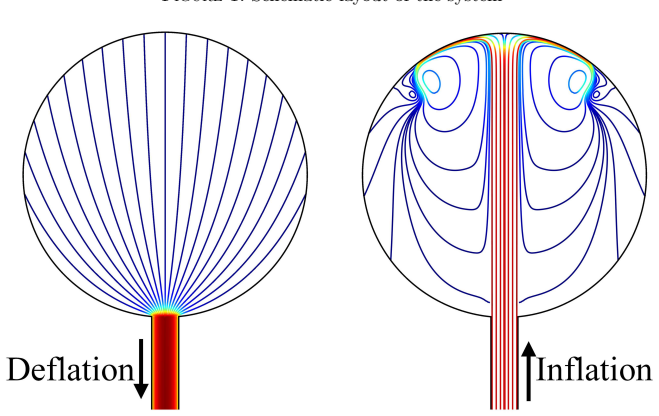
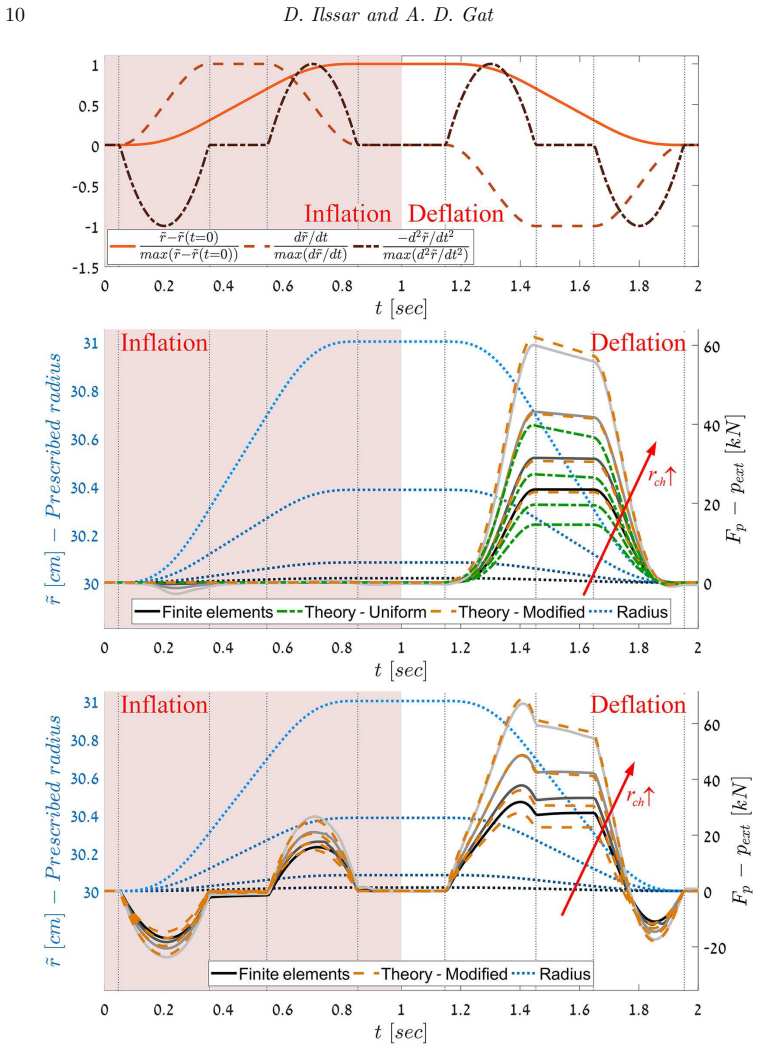
On the paper's own terms, the central claim is that the pressure force on the balloon switches regime with the sign of $\mathrm{d}\tilde r/\mathrm{d}t$. For shrinking radius, the interior flow is irrotational and is solved by a Legendre-polynomial velocity potential, producing inertial and centripetal forces from both the channel and the balloon interior. For growing radius, boundary-layer separation creates an internal jet, and the classical result that a spreading jet in a semi-infinite medium has uniform pressure lets the interior fluid terms drop out, leaving the external pressure plus channel inertia as the only fluid forces. This piecewise force, Eq. (2.15), enters Hamilton's principle together with a two-parameter hyperelastic strain energy, yielding the hybrid oscillator Eq. (2.22). The paper verifies the degenerated forms against fully coupled finite-element simulations of the Navier–Stokes equations and the elastic shell for orifice radii from 1 to 3 cm with and without a 50 cm channel, reporting good agreement in the radius histories during both inflation and deflation.
Load-bearing premise
The load-bearing premise is that during inflation the entering liquid forms a steady jet almost instantly in an effectively semi-infinite interior, so the pressure inside the balloon stays uniform and the fluid inertia and centripetal forces from the balloon interior can be ignored.
Editorial extensions
If this is right
- The full coupled dynamics of a liquid-filled spherical balloon can be integrated as a single second-order ordinary differential equation, so actuator design studies no longer require solving the interior flow field.
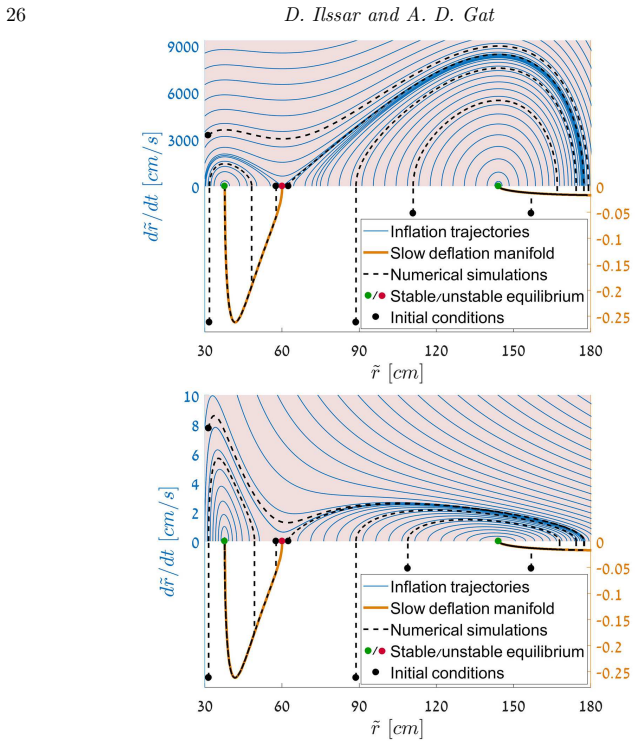
- Inflation and deflation are naturally asymmetric: with no channel, inflation is nearly inertialess in the fluid and follows the driving pressure, while deflation is slowed by the interior fluid's inertia and centripetal force, producing a slow-deflation manifold.
- For a balloon fed by a long channel, the channel length sets the inflation dynamics but not the slow deflation, giving a design parameter that controls inflation speed independently.
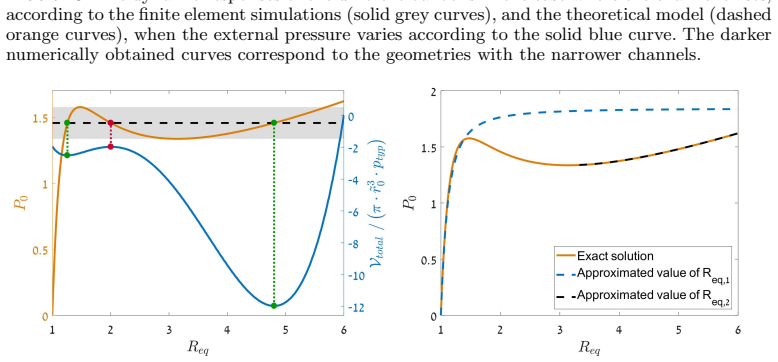
- The static equilibria inherit the classic balloon bistability, and the paper's asymptotic approximations provide closed-form estimates for the two stable equilibrium radii.
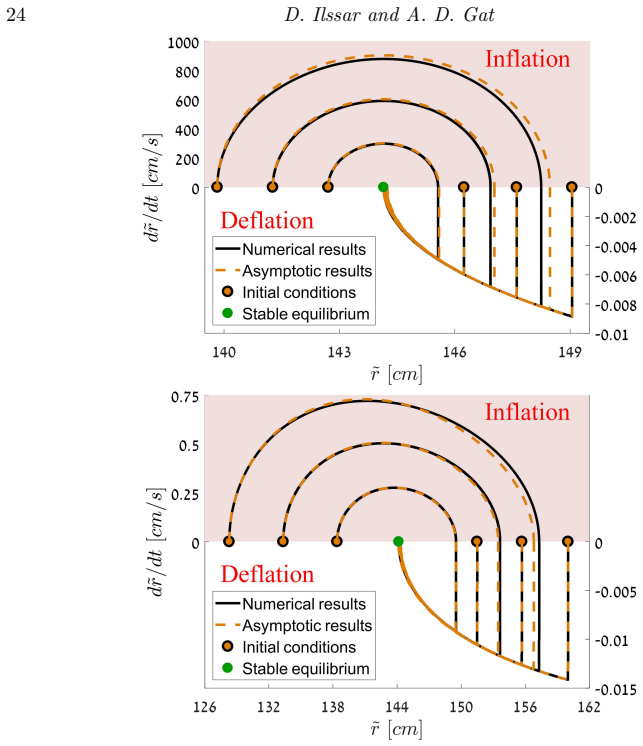
- A system released near a stable equilibrium is predicted to show fast inflation followed by slow sliding deflation on the degenerate manifold, then small oscillations around equilibrium.
Reading between the lines
- If the uniform-pressure inflation branch extends to arrays of connected liquid-filled balloons, the pressure change should propagate element by element through channel inertia rather than through viscosity, so a single pressure input could sequence multi-stable states in soft robots.
- A direct experimental test with water-filled rubber balloons, measuring interior pressure at two points and the radius under step pressure inputs, would show how far the quasi-steady jet assumption limits the model at high inflation rates and small orifice radii.
- The model's empirical correction factors (about 1.095 for inertial force and 1.56 for centripetal force) were fit to a limited set of simulated inlet velocity profiles, so replacing them with a physical model of the inlet profile would remove the main fitting step and strengthen the theory.
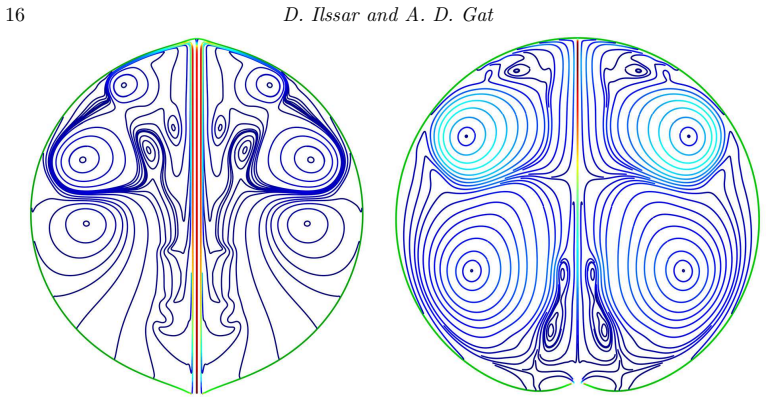
- The pear-shaped oscillations seen in simulations after rapid inflation suggest that adding a second deformation mode to the variational model, rather than changing the fluid model, could capture the residual non-spherical dynamics left out of the single-degree-of-freedom oscillator.
Signed reviews
Editorial analysis
A structured set of objections, weighed in public.
Referee Report
Summary. The paper derives a reduced-order model for the coupled fluid-structure dynamics of a liquid-filled hyperelastic balloon driven through a rigid channel. For deflation, the flow is modeled as irrotational potential flow inside the deforming sphere, leading to a generalized fluid force that is combined with a variational thin-shell Mooney-Rivlin description of the balloon. For inflation, the flow is assumed to separate into a jet that reaches steady form rapidly, so the pressure inside the balloon is taken as uniform and only the channel inertia and external pressure contribute to the generalized force. The result is a piecewise nonlinear hybrid oscillator, Eqs. (2.22)-(2.25). The model is compared with COMSOL finite-element simulations of the fully coupled system, and then analyzed for static equilibria, local asymptotic free motion, and global phase-plane behavior.
Significance. If the model is validated, it would provide a simple design tool for a class of soft-robotic and biomedical devices where spherical hyperelastic cavities are filled with liquid and driven by a single pressure input. The deflation-side potential-flow derivation is detailed and self-contained, and the variational formulation of the thin-shell balloon is standard. The paper also offers useful asymptotic results: closed-form approximations for the stable equilibrium radii, matched-asymptotic solutions for the local dynamics, and phase portraits showing the strongly asymmetric inflation/deflation behavior. These are valuable, falsifiable predictions. The main weakness is that the inflation-branch closure is an assumption rather than a derived result, and the verification against COMSOL is partly circular because correction factors and the nominal inlet profile are extracted from the same finite-element framework. The significance is therefore conditional on establishing the validity domain of the inflation assumption and on an independent validation of the corrected model.
major comments (4)
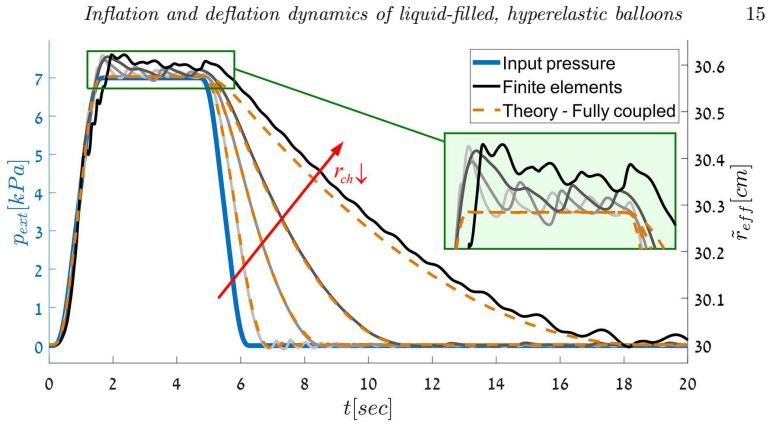
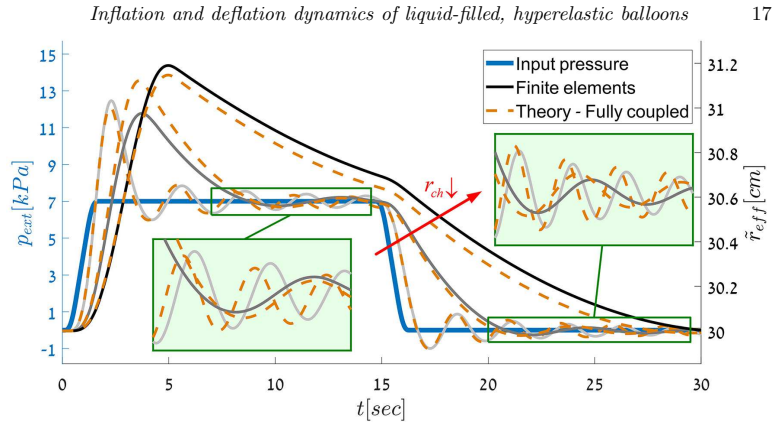
- [§2.2 and §2.5] The inflation branch rests on the assertion, made in the first paragraph of §2.2, that the separated internal jet reaches steady form rapidly and that the pressure field inside the balloon is uniform. This assumption is load-bearing: it justifies dropping all fluid inertial and centripetal terms from the balloon interior and produces the sgn(dr/dt) switches in Eqs. (2.12), (2.15), and (2.22). The paper's own finite-element results contradict this in the regimes where it matters: Fig. 5 shows the jet impinging on the far wall and producing persistent pear-shaped deformation after rapid inflation, and §2.5 concedes that discrepancies become stronger at high inflation rates and in balloons with smaller orifice sizes. These are exactly the conditions where the jet is most focused and the pressure field least uniform. Moreover, Figs. 4 and 6 present only qualitative comparisons, with no error metrics, so the abstract's claim of 'excellent agreement' is not quantitatively substantiated for the inflation branch. I request a quantitative error analysis as a function of inflation rate and orifice size, and a re-statement of the model's validity domain to exclude the regimes where Fig. 5 shows the assumption to fail.
- [§2.3] The correction factors 1.095 and 1.56, introduced in Eq. (2.15), are calibrated by comparing the original potential-flow model with COMSOL dictated-motion simulations, and the nominal inlet velocity profile f(Y) is obtained by averaging the same set of finite-element simulations. The fully coupled verification in §2.5 then compares the corrected model with COMSOL simulations of the same physical framework. This is not an independent test of the model; it is largely a consistency check in which the model is tuned to one output of the very code that is later used as the reference solution. The central claim of verification would be much stronger if the calibrated model were tested against a held-out set of parameters, a different discretization or solver, or experimental data. At minimum, the authors should state explicitly that the correction coefficients are part of the model input and that the fully coupled comparison does not validate those coefficients.
- [Eq. (2.15) and Appendix B] The modification of g3 and g5 is described only by the statement that the original inertial force is multiplied by approximately 1.095 and the centripetal force by approximately 1.56. No explicit formulas for the modified g3 and g5 are given, even though the modified coefficients are central to the model. Because the correction factors are stated to have weak dependency on epsilon but are then taken as constant, the paper should provide the data or an explicit expression for the correction as a function of epsilon, together with the range of orifice radii over which the approximation is valid. Without this, a reader cannot reproduce the model or assess whether the correction is robust outside the specific simulated cases.
- [Figs. 4 and 6] The agreement shown in Figs. 4 and 6 is described as 'good' and 'highly correlated,' but no quantitative measure is provided. The effective radius defined in §2.5 is derived from the inner surface area, which introduces a coupling to the non-spherical modes that are supposed to be negligible. I recommend reporting the root-mean-square or maximum relative error in the radius history, and separately quoting the error during inflation and during deflation, because the two branches are governed by different physical assumptions. The authors should also state the parameter ranges (inflation rate, orifice size, channel length) over which the claimed error is achieved.
minor comments (6)
- [§2.4] In the sentence preceding Eq. (2.16), 'unstarched values' is a typo and should read 'unstretched values.'
- [Eq. (2.13)] The normalized radial coordinate in Eq. (2.13) is not defined until later in the same paragraph; please define it at first use and state its relation to the spherical coordinate system.
- [§2.3] The sentence 'In should be noted that the numerical computations discussed above' contains an extra 'In' and should read 'It should be noted.'
- [§2.5] The authors state that 'the results given in both figures show that the theoretical model gives a good prediction of the system's dynamics,' followed by a cautionary sentence about high inflation rates and short, narrow channels. The caution is a step in the right direction but should appear as a formal statement of the model's validity domain, preferably with quantified thresholds, rather than as a concluding remark.
- [§3.3.1 and §3.3.2] The asymptotic solutions (3.16) and (3.19) are presented as closed-form expressions containing polylogarithms. It would be helpful to state explicitly which symbolic manipulation software, if any, was used to derive and verify these expressions, since the complexity of the matching procedure makes manual verification error-prone.
- [References] The reference to Mangan and Destrade (2015) on Gent models is appropriate, but the related discussion of pear-shaped bifurcation in pressurized balloons would benefit from also citing the recent literature on localized bulging and symmetry-breaking instabilities beyond the two papers cited.
Circularity Check
Empirical FE calibration is reused as the verification benchmark; the analytic core is independent, so circularity is partial.
-
fitted input called prediction
[Section 2.3, Eqs. (2.13)-(2.15); Section 2.5, Figs. 4 and 6]
"the modified forms of the functions g3 and g5 are calculated, where ˆf (Υ ) is determined as a nominal profile achieved by averaging those, computed from all of the simulations ... the original inertial force is multiplied by approximately 1.095, and the centripetal force which shows larger deviations, is multiplied by approximately 1.56. ... for sake of validating the fully coupled model derived above, its two degenerated variants, given by (2.23) and (2.25) are compared to finite element simulations carried out in COMSOL Multiphysics."
The generalized force (2.15) entering the hybrid oscillator is not fully first-principles: its non-channel inertial and centripetal coefficients, and the flow profile f(Y), are extracted from COMSOL dictated-motion simulations. The final 'verification' then compares the same reduced model against COMSOL fully coupled simulations. Since both the calibration and the validation use the same FE flow solver and the same fluid model, the agreement in Figs. 4 and 6 is partly a consistency check with the calibration source rather than an out-of-sample test. Any systematic error in the COMSOL flow description is absorbed into the fitted constants, so the claimed 'excellent agreement' is weaker than an independent prediction.
full rationale
The paper's analytic derivation has substantial independent content: the deflation pressure and generalized force are obtained from a potential-flow solution of Laplace's equation with stated boundary conditions, and the final oscillator equations (2.22)-(2.25) follow from Hamilton's principle. The static, asymptotic, and phase-portrait analyses are consequences of these equations, not of the fitted inputs. The main circularity concern is that Section 2.3 calibrates the correction factors 1.095 and 1.56 and the nominal profile f(Y) from COMSOL simulations, while Section 2.5 presents agreement with COMSOL as the verification. This makes the numerical validation a same-source consistency check rather than an independent test; the paper itself acknowledges 'some discrepancies' and advises that the model 'should still be used cautiously, especially at high inflation rates, and when the channel ... is short and narrow.' Those caveats limit the strength of the central claim but do not make the derivation equivalent to its inputs. No load-bearing self-citation chain or definitional circularity was found.
Assumptions & free parameters
free parameters (4)
- Mooney-Rivlin constants s1, s2 =
s1 = 1.5 MPa, s2 = 0.15 MPa
- Curve-fit coefficients for g3 and g5 =
36 and 24 in Eq. (2.10)
- Empirical correction multipliers for balloon-induced inertia and centripetal terms =
1.095 and 1.56
- Nominal inlet flow velocity profile f(Y) =
Not reported in closed form; described only as an average of simulated profiles
assumptions (8)
- domain assumption The fluid is incompressible and inviscid, with laminar high-Reynolds flow.
- domain assumption The system is axisymmetric and the balloon deforms only in its extensional mode, remaining approximately spherical.
- domain assumption The channel is slender, r_ch << L_ch and r_ch << r_tilde, so pressure is nearly uniform across channel sections and flow is axial.
- domain assumption During deflation the flow is irrotational with no separation, so a velocity potential exists.
- ad hoc to paper During inflation, the separated jet develops rapidly to steady form, the medium is semi-infinite, and pressure is uniform throughout the balloon.
- domain assumption The balloon is a thin-walled incompressible Mooney-Rivlin solid with r^2 d = r0^2 d0 and equibiaxial stretches.
- standard math Unsteady Bernoulli applies in a fixed reference frame and can be averaged across the channel to give a uniform entrance pressure.
- ad hoc to paper The nominal flow profile f(Y) obtained by averaging finite element simulations is representative for all geometries and operating conditions tested.
Cite this review
Pith. "Pith review of On the inflation and deflation dynamics of liquid-filled, hyperelastic balloons." pith.science (2026). https://pith.science/paper/AUTEVGZ4
@misc{pith2026190804074,
  author       = {Pith},
  title        = {Pith review of: On the inflation and deflation dynamics of liquid-filled, hyperelastic balloons},
  year         = {2026},
  howpublished = {\url{https://pith.science/paper/AUTEVGZ4}},
  note         = {Machine review of arXiv:1908.04074}
}
read the original abstract
We derive a reduced-order model describing the inflation and deflation dynamics of a liquid-filled hyperelastic balloon, focusing on inviscid laminar flow and the extensional motion of the balloon. We initially study the flow and pressure fields for dictated motion of the solid, which throughout deflation are obtained by solving the potential problem. However, during inflation, flow separation creates a jet within the balloon, requiring a different approach. The analyses of both flow regimes lead to a simple piecewise model, describing the fluidic pressure during inflation and deflation, which is then verified by finite element computations. We then use a variational approach to derive the equation governing the balloon's dynamics, yielding a nonlinear hybrid oscillator equation, describing the interaction between the extensional mode of the balloon, and the entrapped fluid. Analytical and graphical investigations of the suggested model are presented, shedding light on its static and dynamic behaviour under different operating conditions. Our suggested model and its underlying assumptions are verified utilizing a fully coupled finite element scheme, showing excellent agreement.
Figures

Figures from the paper (6 more)
Reference graph
Works this paper leans on
-
[1]
, " * write output.state after.block = add.period write newline
ENTRY address author booktitle chapter edition editor howpublished institution journal key month note number organization pages publisher school series title type volume year eprint label extra.label sort.label short.list INTEGERS output.state before.all mid.sentence after.sentence after.block FUNCTION init.state.consts #0 'before.all := #1 'mid.sentence ...
-
[2]
write newline
" write newline "" before.all 'output.state := FUNCTION n.dashify 't := "" t empty not t #1 #1 substring "-" = t #1 #2 substring "--" = not "--" * t #2 global.max substring 't := t #1 #1 substring "-" = "-" * t #2 global.max substring 't := while if t #1 #1 substring * t #2 global.max substring 't := if while FUNCTION word.in bbl.in capitalize " " * FUNCT...
-
[3]
Ben-Haim, Eran , Salem, Lior , Or, Yizhar & Gat, Amir D 2019 Single-input control of multiple fluid-driven elastic actuators via interaction between bi-stability and viscosity . arXiv preprint arXiv:1903.04280
work page Pith review arXiv 2019
-
[4]
Advances in Space Research 44 (1), 23--38
Cathey Jr, HM 2009 The nasa super pressure balloon--a path to flight . Advances in Space Research 44 (1), 23--38
work page 2009
-
[5]
IEEE Transactions on Robotics 34 (1), 81--90
Gamus, Benny , Salem, Lior , Ben-Haim, Eran , Gat, Amir D & Or, Yizhar 2017 Interaction between inertia, viscosity, and elasticity in soft robotic actuator with fluidic network . IEEE Transactions on Robotics 34 (1), 81--90
work page 2017
-
[6]
G \'e radin, Michel & Rixen, Daniel J 2014 Mechanical vibrations: theory and application to structural dynamics\/ . John Wiley & Sons
work page 2014
-
[7]
IEEE Transactions on Biomedical Engineering 57 (6), 1264--1272
Glozman, Daniel , Hassidov, Noam , Senesh, Merav & Shoham, Moshe 2010 A self-propelled inflatable earthworm-like endoscope actuated by single supply line . IEEE Transactions on Biomedical Engineering 57 (6), 1264--1272
work page 2010
-
[8]
Goldstein, S. 1965 Modern developments in fluid dynamics: an account of theory and experiment relating to boundary layers, turbulent motion and wakes\/ . Dover Publications
work page 1965
Show all 32 references
-
[9]
Holmes, Mark H 2012 Introduction to perturbation methods\/ , , vol. 20 . Springer Science & Business Media
2012
-
[10]
Gastrointestinal endoscopy 68 (6), 1112--1116
Kawamura, Takuji , Yasuda, Kenjiro , Tanaka, Kiyohito , Uno, Koji , Ueda, Moose , Sanada, Kasumi & Nakajima, Masatsugu 2008 Clinical evaluation of a newly developed single-balloon enteroscope . Gastrointestinal endoscopy 68 (6), 1112--1116
2008
-
[11]
Springer
Manevich, Leonid Isaakovich & Gendelman, Oleg V 2011 Tractable models of solid mechanics: Formulation, analysis and interpretation\/ . Springer
2011
-
[12]
International Journal of non-linear mechanics 68 , 52--58
Mangan, Robert & Destrade, Michel 2015 Gent models for the inflation of spherical balloons . International Journal of non-linear mechanics 68 , 52--58
2015
-
[13]
Physics of Fluids 6 (6), 2221--2223
Maul, Christine & Kim, Sangtae 1994 Image systems for a stokeslet inside a rigid spherical container . Physics of Fluids 6 (6), 2221--2223
1994
-
[14]
Journal of Applied Physiology 19 (2), 207--211
Milic-Emili, J , Mead, JTURNERJM , Turner, JM & Glauser, EM 1964 Improved technique for estimating pleural pressure from esophageal balloons . Journal of Applied Physiology 19 (2), 207--211
1964
-
[15]
Advanced functional materials 24 (15), 2163--2170
Mosadegh, Bobak , Polygerinos, Panagiotis , Keplinger, Christoph , Wennstedt, Sophia , Shepherd, Robert F , Gupta, Unmukt , Shim, Jongmin , Bertoldi, Katia , Walsh, Conor J & Whitesides, George M 2014 Pneumatic networks for soft robotics that actuate rapidly . Advanced functio...
2014
-
[16]
M \"u ller, Ingo & Strehlow, Peter 2004 Rubber and rubber balloons: paradigms of thermodynamics\/ , , vol. 637 . Springer Science & Business Media
2004
-
[17]
European Journal of Physics 32 (2), 517
Mungan, Carl E 2011 The bernoulli equation in a moving reference frame . European Journal of Physics 32 (2), 517
2011
-
[18]
John Wiley & Sons
Nayfeh, Ali H 2008 Perturbation methods\/ . John Wiley & Sons
2008
-
[19]
Advances in Space Research 54 (8), 1525--1529
Saito, Y , Iijima, I , Matsuzaka, Y , Matsushima, K , Tanaka, S , Kajiwara, K & Shimadu, S 2014 Development of a super-pressure balloon with a diamond-shaped net . Advances in Space Research 54 (8), 1525--1529
2014
-
[20]
In 2009 International Conference on Control, Automation, Communication and Energy Conservation\/ , pp
Sankar, P & Norman, Suresh R 2009 Embedded system for monitoring atmospheric weather conditions using weather balloon. In 2009 International Conference on Control, Automation, Communication and Energy Conservation\/ , pp. 1--4 . IEEE
2009
-
[21]
Springer
Schlichting, Hermann & Gersten, Klaus 2016 Boundary-layer theory\/ . Springer
2016
-
[22]
Nature materials 18 (1), 24
Si \'e fert, Emmanuel , Reyssat, Etienne , Bico, Jos \'e & Roman, Beno \^ t 2019 Bio-inspired pneumatic shape-morphing elastomers . Nature materials 18 (1), 24
2019
-
[23]
International Journal for Numerical Methods in Fluids 54 (6-8), 855--900
Tezduyar, Tayfun E & Sathe, Sunil 2007 Modelling of fluid--structure interactions with the space--time finite elements: solution techniques . International Journal for Numerical Methods in Fluids 54 (6-8), 855--900
2007
-
[24]
Fluid dynamics research 11 (1-2), 75
Usha, R & Nigam, SD 1993 Flow in a spherical cavity due to a stokeslet . Fluid dynamics research 11 (1-2), 75
1993
-
[25]
Journal of biomechanics 12 (1), 9--12
Wang, CY & Sonnenblick, EH 1979 Dynamic pressure distribution inside a spherical ventricle . Journal of biomechanics 12 (1), 9--12
1979
-
[26]
International Journal of Non-Linear Mechanics 98 , 137--144
Wang, T , Xu, F , Huo, Y & Potier-Ferry, Michel 2018 Snap-through instabilities of pressurized balloons: Pear-shaped bifurcation and localized bulging . International Journal of Non-Linear Mechanics 98 , 137--144
2018
-
[27]
White, F. M. 1994 Fluid Mechanics\/ . McGraw-Hill
1994
-
[28]
Gastrointestinal endoscopy 53 (2), 216--220
Yamamoto, Hironori , Sekine, Yutaka , Sato, Yukihiro , Higashizawa, Toshihiko , Miyata, Tomohiko , Iino, Satoru , Ido, Kenichi & Sugano, Kentaro 2001 Total enteroscopy with a nonsurgical steerable double-balloon method . Gastrointestinal endoscopy 53 (2), 216--220
2001
-
[29]
Intensive care medicine experimental 5 (1), 35
Yang, Yan-Lin , He, Xuan , Sun, Xiu-Mei , Chen, Han , Shi, Zhong-Hua , Xu, Ming , Chen, Guang-Qiang & Zhou, Jian-Xin 2017 Optimal esophageal balloon volume for accurate estimation of pleural pressure at end-expiration and end-inspiration: an in vitro bench experiment . Intensi...
2017
-
[30]
@esa (Ref
\@ifclassloaded aguplus natbib The aguplus class already includes natbib coding, so you should not add it explicitly Type <Return> for now, but then later remove the command natbib from the document \@ifclassloaded nlinproc natbib The nlinproc class already includes natbib cod...
-
[31]
@stdbsttrue NAT@ctr \@lbibitem[ NAT@ctr ] \@lbibitem[#1]#2 \@extra@b@citeb \@ifundefined br@#2\@extra@b@citeb \@namedef br@#2 \@nameuse br@#2\@extra@b@citeb \@ifundefined b@#2\@extra@b@citeb @num @parse #2 [ @natanchorstart #2\@extra@b@citeb \@biblabel @num @natanchorend] @ifc...
-
[32]
@open @close @open @close and [1] URL: #1 \@ifundefined chapter * \@mkboth \@ifundefined NAT@sectionbib * \@mkboth * \@mkboth\@gobbletwo \@ifclassloaded amsart * \@ifclassloaded amsbook * \@ifundefined bib@heading @heading NAT@ctr thebibliography [1] @ \@biblabel NAT@ctr \@bib...
1996
Reviewed August 14, 2026 · model on record in the stance chip above.
Discussion (0). Continue with ORCID to comment.