REVIEW 3 major objections 5 minor 46 references
Energy, Momentum and Angular Momentum Transfer Between Electrons and Nuclei
T0 review · 3 major / 5 minor · reviewed 2026-08-14 · deepseek-v4-flash
Pith's one-line read Exact subsystem Ehrenfest identities trace electron–nuclear momentum, angular momentum, and kinetic-energy transfer to a single effective electromagnetic force operator.
desk verdict Solid formal contribution: exact momentum and angular momentum IEIs, plus a kinetic-energy identity for \tilde T_n that the abstract overstates. read the letter →
The pith
A machine-rendered reading of the paper's core claim, the machinery that carries it, and where it could break.
The reading
What carries the argument
The load-bearing object is the effective electromagnetic force operator $\hat{\bar{\mathbf F}}_\mu$ built from the exact-factorization potentials. Its electric field $\mathbf E_\mu$ combines the scalar-potential gradient with the time derivative of the vector potential; its magnetic field is the intranuclear Berry curvature $C^{G'G}_{\mu\mu} = \partial_{G'_\mu}A_{G\mu}-\partial_{G\mu}A_{G'_\mu}$, which enters as $\mathbf B_\mu\times\hat{\mathbf v}_\mu$; and $\hat{\mathbf D}_\mu$ collects the internuclear Berry curvatures $C^{G'G}_{\nu\mu}$ between different nuclei. Promoting the velocities in a trajectory-based force function to operators reproduces $\hat{\bar{\mathbf F}}_\mu$, so the identities connect the operator picture with the trajectory picture.
What would settle it
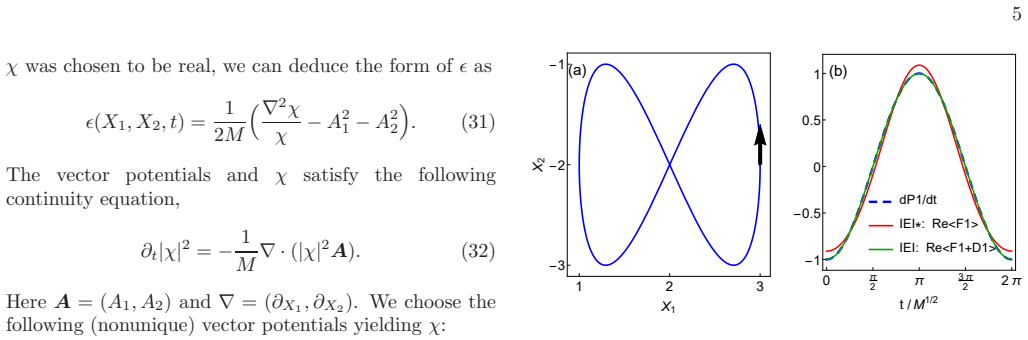
Take a two-nucleus model in which the nuclear wave packet $\chi$ develops a nodal line while the vector potentials remain smooth, compute $d\mathbf P_1/dt$ directly from the time-dependent $\chi$, and compare it with $\mathrm{Re}\langle\chi|\hat{\bar{\mathbf F}}_1|\chi\rangle$; any nonzero difference would show that the discarded surface terms do not vanish and would refute Eq. (26) in that regime.
Extended reading notes
Core claim
The central discovery is that the exact nuclear Schrödinger equation of exact factorization, $i\partial_t\chi = [\sum_\mu (1/2M_\mu)(-i\nabla_{\mathbf R_\mu}+\mathbf A_\mu)^2+\epsilon]\chi$, already contains all electronic back-reaction in the form of an effective electromagnetic field. Replacing the full wave function with the marginal nuclear wave function $\chi$ preserves the exact nuclear momentum and angular momentum, and their time derivatives equal expectation values of a single effective force operator $\hat{\bar{\mathbf F}}_\mu = \mathbf E_\mu + \mathbf B_\mu\times\hat{\mathbf v}_\mu + \hat{\mathbf D}_\mu$, where $\mathbf E_\mu = \partial_t\mathbf A_\mu - \nabla_{\mathbf R_\mu}\epsilon$, $\mathbf B_\mu$ is the intranuclear Berry curvature, and $\hat{\mathbf D}_\mu$ is the internuclear Berry-curvature force. The same operator appears in the identities for momentum, angular momentum, and total nuclear kinetic energy; the magnetic parts do no net work. The internuclear term transfers momentum between individual nuclei but cancels in the total, so it has no classical analog.
Load-bearing premise
The derivations assume the exact-factorization vector and scalar potentials are smooth enough that all boundary terms from integrations by parts vanish, which may fail where the nuclear wave function has nodes or the conditional electronic wave function becomes singular.
Editorial extensions
If this is right
- The identities give a direct way to quantify energy transfer in electron–phonon systems, which the paper highlights as a primary application.
- Nuclear momentum and angular momentum can be extracted exactly from the marginal nuclear wave function alone, without the full electron–nuclear wave function.
- Intranuclear magnetic forces do no work, and the internuclear contributions cancel in the total nuclear kinetic energy while still redistributing momentum among individual nuclei.
- Approximate factorizations based on adiabatic states yield the same inter-subsystem Ehrenfest identities for approximate quantities, extending the results beyond exact factorization.
- The expectation value of the force operator can be evaluated by replacing it with the corresponding classical force function, linking these identities to trajectory-based nonadiabatic dynamics.
Reading between the lines
- In molecular transport or laser-driven dynamics, these identities could decompose electronic energy loss into per-nucleus electric and magnetic channels, separating ordinary Joule-like heating from geometric-phase forces.
- The internuclear Berry-curvature term implies a testable prediction: momentum can appear to pass between two nuclei without any direct nuclear–nuclear force, mediated entirely by the electronic subsystem.
- Because the paper's model has constant internuclear Berry curvature, an immediate next step is to test the identities in a model with spatially varying curvature, where the individual-nucleus kinetic-energy correction operator $\hat G_\mu$ no longer vanishes.
- The same derivation should carry over to multicomponent mixtures or exciton–phonon systems, since only the TDSE form of the subsystem Hamiltonian is used.
Signed reviews
Editorial analysis
A structured set of objections, weighed in public.
Referee Report
Summary. The manuscript derives three inter-subsystem Ehrenfest identities from the exact-factorization nuclear time-dependent Schrödinger equation: one for the nuclear momentum of each nucleus, Eq. (26); one for the nuclear angular momentum, Eq. (27); and one for the total nuclear kinetic energy, Eq. (28). The central structural claim is that a single effective electromagnetic force operator F̂_μ = E_μ + B_μ × v̂_μ + D̂_μ, built from the exact-factorization scalar and vector potentials and their Berry curvatures, appears in all three identities. The authors also introduce a decomposition of the magnetic contribution into an intranuclear (classical Lorentz-like) term and an internuclear term with no classical analog, and they illustrate the momentum and energy identities with a two-nucleus one-dimensional model with analytically constructed potentials.
Significance. If the identities are correct as stated, they provide a compact, representation-independent characterization of momentum, angular momentum, and kinetic-energy exchange between electrons and nuclei in the exact-factorization framework, and they unify previously known trajectory-based force expressions with operator identities. The momentum and angular momentum identities (26) and (27) are well supported by the algebraic derivations and are a useful contribution. The energy identity, however, is exact only for the auxiliary quantity T̃_n = T_n − E_geo, not for the true nuclear kinetic energy T_n, so the manuscript's headline claim that it characterizes energy transfer between electrons and nuclei is not yet established. The numerical example is a consistency check on the algebra rather than a test of the energy-transfer interpretation.
major comments (3)
- [Eq. (6) and Eq. (28)] The energy IEI, Eq. (28), governs T̃_n, not the exact nuclear kinetic energy T_n. As the authors note in Eq. (6), T_n = T̃_n + E_geo, with E_geo defined in Eq. (9), yet no formula for dE_geo/dt is provided and no quantitative estimate of its size is given; the only support for neglecting it is Ref. [36], a personal communication stating that E_geo is 'small in many cases'. Consequently, the abstract and title claims about energy transfer between electrons and nuclei are not supported for the exact T_n. The momentum and angular momentum identities are unaffected because P_n and L_n have no E_geo-type correction, but the energy identity must either be derived for T_n or the claims must be explicitly restricted to T̃_n with a clearly stated caveat.
- [Eqs. (5), (10)–(13) and the associated integration by parts] The derivations assume that the exact-factorization potentials A_μ(R,t) and ϵ(R,t) are sufficiently smooth and that all boundary terms from integration by parts vanish. This assumption enters directly in the commutator algebra leading to Eqs. (10)–(13), (20), and the angular momentum derivation in the SI. It is not justified at nuclear configurations where χ has nodes or where the conditional electronic wavefunction Φ_R becomes singular, as can occur, for example, at conical intersections. Since all three identities rely on this assumption, the paper should either state the precise regularity conditions under which the identities hold or show that the identities extend to distributional settings with appropriate boundary-term cancellations.
- [Exactly solvable model, Eqs. (29)–(34) and Fig. 1] The numerical example contains no electronic degrees of freedom: it is a two-nucleus, one-dimensional model in which a Gaussian χ is prescribed and potentials A_1, A_2, and ϵ are reverse-engineered through Eqs. (31)–(34). The model therefore cannot calibrate the magnitude of E_geo or of dE_geo/dt in a real molecule, and it cannot demonstrate electron–nuclear energy transfer; it only verifies the internal algebraic consistency of the identities for a constructed χ. The caption and text present this as a validation of the IEIs, which is fair for the momentum identity, but the strength of the claim should be adjusted so that this example is not read as empirical or physical support for the energy-transfer interpretation.
minor comments (5)
- [Title and Abstract] The title and abstract contain a typographical spacing error in 'Ele ctrons'; this should be corrected.
- [Ref. [36]] The claim that E_geo is 'small in many cases' is supported only by a personal communication. Since this statement is now load-bearing for the energy identity, the authors should provide a published quantitative example or a derivation of a bound, rather than an unreferenced private communication.
- [SI, Section I.D, Eq. (S54)] The text introducing the operator Ĝ_μ states 'Derivation is omitted.' Because Ĝ_μ is used to explain why the individual-nucleus kinetic energy does not satisfy the simple IEI, the derivation (or a citation to a published derivation) should be included or the remark should be marked as a conjecture.
- [SI, Section III.A] The statement that the angular-momentum IEI has been 'verified numerically (results not shown)' is a claim of verification without supporting data; either include the figure or describe the verification procedure in enough detail for the reader to reproduce it.
- [Eq. (31)] The expression for ϵ in Eq. (31) is obtained by taking the real part of Eq. (29) and dividing by χ, which requires χ ≠ 0; the text should note that this construction is valid only where χ is nonzero, consistent with the smoothness assumptions flagged in the major comments.
Circularity Check
No significant circularity: the inter-subsystem Ehrenfest identities are commutator consequences of the exact-factorization nuclear TDSE, and the numerical model is an acknowledged reverse-engineered consistency check.
full rationale
The derivation starts from Eq. (5), the exact-factorization nuclear TDSE, which is prior published work ([29]-[32]); relying on it is standard external support, not a circular input, because the factorization theorem is not derived from the target identities. Equations (10)-(28) are obtained by applying the Heisenberg equation of motion and evaluating commutators; the force operator is assembled from the terms that emerge (E_mu, B_mu x v_mu, D_mu), rather than fitted so as to force the equality. No parameter is calibrated to data and no fitted quantity is renamed as a prediction. The two-nucleus model is explicitly constructed by choosing chi and solving for A and epsilon (Eqs. (29)-(34), SI III A), so its numerical agreement with the IEIs is a consistency check, not an independent test. The self-citations to earlier exact-factorization work are to published, independently checkable results, not to a uniqueness theorem used to forbid alternatives. The only substantive weakness is interpretive and not circular: Eq. (28) governs d\tilde T_n/dt with \tilde T_n = T_n - E_geo (Eqs. (6), (9)), and the paper gives no formula or estimate for dE_geo/dt, relying instead on a personal communication ([36]) that E_geo is small; this is an unsupported scope/approximation concern. Likewise, the SI omits the derivation of \hat G_mu (Eq. S54). These gaps bear on correctness and completeness but do not make the central derivation equivalent to its inputs.
Assumptions & free parameters
free parameters (4)
- Model nuclear mass M =
2000 m_e
- Model length scale a0 =
1 Bohr
- Trajectory g1(t), g2(t) =
a0(cos(t/sqrt(M))+2), a0(sin(2t/sqrt(M))-2)
- Auxiliary function C1(t) in SI Eq. (S87) =
1
assumptions (3)
- domain assumption Exact-factorization nuclear TDSE (Eq. 5) with scalar potential epsilon and vector potentials A_mu is an exact reformulation of the full electron-nuclear TDSE.
- ad hoc to paper A_mu and epsilon are smooth enough for commutator algebra and integration by parts with boundary terms neglected.
- ad hoc to paper E_geo is small in many cases, so T_tilde_n approximately equals T_n.
Cite this review
Pith. "Pith review of Energy, Momentum and Angular Momentum Transfer Between Electrons and Nuclei." pith.science (2026). https://pith.science/paper/BVTPVKKE
@misc{pith2026190804077,
  author       = {Pith},
  title        = {Pith review of: Energy, Momentum and Angular Momentum Transfer Between Electrons and Nuclei},
  year         = {2026},
  howpublished = {\url{https://pith.science/paper/BVTPVKKE}},
  note         = {Machine review of arXiv:1908.04077}
}
read the original abstract
The recently developed exact factorization approach condenses all electronic effects on the nuclear subsystem into scalar and vector potentials that appear in an effective time dependent Schr\"{o}dinger equation. Starting from this equation, we derive subsystem Ehrenfest identities characterizing the energy, momentum and angular momentum transfer between electrons and nuclei. An effective electromagnetic force operator induced by the electromagnetic field corresponding to the effective scalar and vector potentials appears in all three identities. The effective magnetic field has two components that can be identified with the Berry curvature calculated with (a) different cartesian coordinates of the same nucleus and (b) arbitrary cartesian coordinates of two different nuclei. (a) has a classical interpretation as the induced magnetic field felt by the nucleus, while (b) has no classical analog. Subsystem Ehrenfest identities are ideally suited for quantifying energy transfer in electron-phonon systems. With two explicit examples we demonstrate the usefulness of the new identities.
Figures
Reference graph
Works this paper leans on
- [36]
-
[1]
Zeitschrift f¨ ur Physik1927, 45(7), 455–457
Ehrenfest, P. Zeitschrift f¨ ur Physik1927, 45(7), 455–457
- [2]
-
[3]
Pecourt, J.-M. L.; Peon, J.; Kohler, B. J. Am. Chem. Soc. 2001, 123(42), 10370–10378
work page 2001
-
[4]
Peon, J.; Zewail, A. H. Chem. phys. lett. 2001, 348(3-4), 255–262
work page 2001
-
[5]
Anisimov, S.; Kapeliovich, B.; Perelman, T. Zh. Eksp. Teor. Fiz 1974, 66(2), 375–377
work page 1974
-
[6]
Allen, P. B. Phys. Rev. Lett. 1987, 59, 1460–1463
work page 1987
-
[7]
Waldecker, L.; Bertoni, R.; Ernstorfer, R.; Vorberger, J. Phys. Rev. X 2016, 6, 021003
work page 2016
Show all 46 references
-
[8]
J.; Askerka, M.; Batista, V
Maurer, R. J.; Askerka, M.; Batista, V. S.; Tully, J. C. Phys. Rev. B 2016, 94, 115432. 6
2016
-
[9]
Hopjan, M.; Stefanucci, G.; Perfetto, E.; Verdozzi, C. Phys. Rev. B 2018, 98, 041405
2018
-
[10]
Zewail, A. H. J. Phys. Chem. A 2000, 104(24), 5660– 5694
2000
-
[11]
Martinez, T.; Ben-Nun, M.; Levine, R. J. Phys. Chem. A 1997, 101(36), 6389–6402
1997
-
[12]
C.; Preston, R
Tully, J. C.; Preston, R. K. J. Chem. Phys. 1971, 55(2), 562–572
1971
-
[13]
Heat release in fires; Taylor & Francis, 1990
Babrauskas, V.; Grayson, S. Heat release in fires; Taylor & Francis, 1990
1990
-
[14]
Combustion, flames and explosions of gases; Elsevier, 2012
Lewis, B.; Von Elbe, G. Combustion, flames and explosions of gases; Elsevier, 2012
2012
-
[15]
J¨ ulicher, F.; Ajdari, A.; Prost, J. Rev. Mod. Phys. 1997, 69(4), 1269
1997
-
[16]
R.; Leigh, D
Kay, E. R.; Leigh, D. A.; Zerbetto, F. Angew. Chem. 2007, 46(1-2), 72–191
2007
-
[17]
K.-C.; Stuart, M
Chen, J.; Leung, F. K.-C.; Stuart, M. C.; Kajitani, T.; Fukushima, T.; van der Giessen, E.; Feringa, B. L. Nat. chem. 2018, 10(2), 132
2018
-
[18]
H.; Qian, H
Kim, K. H.; Qian, H. Phys. Rev. E 2007, 75, 022102
2007
-
[19]
Alicki, R. J. Phys A: Math. Gen. 1979, 12(5), L103– L107
1979
-
[20]
Kosloff, R. J. Chem. Phys. 1984, 80(4), 1625–1631
1984
-
[21]
Entropy 2013, 15(6), 2100–2128
Kosloff, R. Entropy 2013, 15(6), 2100–2128
2013
-
[22]
Di Ventra, M.; Pantelides, S.; Lang, N. Phys. Rev. Lett. 2002, 88(4), 046801
2002
-
[23]
J.; Todorov, T
Dundas, D.; McEniry, E. J.; Todorov, T. N. Nat. Nanotechnol. 2009, 4(2), 99
2009
-
[24]
N.; Dundas, D.; L, J.-T.; Brandbyge, M.; Hedeg ˚ ard, P.Euro
Todorov, T. N.; Dundas, D.; L, J.-T.; Brandbyge, M.; Hedeg ˚ ard, P.Euro. J. Phys. 2014, 35(6), 065004
2014
-
[25]
P.; Bowler, D.; Fisher, A.; Todorov, T
Horsfield, A. P.; Bowler, D.; Fisher, A.; Todorov, T. N.; Montgomery, M. J. Phys. Condens. Matter 2004, 16(21), 3609
2004
-
[26]
P.; Bowler, D.; Ness, H.; S´ anchez, C.; Todorov, T
Horsfield, A. P.; Bowler, D.; Ness, H.; S´ anchez, C.; Todorov, T. N.; Fisher, A. Rep. Prog. Phys. 2006, 69(4), 1195
2006
-
[27]
X.; Anoma, M
Zhu, L.; Raman, A.; Wang, K. X.; Anoma, M. A.; Fan, S. Optica 2014, 1(1), 32–38
2014
-
[28]
Donnert, G.; Eggeling, C.; Hell, S. W. Nature methods 2007, 4(1), 81
2007
-
[29]
Hunter, G. Int. J. Quantum Chem. 1975, 9(2), 237–242
1975
-
[30]
I.; Gross, E
Gidopoulos, N. I.; Gross, E. K. U. Philos. Trans. R. Soc. Lond. 2014, A 372 (2011), 20130059
2011
-
[31]
T.; Gross, E
Abedi, A.; Maitra, N. T.; Gross, E. K. U. Phys. Rev. Lett. 2010, 105, 123002
2010
-
[32]
T.; Gross, E
Abedi, A.; Maitra, N. T.; Gross, E. K. U. J. Chem. Phys. 2012, 137(22), 22A530
2012
-
[33]
Berry, M. V. In Geometric Phases in Physics; World Scientific, Singapore, 1989; pages 7–28
1989
-
[34]
Agostini, F.; Abedi, A.; Suzuki, Y.; Gross, E. K. U. Mol. Phys. 2013, 111(22-23), 3625–3640
2013
-
[35]
K.; Maitra, N
Agostini, F.; Abedi, A.; Suzuki, Y.; Min, S. K.; Maitra, N. T.; Gross, E. K. U. J. Chem. Phys. 2015, 142(8), 084303
2015
-
[40]
K.; Abedi, A.; Gross, E
Agostini, F.; Min, S. K.; Abedi, A.; Gross, E. K. U. Journal of Chemical Theory and Computation 2016, 12(5), 2127–2143
2016
-
[42]
Agostini, F.; Tavernelli, I.; Ciccotti, G. Euro. Phys. J. B. 2018, 91(7), 139
2018
-
[43]
Nevertheless, the effect of ˆD1 is only of secondary importance in our model, and much less than the electromotive force E1
By contrast, the fact that the red curve deviates from the blue dashed curve suggests that the generalized Lorentz force is incomplete and the amount of deviation reflects the contribution of ˆD1. Nevertheless, the effect of ˆD1 is only of secondary importance in our model, and ...
-
[44]
exactly solvable
See the Supplemental Material at xxx for further details . arXiv:1908.04077v1 [physics.chem-ph] 12 Aug 2019 Supporting Information of Energy, Momentum and Angular Momentum Transfer Between Electrons and Nuclei Chen Li 1, Ryan Requist 1 and E. K. U. Gross 1, 2 1Max Planck Insti...
1908 arXiv
-
[45]
Abedi, A.; Agostini, F.; Gross, E. K. U. Europhys. Lett. 2014, 106(3), 33001
2014
-
[46]
Agostini, F.; Abedi, A.; Gross, E. K. U. J. Chem. Phys. 2014, 141(21), 214101
2014
-
[47]
K.; Agostini, F.; Gross, E
Min, S. K.; Agostini, F.; Gross, E. K. U. Phys. Rev. Lett. 2015, 115, 073001
2015
-
[48]
K.; Abedi, A.; Gross, E
Agostini, F.; Min, S. K.; Abedi, A.; Gross, E. K. U. J. Chem. Theory Comput. 2016, 12(5), 2127–2143
2016
-
[49]
Curchod, B. F. E.; Agostini, F.; Tavernelli, I. Euro. Phys. J. B. 2018, 91(7), 168
2018
-
[50]
Agostini, F.; Tavernelli, I.; Ciccotti, G. Euro. Phys. J. B. 2018, 91(7), 139. 16
2018
Reviewed August 14, 2026 · model on record in the stance chip above.
Discussion (0). Continue with ORCID to comment.