REVIEW 2 major objections 5 minor 44 references
Fast Adaptation with Meta-Reinforcement Learning for Trust Modelling in Human-Robot Interaction
T0 review · 2 major / 5 minor · reviewed 2026-08-14 · deepseek-v4-flash
Pith's one-line read A meta-learning-based adaptation algorithm raised perceived bi-directional trust in a robot compared with a statistical bandit baseline.
desk verdict First application of meta-RL to HRI trust adaptation, but the user study cannot separate the algorithm from the robot's scripted verbal replies, so the central causal claim does not hold. read the letter →
The pith
A machine-rendered reading of the paper's core claim, the machinery that carries it, and where it could break.
The reading
What carries the argument
The load-bearing object is the meta-policy $\pi^c_{\mathrm{meta}}$, generated for each mental faculty $c \in \{T,G,A\}$ by pre-training with MAML on auxiliary bandit environments and then refined by TRPO in the real interaction. Each faculty is a separate adversarial multi-armed bandit with Gaussian reward $r^c \sim \mathcal{N}(\mu^c_a, (\sigma^c_a)^2)$. The robot's spoken replies are selected by thresholds on the policy's action probabilities, so faster convergence changes the wording of what the robot says early on. The pre-training stage is interpreted as acquiring 'basic trust', the general disposition that lets the robot adapt quickly to a particular human.
What would settle it
Re-run the escape-room study with a control condition in which the Exp3 robot speaks the same utterances, in the same sessions, as the meta-learning robot produced, changing only the underlying probability updates; if trust ratings remain equally high, the attribution to meta-learning is refuted.
Extended reading notes
Core claim
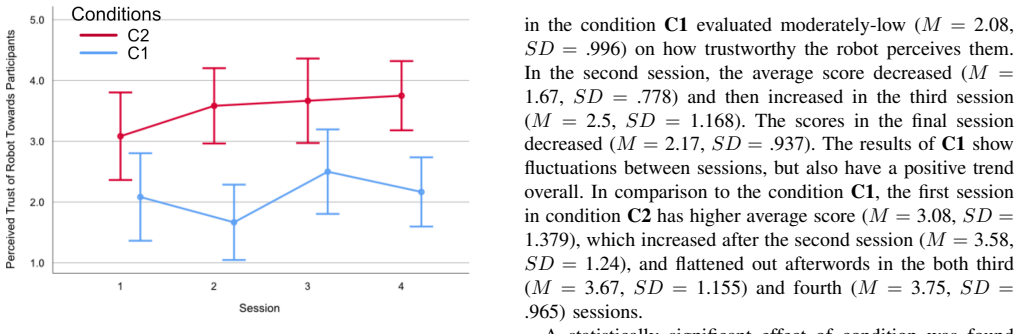
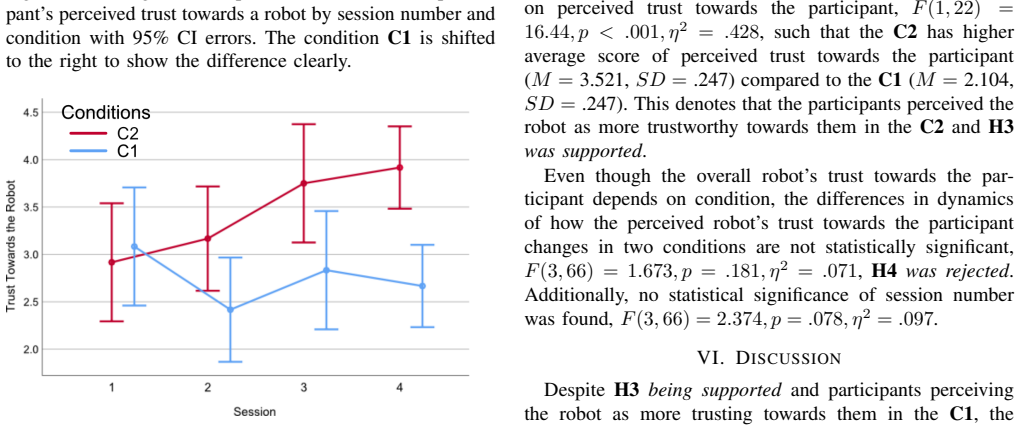
The central claim is that fast adaptation itself is a trust mechanism in human-robot interaction. Treating conation, cognition, and affection as three independent adversarial multi-armed bandit problems, the authors pre-train a neural policy with model-agnostic meta-learning on simulated Gaussian feedback and then refine it with trust region policy optimization during the live interaction. In a between-subjects study with 24 participants, the meta-learning condition scored significantly higher than Exp3 on both perceived trust in the robot (supporting H1) and perceived trust of the robot in the participant (supporting H3), and the dynamics of trust in the robot differed between conditions (supporting H2); the dynamics of perceived robot trust toward the participant did not differ significantly (H4 rejected). The paper concludes that differently structured adaptation algorithms can influence bi-directional perceived trust.
Load-bearing premise
The results rest on the assumption that the questionnaire differences are caused by the adaptation algorithm's learning behaviour, not by the robot's more positive verbal replies, which the faster algorithm produces earlier in the interaction.
Editorial extensions
If this is right
- A robot can be pre-trained in simulation and still adapt to a real person within a dozen interactions, which is the sample-efficiency regime that social robotics needs.
- The adaptation algorithm is a design variable for trust: faster learning can make a robot seem more trustworthy and can make people feel more trusted by it.
- Repeated in-interaction trust measurement can detect condition effects that a single post-interaction questionnaire could miss.
- Meta-learning pre-training offers one concrete way to implement the 'basic trust' component of a three-component trust formalization.
Reading between the lines
- Editorial inference: because the robot's replies are generated from confidence thresholds, the observed trust advantage may be mediated largely by language; a matched-utterance control condition would isolate the learning algorithm from what it says.
- Editorial inference: the rejection of H4 suggests the meta-learning advantage on perceived robot trust is concentrated in the first session; a session-by-session or trial-by-trial analysis could reveal whether continued adaptation adds anything after the initial boost.
- Editorial inference: the same per-faculty bandit decomposition could be applied to other social channels, such as proxemics or gaze, where trust-relevant behaviour could be measured continuously instead of by questionnaire.
Signed reviews
Editorial analysis
A structured set of objections, weighed in public.
Referee Report
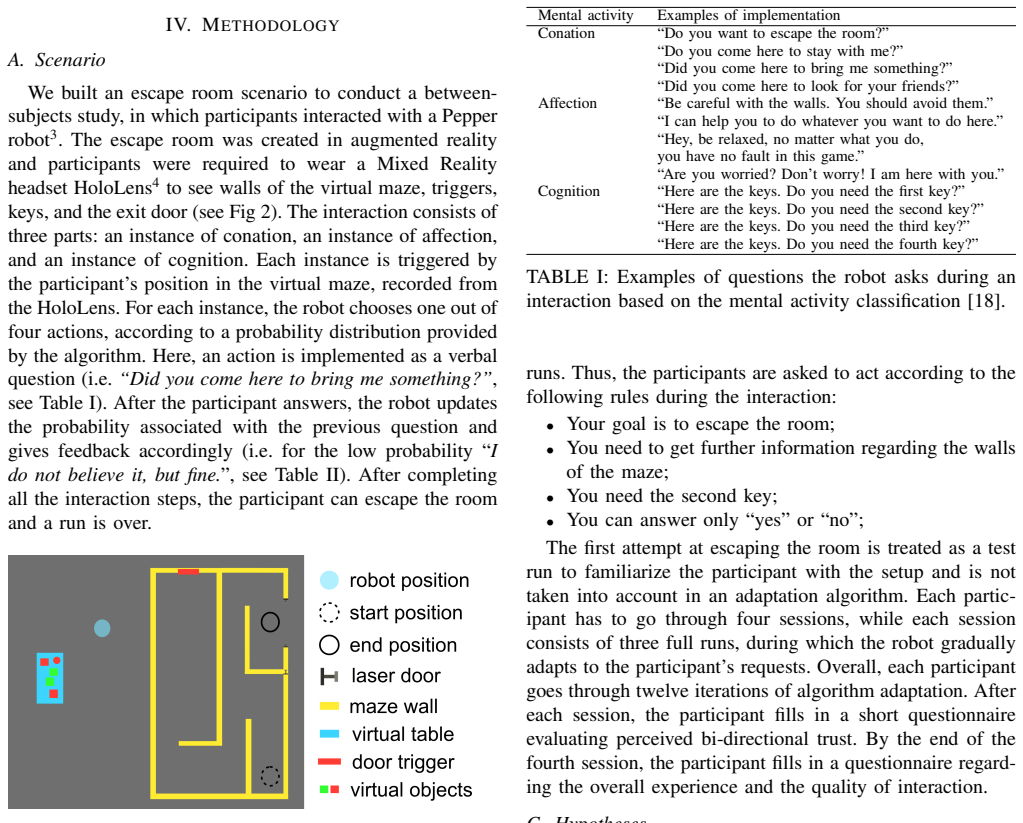
Summary. The paper proposes applying model-agnostic meta-learning (MAML) to policy-gradient training of multi-armed bandit policies for adaptive robot behaviour in human-robot interaction. The system is evaluated in a mixed-reality escape room with a Pepper robot: the robot asks questions, updates action probabilities from yes/no answers, and selects verbal replies from confidence thresholds on the action probability. In a between-subjects study with 24 participants (12 per condition), the meta-learning condition (C2) is compared with the Exp3 condition (C1), and perceived bi-directional trust is measured after each of four sessions. The authors report significant condition effects on trust towards the robot and on perceived robot trust towards the participant, supporting H1 and H3, and a significant session-by-condition interaction for trust towards the robot supporting H2; H4 was rejected. They also report a simulation showing faster convergence for the meta-policy than for Exp3. The central claim is that the meta-learning algorithm itself increases perceived bi-directional trust relative to the statistical baseline.
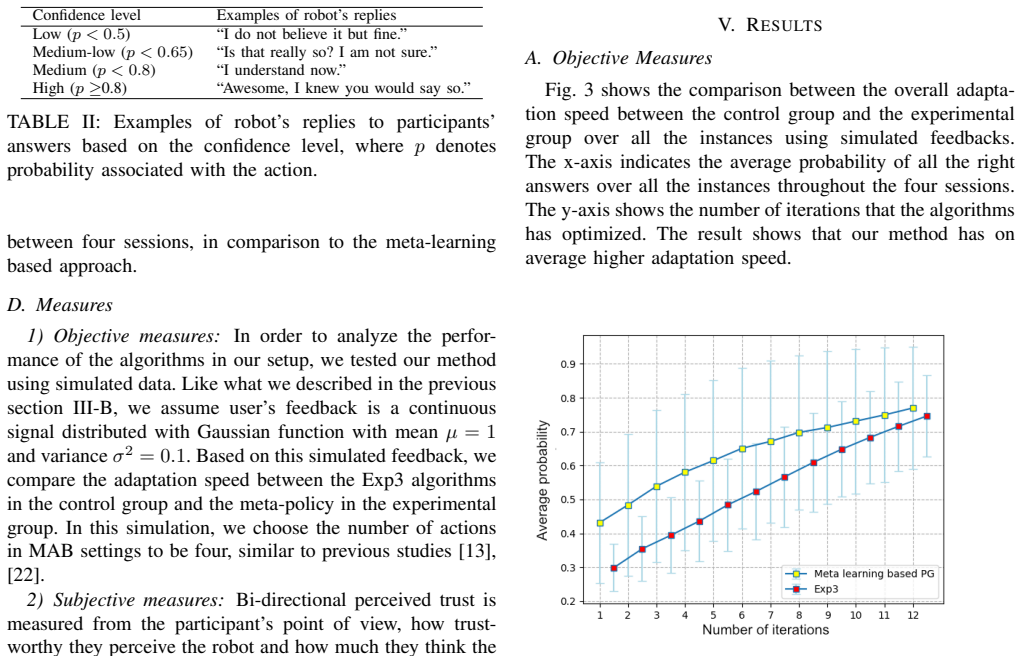
Significance. If the causal attribution were sound, the result would be significant for socially assistive robotics because it would show that algorithmic adaptation choices can shape human trust dynamics. The paper contains real strengths: it is a genuine attempt to measure trust repeatedly during an interaction rather than only once, it applies a current meta-learning method to a concrete HRI task, and the algorithm and implementation are described transparently. These strengths do not, however, compensate for a central experimental confound: the two conditions differ not only in the adaptation algorithm but also in the verbal content of the robot's replies, because those replies are generated from the algorithm's confidence thresholds. The simulation evidence for faster adaptation is also weakened by the fact that the evaluation uses the same Gaussian reward distribution as the pre-training environments. As presented, the empirical support for the paper's main claim is therefore not established.
major comments (2)
- [Section IV-A, Table II] The study confounds the adaptation algorithm with the robot's verbal replies. The robot's utterance is selected by thresholding the algorithm's action probability p, so the two conditions differ systematically in the linguistic content participants hear: as the meta-policy converges faster (Fig. 3), C2 participants receive more affirming replies such as 'Awesome, I knew you would say so' and fewer distrusting replies such as 'I do not believe it, but fine' in the early sessions. Because trust questionnaires were administered after every session, the reported H1 and H3 differences may simply track these words rather than the underlying adaptation behaviour. The paper's own discussion (Section VI) concedes that the observed discrepancies 'can be explained by the explicit nature of how the robot expressed its trust towards the participants.' Without a control condition that matches the utterance schedule across algorithms, or a statistical control based on per-session utterance logs, the ANOVA results cannot support the attribution of the trust gains to meta-learning rather than to the verbal feedback package. This is the central empirical claim of the paper, so the issue is load-bearing.
- [Section IV-D.1, Section V-A, Eq. (4)] The objective measure of adaptation speed is circular with respect to the pre-training distribution. The meta-policy is pre-trained in auxiliary environments whose rewards are modelled as Gaussian distributions rc ~ N(µc, σc²) (Eq. 4), and the evaluation in Section IV-D.1 uses the same Gaussian assumption with µ = 1 and σ² = 0.1. Figure 3 therefore shows that the meta-policy adapts quickly to the exact distribution on which it was trained; it does not demonstrate faster adaptation to real user feedback in the escape-room scenario. No data from the actual human sessions, such as action probabilities, utterance counts, or reward signals, are reported to support the claim that the meta-learning algorithm converged more quickly during those sessions. Since the faster-adaptation mechanism is used to motivate and explain the trust results, this lack of independent evidence is a second load-bearing gap.
minor comments (5)
- [Section V-B] The reported F statistic and p value for the main effect of session are inconsistent: F(3, 66) = 1.427 cannot yield p < .02; the correct p is approximately .24. This should be corrected and rechecked.
- [Section VI] The sentence beginning 'Despite H3 being supported and participants perceiving the robot as more trusting towards them in the C1' appears to contain a typo: the reported means show that C2 perceived the robot as more trusting towards them (M = 3.521) than C1 (M = 2.104), so the clause should refer to C2, not C1.
- [Section V-B] The analysis is described as a 'mixed design repeated measures one-way ANOVA'; this is not a standard term. A more accurate description would be a mixed ANOVA with one within-subjects factor (session) and one between-subjects factor (condition).
- [Section IV-D.2, Section V-B] The trust questionnaire uses single items adapted from previous work, but no reliability information (e.g., test-retest or internal consistency) is reported for the modified items; with one item per construct, the measurement is vulnerable to idiosyncratic interpretation of the wording.
- [Section IV-E, Section V] The study has only 12 participants per condition, and no power analysis is reported; the non-significant interaction for H4 may be an issue of low power, so the conclusion that the dynamics do not differ should be stated with appropriate caution.
Circularity Check
No circularity: the trust hypotheses are tested with external questionnaire measures, and the algorithm/utterance confound is a validity concern, not a derivation-from-inputs circularity.
full rationale
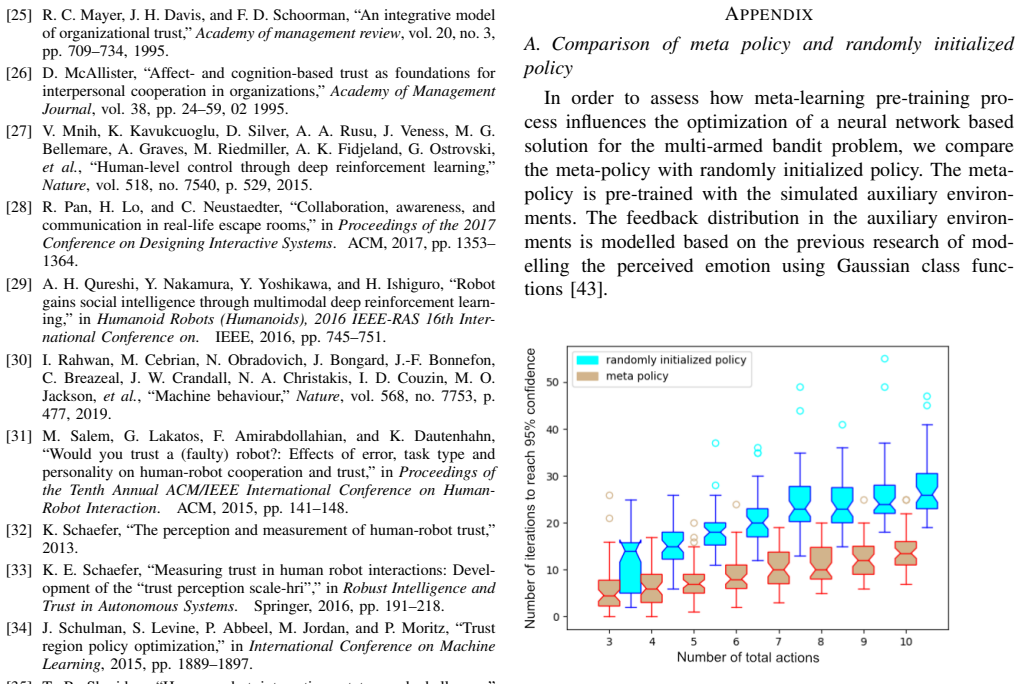
The paper's central claims (H1-H3) are evaluated by a between-subjects human study using Likert questionnaires administered after each session; these perceived-trust measures are external to the algorithm's equations and are not fitted parameters or outputs of the meta-learning model. The meta-policy is pre-trained on auxiliary Gaussian-reward MAB environments and then refined in the real interaction, but the human-study outcome is not derived from that pre-training by construction. The simulated comparison in Section V-A and Appendix A is an illustrative benchmark rather than a prediction of the human result; even though the auxiliary training distribution matches the simulated evaluation distribution, that fact does not determine the questionnaire responses. The paper itself notes in Section VI that the observed dynamics 'can be explained by the explicit nature of how the robot expressed its trust towards the participants,' which identifies a possible confound between the adaptation algorithm and the confidence-thresholded verbal replies in Table II. A confound of this kind threatens causal attribution but is not circularity: H1 and H3 are neither defined in terms of those utterances nor fitted to them. The self-citations (e.g., [13] for personalisation studies and [36] for MR comparison) support scenario design and prior baselines but are not load-bearing for the central trust conclusion. No uniqueness theorem, ansatz smuggled through self-citation, or equation-level reduction of a prediction to its inputs was found. The central derivation is self-contained as an empirical study, so the circularity score is 0.
Assumptions & free parameters
free parameters (2)
- Gaussian reward parameters in auxiliary environments =
µ=1, σ²=0.1
- Confidence thresholds for robot verbal replies =
0.5, 0.65, 0.8
assumptions (4)
- domain assumption The HRI interaction can be decomposed into three independent adversarial multi-armed bandits with a single correct action per category and stationary participant answers.
- ad hoc to paper Simulated Gaussian feedback with µ=1, σ²=0.1 is representative of real user feedback.
- domain assumption The meta-policy pre-trained on auxiliary tasks will adapt faster in the real interaction.
- domain assumption Single self-report Likert items measure perceived trust and perceived robot trust.
Cite this review
Pith. "Pith review of Fast Adaptation with Meta-Reinforcement Learning for Trust Modelling in Human-Robot Interaction." pith.science (2026). https://pith.science/paper/I7XJE6BY
@misc{pith2026190804087,
  author       = {Pith},
  title        = {Pith review of: Fast Adaptation with Meta-Reinforcement Learning for Trust Modelling in Human-Robot Interaction},
  year         = {2026},
  howpublished = {\url{https://pith.science/paper/I7XJE6BY}},
  note         = {Machine review of arXiv:1908.04087}
}
read the original abstract
In socially assistive robotics, an important research area is the development of adaptation techniques and their effect on human-robot interaction. We present a meta-learning based policy gradient method for addressing the problem of adaptation in human-robot interaction and also investigate its role as a mechanism for trust modelling. By building an escape room scenario in mixed reality with a robot, we test our hypothesis that bi-directional trust can be influenced by different adaptation algorithms. We found that our proposed model increased the perceived trustworthiness of the robot and influenced the dynamics of gaining human's trust. Additionally, participants evaluated that the robot perceived them as more trustworthy during the interactions with the meta-learning based adaptation compared to the previously studied statistical adaptation model.
Figures

Figures from the paper (3 more)
Reference graph
Works this paper leans on
-
[1]
Emotion and memory model to promote mathematics learning-an exploratory long-term study,
M. I. Ahmad and O. Mubin, “Emotion and memory model to promote mathematics learning-an exploratory long-term study,” in Proceedings of the 6th International Conference on Human-Agent Interaction . ACM, 2018, pp. 214–221
work page 2018
-
[2]
Trust and social engineering in human robot interaction: Will a robot make you disclose sensitive information, conform to its recommendations or gamble?
A. M. Aroyo, F. Rea, G. Sandini, and A. Sciutti, “Trust and social engineering in human robot interaction: Will a robot make you disclose sensitive information, conform to its recommendations or gamble?” IEEE Robotics and Automation Letters , vol. 3, no. 4, pp. 3701–3708, 2018
2018
-
[3]
Finite-time analysis of the multiarmed bandit problem,
P. Auer, N. Cesa-Bianchi, and P. Fischer, “Finite-time analysis of the multiarmed bandit problem,” Machine learning, vol. 47, no. 2-3, pp. 235–256, 2002
2002
-
[4]
K. Blomqvist, “The many faces of trust,” Scandinavian Journal of Management, vol. 13, no. 3, pp. 271 – 286, 1997. [Online]. Available: http://www.sciencedirect.com/science/article/pii/S0956522197846441
work page 1997
-
[5]
Emotion, embodi- ment, and consequence driven systems,
S. Bozinovski, G. Stojanov, and L. Bozinovska, “Emotion, embodi- ment, and consequence driven systems,” in Proc AAAI fall symposium on embodied cognition and action , 1996, pp. 12–17
work page 1996
-
[6]
G. Brockman, V . Cheung, L. Pettersson, J. Schneider, J. Schul- man, J. Tang, and W. Zaremba, “Openai gym,” arXiv preprint arXiv:1606.01540, 2016
arXiv 2016
-
[7]
Deep reinforcement learning of abstract reasoning from demonstrations,
M. Clark-Turner and M. Begum, “Deep reinforcement learning of abstract reasoning from demonstrations,” in Companion of the 2018 ACM/IEEE International Conference on Human-Robot Interaction . ACM, 2018, pp. 372–372
work page 2018
-
[8]
One-shot imitation learn- ing,
Y . Duan, M. Andrychowicz, B. Stadie, O. J. Ho, J. Schneider, I. Sutskever, P. Abbeel, and W. Zaremba, “One-shot imitation learn- ing,” in Advances in neural information processing systems , 2017, pp. 1087–1098
work page 2017
Show all 44 references
-
[9]
Rl 2: Fast reinforcement learning via slow reinforcement learning,
Y . Duan, J. Schulman, X. Chen, P. L. Bartlett, I. Sutskever, and P. Abbeel, “Rl 2: Fast reinforcement learning via slow reinforcement learning,” arXiv preprint arXiv:1611.02779 , 2016
2016 arXiv
-
[10]
Survey and behavioral measurements of interpersonal trust,
A. M. Evans and W. Revelle, “Survey and behavioral measurements of interpersonal trust,” Journal of Research in Personality , vol. 42, no. 6, pp. 1585–1593, 2008
2008
-
[11]
Model-agnostic meta-learning for fast adaptation of deep networks,
C. Finn, P. Abbeel, and S. Levine, “Model-agnostic meta-learning for fast adaptation of deep networks,” in Proceedings of the 34th International Conference on Machine Learning-Volume 70 . JMLR. org, 2017, pp. 1126–1135
2017
-
[12]
Measurement of trust in human-robot collaboration,
A. Freedy, E. DeVisser, G. Weltman, and N. Coeyman, “Measurement of trust in human-robot collaboration,” in 2007 International Sympo- sium on Collaborative Technologies and Systems . IEEE, 2007, pp. 106–114
2007
-
[13]
When robot personalisation does not help: Insights from a robot-supported learning study,
Y . Gao, W. Barendregt, M. Obaid, and G. Castellano, “When robot personalisation does not help: Insights from a robot-supported learning study,” in IEEE International Symposium on Robot and Human Interactive Communication (RO-MAN), 2018. IEEE, 2018
2018
-
[14]
A sensorimotor reinforcement learning framework for physical human-robot interaction,
A. Ghadirzadeh, J. B ¨utepage, A. Maki, D. Kragic, and M. Bj ¨orkman, “A sensorimotor reinforcement learning framework for physical human-robot interaction,” in Intelligent Robots and Systems (IROS), 2016 IEEE/RSJ International Conference on . IEEE, 2016, pp. 2682– 2688
2016
-
[15]
A very brief measure of the big-five personality domains,
S. D. Gosling, P. J. Rentfrow, and W. B. Swann Jr, “A very brief measure of the big-five personality domains,” Journal of Research in personality, vol. 37, no. 6, pp. 504–528, 2003
2003
-
[16]
A meta-analysis of factors affecting trust in human-robot interaction,
P. A. Hancock, D. R. Billings, K. E. Schaefer, J. Y . Chen, E. J. De Visser, and R. Parasuraman, “A meta-analysis of factors affecting trust in human-robot interaction,” Human Factors, vol. 53, no. 5, pp. 517–527, 2011
2011
-
[17]
Deep residual learning for image recognition,
K. He, X. Zhang, S. Ren, and J. Sun, “Deep residual learning for image recognition,” in Proceedings of the IEEE conference on computer vision and pattern recognition , 2016, pp. 770–778
2016
-
[18]
The trilogy of mind: Cognition, affection, and cona- tion,
E. R. Hilgard, “The trilogy of mind: Cognition, affection, and cona- tion,” Journal of the History of the Behavioral Sciences, vol. 16, no. 2, pp. 107–117, 1980
1980
-
[19]
Decoding the nature of emotion in the brain,
P. A. Kragel and K. S. LaBar, “Decoding the nature of emotion in the brain,” Trends in cognitive sciences , vol. 20, no. 6, pp. 444–455, 2016
2016
-
[20]
Deep learning,
Y . LeCun, Y . Bengio, and G. Hinton, “Deep learning,” nature, vol. 521, no. 7553, p. 436, 2015
2015
-
[21]
Com- putationally modeling interpersonal trust,
J. J. Lee, B. Knox, J. Baumann, C. Breazeal, and D. DeSteno, “Com- putationally modeling interpersonal trust,” Frontiers in psychology , vol. 4, p. 893, 2013
2013
-
[22]
Empathic robots for long-term interaction,
I. Leite, G. Castellano, A. Pereira, C. Martinho, and A. Paiva, “Empathic robots for long-term interaction,” International Journal of Social Robotics, vol. 6, no. 3, pp. 329–341, 2014
2014
-
[23]
Formalising trust as a computational concept,
S. P. Marsh, “Formalising trust as a computational concept,” 1994
1994
-
[24]
Learning social behavior,
M. J. Matari ´c, “Learning social behavior,” Robotics and Autonomous Systems, vol. 20, no. 2-4, pp. 191–204, 1997
1997
-
[25]
An integrative model of organizational trust,
R. C. Mayer, J. H. Davis, and F. D. Schoorman, “An integrative model of organizational trust,”Academy of management review, vol. 20, no. 3, pp. 709–734, 1995
1995
-
[26]
Affect- and cognition-based trust as foundations for interpersonal cooperation in organizations,
D. McAllister, “Affect- and cognition-based trust as foundations for interpersonal cooperation in organizations,” Academy of Management Journal, vol. 38, pp. 24–59, 02 1995
1995
-
[27]
Human-level control through deep reinforcement learning,
V . Mnih, K. Kavukcuoglu, D. Silver, A. A. Rusu, J. Veness, M. G. Bellemare, A. Graves, M. Riedmiller, A. K. Fidjeland, G. Ostrovski, et al. , “Human-level control through deep reinforcement learning,” Nature, vol. 518, no. 7540, p. 529, 2015
2015
-
[28]
Collaboration, awareness, and communication in real-life escape rooms,
R. Pan, H. Lo, and C. Neustaedter, “Collaboration, awareness, and communication in real-life escape rooms,” in Proceedings of the 2017 Conference on Designing Interactive Systems. ACM, 2017, pp. 1353– 1364
2017
-
[29]
Robot gains social intelligence through multimodal deep reinforcement learn- ing,
A. H. Qureshi, Y . Nakamura, Y . Yoshikawa, and H. Ishiguro, “Robot gains social intelligence through multimodal deep reinforcement learn- ing,” in Humanoid Robots (Humanoids), 2016 IEEE-RAS 16th Inter- national Conference on . IEEE, 2016, pp. 745–751
2016
-
[30]
Machine behaviour,
I. Rahwan, M. Cebrian, N. Obradovich, J. Bongard, J.-F. Bonnefon, C. Breazeal, J. W. Crandall, N. A. Christakis, I. D. Couzin, M. O. Jackson, et al. , “Machine behaviour,” Nature, vol. 568, no. 7753, p. 477, 2019
2019
-
[31]
Would you trust a (faulty) robot?: Effects of error, task type and personality on human-robot cooperation and trust,
M. Salem, G. Lakatos, F. Amirabdollahian, and K. Dautenhahn, “Would you trust a (faulty) robot?: Effects of error, task type and personality on human-robot cooperation and trust,” in Proceedings of the Tenth Annual ACM/IEEE International Conference on Human- Robot Interaction....
2015
-
[32]
The perception and measurement of human-robot trust,
K. Schaefer, “The perception and measurement of human-robot trust,” 2013
2013
-
[33]
Measuring trust in human robot interactions: Devel- opment of the “trust perception scale-hri
K. E. Schaefer, “Measuring trust in human robot interactions: Devel- opment of the “trust perception scale-hri”,” in Robust Intelligence and Trust in Autonomous Systems . Springer, 2016, pp. 191–218
2016
-
[34]
Trust region policy optimization,
J. Schulman, S. Levine, P. Abbeel, M. Jordan, and P. Moritz, “Trust region policy optimization,” in International Conference on Machine Learning, 2015, pp. 1889–1897
2015
-
[35]
Human–robot interaction: status and challenges,
T. B. Sheridan, “Human–robot interaction: status and challenges,” Human factors, vol. 58, no. 4, pp. 525–532, 2016
2016
-
[36]
A comparison of visualisation methods for disambiguating verbal requests in human-robot interaction,
E. Sibirtseva, D. Kontogiorgos, O. Nykvist, H. Karaoguz, I. Leite, J. Gustafson, and D. Kragic, “A comparison of visualisation methods for disambiguating verbal requests in human-robot interaction,” in 2018 27th IEEE International Symposium on Robot and Human Interactive Commu...
2018
-
[37]
The negative attitudes towards robots scale and reactions to robot behaviour in a live human-robot interaction study,
D. S. Syrdal, K. Dautenhahn, K. L. Koay, and M. L. Walters, “The negative attitudes towards robots scale and reactions to robot behaviour in a live human-robot interaction study,” Adaptive and Emergent Behaviour and Complex Systems , 2009
2009
-
[38]
Task engagement as personalization feedback for socially-assistive robots and cognitive training,
K. Tsiakas, M. Abujelala, and F. Makedon, “Task engagement as personalization feedback for socially-assistive robots and cognitive training,” Technologies, vol. 6, no. 2, p. 49, 2018
2018
-
[39]
Take one for the team: The effects of error severity in collaborative tasks with social robots,
S. van Waveren, E. J. Carter, and I. Leite, “Take one for the team: The effects of error severity in collaborative tasks with social robots,” in Proceedings of the 19th ACM International Conference on Intelligent Virtual Agents. ACM, 2019, pp. 151–158
2019
-
[40]
Meta-learning: A survey,
J. Vanschoren, “Meta-learning: A survey,” arXiv preprint arXiv:1810.03548, 2018
2018 arXiv
-
[41]
Attention is all you need,
A. Vaswani, N. Shazeer, N. Parmar, J. Uszkoreit, L. Jones, A. N. Gomez, Ł. Kaiser, and I. Polosukhin, “Attention is all you need,” in Advances in Neural Information Processing Systems , 2017, pp. 5998– 6008
2017
-
[42]
All in due time: The development of trust in computer-mediated and face-to-face teams,
J. M. Wilson, S. G. Straus, and B. McEvily, “All in due time: The development of trust in computer-mediated and face-to-face teams,” Organizational behavior and human decision processes, vol. 99, no. 1, pp. 16–33, 2006
2006
-
[43]
Predicting the distribution of emotion perception: capturing inter-rater variability,
B. Zhang, G. Essl, and E. Mower Provost, “Predicting the distribution of emotion perception: capturing inter-rater variability,” inProceedings of the 19th ACM International Conference on Multimodal Interaction . ACM, 2017, pp. 51–59
2017
-
[44]
Learning transferable architectures for scalable image recognition,
B. Zoph, V . Vasudevan, J. Shlens, and Q. V . Le, “Learning transferable architectures for scalable image recognition,” in Proceedings of the IEEE conference on computer vision and pattern recognition , 2018, pp. 8697–8710. APPENDIX A. Comparison of meta policy and randomly in...
2018
Reviewed August 14, 2026 · model on record in the stance chip above.
Discussion (0). Continue with ORCID to comment.