REVIEW 2 major objections 5 minor 3 references
Biofluorescent Worlds I: Global Biological Fluorescence as a Biosignature
T0 review · 2 major / 5 minor · reviewed 2026-08-14 · deepseek-v4-flash
Pith's one-line read The paper proposes biofluorescence as a new surface biosignature: a coral-like biosphere on an F-star planet would add detectable emission at four visible wavelengths, making surface life inferable from colour alone.
desk verdict A novel, honestly parameterized forward model of biofluorescence as an exoplanet biosignature, undercut by an observability claim that rests only on angular resolution, not contrast or SNR. read the letter →
The pith
A machine-rendered reading of the paper's core claim, the machinery that carries it, and where it could break.
The reading
What carries the argument
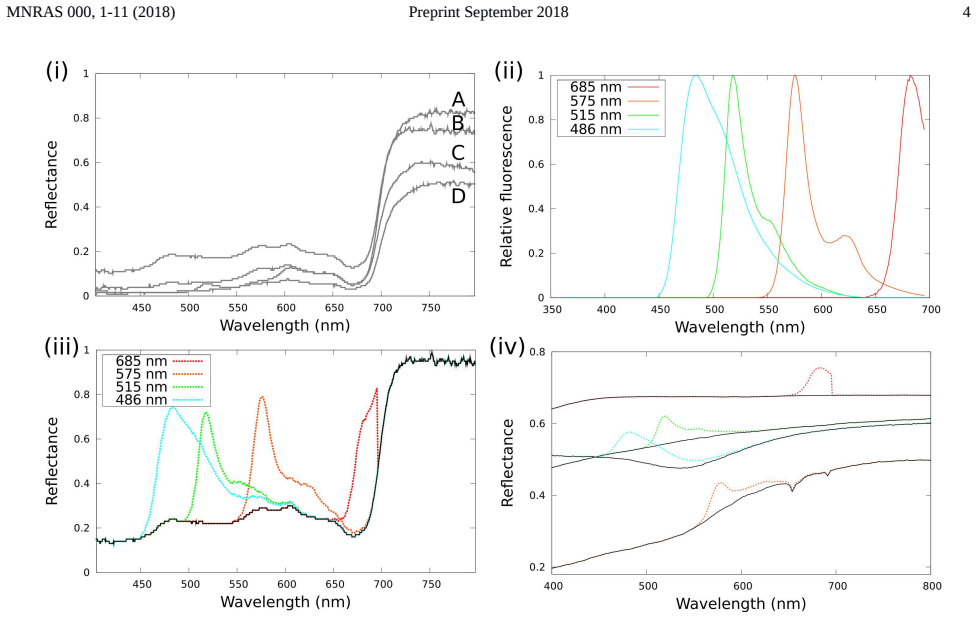
The load-bearing machinery is the Stokes-shift fluorescence of coral-like pigments and proteins—absorption of ultraviolet and blue photons followed by emission of lower-energy visible photons—parameterised by four emission peaks at 486, 515, 575, and 685 nm, their excitation ranges, and fluorescence efficiencies (3–5 percent, 10–12 percent, 8–10 percent, and 1–2 percent for Earth-like corals, and up to 100 percent for engineered proteins). The model couples these emission profiles to coral reflectance spectra, an Earth-like atmospheric radiative-transfer calculation, and cloud albedo, producing synthetic planet spectra and colour-colour positions. The same machinery generates the false-positive comparison: fluorescent minerals with similar emission wavelengths remain separable because non-biological fluorescence is not expected to be strong enough or shaped by selection.
What would settle it
One concrete test is observational: with a telescope capable of resolving orbits near 6 milliarcseconds, observe a sample of the nearest F-star habitable-zone planets out to roughly 300 pc at the four prediction wavelengths; if no rocky planet with clear skies and abundant surface water shows the predicted 486, 515, 575, or 685 nm flux enhancements, the detectability claim fails. On the biological side, laboratory irradiation experiments showing that GFP-like proteins under continuous F-star-level ultraviolet bleach irreversibly before reaching 10–100 percent efficiency under ecologically realistic repair conditions would falsify the biosphere premise.
Extended reading notes
Core claim
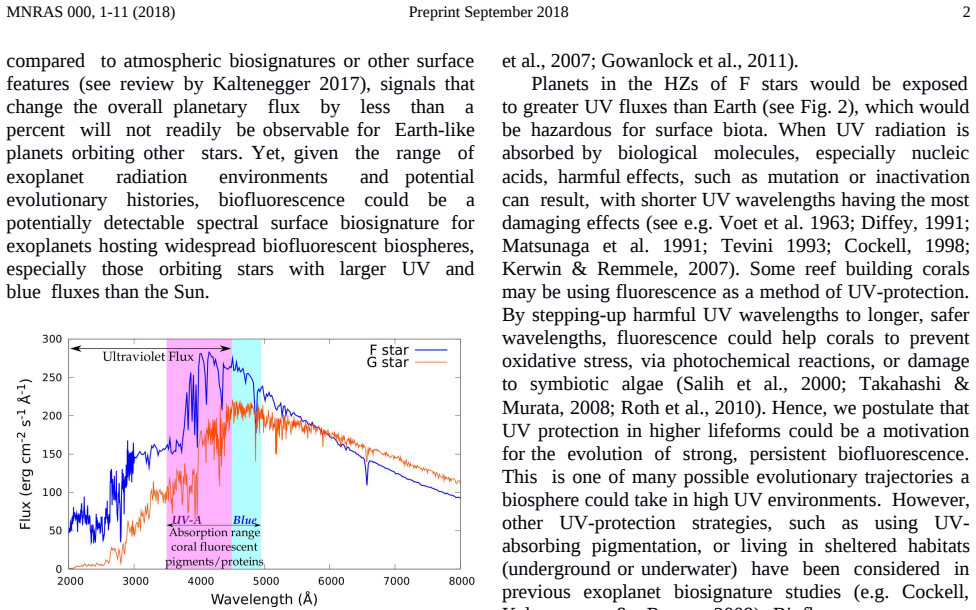
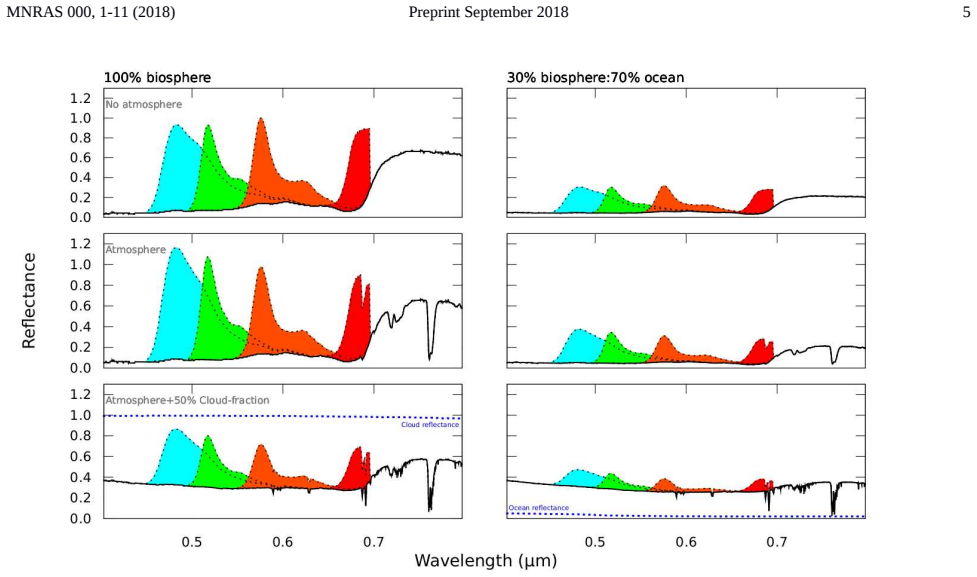
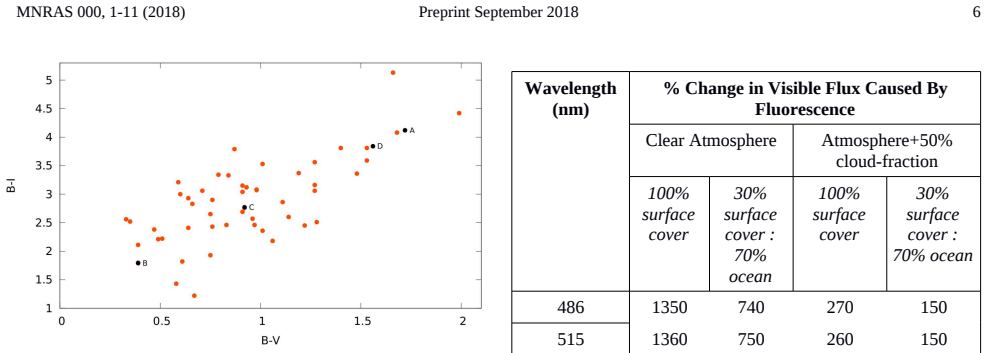
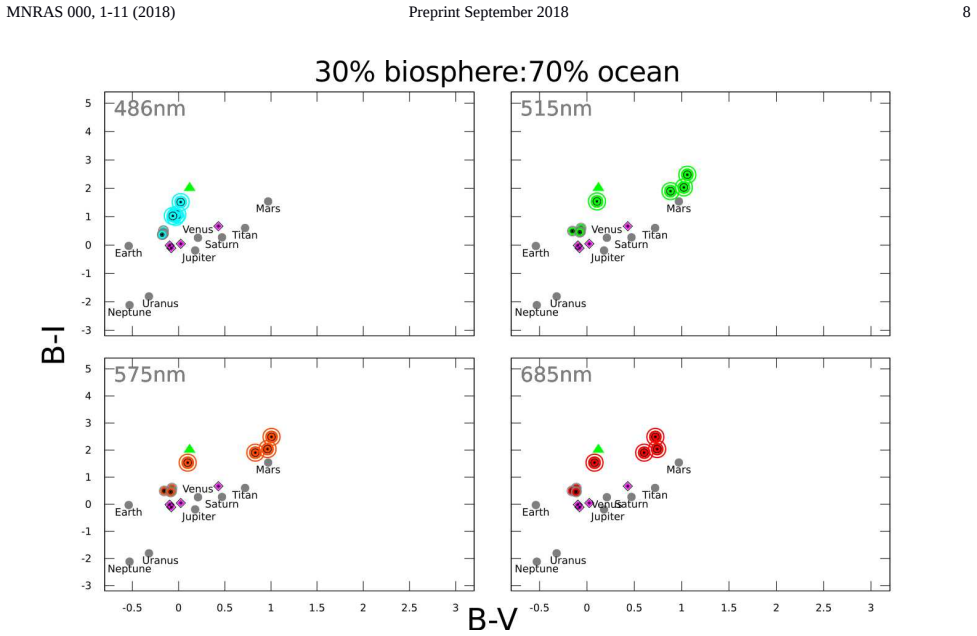
On the paper's own terms, the central discovery is that a globally widespread biofluorescent biosphere, modelled on shallow-water coral reefs, would leave a distinctive, wavelength-specific imprint on an exoplanet's spectrum. Under an F0 star's radiation environment, absorbed ultraviolet and blue photons are re-emitted at 486, 515, 575, and 685 nm; when 30 to 100 percent of the surface ocean is covered and fluorescence efficiency is high, the extra emission can brighten the disk-averaged visible flux by tens to over a thousand percent at those peaks, and can push apparent reflectance above 100 percent in the blue. These fluorescent surfaces occupy a region of colour-colour space distinct from fluorescent minerals, vegetation (with one cyan-wavelength exception), and solar system bodies, so the paper concludes that biofluorescence is a viable surface biosignature for F-star planets and that colour-colour diagrams can help select targets for follow-up observations.
Load-bearing premise
The load-bearing premise is biological: an F-star planet must be able to evolve and maintain a globally widespread shallow-ocean biosphere of coral-like fluorescent organisms covering 30 to 100 percent of its ocean surface, with fluorescence efficiencies reaching near 100 percent, instead of adopting other ultraviolet-protection strategies such as shielding pigments or sheltered habitats.
Editorial extensions
If this is right
- Target selection: colour-colour diagrams that include the modelled fluorescent-biosphere positions will separate F-star habitable-zone planets with potential surface life from mineral, vegetation-like, and solar-system-like surfaces, letting surveys prioritise the best candidates for follow-up spectroscopy.
- Observational strategy: because the signal is wavelength-specific and tied to the surface, short observations confined to roughly 1/20 of a planet's rotation period can separate fluorescent surface patches from clouds, which vary over the full rotation.
- Strong-signature regime: any planet whose biofluorescence evolved as ultraviolet protection—motivated by high F-star ultraviolet flux and weak ozone—would show the largest enhancements toward the inner edge of the habitable zone, where exciting flux is greatest, provided the atmosphere remains clear and water-rich conditions do not shroud the surface.
- False-positive control: fluorescent mineral surfaces occupy different colour space than coral-like surfaces, and 486 nm fluorescence is the only modelled case that overlaps vegetation, so multi-band observations at the remaining peaks would disambiguate a biofluorescent biosphere from minerals and vegetation.
Reading between the lines
- My inference: if biofluorescence is a successful ultraviolet-protection strategy, the best targets are F-star planets with low-oxygen, low-ozone atmospheres, because their surfaces receive the strongest ultraviolet; future missions could prioritise planets showing spectral hints of weak ozone and clear skies.
- My inference: tidal forcing from a large moon could drive nutrient-driven blooms in a shallow-water fluorescent biosphere, producing a periodic strengthening of the 486–685 nm emission that could be separated from the planet's rotation and cloud cycle in time-series photometry.
- My inference: the photobleaching problem gives a falsifiable evolutionary constraint—persistent fluorescence on a high-ultraviolet world would require reversibly switchable fluorescent proteins or quantum-dot-like organic nanoparticles, so any detection of a persistent signal would indirectly constrain the biochemistry of the biosphere.
- My inference: a single bright emission peak, especially at 486 nm, would be ambiguous with vegetation; a secure biosignature claim requires at least two of the four modelled peaks or a peak at 515, 575, or 685 nm together with a blue apparent-reflectance excess above 100 percent.
Signed reviews
Editorial analysis
A structured set of objections, weighed in public.
Referee Report
Summary. This paper proposes biofluorescence as a new surface biosignature for exoplanets, specifically for planets in the habitable zones of F stars. The authors use measured absorption and emission spectra of four common coral fluorescent pigments/proteins (peaks at 486, 515, 575, and 685 nm), combine them with an F0 stellar spectrum and the EXO-Prime atmosphere model, and compute the additional emitted flux for varying surface coverage, cloud fraction, and fluorescence efficiency. They report flux enhancements of 8–160% for Earth-like efficiencies and up to ~1360% for 100% efficiency, and show that model biofluorescent surface spectra occupy distinct regions in BVI color-color diagrams compared to fluorescent minerals, vegetation, and solar system bodies. They argue that the angular separation of F-star habitable-zone planets is sufficient for direct observation with the E-ELT out to ~300 pc.
Significance. The paper presents a novel and well-posed forward model: the input coral spectra are from real measurements, the parameter ranges (coverage, efficiency, cloud cover) are explicitly varied, and the color-color diagrams provide a concrete framework for comparing fluorescent biospheres with abiotic surfaces. The scientific contribution is a new spectral feature that has not previously been evaluated for exoplanets, with quantitative predictions that can be tested by future instrument simulators and observing programs. The authors are transparent about the speculative biological assumptions and explore a wide parameter space, which strengthens the usefulness of the work even if the specific scenario is not guaranteed to occur in nature.
major comments (2)
- [Section 4.1, Table 4] The detectability argument rests entirely on angular separation. The paper shows that a habitable-zone planet around an F star within ~300 pc would be resolvable with a 6 mas inner working angle, but it never computes the planet-star contrast ratio or the signal-to-noise required to measure the 10–160% flux changes in Tables 2 and 3. An Earth-radius planet at ~1 AU from an F star has a reflected-light flux ratio on the order of 10^-9 to 10^-10 relative to the star; the proposed fluorescence excess is a fraction of that already tiny planetary signal. Without a contrast and SNR estimate, the conclusion in Section 5 that such a biosphere 'could be inferred from observations with upcoming telescopes' is not supported. The paper's own statement that observations 'will be challenging' and the caveat that the color-color diagrams are intended as input for instrument simulators stop short of demonstrating actual detectability.
- [Section 3 and Section 4.2] The predicted signal strengths depend on an extreme biological premise: that 30–100% of the planet's surface ocean is covered by biofluorescent organisms with fluorescence efficiencies up to 100%. The authors correctly label this as an assumption, and they note that other UV-protection strategies (UV-absorbing pigments, sheltered habitats) are plausible alternatives in Section 4.2. However, the central claim of a detectable biosignature is load-bearing on the feasibility of such a globally dominant biofluorescent biosphere, and the paper offers no quantitative argument for why this coverage could arise beyond the qualitative UV-protection hypothesis. Terrestrial corals cover only ~0.2% of the ocean floor, so the jump to 30–100% is enormous. A sensitivity analysis at lower, perhaps more realistic, coverage fractions would help the reader assess the robustness of the proposed observable signal.
minor comments (5)
- [Section 3 (Methods)] The word 'deterine' appears in the sentence describing the addition of fluorescence to the reflected photon flux; it should be 'determine'.
- [Section 4.1] 'emittane' should be 'emittance' in the phrase 'reflectance/emittane feature that exceeds 100% reflectivity'.
- [References] The reference to 'Monrise et al.' should be 'Morise et al.' (1974); the in-text citation in Section 4.3 to 'Henerson et al.' should be 'Henderson et al.' (2007).
- [Section 5 (Conclusions)] The word 'succesfully' should be 'successfully'.
- [Section 4.1] The phrase 'exceeds 100% reflectivity' is ambiguous because the apparent reflectance exceeding unity is only in the planetary spectrum relative to the incident stellar flux at that wavelength, not an actual surface reflectivity; consider rewording for clarity.
Circularity Check
No circularity: the biofluorescence signal is a forward radiative calculation from measured coral spectra and independent atmospheric models, not a fit to the claimed result.
full rationale
The paper's derivation is a self-contained forward model rather than a circular one. The fluorescence inputs are externally measured terrestrial data: the four coral fluorescent pigment/protein absorption and emission characteristics (Mazel & Fuchs 2003; Fuchs 2001; Zawada & Mazel 2014), coral reflectance spectra (Roelfsema & Phinn 2006; Clark 2007), and USGS/ASTER mineral spectra for false-positive comparisons. The atmospheric radiation environment is taken from the independently published EXO-Prime model (Kaltenegger & Sasselov 2010) and Rugheimer et al. (2015), which do not contain the fluorescence result. The central calculation, described in Section 3, takes the photon flux over each pigment's excitation range, multiplies by an assumed fluorescence efficiency, and adds the resulting emitted photons to the reflected flux; Tables 2 and 3 are the direct outcome of that scaling, not quantities fitted to make the biosignature appear. The biological premise of globally widespread biofluorescent life is explicitly labeled as an assumption ('We begin with the assumption that the surface ocean is globally inhabited by biofluorescent life'), and the paper explores coverage and efficiency ranges rather than tuning them to a preconceived detection. Self-citations to EXO-Prime, prior HZ calculations, and earlier biosphere work are citation of modelling infrastructure and context, not load-bearing circular evidence: none of those cited results asserts or presupposes a biofluorescent exoplanet signal. The observability discussion in Section 4.1 is underdeveloped because it relies only on angular separation and does not compute planet-star contrast or signal-to-noise, but that is a gap in the strength of the detection claim, not a circular reduction of the spectral prediction to its inputs. Overall, no step in the claimed derivation chain is equivalent by construction to its own inputs, so the circularity score is 0.
Assumptions & free parameters
free parameters (6)
- Quantum efficiency of 486 nm coral pigment =
3-5% (Earth-like), up to 100% in high-efficiency scenario
- Quantum efficiency of 515 nm coral pigment =
10-12%, up to 100%
- Quantum efficiency of 575 nm coral pigment =
8-10%, up to 100%
- Quantum efficiency of 685 nm coral pigment =
1-2%, up to 100%
- Biofluorescent surface coverage fraction =
100% and 30% (with 70% open ocean)
- Cloud cover fraction =
0% and 50% (Earth-like)
assumptions (6)
- domain assumption Coral fluorescent pigments and proteins from Earth represent plausible alien biofluorescence.
- domain assumption A planet can sustain 30-100% global surface coverage by biofluorescent life in shallow transparent oceans.
- domain assumption Biofluorescence can evolve as a UV-protection strategy and persist despite photobleaching.
- domain assumption Abiotic fluorescence from minerals and PAHs is too weak to mimic the signal.
- domain assumption EXO-Prime 1D climate and radiative transfer code correctly predicts F0-star surface UV flux and outgoing spectra.
- domain assumption A present-day Earth-like atmosphere, including ozone, is appropriate for an F-star planet hosting a biosphere.
Cite this review
Pith. "Pith review of Biofluorescent Worlds I: Global Biological Fluorescence as a Biosignature." pith.science (2026). https://pith.science/paper/CEQN24YS
@misc{pith2026190804089,
  author       = {Pith},
  title        = {Pith review of: Biofluorescent Worlds I: Global Biological Fluorescence as a Biosignature},
  year         = {2026},
  howpublished = {\url{https://pith.science/paper/CEQN24YS}},
  note         = {Machine review of arXiv:1908.04089}
}
read the original abstract
In this paper, we analyze a new possible biological surface feature for habitable worlds orbiting other stars: biofluorescence. High ultraviolet (UV) and blue radiation fluxes drive the strongest biofluorescence in terrestrial fluorescent pigments and proteins. F stars emit more blue and UV radiation than the Sun, while planets and exomoons orbiting such stars remain in the habitable zone for 2-4 Gyr; a timespan that could allow a complex biosphere to develop. Therefore we propose biofluorescence as a new surface biosignature for F star planets. We investigate how the extra emission from surface fluorescence could cause observable signals at specific wavelengths in the visible spectrum. Using the absorption and emission characteristics of common coral fluorescent pigments and proteins, we simulate the increased emission at specific visible wavelengths caused by strong fluorescence, accounting for the effects of different (non-fluorescent) surface features, atmospheric absorption and cloud-cover. Our model shows that exoplanets with a fluorescent biosphere could have characteristic surface colours that allow the presence of surface life to be inferred from observations with upcoming telescopes.
Figures

Figures from the paper (4 more)

Reference graph
Works this paper leans on
-
[1]
Abe Y., Abe-Ouchi A., Sleep N. H., Zahnle K. J., 2011, Astrobiology, 11, 443 Ando R., Mizuno H., Miyawaki A., 2004, Science, 306, 1370
work page 2011
-
[2]
Arney, G. et al. 2016, Astrobiology 16, 73 Beltr an J. L., Ferrer R., Guiteras J., 1998, Analytica chimica acta, 373, ́ 311 Bounama C., von Bloh W., Franck S., 2007, Astrobiology, 7, 745 Clark R. N., 2007, USGS Digital Spectral Library splib06a, Data Series 231 Cockell C. S., 1998, J. Theor Biol, 193, 717 Cockell C. S., 1999, Planetary and Space Science, ...
work page Pith review arXiv 2018
-
[3]
2017, PNAS, p.201701053 Takahashi S., Murata N., 2008, Trends in plant science, 13, 178 Tevini M
Taboada, C., et al. 2017, PNAS, p.201701053 Takahashi S., Murata N., 2008, Trends in plant science, 13, 178 Tevini M. (ed.), 1993, In: UV-B Radiation and Ozone Deple- tion: Effects on Humans, Animals, Plants, Microorganisms, and Materials (Boca Raton, Florida: Lewis Publishers) Traub W. A., Stier M. T., 1976, Applied Optics, 15, 364 Tsien R. Y., 1998, Ann...
work page 2018
Reviewed August 14, 2026 · model on record in the stance chip above.
Discussion (0). Continue with ORCID to comment.