REVIEW 4 major objections 4 minor 34 references
Cosmological comoving behavior of the configurational entropy
T0 review · 4 major / 4 minor · reviewed 2026-08-14 · deepseek-v4-flash
Pith's one-line read The paper claims that configurational entropy has a comoving invariant in flat FRW cosmology: $a^3$ for radiation and $a^{3/2}$ for non-relativistic fermionic matter.
desk verdict The cosmological CE idea is new and the paper is readable, but the central a^{-3} radiation scaling contradicts the paper's own normalized modal fraction, so the main result collapses. read the letter →
The pith
A machine-rendered reading of the paper's core claim, the machinery that carries it, and where it could break.
The reading
What carries the argument
The load-bearing object is the modal fraction $\epsilon(k) = |G(k)|^2 / \int_{\mathbb{R}^n} |G(k')|^2 d^n k'$, built from the Fourier transform $G(k)$ of the energy density profile; the configurational entropy is $S_{CE}[G] = -\int_{\mathbb{R}^n} \epsilon^{\diamond}(k) \log \epsilon^{\diamond}(k)\, d^n k$ with $\epsilon^{\diamond} = \epsilon / \epsilon_{\max}$. The key identification is $\rho_i \propto \int_{\mathbb{R}^n} |G(k)|^2 d^n k$, so each cosmic fluid's momentum distribution plays the role of the localizing energy profile. The machinery then converts the scale-factor dependence of the temperature, $T \propto a^{-1}$, into a definite $a$-dependence of $S_{CE}$: no extra dynamics is needed beyond the equilibrium distribution and the Friedmann scale factor.
What would settle it
Evaluate the configurational entropy for ultrarelativistic radiation directly in the dimensionless variable $y = p/T$. Because $T \propto a^{-1}$, the normalized equilibrium distribution $f(y)$ is independent of $a$, so the normalized modal fraction and $S_{CE}$ are also independent of $a$, predicting $dS_{CE}/d\log_2 a = 0$ rather than $3$. Repeating the numerical integration after removing any $a$-dependent cutoff or with a different normalization of $G(k)$ in the identification step would settle whether the reported comoving scaling is a property of the CE or an artifact of the identification.
Extended reading notes
Core claim
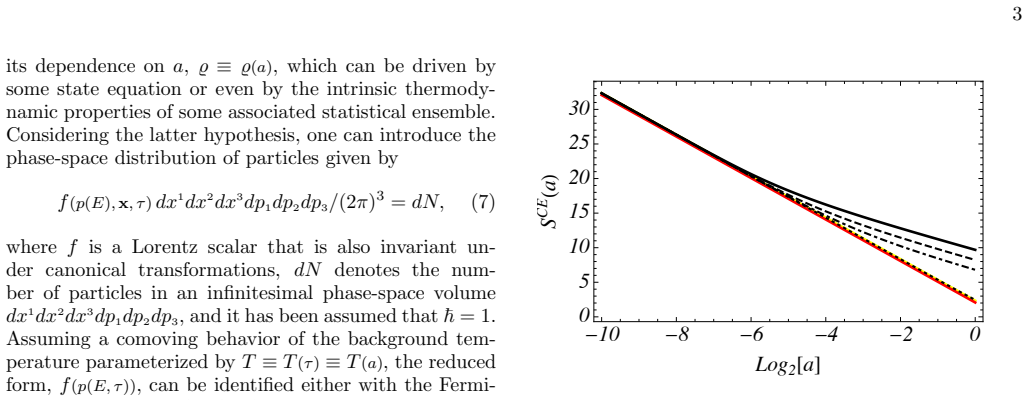
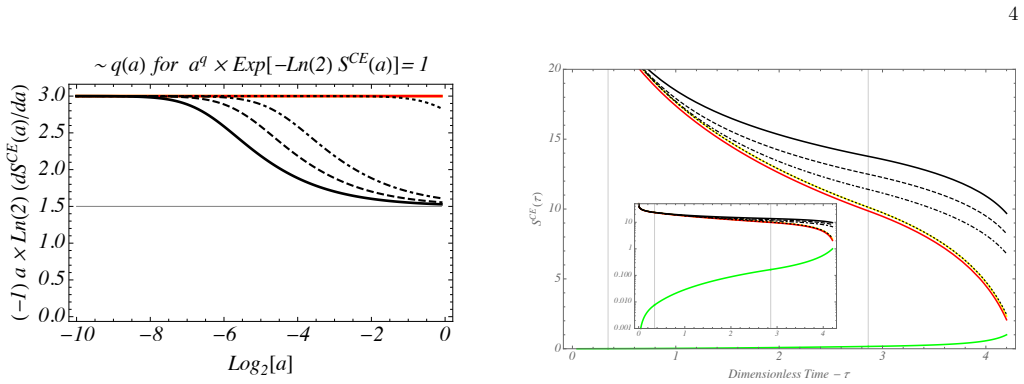
The central claim is that the configurational entropy $S_{CE}(a)$ of cosmological fluids satisfies an approximate comoving invariant in a flat FRW background: $a^{q(a)}\exp[-\ln(2) S_{CE}(a)] \approx \text{const}$, with $q=3$ for ultrarelativistic fermions and photons and $q=3/2$ for non-relativistic fermionic matter. Equivalently, $S_{CE} \approx q \log_2 a$ in each regime. The claim is established by identifying the integrated energy density of each fluid with the squared magnitude of the Fourier transform of its energy profile, constructing the modal fraction from the equilibrium phase-space distributions, and integrating numerically; the two exponents are exact in the ultra- and non-relativistic limits, with a smooth interpolation in between.
Load-bearing premise
The whole argument rests on treating the momentum-space distribution of a homogeneous cosmic fluid as if it were the localized spatial energy profile for which configurational entropy was originally defined; if that analogy is not valid, the computed exponents are not consequences of the CE construction.
Editorial extensions
If this is right
- During a radiation-dominated era, $a^3 \exp[-\ln(2) S_{CE}]$ is conserved for both fermionic and bosonic radiation, so the radiation CE is slaved to the expansion factor.
- During a matter-dominated era, the same combination with $a^{3/2}$ is conserved for non-relativistic fermionic matter, giving a slower logarithmic growth of information content.
- The pattern extends to a simplified $\Lambda$CDM background, and at late times the CE of ultrarelativistic fluids is suppressed more strongly than that of cold dark matter, making cold dark matter the dominant informational component at present.
- Since the construction uses only equilibrium distribution functions, the same computation can be repeated for any fluid component of the cosmic inventory without introducing additional parameters.
Reading between the lines
- A testable extension is to check the radiation case analytically with $y=p/T$: because the normalized distribution is independent of $a$ when $T\propto a^{-1}$, this route predicts a nearly constant $S_{CE}$, so the reported slope may be tied to the normalization choice in the identification step.
- If the comoving invariant is genuine, it suggests defining a comoving information density from $S_{CE}$ analogous to energy density, which the paper does not formalize.
- The same machinery could be applied to non-relativistic bosons, interacting fluids, or cosmic perturbations with localized profiles; the exponents for those cases are not computed here, so whether $3$ and $3/2$ generalize remains open.
- Because CE critical points identify dominant modes in localized systems, a cosmological version might flag preferred scales in perturbation spectra; the paper stops at the homogeneous background.
Editorial analysis
A structured set of objections, weighed in public.
Referee Report
Summary. The manuscript applies the concept of configurational entropy (CE) to the homogeneous FRW flat-universe background by identifying the momentum-space distribution functions of photons, ultra-relativistic fermions, and non-relativistic fermions with the Fourier-space energy profile G(k). It claims, in the abstract and in Section IV, that the CE density evolves as a^{-3} for fermionic and bosonic radiation and as a^{-3/2} for non-relativistic fermionic matter, and that a^q exp[-ln2 S_CE] is approximately constant in each epoch. The paper reports numerical results in Figs. 1-3 and extends the discussion to the ΛCDM background.
Significance. If the claimed comoving behavior were correct, it would establish a new informational invariant for the cosmological background and extend the CE framework to standard-model cosmology. The manuscript has the strength of asking a clear question about whether an information-theoretic measure can be assigned to a homogeneous background, and it honestly notes that localization is absent for the background. However, the central claim is contradicted by the paper's own definitions, and the numerical results are not reproducible from the text because the explicit formula for S_CE is never given. These issues are load-bearing and undermine the main conclusions.
major comments (4)
- [Section III, Eqs. (3)-(5) and (10)-(11)] The claimed a-dependence of S_CE for radiation is internally inconsistent with the definition of the modal fraction. For photons and ultra-relativistic fermions, the integrands in Eqs. (10) and (11) are functions of p/T only. After the change of variables y = p/T, the normalized modal fraction ε(k) = |G(k)|^2 / ∫|G(k)|^2 d^3k is explicitly independent of T, and hence of a (since T ∝ a^{-1} in the FRW comoving frame). Therefore S_CE in Eq. (4) must be exactly constant for radiation, contradicting Figs. 1-2 and the abstract's claim that q = 3. This is not a matter of external consensus but an internal inconsistency of the paper's own equations.
- [Section III, paragraph beginning 'Finally, by following the identification from Eq. (5)'] The manuscript does not provide the explicit formula used to compute S_CE from f±. Eq. (5) identifies ϱ_i with ∫|G(k)|^2 d^nk, but the integrands in Eqs. (10)-(12) are p times the distribution function (or E times the distribution), not squared amplitudes. The mapping from f±(p) to |G(k)|^2, and the resulting ε(k), are never written in the text. As a consequence, the central numerical results in Figs. 1-3 cannot be independently checked, and the apparent contradiction with the Gaussian-limit calculation cannot be resolved.
- [Section IV, paragraph beginning 'Therefore, as a preliminary assumption'] The comoving behavior is posited as an assumption, not derived. The text states that any alternative consistent definition of the information content of the Universe 'should at least obey a similar comoving behavior' and then asserts that it is 'natural to expect' the condition d(a^n e^{-ln2 S_CE})/da = 0. The subsequent 'showing' that the numerically computed S_CE satisfies this condition is therefore circular: the exponents q are read off from the logarithmic derivative of the computed curve (Fig. 2) rather than predicted from the distribution functions. The conclusion that CE evolves as a^{-3} is thus an imposed constraint, not an emergent result.
- [Section III, non-relativistic fermionic component] For non-relativistic fermions with M ≫ T, the Fermi-Dirac distribution approaches the Maxwell-Boltzmann form exp[-(M + p^2/2M)/T], so the normalized modal fraction becomes a Gaussian of width σ² = M T. For this Gaussian, the CE defined by Eq. (4) is either exactly constant (if ε⋄ = ε/εmax is used) or scales as -(3/2) log a (if ε is used directly), and in neither case does it scale as +(3/2) log a as claimed. The missing explicit formula prevents a definitive check, but this asymptotic argument indicates that the reported q = 3/2 is not a consequence of the standard CE definitions.
minor comments (4)
- [Abstract and Section IV] The phrase 'CE evolves with a^{-3}' is imprecise: S_CE is a dimensionless entropy as defined in Eq. (4), while the quantity that behaves as a^{-3} is actually exp[-ln2 S_CE] if the stated condition holds; the text should consistently distinguish the two.
- [Figure 2] The label '(-1)^q × q(a)' is unclear and the function q(a) is not explicitly defined in the text; the values q = 3 and q = 3/2 should be defined precisely, including their relation to dS_CE/dlog2(a).
- [References] Reference [18] appears to be missing a closing bracket in 'arXiv:1807.04540 [nucl-th].'.
- [Section IV] The sentence 'That circumstantial comoving behavior shows...' would be clearer as 'This comoving behavior shows...'.
Circularity Check
Comoving exponents are read off from the numerical derivative and reduce to the assumed T(a)∝a^{-1} scaling of the momentum-space measure; the normalized modal fraction is scale-invariant for radiation.
-
self definitional
[Sect. III, paragraph after Fig. 2 (definition of q via dS_CE/dlog2 a)]
"Such a non expected comoving behavior shows that CE evolves as an approximated functional intrinsically given by a^{q(a)} exp [− ln(2)S_CE(a)] with q(a) = 3 for fermionic and bosonic radiation, and with q = 3/2 for non-relativistic fermionic matter. For the extreme of ultra- and non-relativistic regimes, the results for q are exact and correspond to the values of the logarithmic derivative of S_CE, dS_CE/dlog2(a), as it can be depicted in Fig. 2."
The quantity q(a) is not independently derived. By the chain rule, a^{q(a)} exp[-ln2 S_CE(a)] is constant in each regime precisely when q(a)=dS_CE/dlog2 a. Thus the 'comoving behavior' is an identity defining q as the slope of the numerically computed curve, and the reported exponents are the fitted slopes, not a prediction from the CE definition. The statement that the two sides match is the definition of q, not a physical result.
-
renaming known result
[Sect. III, Eqs. (3), (5), (10)-(12) and Fig. 1]
"Assuming a comoving behavior of the background temperature parameterized by T≡T(τ)≡T(a) ... by following the identification from Eq. (5), after numerical integrations, the CE is depicted in Fig. 1 ... Such a non expected comoving behavior shows that CE evolves as an approximated functional intrinsically given by a^{q(a)} exp [− ln(2)S_CE(a)] with q(a) = 3 for fermionic and bosonic radiation, and with q = 3/2 for non-relativistic fermionic matter."
The only a-dependence in the calculation is the assumed T(a)∝a^{-1} inserted into the momentum distributions and the momentum-space measure d³p. With the normalized modal fraction of Eq. (3), ε(k)=|G(k)|²/∫|G|²d³k, a radiation distribution of the form f(p/T) yields a T-independent ε, so S_CE is a-independent; nonzero q requires retaining the unnormalized measure or an alternative normalization. In that case a^{-3} and a^{-3/2} are just the standard T³ (radiation) and (mT)^{3/2} (nonrelativistic matter) scalings of the momentum-space/entropy-density volume. The CE label renames the known temperature-redshift scaling rather than deriving a new comoving invariant.
full rationale
Most of the paper is self-contained: the CE is defined by Eqs. (1)-(4) and evaluated numerically from standard Fermi/Bose distributions, with no circular dependence on the authors' prior papers. However, the paper's headline result is circular in a specific sense. The quantity q is introduced through the ansatz a^q exp[-ln2 S_CE]=const, and then Fig. 2 literally uses q=dS_CE/dlog2 a. That makes the comoving relation an identity. The numerical values q=3 and 3/2 are not derived from the CE functional; under the normalized modal fraction Eq. (3) they are forced to be zero for any scale-invariant radiation distribution. The q values instead track the momentum-space measure d³p = T³ d³y (or (mT)^{3/2}), i.e., the standard T(a) redshift law. The authors' closing remark that localization is absent in the homogeneous background and only appears for cosmic perturbations reinforces that the background 'CE' is an analogy; its a-dependence is inserted by the T(a) assumption. No external benchmark or independent test of the q values is provided. I therefore score 6: the central 'comoving behavior' claim reduces, by construction, to the assumed temperature scaling and to the definition of q as a log-derivative.
Assumptions & free parameters
free parameters (1)
- M (fermion mass in units of kBT0) =
2, 50, 100, 200
assumptions (3)
- domain assumption The energy density integral equals ∫|G(k)|^2 d^n k (Eq. 5), so the momentum-space amplitude can be treated as the profile whose modal fraction defines the CE.
- domain assumption Thermal distributions f±(E,T) with T ∝ a^{-1} and μ/T constant describe the cosmic inventory (Eqs. 7-9).
- ad hoc to paper The CE must obey a comoving behavior d(a^q 2^{-S_CE})/da = 0 (Sect. IV), taken as a preliminary assumption.
Cite this review
Pith. "Pith review of Cosmological comoving behavior of the configurational entropy." pith.science (2026). https://pith.science/paper/FN5Y6SDB
@misc{pith2026190804095,
  author       = {Pith},
  title        = {Pith review of: Cosmological comoving behavior of the configurational entropy},
  year         = {2026},
  howpublished = {\url{https://pith.science/paper/FN5Y6SDB}},
  note         = {Machine review of arXiv:1908.04095}
}
abstract
It has been shown that a functional dependence of the configurational entropy (CE) density exhibits a cosmological comoving behavior related to the scale parameter, $a$, of the FRW flat universe. Such a circumstantial comoving behavior shows that the CE evolves with $a^{-3}$ for fermionic and bosonic radiation and with $a^{-3/2}$ for non-relativistic fermionic matter. The results are discussed in the domain of matter and radiation, as well as in a simplified context of the $\Lambda$CDM cosmology. Our results suggest that the CE can work as a theoretical driver for particle and nuclear interactions in the context of large scale cosmic events.
Figures
Reference graph
Works this paper leans on
-
[1]
Witten, A Mini-Introduction To Information Theory, [arXiv:1805.11965 [hep-th]]
E. Witten, A Mini-Introduction To Information Theory, [arXiv:1805.11965 [hep-th]]
-
[2]
C. E. Shannon, Bell Syst. Tech. J. 27 (1948) 379; 623
work page 1948
-
[3]
M. Gleiser and N. Stamatopoulos, Phys. Lett. B 713 (2012) 304 [arXiv:1111.5597 [hep-th]]
arXiv 2012
-
[4]
M. Gleiser and N. Stamatopoulos, Phys. Rev. D 86 (2012) 045004 [arXiv:1205.3061 [hep-th]]
arXiv 2012
-
[5]
M. Gleiser and N. Graham, Phys. Rev. D 89 (2014) 083502 [arXiv:1401.6225 [astro-ph.CO]]
arXiv 2014
-
[6]
M. Gleiser and D. Sowinski, Phys. Lett. B 747 (2015) 125 [arXiv:1501.06800 [cond-mat.stat-mech]]
arXiv 2015
-
[7]
A. E. Bernardini, N. R. F. Braga and R. da Rocha, Phys. Lett. B 765 (2017) 81 [arXiv:1609.01258v1 [hep-th]]
arXiv 2017
-
[8]
A. E. Bernardini and R. da Rocha, Phys. Rev. D 98 (2018) 126011 [arXiv:1809.10055 [hep-th]]
arXiv 2018
Show all 34 references
-
[9]
L. F. Ferreira and R. da Rocha, Phys. Rev. D 99, 086001 (2019) [arXiv:1902.04534 [hep-th]]
2019 arXiv
-
[10]
N. R. F. Braga and R. da Rocha, Phys. Lett. B 776 (2018) 78 [arXiv:1710.07383 [hep-th]]
2018 arXiv
-
[11]
A. E. Bernardini and R. da Rocha, Phys. Lett. B 762 (2016) 107 [arXiv:1605.00294 [hep-th]]
2016 arXiv
-
[12]
N. R. F. Braga and R. da Rocha, Phys. Lett. B 767 (2017) 386 [arXiv:1612.03289 [hep-th]]
2017 arXiv
-
[13]
C. O. Lee, Phys. Lett. B 772, 471 (2017) [arXiv:1705.09047 [gr-qc]]
2017 arXiv
-
[14]
Sowinski and M
D. Sowinski and M. Gleiser, J. Stat. Phys. 167 (2017) no.5, 1221 [arXiv:1606.09641 [cond-mat.stat-mech]]
2017 arXiv
-
[15]
Gleiser, M
M. Gleiser, M. Stephens and D. Sowinski, Phys. Rev. D 97 (2018) 096007 [arXiv:1803.08550 [hep-th]]
2018 arXiv
-
[16]
Colangelo and F
P. Colangelo and F. Loparco, Phys. Lett. B 788 (2019) 500 [arXiv:1811.05272 [hep-ph]]
2019 arXiv
-
[17]
Karapetyan, Phys
G. Karapetyan, Phys. Lett. B 781 (2018) 201 6 [arXiv:1802.09105 [nucl-th]]
2018 arXiv
- [18]
-
[19]
Karapetyan, EPL 117 (2017) 18001 [arXiv:1612.09564 [hep-ph]]
G. Karapetyan, EPL 117 (2017) 18001 [arXiv:1612.09564 [hep-ph]]
2017 arXiv
-
[20]
Karapetyan, EPL 118 (2017) 38001 [arXiv:1705.10617 [hep-ph]]
G. Karapetyan, EPL 118 (2017) 38001 [arXiv:1705.10617 [hep-ph]]
2017 arXiv
-
[21]
N. R. F. Braga, L. F. Ferreira and R. da Rocha, Phys. Lett. B 787 (2018) 16 [arXiv:1808.10499 [hep-ph]]
2018 arXiv
-
[22]
Goncalves and R
A. Goncalves and R. da Rocha, Phys. Lett. B 774 (2017) 98 [arXiv:1706.01482 [hep-ph]]
2017 arXiv
-
[23]
C. W. Ma, Y. G. Ma, Prog. Part. Nucl. Phys. 99 (2018) 120 [arXiv:1801.02192 [nucl-th]]
2018 arXiv
-
[24]
Gleiser and D
M. Gleiser and D. Sowinski, Phys. Lett. B 727 (2013) 272 [arXiv:1307.0530 [hep-th]]
2013 arXiv
-
[25]
Gleiser and N
M. Gleiser and N. Jiang, Phys. Rev. D 92 (2015) 044046 [arXiv:1506.05722 [gr-qc]]
2015 arXiv
-
[26]
R. A. C. Correa, P. H. R. S. Moraes, A. de Souza Du- tra and R. da Rocha, Phys. Rev. D 92 (2015) 126005 [arXiv:1508.04493 [hep-th]]
2015 arXiv
-
[27]
R. A. C. Correa, D. M. Dantas, C. A. S. Almeida and R. da Rocha, Phys. Lett. B 755 (2016) 358 [arXiv:1601.00076 [hep-th]]
2016 arXiv
-
[28]
Bazeia, D
D. Bazeia, D. C. Moreira and E. I. B. Rodrigues, J. Magn. Magn. Mater. 475 (2019) 734
2019
-
[29]
Alves, A
A. Alves, A. G. Dias, R. da Silva, Physica 420 (2015) 1 [arXiv:1408.0827 [hep-ph]]
2015 arXiv
-
[30]
C. P. Ma and E. Bertschinger, Astrophys. J. 455 (1995) 7 [arXiv:astro-ph/9401007]
1995 arXiv
-
[31]
A. E. Bernardini and E. L. D. Perico, JCAP 01 (2011) 10 [arXiv:1012.4500 [astro-ph]]
2011 arXiv
-
[32]
E. L. D. Perico and A. E. Bernardini, JCAP 06 (2011) 001 [arXiv:1102.3996 [astro-ph]]
2011 arXiv
-
[33]
A. E. Bernardini and V. A. S. V. Bittencourt, Astropart. Phys. 41 (2013) 31 [arXiv:1210.7987 [hep-th]]
2013 arXiv
-
[34]
Dodelson, Modern Cosmology: Anisotropies and Inho- mogeneities in the Universe, (Academic Press, New York, 2003)
S. Dodelson, Modern Cosmology: Anisotropies and Inho- mogeneities in the Universe, (Academic Press, New York, 2003)
2003
Reviewed August 14, 2026 · model on record in the stance chip above.
Discussion (0). Continue with ORCID to comment.