REVIEW 2 major objections 5 minor 46 references
Floquet engineering of topological phases protected by emergent symmetries under resonant drives
T0 review · 2 major / 5 minor · reviewed 2026-08-14 · deepseek-v4-flash
Pith's one-line read A resonant drive on alternating sites gives a Z2-symmetric spin chain an emergent Z2×Z2 symmetry, and the sign of a static field switches the resulting symmetry-protected topological phase.
desk verdict A clear, well-derived Floquet protocol that uses an emergent Z2 symmetry to realize Z2 x Z2 SPT phases; worth serious refereeing, with requests for larger-scale numerics and a prethermal-lifetime estimate. read the letter →
The pith
A machine-rendered reading of the paper's core claim, the machinery that carries it, and where it could break.
The reading
What carries the argument
The central object is the emergent $\mathbb{Z}_2$ symmetry $X_o = \prod_{j:\text{odd}} \sigma^x_j$, generated by the resonant $\pi$-pulse that acts only on odd sites. Because the resonant drive satisfies $X_o^2 = 1$, the van Vleck effective Hamiltonian at every truncation order commutes with $X_o$, and the original global $\mathbb{Z}_2$ symmetry supplies the complementary factor $X_e = X_{\text{all}}X_o^{-1}$ on even sites, giving the $\mathbb{Z}_2\times\mathbb{Z}_2$ group. The load-bearing mechanism is that the third-order van Vleck term converts the ordinary Ising interaction into the $\mathbb{Z}_2\times\mathbb{Z}_2$-symmetric cluster interaction $\sigma^z_{j-1}\sigma^x_j\sigma^z_{j+1}$; a Jordan-Wigner transformation then maps the effective spin model to two decoupled Kitaev chains, one on odd and one on even sites, whose individual topological indices determine the phase.
What would settle it
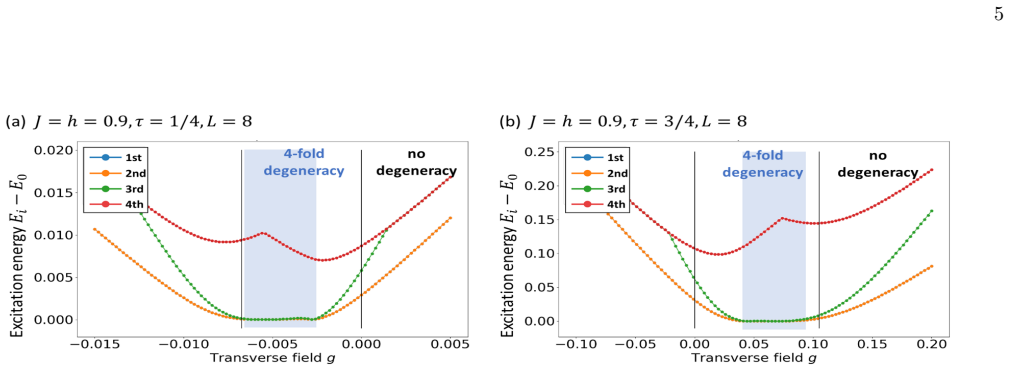
Extend the exact diagonalization of $H_{\rm eff}=\frac{i}{2T}\log U(2T)$ to system sizes beyond $L=8$ and check whether the four-fold ground-state degeneracy persists within the predicted window $-2\gamma<g<0$; if higher-order terms shift the transitions so far that no $g$ in that interval is degenerate, the third-order truncation is not predictive.
Extended reading notes
Core claim
The paper claims that a one-dimensional Ising spin chain with only a global $\mathbb{Z}_2$ symmetry can be made to host nontrivial topological phases protected by an emergent $\mathbb{Z}_2 \times \mathbb{Z}_2$ symmetry. The driving protocol combines a resonant $\pi$-pulse on odd sites, which implants a new $\mathbb{Z}_2$ symmetry at every order of the high-frequency van Vleck expansion, with high-frequency drives whose third-order commutators generate the cluster-type term $\sigma^z_{j-1}\sigma^x_j\sigma^z_{j+1}$. The resulting effective Hamiltonian is $D_3 = (g+\gamma)\sum_j \sigma^x_j + \gamma \sum_j \sigma^z_{j-1}\sigma^x_j\sigma^z_{j+1}$ plus edge terms, with $\gamma = \frac{4J^2h}{3\pi\omega^2}\{2\sin\omega\tau - \omega\tau(1+\cos\omega\tau)\}$. For $\gamma>0$, the system is in a nontrivial $\mathbb{Z}_2\times\mathbb{Z}_2$ SPT phase for $-2\gamma < g < 0$ and trivial otherwise, so reversing the static field direction switches the phase; a perturbation of the resonant pulse yields four distinct phases with independently nontrivial odd- and even-site Kitaev chains.
Load-bearing premise
The whole construction rests on the theorem, taken from the authors' prior work, that a resonant pulse whose one-period unitary squares to the identity implants an emergent extra Z2 symmetry at every order of the high-frequency expansion and that the system stays in the effective static description for an exponentially long time before heating; if that theorem fails or the heating time is too short, the predicted Z2xZ2 SPT phases would not exist.
Editorial extensions
If this is right
- A $\mathbb{Z}_2$-symmetric driven spin chain can realize $\mathbb{Z}_2\times\mathbb{Z}_2$ symmetry-protected topological order without ever adding the second symmetry as a static Hamiltonian term.
- The nontrivial SPT phase is switchable by reversing a static field: for $\gamma>0$ the system is nontrivial for $-2\gamma<g<0$ and trivial outside that window.
- A slight deviation of the resonant pulse from a perfect $\pi$-rotation provides a second control parameter, yielding four distinct SPT phases characterized by the topological indices $(Z_o,Z_e)$ of the two Kitaev chains.
- All four phases can be identified in real-time dynamics from the mean value and amplitude of a nonlocal order parameter that oscillates with period $2T$, in analogy with prethermal discrete time crystals.
- The same symmetry-adding mechanism should extend to resonant drives with $\mathbb{Z}_N$ symmetry and to higher-dimensional systems, enabling SPT phases that are difficult to obtain in equilibrium.
Reading between the lines
- Extension: because the emergent symmetry holds at every order of the van Vleck expansion, a natural next test is to replace the $\pi$-pulse on odd sites with a $2\pi/N$ pulse and search for $\mathbb{Z}_N$-protected or larger SPT phases; the paper sketches this generality but does not demonstrate it.
- Extension: the period-doubled order parameter is prethermal, so an experimental identification of the phases should measure the lifetime of the $2T$ oscillation rather than only its presence, since heating will eventually destroy it.
- Extension: the proposed cold-atom ladder maps the nonlocal order parameter to a two-site boundary observable, so the sign-switch prediction could be tested directly by watching $A(nT)$ while sweeping $g$ through the predicted window.
Editorial analysis
A structured set of objections, weighed in public.
Referee Report
Summary. The manuscript proposes a Floquet engineering scheme in which a one-dimensional Ising chain with only a global Z2 symmetry (plus discrete time-translation symmetry) is driven by a resonant π-pulse on odd sites together with high-frequency transverse fields, so that the stroboscopic 2T dynamics acquire an emergent Z2×Z2 symmetry. Using third-order van Vleck perturbation theory, the authors derive an effective Hamiltonian D3 (Eq. (22)) with a tunable ratio between the σx and σzσxσz terms, which realizes Z2×Z2-protected SPT phases switchable by the sign of a static field g. They verify fourfold ground-state degeneracy by exact diagonalization of the approximation-free effective Hamiltonian for L=8, extend the construction to a flip-error perturbation that yields four distinct phases from two inequivalent Kitaev chains, and propose a dynamical detection via period-doubled nonlocal order parameters. An ultracold-atom implementation is sketched.
Significance. If the claims hold, this is a conceptually interesting route to SPT phases whose protecting symmetry is absent from the original Hamiltonian and is instead generated by the resonant drive. The van Vleck calculation in the Appendix is explicit and internally consistent, and the effective parameters are obtained from microscopic drive amplitudes rather than fitted. The exact-diagonalization checks use the raw Floquet evolution rather than the truncated expansion, and the mapping to two decoupled Kitaev chains gives concrete, falsifiable predictions: fourfold degeneracy when both chains are nontrivial and period-doubled dynamics of a nonlocal order parameter. These are genuine strengths of the paper.
major comments (2)
- [Section VI, Eqs. (42)-(46)] The derivation of the period-doubling signature asserts that '|GS⟩ is an eigenvector of U(2T)', but |GS⟩ was defined as the ground state of \tilde H_eff constructed from \tilde U(2T), which includes the symmetry-breaking 2T-periodic perturbation Hper(t). Unless the perturbation is infinitesimal and the state is confined to the (quasi)degenerate manifold of the unperturbed U(2T), or unless a different preparation protocol is intended, the equality in Eq. (46) does not follow. This is load-bearing for the central dynamical-detection claim, because the correspondence between the four phases and (φo, φe) rests on that equality. Please supply the missing argument, or modify the quench protocol so that the initial state is an eigenstate of the unperturbed U(2T) to the required accuracy.
- [Section II, Eq. (10); Section IV, Fig. 2; Section V, Eq. (33)] The existence of the emergent Z2×Z2 symmetry and the exponentially long prethermal regime is taken as a theorem from Ref. [32] without a self-contained derivation or a quantitative statement of its domain of validity. The exact-diagonalization parameters J=h=0.9, T=1, N=2 used in Figs. 2-4 give λNT=1.8, which is not in the small-parameter regime of the van Vleck/prethermal expansion. The same concern applies to the flip-error analysis, where Eq. (33) requires ε/λT=O((λ/ω)^2) but the ε ranges shown in Figs. 3-4 appear to violate this condition. Since the paper explicitly acknowledges that the time-crystalline regime is prethermal, the physical proposal would be substantially strengthened by a clear statement of the theorem's hypotheses, a quantitative prethermal-lifetime estimate for the parameters used, or numerical/analytical evidence that the required emergent symmetry and phase structure persist for λNT>1 on accessible timescales.
minor comments (5)
- [Section IV, after Eq. (23)] The text says 'sgn(g) = sgn(π−ωτ)'; the symbol g should presumably be γ, since it is the sign of γ that is being discussed.
- [Footnote [33]] The word 'numebr' is a typo and should read 'number'.
- [Section II, text after Eq. (10)] The word 'necessarrily' is a typo and should read 'necessarily'.
- [Fig. 3(b) caption] The degeneracy criterion |E_n−E_0|/|E_0|<0.01 is scale-dependent and may misclassify cases where E_0 is accidentally small; an absolute criterion tied to the finite-size level spacing would be more robust.
- [Section VI, Eq. (49)] The numerically employed observable (σz_1+σx_1σz_2)/2 is a boundary proxy for the nonlocal order parameter of Eq. (45); the text asserts the boundary effect is small, but for L=8 it would be useful to show a test of this assumption.
Circularity Check
No significant circularity: the effective Hamiltonian is derived from microscopic drive parameters and benchmarked against raw Floquet evolution.
full rationale
Walking the derivation chain, I find no step in which a prediction reduces to an input by construction. The effective Hamiltonian D3 (Eq. (22) and Eq. (A20)) is obtained by a third-order van Vleck calculation from the microscopic Hamiltonian H(t) of Eq. (13), with γ = 4J^2h/(3πω^2){2 sin ωτ − ωτ(1+cos ωτ)} fixed by the drive parameters; no parameter is fitted to the target phase diagram. The topological classification of Eq. (22) is then obtained by Jordan-Wigner mapping to two decoupled Kitaev chains, an exact solution of the model of Eq. (25), so the phase boundaries |g|=|2γ| are mathematical consequences rather than imported predictions. The numerical tests in Figs. 2–4 compute Heff = (i/2T) log U(2T) from exact diagonalization of the original time-ordered evolution, so they benchmark the effective-model claim against the raw Floquet dynamics. The only self-citation is Ref. [32], which supplies the general theorem (Eq. (10)) that a resonant drive obeying X^N=1 produces an emergent Z_N symmetry in D_n at every order and an exponentially long prethermal regime; this theorem is parameter-free, has stated assumptions that do not include the target Z2×Z2 SPT phase, and is not fitted to the present data, so it counts as independent support rather than circularity. Concerns about the numerical parameters lying outside the strict small-λNT regime are validation and correctness concerns, not evidence of circularity.
Assumptions & free parameters
free parameters (2)
- symmetry-breaking field strength h_z =
not reported
- degeneracy threshold for numerical phase identification =
0.01 relative energy
assumptions (7)
- domain assumption van Vleck high-frequency expansion is valid and the prethermal regime is exponentially long (Ref. [32])
- domain assumption Emergent symmetry theorem: D_n commutes with the resonant-drive operator X for every truncation order n (Eq. (10))
- domain assumption Energy-scale separations g/λ = O((λ/ω)^2) (Eq. (21)) and ε/λT = O((λ/ω)^2) (Eq. (33)) allow neglecting certain third-order van Vleck terms
- domain assumption The static Z2 x Z2 model (Eq. (25)) maps to two decoupled Kitaev chains and is nontrivial iff |a| < |b| (from Ref. [28])
- standard math Jordan-Wigner transformation and ground-state degeneracy reliably diagnose 1D SPT order
- domain assumption The one-period evolution U(T) is approximately the resonant π-pulse X_odd (Eq. (47))
- domain assumption The system starts in a symmetry-broken ground state of the perturbed effective Hamiltonian
Cite this review
Pith. "Pith review of Floquet engineering of topological phases protected by emergent symmetries under resonant drives." pith.science (2026). https://pith.science/paper/XMTSPV7Z
@misc{pith2026190804100,
  author       = {Pith},
  title        = {Pith review of: Floquet engineering of topological phases protected by emergent symmetries under resonant drives},
  year         = {2026},
  howpublished = {\url{https://pith.science/paper/XMTSPV7Z}},
  note         = {Machine review of arXiv:1908.04100}
}
abstract
Floquet engineering is one of the most vigorous fields in periodically driven (Floquet) systems, with which we can control phases of matter usually by high-frequency drives. In this paper, with Floquet engineering by a combination of high-frequency drives and resonant drives, we propose a way to realize nontrivial topological phases protected by a $\mathbb{Z}_2 \times \mathbb{Z}_2$ symmetry only in the presence of a $\mathbb{Z}_2$ symmetry, using a robust emergent $\mathbb{Z}_2$ symmetry induced by the resonant drives. Moreover, the symmetry protected topological (SPT) phases are switchable between nontrivial and trivial phases only by the direction of a static transverse field, and even perturbations on the resonant drive can be utilized to realize richer SPT phases. We also discuss the real-time dynamics of the model, and find that which topological phases the system lies in can be distinguished by a period doubling of a nonlocal order parameter, as with discrete time crystals. A realization or a control of nontrivial SPT phases without the required symmetries by resonant drives, proposed in this paper, would shed a new light on the observation of topological phenomena in nonequilibrium setups.
Figures


Figures from the paper (3 more)


Reference graph
Works this paper leans on
-
[28]
Mikami, S
T. Mikami, S. Kitamura, K. Yasuda, N. Tsuji, T. Oka, and H. Aoki, Phys. Rev. B 93, 144307 (2016)
2016
-
[32]
D. V. Else, B. Bauer, and C. Nayak, Phys. Rev. X 7, 011026 (2017)
work page 2017
-
[1]
Topological Materi- als Science
As a result, by taking only the lowest order term brought by Hper(t) into account, we arrive at the third- order van Vleck effective Hamiltonian in the perturbed 8 FIG. 5. Numerical results of the stroboscopic dynamics of the order parameter A(nT ) for different parameters which lie in the four distinct phases. In each graph, we choose J = 0.5,h =−0.5,τ = 1...
-
[2]
Kitagawa, E
T. Kitagawa, E. Berg, M. Rudner, and E. Demler, Phys. Rev. B 82, 235114 (2010)
2010
-
[3]
M. S. Rudner, N. H. Lindner, E. Berg, and M. Levin, Phys. Rev. X 3, 031005 (2013)
2013
-
[4]
Nathan and M
F. Nathan and M. S. Rudner, New Journal of Physics 17, 125014 (2015)
2015
-
[5]
Titum, E
P. Titum, E. Berg, M. S. Rudner, G. Refael, and N. H. Lindner, Phys. Rev. X 6, 021013 (2016)
2016
-
[6]
H. C. Po, L. Fidkowski, T. Morimoto, A. C. Potter, and A. Vishwanath, Phys. Rev. X 6, 041070 (2016)
2016
Show all 46 references
-
[7]
Mukherjee, A
S. Mukherjee, A. Spracklen, M. Valiente, E. Andersson, P. ¨Ohberg, N. Goldman, and R. R. Thomson, Nat. Com- mun. 8, 13918 (2017)
2017
-
[8]
D. V. Else, B. Bauer, and C. Nayak, Phys. Rev. Lett. 117, 090402 (2016)
2016
-
[9]
C. W. von Keyserlingk, V. Khemani, and S. L. Sondhi, Phys. Rev. B 94, 085112 (2016)
2016
-
[10]
Khemani, A
V. Khemani, A. Lazarides, R. Moessner, and S. L. Sondhi, Phys. Rev. Lett. 116, 250401 (2016)
2016
-
[11]
Khemani, C
V. Khemani, C. W. von Keyserlingk, and S. L. Sondhi, Phys. Rev. B 96, 115127 (2017)
2017
-
[12]
N. Y. Yao, A. C. Potter, I.-D. Potirniche, and A. Vish- wanath, Phys. Rev. Lett. 118, 030401 (2017)
2017
-
[13]
Oka and H
T. Oka and H. Aoki, Phys. Rev. B 79, 081406 (2009)
2009
-
[14]
Kitagawa, T
T. Kitagawa, T. Oka, A. Brataas, L. Fu, and E. Demler, Phys. Rev. B 84, 235108 (2011)
2011
-
[15]
N. H. Lindner, G. Rafael, and V. Galitski, Nat. Phys. 7, 490 (2011)
2011
-
[16]
A. G. Grushin, A. G´ omez-Le´ on, and T. Neupert, Phys. Rev. Lett. 112, 156801 (2014)
2014
-
[17]
Y. Wang, H. Steinberg, P. Jallilo-Herrero, and N. Gedik, Science 342, 453 (2013)
2013
-
[18]
Jotzu, M
G. Jotzu, M. Messer, R. Desbuquois, M. Lebrat, T. Uehlinger, D. Greif, and T. Esslinger, Nature 515, 237 (2014)
2014
-
[19]
Kuwahara, T
T. Kuwahara, T. Mori, and K. Saito, Annals of Physics 367, 96 (2016)
2016
-
[20]
T. Mori, T. Kuwahara, and K. Saito, Phys. Rev. Lett. 116, 120401 (2016)
2016
-
[21]
D. A. Abanin, W. De Roeck, W. W. Ho, and F. Huve- neers, Phys. Rev. B 95, 014112 (2017)
2017
-
[22]
Abanin, W
D. Abanin, W. De Roeck, W. W. Ho, and F. Huveneers, Commun. Math. Phys. 354, 809 (2017)
2017
-
[23]
Lazarides, A
A. Lazarides, A. Das, and R. Moessner, Phys. Rev. E 90, 012110 (2014)
2014
-
[24]
D’Alessio and M
L. D’Alessio and M. Rigol, Phys. Rev. X 4, 041048 (2014)
2014
-
[25]
Takasan, M
K. Takasan, M. Nakagawa, and N. Kawakami, Phys. Rev. B 96, 115120 (2017)
2017
-
[26]
Bukov, L
M. Bukov, L. D’Alessio, and A. Polkovnikov, Advances in Physics 64, 139 (2015)
2015
-
[27]
Eckardt and E
A. Eckardt and E. Anisimovas, New Journal of Physics 17, 093039 (2015)
2015
-
[29]
Iadecola, L
T. Iadecola, L. H. Santos, and C. Chamon, Phys. Rev. B 92, 125107 (2015)
2015
-
[30]
Potirniche, A
I.-D. Potirniche, A. C. Potter, M. Schleier-Smith, A. Vishwanath, and N. Y. Yao, Phys. Rev. Lett. 119, 123601 (2017)
2017
- [31]
-
[33]
Mizuta, K
K. Mizuta, K. Takasan, and N. Kawakami, Phys. Rev. B 100, 020301(R) (2019)
2019
-
[34]
(2) with N = 2, the number of the odd sites should be even
In order to satisfy the condition Eq. (2) with N = 2, the number of the odd sites should be even. For simplicity, we assume that the numebr of the sites is a multiple of four
-
[35]
Nakagawa, R.-J
M. Nakagawa, R.-J. Slager, S. Higashikawa, and T. Oka, 11 arXiv:1903.12197 (2019)
2019 arXiv
- [36]
-
[37]
Russomanno, F
A. Russomanno, F. Iemini, M. Dalmonte, and R. Fazio, Phys. Rev. B 95, 214307 (2017)
2017
-
[38]
Zhang, P
J. Zhang, P. W. Hess, A. Kyprianidis, P. Becker, A. Lee, J. Smith, G. Pagano, A. C. Potirniche, I.-D.and Potter, A. Vishwanath, N. Y. Yao, and C. Monroe, Nature 543, 217 (2017)
2017
-
[39]
S. Choi, J. Choi, R. Landig, G. Kucsko, H. Zhou, J. Isoya, F. Jelezko, S. Onoda, H. Sumiya, V. Khemani, C. von Keyserlingk, N. Y. Yao, E. Demler, and M. D. Lukin, Nature 543, 221 (2017)
2017
-
[40]
W. W. Ho, S. Choi, M. D. Lukin, and D. A. Abanin, Phys. Rev. Lett. 119, 010602 (2017)
2017
-
[41]
Huang, Y.-H
B. Huang, Y.-H. Wu, and W. V. Liu, Phys. Rev. Lett. 120, 110603 (2018)
2018
-
[42]
C. Fan, D. Rossini, H.-X. Zhang, J.-H. Wu, M. Artoni, and G. C. La Rocca, arXiv:1907.03446 (2019)
2019 arXiv
-
[43]
A. Chew, D. F. Mross, and J. Alicea, arXiv:1907.12570 (2019)
2019 arXiv
-
[44]
Russomanno, B
A. Russomanno, B. Friedman, and E. G. Dalla Torre, Phys. Rev. B 96, 045422 (2017)
2017
-
[45]
D. V. Else, C. Monroe, C. Nayak, and N. Y. Yao, arXiv:1905.13232 (2019). 12 Appendix THE V AN VLECK EFFECTIVE HAMIL TONIAN OF THE MODEL In this section, we show the derivation of the van Vleck effective Hamiltonian D3 from the original Hamiltonian H(t) given by Eq. (13). First ...
2019 arXiv
-
[46]
(A12) results in the real constant C given by C = 1 4π{ωτ (1 + cosωτ )− 2 sinωτ}
(A18) Substituting this into Eq. (A12) results in the real constant C given by C = 1 4π{ωτ (1 + cosωτ )− 2 sinωτ}. (A19) Finally, we arrive at the third order van Vleck effective Hamiltonian D3: D3 = (g +γ) L∑ j=1 σx j +γ L−1∑ j=2 σz j−1σx jσz j+1− γ 2 (σx 1 +σx L), (A20) γ = 4...
Reviewed August 14, 2026 · model on record in the stance chip above.
Discussion (0). Continue with ORCID to comment.