REVIEW 3 major objections 4 minor 1 cited by
The $\beta$-function of ${\cal N}=1$ supersymmetric gauge theories regularized by higher covariant derivatives as an integral of double total derivatives
T0 review · 3 major / 4 minor · reviewed 2026-08-14 · deepseek-v4-flash
Pith's one-line read For a general N = 1 supersymmetric gauge theory regularized by higher covariant derivatives, the beta-function defined through the bare couplings is, in all orders, a sum of integrals of double total derivatives in loop momenta; the paper…
desk verdict A valuable method and a correct three-loop check, but the all-order proof has a genuine gap and the abstract overstates it. read the letter →
The pith
A machine-rendered reading of the paper's core claim, the machinery that carries it, and where it could break.
The reading
What carries the argument
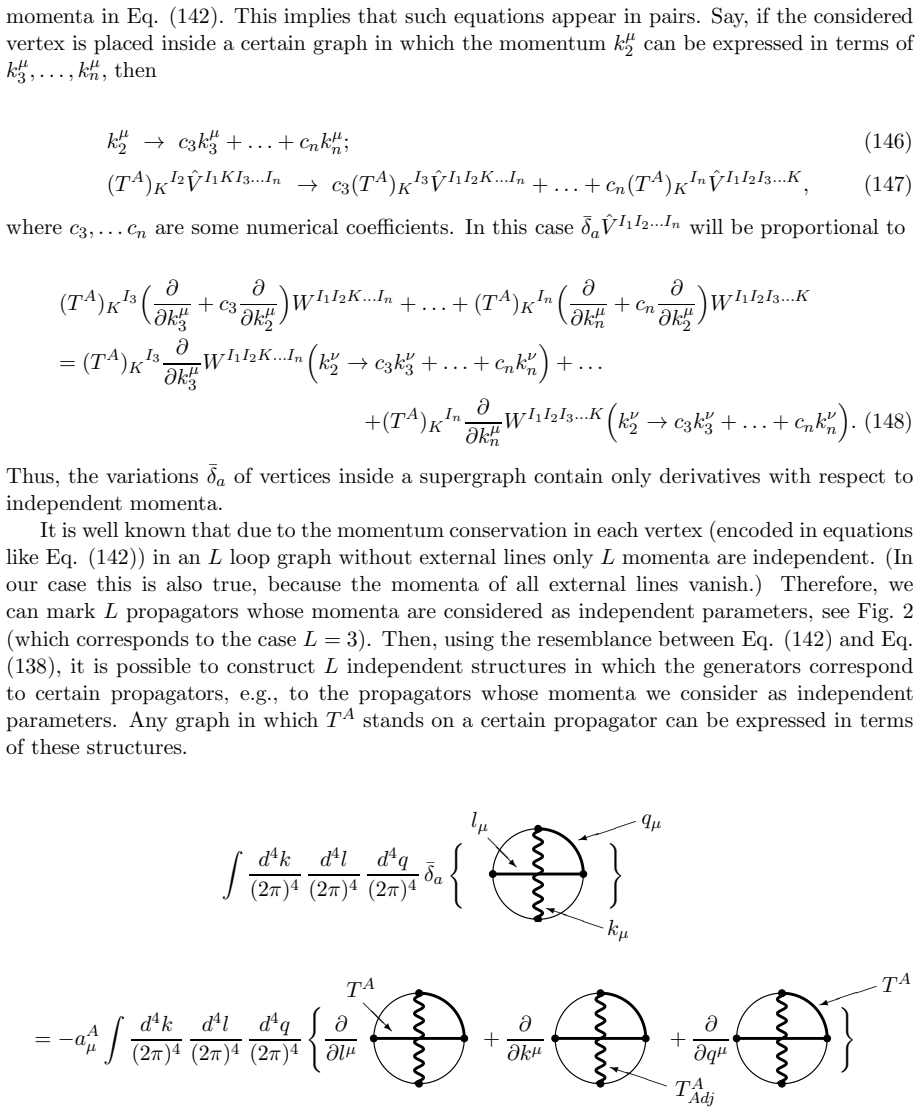
The central object is the second variation of the generating functional under the coordinate-dependent background gauge transformation $A = i a^B_\mu t_B y^\mu$. The transformation multiplies fields by $1 + i a^B_\mu x^\mu t_B + \dots$, so a propagator changes by $-a^A_\mu (T^A) \partial P/\partial k^\mu$, and each vertex variation becomes a derivative with respect to independent loop momenta once momentum conservation is paired with gauge invariance. Repeating the variation gives the replacement $\delta(\delta^b_a) \to (T^A)^b_a \, \partial/\partial Q^\mu$, turning a vacuum supergraph integrand into a double total derivative. The identity $\partial^\mu\partial_\mu (1/Q^2) = -4\pi^2\delta^4(Q)$ then converts the derivative integrals into delta-function contributions.
What would settle it
Choose a four-loop vacuum supergraph whose topology is not among the five types in Fig. 3, apply the replacement rule (152), and compare the resulting double-total-derivative integral with the direct sum of all diagrams obtained by attaching two background gauge legs at every possible place. Any mismatch, or any integrand that is not a double total derivative, would disprove the all-order claim.
Extended reading notes
Core claim
The central claim is that for a simple gauge group, with the higher covariant derivative regularization in N = 1 superspace, the $\beta$-function defined in terms of the bare couplings satisfies an identity whose left-hand side is a sum of integrals of double total derivatives in loop-momentum space. Concretely, after a background-field gauge transformation parameterized by a coordinate-dependent chiral superfield, the variation of every L-loop vacuum graph becomes a derivative with respect to independent loop momenta, and the surviving contribution is a second derivative acting on the integrand. The formal Slavnov-Taylor identity would set this to zero, and the nonzero result is due to delta-function singularities, as in the identity $\partial^\mu\partial_\mu(1/Q^2) = -4\pi^2\delta^4(Q)$. This is the non-Abelian generalization of earlier Abelian proofs and is verified explicitly for all three-loop Yukawa contributions.
Load-bearing premise
The all-order proof assumes that in every L-loop vacuum diagram the L independent loop momenta can be chosen so that the gauge variation of every vertex is exactly a derivative with respect to those momenta, a matching between momentum conservation and group indices that is argued by analogy and examples rather than proved by induction over all graph topologies.
Editorial extensions
If this is right
- Every L-loop contribution with L >= 2 to the beta-function is fixed by delta-function singularities of a double total derivative, so no non-singular loop-momentum integral survives.
- The replacement algorithm computes beta-function integrands from vacuum supergraphs, avoiding the enumeration of all diagrams with two background gauge legs.
- The method exactly reproduces the known three-loop Yukawa-dependent contributions, demonstrating that the construction is not merely formal.
- The factorization recasts the NSVZ relation as the statement that the same singular sum builds the anomalous dimensions of matter, gauge, and ghost superfields, completing the perturbative derivation once the singularities are summed.
- For the Abelian special case the proof reduces to the previously established result for N = 1 supersymmetric electrodynamics.
Reading between the lines
- Pith inference: the combinatorial pairing of momentum conservation with gauge-group indices is the true load-bearing mechanism; a formal graph-topological lemma stating that pairing would turn the all-order argument into a complete induction, and a four- or five-loop check would be the natural test.
- Pith inference: the same double-total-derivative structure should control other non-Abelian renormalization-group functions, such as the Adler D-function and gaugino-mass renormalization, extending Abelian results cited in the paper.
- Pith inference: the delta-function mechanism suggests the NSVZ relation in this regularization is a boundary effect in momentum space; this could be tested by evaluating one of the derived three-loop integrals with a regulator that moves the singularity away from Q = 0 and checking that the residue is exactly the anomalous-dimension term.
Editorial analysis
A structured set of objections, weighed in public.
Referee Report
Summary. The paper studies a general N=1 supersymmetric gauge theory with a simple gauge group, regularized by higher covariant derivatives supplemented by Pauli-Villars fields. Its central claim is an all-order proof that the β-function defined in terms of the bare couplings is given by integrals of double total derivatives with respect to loop momenta. The derivation uses a Slavnov-Taylor identity for the background gauge invariance, a superspace identity (99) proved in Appendix A, and a combinatorial argument in Section 4.4 that variations of vertices under a coordinate-dependent gauge transformation can be converted into derivatives with respect to independent loop momenta. The paper also presents a constructive algorithm for these integrals and tests it by reproducing the three-loop Yukawa-dependent contributions previously computed in Refs. [51,53] by direct summation of superdiagrams.
Significance. If the central claim is correct, this is a substantial step: the factorization into double total derivatives is the technical mechanism that underlies the NSVZ relation for this regularization, and the proposed algorithm would simplify higher-loop β-function calculations significantly. The manuscript is largely self-contained: it derives the Slavnov-Taylor identity from first principles, proves the key θ-identity (99) in Appendix A, and matches the independent three-loop results of Ref. [53] exactly. The main weakness is that the all-order combinatorial step in Section 4.4 is argued by analogy rather than proved by a complete induction over graph topologies, and the treatment of the δ-singularities that convert formally vanishing integrals into the nonzero β-function remains at the level of a scalar illustration. These issues affect the strength of the title claim but not the evident value of the lower-loop verification.
major comments (3)
- [Section 4.4, Eqs. (146)-(152)] The all-order claim is not established by the argument presented. The derivation relies on the assertion that for every L-loop vacuum supergraph one can choose L independent momenta so that the vertex variations under the coordinate-dependent gauge transformation become derivatives with respect to those momenta; the 'resemblance' between momentum conservation (142) and the gauge-invariance identity (138) is stated by analogy, not proved by induction over graph topologies. In particular, vertices containing derivatives, such as those generated by the higher-derivative regulators in Eq. (22), are not analyzed separately, and overlapping-loop topologies are not addressed. Since the abstract states that the factorization is proved in all orders, this gap is load-bearing; the three-loop checks in Section 5 support the statement but do not replace the missing combinatorial proof.
- [Sections 4.3 and 4.5, Eq. (129)] The formal derivation of Eq. (129) uses the gauge parameter A in Eq. (113), which grows at infinity, so the Slavnov-Taylor-based identity is not actually valid; the paper acknowledges this and attributes the nonzero result to δ-singularities. However, Section 4.5 demonstrates the mechanism only for the scalar integral (156)-(162), not for the supergraph sum in Eq. (112) or Eq. (129). What is missing is a general argument that the δ-singularities of the double-total-derivative integrals exactly reproduce the difference between the formal zero and the correct β-function contribution in every order. Without such an argument, the proof remains a plausible framework plus lower-loop evidence rather than the all-order proof announced in the abstract.
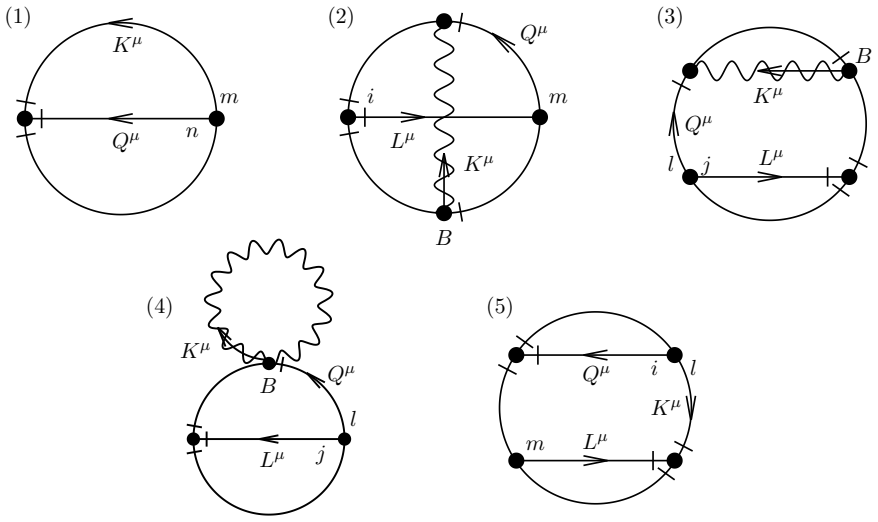
- [Section 5, Eqs. (174), (180), (185), (188), (196)] The numerical verification covers only the three-loop contributions containing Yukawa couplings, i.e., the five graphs of Fig. 3. The gauge-field-only and mixed three-loop contributions, as well as higher-loop graphs, are not checked. This is reasonable as a consistency test, but it does not establish the all-order statement. The authors should either provide the missing general combinatorial proof or explicitly weaken the abstract and conclusion to state that the all-order factorization is a conjecture strongly supported by the three-loop Yukawa verification.
minor comments (4)
- [Section 2, Eqs. (15)-(17)] The same symbol g is used for the coordinate-independent complex parameter introduced in Eq. (15) and for the auxiliary chiral superfield introduced above Eq. (16); this makes equations such as (16) difficult to parse. Distinct notation for the superfield would considerably improve readability.
- [Section 4.2, Eq. (100)] The passage from Eq. (99) to Eq. (100) states that all propagators are Grassmann-even; a brief justification covering the Faddeev-Popov and Nielsen-Kallosh ghost propagators, which are anticommuting fields, would make the step less opaque.
- [Section 5, Eqs. (176), (182), (187)] The functions N(Q,K,L), L(Q,P), and K(Q,K) are defined by long expressions that are hard to absorb without additional guidance. A short comment on their structure, or a direct cross-reference to the corresponding expressions in Ref. [53], would help the reader follow the three-loop verification.
- [Throughout] There are several typographical slips, such as 'begginnings' in the caption of Fig. 2 and the inconsistent use of g versus g for the auxiliary superfield before Eq. (16); these should be corrected in a revised version.
Circularity Check
No significant circularity: the factorization proof is self-contained, and the self-citations that occur are non-load-bearing external checks rather than circular inputs.
full rationale
The central claim is that the beta-function defined in terms of the bare couplings is an integral of double total derivatives. The derivation starts from the manifest background gauge invariance and the Slavnov-Taylor identity (80), transforms the left-hand side of Eq. (73) using the identity (99) (which is proven in Appendix A), and constructs the double-derivative structure in Sect. 4.4 by studying how propagators and vertices change under the gauge transformation (113). This is a first-principles diagrammatic argument, not a restatement of the conclusion: the beta-function is extracted from the two-point Green function via Eqs. (66)-(73), and no parameter is fitted to force the factorization. The three-loop Yukawa computation in Sect. 5 is a re-derivation by the new algorithm, compared with the direct supergraph calculation of Refs. [51,53]; this is a consistency check, not a fitted-input prediction. The self-citations, including [14] for rewriting the NSVZ relation and [57] for scheme independence of RGFs defined in terms of bare couplings, are peripheral to the factorization proof and do not carry its logical weight. The paper honestly defers the summation of singularities needed for the full NSVZ derivation to future work (Sect. 6, step 3), and the all-order claim in Sect. 4.4 relies on an asserted graph-combinatorial pairing between momentum conservation (142) and gauge invariance (138); this is a possible correctness gap, but it is not a circular reduction because the pairing is not assumed as the conclusion. No equation in the paper is equivalent by construction to the target result, and no fitted parameter is renamed as a prediction.
Assumptions & free parameters
assumptions (4)
- domain assumption The gauge group G is simple, and the matter representation satisfies tr(T^A)=0, so invariant tensors with two adjoint indices are proportional to delta^{AB}.
- domain assumption The theory is quantized in the background field method with nonlinear renormalization of the quantum gauge superfield (function F(V)), and the total action is invariant under background gauge transformations.
- domain assumption The higher covariant derivative regulators R(x) and F(x) are rapidly growing functions with R(0)=F(0)=1, and Pauli-Villars masses are proportional to Lambda with coupling-independent coefficients.
- standard math Standard N=1 superspace Feynman rules apply, including the property that integrals over d^4 theta remove terms with fewer than four Grassmann variables.
invented entities (2)
-
Coordinate-dependent auxiliary chiral superfield g-tilde(x, theta)
-
Coordinate-independent complex parameter g
Cite this review
Pith. "Pith review of The $\beta$-function of ${\cal N}=1$ supersymmetric gauge theories regularized by higher covariant derivatives as an integral of double total derivatives." pith.science (2026). https://pith.science/paper/RKFO43HN
@misc{pith2026190804108,
  author       = {Pith},
  title        = {Pith review of: The $\beta$-function of $\cal N=1$ supersymmetric gauge theories regularized by higher covariant derivatives as an integral of double total derivatives},
  year         = {2026},
  howpublished = {\url{https://pith.science/paper/RKFO43HN}},
  note         = {Machine review of arXiv:1908.04108}
}
abstract
For a general ${\cal N}=1$ supersymmetric gauge theory regularized by higher covariant derivatives we prove in all orders that the $\beta$-function defined in terms of the bare couplings is given by integrals of double total derivatives with respect to loop momenta. With the help of the technique used for this proof it is possible to construct a method for obtaining these loop integrals, which essentially simplifies the calculations. As an illustration of this method, we find the expression for the three-loop contribution to the $\beta$-function containing the Yukawa couplings and compare it with the result of the standard calculations made earlier. Also we briefly discuss, how the structure of the loop integrals for the $\beta$-function considered in this paper can be used for the all-loop perturbative derivation of the NSVZ relation in the non-Abelian case.
Figures

Figures from the paper (1 more)
Forward citations
Cited by 1 Pith paper
-
Three-loop contribution of the Faddeev-Popov ghosts to the $\beta$-function of ${\cal N}=1$ supersymmetric gauge theories and the NSVZ relation
The three-loop ghost-loop contribution to the beta function of N=1 SYM is shown to match the NSVZ equation via the two-loop ghost anomalous dimension, verifying the gamma_c term in the NSVZ relation.
Reference graph
Works this paper leans on
-
[53]
A. E. Kazantsev, V. Y. Shakhmanov and K. V. Stepanyantz, JHEP 1804 (2018) 130
2018
-
[1]
M. T. Grisaru and W. Siegel, Nucl. Phys. B 201 (1982) 292 Erratum: [Nucl. Phys. B 206 (1982) 496]
1982
-
[2]
Mandelstam, Nucl
S. Mandelstam, Nucl. Phys. B 213 (1983) 149
1983
-
[3]
Brink, O
L. Brink, O. Lindgren and B. E. W. Nilsson, Nucl. Phys. B 212 (1983) 401
1983
-
[4]
P. S. Howe, K. S. Stelle and P. K. Townsend, Nucl. Phys. B 236 (1984) 125
1984
-
[5]
I. L. Buchbinder, S. M. Kuzenko and B. A. Ovrut, Phys. Lett . B 433 (1998) 335
1998
-
[6]
P. S. Howe, K. S. Stelle and P. C. West, Phys. Lett. 124B (1983) 55
1983
-
[7]
M. A. Shifman and A. I. Vainshtein, In *Shifman, M.A.: ITE P lectures on particle physics and field theory, vol. 2* 485-647 [hep-th/9902018]
Show all 90 references
-
[8]
I. L. Buchbinder and K. V. Stepanyantz, Nucl. Phys. B 883 (2014) 20
2014
-
[9]
V. A. Novikov, M. A. Shifman, A. I. Vainshtein and V. I. Zak harov, Nucl. Phys. B 229 (1983) 381
1983
-
[10]
D. R. T. Jones, Phys. Lett. 123B (1983) 45
1983
-
[11]
V. A. Novikov, M. A. Shifman, A. I. Vainshtein and V. I. Za kharov, Phys. Lett. 166B (1986) 329 [Sov. J. Nucl. Phys. 43 (1986) 294] [Yad. Fiz. 43 (1986) 459]
1986
-
[12]
M. A. Shifman and A. I. Vainshtein, Nucl. Phys. B 277 (1986) 456 [Sov. Phys. JETP 64 (1986) 428] [Zh. Eksp. Teor. Fiz. 91 (1986) 723]
1986
-
[13]
M. T. Grisaru, W. Siegel and M. Rocek, Nucl. Phys. B 159 (1979) 429
1979
-
[14]
K. V. Stepanyantz, Nucl. Phys. B 909 (2016) 316
2016
-
[15]
Dudal, H
D. Dudal, H. Verschelde and S. P. Sorella, Phys. Lett. B 555 (2003) 126
2003
-
[16]
M. A. L. Capri, D. R. Granado, M. S. Guimaraes, I. F. Justo , L. Mihaila, S. P. Sorella and D. Vercauteren, Eur. Phys. J. C 74 (2014) no.4, 2844
2014
-
[17]
K. G. Chetyrkin, Nucl. Phys. B 710 (2005) 499
2005
-
[18]
Hisano and M
J. Hisano and M. A. Shifman, Phys. Rev. D 56 (1997) 5475
1997
-
[19]
Jack and D
I. Jack and D. R. T. Jones, Phys. Lett. B 415 (1997) 383
1997
-
[20]
L. V. Avdeev, D. I. Kazakov and I. N. Kondrashuk, Nucl. Ph ys. B 510 (1998) 289. 40
1998
-
[21]
Shifman and K
M. Shifman and K. Stepanyantz, Phys. Rev. Lett. 114 (2015) no.5, 051601
2015
-
[22]
Shifman and K
M. Shifman and K. V. Stepanyantz, Phys. Rev. D 91 (2015) 105008
2015
-
[23]
Chen and M
J. Chen and M. Shifman, Phys. Rev. D 99 (2019) no.6, 065007
2019
-
[24]
Arkani-Hamed and H
N. Arkani-Hamed and H. Murayama, JHEP 0006 (2000) 030
2000
-
[25]
Kraus, C
E. Kraus, C. Rupp and K. Sibold, Nucl. Phys. B 661 (2003) 83
2003
-
[26]
Siegel, Phys
W. Siegel, Phys. Lett. 84B (1979) 193
1979
-
[27]
W. A. Bardeen, A. J. Buras, D. W. Duke and T. Muta, Phys. Re v. D 18 (1978) 3998
1978
-
[28]
I. Jack, D. R. T. Jones and C. G. North, Phys. Lett. B 386 (1996) 138
1996
-
[29]
I. Jack, D. R. T. Jones and C. G. North, Nucl. Phys. B 486 (1997) 479
1997
-
[30]
I. Jack, D. R. T. Jones and A. Pickering, Phys. Lett. B 435 (1998) 61
1998
-
[31]
R. V. Harlander, D. R. T. Jones, P. Kant, L. Mihaila and M. Steinhauser, JHEP 0612 (2006) 024
2006
-
[32]
Mihaila, Adv
L. Mihaila, Adv. High Energy Phys. 2013 (2013) 607807
2013
-
[33]
Kutasov and A
D. Kutasov and A. Schwimmer, Nucl. Phys. B 702 (2004) 369
2004
-
[34]
A. L. Kataev and K. V. Stepanyantz, Theor. Math. Phys. 181 (2014) 1531
2014
-
[35]
S. S. Aleshin, A. L. Kataev and K. V. Stepanyantz, JHEP 1903 (2019) 196
2019
-
[36]
A. L. Kataev and K. V. Stepanyantz, Phys. Lett. B 730 (2014) 184
2014
-
[37]
A. A. Slavnov, Nucl. Phys. B 31 (1971) 301
1971
-
[38]
A. A. Slavnov, Theor.Math.Phys. 13 (1972) 1064 [Teor. Mat. Fiz. 13 (1972) 174]
1972
-
[39]
V. K. Krivoshchekov, Theor. Math. Phys. 36 (1978) 745 [Teor. Mat. Fiz. 36 (1978) 291]
1978
-
[40]
P. C. West, Nucl. Phys. B 268 (1986) 113
1986
-
[41]
S. S. Aleshin, A. L. Kataev and K. V. Stepanyantz, JETP Le tt. 103 (2016) no.2, 77
2016
-
[42]
S. S. Aleshin, I. O. Goriachuk, A. L. Kataev and K. V. Step anyantz, Phys. Lett. B 764 (2017) 222
2017
-
[43]
A. A. Soloshenko and K. V. Stepanyantz, Theor. Math. Phy s. 140 (2004) 1264 [Teor. Mat. Fiz. 140 (2004) 437]
2004
-
[44]
A. V. Smilga and A. Vainshtein, Nucl. Phys. B 704 (2005) 445
2005
-
[45]
A. B. Pimenov, E. S. Shevtsova and K. V. Stepanyantz, Phy s. Lett. B 686 (2010) 293
2010
-
[46]
K. V. Stepanyantz, Proc. Steklov Inst. Math. 272 (2011) no.1, 256
2011
-
[47]
K. V. Stepanyantz, “Factorization of integrals definin g the two-loop β -function for the general renormalizable N=1 SYM theory, regularized by the h igher covariant derivatives, into integrals of double total derivatives,” arXiv:1108.1 491 [hep-th]
-
[48]
K. V. Stepanyantz, J. Phys. Conf. Ser. 343 (2012) 012115. 41
2012
-
[49]
K. V. Stepanyantz, J. Phys. Conf. Ser. 368 (2012) 012052
2012
-
[50]
A. E. Kazantsev and K. V. Stepanyantz, J. Exp. Theor. Phy s. 120 (2015) no.4, 618 [Zh. Eksp. Teor. Fiz. 147 (2015) no.4, 714]
2015
-
[51]
V. Y. Shakhmanov and K. V. Stepanyantz, Nucl. Phys. B 920 (2017) 345
2017
-
[52]
A. L. Kataev, A. E. Kazantsev and K. V. Stepanyantz, Nucl . Phys. B 926 (2018) 295
2018
-
[54]
K. V. Stepanyantz, Nucl. Phys. B 852 (2011) 71
2011
-
[55]
K. V. Stepanyantz, JHEP 1408 (2014) 096
2014
-
[56]
I. V. Nartsev and K. V. Stepanyantz, JHEP 1704 (2017) 047
2017
-
[57]
A. L. Kataev and K. V. Stepanyantz, Nucl. Phys. B 875 (2013) 459
2013
-
[58]
A. I. Vainshtein, V. I. Zakharov and M. A. Shifman, JETP L ett. 42 (1985) 224 [Pisma Zh. Eksp. Teor. Fiz. 42 (1985) 182]
1985
-
[59]
M. A. Shifman, A. I. Vainshtein and V. I. Zakharov, Phys. Lett. 166B (1986) 334
1986
-
[60]
V. Y. Shakhmanov and K. V. Stepanyantz, Phys. Lett. B 776 (2018) 417
2018
-
[61]
I. V. Nartsev and K. V. Stepanyantz, JETP Lett. 105 (2017) no.2, 69
2017
-
[62]
I. O. Goriachuk, A. L. Kataev and K. V. Stepanyantz, Phys . Lett. B 785 (2018) 561
2018
-
[63]
A. L. Kataev, A. E. Kazantsev and K. V. Stepanyantz, Eur. Phys. J. C 79 (2019) no.6, 477
2019
-
[64]
Super space Or One Thousand and One Lessons in Supersymmetry,
S. J. Gates, M. T. Grisaru, M. Rocek and W. Siegel, “Super space Or One Thousand and One Lessons in Supersymmetry,” Front. Phys. 58 (1983) 1 [hep-th/0108200]
1983 arXiv
-
[65]
Introduction to supersymmetry and supergr avity,
P. C. West, “Introduction to supersymmetry and supergr avity,” Singapore, Singapore: World Scientific (1990) 425 p
1990
-
[66]
Ideas and methods of supersymmetry and super- gravity: Or a walk through superspace,
I. L. Buchbinder and S. M. Kuzenko, “Ideas and methods of supersymmetry and super- gravity: Or a walk through superspace,” Bristol, UK: IOP (19 98) 656 p
-
[67]
Piguet and K
O. Piguet and K. Sibold, Nucl. Phys. B 197 (1982) 257
1982
-
[68]
Piguet and K
O. Piguet and K. Sibold, Nucl. Phys. B 197 (1982) 272
1982
-
[69]
I. V. Tyutin, Yad. Fiz. 37 (1983) 761
1983
-
[70]
Piguet and K
O. Piguet and K. Sibold, Nucl. Phys. B 196 (1982) 428
1982
-
[71]
Piguet and K
O. Piguet and K. Sibold, Nucl. Phys. B 248 (1984) 301
1984
-
[72]
J. W. Juer and D. Storey, Phys. Lett. 119B (1982) 125
1982
-
[73]
J. W. Juer and D. Storey, Nucl. Phys. B 216 (1983) 185
1983
-
[74]
A. E. Kazantsev, M. D. Kuzmichev, N. P. Meshcheriakov, S . V. Novgorodtsev, I. E. Shi- rokov, M. B. Skoptsov and K. V. Stepanyantz, JHEP 1806 (2018) 020. 42
2018
-
[75]
Dynamical theory of groups and fields,
B. S. DeWitt, “Dynamical theory of groups and fields,” Go rdon and Breach, New York, 1965
1965
-
[76]
L. F. Abbott, Nucl. Phys. B 185 (1981) 189
1981
-
[77]
L. F. Abbott, Acta Phys. Polon. B 13 (1982) 33
1982
-
[78]
S. S. Aleshin, A. E. Kazantsev, M. B. Skoptsov and K. V. St epanyantz, JHEP 1605 (2016) 014
2016
-
[79]
Kraus, Nucl
E. Kraus, Nucl. Phys. B 620 (2002) 55
2002
-
[80]
Kraus and D
E. Kraus and D. Stockinger, Nucl. Phys. B 626 (2002) 73
2002
-
[81]
Babington and J
J. Babington and J. Erdmenger, JHEP 0506 (2005) 004
2005
-
[82]
L. D. Faddeev and A. A. Slavnov, Front. Phys. 50 (1980) 1 [Front. Phys. (1991) 1]
1980
-
[83]
Becchi, A
C. Becchi, A. Rouet and R. Stora, Commun. Math. Phys. 42 (1975) 127
1975
-
[84]
Gauge Invariance in Field Theory and Stat istical Physics in Operator For- malism,
I. V. Tyutin, “Gauge Invariance in Field Theory and Stat istical Physics in Operator For- malism,” arXiv:0812.0580 [hep-th]
-
[85]
A. A. Slavnov, Theor. Math. Phys. 33 (1977) 977 [Teor. Mat. Fiz. 33 (1977) 210]
1977
-
[86]
A. E. Kazantsev, M. B. Skoptsov and K. V. Stepanyantz, Mo d. Phys. Lett. A 32 (2017) no.36, 1750194
2017
-
[87]
J. C. Taylor, Nucl. Phys. B 33 (1971) 436
1971
-
[88]
A. A. Slavnov, Theor. Math. Phys. 10 (1972) 99 [Teor. Mat. Fiz. 10 (1972) 153]
1972
-
[89]
A. A. Vladimirov, Sov. J. Nucl. Phys. 31 (1980) 558 [Yad. Fiz. 31 (1980) 1083]
1980
-
[90]
Quarks, Leptons And Gauge Fields,
K. Huang, “Quarks, Leptons And Gauge Fields,” Singapor e, Singapore: World Scientific (1992) 333p. 43
1992
Reviewed August 14, 2026 · model on record in the stance chip above.
Discussion (0). Continue with ORCID to comment.