REVIEW 4 major objections 5 minor 24 references
Cosmic Ray Extremely Distributed Observatory: Status and perspectives of a global cosmic ray detection framework
T0 review · 4 major / 5 minor · reviewed 2026-08-14 · deepseek-v4-flash
Pith's one-line read This paper argues that cosmic-ray ensembles—many particles arriving nearly simultaneously across huge distances—could be searched for by combining the world's existing cosmic-ray detectors, including smartphones, into one global network.
desk verdict Honest status report for a global citizen-science cosmic-ray network; no physics result yet, but the infrastructure and null check earn a serious referee. read the letter →
The pith
A machine-rendered reading of the paper's core claim, the machinery that carries it, and where it could break.
The reading
What carries the argument
The paper's central object is the cosmic-ray ensemble (CRE): a group of air showers and individual particles that arrive at Earth as one correlated event, possibly spanning many hundred kilometres. The mechanism that carries the argument is a two-layer detection chain: a cloud of consumer CMOS cameras (smartphones running the CREDO Detector app, in combination with educational and professional instruments) supplies the geographic spread, while an open server-side analysis pipeline, including the Quantum Gravity Previewer, searches for clusters of time-correlated detections and compares their rate with scrambled-map background simulations. Preshower cascades initiated by ultra-high-energy photons interacting near the Sun or in the terrestrial magnetic field, and decays of super-massive particles, supply concrete production scenarios that give the ensemble search defined expectations to confirm or exclude.
What would settle it
Measure the per-phone track-detection efficiency and timestamp precision of the CREDO Detector app against a scintillator coincidence telescope in the field; if the phone timing error exceeds the few-millisecond light-travel delay expected across a 1000 km-scale ensemble, or if detection efficiency is too low to register particles at the expected density, the claimed global network cannot distinguish a real ensemble from background. Alternatively, a global search using the paper's scrambled-map method that finds no significant excess of correlated doublets at the spatial and temporal scales predicted by preshower models would falsify the near-term discovery claimed for the framework.
Extended reading notes
Core claim
The central claim is that cosmic-ray ensembles are a real, unexamined target and that the way to observe them is not a larger single detector but a planetary array assembled from already-operating instruments. A candidate signal spread over a significant fraction of Earth's surface would leave too few particles at any one site for a single observatory to recognize, but a coordinated global network could register two or more correlated particles or photons and recognize the pattern. The paper establishes the concept's feasibility: smartphone sensors can record particle-track candidates, the open-source app and open data API already collect data globally, and the analysis framework, including the Quantum Gravity Previewer and scrambled-map background estimates, can search for time-correlated clusters. It does not claim an ensemble detection; it claims the observational strategy is operational and that the absence of any confirmed multi-technique observation is what the network is designed to remedy.
Load-bearing premise
The load-bearing premise is that the camera sensors in ordinary smartphones can detect individual cosmic-ray particles and time them accurately enough that a worldwide phone network can tell a true cosmic-ray ensemble from random background.
Editorial extensions
If this is right
- If ensembles are real, CREDO's global network is the only class of instrument that can see them, because the signal's footprint exceeds any single existing observatory.
- A null result from a full global search would place new constraints on preshower and top-down models, including limits on ultra-high-energy photon fractions and on decays of super-massive particles.
- Any candidate detection from smartphone sensors would not be accepted on its own; the paper commits to independent confirmation with scintillator-based detectors and other techniques, so the framework grows a multi-technique core.
- The citizen-science model turns data acquisition into a scalable resource: more phones means more geographic coverage and more manpower for analysis, not just better statistics.
Reading between the lines
- If smartphone timestamps are only good to seconds rather than milliseconds, the phone cloud alone cannot identify a true simultaneous ensemble; a practical extension would be to require an external time-synchronization protocol or to restrict phones to veto or trigger roles.
- The same distributed-coincidence architecture could be applied to other global correlated phenomena, such as searching for transient optical or radio counterparts of astrophysical events, by treating any sensor with a timestamp as a node.
- A testable near-term check would be to correlate CREDO phone track rates with the known muon flux as a function of latitude and altitude; if the phone response does not track the expected flux, per-device detection efficiency is too variable for quantitative ensemble searches.
- The five-minute doublet analysis shown in the paper is far coarser than the millisecond-scale simultaneity expected from a light-speed front; tightening the coincidence window is a direct way to raise sensitivity if sensor timing allows.
Signed reviews
Editorial analysis
A structured set of objections, weighed in public.
Referee Report
Summary. This ICRC2019 proceedings paper presents the status and perspectives of CREDO, a proposed worldwide network that combines existing cosmic-ray detectors—including professional arrays, educational instruments, and smartphone cameras—to search for cosmic-ray ensembles (CRE), a hypothesized class of extended, globally correlated cosmic-ray phenomena. The paper describes the project's concept, the CREDO Detector smartphone app, the open-source and open-data infrastructure, the current user base (7500 users, ~2.9 million images), a first proof-of-principle analysis of time-correlated doublets for a single user using scrambled-map backgrounds, and planned citizen-science and interdisciplinary activities. The central claim is that the distributed smartphone cloud, complemented by scintillator detectors and existing observatories, can enable global searches for CRE that are beyond the reach of individual observatories.
Significance. If the framework performs as proposed, CREDO would open a genuinely new observational window: no existing facility can search for cosmic-ray phenomena spread over a significant fraction of the Earth. The paper's strengths are its open-source code and open-data model, the already operational citizen-science infrastructure with thousands of contributing users, and the use of a scrambled-map background in the illustrative doublet analysis, which provides a template for blind analyses. The scientific significance, however, currently rests on an unvalidated assumption—that smartphone CMOS sensors can provide event rates and timing precision sufficient for meaningful global correlation searches. The paper explicitly acknowledges that smartphone-only observations would need confirmation with other detector types, but it does not provide the calibration or sensitivity estimates needed to assess whether the smartphone component can contribute at all. As a status report the paper is informative, but as a scientific feasibility claim it is not yet supported.
major comments (4)
- [Sec. 2 (smartphone detection capability)] The sentence 'a smartphone with the CREDO Detector is capable of detecting particle track candidates' is presented without any supporting calibration: no detection efficiency, no dark-rate or false-track rate, no timestamp resolution, and no clock-synchronization analysis are given. Since the paper later states that the smartphone cloud is 'the first step' and a 'critically important' component of CREDO, this uncalibrated claim is load-bearing: the accidental-coincidence rate and the sensitivity of any global CRE search are direct functions of per-device trigger rates and timing uncertainties. The authors should either provide measured values (or cite a peer-reviewed characterization) or explicitly reframe the statement as 'the app recognizes track-like patterns whose physical origin remains to be validated.'
- [Sec. 2, Fig. 4 (doublet analysis)] The scrambled-map background is generated from 'randomly generated timestamps using a flat distribution,' but the significance calculation is only referenced to [11] and no systematic uncertainties are presented. Real smartphone data are subject to diurnal user-activity modulation, variable network latency, detector dead time, and timestamp quantization, all of which can alter the expected doublet rate. As shown, the compatibility statement for the single user is qualitative; the authors should define the significance parameter explicitly, discuss the validity of a flat-time null for this dataset, and quantify at least the dominant systematic uncertainties or label the figure as an illustrative pipeline demonstration.
- [Sec. 2 (observing-time claim)] The claim that 'the observing time for all users equates to 958 years searching for particles' is not derived. It is unclear whether this is total wall-clock integration time, active-exposure time after dark-frame rejection, or a scaled quantity based on pixel counts. Without the underlying formula and an assumption about the per-image detection rate, this number is misleading to readers and could be misinterpreted as the equivalent live time of a physics detector. A short derivation or a reference to a technical note is needed.
- [Sec. 2 (network timing)] The manuscript does not address how timestamps from geographically distributed smartphones are synchronized. A global search for CRE requires correlating events at different locations with time differences that could be as short as milliseconds or as long as minutes; the relevant tolerance depends on the scenario. The paper mentions temporal dispersion 'of the order of minutes or more' for some reported phenomena, but does not discuss whether smartphone clock errors (typically seconds to tens of seconds without disciplined synchronization) are tolerable or how synchronization would be achieved. This is an essential technical requirement for the central science goal and should be addressed in a status report.
minor comments (5)
- [References] Reference [4] cites 'Physics Review D'; the journal name should be 'Physical Review D'.
- [Reference [24]] Reference [24] is a conference talk; if a published counterpart exists, it should be cited instead, particularly because the dose-risk statement in Sec. 4 relies on it.
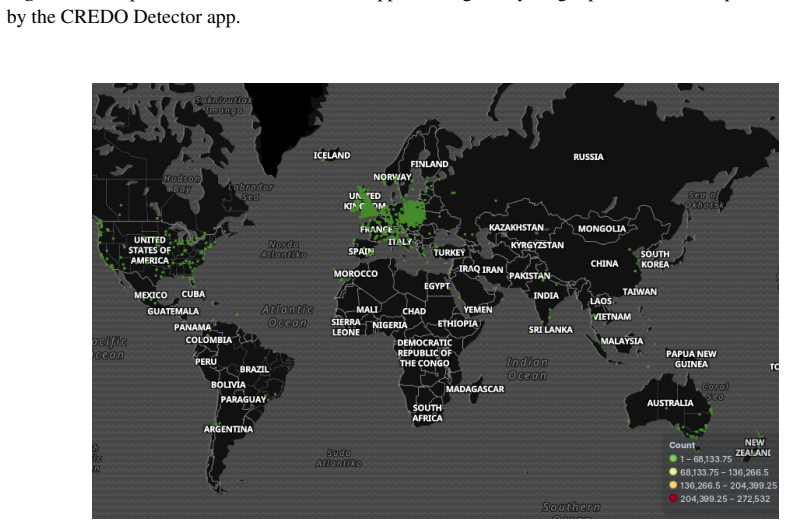
- [Fig. 3] The world map of user locations would benefit from a color scale or count legend so that the density of users is quantitatively interpretable.
- [Sec. 2, first paragraph] The acronym CRE is defined in the abstract but the definition is repeated in the introduction; consider using the definition only at first occurrence.
- [Sec. 4] The statement about an adult human receiving a dose of 40 mGy or larger 'at least once during an individual lifetime' from [24] is nontrivial and should be accompanied by the underlying flux calculation or a proper peer-reviewed reference, rather than a conference talk.
Circularity Check
No circularity found: the paper is a status report whose claims are programmatic and whose one illustrative analysis uses standard self-calibration.
full rationale
The paper does not contain a derivation chain in which an output is equivalent to an input by construction. Its central claim is that a worldwide network of existing detectors, including smartphones, can search for cosmic-ray ensembles; this is a proposal, not a prediction derived from fitted parameters. The only quantitative example, the Quantum Gravity Previewer doublet analysis in Sec. 2, computes the expected number of doublets from scrambled timestamps generated with a flat distribution and the same event count as the user data, which is a standard null-hypothesis self-calibration rather than a circular use of the data. The paper explicitly acknowledges the uncalibrated nature of smartphone detections and states that an anomaly seen only with one technique requires independent confirmation with other detector types, which undercuts any claim that the app data alone establishes a physical signal. Citations to prior CREDO-related work, such as the preshower simulations in Refs. [1,2] and the significance definition in Ref. [11], are used as background motivation or as descriptions of an already public analysis tool; they are self-citations but they are not invoked to force the paper's central conclusion, and the framework's feasibility is not reduced to those citations. Consequently, the appropriate finding is no significant circularity.
Assumptions & free parameters
assumptions (3)
- domain assumption Cosmic-ray ensembles (CRE), correlated multi-particle events spread over large areas, are plausible physical phenomena worth searching for.
- domain assumption Smartphone CMOS image sensors can detect cosmic-ray particle track candidates with sufficient efficiency and timing precision.
- standard math Scrambled-map Monte Carlo correctly models the background of random doublets.
Cite this review
Pith. "Pith review of Cosmic Ray Extremely Distributed Observatory: Status and perspectives of a global cosmic ray detection framework." pith.science (2026). https://pith.science/paper/AVRGJW7F
@misc{pith2026190804139,
  author       = {Pith},
  title        = {Pith review of: Cosmic Ray Extremely Distributed Observatory: Status and perspectives of a global cosmic ray detection framework},
  year         = {2026},
  howpublished = {\url{https://pith.science/paper/AVRGJW7F}},
  note         = {Machine review of arXiv:1908.04139}
}
read the original abstract
The Cosmic-Ray Extremely Distributed Observatory (CREDO) is a project dedicated to global studies of extremely extended cosmic-ray phenomena, the cosmic-ray ensembles (CRE), beyond the capabilities of existing detectors and observatories. Up to date cosmic-ray research has been focused on detecting single air showers, while the search for ensembles of cosmic-rays, which may spread over a significant fraction of the Earth, is a scientific terra incognita. The key idea of CREDO is to combine existing cosmic-ray detectors (large professional arrays, educational instruments, individual detectors, such as smartphones, etc.) into a worldwide network, thus enabling a global analysis. The second goal of CREDO involves a large number of participants (citizen science!), assuring the geographical spread of the detectors and managing manpower necessary to deal with vast amount of data to search for evidence for cosmic-ray ensembles. In this paper the status and perspectives of the project are presented.
Figures


Figures from the paper (1 more)

Reference graph
Works this paper leans on
- [11]
- [1]
-
[2]
Dhital for CREDO Collaborations, [arXiv:1811.10334]
N. Dhital for CREDO Collaborations, [arXiv:1811.10334]
-
[3]
URL: https://credo.science [as on July 2019]
work page 2019
-
[4]
D. J. H. Chung, et al., Physics Review D 59 (2) (1998) 023501
work page 1998
-
[5]
G. R. Smith et al., Phys. Rev. Lett. 50 (1983) 2110
work page 1983
-
[6]
D. J. Fegan and B. McBreen, Phys. Rev. Lett. 51 (1983) 2341
work page 1983
-
[7]
URL: https://play.google.com/store/apps/details?id=science.credo.mobiledetector
Show all 24 references
-
[8]
URL: https://github.com/credo-science
-
[9]
URL: https://api.credo.science/web/
-
[10]
URL: https://credo.science/quantum-gravity-previewer/
-
[12]
URL: https://www.zooniverse.org/projects/credo/dark-universe-welcome [as on July 2019]
2019
-
[13]
URL: https://www.zooniverse.org/projects/credo/private-particle-detective [as on July 2019]
2019
-
[14]
URL: http://www.cyfronet.krakow.pl/en/4421,main.html
-
[15]
Bonnette, Kevin Crowley and Christian D
N. Bonnette, Kevin Crowley and Christian D. Schunn (2019), International Journal of Science Education, DOI: 10.1080/09500693.2019.1623431
2019
-
[16]
URL: https://credo.science/lowcyczastek/ [as on July 2019]
2019
-
[17]
URL: https://indico.ifj.edu.pl/event/216/overview
-
[18]
A. L. Morozova, et al., Phys. Chem. Earth A 25, 321 (2000)
2000
-
[19]
A. J. Foppiano, Geofis. Int. 47, 179 (2008)
2008
-
[20]
L’Huissier, Proc
P. L’Huissier, Proc. AGU Fall Meeting, NH41A-1582. (2012)
2012
-
[21]
N. V . Romanova, Geomagn. Aeronomy 55, 219 (2015)
2015
-
[22]
APPEC GEO – 8 Workshop on Observatory Synergies for Astroparticle physics and Geoscience, Paris, Feb 2019
2019
-
[23]
J. M. Neulepas et al., JNCI 110 (2018)1054, 2018
2018
-
[24]
Beznosko, talk a the CREDO Week 2018 7
D. Beznosko, talk a the CREDO Week 2018 7
2018
Reviewed August 14, 2026 · model on record in the stance chip above.
Discussion (0). Continue with ORCID to comment.