REVIEW 2 major objections 5 minor 70 references
A hybrid approach to extending selected configuration interaction and full configuration interaction quantum Monte Carlo
T0 review · 2 major / 5 minor · reviewed 2026-08-14 · deepseek-v4-flash
Pith's one-line read The paper shows that fixing the initiator space in i-FCIQMC to a selected space from SCI lets the simulation sample the first-order interacting space with a walker population only a small multiple of |V|, and that rejected spawnings…
desk verdict Solid, honest algorithmic paper that deserves serious refereeing; the PT2 estimator's derivation has a minor hidden approximation, but the benchmarks support its use. read the letter →
The pith
A machine-rendered reading of the paper's core claim, the machinery that carries it, and where it could break.
The reading
What carries the argument
The load-bearing object is the fixed initiator space V taken from a prior SCI calculation (here heat-bath CI), together with the initiator spawning rule that walkers in V may spawn to any connected determinant while non-initiators may spawn only to occupied determinants or to V. This construction makes the sampled space V plus its first-order interacting space without ever storing the FOIS vector. The other central object is the population plateau: its height measures how severe the fermion sign problem is, and the paper shows this plateau is a small multiple of |V| under semi-stochastic propagation and optimized orbitals. Finally, the PT2 estimator is assembled from spawnings rejected by the initiator rule, using an equilibrium relation C_i = -S_i/(Δτ(E-H_ii)) to cancel allowed-spawning terms, so the correction is obtained almost for free from data already present in the simulation.
What would settle it
Take a small active space where the H_B matrix in V+FOIS can be diagonalized exactly, run i-FCIQMC(SCI), and record for each non-rejected determinant the difference C_i + S_i/(Δτ(E-H_ii)) over equilibrated iterations; if this difference does not average to zero within statistical error while the variational energy is converged, the PT2 estimator is biased.
Extended reading notes
Core claim
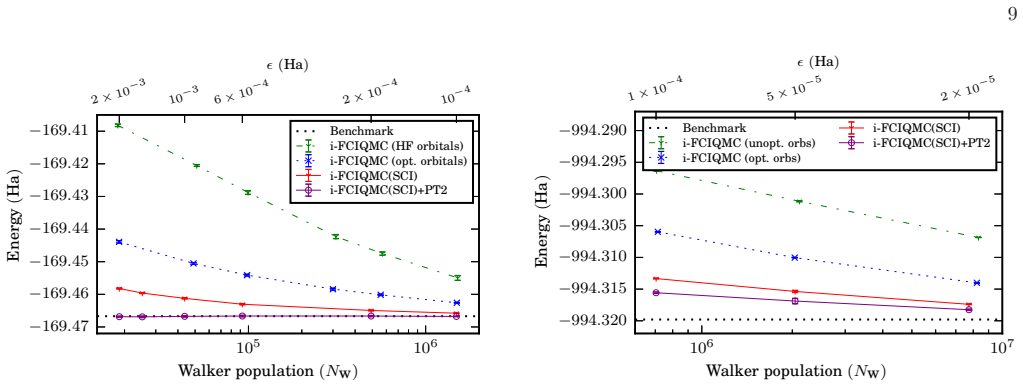
The central claim is that the initiator approximation in i-FCIQMC can be improved by fixing the initiator space to equal the selected space V of a prior SCI calculation instead of letting population thresholds pick initiators dynamically. In this hybrid method, the Hamiltonian acting on the sampled wave function interpolates between H_A (diagonal in the first-order interacting space) and H_B (the full V+FOIS Hamiltonian), so that as the walker population grows, the wave function converges toward the ground state of V+FOIS. The central numerical discovery is that the walker population needed to sample the FOIS accurately is, in every system studied, only a small factor of |V| itself, even when the FOIS is larger by several orders of magnitude; from those walkers, rejected spawning events give a near-free PT2 correction that removes most of the remaining error in weakly correlated systems. This makes i-FCIQMC(SCI)+PT2 a complementary alternative to SCI+PT2: more accurate for a common selected/initiator space, albeit slower, and able to supply variational energy estimates and reduced density matrices in the larger space.
Load-bearing premise
In Section IID, the PT2 derivation assumes that at equilibrium the amplitude C_i and total spawning S_i on every non-rejected determinant satisfy C_i = -S_i/(Δτ(E-H_ii)), so the allowed-spawning terms in Eq. (27) cancel on average; the paper gives no error bound for this cancellation, so a systematic failure would bias the PT2 energies even when variational energies are accurate.
Editorial extensions
If this is right
- For any system where an SCI calculation can produce a selected space V, i-FCIQMC(SCI) can recover most of the correlation energy in V plus its first-order interacting space with memory proportional to a small multiple of |V|, not of the much larger FOIS.
- The same selected space gives variational energies comparable to, and sometimes lower than, SCI+PT2 energies, with a rigorous variational bound and with exact reduced density matrices available for the V+FOIS wave function.
- The rejected-spawn PT2 estimator brings weakly correlated systems to near-exact total energies at selected-space sizes where SCI+PT2 still has residual error.
- The method extends to large active spaces and to basis sets up to quadruple-zeta, with plateau height growing only modestly with basis cardinal number when optimized orbitals and the semi-stochastic adaptation are used.
- Using a fixed initiator space systematically lowers variational energies relative to standard i-FCIQMC for the same walker population, showing that less severe Hamiltonian truncation is possible while keeping the sign problem manageable.
Reading between the lines
- Inference: the plateau-to-|V| scaling suggests a design rule: choose the initiator space as the top of a deterministic importance ranking, and the stochastic sampler will populate its connections at a cost set by the ranked space rather than by the connection space; this could generalize to other projector QMC formulations.
- Inference: if the replica-trick statistical error on the PT2 correction is reduced by a single-replica estimator, the method's practical advantage over SCI+PT2 would grow, since the current bottleneck is noise on the correction, not the variational energy.
- Inference: since the paper tests only heat-bath CI as the SCI generator, comparing CIPSI, ASCI, or other selection criteria would show whether the favorable plateau scaling is a property of the fixed-initiator construction itself or of the particular importance metric.
- Inference: the interpolation between H_A and H_B implies a sharp testable prediction: variational energies should improve monotonically with walker population toward the H_B ground state, and deviations from that trend would signal that the initiator rules are not the only source of bias.
Signed reviews
Editorial analysis
A structured set of objections, weighed in public.
Referee Report
Summary. The paper proposes i-FCIQMC(SCI), a hybrid of selected CI and initiator FCIQMC in which the initiator space is fixed to be the SCI-selected space V rather than chosen by a population threshold. Initiators in V may spawn freely into the first-order interacting space (FOIS), so the simulation samples a variational energy in V ⊕ FOIS, while rejected spawns are used to construct a second-order perturbative correction. The manuscript derives the PT2 estimator, studies population plateaus as a function of basis set and orbital choice, and compares energies against standard i-FCIQMC and SHCI/SCI+PT2 for formamide, hexacene, butadiene, BPEA, and the water dimer. The central conclusion is that the walker population required to sample the FOIS is only a small multiple of |V|, and that i-FCIQMC(SCI)+PT2 provides near-exact energies for weakly correlated systems at memory cost comparable to SCI+PT2.
Significance. Should the claims hold, the method is a practically useful synthesis of SCI and FCIQMC: it offers a variational energy in V ⊕ FOIS without storing that space explicitly, a nearly-free PT2 correction built from rejected spawns, and a reduced need for extrapolation relative to SCI+PT2. The paper is strong on transparency: the PT2 estimator is derived from the Guo-Sharma effective-Hamiltonian expression, the interpolation between the two truncated Hamiltonians HA and HB is clearly formulated, and the benchmarks use independent DMRG or extrapolated SHCI references. No parameters are fitted to benchmark energies; the only tunable inputs are the SCI threshold and the walker population. The main weakness is the unproven average cancellation in the derivation of Eq. (30), which is the basis of all +PT2 results.
major comments (2)
- [Section II D, Eqs. (27)–(30)] The cancellation of the allowed-spawning terms is asserted ‘on average’ via the equilibrium relation (28), but in i-FCIQMC(SCI) the coefficients are produced by a Hamiltonian truncation that depends on the instantaneous set of occupied determinants, so (28) is not an exact property of the full-H eigenvector and the error in the cancellation is uncontrolled. Since Eq. (30) is the basis of every ‘+PT2’ result in Section III, please add a direct numerical verification, for example comparing the full expression (26) with the rejected-only estimator (30) from the same simulation and showing that the difference is within statistical noise, or provide a rigorous bound on the neglected terms. The empirical agreement with DMRG does not isolate this step, because the PT2 contribution is small in the strongly correlated cases where it is least likely to mask a bias.
- [Section III B, Table I] The conclusion that the walker population needed to sample the FOIS is ‘only a small factor of the size of V itself’ is not uniformly supported by the data: Table I reports plateau/NV = 34.7 for the water dimer with HF orbitals and no semi-stochastic adaptation. Please qualify the claim to the regime in which optimized orbitals and/or the semi-stochastic adaptation are used, or explicitly justify why a factor of roughly 35 is considered small in the context of the much larger FOIS.
minor comments (5)
- [Section III A] The system list contains a typo: ‘actone’ should be ‘acetone’.
- [Figure 1 caption] The label ‘W alker pop.’ contains an extraneous space and should read ‘Walker pop.’.
- [Section III D] The sentence ‘these results are all exact within statistical errors’ would be more precise as ‘these results are all consistent with the benchmark within statistical errors.’
- [Section II D, Eq. (27)] The symbol S_i is used for two different quantities in Eq. (27): for rejected determinants it is the amplitude of rejected spawns, while for allowed determinants it is the accepted spawned amplitude. Please clarify this distinction in the text.
- [Section III B, Table I] The statement that the increase in plateau height with basis set cardinal number is ‘only a small factor’ is not immediately evident from the table; for HF orbitals with the semi-stochastic adaptation the ratio changes from 1.7 (cc-pVDZ) to 5.3 (cc-pVTZ). Reporting the ratios explicitly would help the reader assess the claim.
Circularity Check
No circularity: the derivation is self-contained; the PT2 estimator is a standard projector-perturbation expression using the sampled variational energy, not a fit to benchmark energies.
full rationale
The paper's central derivation chain is self-contained and does not reduce any claimed prediction to its own inputs. The variational energy estimator in Eq. (15) follows directly from the definition of the spawned-array S_i in Eq. (4) and replica sampling; no benchmark energy or fitted parameter enters. The PT2 correction in Eqs. (16)-(26) is the exact second-order energy for the zeroth-order Hamiltonian H0 = P E0 P + Q H_d Q, with E0 taken as the sampled Evar, and the algebra from Eq. (25) to Eq. (26) is an identity using Eq. (15). The passage from Eq. (27) to Eq. (30) uses the equilibrium relation C_i = -S_i/(Delta_tau (E-H_ii)) for determinants whose incoming spawns are not rejected, and the paper explicitly states this holds only on average and only where Eqs. (2) or (5) apply. Whether this cancellation is accurate is a statistical and numerical correctness question, not circularity: the final estimator is not equal to its input by construction and is tested against independent benchmarks (SHCI and DMRG). The only self-citations (Refs. 40, 43, 51) concern implementation details or a prior statement of the same PT2 estimator, and the paper re-derives the estimator from Guo et al. rather than relying on a self-citation as evidence. The SCI-selected space V is an input, and the comparison with SCI+PT2 uses the same V, which is a fair shared-input comparison rather than a fitted advantage. No pattern of self-definitional prediction, fitted-input renaming, or uniqueness imported from authors is present.
Assumptions & free parameters
free parameters (2)
- SHCI selection threshold epsilon =
varied per system; e.g., 1e-4 to 2e-3 Ha for formamide, 6e-5 for BPEA
- Walker population N_w =
roughly 1.5 to 10 times |V|; e.g., 1.8e4 for formamide, up to 1e7 for butadiene
assumptions (4)
- standard math FCIQMC's projector P = 1 - delta_tau (H - E_S) converges to the ground state of the truncated Hamiltonian for sufficiently small delta_tau.
- domain assumption In equilibrium, the relation C_i = -S_i / (delta_tau (E - H_ii)) holds on average for determinants not subject to initiator rejection.
- domain assumption The SCI selected space V from SHCI contains the most important determinants, so using V as the fixed initiator space gives a good approximation for the available memory.
- domain assumption The instantaneous occupation of FOIS determinants is sufficient to make the i-FCIQMC(SCI) effective Hamiltonian close to HB, the full Hamiltonian in V plus the FOIS.
Cite this review
Pith. "Pith review of A hybrid approach to extending selected configuration interaction and full configuration interaction quantum Monte Carlo." pith.science (2026). https://pith.science/paper/7LV57KN4
@misc{pith2026190804158,
  author       = {Pith},
  title        = {Pith review of: A hybrid approach to extending selected configuration interaction and full configuration interaction quantum Monte Carlo},
  year         = {2026},
  howpublished = {\url{https://pith.science/paper/7LV57KN4}},
  note         = {Machine review of arXiv:1908.04158}
}
read the original abstract
We present an approach to combining selected configuration interaction (SCI) and initiator full configuration interaction quantum Monte Carlo (i-FCIQMC). In the current i-FCIQMC scheme, the space of initiators is chosen dynamically by a population threshold. Here, we instead choose initiators as the selected space (V) from a prior SCI calculation, allowing substantially larger initiator spaces for a given walker population. While SCI+PT2 adds a perturbative correction in the first-order interacting space (FOIS) beyond V, the approach presented here allows a variational calculation in the same space, and a perturbative correction in the second-order interacting space. The use of a fixed initiator space reintroduces population plateaus into FCIQMC, but it is shown that the plateau height is typically only a small multiple of the size of V. Thus, for a comparable fundamental memory cost to SCI+PT2, a substantially larger space can be sampled. The resulting method can be seen as a complementary approach to SCI+PT2, which is more accurate but slower for a common selected/initiator space. More generally, our results show that approaches exist to significantly improve initiator energies in i-FCIQMC, while still ameliorating the fermion sign problem relative to the original FCIQMC method.
Figures


Figures from the paper (1 more)

Reference graph
Works this paper leans on
-
[1]
author author G. H. \ Booth , author A. J. W. \ Thom , \ and\ author A. Alavi ,\ @noop journal journal J. Chem. Phys. \ volume 131 ,\ pages 054106 ( year 2009 ) NoStop
work page 2009
-
[2]
author author J. S. \ Spencer , author N. S. \ Blunt , \ and\ author W. M. C. \ Foulkes ,\ @noop journal journal J. Chem. Phys. \ volume 136 ,\ pages 054110 ( year 2012 ) NoStop
work page 2012
-
[3]
author author F. R. \ Petruzielo , author A. A. \ Holmes , author H. J. \ Changlani , author M. P. \ Nightingale , \ and\ author C. J. \ Umrigar ,\ @noop journal journal Phys. Rev. Lett. \ volume 109 ,\ pages 230201 ( year 2012 ) NoStop
work page 2012
-
[4]
author author G. H. \ Booth , author S. D. \ Smart , \ and\ author A. Alavi ,\ @noop journal journal Mol. Phys. \ volume 112 ,\ pages 1855 ( year 2014 ) NoStop
work page 2014
-
[5]
author author D. M. \ Cleland , author G. H. \ Booth , \ and\ author A. Alavi ,\ @noop journal journal J. Chem. Phys. \ volume 132 ,\ pages 041103 ( year 2010 ) NoStop
work page 2010
-
[6]
author author D. M. \ Cleland , author G. H. \ Booth , \ and\ author A. Alavi ,\ @noop journal journal J. Chem. Phys. \ volume 134 ,\ pages 024112 ( year 2011 ) NoStop
work page 2011
-
[7]
author author G. H. \ Booth , author D. Cleland , author A. J. W. \ Thom , \ and\ author A. Alavi ,\ @noop journal journal J. Chem. Phys. \ volume 135 ,\ pages 084104 ( year 2011 ) NoStop
work page 2011
-
[8]
Huron , author J
author author B. Huron , author J. P. \ Malrieu , \ and\ author P. Rancurel ,\ @noop journal journal J. Chem. Phys. \ volume 58 ,\ pages 5745 ( year 1973 ) NoStop
1973
Show all 70 references
-
[9]
author author R. J. \ Buenker \ and\ author S. D. \ Peyerimhoff ,\ @noop journal journal Theor. Chim. Acta \ volume 35 ,\ pages 33 ( year 1974 ) NoStop
1974
-
[10]
Evangelisti , author J.-P
author author S. Evangelisti , author J.-P. \ Daudey , \ and\ author J.-P. \ Malrieu ,\ @noop journal journal Chem. Phys. \ volume 75 ,\ pages 91 ( year 1983 ) NoStop
1983
-
[11]
Giner , author A
author author E. Giner , author A. Scemama , \ and\ author M. Caffarel ,\ @noop journal journal Can. J. Chem. \ volume 91 ,\ pages 879 ( year 2013 ) NoStop
2013
-
[12]
author author N. M. \ Tubman , author J. Lee , author T. Y. \ Takeshita , author M. Head-Gordon , \ and\ author B. Whaley ,\ @noop journal journal J. Chem. Phys. \ volume 145 ,\ pages 044112 ( year 2016 ) NoStop
2016
-
[13]
author author A. A. \ Holmes , author N. M. \ Tubman , \ and\ author C. J. \ Umrigar ,\ @noop journal journal J. Chem. Theory Comput. \ volume 12 ,\ pages 3674 ( year 2016 ) NoStop
2016
-
[14]
Garniron , author A
author author Y. Garniron , author A. Scemama , author P.-F. \ Loos , \ and\ author M. Caffarel ,\ @noop journal journal J. Chem. Phys. \ volume 147 ,\ pages 034101 ( year 2017 ) NoStop
2017
-
[15]
author author J. B. \ Schriber \ and\ author F. A. \ Evangelista ,\ @noop journal journal J. Chem. Phys. \ volume 144 ,\ pages 161106 ( year 2016 ) NoStop
2016
-
[16]
author author J. B. \ Schriber \ and\ author F. A. \ Evangelista ,\ @noop journal journal J. Chem. Theory Comput. \ volume 13 ,\ pages 5354 ( year 2017 ) NoStop
2017
-
[17]
Sharma , author A
author author S. Sharma , author A. A. \ Holmes , author G. Jeanmairet , author A. Alavi , \ and\ author C. J. \ Umrigar ,\ @noop journal journal J. Chem. Theory Comput. \ volume 13 ,\ pages 1595 ( year 2017 ) NoStop
2017
-
[18]
author author S. R. \ White ,\ @noop journal journal Phys. Rev. Lett. \ volume 69 ,\ pages 2863 ( year 1992 ) NoStop
1992
-
[19]
author author G. K.-L. \ Chan \ and\ author M. Head-Gordon ,\ @noop journal journal J. Chem. Phys. \ volume 116 ,\ pages 4462 ( year 2002 ) NoStop
2002
-
[20]
author author G. K.-L. \ Chan ,\ @noop journal journal J. Chem. Phys. \ volume 120 ,\ pages 3172 ( year 2004 ) NoStop
2004
-
[21]
Olivares-Amaya , author W
author author R. Olivares-Amaya , author W. Hu , author N. Nakatani , author S. Sharma , author J. Yang , \ and\ author G. K.-L. \ Chan ,\ @noop journal journal J. Chem. Phys. \ volume 142 ,\ pages 034102 ( year 2015 ) NoStop
2015
-
[22]
author author J. J. \ Eriksen , author F. Lipparini , \ and\ author J. Gauss ,\ @noop journal journal The Journal of Physical Chemistry Letters \ volume 8 ,\ pages 4633 ( year 2017 ) NoStop
2017
-
[23]
author author J. J. \ Eriksen \ and\ author J. Gauss ,\ @noop journal journal J. Chem. Theory Comput. \ volume 14 ,\ pages 5180 ( year 2018 ) NoStop
2018
-
[24]
author author J. J. \ Eriksen \ and\ author J. Gauss ,\ @noop journal journal arXiv:1905.02786 [physics.chem-ph] \ ( year 2019 ) NoStop
1905 arXiv
-
[25]
Ten-no ,\ @noop journal journal J
author author S. Ten-no ,\ @noop journal journal J. Chem. Phys. \ volume 138 ,\ pages 164126 ( year 2013 ) NoStop
2013
-
[26]
Ohtsuka \ and\ author S
author author Y. Ohtsuka \ and\ author S. Ten-no ,\ @noop journal journal J. Chem. Phys. \ volume 143 ,\ pages 214107 ( year 2015 ) NoStop
2015
-
[27]
Ten-no ,\ @noop journal journal J
author author S. Ten-no ,\ @noop journal journal J. Chem. Phys. \ volume 147 ,\ pages 244107 ( year 2017 ) NoStop
2017
-
[28]
Overy , author G
author author C. Overy , author G. H. \ Booth , author N. S. \ Blunt , author J. J. \ Shepherd , author D. Cleland , \ and\ author A. Alavi ,\ @noop journal journal J. Chem. Phys. \ volume 141 ,\ pages 244117 ( year 2014 ) NoStop
2014
-
[29]
author author N. S. \ Blunt , author G. H. \ Booth , \ and\ author A. Alavi ,\ @noop journal journal J. Chem. Phys. \ volume 146 ,\ pages 244105 ( year 2017 ) NoStop
2017
-
[30]
Caffarel , author T
author author M. Caffarel , author T. Applencourt , author E. Giner , \ and\ author A. Scemama ,\ in\ @noop booktitle Recent Progress in Quantum Monte Carlo \ ( publisher American Physical Society ,\ year 2016 )\ Chap. chapter 2 , pp.\ pages 15--46 NoStop
2016
-
[31]
Scemama , author Y
author author A. Scemama , author Y. Garniron , author M. Caffarel , \ and\ author P.-F. \ Loos ,\ @noop journal journal J. Chem. Theory Comput. \ volume 14 ,\ pages 1395 ( year 2018 a ) NoStop
2018
-
[32]
Scemama , author A
author author A. Scemama , author A. Benali , author D. Jacquemin , author M. Caffarel , \ and\ author P.-F. \ Loos ,\ @noop journal journal J. Chem. Phys. \ volume 149 ,\ pages 034108 ( year 2018 b ) NoStop
2018
-
[33]
Dash , author S
author author M. Dash , author S. Moroni , author A. Scemama , \ and\ author C. Filippi ,\ @noop journal journal J. Chem. Theory Comput. \ volume 14 ,\ pages 4176 ( year 2018 ) NoStop
2018
-
[34]
author author S. D. \ Pineda Flores \ and\ author E. Neuscamman ,\ @noop journal journal The Journal of Physical Chemistry A \ volume 123 ,\ pages 1487 ( year 2019 ) NoStop
2019
-
[35]
Otis \ and\ author E
author author L. Otis \ and\ author E. Neuscamman ,\ @noop journal journal Phys. Chem. Chem. Phys. \ volume 21 ,\ pages 14491 ( year 2019 ) NoStop
2019
-
[36]
author author L. R. \ Schwarz , author A. Alavi , \ and\ author G. H. \ Booth ,\ @noop journal journal Phys. Rev. Lett. \ volume 118 ,\ pages 176403 ( year 2017 ) NoStop
2017
-
[37]
author author C. J. \ Umrigar , author M. P. \ Nightingale , \ and\ author K. J. \ Runge ,\ @noop journal journal J. Chem. Phys. \ volume 99 ,\ pages 2865 ( year 1993 ) NoStop
1993
-
[38]
author author W. M. C. \ Foulkes , author L. Mitas , author R. J. \ Needs , \ and\ author G. Rajagopal ,\ @noop journal journal Rev. Mod. Phys. \ volume 73 ,\ pages 33 ( year 2001 ) NoStop
2001
-
[39]
This approach is identical within statistical errors
@noop note In the NECI FCIQMC code used in this work, a determinant with amplitude C_i will perform C_i spawning attempts with walker weight 1 , and an extra attempt with probability C_i - C_i . This approach is identical within statistical errors. Stop
-
[40]
author author N. S. \ Blunt , author A. J. W. \ Thom , \ and\ author C. J. C. \ Scott ,\ @noop journal journal J. Chem. Theory Comput. \ volume 15 ,\ pages 3537 ( year 2019 ) NoStop
2019
-
[41]
Li , author M
author author J. Li , author M. Otten , author A. A. \ Holmes , author S. Sharma , \ and\ author C. J. \ Umrigar ,\ @noop journal journal J. Chem. Phys. \ volume 149 ,\ pages 214110 ( year 2018 ) NoStop
2018
-
[42]
Garniron , author A
author author Y. Garniron , author A. Scemama , author E. Giner , author M. Caffarel , \ and\ author P.-F. \ Loos ,\ @noop journal journal The Journal of Chemical Physics \ volume 149 ,\ pages 064103 ( year 2018 ) NoStop
2018
-
[43]
author author N. S. \ Blunt ,\ @noop journal journal J. Chem. Phys. \ volume 148 ,\ pages 221101 ( year 2018 ) NoStop
2018
-
[44]
Zhang \ and\ author M
author author S. Zhang \ and\ author M. H. \ Kalos ,\ @noop journal journal J. Stat. Phys. \ volume 70 ,\ pages 515 ( year 1993 ) NoStop
1993
-
[45]
author author N. S. \ Blunt , author T. W. \ Rogers , author J. S. \ Spencer , \ and\ author W. M. C. \ Foulkes ,\ @noop journal journal Phys. Rev. B \ volume 89 ,\ pages 245124 ( year 2014 ) NoStop
2014
-
[46]
author author N. S. \ Blunt , author A. Alavi , \ and\ author G. H. \ Booth ,\ @noop journal journal Phys. Rev. Lett. \ volume 115 ,\ pages 050603 ( year 2015 ) NoStop
2015
-
[47]
Guo , author Z
author author S. Guo , author Z. Li , \ and\ author G. K.-L. \ Chan ,\ @noop journal journal J. Chem. Phys. \ volume 148 ,\ pages 221104 ( year 2018 a ) NoStop
2018
-
[48]
Sharma ,\ @noop journal journal arXiv:1803.04341 [cond-mat.str-el] \ ( year 2018 ) NoStop
author author S. Sharma ,\ @noop journal journal arXiv:1803.04341 [cond-mat.str-el] \ ( year 2018 ) NoStop
2018 arXiv
-
[49]
author author J. E. T. \ Smith , author B. Mussard , author A. A. \ Holmes , \ and\ author S. Sharma ,\ @noop journal journal J. Chem. Theory Comput. \ volume 13 ,\ pages 5468 ( year 2017 ) NoStop
2017
-
[50]
author author A. D. \ Chien , author A. A. \ Holmes , author M. Otten , author C. J. \ Umrigar , author S. Sharma , \ and\ author P. M. \ Zimmerman ,\ @noop journal journal J. Phys. Chem. A \ volume 122 ,\ pages 2714 ( year 2018 ) NoStop
2018
-
[51]
author author N. S. \ Blunt , author S. D. \ Smart , author J. A. F. \ Kersten , author J. S. \ Spencer , author G. H. \ Booth , \ and\ author A. Alavi ,\ @noop journal journal J. Chem. Phys. \ volume 142 ,\ pages 184107 ( year 2015 ) NoStop
2015
-
[52]
@noop title Dice documentation web page , \ howpublished https://sanshar.github.io/Dice NoStop
-
[53]
Sun , author T
author author Q. Sun , author T. C. \ Berkelbach , author N. S. \ Blunt , author G. H. \ Booth , author S. Guo , author Z. Li , author J. Liu , author J. McClain , author S. Sharma , author S. Wouters , \ and\ author G. K.-L. \ Chan ,\ @noop journal journal WIREs Comput Mol Sc...
2018
-
[54]
Sun , author J
author author Q. Sun , author J. Yang , \ and\ author G. K.-L. \ Chan ,\ @noop journal journal Chemical Physics Letters \ volume 683 ,\ pages 291 ( year 2017 ) NoStop
2017
-
[55]
@noop title Neci github web page , \ howpublished https://github.com/ghb24/NECI_STABLE NoStop
-
[56]
Ghosh , author J
author author D. Ghosh , author J. Hachmann , author T. Yanai , \ and\ author G. K.-L. \ Chan ,\ @noop journal journal The Journal of Chemical Physics \ volume 128 ,\ pages 144117 ( year 2008 ) NoStop
2008
-
[57]
Sharma \ and\ author G
author author S. Sharma \ and\ author G. K.-L. \ Chan ,\ @noop journal journal J. Chem. Phys. \ volume 136 ,\ pages 124121 ( year 2012 ) NoStop
2012
-
[58]
author author Y. G. \ Smeyers \ and\ author L. Doreste-Suarez ,\ @noop journal journal Int. J. Quantum Chem. \ volume 7 ,\ pages 687 ( year 1973 ) NoStop
1973
-
[59]
Schreiber , author M
author author M. Schreiber , author M. R. \ Silva-Junior , author S. P. A. \ Sauer , \ and\ author W. Thiel ,\ @noop journal journal J. Chem. Phys. \ volume 128 ,\ pages 134110 ( year 2008 ) NoStop
2008
-
[60]
Daday , author S
author author C. Daday , author S. Smart , author G. H. \ Booth , author A. Alavi , \ and\ author C. Filippi ,\ @noop journal journal J. Chem. Theory Comput. \ volume 8 ,\ pages 4441 ( year 2012 ) NoStop
2012
-
[61]
author author J. R. \ Lane ,\ @noop journal journal J. Chem. Theory Comput. \ volume 9 ,\ pages 316 ( year 2013 ) NoStop
2013
-
[62]
Hachmann , author J
author author J. Hachmann , author J. J. \ Dorando , author M. Avil\' e s , \ and\ author G. K.-L. \ Chan ,\ @noop journal journal J. Chem. Phys. \ volume 127 ,\ pages 134309 ( year 2007 ) NoStop
2007
-
[63]
\ Wang \ and\ author C
author author L.-P. \ Wang \ and\ author C. Song ,\ @noop journal journal J. Chem. Phys. \ volume 144 ,\ pages 214108 ( year 2016 ) NoStop
2016
-
[64]
author author A. D. \ Becke ,\ @noop journal journal J. Chem. Phys. \ volume 98 ,\ pages 5648 ( year 1993 ) NoStop
1993
-
[65]
Lee , author W
author author C. Lee , author W. Yang , \ and\ author R. G. \ Parr ,\ @noop journal journal Phys. Rev. B \ volume 37 ,\ pages 785 ( year 1988 ) NoStop
1988
-
[66]
Hajgat\' o , author D
author author B. Hajgat\' o , author D. Szieberth , author P. Geerlings , author F. De Proft , \ and\ author M. S. \ Deleuze ,\ @noop journal journal J. Chem. Phys. \ volume 131 ,\ pages 224321 ( year 2009 ) NoStop
2009
-
[67]
Kurashige \ and\ author T
author author Y. Kurashige \ and\ author T. Yanai ,\ @noop journal journal Bulletin of the Chemical Society of Japan \ volume 87 ,\ pages 1071 ( year 2014 ) NoStop
2014
-
[68]
Guo , author Z
author author S. Guo , author Z. Li , \ and\ author G. K.-L. \ Chan ,\ @noop journal journal J. Chem. Theory Comput. \ volume 14 ,\ pages 4063 ( year 2018 b ) NoStop
2018
-
[69]
Manna , author A
author author B. Manna , author A. Nandi , \ and\ author R. Ghosh ,\ @noop journal journal The Journal of Physical Chemistry C \ volume 122 ,\ pages 21047 ( year 2018 ) NoStop
2018
-
[70]
author author Y. J. \ Bae , author G. Kang , author C. D. \ Malliakas , author J. N. \ Nelson , author J. Zhou , author R. M. \ Young , author Y.-L. \ Wu , author R. P. \ Van Duyne , author G. C. \ Schatz , \ and\ author M. R. \ Wasielewski ,\ @noop journal journal Journal of ...
2018
Reviewed August 14, 2026 · model on record in the stance chip above.
Discussion (0). Continue with ORCID to comment.