REVIEW 4 major objections 5 minor 1 cited by
Pebbles versus Planetesimals: The case of Trappist-1
T0 review · 4 major / 5 minor · reviewed 2026-08-14 · deepseek-v4-flash
Pith's one-line read This paper claims that both pebble and planetesimal accretion can form Trappist-1-like planetary systems, and that the only robust observable difference is the planets' water content.
desk verdict Both pebble and planetesimal accretion can make Trappist-1-like systems in this model, but the only claimed observable difference — water content — rests on an uncertain envelope-recycling assumption that the authors themselves flag. read the letter →
The pith
A machine-rendered reading of the paper's core claim, the machinery that carries it, and where it could break.
The reading
What carries the argument
The mechanism that carries the argument is the ablation–recycling prescription for pebble accretion: as water-rich pebbles plunge through a planet's atmosphere, they are heated and ablate, and the released water is assumed to be mixed into the planet's tiny envelope and recycled back into the protoplanetary disc, using a prescribed envelope-mass threshold for ablation that is lowered for water-rich pebbles. This step is what converts pebble accretion from a wet formation route into a dry one. The rest of the model—an N-body integrator, a 1D viscously heated and photoevaporating disc, type I migration, and resonant-convoy dynamics—sets the masses and architectures, but it produces nearly identical systems in both scenarios; the ablation and recycling step is the only piece that separates them.
What would settle it
Measure the bulk water mass fraction of the Trappist-1 planets, for example through transmission spectroscopy or mass-radius interior modelling: if they are water-rich at the tens-of-percent level rather than the few-percent level produced by the dry pebble scenario, the paper's predicted discriminator is falsified.
Extended reading notes
Core claim
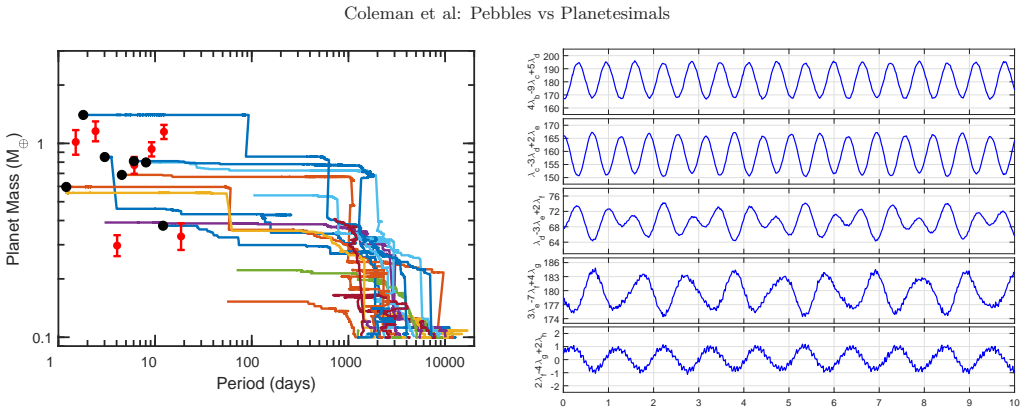
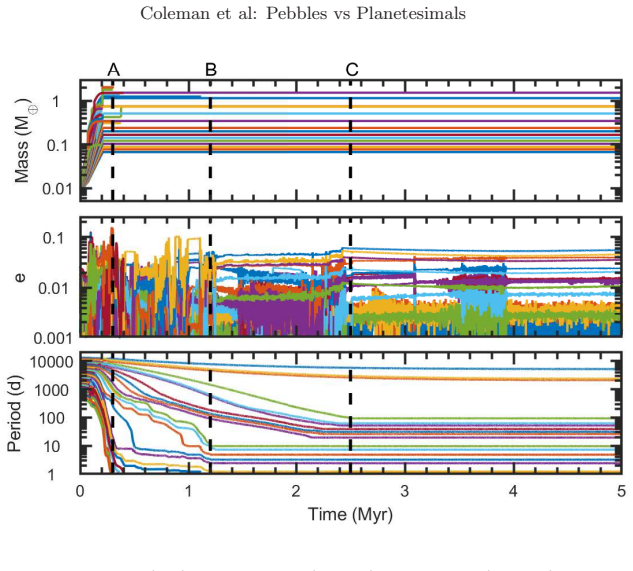
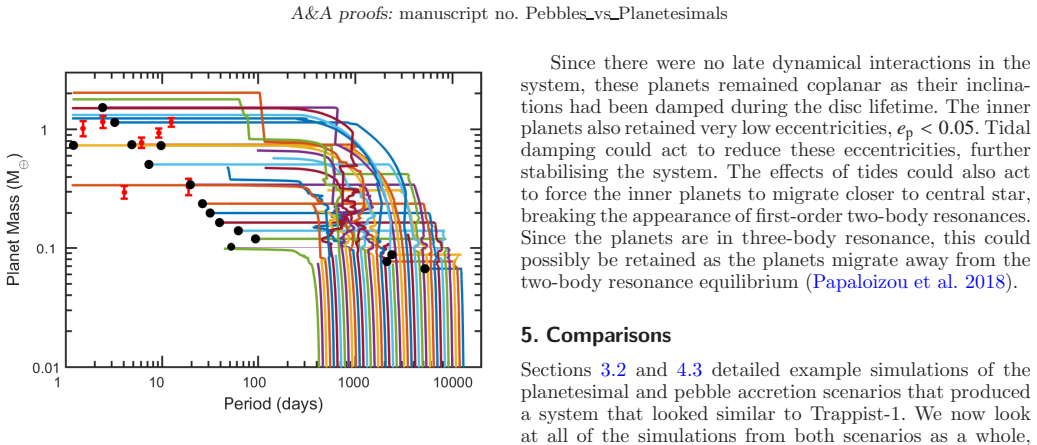
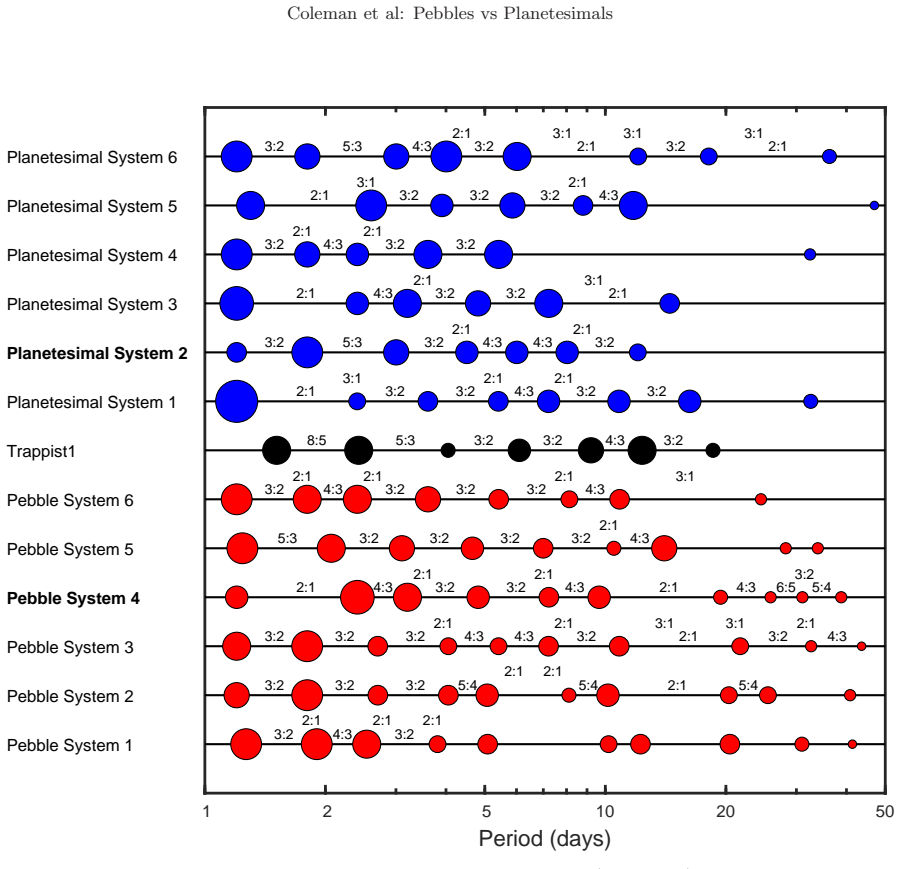
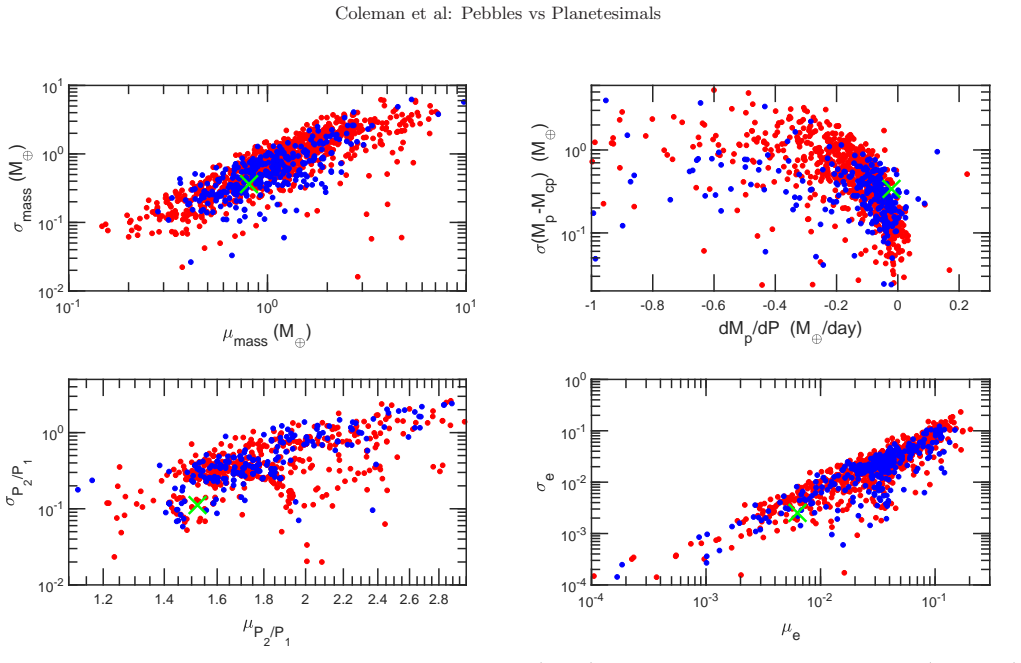
The central claim is that planet formation around M dwarfs like Trappist-1 is degenerate with respect to accretion mode: planetesimal accretion and pebble accretion both produce compact resonant chains of Earth-to-sub-Earth-mass planets inside roughly 20-day orbits, with similar eccentricities, inclinations, mass gradients, and period ratios. The paper's principal discriminator is the final water fraction. Planets that accrete pebbles lose the water content of those pebbles because the pebbles ablate in the planet's envelope and the ablated water is assumed to be efficiently recycled into the local disc; the remaining rocky core grows dry. Planetesimals are too large to be ablated, so planetesimal-built planets keep roughly 50 percent water. If ablation is neglected or the ablated water falls to the core instead of being recycled, pebble-built planets are also wet, restoring the degeneracy.
Load-bearing premise
The load-bearing premise is that a growing planet's thin envelope is fully recycled with the surrounding protoplanetary disc, so that water ablated from pebbles is carried away rather than retained; if recycling is inefficient, pebble-built planets stay wet and the two formation routes become observationally indistinguishable.
Editorial extensions
If this is right
- If the paper is right, matching Trappist-1's masses, periods, and resonant chain does not by itself favour either pebble or planetesimal accretion; both routes are viable across a wide range of disc masses and solid distributions.
- A measured water-poor composition for the Trappist-1 planets would support pebble accretion with efficient envelope recycling, while a water-rich composition would support planetesimal accretion or a breakdown of the recycling assumption.
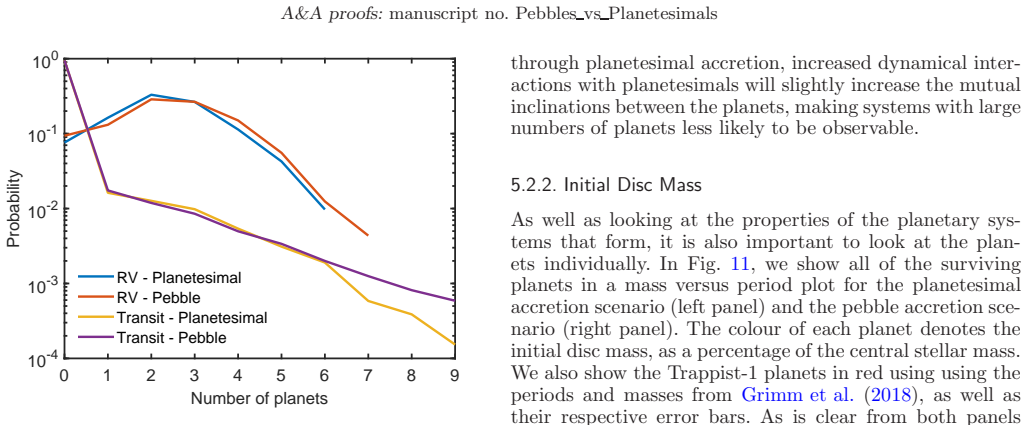
- Pebble-built systems are slightly more compact and coplanar than planetesimal-built ones, so future transit surveys that find many seven-plus-planet systems around M dwarfs may weakly prefer pebble accretion.
- The planetesimal scenario leaves leftover planetesimals that can form debris discs, whereas the pebble scenario leaves little such material; detection of debris discs around low-mass stars would therefore favour planetesimal accretion.
- Long-term irradiation and photolysis can remove water over gigayears, so the water-fraction signature may be blurred in evolved systems like Trappist-1 itself.
Reading between the lines
- A quantitative map of how envelope recycling efficiency varies with envelope mass could turn the binary dry-versus-wet outcome into a graded water-fraction diagnostic; adding such a parameter to the pebble model and comparing with measured bulk compositions would test this.
- The ablation case predicts that water fraction decreases as planet mass increases, so a water-mass anticorrelation within the Trappist-1 planets would be a direct test that the paper does not present as its headline prediction.
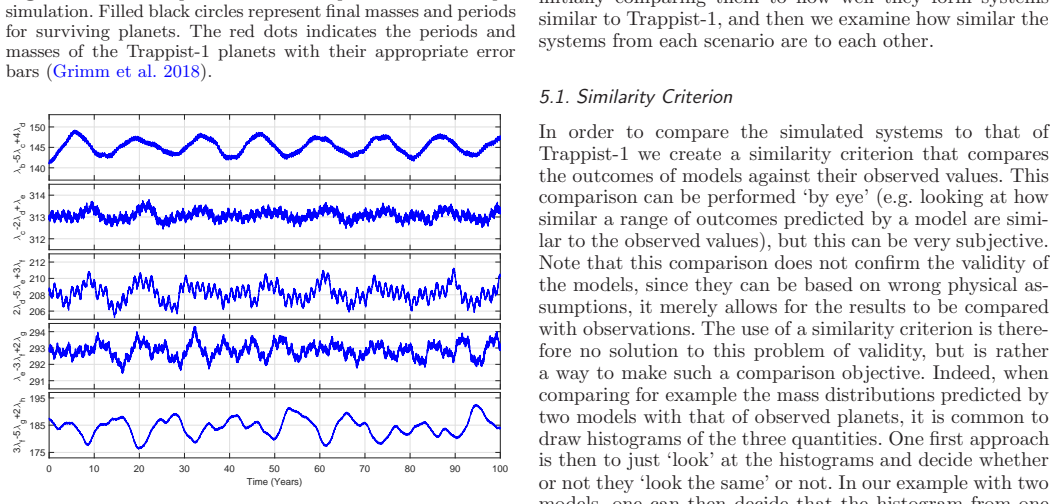
- The simulations reproduce apparent 8:5 period ratios through an unseen planet in a 2:1 resonance, which suggests that precise period-ratio statistics across M-dwarf systems could reveal hidden planets and help distinguish dynamical histories.
- Observing younger, still-forming M-dwarf planetary systems before gigayear-scale water loss would offer a cleaner test of the dry-versus-wet dichotomy than the evolved Trappist-1 planets.
Signed reviews
Editorial analysis
A structured set of objections, weighed in public.
Referee Report
Summary. The paper uses N-body simulations coupled to a 1D viscous disk model, with prescriptions for type-I migration, photoevaporation, and two solid-accretion modes (pebble accretion and planetesimal accretion), to ask whether the Trappist-1 system can be formed in either scenario and whether the two scenarios are distinguishable. A similarity criterion based on planet masses, period ratios, eccentricities, and mass gradients is used to select the most Trappist-like synthetic systems. The authors find that both pebble and planetesimal accretion form resonant chains of low-mass planets matching Trappist-1 in mass, period, and resonance structure, and that the only significant difference is the final water fraction: planetesimal-formed planets are water-rich (~50%), while pebble-formed planets are water-poor (<5%) only when pebble ablation in the envelope is accompanied by full recycling of the envelope with the local disk. Without that recycling, or without ablation, pebble-formed planets are also water-rich. The paper is candid about this dependence, listing more accurate envelope-recycling prescriptions as future work.
Significance. If the central claim holds, the paper provides a genuinely useful result: it shows that Trappist-1-like architectures are not a unique fingerprint of either pebble or planetesimal accretion, and it identifies water content as a potentially decisive discriminator for future observations of low-mass-star planetary systems. The study is broad in parameter coverage (disk mass, pebble fraction, planetesimal size, photoevaporation rate), uses a quantitative similarity criterion rather than eye-balling, and analyzes resonant structures, three-body resonances, and observational biases with commendable detail. The paper also openly discusses limitations, including the planetesimal-size assumption, neglected sublimation, and the recycling uncertainty. The value of the water-fraction result is real but conditional on a microphysical assumption that the authors themselves flag as uncertain, which limits the strength of the paper's headline conclusion.
major comments (4)
- [§4.1.1 and §5.2.3]
- [§3.1 and §4.2]
- [§3.1, §5.2.4, and §6.3(i)]
- [§5.1 and Table 2]
minor comments (5)
- [Figure 8, bottom right panel caption]
- [§4.1.1]
- [Table 2 caption]
- [§5.2.2]
- [§3.2 and §4.3 example simulations]
Circularity Check
No significant circularity: forward formation models are compared with Trappist-1 only as a target, with no parameter fitted to the target; the water-content caveat is explicit.
full rationale
The derivation chain is forward. Initial embryos, discs, migration, photoevaporation, and pebble/planetesimal accretion are prescribed from prior models (Coleman et al. 2017a; Lambrechts & Johansen 2014) and evolved with Mercury-6; observed Trappist-1 masses and periods (Grimm et al. 2018) enter only through the post-hoc similarity criterion (Eqs. 11-13), which does not feed back into the model. No parameter is fitted to reproduce Trappist-1, so there is no fitted-input-called-prediction step. The only observable discriminator, water fraction, is a conditional product of the ablation criterion (Eq. 10) and the full-envelope-recycling assumption in Sect. 4.1.1; the paper explicitly flags this dependence in Sect. 5.2.3 ('For our models, the impact of ablation is dependent on the assumption that the solid material that is ablated is efficiently recycled back into the protoplanetary disc') and lists more accurate envelope recycling as future work (Sect. 6.3(v)). This is an acknowledged microphysical sensitivity, not a definitional equivalence. Self-citations to prior model implementations are independent, earlier developments that do not contain the Trappist-1 result, so they are not load-bearing circularity.
Assumptions & free parameters
free parameters (6)
- Pebble growth efficiency epsilon_d =
0.05
- Envelope mass fraction of planets =
0.1% of planet mass
- Initial embryo mass (planetesimal scenario) =
0.1 Earth masses
- Initial embryo mass (pebble scenario) =
0.01 Earth masses
- Pebble fraction of solids =
50-90%
- Planetesimal size =
100 m or 1 km
assumptions (5)
- domain assumption Type I migration torque prescriptions of Paardekooper et al. (2010, 2011) are valid for the discs and planets modeled
- ad hoc to paper Planetesimals in the modeled size range (100 m to 1 km) can exist in sufficient numbers; streaming instability must somehow produce or fragment into them
- domain assumption Envelopes of sub-terrestrial planets are fully recycled with the disc
- domain assumption Collisions always result in perfect merging
- domain assumption Water content outside the iceline is 50% by mass
Cite this review
Pith. "Pith review of Pebbles versus Planetesimals: The case of Trappist-1." pith.science (2026). https://pith.science/paper/QS4PWDQT
@misc{pith2026190804166,
  author       = {Pith},
  title        = {Pith review of: Pebbles versus Planetesimals: The case of Trappist-1},
  year         = {2026},
  howpublished = {\url{https://pith.science/paper/QS4PWDQT}},
  note         = {Machine review of arXiv:1908.04166}
}
read the original abstract
We present a study on the formation of planetary systems around low mass stars similar to Trappist-1, through the accretion of either planetesimals or pebbles. The aim is to determine if the currently observed systems around low mass stars favour one scenario over the other. We ran numerous N-body simulations, coupled to a thermally evolving viscous disc model, including prescriptions for planet migration and photoevaporation. We examine the differences between the pebble and planetesimal accretion scenarios, but also look at the influences of disc mass, planetesimal size, and the percentage of solids locked up within pebbles. When comparing the resulting planetary systems to Trappist-1, we find that a wide range of initial conditions for both accretion scenarios can form planetary systems similar to Trappist-1, in terms of planet mass, periods, and resonant configurations. Typically these planets formed exterior to the water iceline and migrated in resonant convoys to close to the central star. When comparing the planetary systems formed from pebbles to those formed from planetesimals, we find a large number of similarities, including average planet masses, eccentricities, inclinations and period ratios. One major difference was that of the water content of the planets. When including the effects of ablation and full recycling of the planets envelope with the disc, planets formed from pebbles were extremely dry, whilst those formed from planetesimals were extremely wet. If the water content is not fully recycled and instead falls to the planets core, or if ablation of the water is neglected, then the planets formed from pebbles are extremely wet, similar to those formed from planetesimals. Should the water content of the Trappist-1 planets be determined accurately, this could point to a preferred formation pathway for planetary systems, or to specific physics that may be at play.
Figures

Figures from the paper (14 more)



Forward citations
Cited by 1 Pith paper
-
Red Dots: A temperate 1.5 Earth-mass planet in a compact multi-terrestrial planet system around GJ1061
Three Earth-mass planet candidates orbit the nearby red dwarf GJ 1061 with periods near 3.2, 6.7, and 13 days, and the outer one lies in the habitable zone.
Reference graph
Works this paper leans on
-
[1]
Abod, C. P., Simon, J. B., Li, R., et al. 2018, arXiv e-prints, arXiv:1810.10018
arXiv 2018
-
[2]
1976, Progress of The oretical Physics, 56, 1756
Adachi, I., Hayashi, C., & Nakazawa, K. 1976, Progress of The oretical Physics, 56, 1756
work page 1976
-
[3]
Alexander, R. D. & Armitage, P. J. 2009, ApJ, 704, 989
work page 2009
- [4]
- [5]
- [6]
-
[7]
Alibert, Y., Carron, F., Fortier, A., et al. 2013, A &A, 558, A109
work page 2013
-
[8]
Anglada, G., Amado, P. J., Ortiz, J. L., et al. 2017, ApJ Lette rs, 850, L6 Anglada-Escud´ e, G., Amado, P. J., Barnes, J., et al. 2016, N ature, 536, 437 Anglada-Escud´ e, G., L´ opez-Morales, M., & Chambers, J. E. 2010, ApJ, 709, 168
work page 2017
Show all 79 references
-
[9]
2017 b, A &A, 602, A88 Beaug´ e, C., S´ andor, Z.,´Erdi, B., & S ¨uli, ´A
Astudillo-Defru, N., Forveille, T., Bonfils, X., et al. 2017 b, A &A, 602, A88 Beaug´ e, C., S´ andor, Z.,´Erdi, B., & S ¨uli, ´A. 2007, A &A, 463, 359 Ben ´ ıtez-Llambay, P., Masset, F., Koenigsberger, G., & Szu l´ agyi, J. 2015, Nature, 520, 63
2017
-
[10]
2015, A &A, 582, A112
Bitsch, B., Lambrechts, M., & Johansen, A. 2015, A &A, 582, A112
2015
-
[11]
E., et al
Bolmont, E., Selsis, F., Owen, J. E., et al. 2017, MNRAS, 464, 3728 Bonfils, X., Almenara, J.-M., Cloutier, R., et al. 2018a, A &A, 618, A142 Bonfils, X., Astudillo-Defru, N., D ´ ıaz, R., et al. 2018b, A&A, 613, A25 Broˇ z, M., Chrenko, O., Nesvorn´ y, D., & Lambrechts, M. 2018...
2017
-
[12]
Chambers, J. E. 1999, MNRAS, 304, 793
1999
-
[13]
P., Kuiper, R., & Ormel, C
Cimerman, N. P., Kuiper, R., & Ormel, C. W. 2017, MNRAS, 471, 4662
2017
-
[14]
Coleman, G. A. L. & Nelson, R. P. 2014, MNRAS, 445, 479
2014
-
[15]
N., Hersant, F., & Pierens, A
Cossou, C., Raymond, S. N., Hersant, F., & Pierens, A. 2014, A &A, 569, A56
2014
-
[16]
& Nelson, R
Cresswell, P. & Nelson, R. P. 2006, A &A, 450, 833
2006
-
[17]
& Nelson, R
Cresswell, P. & Nelson, R. P. 2008, A &A, 482, 677
2008
-
[18]
& Nelson, R
Cresswell, P. & Nelson, R. P. 2009, A &A, 493, 1141
2009
-
[19]
Desch, S. J. & Turner, N. J. 2015, ApJ, 811, 156
2015
-
[20]
A., Irwin, J
Dittmann, J. A., Irwin, J. M., Charbonneau, D., et al. 2017, N ature, 544, 333
2017
-
[21]
2015, A &A, 577, A83 Dr֒a˙ zkowska, J
Dorn, C., Khan, A., Heng, K., et al. 2015, A &A, 577, A83 Dr֒a˙ zkowska, J. & Alibert, Y. 2017, A &A, 608, A92
2015
-
[22]
C., Lissauer, J
Fabrycky, D. C., Lissauer, J. J., Ragozzine, D., et al. 2014, ApJ, 790, 146
2014
-
[23]
Fendyke, S. M. & Nelson, R. P. 2014, MNRAS, 437, 96
2014
-
[24]
Fogg, M. J. & Nelson, R. P. 2009, A &A, 498, 575
2009
-
[25]
2015, ApJ, 811, 101
Fung, J., Artymowicz, P., & W u, Y. 2015, ApJ, 811, 101
2015
-
[26]
Gillon, M., Triaud, A. H. M. J., Demory, B.-O., et al. 2017, Na ture, 542, 456
2017
-
[27]
L., Demory, B.-O., Gillon, M., et al
Grimm, S. L., Demory, B.-O., Gillon, M., et al. 2018, A &A, 613, A68
2018
-
[28]
2018, Icarus , 313, 61
Hakim, K., Rivoldini, A., Van Hoolst, T., et al. 2018, Icarus , 313, 61
2018
-
[29]
1981, Progress of Theoretical Physics Suppleme nt, 70, 35
Hayashi, C. 1981, Progress of Theoretical Physics Suppleme nt, 70, 35
1981
-
[30]
& Nelson, R
Hellary, P. & Nelson, R. P. 2012, MNRAS, 419, 2737
2012
-
[31]
& Ikoma, M
Inaba, S. & Ikoma, M. 2003, A &A, 410, 711
2003
-
[32]
N., et al
Izidoro, A., Ogihara, M., Raymond, S. N., et al. 2017, MNRAS, 470, 1750
2017
-
[33]
& Mordasini, C
Jin, S. & Mordasini, C. 2018, ApJ, 853, 163
2018
-
[34]
& Tanigawa, T
Kurokawa, H. & Tanigawa, T. 2018, MNRAS, 479, 635
2018
-
[35]
& Johansen, A
Lambrechts, M. & Johansen, A. 2012, A &A, 544, A32
2012
-
[36]
& Johansen, A
Lambrechts, M. & Johansen, A. 2014, A &A, 572, A107
2014
-
[37]
2014, A &A, 572, A35
Lambrechts, M., Johansen, A., & Morbidelli, A. 2014, A &A, 572, A35
2014
-
[38]
& Lega, E
Lambrechts, M. & Lega, E. 2017, A &A, 606, A146
2017
-
[39]
A., et al
Lambrechts, M., Morbidelli, A., Jacobson, S. A., et al. 2019 , A &A, 627, A83
2019
-
[40]
& Chambers, J
Laughlin, G. & Chambers, J. E. 2002, AJ, 124, 592
2002
-
[41]
2019, arXiv e-prints [arXiv:1901.07640]
Leleu, A., Coleman, G., & Ataiee, S. 2019, arXiv e-prints [arXiv:1901.07640]
2019 arXiv
-
[42]
2019, arXiv e-prints, arXiv:1 906.09261
Li, R., Youdin, A., & Simon, J. 2019, arXiv e-prints, arXiv:1 906.09261
2019
-
[43]
J., Fabrycky, D
Lissauer, J. J., Fabrycky, D. C., Ford, E. B., et al. 2011, Nat ure, 470, 53
2011
-
[44]
& Ormel, C
Liu, B. & Ormel, C. W. 2018, A &A, 615, A138
2018
-
[45]
2003, ApJ, 591, 1220
Lodders, K. 2003, ApJ, 591, 1220
2003
-
[46]
2017, Nature Astro nomy, 1, 0129
Luger, R., Sestovic, M., Kruse, E., et al. 2017, Nature Astro nomy, 1, 0129
2017
-
[47]
2018, A &A, 620, A171
Luque, R., Nowak, G., Pall´ e, E., et al. 2018, A &A, 620, A171
2018
-
[48]
& Pringle, J
Lynden-Bell, D. & Pringle, J. E. 1974, MNRAS, 168, 603
1974
-
[49]
2009, A &A, 493, 1125
Lyra, W., Johansen, A., Klahr, H., & Piskunov, N. 2009, A &A, 493, 1125
2009
-
[50]
S., Morbidelli, A., Crida, A., & Ferreira, J
Masset, F. S., Morbidelli, A., Crida, A., & Ferreira, J. 2006 , ApJ, 642, 478
2006
-
[51]
P., Nelson, R
McNally, C. P., Nelson, R. P., & Paardekooper, S.-J. 2018, MN RAS, 477, 4596
2018
-
[52]
McNeil, D. S. & Nelson, R. P. 2010, MNRAS, 401, 1691
2010
-
[53]
A., Astudillo-Defru, N., et al
Ment, K., Dittmann, J. A., Astudillo-Defru, N., et al. 2019, AJ, 157, 32
2019
-
[54]
M., Fabrycky, D
Mills, S. M., Fabrycky, D. C., Migaszewski, C., et al. 2016, N ature, 533, 509
2016
-
[55]
2006, in Tenth Anniver sary of 51 Peg-b: Status of and prospects for hot Jupiter studies, ed
Mordasini, C., Alibert, Y., & Benz, W. 2006, in Tenth Anniver sary of 51 Peg-b: Status of and prospects for hot Jupiter studies, ed. L. Arnold, F. Bouchy, & C. Moutou, 84–86
2006
-
[56]
Ormel, C. W. & Liu, B. 2018, A &A, 615, A178
2018
-
[57]
W., Liu, B., & Schoonenberg, D
Ormel, C. W., Liu, B., & Schoonenberg, D. 2017, A &A, 604, A1
2017
-
[58]
W., Shi, J.-M., & Kuiper, R
Ormel, C. W., Shi, J.-M., & Kuiper, R. 2015, MNRAS, 447, 3512
2015
-
[59]
Owen, J. E. & W u, Y. 2017, ApJ, 847, 29
2017
-
[60]
2014, MNRAS, 444, 2031
Paardekooper, S.-J. 2014, MNRAS, 444, 2031
2014
-
[61]
201 0, MN- RAS, 401, 1950
Paardekooper, S.-J., Baruteau, C., Crida, A., & Kley, W. 201 0, MN- RAS, 401, 1950
1950
-
[62]
2011, MNRAS, 4 10, 293
Paardekooper, S.-J., Baruteau, C., & Kley, W. 2011, MNRAS, 4 10, 293
2011
-
[63]
Papaloizou, J. C. B., Szuszkiewicz, E., & Terquem, C. 2018, M NRAS, 476, 5032
2018
-
[64]
2015, MNRAS, 454, 2003
Pierens, A. 2015, MNRAS, 454, 2003
2015
-
[65]
& Raymond, S
Pierens, A. & Raymond, S. N. 2014, MNRAS, 442, 2296
2014
-
[66]
B., & Reynolds, R
Podolak, M., Pollack, J. B., & Reynolds, R. T. 1988, Icarus, 7 3, 163
1988
-
[67]
& W u, Y
Pu, B. & W u, Y. 2015, ApJ, 807, 44
2015
-
[68]
2018, Nature, 563, 3 65
Ribas, I., Tuomi, M., Reiners, A., et al. 2018, Nature, 563, 3 65
2018
-
[69]
2018, ApJ, 864, L28
Robertson, P. 2018, ApJ, 864, L28
2018
-
[70]
W., & Dorn, C
Schoonenberg, D., Liu, B., Ormel, C. W., & Dorn, C. 2019, A &A, 627, A149
2019
-
[71]
Shakura, N. I. & Sunyaev, R. A. 1973, A &A, 24, 337
1973
-
[72]
B., Armitage, P
Simon, J. B., Armitage, P. J., Li, R., & Youdin, A. N. 2016, ApJ , 822, 55 Steffen, J. H. & Hwang, J. A. 2015, MNRAS, 448, 1956
2016
-
[73]
2017, ApJ Lett ers, 847, L16
Strugarek, A., Bolmont, E., Mathis, S., et al. 2017, ApJ Lett ers, 847, L16
2017
-
[74]
& Papaloizou, J
Terquem, C. & Papaloizou, J. C. B. 2007, ApJ, 654, 1110
2007
-
[75]
2014, A &A, 562, A27
Thiabaud, A., Marboeuf, U., Alibert, Y., et al. 2014, A &A, 562, A27
2014
-
[76]
& Nakano, T
Umebayashi, T. & Nakano, T. 1988, Progress of Theoretical Ph ysics Supplement, 96, 151
1988
-
[77]
2015, A &A, 576, A114 W agner, F
Venturini, J., Alibert, Y., Benz, W., & Ikoma, M. 2015, A &A, 576, A114 W agner, F. W., Sohl, F., Hussmann, H., Grott, M., & Rauer, H. 2 011, Icarus, 214, 366 W eidenschilling, S. J. 1977, MNRAS, 180, 57
2015
-
[78]
Williams, J. P. & Cieza, L. A. 2011, ARA&A, 49, 67
2011
-
[79]
1980, AJ, 85, 1122 Article number, page 26 of 26
Wisdom, J. 1980, AJ, 85, 1122 Article number, page 26 of 26
1980
Reviewed August 14, 2026 · model on record in the stance chip above.
Discussion (0). Continue with ORCID to comment.