REVIEW 3 major objections 5 minor 54 references
Domain-Specific Embedding Network for Zero-Shot Recognition
T0 review · 3 major / 5 minor · reviewed 2026-08-14 · deepseek-v4-flash
Pith's one-line read The paper claims that generalized zero-shot recognition improves when the semantic-visual projection is split into shared and per-domain branches and a constraint pushes unseen pseudo-features away from seen classes.
desk verdict The domain-specific projection decomposition is a real idea, but the headline SOTA gains are confounded by end-to-end fine-tuning of the backbone; the clean ablation shows a solid but modest improvement. read the letter →
The pith
A machine-rendered reading of the paper's core claim, the machinery that carries it, and where it could break.
The reading
What carries the argument
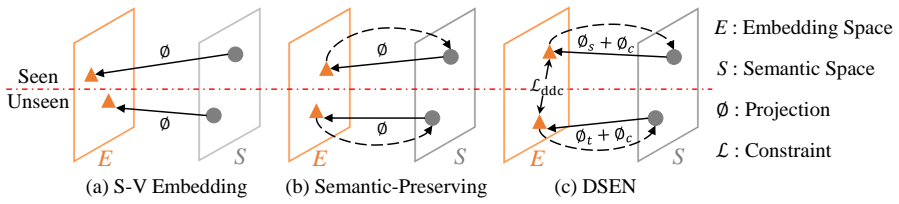
The central object is the decomposed projection function $\phi(a)=\phi_s(a)+\phi_c(a)$ for seen attributes and $\phi(a)=\phi_t(a)+\phi_c(a)$ for unseen attributes, which explicitly models what the two domains share and what is special to each. The semantic reconstruction loss $\mathcal{L}_{sr}$ uses a shared decoder $\phi_{sr}$ to reconstruct semantic attributes from both branches, tying the two specific projections into one embedding space, while the domain division constraint $\mathcal{L}_{ddc}$ penalizes the maximum seen-class score of pseudo unseen features $\phi(a_t)$. The first handles domain specialty; the second handles domain separability.
What would settle it
Measure, per unseen class, the distribution mismatch between pseudo features $\phi(a_t)$ and real features $f(x_t)$ using a domain classifier or MMD; if the classes with the largest mismatch are not the classes where DSEN's unseen accuracy drops most, then the domain division constraint is not the active mechanism behind the reported gains.
Extended reading notes
Core claim
The paper's central claim is that the standard generalized zero-shot pipeline—one semantic-visual projection trained on seen classes and reused on unseen classes—is biased by construction. DSEN replaces the single projection $\phi$ with a sum: $\phi(a)=\phi_s(a)+\phi_c(a)$ for seen attributes and $\phi(a)=\phi_t(a)+\phi_c(a)$ for unseen attributes, where $\phi_c$ is domain-invariant, $\phi_s$ and $\phi_t$ are domain-specific, and a shared decoder $\phi_{sr}$ enforces cycle-consistent semantic reconstruction so both branches live in one embedding space. The companion domain division constraint $\mathcal{L}_{ddc}$ trains a seen-class softmax classifier to treat the pseudo unseen features $\phi(a_t)$ as having a uniform label distribution, so unseen inputs fall outside the seen decision region instead of being absorbed into it. The combined network is trained end-to-end with a pre-trained visual backbone, and at inference a confidence threshold $\tau$ routes confident inputs to the seen softmax classifier and low-confidence inputs to a nearest-neighbor ranking over unseen prototypes. The paper reports state-of-the-art harmonic mean $H$ (the harmonic mean of seen-class and unseen-class top-1 accuracies) on CUB (64.5), SUN (40.4), AWA2 (66.3), and aPY (39.4).
Load-bearing premise
The method works only if the projected attributes of unseen classes resemble real unseen visual features well enough that moving them away from seen classes also moves real unseen images away; when they do not—as the paper admits happens on SUN—the learned domain boundary is the wrong boundary.
Editorial extensions
If this is right
- If DSEN's numbers hold, then on CUB, SUN, AWA2, and aPY the best harmonic-mean accuracy comes from a non-generative embedding model, closing much of the gap that GAN-based feature generators had opened.
- The uniform-label penalty should keep seen-class accuracy high while pushing unseen classes out of the seen decision region, which is why the paper reports that on CUB the fraction of unseen samples with confidence below 0.5 rises from about 50% to 70% under the domain division constraint.
- The two-classifier inference rule makes DSEN a search-space reduction method: once a sample is judged unseen by the confidence threshold, the ranking classifier searches only unseen prototypes, which directly raises unseen-class accuracy.
- Because the visual backbone is trained end-to-end through $\mathcal{L}_{ddc}$, DSEN's features are more separable by domain, reducing the seen-unseen accuracy gap to about 12 points on CUB versus over 30 points for the single-projection baselines it compares against.
Reading between the lines
- The paper leaves implicit that the domain division constraint is a generic noisy-synthetic-data regularizer; the same uniform-distribution penalty could apply to pseudo-labels in semi-supervised learning or to GAN-augmented training sets.
- The SUN result points to a scaling boundary the paper acknowledges but does not probe: as the class count grows and attribute dimensions stay low, projected attributes become weaker stand-ins for images, so DSEN's advantage should shrink unless the pseudo-feature generator is strengthened.
- A testable extension is to use the confidence score $\hat{p}(f(x))$ produced by the domain division classifier as an explicit domain-shift or novelty score, turning DSEN's internal margin into an out-of-distribution detector.
Signed reviews
Editorial analysis
A structured set of objections, weighed in public.
Referee Report
Summary. The paper proposes a Domain-Specific Embedding Network (DSEN) for generalized zero-shot learning (GZSL). Instead of a single shared semantic-visual projection, DSEN decomposes the projection into a domain-invariant component and two domain-specific components (seen and unseen), and trains them with a semantic reconstruction constraint in a cycle-consistency manner. A domain division constraint (DDC) is added to train a seen-domain softmax classifier that treats pseudo visual features from the unseen domain as a uniform distribution over seen classes, enabling a domain-aware inference rule with a threshold. The method is evaluated on CUB, SUN, AWA2, and aPY under both generalized and conventional ZSL settings, reporting state-of-the-art harmonic mean results and average improvements of 9.2% over prior methods. The paper includes ablation studies showing the contribution of each component and releases code.
Significance. If the reported results are clean, the paper makes a useful contribution to GZSL by explicitly modeling domain-specific projections and by introducing a lightweight constraint (DDC) that improves separation between seen and unseen domains without a full generative model. Strengths include a clear motivation, a reproducible experimental setup with released code, consistent arithmetic in the reported tables, and a careful ablation of the three projection components. The claim of state-of-the-art performance, however, rests on a comparison that is confounded by fine-tuning the visual backbone, which is the central weakness. The method's own limitations on SUN are acknowledged in the discussion, which is commendable but also highlights the fragility of the pseudo-feature assumption.
major comments (3)
- [Sec. 4.3, Table 4; Sec. 3.4; Implementation details] The claim that DSEN 'significantly outperforms existing methods' is not supported cleanly because DSEN fine-tunes the ResNet-101 visual extractor end-to-end, whereas all compared prior methods (e.g., SE-ZSL, FGN, SP-AEN) use fixed features. The ablation path from S2V (fixed f, H=35.3 on CUB) to DDC (trainable f, H=62.6) bundles the proposed DDC loss with the large effect of backbone fine-tuning on seen classes. To attribute the reported gains to the proposed components, the paper should include a fixed-feature version of DSEN or a fine-tuned version of a strong baseline such as FGN or SP-AEN.
- [Sec. 3.3, Eq. (7); Sec. 4.3 Discussion] The domain division constraint assumes that the pseudo visual features phi(at) are a reliable proxy for real unseen visual features f(xt). The paper's own Discussion admits that on SUN 'too many categories... make it hard to generate good visual features from semantic attributes of low dimensions,' which is essentially an acknowledgment that this assumption fails in the setting where DSEN shows the smallest improvement. The paper should report sensitivity of DDC/DSEN to pseudo-feature quality, for example by replacing phi(at) with a stronger generator (oracle or GAN-based) and measuring the resulting change in MCAt and H.
- [Sec. 3.3, Eq. (8); Fig. 5] The inference rule in Eq. (8) relies on a per-dataset threshold tau that is selected to maximize H on the validation split (Fig. 5). The paper does not state whether the validation set includes unseen classes or only seen classes. If tau is tuned with access to unseen-domain labels (directly or through a validation set containing unseen classes), then the comparison with methods that do not tune such a threshold on unseen data is not apples-to-apples. Please clarify the validation protocol and, if tau is tuned on seen-only validation, explain how the optimal values are obtained.
minor comments (5)
- [Abstract and Sec. 1] There are several typographical errors: 'Caltech-USCD' should be 'Caltech-UCSD' in Sec. 4.1, 'sate-of-the-art' is misspelled in Sec. 1, and 'zeros-shot learning' in Table 4's caption should be 'zero-shot learning'.
- [Tables 3 and 4] The paper uses 'MACs' and 'MACt' in the caption of Table 3 and in the text, while the evaluation metric in Sec. 4.1 is defined as MCAs and MCAt. Please standardize the notation.
- [Fig. 5] The horizontal axis label uses 'Ƭ' instead of the Greek letter 'tau' used in the text. This makes the figure harder to read.
- [Eq. (3)] The phrase 'i f a∈A s' should be 'if a∈A s' (spacing and missing space) in Eq. (3).
- [Sec. 3.3] The sentence 'because Ys and Yt are disjoint' is grammatically incomplete; it should read 'because Ys and Yt are disjoint sets' or similar.
Circularity Check
No significant circularity: DSEN's claims are empirical and self-contained; self-citations are not load-bearing.
full rationale
The paper makes no claim that reduces by construction to its inputs. The central objective in Eq. (9) is a sum of three explicit loss terms: the semantic-visual loss L_svs, the semantic reconstruction loss L_sr, and the domain division loss L_ddc. Each term is defined from the model components and the data, and the reported improvements are measured on held-out test splits with the standard harmonic mean metric. Hyper-parameters like lambda_1, lambda_2, alpha, and tau are tuned in ablation studies, but this is model selection, not a fitted parameter renamed as a prediction. The pseudo-feature step in Sec. 3.3, where phi(a_t) is treated as pseudo visual data because it is assumed to share a distribution with f(x_t), is a stated modeling assumption that could fail empirically, but it is not circular: the classifier trained on those pseudo features is evaluated on real unseen features, so the claim is falsifiable. The self-citations in the reference list, e.g., [8] and [46], appear only in the introductory paragraph about traditional recognition and are not used to justify any load-bearing premise or to forbid alternative methods. The comparison confound noted by the skeptic, that DSEN fine-tunes ResNet-101 while many prior methods fix features, is a legitimate threat to the SOTA claim's attribution but is a controlled-experiment validity issue, not circular reasoning. The paper is an empirical, externally benchmarked contribution, so the appropriate circularity score is 0.
Assumptions & free parameters
free parameters (4)
- lambda1 =
5
- lambda2 =
1
- alpha =
0.1
- tau per dataset =
0.8 (CUB), 0.5 (SUN), 0.9 (AWA2), 0.8 (aPY)
assumptions (5)
- domain assumption ResNet-101 pretrained on ImageNet provides a visual feature extractor that can be fine-tuned for ZSL.
- domain assumption Category attributes are a sufficient and complete semantic representation for zero-shot transfer.
- domain assumption Two fully connected layers with ReLU can represent the projection and decoder functions.
- ad hoc to paper Cycle-consistent semantic reconstruction with a shared decoder ensures that seen and unseen embeddings share one space.
- ad hoc to paper Pseudo visual features phi(at) approximate real unseen visual features f(xt).
Cite this review
Pith. "Pith review of Domain-Specific Embedding Network for Zero-Shot Recognition." pith.science (2026). https://pith.science/paper/YY55WSXK
@misc{pith2026190804174,
  author       = {Pith},
  title        = {Pith review of: Domain-Specific Embedding Network for Zero-Shot Recognition},
  year         = {2026},
  howpublished = {\url{https://pith.science/paper/YY55WSXK}},
  note         = {Machine review of arXiv:1908.04174}
}
abstract
Zero-Shot Learning (ZSL) seeks to recognize a sample from either seen or unseen domain by projecting the image data and semantic labels into a joint embedding space. However, most existing methods directly adapt a well-trained projection from one domain to another, thereby ignoring the serious bias problem caused by domain differences. To address this issue, we propose a novel Domain-Specific Embedding Network (DSEN) that can apply specific projections to different domains for unbiased embedding, as well as several domain constraints. In contrast to previous methods, the DSEN decomposes the domain-shared projection function into one domain-invariant and two domain-specific sub-functions to explore the similarities and differences between two domains. To prevent the two specific projections from breaking the semantic relationship, a semantic reconstruction constraint is proposed by applying the same decoder function to them in a cycle consistency way. Furthermore, a domain division constraint is developed to directly penalize the margin between real and pseudo image features in respective seen and unseen domains, which can enlarge the inter-domain difference of visual features. Extensive experiments on four public benchmarks demonstrate the effectiveness of DSEN with an average of $9.2\%$ improvement in terms of harmonic mean. The code is available in \url{https://github.com/mboboGO/DSEN-for-GZSL}.
Figures


Figures from the paper (3 more)



Reference graph
Works this paper leans on
-
[1]
Zeynep Akata, Florent Perronnin, Zaid Harchaoui, and Cordelia Schmid. 2013. Label-embedding for attribute-based classification. In 2013 IEEE Conference on Computer Vision and Pattern Recognition . IEEE, 819–826
work page 2013
-
[2]
Zeynep Akata, Florent Perronnin, Zaid Harchaoui, and Cordelia Schmid. 2016. Label-embedding for image classification. IEEE transactions on pattern analysis and machine intelligence 38, 7 (2016), 1425–1438
2016
-
[3]
Zeynep Akata, Scott Reed, Daniel Walter, Honglak Lee, and Bernt Schiele. 2015. Evaluation of output embeddings for fine-grained image classification. In Pro- ceedings of the IEEE Conference on Computer Vision and Pattern Recognition . 2927– 2936
work page 2015
-
[4]
Yashas Annadani and Soma Biswas. 2018. Preserving Semantic Relations for Zero-Shot Learning. In Proceedings of the IEEE Conference on Computer Vision and Pattern Recognition. 7603–7612
work page 2018
-
[5]
Maxime Bucher, Stéphane Herbin, and Frédéric Jurie. 2017. Generating visual representations for zero-shot classification. InProceedings of the IEEE International Conference on Computer Vision . 2666–2673
work page 2017
-
[6]
Soravit Changpinyo, Wei-Lun Chao, Boqing Gong, and Fei Sha. 2016. Synthe- sized classifiers for zero-shot learning. In Proceedings of the IEEE Conference on Computer Vision and Pattern Recognition . 5327–5336
work page 2016
-
[7]
Long Chen, Hanwang Zhang, Jun Xiao, Wei Liu, and Shih-Fu Chang. 2018. Zero- Shot Visual Recognition using Semantics-Preserving Adversarial Embedding Network. In Proceedings of the IEEE Conference on Computer Vision and Pattern Recognition, Vol. 2
work page 2018
-
[8]
Shancheng Fang, Hongtao Xie, Zheng-Jun Zha, Nannan Sun, Jianlong Tan, and Yongdong Zhang. 2018. Attention and language ensemble for scene text recogni- tion with convolutional sequence modeling. In 2018 ACM Multimedia Conference on Multimedia Conference. ACM, 248–256
work page 2018
Show all 54 references
-
[9]
Ali Farhadi, Ian Endres, Derek Hoiem, and David Forsyth. 2009. Describing objects by their attributes. In Proceedings of the IEEE Conference on Computer Vision and Pattern Recognition . IEEE, 1778–1785
2009
-
[10]
Andrea Frome, Greg S Corrado, Jon Shlens, Samy Bengio, Jeff Dean, Tomas Mikolov, et al. 2013. Devise: A deep visual-semantic embedding model. In Ad- vances in neural information processing systems . 2121–2129
2013
-
[11]
Yanwei Fu, Timothy M Hospedales, Tao Xiang, Zhenyong Fu, and Shaogang Gong. 2014. Transductive multi-view embedding for zero-shot recognition and annotation. In European Conference on Computer Vision . Springer, 584–599
2014
-
[12]
Ian Goodfellow, Jean Pouget-Abadie, Mehdi Mirza, Bing Xu, David Warde-Farley, Sherjil Ozair, Aaron Courville, and Yoshua Bengio. 2014. Generative adversarial nets. In Advances in neural information processing systems . 2672–2680
2014
-
[13]
Kaiming He, Xiangyu Zhang, Shaoqing Ren, and Jian Sun. 2016. Deep residual learning for image recognition. In Proceedings of the IEEE conference on computer vision and pattern recognition . 770–778
2016
-
[14]
Xiangteng He and Yuxin Peng. 2018. Only Learn One Sample: Fine-Grained Visual Categorization with One Sample Training. In 2018 ACM Multimedia Conference on Multimedia Conference. ACM, 1372–1380
2018
-
[15]
Huajie Jiang, Ruiping Wang, Shiguang Shan, and Xilin Chen. 2018. Learning class prototypes via structure alignment for zero-shot recognition. In Proceedings of the European conference on computer vision . 118–134
2018
-
[16]
Huajie Jiang, Ruiping Wang, Shiguang Shan, Yi Yang, and Xilin Chen. 2017. Learn- ing discriminative latent attributes for zero-shot classification. In Proceedings of the IEEE International Conference on Computer Vision . 4223–4232
2017
-
[17]
Elyor Kodirov, Tao Xiang, Zhenyong Fu, and Shaogang Gong. 2015. Unsupervised domain adaptation for zero-shot learning. In Proceedings of the IEEE International Conference on Computer Vision . 2452–2460
2015
-
[18]
Elyor Kodirov, Tao Xiang, and Shaogang Gong. 2017. Semantic autoencoder for zero-shot learning. In Proceedings of the IEEE Conference on Computer Vision and Pattern Recognition. 3174–3183
2017
-
[19]
Vinay Kumar Verma, Gundeep Arora, Ashish Mishra, and Piyush Rai. 2018. Generalized zero-shot learning via synthesized examples. In Proceedings of the IEEE conference on computer vision and pattern recognition . 4281–4289
2018
-
[20]
Christoph H Lampert, Hannes Nickisch, and Stefan Harmeling. 2009. Learning to detect unseen object classes by between-class attribute transfer. In Proceedings of the IEEE Conference on Computer Vision and Pattern Recognition . IEEE, 951–958
2009
-
[21]
Christoph H Lampert, Hannes Nickisch, and Stefan Harmeling. 2014. Attribute- based classification for zero-shot visual object categorization. IEEE Transactions on Pattern Analysis and Machine Intelligence 36, 3 (2014), 453–465
2014
-
[22]
Angeliki Lazaridou, Georgiana Dinu, and Marco Baroni. 2015. Hubness and pollution: Delving into cross-space mapping for zero-shot learning. In the 7th International Joint Conference on Natural Language Processing) , Vol. 1. 270–280
2015
-
[23]
Yan Li, Junge Zhang, Jianguo Zhang, and Kaiqi Huang. 2018. Discriminative Learning of Latent Features for Zero-Shot Recognition. In Proceedings of the IEEE Conference on Computer Vision and Pattern Recognition . 7463–7471
2018
-
[24]
Teng Long, Xing Xu, Youyou Li, Fumin Shen, Jingkuan Song, and Heng Tao Shen. 2018. Pseudo transfer with marginalized corrupted attribute for zero-shot learning. In 2018 ACM international conference on Multimedia . ACM, 1802–1810
2018
-
[25]
Ashish Mishra, Shiva Krishna Reddy, Anurag Mittal, and Hema A Murthy. 2018. A generative model for zero shot learning using conditional variational autoen- coders. In Proceedings of the IEEE Conference on Computer Vision and Pattern Recognition Workshops. 2188–2196
2018
-
[26]
Pedro Morgado and Nuno Vasconcelos. 2017. Semantically consistent regulariza- tion for zero-shot recognition. In Proceedings of the IEEE Conference on Computer Vision and Pattern Recognition , Vol. 9. 10
2017
-
[27]
Yulei Niu, Zhiwu Lu, Songfang Huang, Xin Gao, and Ji-Rong Wen. 2017. FeaBoost: Joint Feature and Label Refinement for Semantic Segmentation. In AAAI. 1474– 1480
2017
-
[28]
Mark Palatucci, Dean Pomerleau, Geoffrey E Hinton, and Tom M Mitchell. 2009. Zero-shot learning with semantic output codes. InAdvances in neural information processing systems. 1410–1418
2009
-
[29]
Genevieve Patterson and James Hays. 2012. Sun attribute database: Discovering, annotating, and recognizing scene attributes. InProceedings of the IEEE Conference on Computer Vision and Pattern Recognition . IEEE, 2751–2758
2012
-
[30]
Jeffrey Pennington, Richard Socher, and Christopher Manning. 2014. Glove: Global vectors for word representation. In Proceedings of the 2014 conference on empirical methods in natural language processing . 1532–1543
2014
-
[31]
Ruizhi Qiao, Lingqiao Liu, Chunhua Shen, and Anton van den Hengel. 2016. Less is more: zero-shot learning from online textual documents with noise suppression. In Proceedings of the IEEE Conference on Computer Vision and Pattern Recognition . 2249–2257
2016
-
[32]
Miloš Radovanović, Alexandros Nanopoulos, and Mirjana Ivanović. 2010. Hubs in space: Popular nearest neighbors in high-dimensional data.Journal of Machine Learning Research 11, Sep (2010), 2487–2531
2010
-
[33]
Bernardino Romera-Paredes and Philip Torr. 2015. An embarrassingly simple approach to zero-shot learning. In International Conference on Machine Learning . 2152–2161
2015
-
[34]
Olga Russakovsky, Jia Deng, Hao Su, Jonathan Krause, Sanjeev Satheesh, Sean Ma, Zhiheng Huang, Andrej Karpathy, Aditya Khosla, Michael Bernstein, et al
-
[35]
Yutaro Shigeto, Ikumi Suzuki, Kazuo Hara, Masashi Shimbo, and Yuji Matsumoto
-
[36]
Karen Simonyan and Andrew Zisserman. 2014. Very deep convolutional networks for large-scale image recognition. arXiv preprint arXiv:1409.1556 (2014)
2014 arXiv
-
[37]
In Joint European Conference on Machine Learning and Knowledge Discovery in Databases
Ridge regression, hubness, and zero-shot learning. In Joint European Conference on Machine Learning and Knowledge Discovery in Databases . Springer, 135–151
-
[38]
Jie Song, Chengchao Shen, Yezhou Yang, Yang Liu, and Mingli Song. 2018. Trans- ductive Unbiased Embedding for Zero-Shot Learning. In Proceedings of the IEEE Conference on Computer Vision and Pattern Recognition . 1024–1033
2018
-
[39]
Richard Socher, Milind Ganjoo, Christopher D Manning, and Andrew Ng. 2013. Zero-shot learning through cross-modal transfer. In Advances in neural informa- tion processing systems. 935–943
2013
-
[40]
Chaojie Wang, Bo Chen, Sucheng Xiao, and Mingyuan Zhou. 2019. Convolutional Poisson Gamma Belief Network. In ICML
2019
-
[41]
Nenad Tomasev, Milos Radovanovic, Dunja Mladenic, and Mirjana Ivanovic. 2014. The role of hubness in clustering high-dimensional data. IEEE transactions on knowledge and data engineering 26, 3 (2014), 739–751
2014
-
[42]
Peter Welinder, Steve Branson, Takeshi Mita, Catherine Wah, Florian Schroff, Serge Belongie, and Pietro Perona. 2010. Caltech-UCSD birds 200. (2010)
2010
-
[43]
Chaojie Wang, Bo Chen, and Mingyuan Zhou. 2018. Multimodal Poisson gamma belief network. In Thirty-Second AAAI Conference on Artificial Intelligence
2018
-
[44]
Yongqin Xian, Christoph H Lampert, Bernt Schiele, and Zeynep Akata. 2018. Zero-shot learning-a comprehensive evaluation of the good, the bad and the ugly. IEEE transactions on pattern analysis and machine intelligence (2018)
2018
-
[45]
Yongqin Xian, Zeynep Akata, Gaurav Sharma, Quynh Nguyen, Matthias Hein, and Bernt Schiele. 2016. Latent embeddings for zero-shot classification. InProceedings of the IEEE Conference on Computer Vision and Pattern Recognition . 69–77
2016
-
[46]
Hongtao Xie, Dongbao Yang, Nannan Sun, Zhineng Chen, and Yongdong Zhang
-
[47]
Yongqin Xian, Tobias Lorenz, Bernt Schiele, and Zeynep Akata. 2018. Feature generating networks for zero-shot learning. In Proceedings of the IEEE conference on computer vision and pattern recognition . 5542–5551
2018
-
[48]
Hongguang Zhang and Piotr Koniusz. 2018. Zero-shot kernel learning. In Pro- ceedings of the IEEE Conference on Computer Vision and Pattern Recognition . 7670– 7679
2018
-
[49]
Li Zhang, Tao Xiang, and Shaogang Gong. 2017. Learning a deep embedding model for zero-shot learning. In Proceedings of the IEEE Conference on Computer Vision and Pattern Recognition . 2021–2030
2017
-
[50]
Yang Yang, Yadan Luo, Weilun Chen, Fumin Shen, Jie Shao, and Heng Tao Shen
-
[54]
Feng Zheng, Xin Miao, and Heng Huang. 2018. Fast vehicle identification via ranked semantic sampling based embedding. In Proceedings of the 27th Interna- tional Joint Conference on Artificial Intelligence . AAAI Press, 3697–3703
2018
-
[2015]
International Journal of Computer Vision 115, 3 (2015), 211–252
Imagenet large scale visual recognition challenge. International Journal of Computer Vision 115, 3 (2015), 211–252
2015
-
[2016]
In Proceedings of the 24th ACM international conference on Multimedia
Zero-shot hashing via transferring supervised knowledge. In Proceedings of the 24th ACM international conference on Multimedia . ACM, 1286–1295
-
[2019]
Pattern Recognition 85 (2019), 109–119
Automated pulmonary nodule detection in CT images using deep convolu- tional neural networks. Pattern Recognition 85 (2019), 109–119
2019
Reviewed August 14, 2026 · model on record in the stance chip above.
Discussion (0). Continue with ORCID to comment.