REVIEW 5 minor 41 references
Excision and avoiding the use of boundary conditions in numerical relativity
T0 review · 0 major / 5 minor · reviewed 2026-08-14 · deepseek-v4-flash
Pith's one-line read Excising a computational grid along the innermost characteristic removes the need for boundary conditions in numerical relativity.
desk verdict A sound, honestly-scoped numerical-methods note: the CFL-obeying outer excision works and is demonstrated cleanly; the CFL-violating variant is a flagged conjecture, not a load-bearing part. read the letter →
The pith
A machine-rendered reading of the paper's core claim, the machinery that carries it, and where it could break.
The reading
What carries the argument
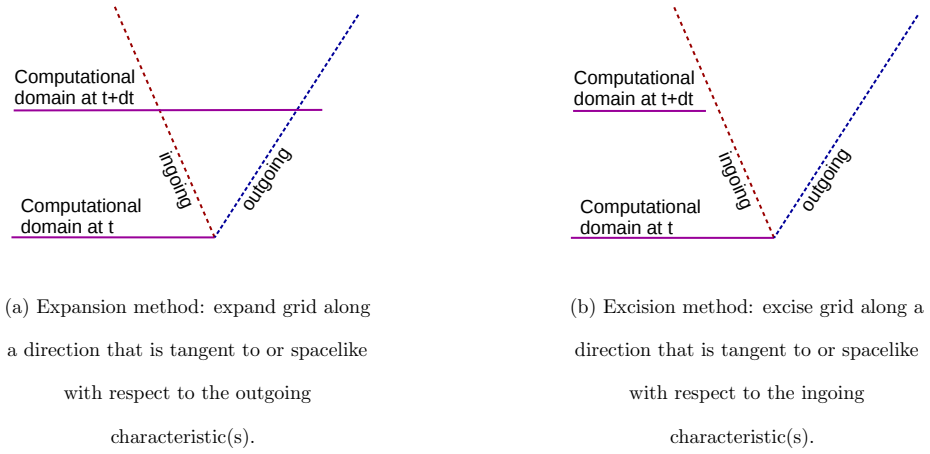
The load-bearing object is the excision surface itself: a moving outer boundary chosen so that every characteristic crossing it is outgoing rather than ingoing. Because the surface is tangent to or spacelike with respect to the innermost characteristic c−, the domain of dependence of each new time slice lies within the old grid, so one can set field values on the boundary by upwinded evolution equations instead of imposed boundary data. The machinery also includes the characteristic speed formula c± = α(±1 − ζ) in Painlevé-Gullstrand coordinates, which locates the excision surface, and the metric decomposition with a null coordinate used to describe surfaces on which no boundary conditions are needed.
What would settle it
Evolve a non-spherically-symmetric gravitational wave or scalar pulse in a 3+1 code using a standard gauge (BSSN or generalized harmonic) with the CFL-violating excision of Sec. III D, at three resolutions, and measure the discrete Einstein-equation residual in the interior: if the error layer grows in width or amplitude with time rather than converging to zero with resolution, the central assumption fails. The paper itself notes this test is beyond its scope.
Extended reading notes
Core claim
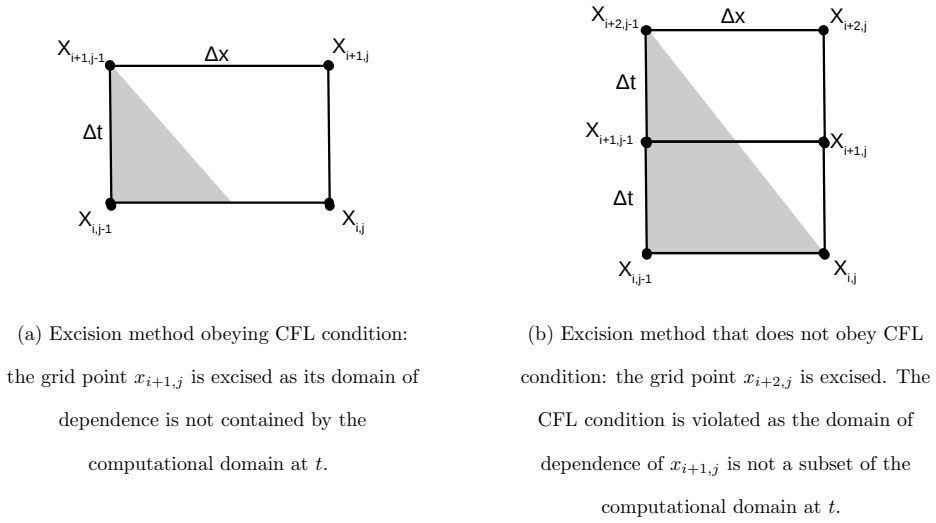
On the paper's own terms, the central discovery is an excision prescription: at each time step, delete the grid points whose domain of dependence is not contained in the previous time slice, choosing the excision surface so it lies tangent to or spacelike with respect to the innermost characteristic speed c−. Along such a surface no characteristics are ingoing, so the evolution is determined entirely by initial data and no boundary conditions are needed. In Painlevé-Gullstrand coordinates for spherical symmetry the characteristic speeds are c± = α(±1 − ζ), and the paper implements two variants: method I excises one grid point per time step (obeying the CFL condition, so evolution time is limited to λT), and method II excises directly along the ingoing null characteristic every 1/(c−λ) time steps (violating CFL at the boundary). Numerical tests with a self-gravitating massless scalar show roughly second-order convergence for both methods; method II develops an error layer near the excision boundary whose width shrinks to zero with resolution, while method I does not. The paper explicitly cautions that these tests are in 1+1 spherical symmetry and that the behavior of CFL-violating excision in axisymmetric or full 3+1 codes with more common gauges is not established.
Load-bearing premise
In the CFL-violating variant, the paper assumes without proof that errors introduced by violating the CFL condition at the excision boundary propagate with characteristic speeds bounded by c−, so they stay in a thin layer near the boundary that shrinks to zero with resolution; the numerical check covers only 1+1 spherical symmetry.
Editorial extensions
If this is right
- If the excision method is correct, numerical relativity codes can evolve compact domains without solving a well-posed, constraint-preserving initial boundary value problem; initial data alone determines the solution.
- For explicit finite-difference schemes with CFL number λ≤1, CFL-obeying excision restricts evolutions to about λ light-crossing times of the initial slice, making the method natural for local gravitational collapse and critical collapse rather than for extracting radiation at large distances.
- With a CFL number of exactly 1, excision can move directly along the ingoing null ray while still satisfying the CFL condition, removing the run-time restriction.
- The CFL-violating variant (method II) yields stable, convergent evolutions in 1+1 spherical symmetry, with any boundary-induced error confined to a layer whose thickness converges to zero with resolution.
- Expansion and excision can be combined: expand the grid first, then excise once the domain reaches a desired size, permitting longer evolutions than pure excision on a fixed initial grid.
Reading between the lines
- A natural testable extension is to repeat the method-II comparison in axisymmetric or full 3+1 evolution with standard gauges such as generalized harmonic or BSSN; if the boundary-error layer continues to converge to zero, CFL-violating excision would become a practical tool for black-hole interior evolutions without outer-boundary prescriptions.
- The same excision principle should apply to any hyperbolic system of equations, not only the Einstein equations, whenever one cares about local dynamics near an outer boundary; a scalar-wave test in flat spacetime would be a minimal check.
- Combining expansion then excision could be developed into a two-phase strategy for long evolutions: expand the grid outward during the early phase, then excise during the phase where the interesting dynamics is local, avoiding both boundary-condition issues and unbounded grid growth.
- If stable CFL=1 or implicit schemes are used, the run-time restriction of one light-crossing time may disappear entirely, which would make excision competitive with compactification or characteristic codes for local collapse problems.
Signed reviews
Editorial analysis
A structured set of objections, weighed in public.
Referee Report
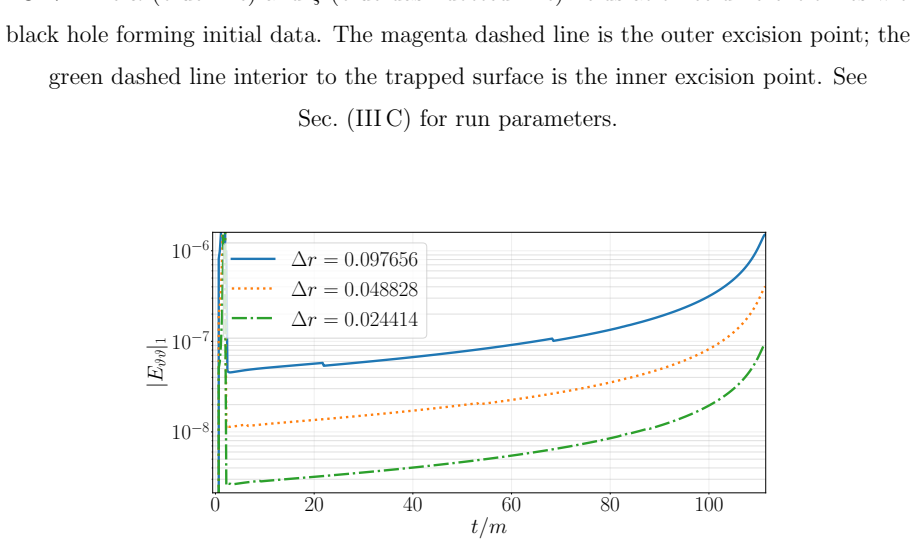
Summary. This paper proposes an 'excision method' for evolving hyperbolic systems, in particular the Einstein equations, on a finite computational domain without imposing boundary conditions. At each time step the outer boundary is moved inward along a surface that is spacelike or tangent to the innermost characteristic, so that no characteristics enter the computational domain. The author contrasts this with the 'expansion method' of Bieri, Garfinkle, and Yau, discusses null-coordinate gauges in which the excision surface can be null, and describes a 1+1 code for a self-gravitating massless scalar in Painlevé-Gullstrand coordinates. Numerical examples cover both non-black-hole and black-hole-forming pulses. The CFL-obeying version (method I) converges at second order in the Einstein constraint residual (Figs. 6 and 8); a CFL-violating version (method II) that excises along the null ray is also tested and shown to have a boundary error layer whose width decreases with resolution, with an explicit caveat that this is only demonstrated in spherical symmetry.
Significance. If the central claim holds, the method offers a simple way to avoid well-posedness and constraint-preservation issues of initial-boundary value formulations for local collapse simulations (e.g., critical collapse or black-hole interiors), at the cost of a maximum evolution time of about one light-crossing time for explicit schemes. The domain-of-dependence argument for method I is standard and correct, and the Einstein-constraint residual is an independent check that gives clean second-order convergence in both non-black-hole and black-hole cases. The paper is honest about the heuristic status of the CFL-violating variant, and no fitted parameters are used in the demonstration. The main claim is defensible as a numerical methods contribution, with the caveat that the tangent/null-limiting case is not proven beyond the tested 1+1 setup.
minor comments (5)
- [Sec. II A / Abstract] The abstract and Sec. II A present excision 'spacelike or tangent' to the innermost characteristic, but the tangent (null) case is implemented by the CFL-violating method II, whose convergence rests on the unproved assumption that boundary errors propagate with speeds bounded by c_- and that the error layer width converges to zero. The author's own caveat in Sec. III D is appropriate, but to avoid overclaiming, please add a qualifier in the abstract (e.g., 'spacelike excision, with numerical evidence for the null-limiting case in spherical symmetry') or explicitly flag the assumption at its first mention in Sec. II A.
- [Sec. II A / Sec. III D] The prescription 'excise one spatial grid point every 1/(c_- lambda) time steps' should read 1/(|c_-| lambda) (or, in practice, ceil(1/(|c_-| lambda))) since c_- is negative; the text in Sec. III D correctly uses 'every other time step' for lambda = 0.5 and |c_-| = 1.
- [Sec. III A, Eq. (9)] The typesetting of the constraint equations is hard to read: 'zeta 2' should be zeta^2, and 'r zeta jr' should be r zeta j_r (with the subscript on j). Please also check the sign of the momentum constraint term against the definition j_r = -PQ, since the current notation makes it difficult to verify.
- [Sec. IV] Minor typos: 'if one uses an scheme' should be 'if one uses a scheme', and 'time lambda T' should be 'time lambda T' with a multiplication symbol or space.
- [Fig. 6] The claim of 'roughly second order convergence' would be easier to assess with a convergence-factor plot or a quantitative rate for the intermediate resolution range; currently Fig. 6 only shows the residuals at three resolutions.
Circularity Check
No significant circularity: the excision claim follows from a domain-of-dependence argument, and the numerical results are checked against the Einstein equation residual.
full rationale
The paper's central claim is that excising along a surface spacelike or tangent to the innermost characteristic removes the need for boundary conditions, because no characteristics are ingoing on that surface. This is a self-contained mathematical argument based on the domain of dependence: the excision condition |δx| ≥ |c−Δt| (Sec. II A) follows from the definition of the characteristic speed c−, computed explicitly for the scalar field in Eq. (13). No fitted parameter is renamed as a prediction; no parameter is fitted to the data at all. The convergence of the method is validated against the discrete one-norm of the ϑϑ component of the Einstein equations (Figs. 6 and 8), which is an independent residual measure rather than an input to the method. The only self-citation is [19], used for the general metric decomposition, and it is not load-bearing. The CFL-violating variant (method II) does rely on an explicit assumption that errors incurred at the boundary propagate with characteristic speeds bounded by c−; this is stated as an assumption, supported by citation to external work [14], and investigated numerically in Sec. III D. Even if that assumption were regarded as insufficiently proven, it is an open correctness question, not a circular reduction: method II is an optional extension, and the primary demonstration uses method I, whose domain-of-dependence reasoning is independent of that assumption. The paper also explicitly cautions that the CFL-violating results may not generalize beyond 1+1 spherical symmetry, further showing the claim is not presented as forced by its own construction. Overall, the derivation does not reduce to its inputs by definition or by self-citation.
Assumptions & free parameters
assumptions (3)
- domain assumption All physical characteristic speeds lie within the null cone of the spacetime metric.
- standard math The CFL condition is necessary and sufficient for stability of the explicit finite difference schemes used here.
- ad hoc to paper Errors introduced by CFL violation at the excision boundary propagate with speeds bounded by the innermost characteristic speed c- and their region shrinks with resolution.
Cite this review
Pith. "Pith review of Excision and avoiding the use of boundary conditions in numerical relativity." pith.science (2026). https://pith.science/paper/GFYLFYTG
@misc{pith2026190804234,
  author       = {Pith},
  title        = {Pith review of: Excision and avoiding the use of boundary conditions in numerical relativity},
  year         = {2026},
  howpublished = {\url{https://pith.science/paper/GFYLFYTG}},
  note         = {Machine review of arXiv:1908.04234}
}
read the original abstract
A procedure for evolving hyperbolic systems of equations on compact computational domains with no boundary conditions was recently described in [arXiv:1905.08657]. In that proposal, the computational grid is expanded in spacelike directions with respect to the outermost characteristic and initial data is imposed on the expanded grid boundary. We discuss a related method that removes the need for imposing boundary conditions: the computational domain is excised along a direction spacelike with respect to the innermost going characteristic. We compare the two methods, and provide example evolutions from a code that implements the excision method: evolution of a massless self-gravitating scalar field in spherical symmetry.
Figures

Figures from the paper (6 more)



Reference graph
Works this paper leans on
-
[1]
A No-Boundary Method for Numerical Relativity
L. Bieri, D. Garfinkle, and S.-T. Yau, (2019), arXiv:1905.08657 [gr-qc]
work page Pith review arXiv 2019
-
[2]
Garfinkle and G
D. Garfinkle and G. C. Duncan, Phys. Rev. D 63, 044011 (2001)
2001
-
[3]
F. Pretorius, Class. Quant. Grav. 22, 425 (2005), arXiv:gr-qc/0407110 [gr-qc]. 17
arXiv 2005
-
[4]
Problems and Successes in the Numerical Approach to the Conformal Field Equations
S. Husa, The conformal structure of space-time: Geometry, analysis, numerics , Lect. Notes Phys. 604, 239 (2002), [,239(2002)], arXiv:gr-qc/0204043 [gr-qc]
work page Pith review arXiv 2002
-
[5]
Frauendiener, Living Reviews in Relativity 7, 1 (2004)
J. Frauendiener, Living Reviews in Relativity 7, 1 (2004)
work page 2004
-
[6]
Winicour, Living Reviews in Relativity 15, 2 (2012)
J. Winicour, Living Reviews in Relativity 15, 2 (2012)
work page 2012
- [7]
-
[8]
H. Friedrich and G. Nagy, Communications in Mathematical Physics 201, 619 (1999)
work page 1999
Show all 41 references
-
[9]
M. C. Babiuc, B. Szil´ agyi, and J. Winicour, Phys. Rev. D 73, 064017 (2006)
2006
-
[10]
Sarbach and M
O. Sarbach and M. Tiglio, Living Reviews in Relativity 15, 9 (2012)
2012
-
[11]
Kreiss and J
H. Kreiss and J. Lorenz, Initial-boundary Value Problems and the Navier-Stokes Equations , Initial-boundary value problems and the Navier-Stokes equations No. v. 136 (Academic Press, 1989)
1989
-
[12]
Seidel and W.-M
E. Seidel and W.-M. Suen, Phys. Rev. Lett. 69, 1845 (1992)
1992
-
[13]
Boyle, D
M. Boyle, D. A. Brown, L. E. Kidder, A. H. Mroue, H. P. Pfeiffer, M. A. Scheel, G. B. Cook, and S. A. Teukolsky, Phys. Rev. D76, 124038 (2007), arXiv:0710.0158 [gr-qc]
2007 arXiv
-
[14]
for an example of a stable and convergent code that excises along an ingoing null ray, and also the discussion in Sec. (III D). Along the excision surface one may use, e.g. upwind difference stencils as is done in the example code described in this paper; see Sec. (III B). By c...
2000
-
[15]
Pretorius and M
F. Pretorius and M. W. Choptuik, Phys. Rev. D62, 124012 (2000), arXiv:gr-qc/0007008 [gr- qc]
2000 arXiv
-
[16]
C. W. Misner, K. S. Thorne, and J. A. Wheeler, Gravitation (W. H. Freeman, San Francisco, 1973)
1973
-
[17]
Courant, K
R. Courant, K. Friedrichs, and H. Lewy, IBM Journal of Research and Development 11, 215 (1967)
1967
-
[18]
R. P. Geroch, in General relativity. Proceedings, 46th Scottish Universities Summer School in Physics, NATO Advanced Study Institute, Aberdeen, UK, July 16-29, 1995 (1996) arXiv:gr- qc/9602055 [gr-qc]
1996
-
[19]
S. W. Hawking and G. F. R. Ellis, The Large Scale Structure of Space-Time (Cambridge Monographs on Mathematical Physics) (Cambridge University Press, 1975)
1975
-
[20]
J. L. Ripley and K. Yagi, Phys. Rev. D97, 024009 (2018), arXiv:1705.03068 [gr-qc]
2018 arXiv
-
[21]
Bondi, Nature 186, 535 (1960)
H. Bondi, Nature 186, 535 (1960)
1960
-
[22]
Bondi, M
H. Bondi, M. G. J. van der Burg, and A. W. K. Metzner, Proceedings of the Royal Society. A. Mathematical, Physical and Engineering Sciences 269 (1962), 10.1098/rspa.1962.0161
1962
-
[23]
R. K. Sachs, Proceedings of the Royal Society. A. Mathematical, Physical and Engineering 18 Sciences 270 (1962), 10.1098/rspa.1962.0206
1962
-
[24]
Pretorius and L
F. Pretorius and L. Lehner, J. Comput. Phys. 198, 10 (2004), arXiv:gr-qc/0302003 [gr-qc]
2004 arXiv
- [25]
-
[26]
R. J. Adler, J. D. Bjorken, P. Chen, and J. S. Liu, Am. J. Phys. 73, 1148 (2005), arXiv:gr- qc/0502040 [gr-qc]
2005
-
[27]
Ziprick and G
J. Ziprick and G. Kunstatter, Phys. Rev. D79, 101503 (2009), arXiv:0812.0993 [gr-qc]
2009 arXiv
-
[28]
Kanai, M
Y. Kanai, M. Siino, and A. Hosoya, Prog. Theor. Phys. 125, 1053 (2011), arXiv:1008.0470 [gr-qc]
2011 arXiv
-
[29]
C. W. Misner and D. H. Sharp, Phys. Rev. 136, B571 (1964)
1964
-
[30]
R. L. Arnowitt, S. Deser, and C. W. Misner, Gen. Rel. Grav. 40, 1997 (2008), arXiv:gr- qc/0405109 [gr-qc]
2008
-
[31]
M. W. Choptuik, Phys. Rev. Lett. 70, 9 (1993)
1993
-
[32]
A. T. Franzen, Commun. Math. Phys. 343, 601 (2016), arXiv:1407.7093 [gr-qc]
2016 arXiv
-
[33]
Luk and S.-J
J. Luk and S.-J. Oh, Duke Math. J. 166, 437 (2017), arXiv:1501.04598 [gr-qc]
2017 arXiv
-
[34]
Dafermos and J
M. Dafermos and J. Luk, (2017), arXiv:1710.01722 [gr-qc]
2017
-
[35]
Penrose, in General Relativity: An Einstein centenary survey , edited by S
R. Penrose, in General Relativity: An Einstein centenary survey , edited by S. W. Hawking and W. Israel (1979) pp. 581–638
1979
-
[36]
Christodoulou, in On recent developments in theoretical and experimental general relativ- ity, astrophysics and relativistic field theories
D. Christodoulou, in On recent developments in theoretical and experimental general relativ- ity, astrophysics and relativistic field theories. Proceedings, 12th Marcel Grossmann Meet- ing on General Relativity, Paris, France, July 12-18, 2009. Vol. 1-3 (2008) pp. 24–34, arXiv:...
2008 arXiv
-
[37]
J. M. McNamara and R. Penrose, Proceedings of the Royal Soci- ety of London. A. Mathematical and Physical Sciences 358, 499 (1978), https://royalsocietypublishing.org/doi/pdf/10.1098/rspa.1978.0024
1978
-
[38]
Poisson and W
E. Poisson and W. Israel, Phys. Rev. D41, 1796 (1990)
1990
-
[39]
P. M. Chesler, E. Curiel, and R. Narayan, Phys. Rev. D99, 084033 (2019), arXiv:1808.07502 [gr-qc]
2019 arXiv
-
[40]
P. R. Brady, Progress of Theoretical Physics Supplement 136, 29 (1999)
1999
-
[41]
Nakonieczna, L
A. Nakonieczna, L. Nakonieczny, and D.-H. Yeom, International Journal of Modern Physics D 28, 1930006 (2019), https://doi.org/10.1142/S0218271819300064. 19
2019 doi
Reviewed August 14, 2026 · model on record in the stance chip above.
Discussion (0). Continue with ORCID to comment.