REVIEW 3 major objections 3 minor 63 references
Effect of superfluid matter of neutron star on the tidal deformability
T0 review · 3 major / 3 minor · reviewed 2026-08-14 · deepseek-v4-flash
Pith's one-line read This paper argues that a neutron star with a two-fluid superfluid core is tidally more deformable than a normal-fluid star with the same equation of state, and that measuring higher-order Love numbers could distinguish the two.
desk verdict The beta-equilibrium argument is right: the reported superfluid tidal enhancement is an artifact of the comparison setup, not a real two-fluid effect. read the letter →
The pith
A machine-rendered reading of the paper's core claim, the machinery that carries it, and where it could break.
The reading
What carries the argument
The load-bearing object is the relativistic master function $\Lambda(n^2,p^2,x^2)$ of two-fluid superfluid hydrodynamics, together with the entrainment coefficient $A=-\partial\Lambda/\partial x^2$, which couples the neutron and proton currents. In the superfluid core this master function supplies the background structure equations (for the two Fermi wave numbers $k_n$, $k_p$ and the Dirac effective mass $m_*$) and the coefficients $A^0_0$, $B^0_0$, $C^0_0$ that enter the perturbed Einstein equations. The crucial step is that the two-fluid perturbation abandons the single-fluid barotropic shortcut $\delta\rho=(d\rho/dp)\delta p$; instead $\delta\Lambda$ is computed explicitly from the perturbed densities, adding a term $g$ to the even-parity equation for $H^{(l)}$. The odd-parity sector is carried by the master function $\psi^{(l)}$, and the two layers are joined by continuity of the first and second fundamental forms at the core-envelope boundary. These equations ultimately change the surface values $y^{(l)}=rH^{(l)'}/H^{(l)}$ and $y^{(l)}=r\psi^{(l)'}/\psi^{(l)}$, which feed the standard Love-number formulas.
What would settle it
A decisive calculation would recompute the two-fluid star with the entrainment coefficient set to zero and with the same unified crust equation of state used for the one-fluid star; if the Love numbers then coincide with the one-fluid values, the claimed superfluid enhancement is not real. Observationally, high-precision measurements of $\Lambda_2^{\rm el}$ from a binary neutron star inspiral that scatter around the one-fluid universal relation rather than the two-fluid one would falsify the claim that superfluidity measurably shifts the tidal response.
Extended reading notes
Core claim
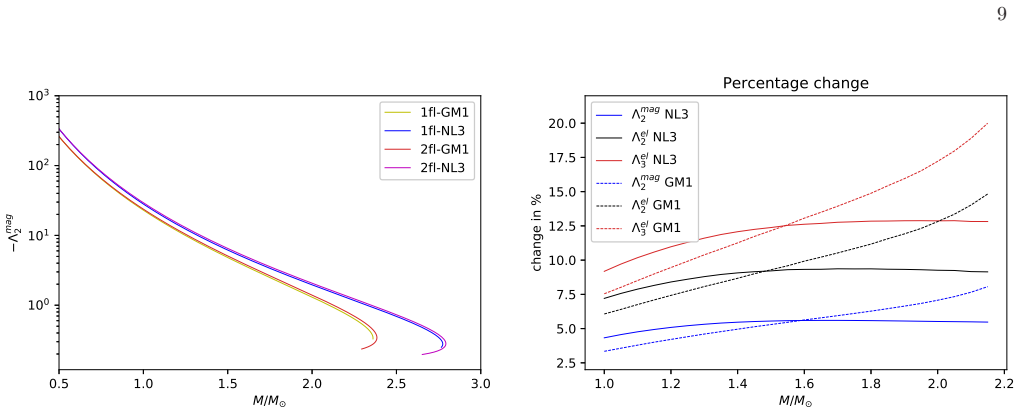
On the paper's own terms, the discovery is that a relativistic two-fluid superfluid core increases a neutron star's tidal response across all the Love numbers studied: for a 1.4 $M_\odot$ star the electric quadrupole tidal deformability $\Lambda_2^{\rm el}$ grows from 1268 to 1391 for NL3 and from 903 to 979 for GM1, the electric octupole $\Lambda_3^{\rm el}$ grows from 3455 to 4015.5 (NL3) and 2241 to 2440.5 (GM1), and the magnetic quadrupole $-\Lambda_2^{\rm mag}$ grows from 7.9 to 8.4 (NL3) and 6.2 to 6.6 (GM1). The percentage increase rises with stellar mass. The authors attribute the larger response to the additional superfluid oscillation modes that a two-fluid star possesses, since tidal deformation can be viewed as a sum over fluid modes. They also find that the universal relations among $\Lambda_2^{\rm el}$, $\Lambda_3^{\rm el}$, $\Lambda_2^{\rm mag}$, and compactness are satisfied in the two-fluid case, but the fitted universal curves differ from the one-fluid ones, which means a measurement of more than one tidal parameter could in principle distinguish a superfluid core from a normal fluid even when the equation of state is unknown.
Load-bearing premise
The load-bearing assumption is that the one-fluid and two-fluid stars differ only in the superfluid core, but the two implementations use different crust equations of state, so part of the reported increase in deformability could be a crust-model effect rather than a superfluid effect.
Editorial extensions
If this is right
- One-fluid interpretations of observed $\Lambda_2^{\rm el}$ will associate the measured value with the wrong equation of state if the star in fact has a superfluid core.
- Tidal constraints on the equation of state derived under the one-fluid assumption will exclude equations of state that would remain viable once superfluidity is included.
- Because the fitted universal curves differ, combining a $\Lambda_2^{\rm el}$ measurement with $\Lambda_3^{\rm el}$ or $\Lambda_2^{\rm mag}$ offers a route to distinguish the two-fluid and one-fluid scenarios from gravitational-wave data.
- The effect grows with stellar mass in the computed range, so the most massive binaries, not the canonical $1.4\,M_\odot$ systems, carry the clearest superfluid signature.
Reading between the lines
- The paper leaves implicit the cleanest control calculation: setting the entrainment coefficient $A$ to zero in the two-fluid model, or using the identical unified crust equation of state in both one- and two-fluid stars, would show how much of the Love-number increase is due to the superfluid two-fluid dynamics rather than to the different crust treatments.
- A natural extension, not performed here, is to treat the inner-crust neutrons as superfluid as well; adding that third layer could shift the Love numbers beyond the core-only calculation and change the universal curves further.
- If the universal curves really are fluid-dependent, a Bayesian model comparison using the two sets of fitted relations as separate hypotheses on existing binary-neutron-star data would be a direct test of whether current gravitational-wave observations already prefer one fluid model over the other.
- The paper's reasoning suggests that measurements of higher multipoles, though individually weak in the waveform, should be combined rather than marginalized over, because their joint correlation with $\Lambda_2^{\rm el}$ is what carries the superfluid signature.
Signed reviews
Editorial analysis
A structured set of objections, weighed in public.
Referee Report
Summary. The paper presents a general-relativistic calculation of tidal Love numbers for neutron stars with a superfluid core modeled as a two-fluid system with entrainment, matched to a normal-fluid envelope. Using the RMF parametrizations NL3 and GM1 and imposing beta equilibrium at the center, the authors compute electric-type (l=2 and l=3) and magnetic-type (l=2) Love numbers and tidal deformabilities. They report that the two-fluid deformabilities are systematically larger than the one-fluid values (Table II), fit universal relations for each case (Table III and Figs. 8-11), and conclude that measurements of multiple Love numbers could break the degeneracy between the equation of state and the superfluid nature of matter.
Significance. If correct, the claimed result would matter for gravitational-wave tidal measurements: it would imply that the superfluid nature of the core must be included in equation-of-state inference and that higher-order Love numbers could act as a probe of superfluidity. The manuscript contains a systematic derivation of the two-fluid perturbation equations and junction conditions, and the one-fluid baseline numbers (Lambda2 about 1268 for NL3 and 903 for GM1 at 1.4 solar masses) agree with earlier work, suggesting that the numerical implementation is plausible. However, the central distinguishing claim is not supported by the paper's own equations: under the beta-equilibrium setup, the static electric-type perturbation reduces exactly to the one-fluid barotropic problem, so the reported enhancement is an artifact of the different equation-of-state and crust inputs used in the comparison rather than a superfluid effect. The significance of the paper for gravitational-wave phenomenology is therefore not established.
major comments (3)
- [Sec. III.A, Eqs. (10), (24), (26), (28)-(29); Sec. VI] The central claim that superfluidity increases the tidal deformability is not supported by the calculation. From the equilibrium equations (10), the combinations mu*exp(nu/2) and chi*exp(nu/2) are constant. Because the authors impose mu=chi at the center (Sec. VI), the two chemical potentials are equal throughout the core. The perturbed conditions delta_mu_0=delta_chi_0=0 used to obtain Eq. (24) then imply delta_mu=delta_chi=0, so the perturbed configuration also lies on the beta-equilibrium curve. Substituting mu=chi into the definition of g in Eq. (26) gives g=-(rho+p)/(dp/drho), and Eq. (28) becomes term-by-term identical to the one-fluid barotropic equation (29). Thus, within the paper's own equations, the static electric-type Love numbers of the two-fluid core are exactly those of a barotropic one-fluid star with the same equilibrium equation of state; superfluidity and entrainment drop out. The differences in Table II (e.g., Lambda2 going from 1268 to 1391 for NL3) must therefore be due to the different equation-of-state and crust inputs used in the two setups (matched Grill/DH envelope versus unified EOS, Secs. II.A and VI), not to superfluidity. This invalidates the conclusion in Sec. VIII that values of the deformabilities for superfluid NS are higher than for the normal-fluid star.
- [Sec. VII, Table III, Figs. 8-11] The universal-relation analysis compares two sets of models that differ not only in fluid nature but also in equation-of-state construction (unified EOS versus matched core/envelope), and the core equation is effectively barotropic once Eq. (28) reduces to Eq. (29). The difference between the fitted curves in Table III is consequently not evidence that superfluidity changes the C-Lambda2 or Lambda3-Lambda2 relations. In addition, each fit uses only two EOS parametrizations (NL3 and GM1), and no uncertainties are quoted for the fitted coefficients, so the claimed difference between the one-fluid and two-fluid universal curves in Figs. 10-11 is not established to be statistically significant. The conclusion that measuring higher-order Love numbers can break the degeneracy between fluid nature and equation of state is therefore unsupported.
- [Sec. VIII] The proposed physical explanation for the larger two-fluid deformabilities, namely that 'due to the appearance of extra fluid modes in the superfluid stars, we will get slightly larger deformations', is not quantitative and is not consistent with the static calculation: the Love numbers are computed in the zero-frequency limit, and finite-frequency superfluid modes do not contribute to the static response. Since Eq. (28) reduces to the one-fluid barotropic equation under beta equilibrium, no extra static degrees of freedom are present in the model. This paragraph should be removed or replaced with an explicit mode-sum calculation that demonstrates a superfluid effect.
minor comments (3)
- [Sec. II.A] The matching between the two-fluid core and the normal-fluid envelope is described only as 'smoothly join... keeping pressure continuous'; the matched radius, the crust-core transition pressure, and the precise form of the unified EOS used for the one-fluid comparison should be stated explicitly to make the results in Table II reproducible.
- [Sec. III.A] The statement 'Staticity implies delta_mu_0 = delta_chi_0 = 0' is not self-evident; the authors should specify the gauge condition and the physical content of this requirement, since it is central to deriving Eq. (24).
- [General] Several figure captions and labels use notation such as '1fl.M/GM1' and '2fl-NL3' inconsistently; standard typographic notation for the solar mass and consistent naming of one-fluid versus two-fluid curves would improve readability.
Circularity Check
Under the paper's own beta-equilibrium condition, the two-fluid static tidal equation reduces exactly to the barotropic one-fluid equation; the reported superfluid enhancement is a relabeling of a one-fluid result with different EOS/crust inputs.
-
renaming known result
[Sec. III A (Eqs. 10, 23, 28-29); Sec. VI; Sec. VIII]
"We impose β-equilibrium at the center of the star by imposing µ|0 = χ|0 ... The main difference between Eq. (28) and its non-superfluid single fluid counterpart Eq. (15) in Ref. [7] is as follows. In the case of the normal fluid, it is assumed that the fluid is barotropic in nature. ... For any multi-fluid scenarios, this assumption is incorrect, in general. ... the final equation of even parity perturbation gets modified and so does the response to the perturbation subsequently."
Eq. (10) integrates to µe^{ν/2}=const and χe^{ν/2}=const; with µ=χ at the center (Sec. VI), µ=χ throughout the core. Eq. (23) with δµ0=δχ0=0 forces δµ=δχ=-(µ/2)H P_l, so the perturbed star remains β-equilibrated. Thus δΛ=-[χδp+µδn]=-µδ(n+p) is barotropic, and g in Eq. (26) equals -(ρ+p)/(dp/dρ). With ρ=-Λ and Ψ=p, Eq. (28) is term-by-term identical to the one-fluid barotropic Eq. (29). Entrainment (A) and the second-fluid degree of freedom drop out of the static tide. The Table II increases therefore come from the different input EOS/crust treatments (two-fluid RMF core matched to Grill/DH envelope vs. one-fluid unified EOS), not from superfluidity.
full rationale
The numerical Love numbers are computed from the perturbed Einstein equations, not fitted to any observed tidal deformability, and the universal-relation coefficients in Table III are calibrated on the model's own computed points exactly as is standard for quasi-universal relations; that part is not circular. The self-citations (paper I, and Comer et al. for superfluid modes) are not load-bearing for the central derivation: paper I is motivation and Comer et al. appears only in the mode-sum interpretation in Sec. VIII. The circularity is of a different, more structural kind. The paper's own equilibrium equations imply that the β-equilibrium imposed at the center in Sec. VI holds at every radius, and the perturbation equations (23) force the perturbation to remain in β-equilibrium. With that, the coefficient g in Eq. (26) reduces to the barotropic sound-speed combination, and the central even-parity equation (28) is term-by-term identical to the one-fluid barotropic equation (29). Entrainment and the counter-moving superfluid degree of freedom therefore cancel out of the static tide. Consequently the reported increase in tidal deformabilities is a property of the different EOS/crust inputs used for the two configurations rather than a prediction of the two-fluid model. The conclusion that a superfluid star has higher deformability 'for a given RMF model' is, on the paper's own equations, a relabeling of the known barotropic result; this makes the central claim partially circular/definitional, warranting score 6.
Assumptions & free parameters
assumptions (5)
- domain assumption General relativity holds and the equilibrium star is static and spherically symmetric, described by the Schwarzschild metric (Eq. 8).
- domain assumption The two-fluid formalism with master function Lambda(n^2, p^2, x^2), the energy-momentum tensor (Eq. 1), and the Euler equations (Eq. 6) correctly describes superfluid neutron star matter.
- domain assumption The RMF sigma-omega-rho model with self-interactions (Eq. 7), using NL3 and GM1 parameter sets, provides the equation of state for the superfluid core.
- ad hoc to paper The superfluid region is confined to the core, the envelope is a one-component normal fluid, and the crust is approximated as a non-elastic fluid.
- domain assumption The zero-frequency limit of the odd-parity perturbation is taken carefully following Ref. [46] to define the magnetic-type Love number.
Cite this review
Pith. "Pith review of Effect of superfluid matter of neutron star on the tidal deformability." pith.science (2026). https://pith.science/paper/7Q2ZPP3Z
@misc{pith2026190804235,
  author       = {Pith},
  title        = {Pith review of: Effect of superfluid matter of neutron star on the tidal deformability},
  year         = {2026},
  howpublished = {\url{https://pith.science/paper/7Q2ZPP3Z}},
  note         = {Machine review of arXiv:1908.04235}
}
read the original abstract
We study the effect of superfluidity on the tidal response of a neutron star in a general relativistic framework. In this work, we take a dual-layer approach where the superfluid matter is confined in the core of the star. Then, the superfluid core is encapsulated with an envelope of ordinary matter fluid which acts effectively as the low-density crustal region of the star. In the core, the matter content is described by a two-fluid model where only the neutrons are taken as superfluid and the other fluid consists of protons and electrons making it charge neutral. We calculate the values of various tidal love numbers of a neutron star and discuss how they are affected due to the presence of entrainment between the two fluids in the core. We also emphasize that more than one tidal parameter is necessary to probe superfluidity with the gravitational wave from the binary inspiral.
Figures


Figures from the paper (6 more)



Reference graph
Works this paper leans on
-
[1]
Superfluid core In the core the energy momentum tensor will take that of an SF matter, as has been described in Eq.(13). The two metric functions can then be evaluated from the Ein- stein’s equations as follows, κ′ = 1 −eκ r − 8πreκΛ|0, ν′ = − 1 −eκ r + 8πreκΨ |0, (9) By the following equations the radial profiles for n(r) and p(r) are determined,[36], A0 0...
-
[2]
Normal fluid envelope In the envelope the matter is modeled as one compo- nent normal fluid (NF). Therefore the energy momentum tensor can be written as, Tµ ν =pδµ ν + (ρ +p)uµuν, (13) where ρ and p are the energy density and the pressure of the fluid in the envelope, respectively. And uµ is the four velocity of the fluid. Using this form of energy-momentum t...
-
[3]
Equilibrium configuration and even parity sector As we are mainly interested in the perturbation on the background, we write Ψ as follows, Ψ (t,r,θ ) = Ψ0(r) +δΨ (r,θ ). (A4) As a smooth background is constructible even in the presence of perturbation, we assume that the background and the perturbed part of γµν and Kµν are separately continuous at the junc...
-
[4]
But as has been discussed earlier we consider the time dependent perturbation for that purpose
Odd parity sector For the continuity of the quantities of the odd mode perturbation we follow similar procedure. But as has been discussed earlier we consider the time dependent perturbation for that purpose. we find γ03 =δg03 (A15) γ13 = −δg13 (A16) K03 = 1 √ g(0)11 ( ˙δg13 −δg ′
-
[5]
Continuity of K03 implies ωe(ν −κ )/ 2rψ + {e(ν −κ )/ 2(ψr )′}′ ω is continuous
(A17) Taking hi(t,r ) = ∫ dωˆhi(ω,r )e−iωt implies ˆhi is con- tinuous implying ψ is continuous (for the definition check IV). Continuity of K03 implies ωe(ν −κ )/ 2rψ + {e(ν −κ )/ 2(ψr )′}′ ω is continuous. Using Eq.(35) in SF region we find that the following expression is continuous: ωe(κ −ν )/ 2rψ + e(ν −κ )/ 2 ω [ 2ψ′ +ψeκ( − 4M (r) r2 + l(l + 1) r )] ...
-
[6]
B. P. Abbott et al. (LIGO Scientific and Virgo Collabo- rations), Phys. Rev. Lett. 119, 161101 (2017)
2017
-
[7]
B. P. Abbott et al. (LIGO Scientific and Virgo Collabo- rations), Phys. Rev. Lett. 121, 161101 (2018)
work page 2018
- [8]
Show all 63 references
-
[9]
Binnington, E
T. Binnington, E. Poisson Phys. Rev. D 80, 084018 (2009)
2009
-
[10]
Hinderer, B
T. Hinderer, B. D. Lackey, R. N. Lang and J. S. Read, Phys. Rev. D 81, 123016 (2010)
2010
-
[11]
´E Flanagan, and T
´E. ´E Flanagan, and T. Hinderer, Phys. Rev. D 77, 021502 (2008)
2008
-
[12]
Hinderer, Astrophys
T. Hinderer, Astrophys. J. 677, 1216 (2008)
2008
-
[13]
Agathos, J
M. Agathos, J. Meidam, W. Del Pozzo, T. G. F. Li, M. Tompitak, J. Veitch, S. Vitale, and C. Van Den Broeck, Phys. Rev. D 92 , 023012 (2015)
2015
-
[14]
Takami, L
K. Takami, L. Rezzolla, and L. Baiotti, Phys. Rev. Lett. 113, 091104 (2014)
2014
-
[15]
S. Bose, K. Chakravarti, L. Rezzolla, B. S. Sathyaprakash, K. Takami, Phys. Rev. Lett. 120, 031102 (2018)
2018
-
[16]
Vines, E
J. Vines, E. E. Flanagan, and T. Hinderer, Phys. Rev. D 83, 084051 (2011)
2011
-
[17]
Damour, A
T. Damour, A. Nagar, and L. Villain, Phys. Rev. D 85, 123007 (2012)
2012
-
[18]
J. S. Read, L. Baiotti, J. D. E. Creighton, J. L. Friedman , B. Giacomazzo, K. Kyutoku, C. Markakis, L. ezzolla, M. Shibata, and K. Taniguchi, Phys. Rev. D 88, 044042 (2013)
2013
-
[19]
Del Pozzo, T
W. Del Pozzo, T. G. F. Li, M. Agathos, C. Van Den Broeck, and S. Vitale, Phys. Rev. Lett. 111, 071101 (2013)
2013
-
[20]
L. Wade, J. D. E. Creighton, E. Ochsner, B. D. Lackey, B. F. Farr, T. B. Littenberg, and V. Raymond, Phys. Rev. D 89 , 103012 (2014)
2014
-
[21]
Favata, Phys
M. Favata, Phys. Rev. Lett. 112, 101101 (2014)
2014
-
[22]
Hotokezaka, K
K. Hotokezaka, K. Kyutoku, Y. Sekiguchi, and M. Shi- bata, Phys. Rev. D 93, 064082 (2016)
2016
- [23]
-
[24]
Clark, R
J. Clark, R. Dav´ e, and J. Chen, The Structure and Evo- lution of Neutron Stars, edited by D. Pines, R. Tam- agaki, and S. Tsurate (Addison-Wesley, Redwood City, CA, 1992)
1992
-
[25]
A. B. Migdal, Nucl. Phys. 13, 655 (1959)
1959
-
[26]
G. Baym, C. J. Pethick, D. Pines, and M. Ruderman, Nature (London) 224, 872 (1969)
1969
-
[27]
P. W. Anderson and N. Itoh, Nature (London) 256, 25 (1975)
1975
-
[28]
D. Page, M. Prakash, J. M. Lattimer, and A. W. Steiner, Phys. Rev. Lett. 106, 081101 (2011)
2011
-
[29]
P. S. Shternin, D. G. Yakovlev, C. O. Heinke, W. C. G. Ho, and D. J. Patnaude, Mon. Not. R. Astron. Soc. 412, L108 (2011)
2011
-
[30]
Prasanta Char, Sayak Datta, Phys. Rev. D 98, 084010 (2018)
2018
-
[31]
Carter, Relativistic Fluid Dynamics, edited by A
B. Carter, Relativistic Fluid Dynamics, edited by A. Anile and M. Choquet-Bruhat Springer-Verlag, Berlin, 1989
1989
-
[32]
Comer and D
G.L. Comer and D. Langlois, Class. Quantum Grav. 11, 709 (1994)
1994
-
[33]
Carter and D
B. Carter and D. Langlois, Phys. Rev. D 51, 5855 (1995)
1995
-
[34]
Carter and D
B. Carter and D. Langlois, Nucl. Phys. B454, 402 (1998)
1998
-
[35]
Carter and D
B. Carter and D. Langlois, Nucl. Phys. B531, 478 (1998)
1998
-
[36]
Langlois, A
D. Langlois, A. Sedrakian, and B. Carter, Mon. Not. R. Astron. Soc. 297, 1189 1998
1998
-
[37]
Prix, Phys
R. Prix, Phys. Rev. D 62, 103005 (2000)
2000
-
[38]
Andersson, G
N. Andersson, G. L. Comer, and D. Langlois Phys. Rev. D 66, 104002 (2002)
2002
-
[39]
Biswas, R
B. Biswas, R. Nandi, P. Char and S. Bose, Phys. Rev. D 100, 044056 (2019)
2019
-
[40]
Andersson and G.L
N. Andersson and G.L. Comer, Class. Quantum Grav. 18, 969 (2001)
2001
-
[41]
Comer, D
G. Comer, D. Langlois and L. M. Lin, Phys. Rev. D 60, 104025 (1999)
1999
-
[42]
G. L. Comer and R. Joynt, Phy. Rev. D 68, 023002 (2003)
2003
-
[43]
Comer, Phys
G. Comer, Phys. Rev. D 69, 123009 (2004)
2004
-
[44]
Kheto and D
A. Kheto and D. Bandyopadhyay, Phys. Rev. D 89, 023007 (2014)
2014
-
[45]
Kheto and D
A. Kheto and D. Bandyopadhyay, Phys. Rev. D 91, 043006 (2015)
2015
-
[46]
Grill, H
F. Grill, H. Pais, C. Providˆ encia, I. Vida˜ na, and S. S. Avancini, Phys. Rev. C 90, 045803 (2014)
2014
-
[47]
Y., Yakovlev, D
Haensel, P., Potekhin, A. Y., Yakovlev, D. G. 2007, Neu- tron Stars 1, Equation of State and Structure (Berlin: Springer)
2007
-
[48]
K. S. Thorne and A. Campolattaro, Astrophys. J. 149, 591 (1967)
1967
-
[49]
Chandrasekhar, The Mathematical Theory of Black Holes (Oxford University press, New Delhi 2010)
S. Chandrasekhar, The Mathematical Theory of Black Holes (Oxford University press, New Delhi 2010)
2010
-
[50]
Regge and J
T. Regge and J. A. Wheeler, Phys. Rev. 108, 1063 (1957)
1957
-
[51]
Paolo Pani, Leonardo Gualtieri, Tiziano Abdelsalhin, and Xisco Jim ˜A c© nez-Forteza, Phys. Rev. D 98, 124023 (2018)
2018
-
[52]
Fattoyev, C.J
F.J. Fattoyev, C.J. Horowitz, J. Piekarewicz, and G. 16 Shen, Phys. Rev. C 82, 055803 (2010)
2010
-
[53]
N. K. Glendenning and S. A. Moszkowski, Phys. Rev. Lett. 67, 2414 (1991)
1991
-
[54]
Kent Yagi Phys. Rev. D 89, 043011 (2014)
2014
-
[55]
Andrea Maselli, Vitor Cardoso, Valeria Ferrari, Leona rdo Gualtieri, and Paolo Pani Phys. Rev. D 88, 023007 (2013)
2013
-
[56]
Rana Nandi, Prasanta Char, Subrata Pal arXiv:1809.07108
-
[57]
Bharat Kumar, Philippe Landry arXiv:1902.04557
1902 arXiv
-
[58]
Steiner, and Kent Yagi Phys
Zack Carson, Andrew W. Steiner, and Kent Yagi Phys. Rev. D 99, 043010 (2019)
2019
-
[59]
Zack Carson, Katerina Chatziioannou, Carl-Johan Haster, Kent Yagi, Nicol ˜A¡s Yunes, arXiv:1903.03909
1903 arXiv
-
[60]
Luca Baiotti, arXiv:1907.08534
1907 arXiv
- [61]
-
[62]
Guilherme Raposo, Paolo Pani, Miguel Bezares, Carlos Palenzuela, and Vitor Cardoso Phys. Rev. D 99, 104072 (2019)
2019
-
[63]
Misner, K.S
C.W. Misner, K.S. Thorne and J.A. Wheeler, Gravitation (Freeman Press, San Fransisco, 1973)
1973
Reviewed August 14, 2026 · model on record in the stance chip above.
Discussion (0). Continue with ORCID to comment.