REVIEW 4 major objections 5 minor 34 references
Diameter-independent skyrmion Hall angle in the plastic flow regime observed in chiral magnetic multilayers
T0 review · 4 major / 5 minor · reviewed 2026-08-14 · deepseek-v4-flash
Pith's one-line read Skyrmion Hall angle is diameter-independent in the plastic flow regime: about 9° from 35 to 825 nm.
desk verdict Direct imaging of a flat skyrmion Hall angle across 35–825 nm in the plastic flow regime, but the small-diameter null result needs more statistical and selection-bias work before I'd take it as proven. read the letter →
The pith
A machine-rendered reading of the paper's core claim, the machinery that carries it, and where it could break.
The reading
What carries the argument
The load-bearing machinery is the Thiele equation for rigid skyrmion motion, which supplies the baseline prediction for the Hall angle, and the plastic-flow picture of disordered magnets, in which skyrmions move through a rugged energy landscape. The measurement machinery is single-particle tracking of soft X-ray magnetic images: skyrmion centres are identified automatically, displacements between 9 ns current pulses give velocity and Hall angle, and effective diameters come from pixel area under a circular-skyrmion assumption. The paper uses this combination to separate the topological force, the disorder force, and the negligible field-gradient force (estimated at $F_B/F_{\mathrm{stt}} \approx 0.0028$) acting on each skyrmion.
What would settle it
Repeat the diameter-resolved Hall angle measurement with imaging that can resolve and track skyrmions down to the smallest nucleated sizes without annihilation, or increase the pulse current so small skyrmions survive; if the mean Hall angle turns upward below about 150 nm diameter, the reported diameter-independence is a selection artifact.
Extended reading notes
Core claim
The paper's central claim is that the skyrmion Hall angle is diameter-independent in the plastic flow regime, with an average value of 9° ± 2° measured over skyrmion diameters from 35 to 825 nm at an average velocity of 6 ± 1 m/s. The authors show that the observed angle is flat where the rigid-skyrmion Thiele model $\tan \theta_{\mathrm{Sky}} \approx \pm 8\Delta/(\alpha_G \pi^2 d)$ predicts a steep rise for small diameters. They attribute the flatness to disorder-dominated dynamics: moving and pinned skyrmions coexist, trajectories bend at pinning sites and near other domains, and skyrmions in low-pinning regions still move near 10°, matching the Thiele prediction for diameters above about 250 nm. The work concludes that the topological contribution to the Hall angle is quenched by the energy landscape in this regime.
Load-bearing premise
The flat Hall angle is physical rather than an artifact of which skyrmions were resolved and tracked, since skyrmions smaller than about 150 nm sit near the imaging resolution and are preferentially lost to annihilation during current pulses.
Editorial extensions
If this is right
- Within the measured velocity window, skyrmion size is not a control knob for the Hall angle: reducing diameter from 825 nm to 35 nm leaves the average deflection at about 9°.
- In the plastic flow regime the Hall angle records the local energy landscape rather than skyrmion topology, so trajectory control reduces to engineering low-pinning pathways.
- Because small skyrmions do not deflect more steeply, compact skyrmion racetrack designs would not gain transverse stability from size alone.
- The observed collapse of angular scatter at higher velocities supports the plastic-flow interpretation and suggests that faster driving restores more coherent motion.
Reading between the lines
- If the flat angle comes from disorder masking topology, then in a cleaner sample the pristine diameter dependence should reappear; that prediction can be tested without changing the measurement method.
- The small-skyrmion population is the least certain part of the data: skyrmions below 150 nm are close to the 25–30 nm imaging resolution and preferentially annihilate, so the true small-diameter Hall angle could be steeper than the binned average.
- A comparable experiment at higher current densities, beyond the plastic flow regime, would show whether the diameter dependence recovers as pinning becomes less relevant.
Signed reviews
Editorial analysis
A structured set of objections, weighed in public.
Referee Report
Summary. The manuscript reports STXM observations of current-driven skyrmion motion in 2-μm-wide Pt/CoB/Ir multilayer wires. The authors track skyrmion centroids over pulse trains at applied fields from 0 to -4 mT, covering skyrmion diameters from 35 to 825 nm, and report a diameter-independent average skyrmion Hall angle of 9° ± 2° at an average velocity of 6 ± 1 m/s in the plastic flow regime. This flat behavior is contrasted with the rigid-skyrmion Thiele prediction tan θ ∝ 1/d, which the authors argue is quenched by pinning and skyrmion–skyrmion interactions. The paper also examines the Oersted-field gradient, estimates its effect on the Hall angle, and uses trajectory maps to infer local energy landscapes in the wire.
Significance. If the central null result is correct, it is significant: it would provide direct experimental evidence that, in a disordered, low-velocity plastic-flow regime, the topological contribution to the skyrmion Hall angle is quenched, and it would constrain models of current-driven skyrmion dynamics in technologically relevant multilayers. The paper combines direct X-ray imaging with particle tracking, presents the data in transparent binned form, and gives a clear comparison with the Thiele model, which is a strength. The main claim, however, is a null result whose robustness depends on a quantitative treatment of measurement and selection biases; that treatment is currently missing. The manuscript also demonstrates a useful approach for inferring local energy landscapes from skyrmion trajectories, although that aspect is secondary.
major comments (4)
- [Skyrmion Hall angle; Fig. 3b] The central null claim is not statistically quantified: the paper reports a constant average of 9° ± 2° and shows a linear fit, but it gives no confidence interval on the fitted slope, no goodness-of-fit measure, and no explicit test that the slope is compatible with zero and incompatible with the 1/d prediction of Eq. (2). Without such a test, the statement that no diameter dependence was observed is not supported at the level that a quantitative experimental claim requires.
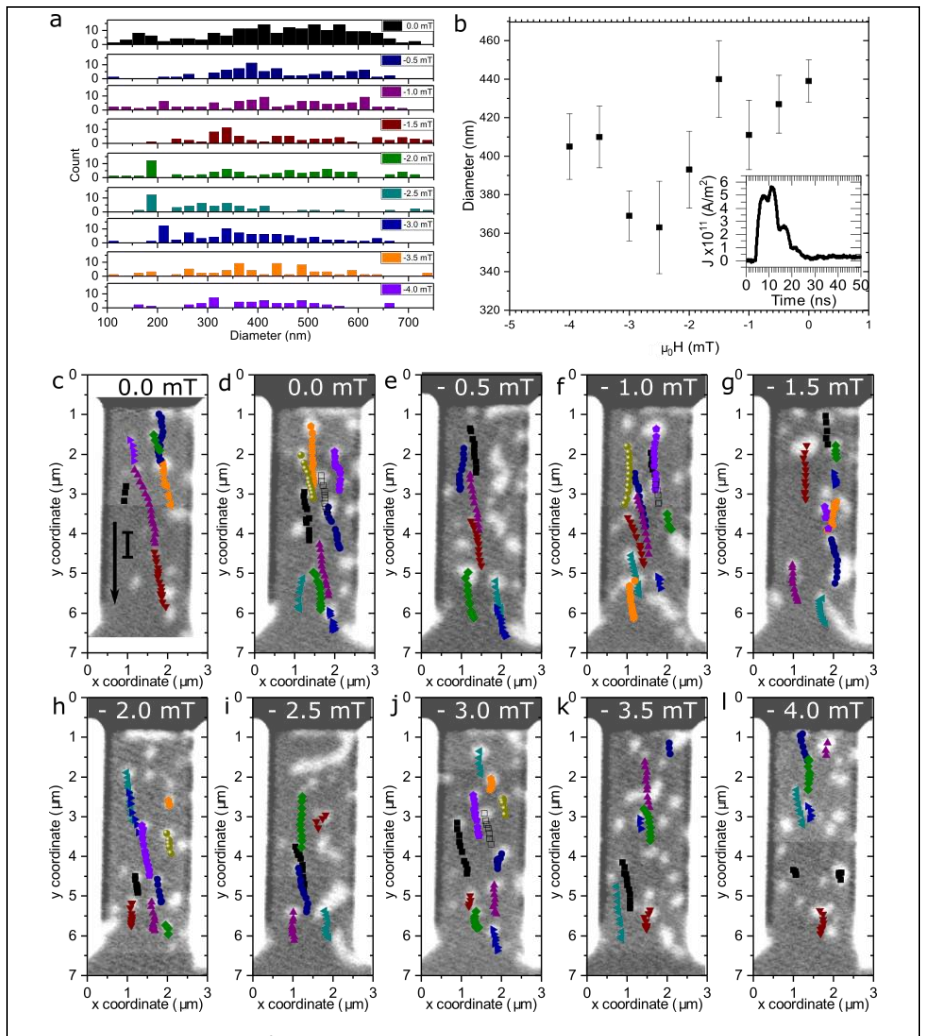
- [Soft x-ray imaging; Fig. 3a-b] Diameters are extracted by counting pixels with a 35 nm pixel size while the spatial resolution is 25–30 nm; for skyrmions with d = 35–150 nm, the diameter and centroid are determined from only a few pixels. The tracking bias of the TrackMate algorithm and the bias of the effective-diameter conversion (d = 2√(a/π)) are not characterized in this size range. Because Eq. (2) predicts the largest variation exactly in this small-diameter range, the flat trend in Fig. 3b could be an artifact of thresholding, centroid estimation, or the area-to-diameter conversion rather than a physical quenching.
- [Results; Fig. 2b] The paper states that for fields beyond -3 mT small skyrmions disappear after the first current pulse train and that annihilation events artificially skew the diameter distribution toward larger values. This selection is asymmetric with respect to the quantity of interest, since the Thiele prediction gives the largest Hall angles for the smallest skyrmions. The authors do not quantify detection efficiency or annihilation probability as a function of diameter, so the observed flat angle-versus-diameter relation could be produced by preferential loss of large-angle small skyrmions rather than by disorder-dominated dynamics.
- [Skyrmion Hall angle; Oersted field effects] The comparison with theory is partly circular: αG = 0.07 is obtained by fitting Eq. (2) to the same dataset restricted to diameters of 175 nm and larger, and the expected curves in Fig. 3b then use this fitted value. An independent determination of αG, or a simultaneous fit with confidence bands, is needed for the claimed contradiction with Eq. (2). In addition, the field-gradient force estimate uses a micromagnetic simulation with uniaxial anisotropy reduced to 0.1 MJ/m3, so the quantitative conclusion that FB/Fstt = 0.0028 is not directly transferable to the experimental multilayer parameters.
minor comments (5)
- [Fig. 3b caption and main text] The linear fit is described as a 'blue dash-dot-dotted line' in one place and a 'blue dashed line' in another; please unify the line-style references.
- [Equation numbering] There are two equations numbered (4): the BLS relation in Methods and the Hall-angle expression in the Oersted-field section; please renumber the equations consistently.
- [Typos] There are typographical errors such as 'skymion' in the Fig. 3b caption and 'in in the low-velocity, plastic flow regime' in the Skyrmion energy landscape section; these should be corrected.
- [Data availability] The data availability statement says 'openly available from XYZ , XYZ' without a repository identifier or DOI; this must be completed for the claims to be verifiable.
- [Reference 15] Reference 15 is formatted as a file name ('EverSchorSitte JAP 115 172602 (2014).pdf') and should be replaced with the standard citation to the published article.
Circularity Check
Central flat-Hall-angle claim is a direct measurement; the only circularity is a Thiele-model 'consistency' check that uses alpha_G fitted from the same dataset.
-
fitted input called prediction
[Results, 'Skyrmion Hall angle' section; Fig. 3b; Conclusion (Eq. 2 and surrounding text)]
"A Gilbert damping constant of 0.07 was obtained by fitting the data using equation (2) and restricting the range of the fitted data to diameters of 175 nm and larger. ... This angle is consistent with predictions using the modified Thiele equation, for skyrmions with diameters above 250 nm (as predicted by equation (1))."
The parameter alpha_G = 0.07 is not an independent model input: it is extracted by fitting Eq. (2) to the same Hall-angle dataset (for d >= 175 nm) that is later compared with Eq. (2). The red 'expected behaviour' curve plotted with this alpha_G therefore passes through the fitted data by construction, and the statement that the ~10 degree angle in low-pinning regions is 'consistent with predictions' is a consistency statement about the fitted curve rather than an independent prediction of the diameter-independent Hall angle. The central claim of diameter independence, however, is a direct measurement of theta_Sky versus d and does not rely on this fitted parameter.
full rationale
The paper's headline result, a diameter-independent skyrmion Hall angle of 9 +/- 2 degrees in the plastic flow regime, is a direct measurement: skyrmion centres were tracked from XMCD-STXM images, diameters were obtained from pixel counts, and Hall angles were obtained from centre displacements, then binned and averaged. The flat linear fit in Fig. 3b is not derived from the Thiele model. The Thiele-model comparison is ancillary, and the paper openly states that alpha_G = 0.07 was obtained by fitting Eq. (2) to the d >= 175 nm portion of that same dataset. That makes the later 'consistent with predictions' remark partially circular, but it is not load-bearing for the central observation. The self-citations (refs 24 and 29) support peripheral points such as field-dependent skyrmion diameter pinning and a common nucleation approach, not the Hall-angle claim. The Oersted-field estimate uses a micromagnetic simulation with a reduced anisotropy to bound a correction, but that correction is not the source of the flat Hall-angle result. Overall, no load-bearing circularity is present; only one fitted parameter is later invoked as a 'prediction' in a consistency remark, so the appropriate score is low.
Assumptions & free parameters
free parameters (3)
- Gilbert damping αG =
0.07
- Exchange stiffness A =
10 pJ/m
- Uniaxial anisotropy in micromagnetic simulation =
0.1 MJ/m^3
assumptions (5)
- standard math The rigid skyrmion approximation and Thiele equation give the velocity components in Eq. (1) and the Hall angle tan θ_Sky = -Q/(αG D).
- domain assumption For skyrmions with diameter d larger than domain-wall width Δ, tan θ_Sky ≈ ±8Δ/(αG π^2 d) (Eq. 2), with Δ = sqrt(A/K_eff) = 4.6 nm.
- domain assumption The observed large scatter in Hall angle at low velocities is attributed to disorder in the plastic flow regime (ref. 26), not to measurement noise.
- domain assumption Velocity is computed as displacement between consecutive images divided by 18 ns, the total duration of two 9 ns pulses, ignoring the 2 μs delay between pulses and any motion outside the pulses.
- domain assumption The effective diameter computed from pixel area as d = 2√(a/π) represents the physical skyrmion diameter for comparison with Eq. (2).
Cite this review
Pith. "Pith review of Diameter-independent skyrmion Hall angle in the plastic flow regime observed in chiral magnetic multilayers." pith.science (2026). https://pith.science/paper/4RYDR6NV
@misc{pith2026190804239,
  author       = {Pith},
  title        = {Pith review of: Diameter-independent skyrmion Hall angle in the plastic flow regime observed in chiral magnetic multilayers},
  year         = {2026},
  howpublished = {\url{https://pith.science/paper/4RYDR6NV}},
  note         = {Machine review of arXiv:1908.04239}
}
abstract
Magnetic skyrmions are topologically non-trivial nanoscale objects. Their topology, which originates in their chiral domain wall winding, governs their unique response to a motion-inducing force. When subjected to an electrical current, the chiral winding of the spin texture leads to a deflection of the skyrmion trajectory, characterized by an angle with respect to the applied force direction. This skyrmion Hall angle was believed to be skyrmion diameter-dependent. In contrast, our experimental study finds that within the plastic flow regime the skyrmion Hall angle is diameter-independent. At an average velocity of 6 $\pm$ 1 m/s the average skyrmion Hall angle was measured to be 9{\deg} $\pm$ 2{\deg}. In fact, in the plastic flow regime, the skyrmion dynamics is dominated by the local energy landscape such as materials defects and the local magnetic configuration.
Figures

Reference graph
Works this paper leans on
-
[1]
K., Bogdanov, A
Rößler, U. K., Bogdanov, A. N. & Pfleiderer, C. Spontaneous skyrmion ground states in magnetic metals. Nature 442, 797–801 (2006)
2006
-
[2]
Muehlbauer, S. et al. Skyrmion Lattice in a Chiral Magnet. Science (80-. ). 323, 915–920 (2009)
work page 2009
-
[3]
Boulle, O. et al. Room-temperature chiral magnetic skyrmions in ultrathin magnetic nanostructures. Nat. Nanotechnol. 11, 449–54 (2016)
work page 2016
-
[4]
Moreau-Luchaire, C. et al. Additive interfacial chiral interaction in multilayers for stabilization of small individual skyrmions at room temperature. Nat. Nanotechnol. 11, 444–448 (2016)
work page 2016
-
[5]
Heinze, S. et al. Spontaneous atomic-scale magnetic skyrmion lattice in two dimensions. Nat. Phys. 7, 713–718 (2011)
work page 2011
-
[6]
Rohart, S. & Thiaville, A. Skyrmion confinement in ultrathin film nanostructures in the presence of Dzyaloshinskii-Moriya interaction. Phys. Rev. B 88, 184422 (2013)
work page 2013
-
[7]
Chen, G., Mascaraque, A., N’Diaye, A. T. & Schmid, A. K. Room temperature skyrmion ground state stabilized through interlayer exchange coupling. Appl. Phys. Lett. 106, 242404 (2015)
work page 2015
-
[8]
Woo, S. et al. Observation of room-temperature magnetic skyrmions and their current-driven dynamics in ultrathin metallic ferromagnets. Nat. Mater. 15, 501–506 (2016)
2016
Show all 34 references
-
[9]
Yu, G. et al. Room-Temperature Creation and Spin-Orbit Torque Manipulation of Skyrmions in Thin Films with Engineered Asymmetry. Nano Lett. 16, 1981–1988 (2016)
2016
-
[10]
Jonietz, F. et al. Spin Transfer Torques in MnSi. Science (80-. ). 330, 1648 (2011)
2011
-
[11]
& Tokura, Y
Nagaosa, N. & Tokura, Y. Topological properties and dynamics of magnetic skyrmions. Nat. Nanotechnol. 8, 899–911 (2013)
2013
-
[12]
Schulz, T. et al. Emergent electrodynamics of skyrmions in a chiral magnet. Nat. Phys. 8, 301– 304 (2012)
2012
-
[13]
Zang, J., Mostovoy, M., Han, J. H. & Nagaosa, N. Dynamics of Skyrmion Crystals in Metallic Thin Films. Phys. Rev. Lett. 107, 136804 (2011)
2011
-
[14]
& Fert, A
Sampaio, J., Cros, V., Rohart, S., Thiaville, A. & Fert, A. Nucleation, stability and current- induced motion of isolated magnetic skyrmions in nanostructures. Nat. Nanotechnol. 8, 839– 844 (2013)
2013
-
[15]
EverSchorSitte JAP 115 172602 (2014).pdf
Everschor-Sitte, K. EverSchorSitte JAP 115 172602 (2014).pdf. J. Appl. Phys. 115, 172602 (2014)
2014
-
[16]
E., Sinova, J
Knoester, M. E., Sinova, J. & Duine, R. A. Phenomenology of current-skyrmion interactions in thin films with perpendicular magnetic anisotropy. Phys. Rev. B 89, 064425 (2014)
2014
-
[17]
& Chern, G.-W
Thiele, A. . & Chern, G.-W. Steady-State Motion of Magnetic Domains. Phys. Rev. Lett. 30, 230–233 (1973)
1973
-
[18]
Tomasello, R. et al. A strategy for the design of skyrmion racetrack memories. Sci. Rep. 4, 6784 (2014)
2014
-
[19]
Tomasello, R. et al. Origin of temperature and field dependence of magnetic skyrmion size in ultrathin nanodots. Phys. Rev. B 97, 060402(R) (2018)
2018
-
[20]
Jiang, W. et al. Direct observation of the skyrmion Hall effect. Nat. Phys. 13, 162–169 (2017)
2017
-
[21]
Litzius, K. et al. Skyrmion Hall effect revealed by direct time-resolved X-ray microscopy. Nat. Phys. 13, 170–175 (2017)
2017
-
[22]
Legrand, W. et al. Room-Temperature Current-Induced Generation and Motion of sub-100 nm Skyrmions. Nano Lett. 17, 2703–2712 (2017)
2017
-
[23]
Von & Yoo, M
Kim, J. Von & Yoo, M. W. Current-driven skyrmion dynamics in disordered films. Appl. Phys. Lett. 110, 132404 (2017)
2017
-
[24]
Zeissler, K. et al. Pinning and hysteresis in the field dependent diameter evolution of skyrmions in Pt / Co / Ir superlattice stacks. Sci. Rep. 7, 15125 (2017)
2017
-
[25]
Lin, S., Reichhardt, C., Batista, C. D. & Saxena, A. Particle model for skyrmions in metallic chiral magnets : Dynamics , pinning , and creep. Phys. Rev. B 87, 214419 (2013)
2013
-
[26]
& Reichhardt, C
Reichhardt, C. & Reichhardt, C. J. O. Noise fluctuations and drive dependence of the skyrmion Hall effect in disordered systems. New J. Phys. 18, 095005 (2016)
2016
-
[27]
Juge, R. et al. Current driven dynamics of magnetic skyrmions in an ultrathin film. arXiv 1904.08275, (2019)
2019 arXiv
-
[28]
Hrabec, A. et al. Current-induced skyrmion generation and dynamics in symmetric bilayers. Nat. Commun. 8, 15765 (2017)
2017
-
[29]
Zeissler, K. et al. Discrete Hall resistivity contribution from Néel skyrmions in multilayer nanodiscs. Nat. Nanotechnol. 13, 1161–1166 (2018)
2018
-
[30]
& Schindelin, J
Tinevez, J., Perry, N. & Schindelin, J. TrackMate: An open and extensible platform for single- particle tracking. Methods 115, 80 (2016)
2016
-
[31]
Zhang, S. L. et al. Manipulation of skyrmion motion by magnetic field gradients. Nat. Commun. 9, 2115 (2018)
2018
-
[32]
& Liu, Y
Wang, C., Xiao, D., Chen, X., Zhou, Y. & Liu, Y. Manipulating and trapping skyrmions by magnetic field gradients. New J. Phys. 19, 083008 (2017)
2017
-
[33]
Bisotti, M. et al. Fidimag – A Finite Difference Atomistic and Micromagnetic Simulation Package. J. Open Res. Softw. 6, 22 (2018)
2018
-
[34]
Metrology for topological spin structures
Woo, S. et al. Deterministic creation and deletion of a single magnetic skyrmion observed by direct time-resolved X-ray microscopy. Nat. Electron. 1, 288–296 (2018). ACKNOWLEDGEMENTS Support from EP/M000923/1 and the European Union (H2020 grant MAGicSky No. FET-Open- 665095.10...
2018
Reviewed August 14, 2026 · model on record in the stance chip above.
Discussion (0). Continue with ORCID to comment.