REVIEW 3 major objections 5 minor 1 cited by
A Flaring AGN In a ULIRG candidate in Stripe 82
T0 review · 3 major / 5 minor · reviewed 2026-08-14 · deepseek-v4-flash
Pith's one-line read Mid-infrared flux doubles in a Stripe 82 galaxy, marking a flaring AGN.
desk verdict A credible discovery of a rare MIR-variable AGN in a ULIRG candidate; the variability is solid, but the ULIRG classification and BH mass rest on a template extrapolation that needs better scrutiny. read the letter →
The pith
A machine-rendered reading of the paper's core claim, the machinery that carries it, and where it could break.
The reading
What carries the argument
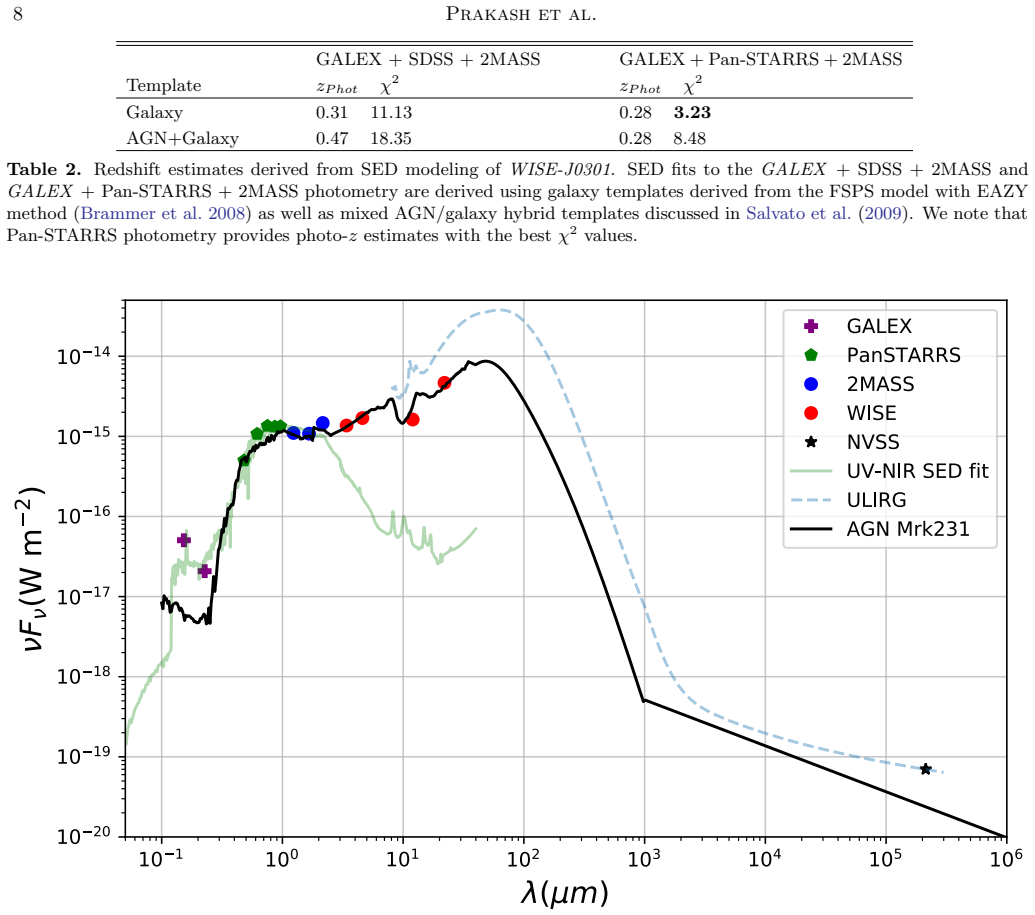
The load-bearing mechanism is the spectral template of Mrk231, a nearby prototypical obscured AGN, scaled by a factor of 0.45 to the observed WISE mid-infrared photometry. This template converts the measured 3.4 and 4.6 micron fluxes into an estimate of the total 8–1000 micron luminosity, from which the ULIRG classification, the star-formation rate of roughly $70\,M_\odot\,\mathrm{yr}^{-1}$, and the upper limit on the black hole mass all follow. The companion mechanism is the construction of the eight-year WISE light curves from quality-filtered single-exposure images, with the stellar contribution subtracted using the SED model; that procedure isolates a factor-of-two variability that is correlated between W1 and W2 and absent in the bluest optical bands.
What would settle it
A single far-infrared measurement of WISE-J0301 at, say, 160–500 microns would settle the ULIRG question: if the observed flux is inconsistent with the scaled Mrk231 template and the integrated $L_{\rm IR}$ falls below $10^{12}\,L_\odot$, the ULIRG classification fails, while a measured optical-to-mid-infrared lag would test the accretion-rate reprocessing scenario.
Extended reading notes
Core claim
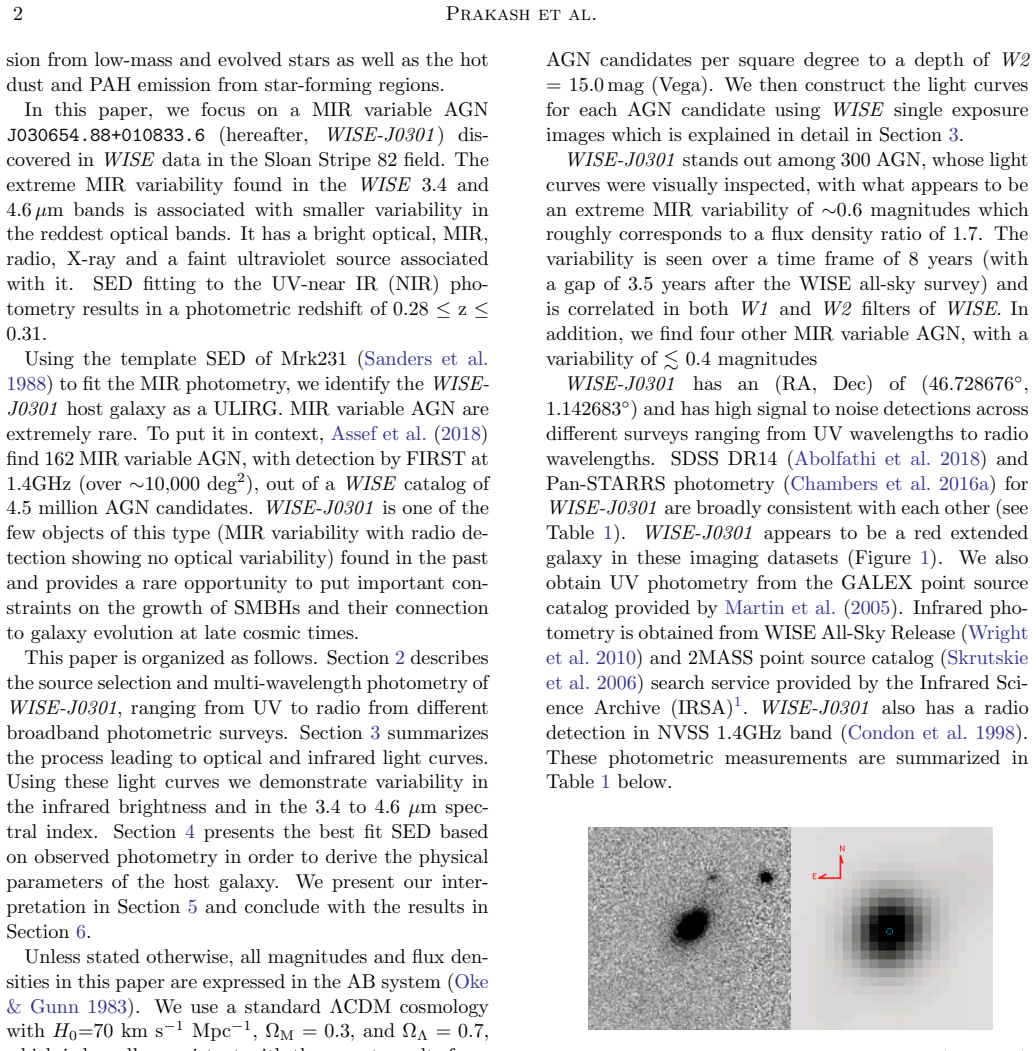
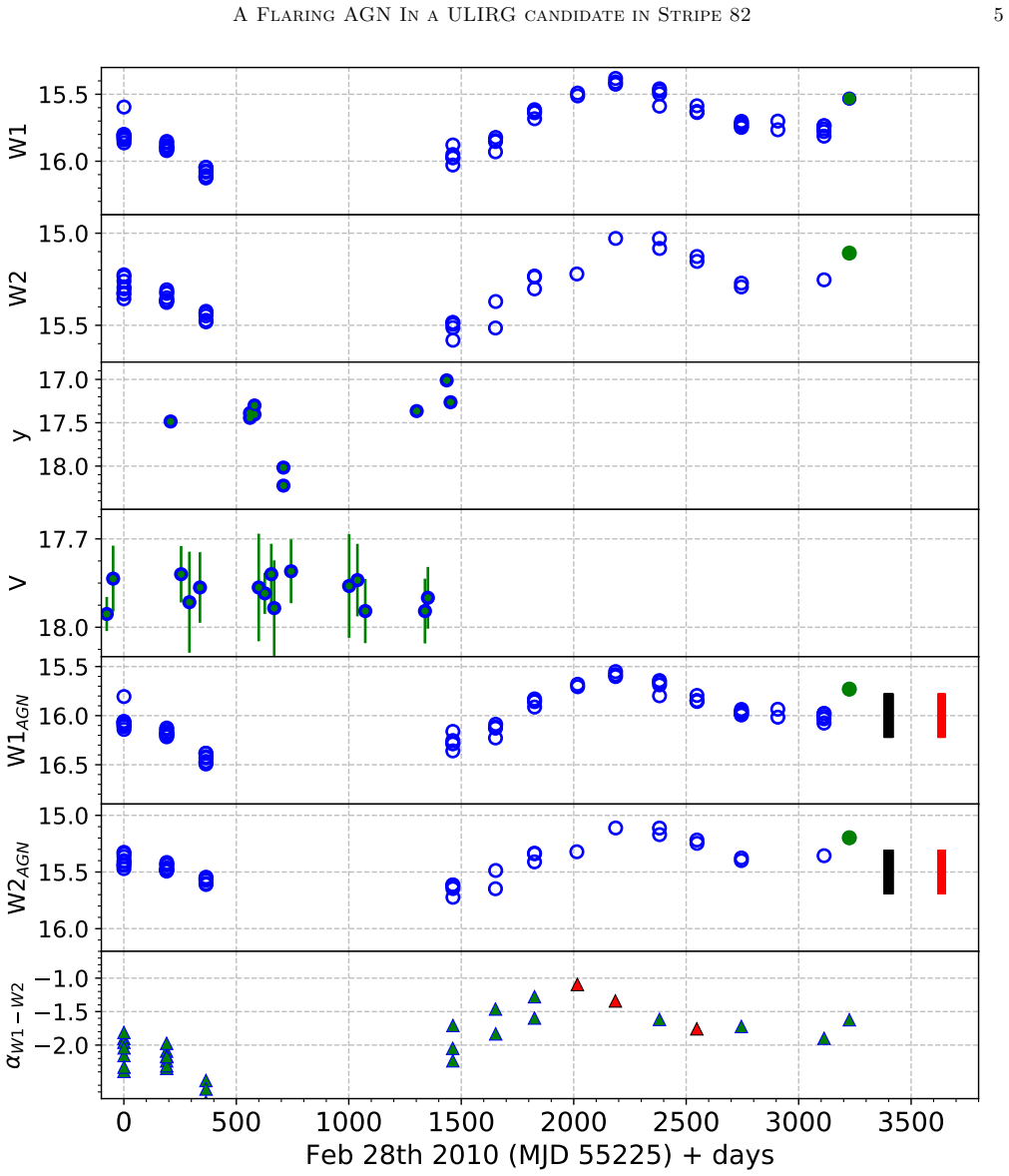
The paper's discovery is that WISE J030654.88+010833.6 (WISE-J0301), a red extended galaxy at photometric redshift $0.28\le z\le0.31$, is a mid-infrared variable AGN hosted in an ultraluminous infrared galaxy candidate. In the WISE W1 and W2 light curves spanning eight years, the source brightened and faded by roughly a factor of two, with the changes correlated between the two bands, while the bluest optical light showed no comparable variability. The ultraviolet-to-near-infrared SED is well fit by a stellar population, giving $M_*\sim1.9\times10^{11}\,M_\odot$ and an unobscured star-formation rate of about $0.7\,M_\odot\,\mathrm{yr}^{-1}$; the mid-infrared photometry is fit by a scaled Mrk231 template (factor 0.45), implying $L_{\rm IR}$ between $9.0\times10^{11}$ and $1.5\times10^{12}\,L_\odot$, a reprocessed star-formation rate near $70\,M_\odot\,\mathrm{yr}^{-1}$, and a black hole mass upper limit near $10^8\,M_\odot$. The paper interprets the correlated long-term mid-infrared variability as variations in the accretion rate, with the luminosity thermally reprocessed by dust near the AGN, and notes that the host may be at a very late stage of a merger.
Load-bearing premise
The paper's physical parameters—ULIRG classification, star-formation rate, and black hole mass upper limit—all rest on the assumption that the Mrk231 spectral template, scaled by 0.45, accurately represents the unseen rest-frame 8–1000 micron SED of WISE-J0301, since no far-infrared detection or spectrum exists.
Editorial extensions
If this is right
- The variability detection is independent of the SED template: the correlated factor-of-two change in W1 and W2 over eight years stands on the photometry alone, so the object is a robust mid-infrared variable AGN even if the ULIRG classification is later revised.
- If the accretion-rate interpretation is correct, simultaneous optical and mid-infrared monitoring should reveal a time delay set by the light-travel time from the accretion disk to the hot dust, a test that planned infrared and optical monitoring can carry out.
- With $L_{\rm IR}$ near $10^{12}\,L_\odot$, the source joins the rare low-redshift class of AGN-dominated ULIRGs, and its black-hole-to-stellar-mass ratio becomes consistent with local broad-line AGN, supporting the Mrk231-like SED.
- A confirmed ULIRG at $z\approx0.3$ with no obvious merger morphology would indicate either a very late-stage merger or a non-merger trigger for the simultaneous starburst and AGN activity.
Reading between the lines
- The ULIRG classification depends entirely on the Mrk231 scaling, so a single far-infrared measurement that falsifies the template would leave the variability result intact but move the source below $10^{12}\,L_\odot$; the paper's physical interpretation would then need revision.
- The observed range of W1–W2 spectral index, from about $-2.7$ to $-1.2$, may reflect a varying mix of hot dust and 3.3 $\mu$m PAH emission; decomposing the color variability by epoch could separate dust reprocessing from intrinsic changes in the accretion disk.
- Because the y-band minimum appears to fall in the gap of the WISE light curve, the currently claimed lack of optical-mid-infrared correlation is provisional; denser sampling across a future outburst could either confirm the expected lag or rule out the thermal-reprocessing scenario.
- If the host is confirmed as a ULIRG at $z\sim0.3$, it becomes a strong target for molecular-gas mapping to test whether AGN feedback is clearing the nucleus and whether the AGN dominates the total infrared output.
Signed reviews
Editorial analysis
A structured set of objections, weighed in public.
Referee Report
Summary. The paper reports the discovery and multiwavelength characterization of WISE J030654.88+010833.6, a WISE-selected, red extended galaxy in Stripe 82. From WISE and NEOWISE single-exposure photometry, the authors construct 8-year W1/W2 light curves that show correlated factor-of-~2 variability at 3.4 and 4.6 micron, with per-epoch photometric uncertainties at or below 0.03 mag. They assemble GALEX, SDSS, PanSTARRS, 2MASS, WISE, Spitzer IRAC, NVSS, and archival Chandra data. FSPS/EAZY SED fitting gives a photometric redshift z ~ 0.28-0.31 and a stellar mass near 1.9e11 Msun; scaling the Mrk231 template to the MIR photometry yields L_IR ~ 9e11-1.5e12 Lsun, SFR_IR ~ 70 Msun/yr, and a BH mass range ~1e7-1e8 Msun. The paper interprets the MIR variability as accretion-rate variations whose energy is reprocessed by dust, with a possible lag to be tested by future Spitzer and PanSTARRS data.
Significance. If the variability detection and AGN identification hold, WISE-J0301 is a scientifically valuable object: a mid-IR variable, radio- and X-ray-detected AGN at z ~ 0.3 whose host may be a ULIRG. The variability claim is well supported by the light-curve quality cuts, the small photometric errors, and the correlated behavior between W1 and W2, and the radio and X-ray detections independently support AGN activity. The analysis uses publicly available archival data and standard external templates, so the variability claim is not circular. The main weakness is that the ULIRG classification, SFR, and BH mass depend on a scaled Mrk231 template without FIR photometry; those parts of the paper need to be either quantitatively supported or explicitly downgraded.
major comments (3)
- [Section 5.3, Figure 3] The ULIRG classification and SFR_IR are derived by scaling the Mrk231 template by 0.45 to the MIR photometry, with no FIR detection (IRAS non-detection only; no Akari or Herschel data). The quoted L_IR = 9.0e11-1.5e12 Lsun straddles the 10^12 Lsun ULIRG boundary, so a modest change in FIR shape or normalization changes the classification. The IRAS consistency check does not validate the template: the paper quotes a 1-sigma 60+100 micron limit converted to SFR ~67 Msun/yr through a star-formation conversion, but it never compares the scaled template's predicted 60 and 100 micron flux densities with the per-band SCANPI noise. I request that quantitative comparison, or a clear statement in the title and conclusions that the ULIRG nature is unconfirmed. In addition, the template scaling should be applied to AGN-only W1/W2 fluxes after subtracting the stellar contribution estimated in Section 3.1, rather than to the total WISE photometry, and the sensitivity to this choice should be reported.
- [Section 4, Table 2; Section 5.3] The adopted redshift z = 0.28-0.31 is load-bearing for L_IR, because the input optical photometry from SDSS and PanSTARRS was taken at different epochs and is variable (Table 1), and because the SDSS KD-tree photo-z is z = 0.215. Since L_IR scales as the square of the luminosity distance, adopting z = 0.215 would lower L_IR by roughly a factor of two, which would move the source below the ULIRG threshold. Please provide the SED fit at z = 0.215 and the resulting L_IR, SFR_IR, and BH mass, and discuss how the epoch-dependent photometry affects the photo-z preference.
- [Section 5.4, Eq. (6)] The BH mass upper limit of ~1e8 Msun is obtained by multiplying the Mrk231 BH mass by the same 0.45 luminosity scaling factor used in the MIR template fit, which assumes that the Eddington ratio and the MIR-to-bolometric correction of WISE-J0301 are identical to those of Mrk231; the X-ray lower limit assumes Eddington-limited accretion. These are assumptions rather than measurements, so the statement that the BH-to-stellar mass ratio is consistent with broad-line AGN is a consistency check of the template, not an independent constraint. I recommend presenting the BH mass as an illustrative range under explicit assumptions, as Section 6 does, and qualifying the corresponding sentence in the abstract.
minor comments (5)
- [Table 1, NVSS row] The wavelength entry '2.14 x 10^5' for NVSS should be labeled as 21 cm (2.14e5 micron) so that the column units are unambiguous.
- [Section 4, Table 2] The text says '9 bands of GALEX+SDSS+2MASS, and 10 bands of GALEX+SDSS u+Pan-STARRS+2MASS,' but the listed surveys contain 10 and 11 bands, respectively; please clarify which bands were excluded.
- [Section 3.1] The Spitzer aperture correction '1.047' should state whether it is a multiplicative flux factor or an additive magnitude correction.
- [Section 3.2] The statement that PanSTARRS DR2 shows 'a factor of 3 variability' in the y-band is difficult to reconcile with the 0.25-0.39 mag variability quoted for i/r/z; please correct or clarify this value.
- [Introduction / Section 5.3] The Introduction says the Mrk231 fit 'identify the host galaxy as a ULIRG,' while Sections 5.3 and 6 use 'possibly' and 'highly uncertain'; the wording should be harmonized with the actual uncertainty so the body and abstract do not overstate the classification.
Circularity Check
No significant circularity: the variability detection is directly observed, and the IR luminosity and black-hole-mass estimates are explicitly template-based extrapolations rather than circular derivations.
full rationale
The central claim, MIR variability of WISE-J0301 in WISE W1/W2, is derived directly from single-exposure aperture photometry in Section 3.1 and does not rely on any fitted model. The photometric redshift is obtained from UV-to-NIR SED fitting with the MIR bands excluded (Section 4), so it is independent of the AGN template fit. The L_IR, SFR_IR, and BH-mass numbers in Sections 5.3-5.4 are obtained by scaling the external Mrk231 template from Chary & Elbaz (2001) by a fitted factor of about 0.45 to the observed MIR photometry. This is a transparent model-dependent extrapolation, not a circular derivation: the template and the Mrk231 BH mass are external inputs, and the derived L_IR or M_BH are never fed back as inputs into the fit that produces them. The same 0.45 scale factor is used for both the FIR luminosity and the BH upper limit, so those quantities are not independent of the MIR normalization, but that is a normalization dependence, not a logical circularity. The paper explicitly acknowledges the limitation in Section 6: 'Our estimates of the SFR IR and BH mass of WISE-J0301 are highly uncertain and based on scaling the Mrk231 SED template to the MIR photometry.' The IRAS non-detection is used only as a rough consistency check, not as a template validation, and the resulting uncertainty in the ULIRG classification is a correctness risk rather than a circular step. No load-bearing argument reduces to a self-citation or to a quantity defined in terms of the conclusion.
Assumptions & free parameters
free parameters (3)
- Mrk231 template scaling factor =
0.45
- Stellar contribution in WISE W1/W2 =
370 uJy (W1), 260 uJy (W2)
- AGN fraction of bolometric luminosity =
0.75
assumptions (4)
- domain assumption The Mrk231 template shape represents the MIR-FIR SED of WISE-J0301
- domain assumption The MIR-X-ray luminosity correlation of Lutz et al. (2004) applies to this source
- domain assumption Accretion is Eddington-limited for the BH mass lower limit
- domain assumption The WISE variability is intrinsic and not due to image artifacts
Cite this review
Pith. "Pith review of A Flaring AGN In a ULIRG candidate in Stripe 82." pith.science (2026). https://pith.science/paper/VW3GEP4D
@misc{pith2026190804280,
  author       = {Pith},
  title        = {Pith review of: A Flaring AGN In a ULIRG candidate in Stripe 82},
  year         = {2026},
  howpublished = {\url{https://pith.science/paper/VW3GEP4D}},
  note         = {Machine review of arXiv:1908.04280}
}
abstract
We report the discovery of a mid-infrared variable AGN which is hosted by an ultraluminous infrared galaxy (ULIRG) candidate in the Sloan Stripe 82 field. \textit{WISE} \textit{J030654.88+010833.6} is a red, extended galaxy, which we estimate to be at a photometric redshift of 0.28 $\leq$ z $\leq$ 0.31, based on its optical and near-infrared spectral energy distribution (SED). The factor of two variability over 8 years seen in the \textit{WISE} 3.4 and 4.6 $\mu$m wavelength channels is not clearly correlated with optical variability in archival data. Based on our estimation of the physical parameters of the host galaxy, \textit{J030654.88+010833.6} is possibly a composite AGN/starburst ULIRG in a phase where high star formation $\sim$ 70 M$_{\odot}$ year$^{-1}$ is occurring. Our estimate of the black hole mass to stellar mass ratio also appears to be consistent with that of broad-line AGN in the local universe. The long-term variability of \textit{J030654.88+010833.6} as seen in the \textit{WISE} \textit{W1} and \textit{W2} light curves is likely due to variations in the accretion rate, with the energy being reprocessed by dust in the vicinity of the AGN.
Figures
Forward citations
Cited by 1 Pith paper
-
How to Find Variable Active Galactic Nuclei with Machine Learning
Self-organizing maps applied to nonparametric variability estimators identify variable AGN light curves with 86% purity and 66% completeness, comparable to deep learning.
Reference graph
Works this paper leans on
-
[1]
S., Aguilar, G., et al
Abolfathi, B., Aguado, D. S., Aguilar, G., et al. 2018, ApJS, 235, 42
2018
-
[2]
D., Allende Prieto, C., et al
Alam, S., Albareti, F. D., Allende Prieto, C., et al. 2015, ApJS, 219, 12
2015
-
[3]
J., Stern, D., Noirot, G., et al
Assef, R. J., Stern, D., Noirot, G., et al. 2018, ApJS, 234, 23 Astropy Collaboration, Robitaille, T. P., Tollerud, E. J., et al. 2013, A&A, 558, A33
work page 2018
-
[4]
2018, astropy/photutils: v0.5, doi:10.5281/zenodo.1340699
Bradley, L., Sipocz, B., Robitaille, T., et al. 2018, astropy/photutils: v0.5, doi:10.5281/zenodo.1340699
-
[5]
B., van Dokkum, P
Brammer, G. B., van Dokkum, P. G., & Coppi, P. 2008, ApJ, 686, 1503
2008
-
[6]
Chambers, K. C., Magnier, E. A., Metcalfe, N., et al. 2016a, ArXiv e-prints, arXiv:1612.05560 —. 2016b, arXiv e-prints, arXiv:1612.05560
- [7]
-
[8]
P., L´ opez-Caniego, M., et al
Chen, X., Rachen, J. P., L´ opez-Caniego, M., et al. 2013, A&A, 553, A107
work page 2013
Show all 38 references
-
[9]
J., Cotton, W
Condon, J. J., Cotton, W. D., Greisen, E. W., et al. 1998, AJ, 115, 1693
1998
-
[10]
E., & White, M
Conroy, C., Gunn, J. E., & White, M. 2009, ApJ, 699, 486
2009
-
[11]
2010, ApJ, 724, 425
Dahlen, T., Mobasher, B., Dickinson, M., et al. 2010, ApJ, 724, 425
2010
-
[12]
T., & Li, A
Draine, B. T., & Li, A. 2007, ApJ, 657, 810
2007
-
[13]
J., Djorgovski, S
Drake, A. J., Djorgovski, S. G., Mahabal, A., et al. 2009, ApJ, 696, 870
2009
-
[14]
S., Pacholczyk, A
Fitch, W. S., Pacholczyk, A. G., & Weymann, R. J. 1967, ApJL, 150, L67
1967
-
[15]
Gao, Y., & Solomon, P. M. 2004, ApJ, 606, 271
2004
-
[16]
2012, MNRAS, 420, 320
Hernquist, L. 2012, MNRAS, 420, 320
2012
-
[17]
F., Hernquist, L., Martini, P., et al
Hopkins, P. F., Hernquist, L., Martini, P., et al. 2005, ApJL, 625, L71
2005
-
[18]
Kawaguchi, T., Mineshige, S., Umemura, M., & Turner, E. L. 1998, ApJ, 504, 671
1998
-
[19]
2013, ApJ, 763, 123
Kirkpatrick, A., Pope, A., Charmandaris, V., et al. 2013, ApJ, 763, 123
2013
-
[20]
M., Terndrup, D
Leighly, K. M., Terndrup, D. M., Baron, E., et al. 2014, The Astrophysical Journal, 788, 123
2014
-
[21]
Lutz, D., Maiolino, R., Spoon, H. W. W., & Moorwood, A. F. M. 2004, A&A, 418, 465
2004
-
[22]
2011, ApJ, 731, 53
Mainzer, A., Bauer, J., Grav, T., et al. 2011, ApJ, 731, 53
2011
-
[23]
C., Fanson, J., Schiminovich, D., et al
Martin, D. C., Fanson, J., Schiminovich, D., et al. 2005, ApJL, 619, L1
2005
-
[24]
J., & Ma, C.-P
McConnell, N. J., & Ma, C.-P. 2013, ApJ, 764, 184
2013
-
[25]
J., van Duinen, R., et al
Neugebauer, G., Habing, H. J., van Duinen, R., et al. 1984, ApJL, 278, L1
1984
-
[26]
B., & Gunn, J
Oke, J. B., & Gunn, J. E. 1983, ApJ, 266, 713
1983
-
[27]
Peterson, B. M. 1997, An Introduction to Active Galactic Nuclei Planck Collaboration, Ade, P. A. R., Aghanim, N., et al. 2014, A&A, 571, A16
1997
-
[28]
E., & Volonteri, M
Reines, A. E., & Volonteri, M. 2015, ApJ, 813, 82
2015
-
[29]
P., & Hurley-Walker, N
Reynolds, C., Punsly, B., O’Dea, C. P., & Hurley-Walker, N. 2013, ApJL, 776, L21
2013
-
[30]
2009, ApJ, 690, 1250
Salvato, M., Hasinger, G., Ilbert, O., et al. 2009, ApJ, 690, 1250
2009
-
[31]
B., Soifer, B
Sanders, D. B., Soifer, B. T., Elias, J. H., et al. 1988, ApJ, 325, 74
1988
-
[32]
I., & Sunyaev, R
Shakura, N. I., & Sunyaev, R. A. 1973, A&A, 24, 337
1973
-
[33]
Shields, G. A. 1978, in BAAS, Vol. 10, Bulletin of the American Astronomical Society, 690
1978
-
[34]
F., Cutri, R
Skrutskie, M. F., Cutri, R. M., Stiening, R., et al. 2006, AJ, 131, 1163
2006
-
[35]
J., Benford, D
Stern, D., Assef, R. J., Benford, D. J., et al. 2012, ApJ, 753, 30
2012
-
[36]
Veilleux, S., Rupke, D. S. N., Kim, D.-C., et al. 2009, ApJS, 182, 628
2009
-
[37]
W., Hao, L., Higdon, S
Weedman, D. W., Hao, L., Higdon, S. J. U., et al. 2005, ApJ, 633, 706
2005
-
[38]
L., Eisenhardt, P
Wright, E. L., Eisenhardt, P. R. M., Mainzer, A. K., et al. 2010, AJ, 140, 1868
2010
Reviewed August 14, 2026 · model on record in the stance chip above.
Discussion (0). Continue with ORCID to comment.