REVIEW 3 major objections 4 minor 60 references
In-Situ Scattering of Warm Jupiters and Implications for Dynamical Histories
T0 review · 3 major / 4 minor · reviewed 2026-08-14 · deepseek-v4-flash
Pith's one-line read Planet-planet scattering at sub-AU distances can excite the eccentricities of warm Jupiters, and the observed eccentricity distribution of solitary warm Jupiters implies that roughly 60 percent of them underwent such scattering.
desk verdict First systematic N-body study of scattering in the warm-Jupiter regime; the qualitative two-population picture holds, but the ~60% scattered fraction is softer than the abstract implies. read the letter →
The pith
A machine-rendered reading of the paper's core claim, the machinery that carries it, and where it could break.
The reading
What carries the argument
The central object is the N-body scattering experiment: three or four giant planets started on nearly circular, nearly coplanar orbits spaced by a fixed number of mutual Hill radii (3 to 5), with the innermost planet drawn uniformly from 0.1 to 1 AU, integrated with a high-accuracy integrator that includes general-relativistic apsidal precession and treats any planet-planet contact as a perfectly inelastic merger conserving mass and momentum. The physical quantity that determines the outcome is the Safronov number — the squared ratio of surface escape velocity to orbital velocity — which is of order unity for warm Jupiters, placing them in the regime where encounters split between collisions and ejections. The branching between those two channels controls both the final multiplicities and the eccentricity distribution: collisions produce compact, low-eccentricity two-planet systems, while ejections raise the eccentricities of surviving single planets. The comparison tool is a two-population mixture model, $f(e) = F f_{\mathrm{circ}}(e) + (1-F) f_{\mathrm{scat}}(e)$, in which the quiescent component is a half-Gaussian peaked at $e = 0$ with a fitted width and the scattered component is the simulated eccentricity distribution; maximizing the likelihood over $F$ and the width gives the roughly 60-percent scattered fraction.
What would settle it
A decisive observational check would be long-baseline radial-velocity monitoring of the 83 solitary warm Jupiters: the scattering model predicts that many of these systems actually carry close companions with velocity semi-amplitudes of 10 to 100 m/s, and the mixture model predicts a specific full shape for the eccentricity distribution. If the companions are not found and the low-eccentricity peak is wider or narrower than the half-Gaussian-plus-scattering-tail mixture predicts, the 60-percent fraction would need substantial revision. A complementary calculation would simulate the grazing giant-planet collisions that dominate these experiments to test whether mergers, rather than hit-and-run events, set the true branching ratios.
Extended reading notes
Core claim
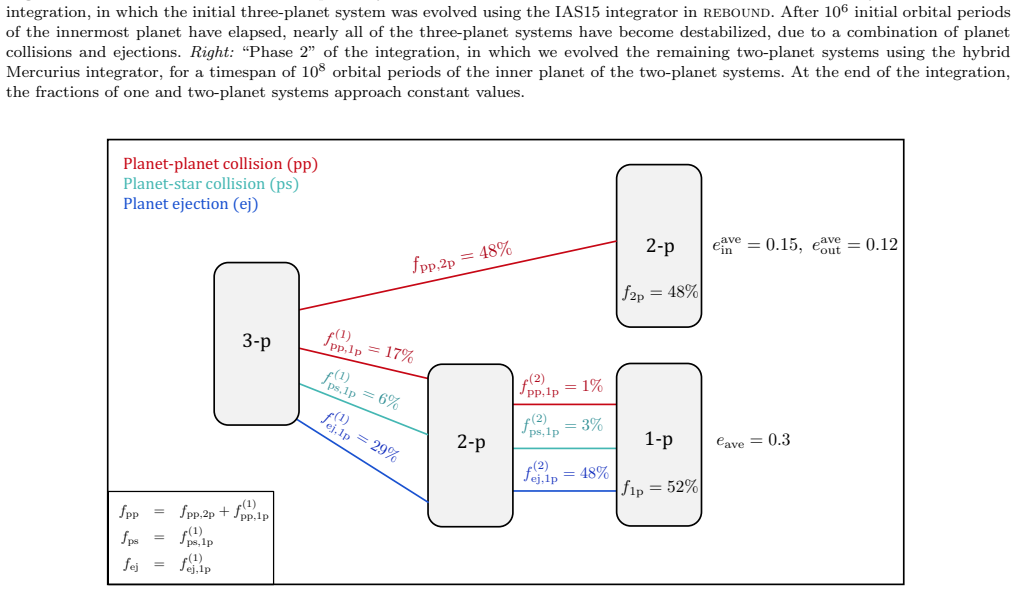
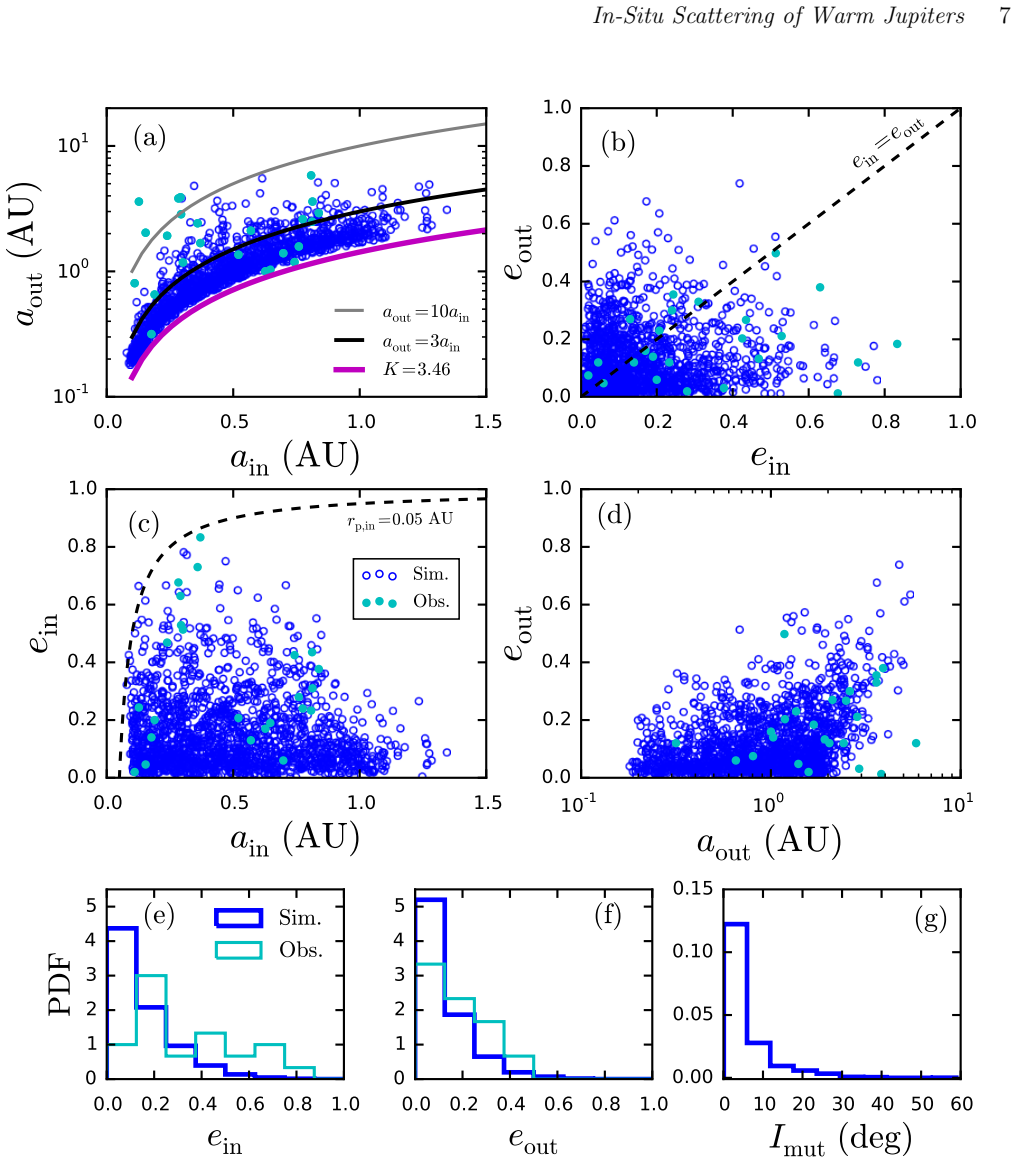
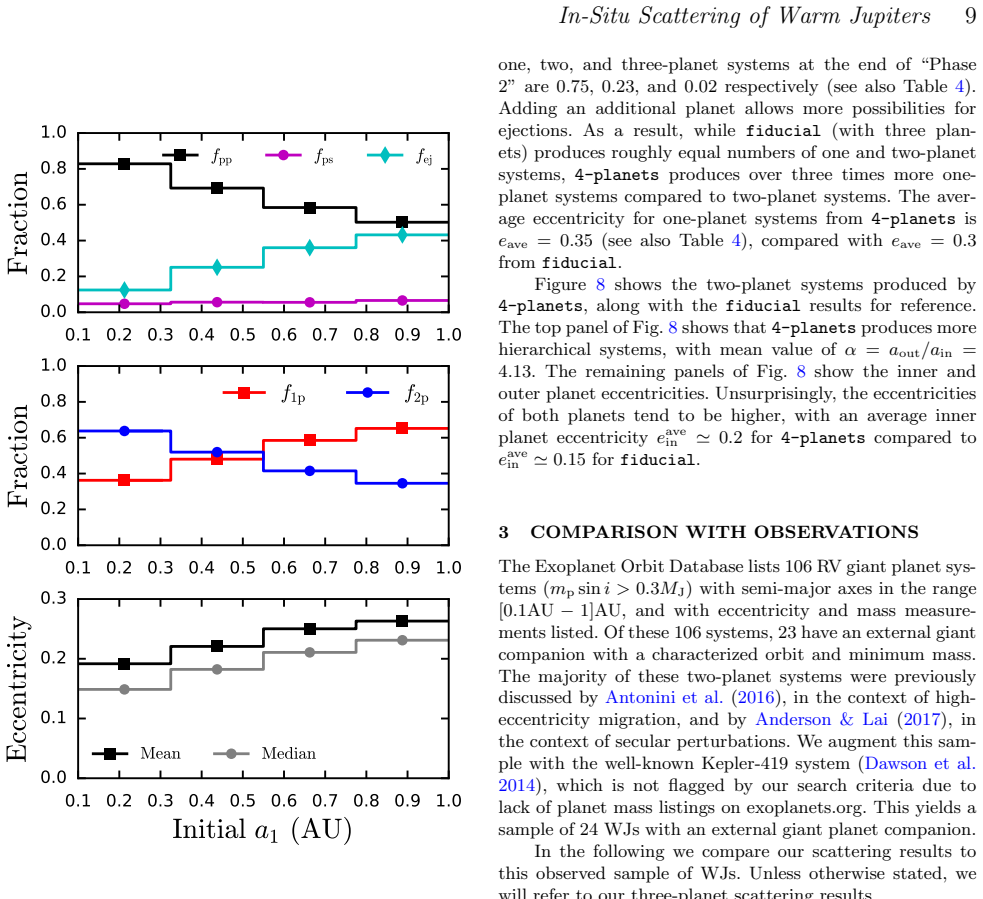
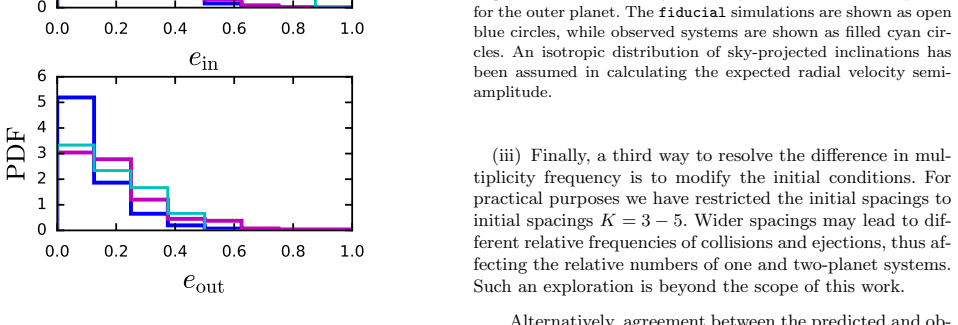
At distances of 0.1 to 1 AU, the escape velocity from a giant planet's surface is comparable to its orbital velocity, so close encounters between planets end in a mixture of collisions and ejections rather than the ejection-dominated outcome familiar from cold Jupiters at several AU. In the authors' fiducial simulations of three planets with masses 0.5, 1, and 2 Jupiter masses spaced by four mutual Hill radii, the first planet loss is a planet-planet collision 65 percent of the time, an ejection 29 percent of the time, and a collision with the star 6 percent of the time; the final state is 52 percent one-planet and 48 percent two-planet systems. Every surviving two-planet system was produced by a collision, which gives these systems low eccentricities (average inner-planet eccentricity 0.15, with 90 percent below 0.34), low mutual inclinations (90 percent below about 13 degrees), and compact spacing (90 percent with a semi-major axis ratio below 3). One-planet systems carry higher eccentricities (average 0.30, with 90 percent below 0.55) because each suffered at least one ejection. When the simulated single-planet eccentricity distribution is combined with a quiescent, low-eccentricity population in a mixture model, the observed eccentricities of 83 solitary warm Jupiters are reproduced with roughly 60 percent of systems having scattered and the rest quiescent; the same model also exposes tensions, since scattering produces an excess of circular two-planet systems and more compact pairs than are observed.
Load-bearing premise
The whole picture rests on treating every planet-planet collision as a perfect merger that conserves mass and momentum; if real giant-planet collisions are often hit-and-run or shed substantial mass, the balance between collisions and ejections changes and the fitted 60-percent scattering fraction would shift.
Editorial extensions
If this is right
- Planet-planet scattering at 0.1 to 1 AU is an effective eccentricity-excitation mechanism: the simulated single-planet eccentricity distribution reproduces the moderate-to-high eccentricity tail observed among solitary warm Jupiters.
- Scattered systems carry recognizable hallmarks: compact two-planet systems with low mutual inclinations arise exclusively from collisions, while a high-eccentricity single planet implies at least one ejection occurred.
- The observed solitary-warm-Jupiter eccentricities imply a two-population history: roughly 60 percent scattered in situ and roughly 40 percent remained quiescent, the latter consistent with the observed warm Jupiters that host low-mass neighbors.
- Extrapolating the same scattering inward to hot-Jupiter distances would overproduce compact two-planet systems that are not observed, suggesting hot Jupiters and warm Jupiters often have distinct formation and dynamical histories.
- The observed eccentric, hierarchical two-planet systems with semi-major axis ratios above 3 are not reproduced by sub-AU scattering, so those systems require a different origin.
Reading between the lines
- A sharper test that the authors do not perform: the scattered fraction should rise with host-star metallicity, since more metals favor forming multiple giant planets; measuring eccentricity distributions in metal-poor versus metal-rich subsamples would test the 60-percent split directly.
- If hot and warm Jupiters have distinct histories as the paper argues, a testable consequence is that hot Jupiters should show a very different close-companion frequency than the compact two-planet systems this model produces.
- Because the simulations show that grazing collisions dominate the merger events, the assumption of perfect mergers could be the first thing to revisit: if many grazing encounters are hit-and-run, more planets survive and the collision-to-ejection ratio shifts, which would change the fitted scattering fraction.
- An observational follow-up suggested by the model: eccentric solitary warm Jupiters should more often show signs of a depleted outer region (no distant companions) than circular ones, a difference that could be tested with extended radial-velocity monitoring.
Signed reviews
Editorial analysis
A structured set of objections, weighed in public.
Referee Report
Summary. The paper investigates whether in-situ planet-planet scattering among 3-4 giant planets at 0.1-1 AU can explain the eccentricity distribution of warm Jupiters. The authors run a large suite of rebound N-body simulations with a range of masses, spacings, and initial semi-major axes, including general relativistic precession, and catalogue the branching ratios into one-planet and two-planet systems and the resulting eccentricity distributions. They find that two-planet systems arise almost exclusively from planet-planet collisions and are dynamically cold, while one-planet systems come from a mix of collisions and ejections and have higher eccentricities. Comparing with the observed sample of 83 solitary WJs and 24 WJs with an external giant companion, they find that the combined eccentricity distribution is reproduced, but the separate one- and two-planet distributions are not. They then fit a two-population mixture model to the solitary WJ eccentricities, with a quiescent half-Gaussian component and a scattered component taken from the fiducial simulations, obtaining a maximum-likelihood quiescent fraction F≈0.35 and thus concluding that roughly 60% of solitary WJs have undergone in-situ scattering.
Significance. If the central claim holds, the paper establishes planet-planet scattering at sub-AU distances as a common and effective mechanism for producing eccentric warm Jupiters, with a sizeable quiescent component. The study is systematic and clearly presented: it uses standard, publicly available tools (rebound/reboundx), checks timestep convergence, integrates two-planet systems to 10^8 orbits and a subset to 10^9 orbits, and provides branching ratios as a function of mass, spacing, and semi-major axis. The mixture-model analysis is transparent, with a maximum-likelihood fit and confidence contours. The main quantitative conclusion, however, is contingent on the treatment of planet-planet collisions as perfect inelastic mergers, a simplification the paper explicitly flags in Appendix A but does not quantify. Because the simulated single-planet eccentricity template directly controls the inferred 60% fraction, this is a load-bearing uncertainty.
major comments (3)
- [Section 3.4 and Appendix A] The headline result that roughly 60% of solitary WJs have experienced in-situ scattering is obtained by fitting a mixture model (Eq. 4-5) in which fscat is the single-planet eccentricity template from the fiducial simulations. Those simulations adopt rebound's built-in collision routine, which merges any pair whose separation falls below the sum of the physical radii, conserving mass and momentum. Appendix A itself calls this treatment 'clearly a simplification,' and Fig. A1 shows that the collisions are predominantly grazing, with bcoll/(R1+R2)~1 and vcoll/v0~1. In giant-planet impact physics, this is precisely the regime where a substantial fraction of encounters are expected to be hit-and-run rather than mergers. A hit-and-run outcome would change the branching ratios (fpp, fej, f1p/f2p) and alter the survivor eccentricity distribution, directly shifting the fitted F. The quoted 95% interval F=0.18-0.54 does not include this systematic effect. Please provide a sensitivity test, for example a simple hit-and-run prescription or a bracketing model based on published giant-impact results, or at minimum rephrase the abstract and Section 3.4 to state explicitly that the 60% estimate is conditional on the perfect-merger assumption.
- [Section 3.4, Eq. (5), and Tables 3-4] The likelihood treats the simulated template fscat as fixed, so the confidence contours in Fig. 11 reflect only Poisson/sampling noise in the observed eccentricities, not uncertainty in the shape of fscat. The template is sensitive to the assumed initial planet masses and planet number: for example, the near-eq-mass simulations produce one-planet systems with mean eccentricity 0.47 versus 0.30 in fiducial (Table 3), and the 4-planet run has f1p=0.75 versus 0.52 for fiducial (Tables 1 and 4). Since F is inferred by matching the shape of fscat, the true uncertainty range for the quoted scattering fraction is larger than the plotted 95% contour. A propagation of the mass-function and planet-number variations, and ideally the collision prescription, is needed before the claim 'roughly 60% of systems' can be taken at face value.
- [Sections 3.1, 3.3, and 4.2] The mixture model is fit only to the eccentricities of 83 solitary WJs, but the same scattering model has a strong implication for the relative numbers of one- and two-planet systems that is not incorporated into the inference. The fiducial simulation yields N1/N2 ≈ 1 due to f1p=0.52, f2p=0.48, and all other three-planet runs give N1/N2 between roughly 0.5 and 1.5, whereas the observed ratio is N1/N2 ≈ 2.3-3.5 (Section 3.3). If 65% of solitary WJs are scattered remnants, the same scattering events would produce a large population of compact two-planet systems, which is not observed. The paper discusses this discrepancy qualitatively, but a joint likelihood over both the eccentricity distributions and the multiplicity ratio would be a more robust basis for the two-population conclusion. As written, the 'scattered + quiescent' model is not self-consistently tested against all the data presented.
minor comments (4)
- [Section 3.4] The Gaussian kernel-density estimate used to construct a smooth fscat(e) is not accompanied by a stated bandwidth; the inferred F may depend on this choice, so please report the bandwidth and check the sensitivity.
- [Section 3.4] The likelihood neglects uncertainties in the observed eccentricities; a short Monte Carlo test perturbing the eccentricities within their error bars would justify this assumption.
- [Section 2.4 and Table 1] For fiducial-K-5 the initial eccentricities are increased to make instabilities practical, so the K-dependence is convolved with a change in initial eccentricity; this is explained in the text but should be flagged more prominently in Table 1 or its caption.
- [Abstract and Section 3.4] The abstract states 'roughly 60%' scattered, which corresponds to 1-F at the MLE, but the 95% confidence range (F=0.18-0.54, i.e., 46-82% scattered) is quite wide; quoting this range in the abstract or conclusions would be more informative.
Circularity Check
No significant circularity: the scattering templates are forward-simulation outputs, and the mixture-model fit is a transparent statistical comparison rather than a derivation that reuses its inputs.
full rationale
The paper's central quantitative claim, that roughly 60% of solitary warm Jupiters may have undergone in-situ scattering, comes from a two-population likelihood fit (Eqs. 4-5) in which f_scat is the eccentricity distribution of one-planet survivors from an N-body sample and f_circ is a half-Gaussian with fitted width. Neither template is derived from the observed eccentricities used in the likelihood: the fiducial simulations draw initial masses, spacings, eccentricities, and inclinations from physically motivated distributions (Section 2.1), and the observed Exoplanet Orbit Database sample enters only at the comparison stage. The collision prescription, perfect merger conserving mass and momentum, is explicitly flagged as a simplification in Appendix A and affects the shape of f_scat, but this is model dependence rather than circularity because the observed distribution is not used to tune the collision outcome. Self-citations such as Anderson & Lai (2017) provide context and prior related work, but they are not load-bearing for the scattering simulations or the mixture fit. The mixture model is a transparent fit with reported confidence contours, not a prediction disguised as an independent check, so no circular step can be exhibited from the paper's own equations or citations.
Assumptions & free parameters
free parameters (2)
- F (quiescent fraction) =
0.35 (95% interval 0.18-0.54)
- sigma (width of quiescent half-Gaussian) =
0.07 (best fit)
assumptions (5)
- domain assumption Three or four giant planets on closely spaced, low-eccentricity orbits at 0.1-1 AU represent plausible post-disk-disposal configurations for warm Jupiters.
- domain assumption Planet-planet collisions are treated as completely inelastic mergers conserving mass and momentum (radius 1.6 RJ).
- ad hoc to paper The quiescent population's eccentricity distribution is a half-Gaussian peaked at e=0.
- domain assumption Observed eccentricity uncertainties are negligible for the likelihood calculation.
- domain assumption The observed solitary WJ sample from exoplanets.org is representative without correction for RV detection biases.
Cite this review
Pith. "Pith review of In-Situ Scattering of Warm Jupiters and Implications for Dynamical Histories." pith.science (2026). https://pith.science/paper/QEJMS4EW
@misc{pith2026190804300,
  author       = {Pith},
  title        = {Pith review of: In-Situ Scattering of Warm Jupiters and Implications for Dynamical Histories},
  year         = {2026},
  howpublished = {\url{https://pith.science/paper/QEJMS4EW}},
  note         = {Machine review of arXiv:1908.04300}
}
read the original abstract
Many warm Jupiters (WJs) have substantial eccentricities, which are linked to their formation and migration histories. This paper explores eccentricity excitation of WJs due to planet-planet scattering, beginning with 3-4 planets in unstable orbits, with the innermost planet placed in the range (0.1 - 1)AU. Such a setup is consistent with either in-situ formation or arrival at sub-AU orbits due to disk migration. Most previous N-body experiments have focused on "cold" Jupiters at several AU, where scattering results in planet ejections, efficiently exciting the eccentricities of surviving planets. In contrast, scattering at sub-AU distances results in a mixture of collisions and ejections, and the final eccentricities of surviving planets are unclear. We conduct scattering experiments for a range of planet masses and initial spacings, including the effect of general relativistic apsidal precession, and systematically catalogue the scattering outcomes and properties of surviving planets. A comparable number of one-planet and two-planet systems are produced. Two-planet systems arise exclusively through planet-planet collisions, and tend to have low eccentricities/mutual inclinations and compact configurations. One-planet systems arise through a combination of ejections and collisions, resulting in higher eccentricities. The observed eccentricity distribution of solitary WJs (lacking detection of a giant planet companion) is consistent with roughly 60% of the systems having undergone in-situ scattering, and the remaining experiencing a quiescent history.
Figures

Figures from the paper (8 more)





Reference graph
Works this paper leans on
-
[1]
Adams F. C., Laughlin G., 2003, @doi [ ] 10.1016/S0019-1035(03)00081-2 , http://adsabs.harvard.edu/abs/2003Icar..163..290A 163, 290
-
[2]
Anderson K. R., Lai D., 2017, @doi [ ] 10.1093/mnras/stx2250 , http://adsabs.harvard.edu/abs/2017MNRAS.472.3692A 472, 3692
-
[3]
Anderson K. R., Storch N. I., Lai D., 2016, @doi [ ] 10.1093/mnras/stv2906 , http://adsabs.harvard.edu/abs/2016MNRAS.456.3671A 456, 3671
-
[4]
Antonini F., Hamers A. S., Lithwick Y., 2016, @doi [ ] 10.3847/0004-6256/152/6/174 , http://adsabs.harvard.edu/abs/2016AJ....152..174A 152, 174
-
[5]
Baruteau C., et al., 2014, @doi [Protostars and Planets VI] 10.2458/azu_uapress_9780816531240-ch029 , http://adsabs.harvard.edu/abs/2014prpl.conf..667B pp 667--689
-
[6]
Batygin K., Bodenheimer P. H., Laughlin G. P., 2016, @doi [ ] 10.3847/0004-637X/829/2/114 , https://ui.adsabs.harvard.edu/abs/2016ApJ...829..114B 829, 114
-
[7]
Beaug \'e C., Nesvorn \'y D., 2012, @doi [ ] 10.1088/0004-637X/751/2/119 , http://adsabs.harvard.edu/abs/2012ApJ...751..119B 751, 119
-
[8]
Boley A. C., Granados Contreras A. P., Gladman B., 2016, @doi [ ] 10.3847/2041-8205/817/2/L17 , https://ui.adsabs.harvard.edu/abs/2016ApJ...817L..17B 817, L17
Show all 60 references
-
[9]
E., Wetherill G
Chambers J. E., Wetherill G. W., Boss A. P., 1996, @doi [ ] 10.1006/icar.1996.0019 , http://adsabs.harvard.edu/abs/1996Icar..119..261C 119, 261
1996
-
[10]
B., Matsumura S., Rasio F
Chatterjee S., Ford E. B., Matsumura S., Rasio F. A., 2008, @doi [ ] 10.1086/590227 , http://adsabs.harvard.edu/abs/2008ApJ...686..580C 686, 580
2008 doi
-
[11]
Correia A. C. M., Laskar J., Farago F., Bou \'e G., 2011, @doi [Celestial Mechanics and Dynamical Astronomy] 10.1007/s10569-011-9368-9 , https://ui.adsabs.harvard.edu/abs/2011CeMDA.111..105C 111, 105
2011 doi
-
[12]
P., Marcy G
Cumming A., Butler R. P., Marcy G. W., Vogt S. S., Wright J. T., Fischer D. A., 2008, @doi [ ] 10.1086/588487 , https://ui.adsabs.harvard.edu/abs/2008PASP..120..531C 120, 531
2008 doi
-
[13]
I., Chiang E., 2014, @doi [Science] 10.1126/science.1256943 , http://adsabs.harvard.edu/abs/2014Sci...346..212D 346, 212
Dawson R. I., Chiang E., 2014, @doi [Science] 10.1126/science.1256943 , http://adsabs.harvard.edu/abs/2014Sci...346..212D 346, 212
2014 doi
-
[14]
I., Johnson J
Dawson R. I., Johnson J. A., 2018, @doi [ ] 10.1146/annurev-astro-081817-051853 , http://adsabs.harvard.edu/abs/2018ARA
2018 doi
-
[15]
I., Murray-Clay R
Dawson R. I., Murray-Clay R. A., 2013, @doi [ ] 10.1088/2041-8205/767/2/L24 , http://adsabs.harvard.edu/abs/2013ApJ...767L..24D 767, L24
2013 doi
-
[16]
I., et al., 2014, @doi [ ] 10.1088/0004-637X/791/2/89 , http://adsabs.harvard.edu/abs/2014ApJ...791...89D 791, 89
Dawson R. I., et al., 2014, @doi [ ] 10.1088/0004-637X/791/2/89 , http://adsabs.harvard.edu/abs/2014ApJ...791...89D 791, 89
2014 doi
-
[17]
Dong S., Katz B., Socrates A., 2014, @doi [ ] 10.1088/2041-8205/781/1/L5 , http://adsabs.harvard.edu/abs/2014ApJ...781L...5D 781, L5
2014 doi
-
[18]
C., Chiang E., 2015, @doi [ ] 10.1088/0004-637X/812/2/94 , http://adsabs.harvard.edu/abs/2015ApJ...812...94D 812, 94
Duffell P. C., Chiang E., 2015, @doi [ ] 10.1088/0004-637X/812/2/94 , http://adsabs.harvard.edu/abs/2015ApJ...812...94D 812, 94
2015 doi
-
[19]
Fabrycky D., Tremaine S., 2007, @doi [ ] 10.1086/521702 , http://adsabs.harvard.edu/abs/2007ApJ...669.1298F 669, 1298
2007 doi
-
[20]
B., Rasio F
Ford E. B., Rasio F. A., 2008, @doi [ ] 10.1086/590926 , http://adsabs.harvard.edu/abs/2008ApJ...686..621F 686, 621
2008 doi
-
[21]
B., Havlickova M., Rasio F
Ford E. B., Havlickova M., Rasio F. A., 2001, @doi [ ] 10.1006/icar.2001.6588 , http://adsabs.harvard.edu/abs/2001Icar..150..303F 150, 303
2001
-
[22]
A., Petrovich C., 2019, arXiv e-prints, https://ui.adsabs.harvard.edu/abs/2019arXiv190603266F p
Frelikh R., Jang H., Murray-Clay R. A., Petrovich C., 2019, arXiv e-prints, https://ui.adsabs.harvard.edu/abs/2019arXiv190603266F p. arXiv:1906.03266
2019 arXiv
-
[23]
Goldreich P., Sari R., 2003, @doi [ ] 10.1086/346202 , http://adsabs.harvard.edu/abs/2003ApJ...585.1024G 585, 1024
2003 doi
-
[24]
S., Antonini F., Lithwick Y., Perets H
Hamers A. S., Antonini F., Lithwick Y., Perets H. B., Portegies Zwart S. F., 2017, @doi [ ] 10.1093/mnras/stw2370 , http://adsabs.harvard.edu/abs/2017MNRAS.464..688H 464, 688
2017 doi
-
[25]
Huang C., Wu Y., Triaud A. H. M. J., 2016, @doi [ ] 10.3847/0004-637X/825/2/98 , http://adsabs.harvard.edu/abs/2016ApJ...825...98H 825, 98
2016 doi
-
[26]
Juri \'c M., Tremaine S., 2008, @doi [ ] 10.1086/590047 , http://adsabs.harvard.edu/abs/2008ApJ...686..603J 686, 603
2008 doi
-
[27]
P., 2012, @doi [ ] 10.1146/annurev-astro-081811-125523 , http://adsabs.harvard.edu/abs/2012ARA
Kley W., Nelson R. P., 2012, @doi [ ] 10.1146/annurev-astro-081811-125523 , http://adsabs.harvard.edu/abs/2012ARA
2012 doi
-
[28]
Kozai Y., 1962, @doi [ ] 10.1086/108790 , http://adsabs.harvard.edu/abs/1962AJ.....67..591K 67, 591
1962 doi
-
[29]
J., Chiang E., 2016, @doi [ ] 10.3847/0004-637X/817/2/90 , https://ui.adsabs.harvard.edu/abs/2016ApJ...817...90L 817, 90
Lee E. J., Chiang E., 2016, @doi [ ] 10.3847/0004-637X/817/2/90 , https://ui.adsabs.harvard.edu/abs/2016ApJ...817...90L 817, 90
2016 doi
-
[30]
J., Chiang E., Ormel C
Lee E. J., Chiang E., Ormel C. W., 2014, @doi [ ] 10.1088/0004-637X/797/2/95 , https://ui.adsabs.harvard.edu/abs/2014ApJ...797...95L 797, 95
2014 doi
-
[31]
L., 1962, @doi [ ] 10.1016/0032-0633(62)90129-0 , http://adsabs.harvard.edu/abs/1962P
Lidov M. L., 1962, @doi [ ] 10.1016/0032-0633(62)90129-0 , http://adsabs.harvard.edu/abs/1962P
1962 doi
-
[32]
Lin D. N. C., Ida S., 1997, @doi [ ] 10.1086/303738 , http://adsabs.harvard.edu/abs/1997ApJ...477..781L 477, 781
1997 doi
-
[33]
Lin D. N. C., Bodenheimer P., Richardson D. C., 1996, @doi [ ] 10.1038/380606a0 , http://adsabs.harvard.edu/abs/1996Natur.380..606L 380, 606
1996 doi
-
[34]
Lithwick Y., Wu Y., 2011, @doi [ ] 10.1088/0004-637X/739/1/31 , http://adsabs.harvard.edu/abs/2011ApJ...739...31L 739, 31
2011 doi
-
[35]
Lithwick Y., Wu Y., 2014, @doi [Proceedings of the National Academy of Science] 10.1073/pnas.1308261110 , http://adsabs.harvard.edu/abs/2014PNAS..11112610L 111, 12610
2014 doi
-
[36]
A., Aarseth S
Mardling R. A., Aarseth S. J., 2001, @doi [ ] 10.1046/j.1365-8711.2001.03974.x , http://adsabs.harvard.edu/abs/2001MNRAS.321..398M 321, 398
2001
-
[37]
Marzari F., Nagasawa M., 2019, @doi [Astronomy and Astrophysics] 10.1051/0004-6361/201935065 , https://ui.adsabs.harvard.edu/abs/2019A&A...625A.121M 625, A121
2019 doi
-
[38]
J., Lai D., Liu B., 2016, @doi [ ] 10.1093/mnras/stw983 , http://adsabs.harvard.edu/abs/2016MNRAS.460.1086M 460, 1086
Mu \ n oz D. J., Lai D., Liu B., 2016, @doi [ ] 10.1093/mnras/stw983 , http://adsabs.harvard.edu/abs/2016MNRAS.460.1086M 460, 1086
2016 doi
-
[39]
J., Davies M
Mustill A. J., Davies M. B., Johansen A., 2017, @doi [ ] 10.1093/mnras/stx693 , http://adsabs.harvard.edu/abs/2017MNRAS.468.3000M 468, 3000
2017 doi
-
[40]
Nagasawa M., Ida S., 2011, @doi [ ] 10.1088/0004-637X/742/2/72 , http://adsabs.harvard.edu/abs/2011ApJ...742...72N 742, 72
2011 doi
-
[41]
Nagasawa M., Ida S., Bessho T., 2008, @doi [ ] 10.1086/529369 , http://adsabs.harvard.edu/abs/2008ApJ...678..498N 678, 498
2008 doi
-
[42]
M., Rasio F
Naoz S., Farr W. M., Rasio F. A., 2012, @doi [ ] 10.1088/2041-8205/754/2/L36 , http://adsabs.harvard.edu/abs/2012ApJ...754L..36N 754, L36
2012 doi
-
[43]
Petrovich C., 2015a, @doi [ ] 10.1088/0004-637X/799/1/27 , http://adsabs.harvard.edu/abs/2015ApJ...799...27P 799, 27
-
[44]
Petrovich C., 2015b, @doi [ ] 10.1088/0004-637X/805/1/75 , http://adsabs.harvard.edu/abs/2015ApJ...805...75P 805, 75
-
[45]
Petrovich C., 2015c, @doi [ ] 10.1088/0004-637X/808/2/120 , http://adsabs.harvard.edu/abs/2015ApJ...808..120P 808, 120
-
[46]
Petrovich C., Tremaine S., 2016, @doi [ ] 10.3847/0004-637X/829/2/132 , http://adsabs.harvard.edu/abs/2016ApJ...829..132P 829, 132
2016 doi
-
[47]
Petrovich C., Tremaine S., Rafikov R., 2014, @doi [ ] 10.1088/0004-637X/786/2/101 , http://adsabs.harvard.edu/abs/2014ApJ...786..101P 786, 101
2014 doi
-
[48]
Petrovich C., Wu Y., Ali-Dib M., 2019, @doi [ ] 10.3847/1538-3881/aaeed9 , http://adsabs.harvard.edu/abs/2019AJ....157....5P 157, 5
2019 doi
-
[49]
J., Lodato G., 2018, @doi [ ] 10.1093/mnras/stx3094 , https://ui.adsabs.harvard.edu/abs/2018MNRAS.474.4460R 474, 4460
Ragusa E., Rosotti G., Teyssandier J., Booth R., Clarke C. J., Lodato G., 2018, @doi [ ] 10.1093/mnras/stx3094 , https://ui.adsabs.harvard.edu/abs/2018MNRAS.474.4460R 474, 4460
2018 doi
-
[50]
A., Ford E
Rasio F. A., Ford E. B., 1996, @doi [Science] 10.1126/science.274.5289.954 , http://adsabs.harvard.edu/abs/1996Sci...274..954R 274, 954
1996 doi
-
[51]
N., Barnes R., Veras D., Armitage P
Raymond S. N., Barnes R., Veras D., Armitage P. J., Gorelick N., Greenberg R., 2009, @doi [ ] 10.1088/0004-637X/696/1/L98 , http://adsabs.harvard.edu/abs/2009ApJ...696L..98R 696, L98
2009 doi
-
[52]
Rein H., Liu S.-F., 2012, @doi [ ] 10.1051/0004-6361/201118085 , http://adsabs.harvard.edu/abs/2012A
2012 doi
-
[53]
S., 2015, @doi [ ] 10.1093/mnras/stu2164 , http://adsabs.harvard.edu/abs/2015MNRAS.446.1424R 446, 1424
Rein H., Spiegel D. S., 2015, @doi [ ] 10.1093/mnras/stu2164 , http://adsabs.harvard.edu/abs/2015MNRAS.446.1424R 446, 1424
2015 doi
-
[54]
Rein H., Tamayo D., 2015, @doi [ ] 10.1093/mnras/stv1257 , http://adsabs.harvard.edu/abs/2015MNRAS.452..376R 452, 376
2015 doi
-
[55]
R., 2002, @doi [ ] 10.1086/324713 , http://adsabs.harvard.edu/abs/2002ApJ...565.1257T 565, 1257
Tanaka H., Takeuchi T., Ward W. R., 2002, @doi [ ] 10.1086/324713 , http://adsabs.harvard.edu/abs/2002ApJ...565.1257T 565, 1257
2002 doi
-
[56]
Teyssandier J., Lai D., Vick M., 2019, arXiv e-prints, http://adsabs.harvard.edu/abs/2019arXiv190105006T
2019
-
[57]
J., Cumming A., 2014, @doi [ ] 10.1088/0004-637X/782/2/113 , http://adsabs.harvard.edu/abs/2014ApJ...782..113T 782, 113
Tsang D., Turner N. J., Cumming A., 2014, @doi [ ] 10.1088/0004-637X/782/2/113 , http://adsabs.harvard.edu/abs/2014ApJ...782..113T 782, 113
2014 doi
-
[58]
R., 2019, @doi [ ] 10.1093/mnras/stz354 , http://adsabs.harvard.edu/abs/2019MNRAS.484.5645V 484, 5645
Vick M., Lai D., Anderson K. R., 2019, @doi [ ] 10.1093/mnras/stz354 , http://adsabs.harvard.edu/abs/2019MNRAS.484.5645V 484, 5645
2019 doi
-
[59]
Wisdom J., Holman M., 1991, @doi [ ] 10.1086/115978 , https://ui.adsabs.harvard.edu/abs/1991AJ....102.1528W 102, 1528
1991 doi
-
[60]
Wu Y., Murray N., 2003, @doi [ ] 10.1086/374598 , http://adsabs.harvard.edu/abs/2003ApJ...589..605W 589, 605
2003 doi
Reviewed August 14, 2026 · model on record in the stance chip above.
Discussion (0). Continue with ORCID to comment.