REVIEW 2 major objections 4 minor 18 references
Multi-timescale Trajectory Prediction for Abnormal Human Activity Detection
T0 review · 2 major / 4 minor · reviewed 2026-08-14 · deepseek-v4-flash
Pith's one-line read The paper claims that detecting abnormal human activities requires predicting pose trajectories at several timescales at once, and that a multi-layered 1D convolutional network supervised at timescales 3, 5, 13, and 25 outperforms…
desk verdict A clean multi-timescale extension of pose-based anomaly detection with a genuinely useful new dataset, but the headline gain rests on a hand-picked uniform timescale average and single-run numbers. read the letter →
The pith
A machine-rendered reading of the paper's core claim, the machinery that carries it, and where it could break.
The reading
What carries the argument
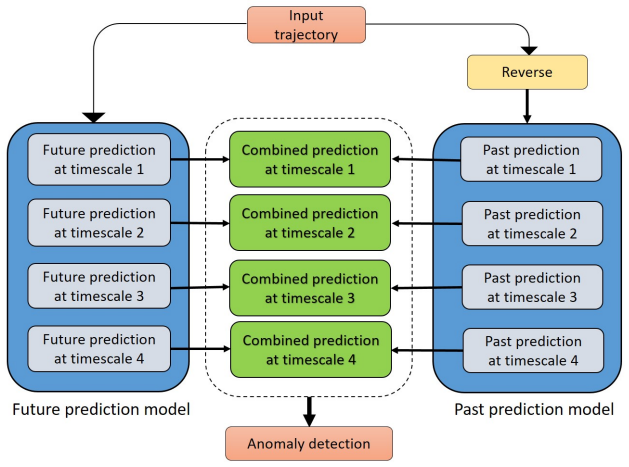
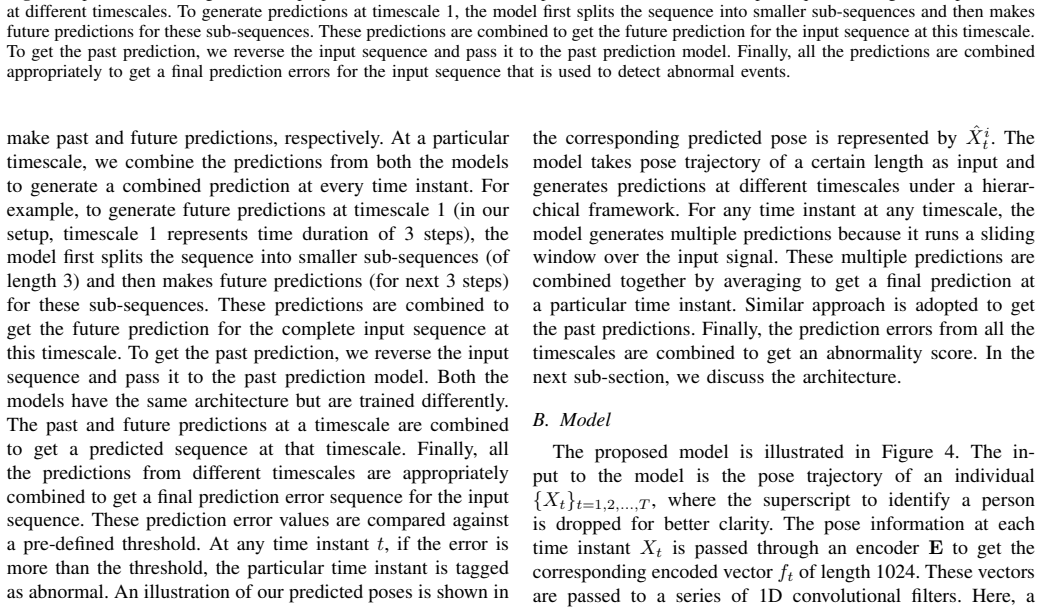
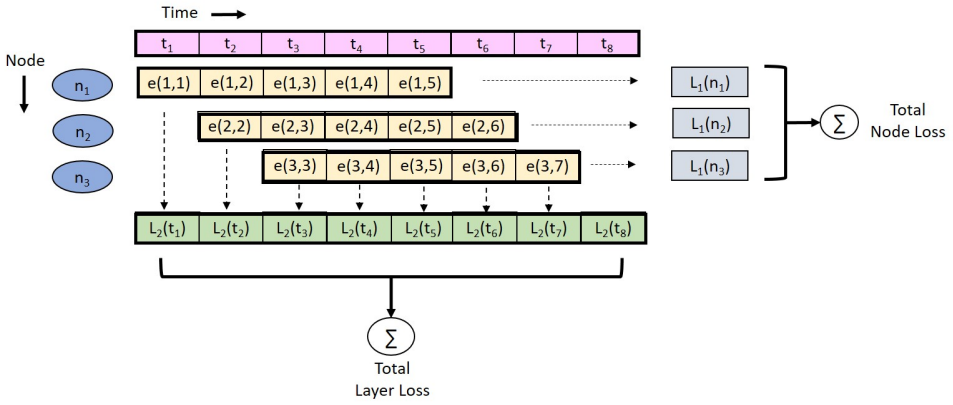
The load-bearing mechanism is a multi-layered 1D convolutional encoder-decoder in which intermediate layers are supervised, through node-level and layer-level losses, to predict trajectory offsets at chosen time horizons. Layer 1 has a receptive field of 3 frames and predicts 3 steps ahead; layers 2, 4, and 7 correspond to horizons 5, 13, and 25. A sliding window over the input produces several predictions per time instant, and these are averaged into layer losses, so training mimics the sliding-window test procedure. Past predictions come from running the same architecture on the reversed trajectory. The final anomaly score at time $t$ is the equal-weight average over timescales of the per-layer losses, taking the maximum over all people in the frame.
What would settle it
A single experiment would settle it: train the same architecture with only the 25-step supervision and only the 3-step supervision, and compare both against the combined model on the Corridor dataset's loitering and sudden-running sequences. If the combined model does not beat the best single timescale on both anomaly types, the multi-timescale claim fails.
Extended reading notes
Core claim
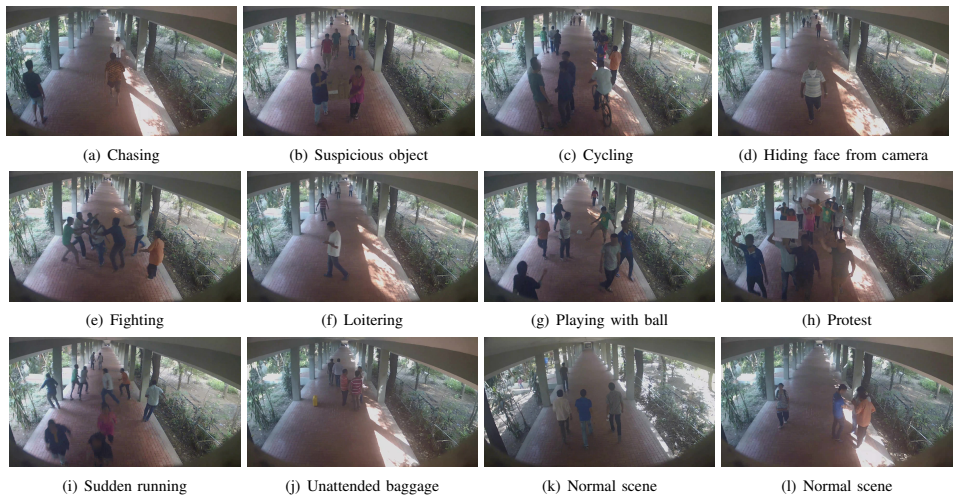
The central claim is that prediction error signals abnormality only at the right timescale, so a model should predict at many timescales and combine the errors. The authors train a seven-layer 1D convolutional network on human pose trajectories, supervising layers 1, 2, 4, and 7 to predict 3, 5, 13, and 25 steps into the future, and a twin model that makes the same predictions into the past. At test time, per-timescale errors are averaged to score each frame, and frames above a threshold are tagged abnormal. On HR-ShanghaiTech the full model reaches 77.04 Frame-AUC and on HR-Avenue 88.33, exceeding the compared single-timescale baselines; the ablation shows AUC climbing from 72.05 with only 3-step prediction to 77.04 with all four timescales. The paper also introduces the Corridor dataset, 483,566 annotated frames of staged single- and group-level anomalies.
Load-bearing premise
The central claim rests on the assumption that the four hand-picked timescales {3, 5, 13, 25} are the right ones and that averaging their prediction errors with equal weight is a good anomaly score.
Editorial extensions
If this is right
- A fixed-horizon predictor can be upgraded to a multi-timescale one by adding supervision at intermediate layers, without any new labels.
- On HR-ShanghaiTech, Frame-AUC rises monotonically as timescales 3, 5, 13, and 25 are added, from 72.05 to 77.04, so long-horizon errors carry information that short-horizon errors miss.
- Combining past and future predictions improves over either direction alone in most tested configurations.
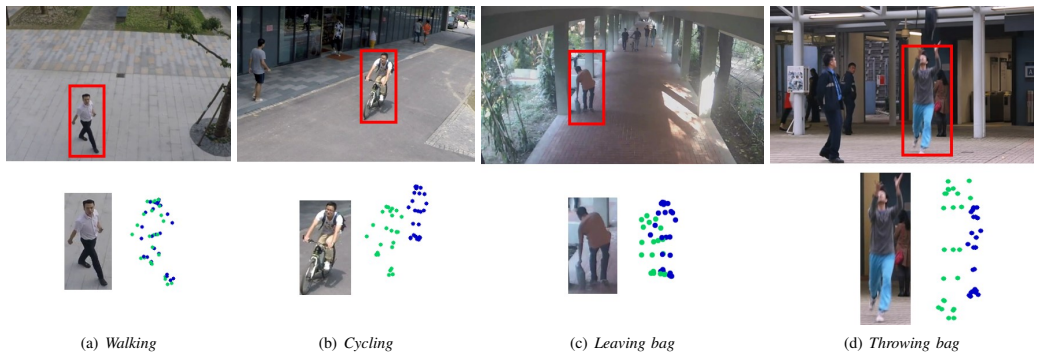
- Pose trajectories alone are sufficient to detect human anomalies; the max-over-people aggregation makes the method applicable to group scenes.
- The chosen timescales must match the anomalies present: on HR-Avenue, adding the 25-step timescale slightly reduces AUC because that dataset lacks long-term anomalies.
Reading between the lines
- The equal-weight voting rule is the most brittle part of the design; a learned weighting of the four timescales would probably improve datasets with mixed anomaly durations, since Table III already shows the 25-step timescale hurting HR-Avenue.
- The timescale set {3, 5, 13, 25} is fixed by the network's receptive fields rather than by anomaly statistics; selecting horizons from the training data could reveal whether an intermediate duration such as 9 steps matters.
- The same intermediate-supervision trick could be applied to other sequential abnormality signals, such as optical flow or object trajectories, not only human skeletons.
- The paper reports only Frame-AUC, so per-anomaly recall by duration is untested; that measurement would directly validate or undermine the multi-timescale explanation.
Signed reviews
Editorial analysis
A structured set of objections, weighed in public.
Referee Report
Summary. This paper proposes a multi-timescale framework for abnormal human activity detection in videos. The input is a human pose trajectory; two 1D-convolutional models predict future and past trajectories at four timescales (3, 5, 13, and 25 steps), with supervision at intermediate layers whose receptive fields match these horizons. At test time, prediction errors from all timescales and both directions are averaged (Eq. 7, with max over persons in Eq. 8) and thresholded to tag abnormal frames. The authors introduce a new Corridor dataset with 483,566 annotated frames and evaluate on HR-ShanghaiTech, HR-Avenue, Avenue, and ShanghaiTech. Table I reports improvements over prior methods on the HR variants, and Table III ablates the effect of adding timescales and the past-prediction branch.
Significance. If the results are reliable, the paper makes a useful contribution by showing that supervising intermediate convolutional layers at multiple temporal horizons yields prediction errors that are more discriminative for anomaly detection than a single timescale. The Corridor dataset is a substantial new resource with multi-person anomalies and class labels. The ablations in Table III provide direct evidence for the multi-timescale principle, and the architecture and loss are described in sufficient detail to be reimplemented. The main weaknesses are the lack of statistical validation and the hand-picked, uniformly weighted timescale set, which make the quantitative claims less robust than the text suggests.
major comments (2)
- [V-E (Table III) and Eq. (7)] The central claim rests on the specific timescale set S = {3, 5, 13, 25} and the uniform averaging in Eq. (7). Table III shows that adding the 25-step timescale reduces HR-Avenue AUC from 88.43 to 88.33, which the authors attribute to the dataset lacking long-term anomalies, but no per-anomaly or per-timescale analysis is provided to test that explanation. Because the final configuration appears to be selected after observing the test-set results, the reported gains could be configuration-specific. Please provide validation-based selection of S, a sensitivity analysis over S and the weights in Eq. (7), or a per-anomaly breakdown demonstrating that different timescales contribute to different anomaly types.
- [V-D (Tables I and III)] All reported Frame-AUC values are point estimates from a single run. The margins between configurations are small (e.g., 75.65 vs 77.04 on HR-ShanghaiTech; 88.43 vs 88.33 on HR-Avenue) and may be within run-to-run variance for a deep model trained with this protocol. Please report the mean and standard deviation over multiple training runs, or confidence intervals via bootstrap over the test set, and state whether the differences versus the baselines and ablations are statistically significant.
minor comments (4)
- [Abstract and Section V-D] The abstract claims the model 'outperforms existing methods' without qualification, but Table I shows lower Frame-AUC on the full Avenue dataset (82.85) than Liu et al. (84.90). The body qualifies the claim to HR-ShanghaiTech and HR-Avenue; the abstract should be corrected to avoid overclaim.
- [III-C (Eq. 3)] The definition of L_2^j in Eq. (3) is inconsistent with Eqs. (1) and (7): as written it defines a per-time average error, yet Eq. (1) uses it as a sum over t and Eq. (7) uses L_2^j(t). Please clarify the notation, e.g., define L_2^j(t) explicitly and write the layer-level loss as a sum over t.
- [V-B] The sentence 'The loss after an epoch is equal to the loss incurred at the last sub-epoch' is ambiguous about whether gradients from earlier sub-epochs are retained. Please specify the optimizer update rule and how the multi-timescale loss in Eq. (4) is used during training.
- [IV (Corridor dataset)] The dataset description gives the total number of frames but not the distribution of abnormal frames across activity classes; a per-class frame count would help readers assess the difficulty and potential biases.
Circularity Check
No circularity: the multi-timescale anomaly score is an empirically evaluated prediction-error pipeline, not a reduction of the result into its inputs.
full rationale
The claimed derivation chain is: supervised intermediate convolutional layers produce pose predictions at timescales {3, 5, 13, 25}; prediction errors are weighted by pose confidence and combined as layer losses; the test-time anomaly score in Eq. (7) is the uniform average of per-layer errors; and Frame-AUC is evaluated against external frame-level annotations on HR-ShanghaiTech, HR-Avenue, and the new Corridor dataset. None of these steps defines the target outcome in terms of itself: the model is trained only on normal data (Section V-B), the anomaly labels are external annotations, and the reported scores are computed on held-out test sets. The choice S = {3, 5, 13, 25} and the uniform average in Eq. (7) are hand-picked hyperparameters rather than quantities fitted to the benchmark labels; selecting the configuration after inspecting Table III is a test-set reuse or robustness concern, not a circularity. The acknowledged degradation on HR-Avenue with the 25-step timescale is an empirical caveat, not a circular reduction. No load-bearing self-citation is present: the HR dataset variants and pose preprocessing are attributed to prior work by Morais et al. and OpenPose, which are independent external sources. I therefore find no circular step.
Assumptions & free parameters
free parameters (4)
- Timescale set =
{3, 5, 13, 25}
- Anomaly detection threshold =
not reported
- Model capacity hyperparameters =
7 layers, 1024 filters, filter lengths 3, 3, 5, 5, 5, 5, 5
- Voting weights in Eq. (7) =
uniform 1/|S|
assumptions (4)
- domain assumption The training set consists exclusively of normal activities and adequately represents the normal behavior seen at test time.
- domain assumption Human pose trajectories extracted by the detector, tracker, and pose estimator are sufficiently accurate to capture abnormal activities.
- domain assumption Prediction error of future and past poses is a valid proxy for abnormality, i.e., normal activities are predictable and abnormal activities are not.
- ad hoc to paper A 1D convolutional layer's receptive field length corresponds to the temporal horizon of dynamics, so supervising layers with receptive fields 3, 5, 13, and 25 yields predictions at those timescales.
Cite this review
Pith. "Pith review of Multi-timescale Trajectory Prediction for Abnormal Human Activity Detection." pith.science (2026). https://pith.science/paper/4ZTNNQHK
@misc{pith2026190804321,
  author       = {Pith},
  title        = {Pith review of: Multi-timescale Trajectory Prediction for Abnormal Human Activity Detection},
  year         = {2026},
  howpublished = {\url{https://pith.science/paper/4ZTNNQHK}},
  note         = {Machine review of arXiv:1908.04321}
}
read the original abstract
A classical approach to abnormal activity detection is to learn a representation for normal activities from the training data and then use this learned representation to detect abnormal activities while testing. Typically, the methods based on this approach operate at a fixed timescale - either a single time-instant (eg. frame-based) or a constant time duration (eg. video-clip based). But human abnormal activities can take place at different timescales. For example, jumping is a short term anomaly and loitering is a long term anomaly in a surveillance scenario. A single and pre-defined timescale is not enough to capture the wide range of anomalies occurring with different time duration. In this paper, we propose a multi-timescale model to capture the temporal dynamics at different timescales. In particular, the proposed model makes future and past predictions at different timescales for a given input pose trajectory. The model is multi-layered where intermediate layers are responsible to generate predictions corresponding to different timescales. These predictions are combined to detect abnormal activities. In addition, we also introduce an abnormal activity data-set for research use that contains 4,83,566 annotated frames. Data-set will be made available at https://rodrigues-royston.github.io/Multi-timescale_Trajectory_Prediction/ Our experiments show that the proposed model can capture the anomalies of different time duration and outperforms existing methods.
Figures

Figures from the paper (4 more)

Reference graph
Works this paper leans on
- [1]
-
[2]
A. Adam, E. Rivlin, I. Shimshoni, and D. Reinitz. Robust real-time unusual event detection using multiple fixed-location monitors. IEEE transactions on pattern analysis and machine intelligence , 30(3):555– 560, 2008
work page 2008
-
[3]
Z. Cao, G. Hidalgo, T. Simon, S.-E. Wei, and Y . Sheikh. OpenPose: realtime multi-person 2D pose estimation using Part Affinity Fields. In arXiv preprint arXiv:1812.08008 , 2018
arXiv 2018
-
[4]
Z. Cao, T. Simon, S.-E. Wei, and Y . Sheikh. Realtime multi-person 2d pose estimation using part affinity fields. In CVPR, 2017
work page 2017
- [5]
- [6]
-
[7]
J. Huang, V . Rathod, C. Sun, M. Zhu, A. Korattikara, A. Fathi, I. Fischer, Z. Wojna, Y . Song, S. Guadarrama, et al. Speed/accuracy trade-offs for modern convolutional object detectors. In Proceedings of the IEEE conference on computer vision and pattern recognition , pages 7310– 7311, 2017
work page 2017
-
[8]
W. Li, V . Mahadevan, and N. Vasconcelos. Anomaly detection and localization in crowded scenes. IEEE transactions on pattern analysis and machine intelligence , 36(1):18–32, 2013
work page 2013
Show all 18 references
-
[9]
W. Liu, W. Luo, D. Lian, and S. Gao. Future frame prediction for anomaly detection–a new baseline. In Proceedings of the IEEE Conference on Computer Vision and Pattern Recognition , pages 6536– 6545, 2018
2018
-
[10]
C. Long, A. Haizhou, Z. Zijie, and S. Chong. Real-time multiple people tracking with deeply learned candidate selection and person re- identification. In ICME, 2018
2018
-
[11]
C. Lu, J. Shi, and J. Jia. Abnormal event detection at 150 fps in matlab. In Proceedings of the IEEE international conference on computer vision, pages 2720–2727, 2013
2013
-
[12]
W. Luo, W. Liu, and S. Gao. A revisit of sparse coding based anomaly detection in stacked rnn framework. In Proceedings of the IEEE International Conference on Computer Vision , pages 341–349, 2017
2017
-
[13]
Morais, V
R. Morais, V . Le, T. Tran, B. Saha, M. Mansour, and S. Venkatesh. Learning regularity in skeleton trajectories for anomaly detection in videos. In Proceedings of the IEEE Conference on Computer Vision and Pattern Recognition, pages 11996–12004, 2019
2019
-
[14]
Najibi, P
M. Najibi, P. Samangouei, R. Chellappa, and L. Davis. SSH: Single stage headless face detector. In The IEEE International Conference on Computer Vision (ICCV) , 2017
2017
-
[15]
Ravanbakhsh, M
M. Ravanbakhsh, M. Nabi, E. Sangineto, L. Marcenaro, C. Regazzoni, and N. Sebe. Abnormal event detection in videos using generative adversarial nets. In 2017 IEEE International Conference on Image Processing (ICIP), pages 1577–1581. IEEE, 2017
2017
-
[16]
H. T. Tran and D. Hogg. Anomaly detection using a convolutional winner-take-all autoencoder. In Proceedings of the British Machine Vision Conference 2017. British Machine Vision Association, 2017
2017
-
[17]
Tudor Ionescu, S
R. Tudor Ionescu, S. Smeureanu, B. Alexe, and M. Popescu. Unmasking the abnormal events in video. In Proceedings of the IEEE International Conference on Computer Vision , pages 2895–2903, 2017
2017
-
[18]
D. Xu, E. Ricci, Y . Yan, J. Song, and N. Sebe. Learning deep representations of appearance and motion for anomalous event detection. arXiv preprint arXiv:1510.01553 , 2015
2015 arXiv
Reviewed August 14, 2026 · model on record in the stance chip above.
Discussion (0). Continue with ORCID to comment.