REVIEW 3 major objections 5 minor 36 references
Classes of Full-Duplex Channels with Capacity Achieved Without Adaptation
T0 review · 3 major / 5 minor · reviewed 2026-08-14 · deepseek-v4-flash
Pith's one-line read Non-adaptive transmission achieves the Shannon capacity region for injective semi-deterministic two-way channels and is asymptotically optimal for the Poisson two-way channel at high dark current.
desk verdict Solid ISD capacity results, but the Poisson half has a load-bearing inconsistency: Theorem 5's one-way capacity is contradicted by the proof of Theorem 6. read the letter →
The pith
A machine-rendered reading of the paper's core claim, the machinery that carries it, and where it could break.
The reading
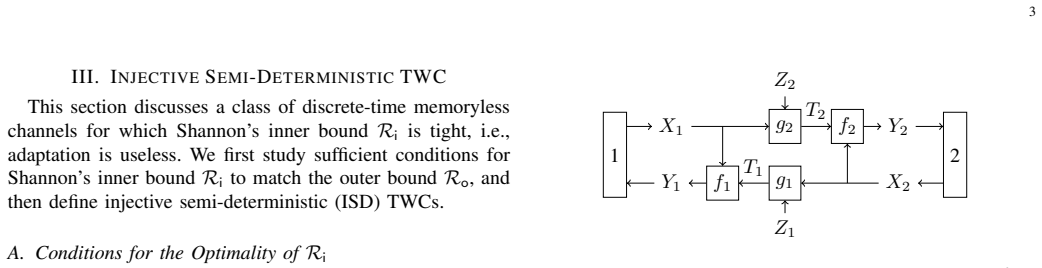
The first class is the injective semi-deterministic two-way channel: each output is obtained by passing the other terminal's input, plus independent noise, through injective functions. This covers additive channels with exponential, Cauchy, or Gaussian noise, multiplicative channels, and some input-dependent noise models. For all of these, the capacity region is a rectangle and the paper gives closed-form rate expressions. The second class is the continuous-time Poisson channel, used for optical communication, where the receiver counts photons. Using Wyner's discretization, the authors reduce it to a binary channel and prove that as dark current grows, the gap between the non-adaptive inner bound and the one-way outer bound shrinks like the inverse square of the dark current rate, so non-adaptive coding is asymptotically optimal.
The core mathematics is largely clean and the appendix algebra checks out. The main blemishes are textual: the stated capacity regions in Theorems 3 and 4 contain index and notation errors that contradict the proofs, and the discretization lemma for the Poisson channel is given only as a proof sketch.
Extended reading notes
Core claim
For injective semi-deterministic two-way channels (Definition 1), Shannon's inner and outer bounds coincide, so the capacity region is achieved without adaptation and equals the rectangle R_i ≤ max_{p_{X_i}} [H(g_j(X_i,Z_j)) - H(Z_j)] (Theorem 2, Corollary 1). For the Poisson two-way channel, the non-adaptive inner bound meets the one-way outer bound asymptotically as dark current grows: the gap is O(s^-2) = O(λ_0^-2) (Theorem 6). If correct, non-adaptive coding achieves full capacity on these families.
Load-bearing premise
The Poisson TWC result rests entirely on Lemma 1 (Section V-B): Wyner's one-way discretization, which replaces the continuous-time Poisson channel by a discrete-time binary channel with transition probabilities α, β, γ, is asserted to carry over to the two-way channel 'without significant changes.' This is presented as a proof sketch. If the two interacting waveforms cannot be independently discretized without disturbing the two-way capacity, or if the genie outer bound in Proposition 1 is not tight in the relevant limit, the asymptotic optimality claim loses its foundation. The ISD results rest on a different premise: injectivity of f_i and g_i, which by the paper's own note excludes the binary multiplier channel where Shannon's bounds do not coincide.
Signed reviews
Editorial analysis
A structured set of objections, weighed in public.
Referee Report
Summary. The paper studies two-way channels (TWCs) and asks when Shannon's inner bound, which is achievable by non-adaptive coding, coincides with the general outer bound. It introduces the class of injective semi-deterministic (ISD) TWCs, proves that for this class the Shannon inner and outer bounds coincide, and derives an explicit rectangular capacity region (Theorems 1-2, Corollary 1). Examples include multiplicative channels, additive channels with exponential and Cauchy noise, and an input-dependent Gaussian noise model. The second contribution is a continuous-time Poisson TWC. The authors discretize it into a binary TWC (Lemma 1), define Shannon inner and one-way outer bounds, and claim in Theorem 6 that the inner bound asymptotically meets the one-way outer bound as the dark current grows, with an O(s^{-2}) gap; the proof is an asymptotic expansion in the Appendix. The ISD part is clean and checkable. The Poisson part currently contains a serious internal inconsistency in the statement of the one-way capacity formula and its use in the asymptotic proof.
Significance. If the ISD results stand, they provide a broad and useful sufficient condition under which adaptation is unnecessary, together with closed-form capacity expressions for realistic full-duplex channel models; this part is a genuine contribution. The Poisson TWC result, if proved with a correct one-way capacity statement and a rigorous discretization, would be an interesting first continuous-time full-duplex capacity characterization and would show that adaptation is asymptotically useless in the high-dark-current regime. The paper contains no fitted parameters and the asymptotic expansions are explicit and testable. However, the Poisson claim is not currently supported as written because of the contradiction described below, so the significance of the paper depends on a fixable but nontrivial revision.
major comments (3)
- [Section V-C, Theorem 5 and Appendix] The one-way capacity formula in Theorem 5 defines pi* = min(sigma, pi0(s)) with pi0(s) = ((1+s)^{1+s}/s^s)e^{-s}. For large s this pi0(s) decays as s e^{1-s}, so the printed C_OWC(sigma) would decay exponentially in s for every fixed sigma>0. The unconstrained maximizer of the displayed expression is actually ((1+s)^{1+s}/s^s)e^{-1} - s, which tends to 1/2; the printed pi0(s) also exceeds 1 for some s (for example at s=1 it is 4/e). Yet the paragraph immediately before Theorem 6 and the entire Appendix set pi*_i = min(sigma_i,1/2) and derive the gap A pi*_1(1-pi*_1)pi*_2/(2s^2) + O(s^{-3}). Thus the asymptotic proof is not comparing against the outer bound stated in Theorem 5. Theorem 6 needs to be re-derived from a corrected, consistently stated one-way capacity expression, with the optimizer used in the Appendix matching the optimizer in Theorem 5.
- [Section V-B, Lemma 1] Lemma 1 is the bridge from the continuous-time Poisson TWC to the discrete-time binary channel in (6), but its proof is only a sketch asserting that Wyner's one-way discretization carries over 'without significant changes.' In a two-way channel the two transmitted waveforms interact in both received Poisson processes, and each terminal's encoder may in general depend on its past received signal; it is not automatic that both waveforms can simultaneously be made slot-constant 0/A and that slot-wise photon-count thresholding is optimal without changing the rate region. Both the inner bound Ri and the equivalent channel used in the asymptotic computation rely on this lemma. A complete proof of the two-way discretization, or a precise citation establishing it, is needed before the Poisson capacity claim is fully supported.
- [Appendix, first paragraph] The proof says it is sufficient to show that at least one point of C lies within an O(1/lambda_0^2) ball centered at the outer-bound corner. For a general convex region this would not imply that the boundaries are close; however, the subsequent computation in fact gives both coordinates of the inner-bound rectangle for the fixed product distribution (p*_1,p*_2), and for fixed product inputs the inner bound contains the rectangle [0,I_1] x [0,I_2]. The proof should state this explicitly, since the boundary-gap conclusion follows from the rectangle, not from the single-point formulation as written.
minor comments (5)
- [Section IV-B.2, Theorem 4] Theorem 4 uses m1 and m2 in the capacity expressions, but the Cauchy model is parameterized by dispersions gamma_1 and gamma_2 and no m_i is defined in that section; the theorem should read log(A1/gamma_2) and log(A2/gamma_1), consistent with the proof.
- [Section V-B, Definition 2] Definition 2 calls Ri the 'Shannon inner bound' but omits the convex-hull operation that appears in the discrete-time inner bound in Section II-B and that is needed for time sharing between product distributions; the definition and Proposition 1 should be aligned on this point.
- [Section V-C, Theorem 5] After correcting pi0(s), the notation pi* should be unified: Theorem 5 uses it for the one-way optimizer, while the Appendix uses pi*_i = min(sigma_i,1/2) without noting that this is the large-s limit of the corrected optimizer; a single consistent definition would remove the current ambiguity.
- [Section V-A] The sentence 'Generalization does not significantly change results of this paper' about unequal peak powers/dark currents is unsupported; either give the straightforward generalization or remove the claim.
- [Appendix] The expansion assumes sigma_i>0, since pi*_i appears in a denominator later as a factor in the leading term; this should be stated as a standing assumption in Theorem 6.
Circularity Check
No significant circularity: ISD capacity follows from Shannon bounds; Poisson asymptotic gap is an analytic comparison to an external one-way upper bound.
full rationale
The paper's derivations are not circular. The ISD capacity result (Theorem 2 and Corollary 1) is obtained by checking Shannon's conditions (C1) and (C2) from the stated structural assumptions; the capacity expression is then a direct evaluation of mutual information, not a quantity fitted to the target. The examples (multiplicative, exponential, Cauchy, input-dependent Gaussian noise) are applications of the same theorem, and while one sub-result is deferred to the authors' [1], that citation is not load-bearing because Theorem 2 supplies the capacity region independently. For the Poisson TWC, Theorem 6 is an asymptotic comparison between Shannon's inner bound at a product input and the one-way capacity used as an outer bound; the outer bound is imported from external work [24]-[26], and the gap is computed analytically without fitting the O(s^-2) rate to data. Lemma 1 is a proof sketch carrying over Wyner's discretization, but carrying over an external result is not circular. I note, as a correctness issue rather than a circularity issue, that the appendix sets pi*_i = min(sigma_i,1/2) while Theorem 5 prints pi0(s) = ((1+s)^(1+s)/s^s)e^(-s), which appear inconsistent; a referee should correct this, but it does not make the derivation circular because the theorem is not being used to define its own outer bound. Self-citations [1], [2], and [20] are conference versions or surveys and do not carry the central argument.
Assumptions & free parameters
assumptions (6)
- standard math Shannon's inner and outer bounds (with convex hull) sandwich the TWC capacity region
- domain assumption Wyner's discretization reduces the continuous-time Poisson channel to an i.i.d. discrete-time binary channel without changing capacity
- standard math One-way Poisson channel capacity formula (Theorem 5)
- domain assumption Injectivity of f_i and g_i in the ISD definition
- domain assumption Noise variables Z_1, Z_2 are independent of the inputs
- standard math Exponential and Cauchy one-way saddle-point capacity results
Cite this review
Pith. "Pith review of Classes of Full-Duplex Channels with Capacity Achieved Without Adaptation." pith.science (2026). https://pith.science/paper/PLVQLFWN
@misc{pith2026190804327,
  author       = {Pith},
  title        = {Pith review of: Classes of Full-Duplex Channels with Capacity Achieved Without Adaptation},
  year         = {2026},
  howpublished = {\url{https://pith.science/paper/PLVQLFWN}},
  note         = {Machine review of arXiv:1908.04327}
}
read the original abstract
Full-duplex communication allows a terminal to transmit and receive signals simultaneously, and hence, it is helpful in general to adapt transmissions to received signals. However, this often requires unaffordable complexity. This work focuses on simple non-adaptive transmission, and provides two classes of channels for which Shannon's information capacity regions are achieved without adaptation. The first is the injective semi-deterministic two-way channel that includes additive channels with various types of noises modeling wireless, coaxial cable, and other settings. The other is the Poisson two-way channel, for which we show that non-adaptive transmission is asymptotically optimal in the high dark current regime.
Figures


Reference graph
Works this paper leans on
-
[1]
Two way communication over exponential family type channels,
L. R. Varshney, “Two way communication over exponential family type channels,” in Proc. 2013 IEEE Int. Symp. Inf. Theory , Jul. 2013, pp. 2795–2799
work page 2013
-
[2]
The capacity of injective semi-deterministic two-way channels,
A. Chaaban, L. R. Varshney, and M.-S. Alouini, “The capacity of injective semi-deterministic two-way channels,” in Proc. 2017 IEEE Int. Symp. Inf. Theory , Jun. 2017, pp. 431–435
work page 2017
-
[3]
Achieving single channel, full duplex wireless communication,
J. I. Choi, M. Jain, K. Srinivasan, P. Levis, and S. Katti, “Achieving single channel, full duplex wireless communication,” inProc. 16th Annu. Int. Conf. Mobile Comput. Netw. (MobiCom’10) , Sep. 2010, pp. 1–12
work page 2010
-
[4]
Practical, real-time, full duplex wireless,
M. Jain, J. I. Choi, T. M. Kim, D. Bharadia, S. Seth, K. Srinivasan, P. Levis, S. Katti, and P. Sinha, “Practical, real-time, full duplex wireless,” in Proc. 17th Annu. Int. Conf. Mobile Comput. Netw. (Mobi- Com’11), Sep. 2011, pp. 301–312
work page 2011
-
[5]
Full-duplex wireless: Design, implementation and charac- terization,
M. Duarte, “Full-duplex wireless: Design, implementation and charac- terization,” Ph.D. dissertation, Rice University, Houston, TX, Apr. 2012
work page 2012
-
[6]
In-band full-duplex wireless: Challenges and opportuni- ties,
A. Sabharwal, P. Schniter, D. Guo, D. W. Bliss, S. Rangarajan, and R. Wichman, “In-band full-duplex wireless: Challenges and opportuni- ties,” IEEE J. Sel. Areas Commun. , vol. 32, no. 9, pp. 1637–1652, Sep. 2014
2014
-
[7]
Introducing full duplex in hybrid fiber coaxial networks,
W. Coomans, H. Chow, and J. Maes, “Introducing full duplex in hybrid fiber coaxial networks,” IEEE Commun. Stand. Mag. , vol. 2, no. 1, pp. 74–79, Mar. 2018. 9
work page 2018
-
[8]
Full duplex DOCSIS: Opportunities and challenges,
B. Berscheid and C. Howlett, “Full duplex DOCSIS: Opportunities and challenges,” IEEE Commun. Mag., vol. 57, no. 8, pp. 28–33, Aug. 2019
work page 2019
Show all 36 references
-
[9]
Two-way communication channels,
C. E. Shannon, “Two-way communication channels,” in Proc. 4th Berkeley Symp. Math. Stat. Probab. , J. Neyman, Ed., vol. 1. Berkeley: University of California Press, 1961, pp. 611–644
1961
-
[10]
Dependence balance bounds for single-output two-way channels,
A. P. Hekstra and F. M. J. Willems, “Dependence balance bounds for single-output two-way channels,”IEEE Trans. Inf. Theory, vol. 35, no. 1, pp. 44–53, Jan. 1989
1989
-
[11]
The binary multiplying channel–A coding scheme that operates beyond Shannon’s inner bound region,
J. P. M. Schalkwijk, “The binary multiplying channel–A coding scheme that operates beyond Shannon’s inner bound region,” IEEE Trans. Inf. Theory, vol. IT-28, no. 1, pp. 107–110, Jan. 1982
1982
-
[12]
El Gamal and Y .-H
A. El Gamal and Y .-H. Kim, Network Information Theory. Cambridge: Cambridge University Press, 2011
2011
-
[13]
The capacity region of the two-way channel can exceed the inner bound,
G. Dueck, “The capacity region of the two-way channel can exceed the inner bound,” Inf. Control, vol. 40, no. 3, pp. 258–266, Mar. 1979
1979
-
[14]
Two-way networks: When adaptation is useless,
Z. Cheng and N. Devroye, “Two-way networks: When adaptation is useless,” IEEE Trans. Inf. Theory , vol. 60, no. 3, pp. 1793–1813, Mar. 2014
2014
-
[15]
A general coding scheme for the two-way channel,
T. S. Han, “A general coding scheme for the two-way channel,” IEEE Trans. Inf. Theory, vol. 30, no. 1, pp. 35–44, Jan. 1984
1984
-
[16]
Two-way writing on dirty paper,
R. Khosravi-Farsani and M. Rostami, “Two-way writing on dirty paper,” IEEE Commun. Lett. , vol. 15, no. 7, pp. 689–691, Jul. 2011
2011
-
[17]
Capacity of two-way channels with symmetry properties,
J.-J. Weng, L. Song, F. Alajaji, and T. Linder, “Capacity of two-way channels with symmetry properties,” IEEE Trans. Inf. Theory , vol. 65, no. 10, pp. 6290–6313, Oct. 2019
2019
-
[18]
Capacity of generalized discrete- memoryless push-to-talk two-way channels,
J.-J. Weng, F. Alajaji, and T. Linder, “Capacity of generalized discrete- memoryless push-to-talk two-way channels,” in Can. Workshop Inf. Theory, May 2019
2019
-
[19]
An achievable rate region for the two- way channel with common output,
O. Sabag and H. H. Permuter, “An achievable rate region for the two- way channel with common output,” in Proc. 56th Annu. Allerton Conf. Commun. Control Comput. , Oct. 2018, pp. 527–531
2018
-
[20]
Multi-way communications: An information theoretic perspective,
A. Chaaban and A. Sezgin, “Multi-way communications: An information theoretic perspective,” Found. Trends Commun. Inf. Theory, vol. 12, no. 3-4, pp. 185–371, Sep. 2015
2015
-
[21]
Ghassemlooy, W
Z. Ghassemlooy, W. Popoola, and S. Rajbhandari, Optical Wireless Communications: System and Channel Modelling with MATLAB . Boca Raton, FL, USA: CRC Press, 2018
2018
-
[22]
Capacity of electron-based communication over bacterial cables: The full-CSI case,
N. Michelusi and U. Mitra, “Capacity of electron-based communication over bacterial cables: The full-CSI case,” IEEE Trans. Mol. Bio. Multi- Scale Commun., vol. 1, no. 1, pp. 62–75, Mar. 2015
2015
-
[23]
Bounds on the capacity of a spec- trally constrained Poisson channel,
S. Shamai (Shitz) and A. Lapidoth, “Bounds on the capacity of a spec- trally constrained Poisson channel,” IEEE Trans. Inf. Theory , vol. 39, no. 1, pp. 19–29, Jan. 1993
1993
-
[24]
Capacity and cutoff rate for Poisson-type channels,
M. H. A. Davis, “Capacity and cutoff rate for Poisson-type channels,” IEEE Trans. Inf. Theory , vol. IT-26, no. 6, pp. 710–715, Nov. 1980
1980
-
[25]
Capacity and error exponent for the direct detection photon channel–Part I,
A. D. Wyner, “Capacity and error exponent for the direct detection photon channel–Part I,” IEEE Trans. Inf. Theory , vol. 34, no. 6, pp. 1449–1461, Nov. 1988
1988
-
[26]
Capacity and error exponent for the direct detection photon channel–Part II,
——, “Capacity and error exponent for the direct detection photon channel–Part II,” IEEE Trans. Inf. Theory , vol. 34, no. 6, pp. 1462– 1471, Nov. 1988
1988
-
[27]
The Poisson multiple-access channel,
A. Lapidoth and S. Shamai (Shitz), “The Poisson multiple-access channel,” IEEE Trans. Inf. Theory , vol. 44, no. 2, pp. 488–501, Mar. 1998
1998
-
[28]
On wide-band broadcast channels,
A. Lapidoth, ˙I. E. Telatar, and R. Urbanke, “On wide-band broadcast channels,” IEEE Trans. Inf. Theory, vol. 49, no. 12, pp. 3250–3258, Dec. 2003
2003
-
[29]
On the capacity bounds for Poisson interference channels,
L. Lai, Y . Liang, and S. Shamai (Shitz), “On the capacity bounds for Poisson interference channels,” IEEE Trans. Inf. Theory , vol. 61, no. 1, pp. 223–238, Jan. 2015
2015
-
[30]
Effect of feedback on the capacity of discrete additive channels with memory,
F. Alajaji and T. Fuja, “Effect of feedback on the capacity of discrete additive channels with memory,” in Proc. 1994 IEEE Int. Symp. Inf. Theory, June-July 1994, p. 464
1994
-
[31]
The exponential distribution in information theory,
S. Verd ´u, “The exponential distribution in information theory,” Probl. Inf. Transm., vol. 32, no. 1, pp. 100–111, Jan.-Mar. 1996
1996
-
[32]
Bits through queues,
V . Anantharam and S. Verd ´u, “Bits through queues,” IEEE Trans. Inf. Theory, vol. 42, no. 1, pp. 4–18, Jan. 1996
1996
-
[33]
Mutual information saddle points in channels of exponential family type,
T. P. Coleman and M. Raginsky, “Mutual information saddle points in channels of exponential family type,” in Proc. 2010 IEEE Int. Symp. Inf. Theory, Jun. 2010, pp. 1355–1359
2010
-
[34]
A Cauchy input achieves the capacity of a Cauchy channel under a logarithmic constraint,
J. Fahs and I. Abou-Faycal, “A Cauchy input achieves the capacity of a Cauchy channel under a logarithmic constraint,” in Proc. 2014 IEEE Int. Symp. Inf. Theory , June-July 2014, pp. 3077–3081
2014
-
[35]
Capacity results of an optical intensity channel with input- dependent Gaussian noise,
S. M. Moser, “Capacity results of an optical intensity channel with input- dependent Gaussian noise,” IEEE Trans. Inf. Theory , vol. 58, no. 1, pp. 207–223, Jan. 2012
2012
-
[36]
On the analog self- interference cancellation for full-duplex communications with imperfect channel state information,
D. Liu, Y . Shen, S. Shao, Y . Tang, and Y . Gong, “On the analog self- interference cancellation for full-duplex communications with imperfect channel state information,” IEEE Access, vol. 5, pp. 9277–9290, 2017
2017
Reviewed August 14, 2026 · model on record in the stance chip above.
Discussion (0). Continue with ORCID to comment.