REVIEW 6 major objections 5 minor 36 references
Apache Spark Accelerated Deep Learning Inference for Large Scale Satellite Image Analytics
T0 review · 6 major / 5 minor · reviewed 2026-08-14 · deepseek-v4-flash
Pith's one-line read This paper claims that a distributed pipeline called RESFlow, which partitions satellite imagery by spectral and semantic similarity, runs deep-learning pixel labeling at 5.245 sq km/sec and cuts a 28-day country-scale mapping job to 21…
desk verdict Novel Spark-based partitioned inference system, but the paper's own numbers contradict the headline speedup and throughput claims. read the letter →
The pith
A machine-rendered reading of the paper's core claim, the machinery that carries it, and where it could break.
The reading
What carries the argument
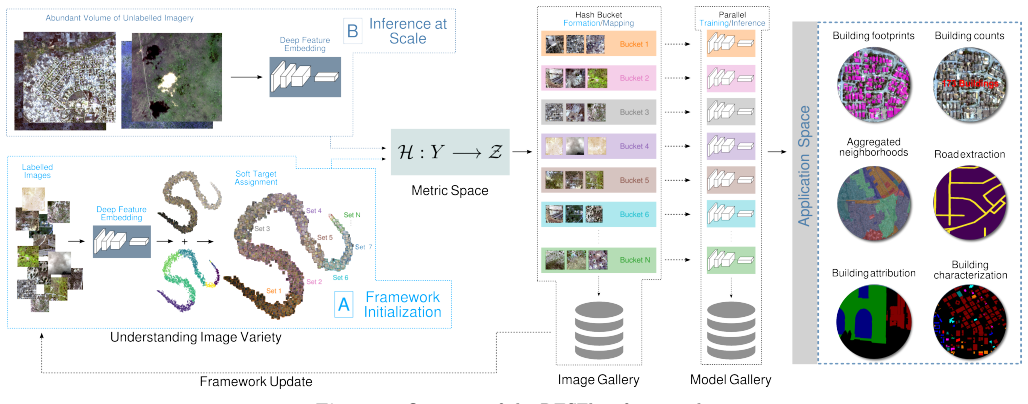
The load-bearing mechanism is the image-bucket abstraction built from a learned metric space. A convolutional hash-mapping network converts each image patch into a compact binary bitstring such that patches with similar spectral and semantic content land near each other in Hamming space; the bitstrings are grouped into buckets, and the centroid bitstring of each bucket doubles as the index for a dedicated model in the model gallery. This turns one monolithic inference job into many independent per-bucket jobs that Spark can schedule across GPUs, while a simple GPU ticketing system, tickets placed in a shared folder, one per physical GPU, prevents executors from over-subscribing a GPU. The same bucket structure also supports the three inference stages: deep feature extraction, deep metric mapping, and deep semantic segmentation.
What would settle it
A single check settles the central claim: time the same U-Net inference on one 40,000x35,000-pixel scene on one 16GB V100 GPU, and multiply 0.243 GB/sec by 86,400 seconds. If the baseline is under 35 minutes or the product is about 21,000 GB rather than 21,028 TB, the speedup and volume figures as stated do not hold.
Extended reading notes
Core claim
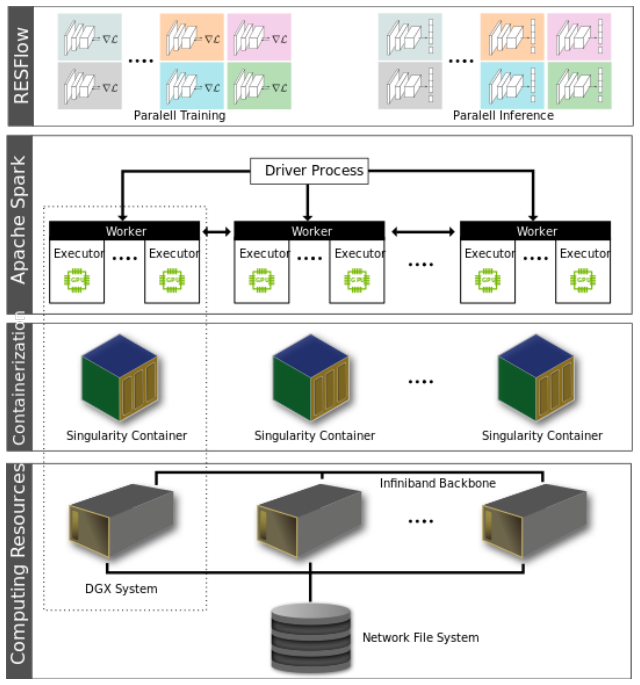
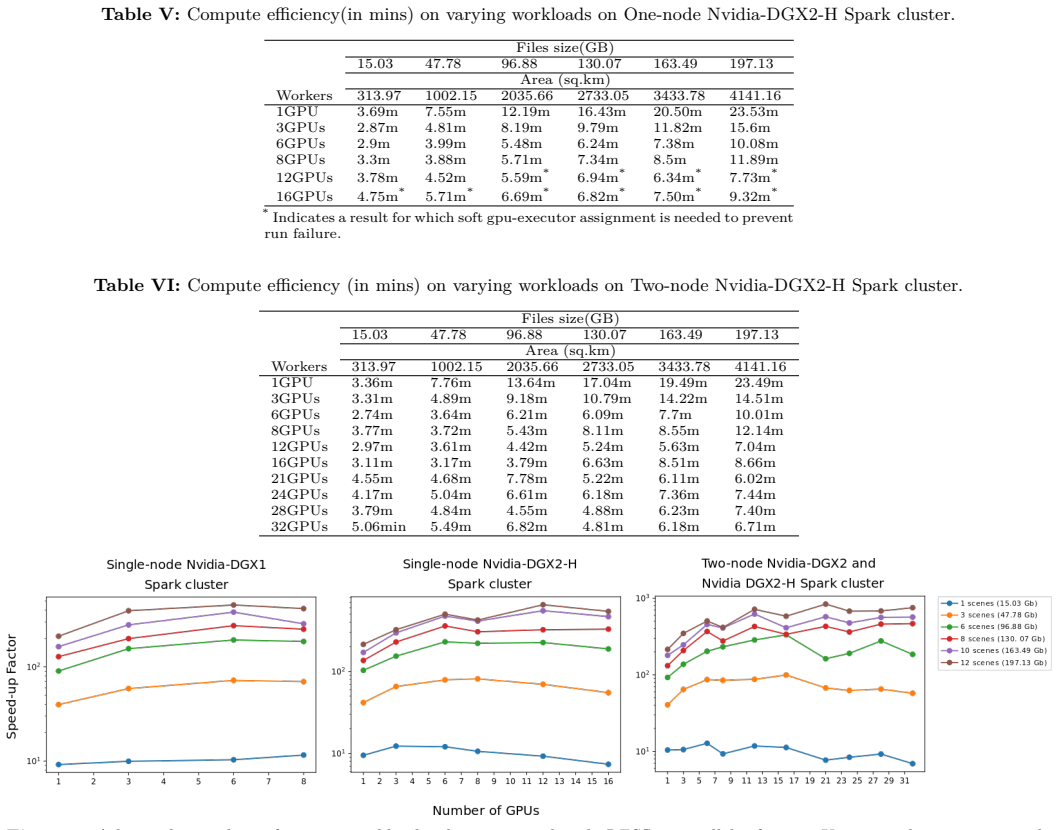
The central claim is that data partitioning, not just hardware parallelism, is what makes large-scale inference feasible. RESFlow maps every image patch into a learned metric space, clusters those embeddings, and uses a hash-mapping network to assign each patch to one of six buckets; each bucket gets its own trained segmentation model (ResNet50-FCN, U-Net, SegNet, or DeepLab) drawn from a model gallery. During inference, Spark distributes image tiles to the matching bucket model, and a file-folder ticket system soft-assigns GPUs to executors to prevent memory exhaustion. On held-out out-of-country regions, the per-bucket ensemble matches a monolithic model within roughly 0.01-0.03 IoU on three of four test regions, while on New Mexico it is worse (0.62 vs 0.72 IoU). The paper reports 9x-750x speedups over a 35-minute-per-scene serial baseline, culminating in a 21-hour run over 14 TB covering New Mexico.
Load-bearing premise
The reported speedups depend on a single serial baseline of 35 minutes per large satellite image scene on one 16GB GPU, described in one sentence with no implementation details; if a well-tuned single-GPU pipeline would run faster, the speedup ratios and the 28-day-to-21-hour reduction lose their meaning.
Editorial extensions
If this is right
- If the reported throughput holds, a country-scale building-footprint map of about 780,000 sq km can be produced in roughly 21 hours on a two-node DGX2 cluster, instead of about 28 days on a serial single-GPU pipeline.
- Partitioning by spectral and semantic similarity means models trained on limited labeled data from a few countries can be reused on out-of-sample regions with only small accuracy loss, suggesting that labor-intensive labeling effort can be concentrated by bucket rather than repeated for every new geography.
- The three-stage pipeline, feature extraction, metric hashing, and segmentation, makes the same framework directly applicable to other dense labeling tasks such as land cover, settlement, or damage mapping, since the modules are application-agnostic.
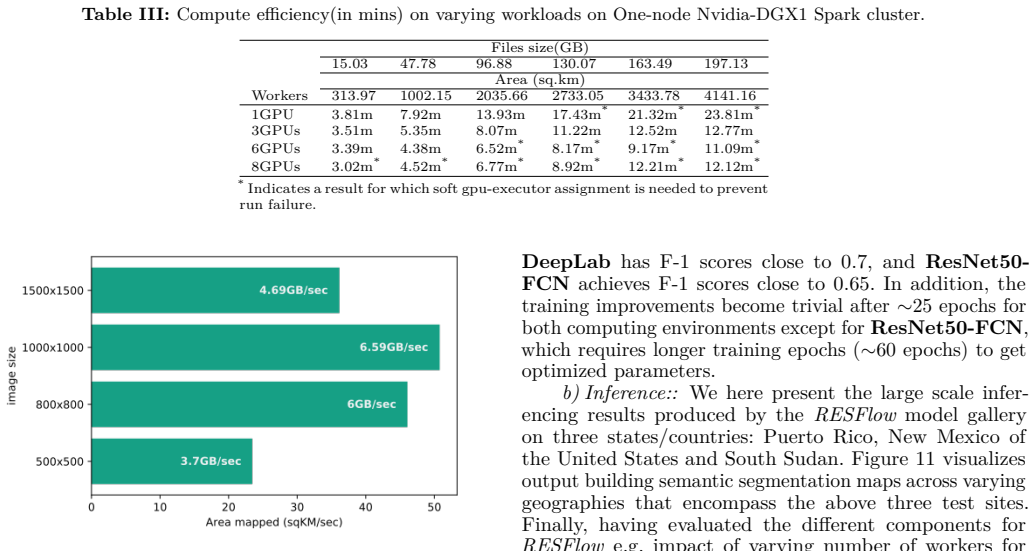
- Speedups are not linear in GPU count: mask reconstruction by a single worker and NFS I/O become the bottleneck beyond about 6-12 GPUs, so the practical scaling ceiling is set by orchestration, not by the added GPUs.
Reading between the lines
- A natural extension the paper does not demonstrate is an active-learning loop: buckets whose held-out performance lags, New Mexico is the example here, could be identified by IoU, and new labeled samples drawn only from those buckets to fine-tune the corresponding gallery model rather than retraining globally.
- If the bucket abstraction is as reusable as claimed, it should support temporal change detection by comparing per-bucket outputs across revisits of the same geography; the paper lists change detection as a possible application but does not test it.
- The single-worker mask merge bottleneck suggests a concrete design change, distributed merging or overlapping tile seams, that would plausibly push the speedup curve closer to linear with GPU count; this is a testable modification, not a claim the paper makes.
Signed reviews
Editorial analysis
A structured set of objections, weighed in public.
Referee Report
Summary. The paper presents RESFlow, a distributed inference framework for satellite imagery pixel labeling that combines Apache Spark with deep learning models partitioned by spectral/semantic clustering and deep hashing. The authors report speedups up to 750x over a serial single-GPU baseline, a daily throughput of 21,028 Terabytes, and a mapping rate of 5.245 sq.km/sec, and claim accuracy comparable to a monolithic model on held-out regions. The system design is described in detail, including a GPU ticketing mechanism and Spark RDDs for image paths, but the quantitative claims are undermined by arithmetic inconsistencies and an underspecified baseline.
Significance. If the reported performance numbers were correct, RESFlow would represent a significant engineering contribution to large-scale geospatial analytics, demonstrating how Spark and GPU clusters can be used for production inference workloads. The paper includes useful details such as system configurations, scaling experiments across DGX1 and DGX2, and tile-based inference with reconstruction. However, the internal contradictions in the headline speedup and throughput figures mean the paper's central quantitative claims cannot be accepted as stated.
major comments (6)
- [Abstract and Table VII] The abstract and conclusions state that the pipeline processes '21,028 Terrabytes' of imagery per day, but Table VII reports the daily total image data as 21,028 GB, which is approximately 21 TB, not 21,028 TB. This thousand-fold overstatement is a factor-of-1000 error in the central throughput claim.
- [Section IV.C and Tables V and VI] The text claims a 750x speedup for the 197.13 GB workload on 12 GPU-workers, but the stated serial baseline of 35 minutes per scene gives a serial time of 420 minutes for 12 scenes, and Table VI lists 7.04 minutes for that configuration, implying only about 60x. The same paragraph reports a 6.91x improvement for a single scene on 12 GPU-workers, whereas the runtimes in Table V (3.78 min) and Table VI (2.97 min) imply speedups of 9.3x and 11.8x. No derivation is provided for either the 750x or the 6.91x figure.
- [Section IV.A] The serial baseline of 35 minutes per 40,000×35,000 pixel scene on a single 16GB V100 GPU is described in one sentence, without any batching, tiling, framework, or I/O configuration details. Every speedup ratio in the paper is computed against this baseline, yet the baseline itself is not reproducible as described.
- [Section V.b and Table VII] The large-scale experiment states that 'the entire set of 1440 image scene completed in 21hrs,' while Table VII reports 80 images per second and 6,912,000 images per day. These figures cannot be reconciled without a conversion between scenes and the tiles used by the pipeline, and no such conversion is given, so the per-day workload extrapolation is not auditable.
- [Section III.B and Figure 4] The hash-mapping network is trained to reproduce the cluster assignments produced by agglomerative clustering and is then evaluated by its mAP in reconstructing those same cluster labels (98.3%). This is a self-consistency measure rather than an independent test of semantic partitioning; the paper should explicitly acknowledge this limitation or provide an external evaluation.
- [Section IV.C and Table IV] The assertion that RESFlow 'perform[s] very similarly to the Mono model for two of the three test regions' is contradicted by the data: RESFlow obtains lower IoU and F1 scores than Mono on all four held-out regions, and the New Mexico gap (IoU 0.62 vs. 0.72, F1 0.77 vs. 0.84) is substantial. The claimed accuracy advantage of the partitioned-model approach is therefore not demonstrated.
minor comments (5)
- [Abstract and throughout] The abstract contains the phrase 'shear volumes,' which should be 'sheer volumes,' and the term 'Terrabytes' is a misspelling of 'Terabytes' (used correctly elsewhere as 'TB').
- [Sections III.C, III.E, and V.b] The manuscript contains unresolved cross-references: 'Figure ??' appears in Sections III.C and III.E, and 'Figure II' in Section V.b should be replaced with the correct figure number.
- [Throughout] The paper uses inconsistent proper nouns, such as 'Nvidia' versus 'NVIDIA' and the ligature 'RESflow' versus 'RESFlow,' which should be normalized.
- [Figure 4 caption] The caption of Figure 4 mentions 'relative changes' but does not explain the color-coding scheme or what the percentages in parentheses represent, making the comparison between clusters and hash-buckets difficult to interpret.
- [Section IV.C] The text says 'The deep learning fully convolutional network of choice is the U-Net architecture' but later refers to the RESFlow quorum of four networks; the relationship between the U-Net speed tests and the RESFlow ensemble should be clarified.
Circularity Check
Hash-mapping validation is self-referential; core speedup and accuracy claims are independent.
-
self definitional
[Section III-B (Image-Bucket Assignment) and Figure 4 caption]
"The hash-mapping network is evaluated using the mean Average Precision (mAP) metric which assesses the average value of the maximum precision for different recall levels while reconstructing the structure of initial clusters. ... Hash-buckets are reconstructed with a validation mAP score of 98.3% with fewer image patches on the bottom row noted to have been placed in different buckets than their cluster of origin."
The soft-labels used to train the hash-mapping network are the agglomerative cluster assignments produced by the Clustering and Embedding module: the text says clustering provides 'the key soft-labels needed to learn the semantic structure,' and the hash-mapping network is then evaluated by how well it 'reconstructs' those same initial clusters. The reported 98.3% validation mAP is therefore a self-consistency score: a network trained to reproduce cluster labels will, by construction, score highly at reproducing them. It is not an independent test of whether the buckets capture semantic or spectral structure.
full rationale
The only substantive circularity I can identify is in the hash-bucket validation. The 98.3% mAP is computed as the agreement between the hash-mapping network's outputs and the agglomerative cluster labels that provided the network's training targets, making it a reconstruction or self-consistency measure rather than an independent evaluation. This does not affect the central claims about distributed inference throughput, which rest on measured execution times and a stated serial baseline, nor does it affect the held-out accuracy comparison between the RESFlow ensemble and a monolithic U-Net. The speedup arithmetic has apparent inconsistencies, but those are correctness or reproducibility concerns, not circularity. Because the self-referential validation appears only in one supporting component and the main comparative results are externally grounded, a moderate score of 3 is appropriate.
Assumptions & free parameters
free parameters (3)
- Number of buckets =
6
- Input tile size =
1000x1000x3 for peak throughput
- Batch size =
12, 8, 5, 2 for tile sizes 500, 800, 1000, 1500
assumptions (4)
- ad hoc to paper Serial baseline of 35 minutes per 40,000x35,000 scene is a representative single-GPU implementation
- domain assumption Partitioning image tiles by learned semantic binary codes yields homogeneous distributions that preserve or improve model accuracy
- domain assumption NFS path-based RDDs with double disk reads will still outperform in-memory image caching for the reported workloads
- domain assumption Apache Spark lazy evaluation prevents redundant computation in the three-stage pipeline
Cite this review
Pith. "Pith review of Apache Spark Accelerated Deep Learning Inference for Large Scale Satellite Image Analytics." pith.science (2026). https://pith.science/paper/XD45D6GK
@misc{pith2026190804383,
  author       = {Pith},
  title        = {Pith review of: Apache Spark Accelerated Deep Learning Inference for Large Scale Satellite Image Analytics},
  year         = {2026},
  howpublished = {\url{https://pith.science/paper/XD45D6GK}},
  note         = {Machine review of arXiv:1908.04383}
}
read the original abstract
The shear volumes of data generated from earth observation and remote sensing technologies continue to make major impact; leaping key geospatial applications into the dual data and compute intensive era. As a consequence, this rapid advancement poses new computational and data processing challenges. We implement a novel remote sensing data flow (RESFlow) for advanced machine learning and computing with massive amounts of remotely sensed imagery. The core contribution is partitioning massive amount of data based on the spectral and semantic characteristics for distributed imagery analysis. RESFlow takes advantage of both a unified analytics engine for large-scale data processing and the availability of modern computing hardware to harness the acceleration of deep learning inference on expansive remote sensing imagery. The framework incorporates a strategy to optimize resource utilization across multiple executors assigned to a single worker. We showcase its deployment across computationally and data-intensive on pixel-level labeling workloads. The pipeline invokes deep learning inference at three stages; during deep feature extraction, deep metric mapping, and deep semantic segmentation. The tasks impose compute intensive and GPU resource sharing challenges motivating for a parallelized pipeline for all execution steps. By taking advantage of Apache Spark, Nvidia DGX1, and DGX2 computing platforms, we demonstrate unprecedented compute speed-ups for deep learning inference on pixel labeling workloads; processing 21,028~Terrabytes of imagery data and delivering an output maps at area rate of 5.245sq.km/sec, amounting to 453,168 sq.km/day - reducing a 28 day workload to 21~hours.
Figures

Figures from the paper (8 more)





Reference graph
Works this paper leans on
-
[1]
Building Extraction at Scale using Convolutional Neural Network: Mapping of the United States
Hsiuhan Lexie Yang, Jiangye Yuan, Dalton Lunga, Melanie Laverdiere, Amy N. Rose, and Budhendra L. Bhaduri, “Building extraction at scale using convolutional neural network: Mapping of the united states,” CoRR, vol. abs/1805.08946, 2018
work page Pith review arXiv 2018
-
[2]
Large-scale damage detection using satellite imagery,
Lionel Gueguen and Raffay Hamid, “Large-scale damage detection using satellite imagery,” in The IEEE Conference on Computer Vision and Pattern Recognition (CVPR) , June 2015
work page 2015
-
[3]
Global-scale object detection using satellite imagery,
Stephen; Tabb Mark Hamid, Raffay; O’Hara, “Global-scale object detection using satellite imagery,” in International Archives of the Photogrammetry, Remote Sensing & Spatial Information Sciences, June 2014, vol. 40
work page 2014
-
[4]
Budhendra Bhaduri, Edward Bright, Phillip Coleman, and Marie L. Urban, “Landscan usa: a high-resolution geospatial and temporal modeling approach for population distribution and dynamics,” GeoJournal, vol. 69, no. 1, pp. 103–117, Jun 2007
work page 2007
-
[5]
Infrastructure Quality Assessment in Africa using Satellite Imagery and Deep Learning,
Barak Oshri, Annie Hu, Peter Adelson, Xiao Chen, Pascaline Dupas, Jeremy Weinstein, Marshall Burke, David Lobell, and Stefano Ermon, “Infrastructure Quality Assessment in Africa using Satellite Imagery and Deep Learning,” in Proceedings of the 24th ACM SIGKDD International Conference on Knowledge Discovery and Data Mining . 2018, vol. 18, p. 10, ACM
work page 2018
-
[6]
Adrian Albert, Jasleen Kaur, and Marta Gonzalez, “Using convolutional networks and satellite imagery to identify patterns in urban environments at a large scale,” in Proceedings of the 23rd ACM SIGKDD International Conference on Knowledge Discovery and Data Mining , 2017, pp. 1357–1366
work page 2017
-
[7]
“Apache hadoop,” http://hadoop.apache.org/docs/rl.2.1/hdfs design.html, Available
-
[8]
Remote sensing image segmentation based on hadoop cloud platform,
Fubin Cao Jie Li, Lingling Zhu, “Remote sensing image segmentation based on hadoop cloud platform,” 2018
work page 2018
Show all 36 references
-
[9]
High resolution satellite image processing using hadoop framework,
R. Rajak, D. Raveendran, M. C. Bh, and S. S. Medasani, “High resolution satellite image processing using hadoop framework,” in 2015 IEEE International Conference on Cloud Computing in Emerging Markets (CCEM) , Nov 2015, pp. 16–21
2015
-
[10]
Parallel k-means clustering of remote sensing images based on mapreduce,
Zhenhua Lv, Yingjie Hu, Haidong Zhong, Jianping Wu, Bo Li, and Hui Zhao, “Parallel k-means clustering of remote sensing images based on mapreduce,” in Web Information Systems and Mining , Fu Lee Wang, Zhiguo Gong, Xiangfeng Luo, and Jingsheng Lei, Eds., Berlin, Heidelberg, 201...
2010
-
[11]
Mapreduce: a flexible data processing tool,
Jeffrey Dean and Sanjay Ghemawat, “Mapreduce: a flexible data processing tool,” Commun. ACM, vol. 53, pp. 72–77, 2010
2010
-
[12]
A new approach for large-scale scene image retrieval based on improved parallel k-means algorithm in mapreduce environment,
Hao Shi Guohua Hu Jianfang Cao, Min Wang and Yun Tian, “A new approach for large-scale scene image retrieval based on improved parallel k-means algorithm in mapreduce environment,” Mathematical Problems in Engineering , vol. 2016
2016
-
[13]
In-memory parallel processing of massive remotely sensed data using an apache spark on hadoop yarn model,
W. Huang, L. Meng, D. Zhang, and W. Zhang, “In-memory parallel processing of massive remotely sensed data using an apache spark on hadoop yarn model,” IEEE Journal of Selected Topics in Applied Earth Observations and Remote Sensing , vol. 10, no. 1, pp. 3–19, Jan 2017
2017
-
[14]
Spark: Cluster computing with working sets,
Matei Zaharia, Mosharaf Chowdhury, Michael J. Franklin, Scott Shenker, and Ion Stoica, “Spark: Cluster computing with working sets,” in Proceedings of the 2Nd USENIX Conference on Hot Topics in Cloud Computing , Berkeley, CA, USA, 2010, HotCloud’10, pp. 10–10, USENIX Association
2010
-
[15]
Resilient distributed datasets: A fault-tolerant abstraction for in-memory cluster computing,
Matei Zaharia, Mosharaf Chowdhury, Tathagata Das, Ankur Dave, Justin Ma, Murphy McCauly, Michael J. Franklin, Scott Shenker, and Ion Stoica, “Resilient distributed datasets: A fault-tolerant abstraction for in-memory cluster computing,” in Presented as part of the 9th USENIX S...
2012
-
[16]
A model of parallel mosaicking for massive remote sensing images based on spark,
W. Jing, S. Huo, Q. Miao, and X. Chen, “A model of parallel mosaicking for massive remote sensing images based on spark,” IEEE Access, vol. 5, pp. 18229–18237, 2017
2017
-
[17]
A spark-based big data platform for massive remote sensing data processing,
Zhongyi Sun, Fengke Chen, Mingmin Chi, and Yangyong Zhu, “A spark-based big data platform for massive remote sensing data processing,” 08 2015, pp. 120–126
2015
-
[18]
Exploring flexible communications for streamlining dnn ensemble training pipelines,
Randall Pittman, Hui Guan, Xipeng Shen, Seung-Hwan Lim, and Robert M. Patton, “Exploring flexible communications for streamlining dnn ensemble training pipelines,” in Proceedings of the International Conference for High Performance Computing, Networking, Storage, and Analysis ,...
2018
-
[19]
Cosmoflow: Using deep learning to learn the universe at scale,
Amrita Mathuriya, Deborah Bard, Peter Mendygral, Lawrence Figure 11: Example building footprint mapping results for the RESFlow models on held-out New Mexico, Puerto Rico and South Sudan data. Owing to the varying image characteristics and geographies image tiles clipped from ...
2018
-
[20]
Exascale deep learning for climate analytics,
Thorsten Kurth, Sean Treichler, Joshua Romero, Mayur Mudigonda, Nathan Luehr, Everett Phillips, Ankur Mahesh, Michael Matheson, Jack Deslippe, Massimiliano Fatica, Prabhat, and Michael Houston, “Exascale deep learning for climate analytics,” in Proceedings of the International...
2018
-
[21]
An efficient and scalable framework for processing remotely sensed big data in cloud computing environments,
J. Sun, Y. Zhang, Z. Wu, Y. Zhu, X. Yin, Z. Ding, Z. Wei, J. Plaza, and A. Plaza, “An efficient and scalable framework for processing remotely sensed big data in cloud computing environments,” IEEE Transactions on Geoscience and Remote Sensing, pp. 1–15, 2019
2019
-
[22]
Open sourcing tensorflowonspark: Distributed deep learning on big- data clusters,
Lee Yang, Jun Shi, Bobbie Chern, and Andy Feng, “Open sourcing tensorflowonspark: Distributed deep learning on big- data clusters,” 2017
2017
-
[23]
Semantic image segmen- tation with deep convolutional nets and fully connected crfs,
Liang-Chieh Chen, George Papandreou, Iasonas Kokkinos, Kevin Murphy, and Alan L. Yuille, “Semantic image segmen- tation with deep convolutional nets and fully connected crfs,” in 3rd International Conference on Learning Representations, ICLR 2015, San Diego, CA, USA, May 7-9, ...
2015
-
[24]
U-net: Convolutional networks for biomedical image segmentation,
Olaf Ronneberger, Philipp Fischer, and Thomas Brox, “U-net: Convolutional networks for biomedical image segmentation,” in International Conference on Medical image computing and computer-assisted intervention. Springer, 2015, pp. 234–241
2015
-
[26]
Large-scale remote sensing image retrieval by deep hashing neural networks,
Y. Li, Y. Zhang, X. Huang, H. Zhu, and J. Ma, “Large-scale remote sensing image retrieval by deep hashing neural networks,” IEEE Transactions on Geoscience and Remote Sensing , vol. 56, no. 2, pp. 950–965, Feb 2018
2018
-
[27]
Deep metric and hash-code learning for content-based retrieval of remote sensing images,
S. Roy, E. Sangineto, B. Demir, and N. Sebe, “Deep metric and hash-code learning for content-based retrieval of remote sensing images,” in IGARSS 2018 - 2018 IEEE International Geoscience and Remote Sensing Symposium , July 2018, pp. 4539–4542
2018
-
[28]
ImageNet: A Large-Scale Hierarchical Image Database,
J. Deng, W. Dong, R. Socher, L.-J. Li, K. Li, and L. Fei-Fei, “ImageNet: A Large-Scale Hierarchical Image Database,” in CVPR09, 2009
2009
-
[29]
Active learning for designing detectors for infrequently occurring objects in wide-area satellite imagery,
Tanmay Prakash and Avinash C. Kak, “Active learning for designing detectors for infrequently occurring objects in wide-area satellite imagery,” Computer Vision and Image Understanding, vol. 170, pp. 92 – 108, 2018
2018
-
[30]
Tensorframes on google’s tensorflow and apache spark,
T Hunter, “Tensorframes on google’s tensorflow and apache spark,” Bay Area Spark Meetup , 2016
2016
-
[31]
Tensorflow: A system for large-scale machine learning,
Mart´ ın Abadi, Paul Barham, Jianmin Chen, Zhifeng Chen, Andy Davis, Jeffrey Dean, Matthieu Devin, Sanjay Ghemawat, Geoffrey Irving, Michael Isard, et al., “Tensorflow: A system for large-scale machine learning,” in 12th {USENIX} Symposium on Operating Systems Design and Implemen...
2016
-
[32]
Automatic differentiation in pytorch,
Adam Paszke, Sam Gross, Soumith Chintala, Gregory Chanan, Edward Yang, Zachary DeVito, Zeming Lin, Alban Desmaison, Luca Antiga, and Adam Lerer, “Automatic differentiation in pytorch,” 2017
2017
-
[33]
GDAL/OGR contributors, GDAL/OGR Geospatial Data Ab- straction software Library, Open Source Geospatial Foundation, 2018
2018
-
[34]
Deep residual learning for image recognition,
Kaiming He, Xiangyu Zhang, Shaoqing Ren, and Jian Sun, “Deep residual learning for image recognition,” in Proceedings of the IEEE conference on computer vision and pattern recognition , 2016, pp. 770–778
2016
-
[35]
Segnet: A deep convolutional encoder-decoder architecture for image segmentation,
V. Badrinarayanan, A. Kendall, and R. Cipolla, “Segnet: A deep convolutional encoder-decoder architecture for image segmentation,” IEEE Transactions on Pattern Analysis and Machine Intelligence , vol. 39, no. 12, pp. 2481–2495, Dec 2017
2017
-
[36]
Deeplab: Semantic image segmentation with deep convolutional nets, atrous convolution, and fully connected crfs,
Liang-Chieh Chen, George Papandreou, Iasonas Kokkinos, Kevin Murphy, and Alan L Yuille, “Deeplab: Semantic image segmentation with deep convolutional nets, atrous convolution, and fully connected crfs,” IEEE transactions on pattern analysis and machine intelligence , vol. 40, ...
2018
-
[37]
DeepGlobe 2018: A Challenge to Parse the Earth through Satellite Images,
Ilke Demir, Krzysztof Koperski, David Lindenbaum, Guan Pang, Jing Huang, Saikat Basu, Forest Hughes, Devis Tuia, and Ramesh Raskar, “DeepGlobe 2018: A Challenge to Parse the Earth through Satellite Images,” in CVPR - DeepGlobe 2018 Challenge Workshop , 2018
2018
Reviewed August 14, 2026 · model on record in the stance chip above.
Discussion (0). Continue with ORCID to comment.