REVIEW 4 major objections 5 minor 32 references
Bose-Einstein condensation in relativistic plasma
T0 review · 4 major / 5 minor · reviewed 2026-08-14 · deepseek-v4-flash
Pith's one-line read Plasma at billions of kelvin can host a transient Bose-Einstein condensate of photons, the paper argues from first-principles kinetic simulations.
desk verdict A real kinetic simulation with a nontrivial transient photon excess, but the 'BEC' label rests on a nonstandard definition and an unresolved ground-state mode. read the letter →
The pith
A machine-rendered reading of the paper's core claim, the machinery that carries it, and where it could break.
The reading
What carries the argument
The machinery is the relativistic Boltzmann equation with Uehling-Uhlenbeck collision integrals, eq. (4), solved numerically with a finite-difference phase-space grid and QED matrix elements for all binary and triple reactions. The governing criterion is the photon-number-over-equilibrium condition, eq. (3): a condensate can form only if the photon number density exceeds the Planck-equilibrium value at the kinetic temperature. The separation of timescales between binary interactions, which conserve photon number and establish kinetic equilibrium, and triple interactions, which change photon number and drive thermal equilibrium, is what makes the transient condensate possible; the excess appears while kinetic equilibrium holds and disappears once triple reactions complete thermalization.
What would settle it
Run the same kinetic calculation with a grid that resolves photon energies below the plasma frequency, where the effective photon mass matters, or with an explicit low-energy boundary: if the intermediate-energy excess over Planck vanishes or fails to correspond to accumulation in the lowest resolved states, the claimed transient condensate is a numerical artifact. In the laboratory, a time-resolved spectrum of an X-ray-laser-heated dense plasma with initial photon number exceeding the equilibrium value would settle it: no excess above the critical energy means the claim fails.
Extended reading notes
Core claim
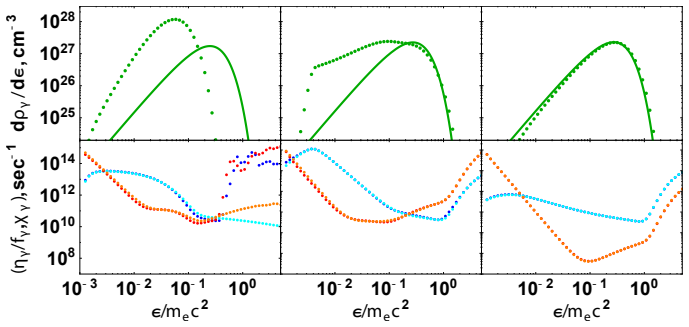
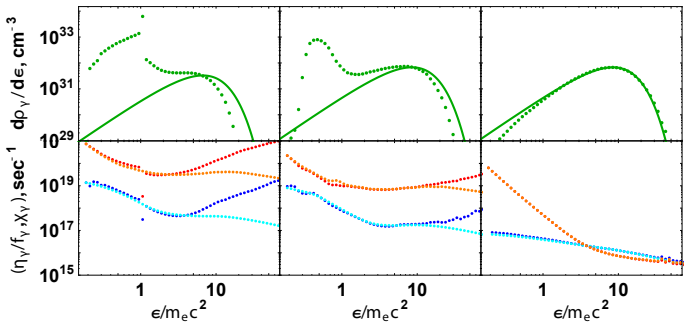
The paper's central claim is that Bose-Einstein condensation of photons appears as a transient state in relativistic plasma, provided three conditions hold at the initial time: the photon distribution is not broader than a Wien spectrum, its peak lies above the critical energy below which triple processes dominate over binary ones, and the photon number density exceeds the equilibrium value $n_\gamma > \frac{2\zeta(3)}{\pi^2}(\frac{\hbar}{mc})^{-3}(\frac{kT_k}{m_e c^2})^3$ from eq. (3). Solving the full set of relativistic Boltzmann equations with Uehling-Uhlenbeck collision integrals and all binary and triple QED processes, the authors see the photon spectrum relax first to kinetic equilibrium, then develop a clear excess over the Planck spectrum in the energy band between the critical energy and the spectral peak; this excess is the condensate. In the nonrelativistic example ($\theta \simeq 0.1$) the excess is a power law and survives from about $10^{-11}$ s until thermal equilibrium at about $10^{-8}$ s; in the relativistic example ($\theta = 3$) it is a bump, and it appears even though triple interactions are faster than binary ones. The authors also show that the previously proposed hot-photon/cold-electron cooling scenario does not condense, because triple reactions remove the surplus photons. Because the numerical grid treats photons as massless, the condensate is identified spectrally as this excess rather than as resolved occupation of a lowest-energy level.
Load-bearing premise
Everything rests on whether the intermediate-energy excess over the Planck spectrum really is the photon condensate, given that the numerical grid never resolves the lowest-energy photon states or the plasma's effective photon mass.
Editorial extensions
If this is right
- The necessary conditions for photon BEC are concrete: initial photon spectrum not broader than Wien, peak above the critical energy, and photon number above eq. (3); broader spectra such as a Planck distribution fail because bremsstrahlung removes low-energy photons too fast.
- The condensate is transient but long-lived relative to kinetic equilibration: in the $\theta \simeq 0.1$ example it persists from about $10^{-11}$ s to about $10^{-8}$ s, outliving the kinetic timescale by orders of magnitude.
- The hot-photon/cold-electron cooling scenario proposed in earlier work does not produce condensation once triple reactions are treated correctly; this corrects the earlier expectation.
- At relativistic temperatures, condensation survives even though triple interactions dominate over binary ones, appearing as a bump excess over the Planck spectrum.
- Observable targets follow: time-resolved gamma-ray burst spectra showing cutoff power laws, and X-ray laser pulses interacting with dense plasma targets, are proposed as places to look for the excess.
Reading between the lines
- A natural extension of the number-excess criterion: condensation should occur in any optically thick photon gas whose photon number temporarily exceeds its thermal value, including laser-generated pair plasmas at MeV energies; this is not simulated in the paper but follows directly from eq. (3).
- The spectral-excess identification could be tested by adding a low-energy grid cutoff at the plasma frequency; if a resolved ground-state occupation develops together with the excess, the interpretation would be confirmed, while disappearance of the excess would point to a grid artifact.
- For astrophysical applications, the homogeneous assumption ignores expansion losses; whether a fireball's expansion destroys the excess before triple reactions do is an open question the paper leaves implicit.
- An experimental handle suggested by the conditions: tune the initial photon number across the critical value eq. (3) in a laser-plasma experiment and look for the excess to switch on; the sharp threshold would be a decisive signature.
Signed reviews
Editorial analysis
A structured set of objections, weighed in public.
Referee Report
Summary. The paper claims a first-principles demonstration that, for suitable initial conditions, an optically thick non-equilibrium electron-positron-photon plasma at relativistic temperatures undergoes transient Bose-Einstein condensation of photons. The authors solve relativistic Boltzmann equations with Uehling-Uhlenbeck collision integrals and published QED transition rates, and identify condensation as an excess of photons over the Planck spectrum that appears after kinetic equilibrium is established and disappears when triple interactions achieve thermal balance. They report such an excess for a nonrelativistic example (final temperature θ ≈ 0.1) and a relativistic example (θ = 3), propose necessary conditions involving the initial photon spectrum and number density, and discuss observational analogues in gamma-ray bursts and possible laboratory experiments with X-ray lasers.
Significance. If the central claim is correct, the paper would substantially extend the known regime of Bose-Einstein condensation from cold atomic gases or microcavity photons to relativistic plasmas at temperatures of billions of kelvin, and would provide a concrete kinetic-theory mechanism based on QED rates rather than on a simplified model. The numerical machinery, with full binary and triple interactions and quantum statistics, is a strength of the paper, as is the explicit use of independently published transition rates so that the result is not produced by a fit. The proposed observational connection to gamma-ray burst spectra is suggestive and falsifiable. The significance is therefore potentially high, but it is conditional on whether the simulated spectral excess is actually the signature of condensation rather than a non-equilibrium pile-up.
major comments (4)
- [Section 4] The paper explicitly states: 'Due to a finite numerical resolution, the effective photon mass in plasma [18] always turns out to be outside our grid, therefore we consider photons as massless particles.' This is a load-bearing limitation. Bose-Einstein condensation is, by definition, macroscopic occupation of the lowest-energy single-particle state. With massless photons and a grid that excludes the plasma-frequency mode, the Boltzmann scheme contains no discrete low-energy mode that can accommodate a condensate, and no condensate amplitude is included. The spectral excess shown in Figs. 2 and 3 is therefore, at face value, a non-equilibrium feature of a continuum spectrum, which could equally be a transient overpopulation with negative or near-zero chemical potential, or the result of low-energy losses in triple interactions. The Conclusions define the condensate as 'an excess formed in the energy range above the critical energy ... and below the peak of the spectrum,' which is not the same as occupation of the lowest mode. To support the headline claim, the authors must either resolve the effective photon mass and the corresponding ground-state mode, include an explicit condensate amplitude, or provide a concrete diagnostic that distinguishes the observed excess from a pre-condensation transient or a spectral bump.
- [Conclusions] The 'necessary conditions' for condensation are stated as general results ('initial distribution of photons not broader than Wien spectrum with the peak of the distribution located above the critical energy') but are supported only by a small number of numerical examples described in Section 4, with no derivation and no systematic parameter scan. No quantitative definition of 'not broader than Wien' is given, and no exploration of the boundary of the claimed regime is reported. The manuscript should either qualify these as observed sufficient conditions or provide a more systematic study, for example by varying the initial spectral width, peak position, and degeneracy factor across a grid of cases and stating where condensation does and does not occur.
- [Section 4] The paper reports a single grid resolution of 60 energy and 24 angular intervals and states that small deviations from the Planck spectrum in the final state are 'within the numerical accuracy obtained on the grid,' but no convergence test, grid-refinement study, or error estimate is provided. Since the central claim concerns a spectral excess whose magnitude and location are the main evidence for condensation, convergence under grid refinement is essential. The authors should show that the excess in the middle panels of Figs. 2 and 3 is independent of the number of energy and angular grid points, and that the final-state deviations decrease with resolution.
- [Section 4, relativistic case] The paper notes that for the relativistic case (θ = 3), triple interactions are faster than binary ones, citing ref. [23], so kinetic equilibrium need not be established before thermalization. This appears to conflict with the mechanism described in Section 2, where BEC is associated with a metastable kinetic equilibrium with nonzero photon chemical potential. The relativistic excess in Fig. 3 therefore lacks the theoretical underpinning given for the nonrelativistic case. The authors should explain how a condensate can form without the binary-interaction-dominated kinetic equilibrium phase, or provide a separate mechanism for the relativistic case.
minor comments (5)
- [Abstract] The phrase 'demonstrate out of first principles' should be 'demonstrate from first principles'.
- [Section 2, after Eq. (3)] The text says 'if the initial number density of photons nγ exceeds the one given by eq. (1)', but Eq. (1) is a distribution function, not a number density. This should be rephrased to refer to the number density obtained by integrating Eq. (1) with zero photon chemical potential.
- [Section 4] The description of the numerical setup does not state the energy grid boundaries or the spacing law beyond 'logarithmic and homogeneous,' so it is impossible to assess how many low-energy modes are resolved and whether the plasma-frequency scale is truly far outside the grid. Adding a short grid description, including minimum and maximum energy, would clarify the extent of the limitation.
- [Section 4] The sentence 'the system loose memory of initial distribution' contains a typo: 'loose' should be 'lose'.
- [Section 4] Reference [32] is cited as 'in preparation' in support of the statement that the Zeldovich-Levich initial conditions do not lead to condensation. Unpublished work should not be used as primary support for a key negative result; the authors should either include the relevant data in this paper or cite a published source.
Circularity Check
Simulation is not fitted, but the BEC claim is partly definitional: the condensate is identified with the simulated Planck excess, and the grid excludes the photon mass mode.
-
self definitional
[Section 1 (Introduction) and Section 4 (Numerical results), around Eqs. (1)-(3) and Fig. 2]
"Unlike ideal Bose gases, BEC manifests itself as an excess of photons over the Planck distribution [15], which is only possible at intermediate energies: between the spectral peak and the critical energy, below which absorption dominates. ... This excess is indeed visible in the middle panel of Fig. 2."
The paper's operational definition of photon BEC in plasma is precisely the intermediate-energy excess over the Planck spectrum (following [15]), and the numerical evidence offered for condensation is that same excess. The conclusion 'BEC occurs' therefore restates 'the simulated spectrum has the excess that the paper defines as BEC,' rather than demonstrating macroscopic occupation of a resolved lowest-energy photon mode. This is a mild definitional circularity in the identification of the phenomenon; the underlying kinetic simulation is a genuine first-principles output and is not fitted to produce the excess.
full rationale
The derivation chain is otherwise self-contained: the Uehling-Uhlenbeck equations (4)-(9) are evolved with standard QED matrix elements, and the condensation criterion eq. (3) is the textbook Bose-Einstein critical number, not an output of the code. Refs. [21], [23], [30] are the authors' own code and prior rate calculations, but they are methodological self-citations rather than load-bearing proofs: the QED rates come from external sources ([26]-[29]), and the central result is a numerical solution, not a theorem imported from those papers. The one circular element is the label: the paper adopts [15]'s identification of BEC with a Planck-spectrum excess and then reports that excess as the demonstration. Section 4 openly states the effective photon mass is outside the grid ('Due to a finite numerical resolution, the effective photon mass in plasma [18] always turns out to be outside our grid, therefore we consider photons as massless particles'), so the excess cannot be tied to a resolved condensate mode; this is a correctness limitation, not a circularity, but it reinforces why the definitional identification matters. Overall the numerical derivation is not equivalent to its inputs, hence low score.
Assumptions & free parameters
free parameters (1)
- Initial photon overpopulation factor =
3, 5, 7, 10 times the equilibrium value in the degeneracy scan
assumptions (4)
- ad hoc to paper Photons are treated as massless and the plasma effective photon mass lies outside the numerical grid.
- domain assumption The relativistic Boltzmann equations with Uehling-Uhlenbeck collision integrals and QED matrix elements completely describe relaxation of the electron-positron-photon plasma.
- domain assumption Pairs reach Fermi-Dirac form quickly via Coulomb collisions, so photons scatter on Maxwellian electrons during the relevant evolution.
- ad hoc to paper The numerical grid with 60 energy and 24 angular intervals resolves the condensation excess.
Cite this review
Pith. "Pith review of Bose-Einstein condensation in relativistic plasma." pith.science (2026). https://pith.science/paper/6YFSUN3E
@misc{pith2026190804402,
  author       = {Pith},
  title        = {Pith review of: Bose-Einstein condensation in relativistic plasma},
  year         = {2026},
  howpublished = {\url{https://pith.science/paper/6YFSUN3E}},
  note         = {Machine review of arXiv:1908.04402}
}
read the original abstract
The phenomenon of Bose-Einstein condensation is traditionally associated with and experimentally verified for low temperatures: either of nano-Kelvin scale for alkali atoms [1-3] or room temperatures for quasi-particles [4,5] or photons in two dimensions [6]. Here we demonstrate out of first principles that for certain initial conditions non-equilibrium plasma at relativistic temperatures of billions of Kelvin undergoes condensation, predicted by Zeldovich and Levich in their seminal work [7]. We determine the necessary conditions for the onset of condensation and discuss the possibilities to observe such a phenomenon in laboratory and astrophysical conditions.
Figures

Reference graph
Works this paper leans on
-
[32]
M. A. Prakapenia and G. V. Vereshchagin, (in preparation). 12
-
[18]
J. T. Mendon¸ ca and H. Ter¸ cas, Phys. Rev. A95, 063611 (2017)
work page 2017
-
[23]
M. A. Prakapenia, I. A. Siutsou, and G. V. Vereshchagin, Physics Letters A 383, 306 (2019)
work page 2019
-
[1]
M. H. Anderson, J. R. Ensher, M. R. Matthews, C. E. Wieman, and E. A. Cornell, Science 269, 198 (1995)
1995
-
[2]
C. C. Bradley, C. A. Sackett, J. J. Tollett, and R. G. Hulet, Physical Review Letters 75, 1687 (1995)
work page 1995
-
[3]
K. B. Davis et al., Physical Review Letters 75, 3969 (1995)
work page 1995
-
[4]
H. Deng, G. Weihs, C. Santori, J. Bloch, and Y. Yamamoto, Science 298, 199 (2002)
work page 2002
-
[5]
S. O. Demokritov et al., Nature 443, 430 (2006)
work page 2006
Show all 32 references
-
[6]
Klaers, J
J. Klaers, J. Schmitt, F. Vewinger, and M. Weitz, Nature 468, 545 (2010)
2010
-
[7]
Y. B. Zeldovich and E. V. Levich, Soviet Journal of Experimental and Theoretical Physics 28, 1287 (1969)
1969
-
[8]
Bose, Zeitschrift fur Physik 26, 178 (1924)
S. Bose, Zeitschrift fur Physik 26, 178 (1924)
1924
-
[9]
Einstein, Sitzungber
A. Einstein, Sitzungber. Kgl. Preuss. Akad. Wiss. , 261 (1924)
1924
-
[10]
Einstein, Sitzungber
A. Einstein, Sitzungber. Kgl. Preuss. Akad. Wiss. , 3 (1925). 10
1925
-
[11]
L. D. Landau and E. M. Lifshitz, Statistical physics. Pt.1, Pt.2 , Oxford: Pergamon Press, 1980
1980
-
[12]
C. J. Pethick and H. Smith, Bose-Einstein Condensation in Dilute Gases , Cambridge University Press, 2008
2008
-
[13]
Klaers, Journal of Physics B Atomic Molecular Physics 47, 243001 (2014)
J. Klaers, Journal of Physics B Atomic Molecular Physics 47, 243001 (2014)
2014
-
[14]
A. S. Kompaneets, Soviet Journal of Experimental and Theoretical Physics 4, 730 (1956)
1956
-
[15]
E. E. M¨ uller, Physica A Statistical Mechanics and its Applications 139, 165 (1986)
1986
-
[16]
Y. B. Zeldovich and R. A. Sunyaev, Ap&SS 4, 301 (1969)
1969
-
[17]
R. A. Sunyaev and Y. B. Zeldovich, Ap&SS 7, 3 (1970)
1970
-
[19]
Kruchkov and Y
A. Kruchkov and Y. Slyusarenko, Phys. Rev. A 88, 013615 (2013)
2013
-
[20]
Mati, arXiv:1902.07998 , arXiv:1902.07998 (2019)
P. Mati, arXiv:1902.07998 , arXiv:1902.07998 (2019)
2019 arXiv
-
[21]
A. G. Aksenov, R. Ruffini, and G. V. Vereshchagin, Phys. Rev. Lett. 99, 125003 (2007)
2007
-
[22]
A. G. Aksenov, R. Ruffini, and G. V. Vereshchagin, Phys. Rev. D 79, 043008 (2009)
2009
-
[24]
A. G. Aksenov, R. Ruffini, and G. V. Vereshchagin, Phys. Rev. E81, 046401 (2010)
2010
-
[25]
G. V. Vereshchagin and A. G. Aksenov, Relativistic Kinetic Theory, Cam- bridge University Press, 2017
2017
-
[26]
V. B. Berestetskii, E. M. Lifshitz, and V. B. Pitaevskii, Quantum Electro- dynamics, Elsevier, 1982
1982
-
[27]
Mandl and T
F. Mandl and T. H. R. Skyrme, Proceedings of the Royal Society of London Series A 215, 497 (1952)
1952
-
[28]
Haug and W
E. Haug and W. Nakel, The Elementary Process of Bremsstrahlung, World Scientific Publishing Co, 2004
2004
-
[29]
J. M. Jauch and F. Rohrlich, The Theory of Photons and Electrons , Springer-Verlag, 1976. 11
1976
-
[30]
M. A. Prakapenia, I. A. Siutsou, and G. V. Vereshchagin, Journal of Com- putational Physics 373, 533 (2018)
2018
-
[31]
Hall and J
G. Hall and J. M. Watt, Modern Numerical Methods for Ordinary Differ- ential Equations, New York, Oxford University Press, 1976
1976
Reviewed August 14, 2026 · model on record in the stance chip above.
Discussion (0). Continue with ORCID to comment.