REVIEW 4 major objections 5 minor 7 references
Gravitational Radiation from Binaries: A Pedagogical Introduction
T0 review · 4 major / 5 minor · reviewed 2026-08-14 · deepseek-v4-flash
Pith's one-line read An effective-potential expansion near the ISCO, joined numerically to the adiabatic inspiral, gives the gravitational-wave frequency, number of cycles, and signal-to-noise ratio for the transition to plunge in extreme-mass-ratio binaries.
desk verdict A mostly faithful review of Ori-Thorne/Sundararajan wrapped around a routine RN extension whose table errors and quadrupole-level fluxes undercut the abstract's claims—useful as a teaching draft, not as research. read the letter →
The pith
A machine-rendered reading of the paper's core claim, the machinery that carries it, and where it could break.
The reading
What carries the argument
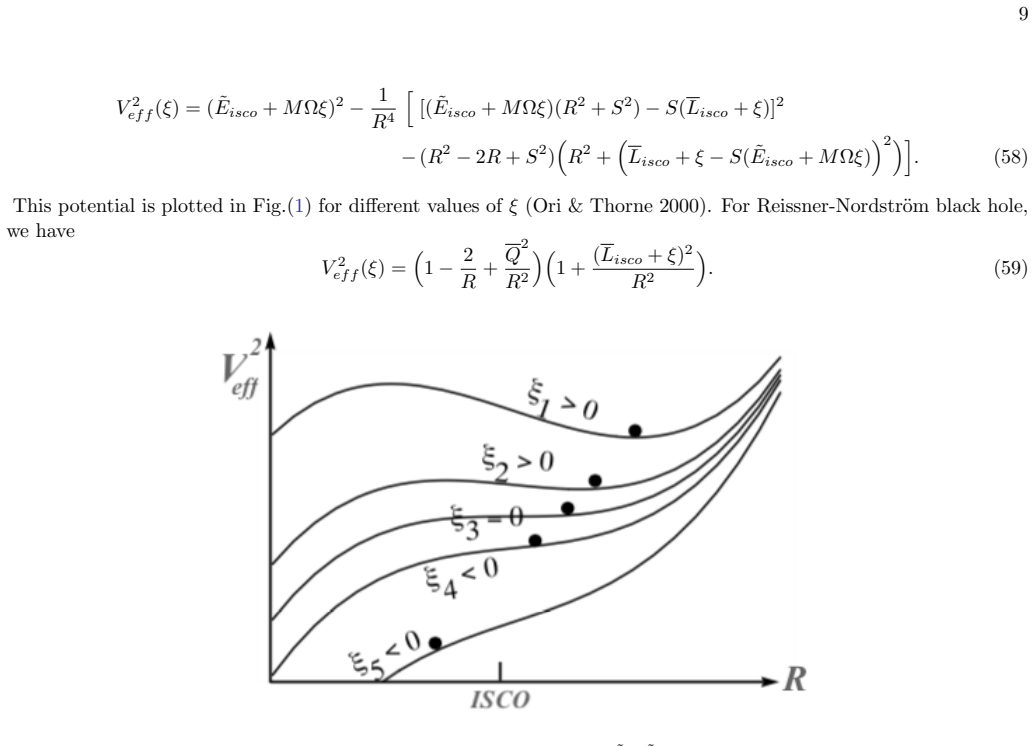
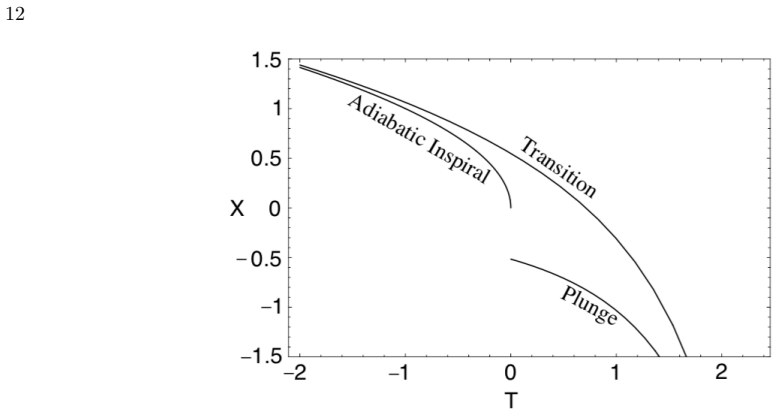
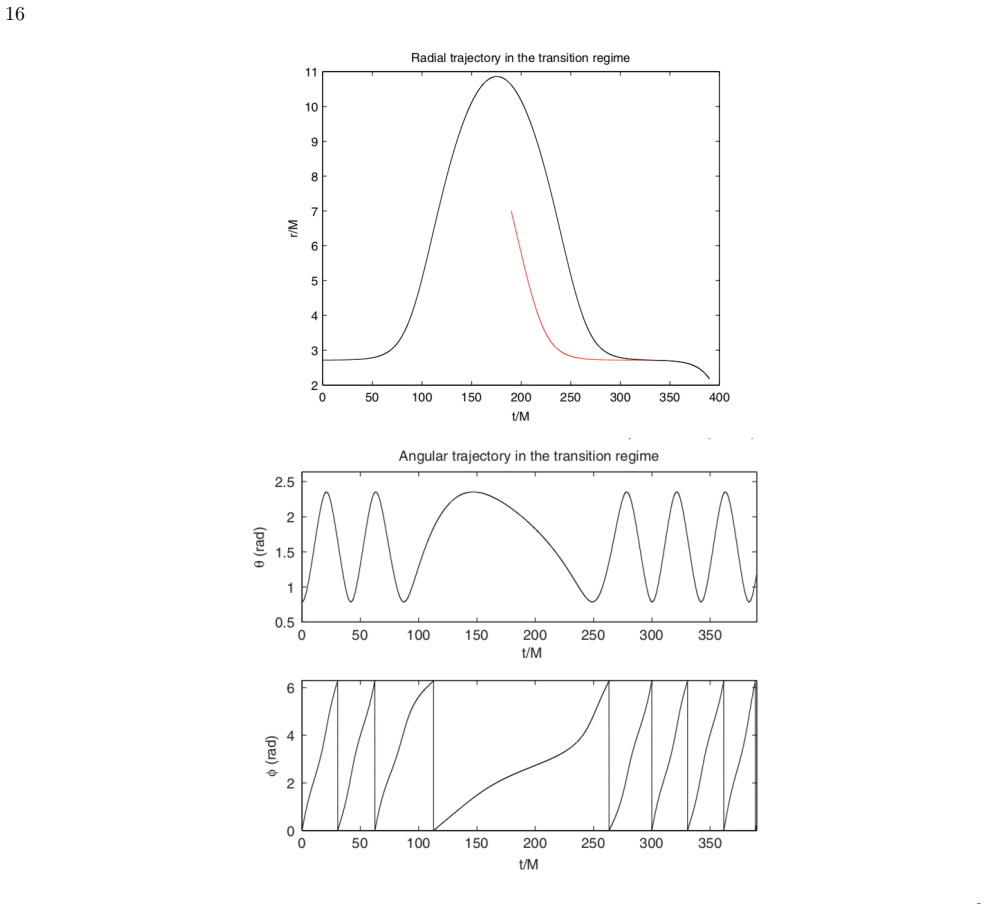
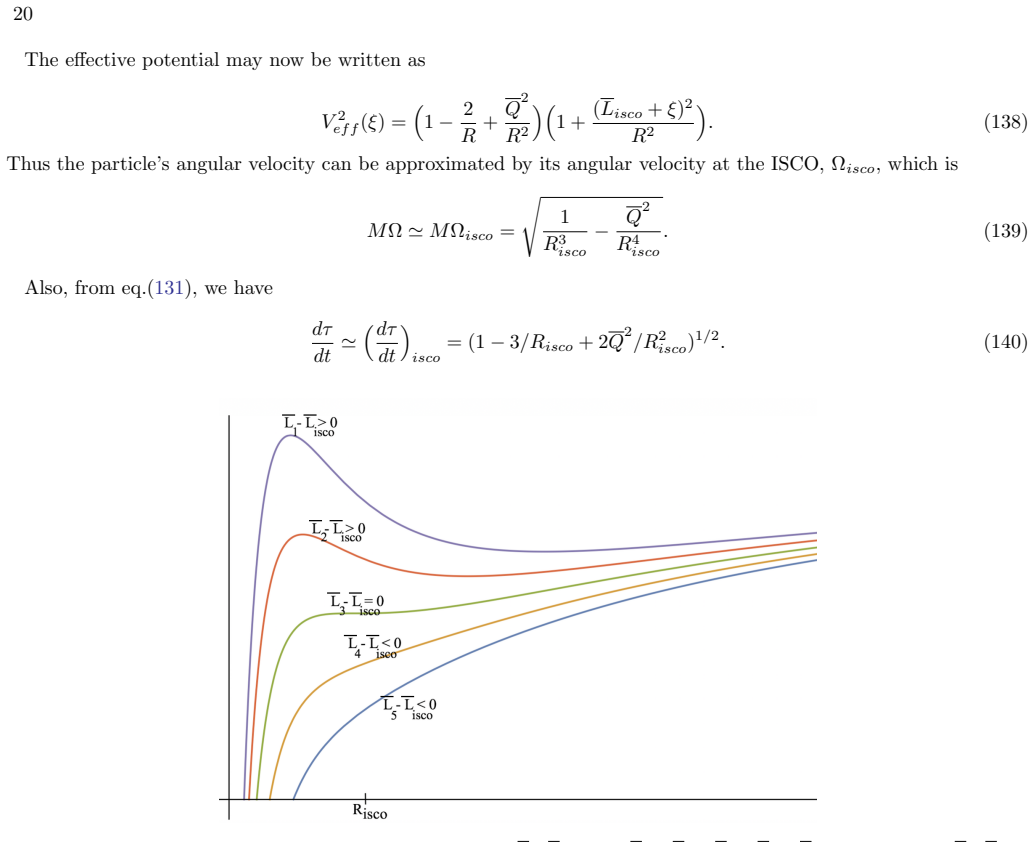
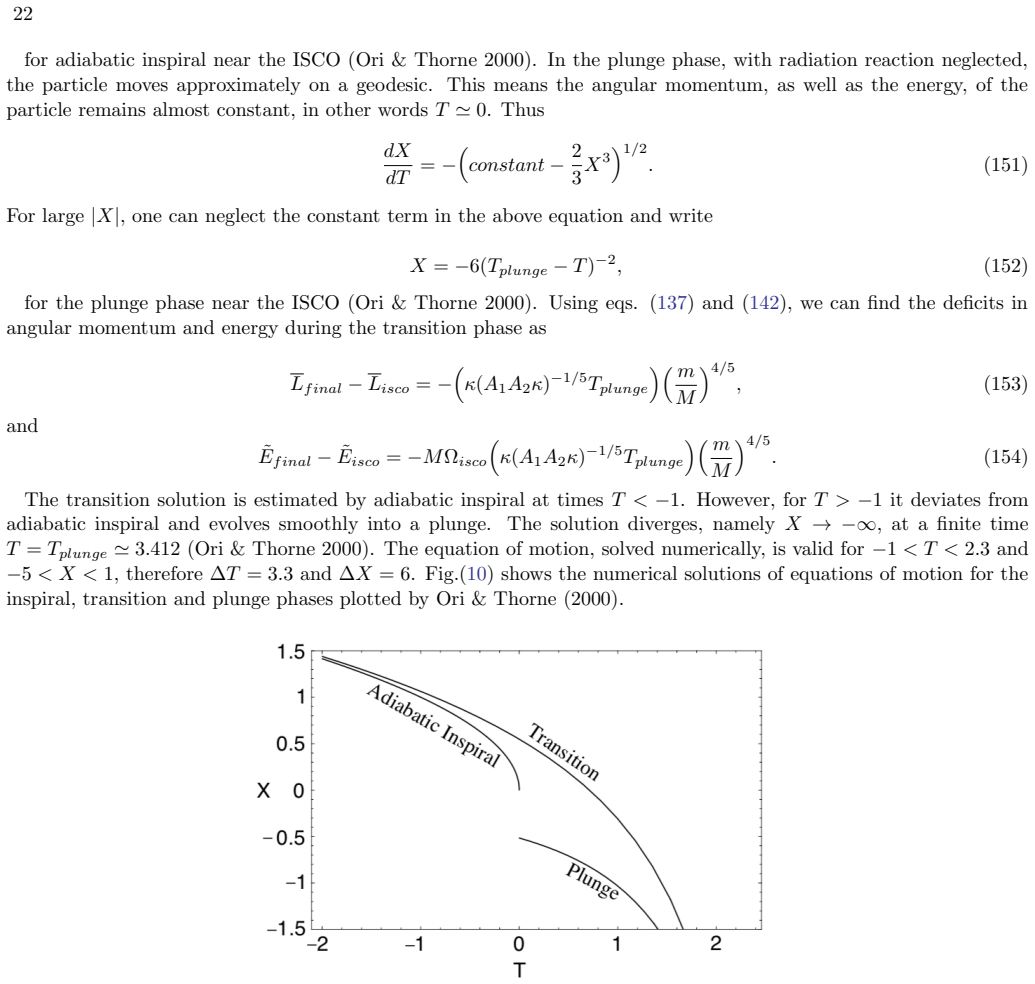
The load-bearing object is the truncated Taylor expansion of the squared effective potential, $V_{\rm eff}^2(\Delta R, \xi) = (2A_1/3)\,\Delta R^3 - 2A_2\,\Delta R\,\xi + \text{const.}$, where $A_1$ and $A_2$ are combinations of derivatives of the potential with respect to radius, energy, and angular momentum, evaluated at the ISCO. Substituting the radiation-reaction law $\xi = -\kappa\,(m/M^2)\,\tau$ turns this into the dimensionless equation of motion $d^2X/dT^2 = -X^2 - T$, whose solution describes adiabatic inspiral for $T < -1$ and plunges at a finite time $T_{\rm plunge} \approx 3.412$. The same machinery produces the scaling of the transition duration, frequency bandwidth, and wave-cycle count with the coefficients $A_1$, $A_2$, $\kappa$ and with the mass ratio as $(m/M)^{-1/5}$ and $(m/M)^{2/5}$.
What would settle it
Take a specific case from Table 3—$m = 10\,M_\odot$, $M = 10^6\,M_\odot$, distance 1 Gpc, $Q = 0$—and compute the same transition waveform with a fully relativistic treatment that keeps the self-force or uses a full perturbative radiation-reaction calculation. If the resulting peak frequency, transition duration, or number of cycles differs from $f \approx 0.0044$ Hz, $\Delta t \approx 5\times 10^3$ s, and $N \approx 22$ by more than the intrinsic bandwidth quoted in the paper, then the test-particle-plus-quadrupole approximation underlying the numbers is ruled out.
Extended reading notes
Core claim
The central claim is that once the effective potential is Taylor expanded in the radius deviation $\Delta R = R - R_{\rm ISCO}$ and the angular-momentum deviation $\xi = L - L_{\rm ISCO}$, keeping terms to second order in $\Delta R$ and first order in $\xi$, the transition motion becomes universal: $d^2X/dT^2 = -X^2 - T$, with the same form in Kerr and Reissner-Nordström backgrounds. The paper's strongest quantitative result is that this equation, solved numerically and matched to the adiabatic inspiral branch $X = (-T)^{1/2}$ at $T \ll -1$, yields concrete transition-wave parameters: for a $10\,M_\odot$ object falling into a $10^6\,M_\odot$ black hole at 1 Gpc, peak frequency $f \approx 0.0044$ Hz, duration $\Delta t \approx 5\times 10^3$ s, about 22 wave cycles, and $S/N \approx 1.7$. For a charged central hole, the paper's Table 3 shows these parameters are nearly charge-independent for $Q/M \lesssim 0.1$ and shift only for charge-to-mass ratios it regards as unrealistically large in astrophysics.
Load-bearing premise
The load-bearing premise is that, during the transition, the infalling compact object can be treated as a test particle radiating energy through the Newtonian quadrupole formula, while its own gravitational back-reaction (the self-force) and higher-order terms in the potential expansion are ignored.
Editorial extensions
If this is right
- For a $10\,M_\odot$ compact object spiraling into a $10^6\,M_\odot$ black hole at 1 Gpc, the transition gravitational waves peak near 0.004 Hz, last about 5,000 s, and contain only about 22 cycles, making the transition a short, faint event in LISA's band.
- The transition waveform parameters for a charged central black hole are essentially the same as Schwarzschild for $Q/M \le 0.1$; measurable differences appear only for $Q/M \gtrsim 0.5$, so astrophysically plausible charges would not spoil uncharged templates.
- Because the transition obeys the universal equation $d^2X/dT^2 = -X^2 - T$, the qualitative shape of the transition—approach along $X = (-T)^{1/2}$ and divergence at $T \approx 3.412$—does not depend on the black hole's spin or charge; those enter only through the rescaling of $X$ and $T$.
- The mass-ratio scalings $(m/M)^{-1/5}$ for duration and $(m/M)^{2/5}$ for frequency bandwidth mean the transition becomes shorter and sharper as the mass ratio decreases, which sets the time resolution needed in template banks for extreme-mass-ratio inspirals.
Reading between the lines
- A natural test of the expansion is to add a conservative self-force term to $d^2X/dT^2 = -X^2 - T$ and measure how much $T_{\rm plunge} \approx 3.412$ shifts; even a small shift would change the duration and cycle count at the few-percent level, which matters for matched-filtering searches.
- The near-constancy of the signal-to-noise ratio with charge suggests the transition waveform itself is a poor charge detector; the long inspiral, where charge effects accumulate in the orbital phase over many cycles, would be far more discriminating than the numbers in Table 3.
- If, as the paper notes from earlier work, the transition time is controlled mainly by the coefficient $A_1$, then a template family parameterized by $(A_1, A_2, \kappa)$ rather than solely by $(M, a, e, \iota)$ might cover eccentric and inclined transitions more efficiently.
Signed reviews
Editorial analysis
A structured set of objections, weighed in public.
Referee Report
Summary. This manuscript is a pedagogical review of the gravitational-wave-driven transition from inspiral to plunge in extreme-mass-ratio binaries. It reviews the Kerr-Newman metric and effective-potential formalism, recapitulates the Ori-Thorne expansion for circular equatorial orbits, reproduces Sundararajan's treatment of inclined/circular and inclined/eccentric orbits, and then extends the calculation to a neutral test particle around a Reissner-Nordström black hole. For the charged case, the author computes ISCO parameters, expansion coefficients, transition duration, frequency band, number of cycles, wave amplitude, and signal-to-noise ratio, and compares them with the Schwarzschild case. An appendix gives an elementary introduction to general relativity and Einstein's field equations.
Significance. If the Reissner-Nordström calculation were reliable, it would provide a simple estimate of how a small central charge affects transition-regime waveforms and whether LISA-like observations could constrain Q/M. The review portions usefully collect the Ori-Thorne and Sundararajan formulas in one place, and the author is candid in Section 7 about the known limitations of the framework. However, the new quantitative results currently contain internal inconsistencies, omit an important relativistic correction that is retained elsewhere in the paper, and are in tension with the paper's own caveats. The pedagogical value is real, but the new numerical claims are not yet supported.
major comments (4)
- [§6.2, Eq. (135)] The energy-loss rate used for the Reissner-Nordström transition is the bare Newtonian quadrupole formula, (32/5)(m/M)^2(MΩ)^{10/3}, with no relativistic correction factor. This is inconsistent with the Kerr treatment in §3, where Eq. (55) explicitly multiplies the same Newtonian expression by ˙E, the general-relativistic correction to the quadrupole formula. Equation (52) shows that the leading correction is of order (1247/336)v^2; at the RN ISCO, v^2 ~ M/R_isco ranges from about 1/6 to 1/4, so the omitted term is a 40–80% effect. Since κ in Eq. (142) and hence Δt, N, and S/N in Table 3 all depend on the luminosity, the quantitative entries in Table 3 are not supported as stated. The author should either include this correction factor with a derivation appropriate to the RN spacetime, or explicitly label the results as Newtonian-approximation illustrations and remove the measurement-oriented conclusions.
- [Table 2] Table 2 lists identical values of MΩisco, A1, A2, and κ for Q=0.7 and Q=0.8 despite the different ISCO radii (Risco=5.185 and 4.890), and identical values for Q=0.9 and Q=0.99 despite Risco=4.513 and 4.060. These parameters enter Eqs. (147)–(158) and therefore every row of Table 3, so the duplication cannot be correct. In addition, the A2 entry for Q=0.1 is 0.1611, an order of magnitude larger than neighboring values and inconsistent with the smooth trend; this is very likely a missing zero (0.01611). The table must be recomputed and checked before the RN results can be used.
- [§7] Section 7 states that the quantitative details of Ori-Thorne-type calculations "are not accurate" because of strong-field radiation, the conservative self-force, and finite-size effects, and that these corrections "will typically be many orders of magnitude larger than the contribution due to the black hole charge," concluding that charge affects waveforms only for unrealistically large Q/M. This directly conflicts with the abstract and with Section 6, where frequency, cycle number, amplitude, and S/N are said to be "obtained" and where the comparison is suggested as a way to "measure the electric charge of the hole." These statements must be reconciled: either the RN results are presented as an illustrative exercise with explicit error estimates, or the measurement claim must be withdrawn.
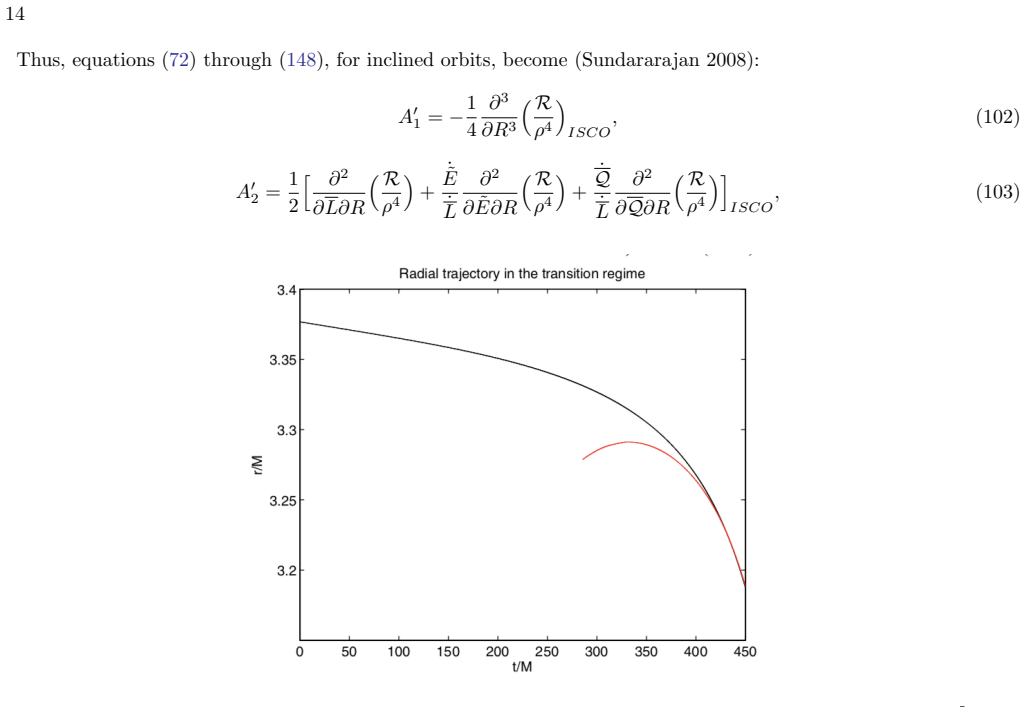
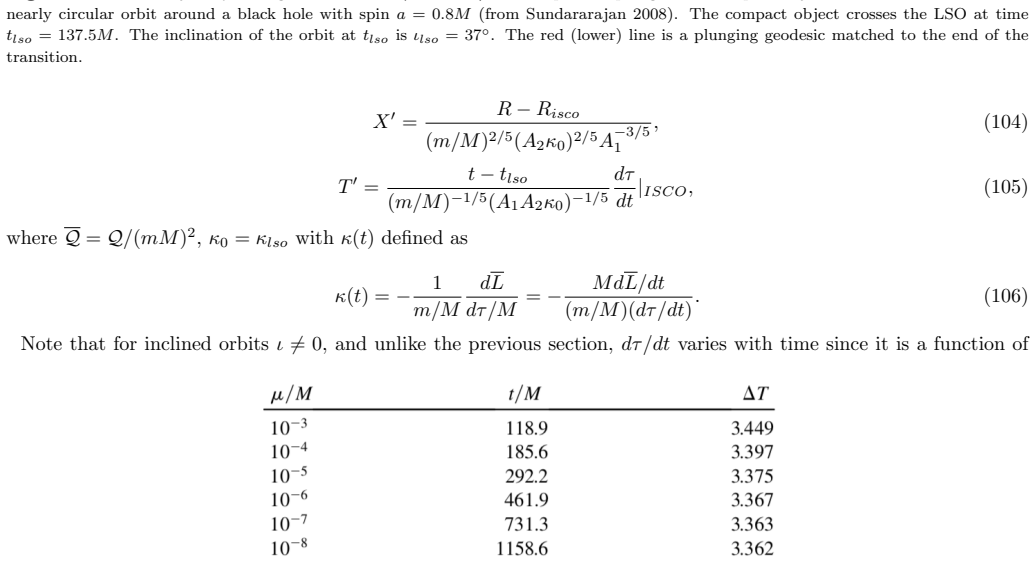
- [Abstract and §§4–5] The abstract claims that "the equations of motion, during the inspiral and transition phases, are joined numerically" and that transition parameters are obtained for circular/inclined and elliptical/inclined orbits. In the body, the inclined and eccentric cases are reviewed from Sundararajan (2008) with reproduced figures (Figs. 3–6), and the dimensionless transition equation (80)/(149) is the universal Ori-Thorne equation; no original numerical integration for the Kerr cases is presented. For the RN case, Table 3 appears to be generated directly from the closed-form expressions (155)–(162) rather than from a numerical match of inspiral and transition solutions. The abstract should be amended to describe what is actually reported: a review of existing numerical results and an analytic estimate for the RN test-particle case.
minor comments (5)
- [Throughout] Equation cross-references are systematically wrong: §2 refers to "equation (117)" for the Lagrangian (should be Eq. (11)); §3 refers to Eqs. (135), (137), (142), (143), and (144) where Eqs. (55), (57), (67), (70), and (71) are meant; §4 refers to "equations (72) through (148)" in a way that is not meaningful. The manuscript needs a consistent renumbering or corrected references.
- [§1, §4] Several author-year citations are inconsistent: "Ori & Thorne (2003)" and "Ori & Thorne (2008)" appear in the text, while the reference list and the rest of the paper cite Ori & Thorne (2000).
- [Table 3] The Q=0 and Q=0.01 rows are identical to the displayed precision, although Eq. (132) gives slightly different ISCO radii; the precision should be sufficient to show the small difference, or the table should state that entries are rounded to the shown precision.
- [§2, Eq. (2)] The notation G^2 = g^2 + Q^2 and then "G2 = G2/M2 = g2+Q2/M2" is confusing and uses G both for the combined charge parameter and, implicitly, for Newton's constant elsewhere; the symbols should be clarified.
- [Throughout] There are numerous typographical errors, including "Sundrarajan" (should be Sundararajan), "Mattews" (should be Matthews), "Reissner-Nordstrm" in Section 7, and "generelize" in the appendix. A careful proofreading pass is needed.
Circularity Check
No circularity: the transition parameters are computed from the RN metric's ISCO quantities and the standard quadrupole flux, with no fitted-input-called-prediction step.
full rationale
I checked the chain from the Kerr-Newman/RN geodesic constants (Eqs. 27-48), the quadrupole luminosity (Eqs. 51-55), the effective-potential Taylor expansion (Eqs. 70-80, 143-149), and the waveform estimates (Eqs. 155-163). The Section 6 outputs (Table 3) are obtained by evaluating analytic expressions: Omega_isco from Eq. (139), kappa from Eq. (142), A1/A2 from Eqs. (145)-(146), and then f, Delta-t, N, and S/N from Eqs. (155)-(162) with the LISA noise curve of Ori & Thorne (2000). None of the target quantities is used to define an input parameter, and no parameter is fitted to the tabulated results. The derivation is self-contained in the sense that inputs are the RN metric, the test-particle constants of motion, and the standard Newtonian quadrupole radiation formula. Section 7 explicitly concedes that the quantitative details are inaccurate due to strong-field radiation, the conservative self-force, and finite-size effects; this is an accuracy caveat, not a circularity, and the paper should be judged as a pedagogical review rather than a precision prediction. Table 2 contains suspicious duplicated entries for Q=0.7/0.8 and Q=0.9/0.99, which suggests a typographical or copying error, but it does not make any output equal an input by construction. The citations to Ori & Thorne (2000) and Sundararajan (2008) are external support, not self-citations, and the expansion ansatz is openly attributed to those works rather than disguised as a new first-principles result.
Assumptions & free parameters
free parameters (5)
- mass ratio m/M =
10^-5 (10 solar mass object into 10^6 solar mass black hole)
- source distance D =
1 Gpc
- black hole spin a/M =
0.8 in Figures 3, 5 and 6
- charge-to-mass ratio Q/M =
0, 0.01, ..., 0.999 in Table 3
- eccentricity and inclination at LSO =
e = 0.6, inclination = 45 degrees in Figure 5
assumptions (6)
- standard math Einstein field equations and geodesic motion describe the binary system.
- domain assumption The compact object behaves as a test particle for m much less than M.
- domain assumption Gravitational energy loss during inspiral and transition is given by the Newtonian quadrupole formula plus the cited post-Newtonian corrections.
- domain assumption The effective potential can be Taylor-expanded to first order in angular momentum deviation and second order in radius deviation near the ISCO.
- domain assumption Circular orbits remain circular under adiabatic radiation reaction.
- ad hoc to paper Sundararajan's numerical results for inclined and elliptical orbits can be reproduced from the cited equations without the original code.
Cite this review
Pith. "Pith review of Gravitational Radiation from Binaries: A Pedagogical Introduction." pith.science (2026). https://pith.science/paper/YDUUZ7YH
@misc{pith2026190804410,
  author       = {Pith},
  title        = {Pith review of: Gravitational Radiation from Binaries: A Pedagogical Introduction},
  year         = {2026},
  howpublished = {\url{https://pith.science/paper/YDUUZ7YH}},
  note         = {Machine review of arXiv:1908.04410}
}
abstract
This short note serves as an introduction to gravitational radiation through reviewing the inspiral-plunge transition phase in extreme mass ratio binaries. We study the relativistic motion of a compact object (CO) of mass $m$ around a massive black hole of mass $M\gg m$. The Kerr-Newman metric, effective potential for the general case of elliptical orbits, gravitational radiation, orbital energy and angular momentum of a coalescing CO in Kerr spacetime and gravitational wave frequency and signal to noise ratio are briefly reviewed. The main focus is on the transition from inspiral to plunge for a CO assuming that a test particle approach is plausible in the regime $m\ll M$ without appealing to a perturbative analysis. The effective potential is used to obtain the properties of the Innermost Stable Circular Orbit (ISCO) near which the adiabatic inspiral phase ends abruptly and the CO enters the plunge phase. For the transition phase, the effective potential is expanded in terms of parameters such as the radial (coordinate) distance from the ISCO and the deviation of particle's angular momentum from its value at the ISCO to obtain the equation of motion. The equations of motion, during the inspiral and transition phases, are joined numerically and the gravitational wave frequency, number of wave cycles and signal to noise ratio (SN) during the transition is obtained for circular/inclined as well as elliptical/inclined orbits. The limitations and inaccuracies of the current methods used to approach this problem is discussed. A short introduction to the fundamental concepts of General Relativity, in particular Einstein Field Equations is also provided in the Appendix.
Figures
Figures from the paper (7 more)

Reference graph
Works this paper leans on
-
[1]
INTRODUCTION Coalescing black hole binary systems, in the Extreme Mass Ratio (EMR) regime, are one of the promising sources of gravitational radiation detectable by the Laser Interferometer Space Antenna (LISA). The EMR is the most relevant regime for compact stars inspiraling toward massive black holes, e.g., in galactic nuclei. The small mass ratio, typ...
work page 1973
-
[2]
(10) The outer horizon corresponds to ∆ = 0 which givesr+ =M + √ M2− (a2 +g2 +Q2)
KERR-NEWMAN SPACETIME The Kerr-Newman metric is given in the form of the following line element in Boyer-Lindquist coordinates (t,r,θ,φ ): ds2 =− (∆−a2 sin2θ ρ2 ) dt2− 2ωω2dtdφ +ω2dφ2 +ρ2dθ2 + ρ2 ∆dr2, (1) where ∆ =r2 +a2− 2Mr +G2 =M2(S2 +R2 +G 2 − 2R), (2) ρ = (r2 +a2 cos2θ)1/2 =M(R2 +S2 cos2θ)1/2, (3) Σ = [ (r2 +a2)2−a2∆ sin2θ ]1/2 (4) ω = Σ ρ sinθ, (5)...
work page 1973
-
[3]
EQUATORIAL AND CIRCULAR ORBITS One method to study the transition regime, and the properties of the radiated waves during this phase, is to expand the effective potential in terms of few small parameters. The idea is to approximate the effective potential, so the equation of motion, for the transitioning particle by Taylor expanding it in terms of small dev...
work page 2000
-
[4]
INCLINED AND CIRCULAR ORBITS Inclination of an orbit can be defined by an angle ι in terms of the Carter constant Q and the component of the orbital angular momentum on the black hole’s spin axis z; cosι = L√ L2 +Q≡ Lz√ L2z +Q , (95) which also represents our notation L =Lz. To estimate the transitioning particle’s angular momentum and energy, one may Tayl...
work page 2000
-
[5]
INCLINED AND ELLIPTICAL ORBITS In this section, we follow the approach taken by Sundararajan (2008) for elliptical and inclined orbits. An elliptical orbit is represented by r(t) = p 1 +e cosψ, (107) whereψ(t), similar to the eccentric anomaly, is a function of time,p is the semi-latus rectum, ande is the eccentricity. The inner and outer turning points, ...
work page 2008
-
[6]
CHARGED BLACK HOLES Electric charge of black holes is usually assumed to be zero, or negligible. One way of testing this assumption is through calculating wave templates for gravitational waves from charged binaries. The inspiral-plunge transition phase of a Compact Object (CO) orbiting around an electrically charged, massive black hole, for example, gene...
work page 2008
-
[7]
DISCUSSION Ori & Thorne (2000) analytically approximated the transition between an adiabatic gravitational-wave inspiral and a plunge in extreme-mass-ratio inspirals in Kerr space-time. This computation provides a qualitatively correct picture but the quantitative details are not accurate because such calculations will receive corrections due to strong fie...
work page 2000
Reviewed August 14, 2026 · model on record in the stance chip above.
Discussion (0). Continue with ORCID to comment.