REVIEW 3 major objections 5 minor 86 references
An accelerated linear method for optimizing non-linear wavefunctions in variational Monte Carlo
T0 review · 3 major / 5 minor · reviewed 2026-08-14 · deepseek-v4-flash
Pith's one-line read This paper claims that the linear method for optimizing variational Monte Carlo wavefunctions can shed its memory bottleneck by solving its generalized eigenvalue problem iteratively with Jacobi-Davidson, without ever constructing the…
desk verdict A genuine algorithmic advance for large-parameter VMC optimization, with a reproducibility gap around the nonsymmetric sampled Hamiltonian that needs fixing before the solver details can be trusted. read the letter →
The pith
A machine-rendered reading of the paper's core claim, the machinery that carries it, and where it could break.
The reading
What carries the argument
The load-bearing identity is the outer-product decomposition of the linear-method matrices: with $\bar g_i[n]$ and $\bar h_i[n]$ vanishing for index zero, equations (24) and (25) express $\bar{\mathbf{S}}$ and $\bar{\mathbf{H}}$ as sums of outer products of the sampled vectors. This turns each matrix-vector product into a few dot products and vector additions. The other half of the machinery is Jacobi-Davidson, an iterative eigensolver that builds a small subspace, solves a projected eigenproblem, and corrects its current best vector by approximately solving a preconditioned equation with the Jacobi orthogonal component correction; the paper uses subspace size 25 with restarts of 5 vectors and loose tolerances for fast progress.
What would settle it
Measure the autocorrelation time of $g_i[n]$, $h_i[n]$, and $E_L[n]$ as the system size grows for a fixed ansatz family; if $n_{\mathrm{corr}}$ does not grow linearly with $N$, the $O(N^4)$ scaling argument in Section III breaks. Alternatively, run the optimizer on a system with a short, saturating correlation length and check whether per-iteration memory or time departs from the reported $O(n_s n_{\mathrm{var}}^{1.16}/n_{\mathrm{proc}})$ scaling.
Extended reading notes
Core claim
The central claim is that the linear method's step can be obtained by solving $\bar{\mathbf{H}}\,\delta p = E\,\bar{\mathbf{S}}\,\delta p$ with the Jacobi-Davidson algorithm, using only matrix-vector products. The paper shows that $\bar{\mathbf{H}}$ and $\bar{\mathbf{S}}$ can be written as sums of outer products of the sampled primitives $g_i[n]=\langle n|\Psi_i\rangle/\langle n|\Psi\rangle$, $h_i[n]=\langle n|\hat H|\Psi_i\rangle/\langle n|\Psi\rangle$, and the local energy $E_L[n]$, so their action on a vector costs $O(n_s n_{\mathrm{var}})$ rather than the $O(n_s n_{\mathrm{var}}^2)$ needed to build the matrices. Storing these primitives instead of the matrices gives a memory per processor of $O(n_s n_{\mathrm{var}}/n_{\mathrm{proc}})$, and sampling only every correlation length reduces both memory and time by a factor $n_{\mathrm{corr}}$. Empirically the solver scales as $O(n_s n_{\mathrm{var}}^{1.16}/n_{\mathrm{proc}})$, and the paper reports optimizations of a 98-site Hubbard model with 57,722 parameters, with converged energies matching reference results.
Load-bearing premise
The claimed $\mathcal O(N^4)$ overall scaling rests on the assumption that the sampled primitives are serially correlated with a correlation length that grows linearly with system size, so that sampling every $\mathcal O(N)$ Monte Carlo moves cuts storage and computation by a factor $n_{\mathrm{corr}}$; if the correlation length grows more slowly, memory and CPU costs grow faster than claimed.
Editorial extensions
If this is right
- The linear method can now be applied to wavefunctions with tens of thousands of parameters; the paper demonstrates 57,722 parameters on the 98-site Hubbard model.
- Per-iteration wall time for the linear method drops by roughly an order of magnitude compared with explicitly building and diagonalizing the matrices.
- Because the matrices are never stored, memory per processor shrinks as parallelism grows, making the optimizer progressively more attractive on many-core machines.
- Starting with AMSGrad far from the minimum and switching to the direct linear method near convergence reaches lower energies in comparable or less wall time than either approach alone.
- For real-space Jastrow wavefunctions, the direct linear method is reported as the optimizer of choice, since first-order methods converge inconsistently on those systems.
Reading between the lines
- If the near-linear solver scaling persists beyond 57,722 parameters, the practical ceiling for this optimization strategy shifts from linear algebra to the cost of computing the primitives $g_i$ and $h_i$, so hand-coded analytic gradients could extend the method further.
- The same matrix-free recipe, outer-product-stored samples plus an iterative eigensolver, should transfer to other high-dimensional stochastic optimizations, including neural-network quantum states, where the overlap matrix would otherwise be prohibitively large.
- The bias check protocol, running many unbiased SGD steps around the converged minimum and checking the energy histogram, is a reusable diagnostic for any stochastic second-order optimizer.
- A direct testable extension is to record the measured correlation length $n_{\mathrm{corr}}$ for each system; the claimed $O(N^4)$ scaling assumes it grows linearly with system size, and publishing these values would let others verify the scaling claim without reimplementing the code.
Signed reviews
Editorial analysis
A structured set of objections, weighed in public.
Referee Report
Summary. The manuscript presents an accelerated linear method (aLM) for optimizing non-linearly parametrized variational Monte Carlo wavefunctions. The Hamiltonian and overlap matrices of the linear method are rewritten as sums of outer products of sampled primitives (Eqs. 24-25), so that their action on a vector can be computed in O(ns nvar) time without building and storing the matrices. The generalized eigenvalue problem is then solved with a Jacobi-Davidson iterative solver, and AMSGrad is used far from the minimum before switching to the linear method. The method is applied to real-space Jastrow wavefunctions for Be and Ne, orbital-space Jastrow-GHF wavefunctions for C2, H50, a 98-site Hubbard model, and Fe(II) porphyrin, with up to 57,722 parameters. Energies agree with exact diagonalization, SHCI, and GFMC references. The authors report an empirical solver scaling of O(ns nvar^1.16/nproc) and argue for an overall O(N^4) scaling.
Significance. The central idea of avoiding explicit matrix storage by combining the outer-product representation with an iterative eigensolver is conceptually clean and, if correctly implemented, would remove the main memory bottleneck that limits the linear method to roughly 10^4 parameters. The algebraic identities in Eqs. (24)-(26) are straightforward, and the benchmark results against SHCI and GFMC are credible. The paper also includes a sensible check for stochastic bias using long SGD runs after convergence. These are real strengths. The main uncertainties are the correctness of the iterative solve for the nonsymmetric sampled Hamiltonian and the scope of the scaling claims, which are not fully established by the presented data.
major comments (3)
- [Section II.C, Eqs. (30)-(32)] The sampled Hamiltonian is explicitly stated to be nonsymmetric in Section II.B after Eq. (11), yet the Jacobi-Davidson correction equation F = P†(A - rho B)P is claimed to be positive semi-definite and to require only a few conjugate-gradient iterations. For a nonsymmetric A, F is not Hermitian, so conjugate gradient is not mathematically justified and positive semi-definiteness is not defined in the usual sense. The paper does not state any symmetrization of Hbar, such as replacing A by (A + A^T)/2 or averaging Gr and Gc, before entering the Davidson iterations. Because every reported aLM optimization passes through this solve, this missing specification is load-bearing for the central algorithmic claim.
- [Section IV.E, Fig. 4 and Section III] The empirical scaling measurement covers only the Jacobi-Davidson solver time, not the end-to-end optimization, while the abstract claims that the method 'improves the scaling of the algorithm' with respect to the number of parameters. Please either provide an end-to-end scaling benchmark or explicitly restrict the claim to the solver. In addition, the O(N^4) scaling in Section III depends on the assumption that the Monte Carlo correlation length grows linearly with system size. That assumption is stated without supporting measurements, and the observed correlation length of about 1.5 for FeP in Section IV.G shows that the correlation length is not universally large; if it grows more slowly than linearly, the number of stored primitives ns and the direct-method cost grow accordingly.
- [Section IV, Tables I-VI] The paper's motivation is the memory bottleneck of the linear method, but no memory measurements are reported. Timings alone do not directly demonstrate the memory advantage of aLM over LM. A comparison of peak memory per process for aLM versus LM, at least for the larger systems, would make the central claim concrete and is needed to support the abstract's statement that the method 'greatly lowers the cost'.
minor comments (5)
- [Throughout] There are several typos and formatting issues: 'wav efunctions' in the title, 'symmerty' in Section II.A, and 'Lowdin' should be 'Löwdin' in Section IV.D and the references.
- [Section II.C, Davidson algorithm step 2] The equation A' = V†A V = V†VA is ambiguous because V†VA could be read as (V†V)A; please write V†(VA) or define VA = A V explicitly before the step.
- [Tables I and II] The comparison energies for Be and Ne are exact diagonalization in aug-cc-pVQZ and aug-cc-pV5Z Gaussian bases, while the VMC calculations use Slater-type bases. The text should state explicitly that these are different basis sets, which explains why the VMC energy can lie below the quoted CI reference.
- [Section III, line search] The line-search procedure with slave wavefunctions and Eq. (37) is described, but the statement that 'the median value step size' is used is not completely specified; please clarify how the median is selected among the five candidate step sizes.
- [Fig. 4] The y-axis label 'Avg. time/(ns/nproc)' and the caption 'per Monte Carlo sample per process' should be reconciled, and the axis label should state explicitly that the horizontal axis is the number of parameters nvar.
Circularity Check
No significant circularity: the aLM derivation is self-contained and its results are benchmarked against external references.
full rationale
The paper's central contribution is an algorithmic reformulation: instead of building the LM Hamiltonian and overlap matrices, the Jacobi-Davidson solver acts on vectors via outer-product forms of Eqs. (24)-(26). This is derived from the standard linear method equations, which are explicitly stated and attributed to prior community work rather than assumed from the authors' own results. The claimed memory and CPU improvements follow from the structural fact that matrix-vector products cost O(ns nvar) rather than O(ns nvar^2), and from the stated sampling assumption about correlation length. No parameter of the method is fitted to the benchmark energies; the empirical scaling exponent 1.16 is a measured performance characteristic, not an input to the physics. The self-citations to refs. 8 and 23 provide the underlying VMC framework and wavefunction ansatz, but the core Jacobi-Davidson/direct linear method is independently derived and could stand without those citations. The optimized energies are compared with external SHCI and GFMC references, so the numerical claims are not validated by the paper's own inputs. The reviewer-identified issue that the sampled nonsymmetric H may invalidate the conjugate-gradient solve is a correctness or reproducibility concern, not a circularity: it does not make any output equivalent to an input by construction. Accordingly, no circular step can be quoted, and the appropriate score is 0.
Assumptions & free parameters
free parameters (5)
- Initial diagonal shift and decay factor for H trust radius =
0.1, decay 0.65
- Umrigar-Toulouse nonlinear scaling parameter xi =
0.5
- AMSGrad hyperparameters (alpha, beta1, beta2) =
0.01, 0.1, 0.01 (aggressive); 0.001, 0.1, 0.001 (start of aLM)
- Davidson subspace sizes Vmax, Vrestart =
25, 5
- Line search step multipliers =
0.01, 0.05, 0.1, 0.5, 1.0
assumptions (5)
- standard math The variational principle: the expectation value of the Hamiltonian for any wavefunction is an upper bound to the true ground state energy.
- domain assumption The Monte Carlo estimates of the matrices H and S converge to the exact averages, and the resulting stochastic noise in the eigenvector is unbiased enough to be mitigated.
- domain assumption The primitives EL[n], gi[n], and hi[n] can be evaluated at the claimed O(N^2) and O(N^3) costs, including the reverse-mode algorithmic differentiation of the local energy.
- domain assumption The correlation length of the sampled primitives grows linearly with system size, justifying the O(N) downsampling and the claimed O(N^4) total scaling.
- ad hoc to paper The Jacobi-Davidson method with Jacobi orthogonal component correction converges for the non-symmetric, noisy generalized eigenvalue problem encountered here, with a diagonal shift acting as a trust radius.
Cite this review
Pith. "Pith review of An accelerated linear method for optimizing non-linear wavefunctions in variational Monte Carlo." pith.science (2026). https://pith.science/paper/5KWSELX5
@misc{pith2026190804423,
  author       = {Pith},
  title        = {Pith review of: An accelerated linear method for optimizing non-linear wavefunctions in variational Monte Carlo},
  year         = {2026},
  howpublished = {\url{https://pith.science/paper/5KWSELX5}},
  note         = {Machine review of arXiv:1908.04423}
}
read the original abstract
Although the linear method is one of the most robust algorithms for optimizing non-linearly parametrized wavefunctions in variational Monte Carlo, it suffers from a memory bottleneck due to the fact at each optimization step a generalized eigenvalue problem is solved in which the Hamiltonian and overlap matrices are stored in memory. Here we demonstrate that by applying the Jacobi-Davidson algorithm, one can solve the generalized eigenvalue problem iteratively without having to build and store the matrices in question. The resulting direct linear method greatly lowers the cost and improves the scaling of the algorithm with respect to the number of parameters. To further improve the efficiency of optimization for wavefunctions with a large number of parameters, we use the first order method AMSGrad far from the minimum as it is very inexpensive, and only switch to the direct linear method near the end of the optimization where methods such as AMSGrad have long convergence tails. We apply this improved optimizer to various wavefunctions with both real and orbital space Jastrow factors for atomic systems such as Beryllium and Neon, molecular systems such as the Carbon dimer and Iron(II) Porphyrin, and model systems such as the Hubbard model and Hydrogen chains.
Figures
Reference graph
Works this paper leans on
-
[1]
The use of an effective Hamiltonian that reduces the cost of the local energy calculation from O(N 4) to O(N 2); inspired by the Heat-bath Configuration Interaction (HCI) algorithm[ 20]
-
[2]
The use of continuous time Monte Carlo for sam- pling occupation number vectors that ensures er- godic and efficient moves[ 21, 22]
-
[3]
The use of AMSGrad to optimize parameters[ 18]. This is a stochastic gradient descent algorithm developed in the machine learning community that yields comparable convergence to the popular stochastic reconfiguration (SR) algorithm[ 6, 8]. We have recently published an article expanding this framework with highly accurate wavefunction ansatzes consisting o...
-
[4]
Initialize the subspace matrices V = [ x0], VA = [Ax0], and VB = [Bx0]
-
[5]
Select the eigenpair ( θ, s) in which θ is closest to t
Solve the subspace problem, A′ · s = θ · B′ · s, (33) where A′ = V†A V= V†VA and B′ = V†BV = V†VB. Select the eigenpair ( θ, s) in which θ is closest to t
-
[6]
Transform s into the original problem space, u = V·s, and calculate action of matrices, uA = A·u = VA · s and uB = B · u = VB · s
-
[7]
If ‖r‖ is less than some predefined threshold, return ( θ, u)
Calculate the residual vector r = (A − θ · B) · u = uA − θ · uB. If ‖r‖ is less than some predefined threshold, return ( θ, u)
-
[8]
In the Jacobi- Davidson scheme, F = (I − uB · u†)(A − θ · B)(I − u · uB†)
Approximately solve the correction equation for δ, F · δ = −r, (34) with a chosen preconditioner F. In the Jacobi- Davidson scheme, F = (I − uB · u†)(A − θ · B)(I − u · uB†)
Show all 86 references
-
[9]
This can be done with a Gram- Schmidt procedure: (a) for v ∈ Cols(V) δ := δ − v · (v† · B · δ) (b) xt = δ/ ‖δ‖, where ‖δ‖ = √ δ† · B · δ
Orthonormalize δ with respect to the subspace, the columns of V. This can be done with a Gram- Schmidt procedure: (a) for v ∈ Cols(V) δ := δ − v · (v† · B · δ) (b) xt = δ/ ‖δ‖, where ‖δ‖ = √ δ† · B · δ
-
[10]
V := [ V, xt], VA := [VA, Axt], and VB := [VB, Bxt]
Append xt to the subspace. V := [ V, xt], VA := [VA, Axt], and VB := [VB, Bxt]
-
[11]
To ensure the size of the subspace doesn’t grow too large, restarts should be taken advantage of
Repeat steps 2-8 until a desired convergence for ‖r‖ has been achieved. To ensure the size of the subspace doesn’t grow too large, restarts should be taken advantage of. This can be ac- complished very easily by taking a number of the eigen- vectors in the subspace problem tha...
-
[12]
time/( ns/nproc) Number of parameters Practical Scaling with Number of Parameters FIG
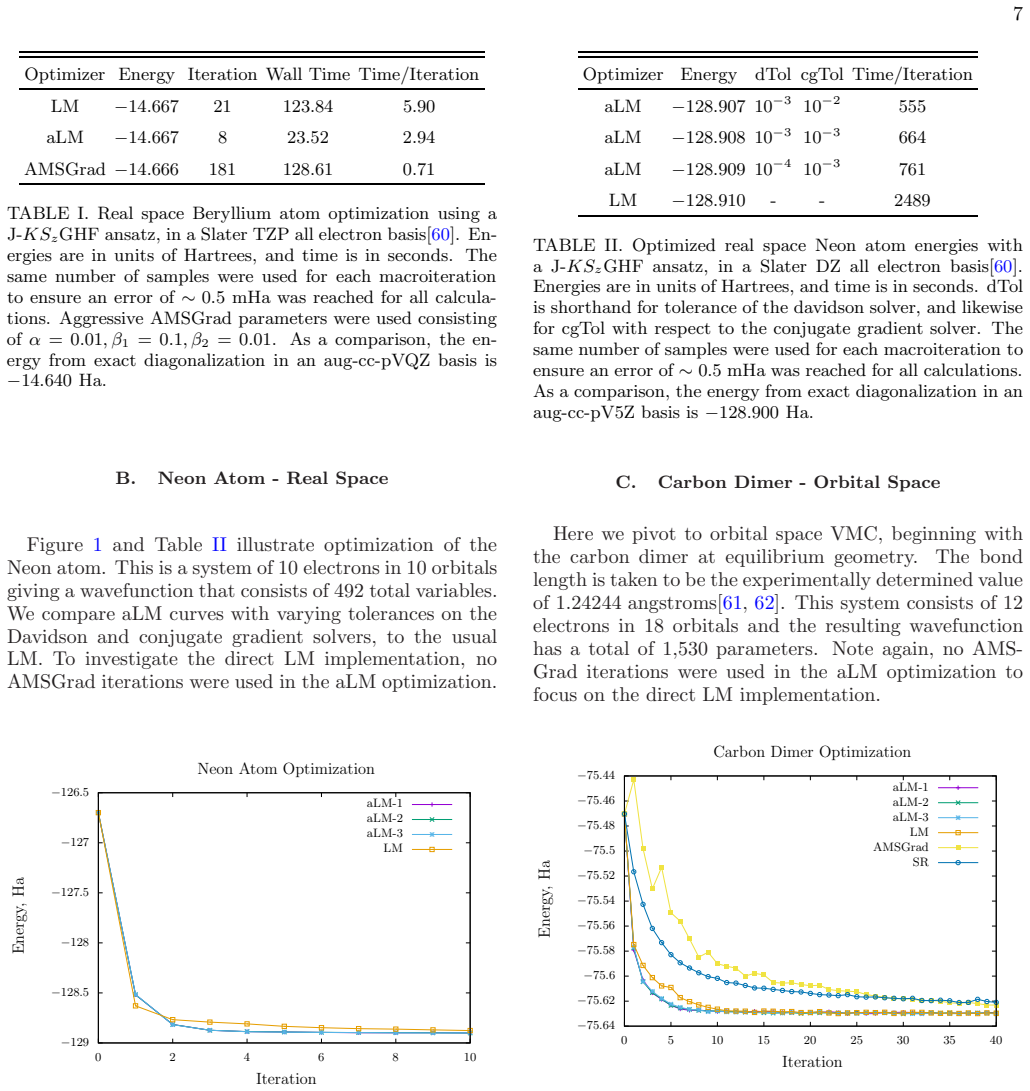
01 1000 10000 slope = 1.16 Avg. time/( ns/nproc) Number of parameters Practical Scaling with Number of Parameters FIG. 4. Average wall time of Jacobi-Davidson solver per Monte Carlo sample per process vs. number of parameters plotted on a log-log scale. Loose tolerances of dTo...
-
[13]
We use this example to in- vestigate any bias in the aLM optimizer
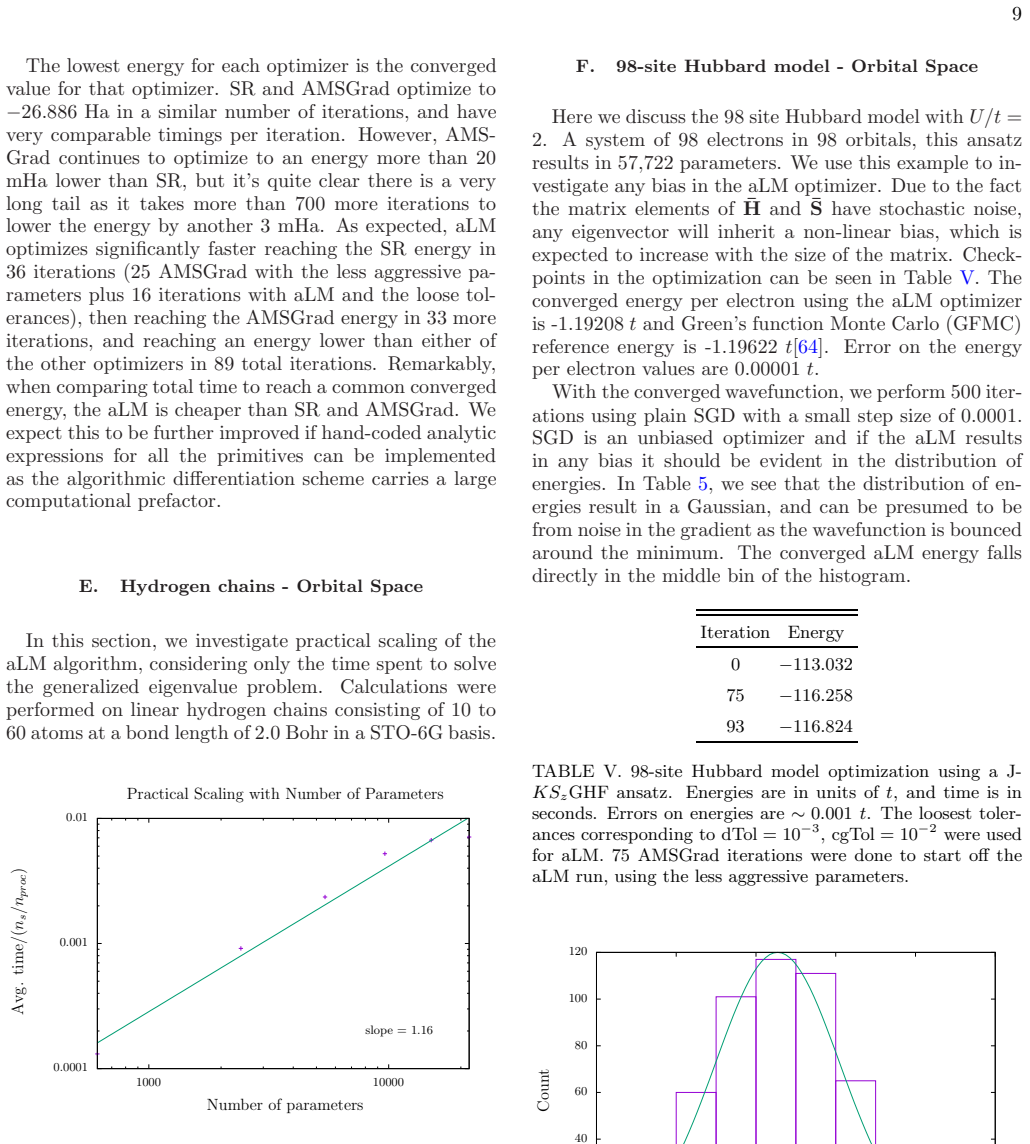
A system of 98 electrons in 98 orbitals, this ansatz results in 57,722 parameters. We use this example to in- vestigate any bias in the aLM optimizer. Due to the fact the matrix elements of ¯H and ¯S have stochastic noise, any eigenvector will inherit a non-linear bias, which ...
-
[14]
Becca and S
F. Becca and S. Sorella, Quantum Monte Carlo Ap- proaches for Correlated Systems, 1st ed. (Cambridge Uni- versity Press, 2017)
2017
-
[15]
Nightingale and C
M. Nightingale and C. J. Umrigar, Quantum Monte Carlo Methods in Physics and Chemistry (Springer, 1999)
1999
-
[16]
Sorella, Generalized lanczos algorithm for variational quantum monte carlo, Physical Review B 64, 024512 (2001)
S. Sorella, Generalized lanczos algorithm for variational quantum monte carlo, Physical Review B 64, 024512 (2001)
2001
-
[17]
Sorella, Wave function optimization in the variational monte carlo method, Physical Review B 71, 241103 (2005)
S. Sorella, Wave function optimization in the variational monte carlo method, Physical Review B 71, 241103 (2005)
2005
-
[18]
T. D. Beaudet, M. Casula, J. Kim, S. Sorella, and R. M. Martin, Molecular hydrogen adsorbed on benzene: In- sights from a quantum monte carlo study, The Journal of chemical physics 129, 164711 (2008)
2008
-
[19]
Neuscamman, C
E. Neuscamman, C. Umrigar, and G. K.-L. Chan, Op- timizing large parameter sets in variational quantum monte carlo, Physical Review B 85, 045103 (2012)
2012
-
[20]
L. R. Schwarz, A. Alavi, and G. H. Booth, Projector quantum monte carlo method for nonlinear wave func- tions, Physical review letters 118, 176403 (2017)
2017
-
[21]
Sabzevari and S
I. Sabzevari and S. Sharma, Improved speed and scal- ing in orbital space variational monte carlo, Journal of chemical theory and computation 14, 6276 (2018)
2018
-
[22]
Nightingale and V
M. Nightingale and V. Melik-Alaverdian, Optimization of ground-and excited-state wave functions and van der waals clusters, Physical review letters 87, 043401 (2001)
2001
-
[23]
Umrigar, J
C. Umrigar, J. Toulouse, C. Filippi, S. Sorella, and R. G. Hennig, Alleviation of the fermion-sign problem by opti- mization of many-body wave functions, Physical review letters 98, 110201 (2007)
2007
-
[24]
Toulouse and C
J. Toulouse and C. J. Umrigar, Optimization of quantum monte carlo wave functions by energy minimization, The Journal of chemical physics 126, 084102 (2007)
2007
-
[25]
Toulouse and C
J. Toulouse and C. Umrigar, Full optimization of jastrow–slater wave functions with application to the first-row atoms and homonuclear diatomic molecules, The Journal of chemical physics 128, 174101 (2008)
2008
-
[26]
E. Neuscamman, Improved optimization for the cluster jastrow antisymmetric geminal power and tests on triple- bond dissociations, Journal of chemical theory and com- putation 12, 3149 (2016)
2016
-
[27]
B. V. D. Goetz and E. Neuscamman, Suppressing ionic terms with number-counting jastrow factors in real space, Journal of chemical theory and computation 13, 2035 (2017)
2017
-
[28]
Brown, J
M. Brown, J. R. Trail, P. L´ opez R ´ ıos, and R. Needs, En- ergies of the first row atoms from quantum monte carlo, The Journal of chemical physics 126, 224110 (2007)
2007
-
[29]
F. R. Petruzielo, J. Toulouse, and C. Umrigar, Approach- ing chemical accuracy with quantum monte carlo, The Journal of chemical physics 136, 124116 (2012)
2012
-
[30]
Zhao and E
L. Zhao and E. Neuscamman, A blocked linear method for optimizing large parameter sets in variational monte carlo, Journal of chemical theory and computation 13, 2604 (2017)
2017
-
[31]
S. J. Reddi, S. Kale, and S. Kumar, On the convergence of adam and beyond, arXiv preprint arXiv:1904.09237 (2019)
2019 arXiv
-
[32]
Wei and E
H. Wei and E. Neuscamman, Reduced scaling hilbert space variational monte carlo, The Journal of chemical physics 149, 184106 (2018)
2018
-
[33]
A. A. Holmes, N. M. Tubman, and C. Umrigar, Heat- bath configuration interaction: An efficient selected con- figuration interaction algorithm inspired by heat-bath sampling, Journal of chemical theory and computation 12, 3674 (2016)
2016
-
[34]
A. B. Bortz, M. H. Kalos, and J. L. Lebowitz, A new al- gorithm for monte carlo simulation of ising spin systems, Journal of Computational Physics 17, 10 (1975)
1975
-
[35]
D. T. Gillespie, A general method for numerically sim- ulating the stochastic time evolution of coupled chemi- cal reactions, Journal of computational physics 22, 403 (1976)
1976
-
[36]
Mahajan and S
A. Mahajan and S. Sharma, Symmetry-projected jastrow mean-field wave function in variational monte carlo, The Journal of Physical Chemistry A 123, 3911 (2019)
2019
-
[37]
V. Bach, E. H. Lieb, and J. P. Solovej, Generalized hartree-fock theory and the hubbard model, Journal of statistical physics 76, 3 (1994)
1994
-
[38]
Lykos and G
P. Lykos and G. Pratt, Discussion on the hartree-fock ap- proximation, Reviews of Modern Physics 35, 496 (1963)
1963
-
[39]
L¨ owdin, Quantum theory of many-particle systems
P.-O. L¨ owdin, Quantum theory of many-particle systems. iii. extension of the hartree-fock scheme to include degen- erate systems and correlation effects, Physical review 97, 1509 (1955)
1955
-
[40]
G. E. Scuseria, C. A. Jim´ enez-Hoyos, T. M. Henderson, K. Samanta, and J. K. Ellis, Projected quasiparticle the- ory for molecular electronic structure, The Journal of chemical physics 135, 124108 (2011)
2011
-
[41]
Rodr ´ ıguez-Guzm´ an, K
R. Rodr ´ ıguez-Guzm´ an, K. Schmid, C. A. Jim´ enez- Hoyos, and G. E. Scuseria, Symmetry-projected vari- ational approach for ground and excited states of the two-dimensional hubbard model, Physical Review B 85, 245130 (2012)
2012
-
[42]
C. A. Jim´ enez-Hoyos, T. M. Henderson, T. Tsuchimochi, and G. E. Scuseria, Projected hartree–fock theory, The Journal of chemical physics 136, 164109 (2012)
2012
-
[43]
Mezzacapo, N
F. Mezzacapo, N. Schuch, M. Boninsegni, and J. I. Cirac, Ground-state properties of quantum many-body systems: entangled-plaquette states and variational monte carlo, New Journal of Physics 11, 083026 (2009)
2009
-
[44]
Neuscamman and G
E. Neuscamman and G. K.-L. Chan, Correlator product state study of molecular magnetism in the giant keplerate mo 72 fe 30, Physical Review B 86, 064402 (2012)
2012
-
[45]
M. C. Gutzwiller, Effect of correlation on the ferromag- netism of transition metals, Physical Review Letters 10, 159 (1963)
1963
-
[46]
Neuscamman, Size consistency error in the antisym- metric geminal power wave function can be completely 12 removed, Physical review letters 109, 203001 (2012)
E. Neuscamman, Size consistency error in the antisym- metric geminal power wave function can be completely 12 removed, Physical review letters 109, 203001 (2012)
2012
-
[47]
Neuscamman, The jastrow antisymmetric geminal power in hilbert space: Theory, benchmarking, and ap- plication to a novel transition state, J
E. Neuscamman, The jastrow antisymmetric geminal power in hilbert space: Theory, benchmarking, and ap- plication to a novel transition state, J. Chem. Phys. 139, 194105 (2013)
2013
-
[48]
Neuscamman, Communication: A jastrow factor cou- pled cluster theory for weak and strong electron correla- tion (2013)
E. Neuscamman, Communication: A jastrow factor cou- pled cluster theory for weak and strong electron correla- tion (2013)
2013
-
[49]
Neuscamman, Subtractive manufacturing with gem- inal powers: making good use of a bad wave function, Molecular Physics 114, 577 (2016)
E. Neuscamman, Subtractive manufacturing with gem- inal powers: making good use of a bad wave function, Molecular Physics 114, 577 (2016)
2016
-
[50]
T. M. Henderson and G. E. Scuseria, Linearized jastrow- style fluctuations on spin-projected hartree-fock, The Journal of chemical physics 139, 234113 (2013)
2013
-
[51]
Tahara and M
D. Tahara and M. Imada, Variational monte carlo method combined with quantum-number projection and multi-variable optimization, Journal of the Physical So- ciety of Japan 77, 114701 (2008)
2008
-
[52]
Tahara and M
D. Tahara and M. Imada, Variational monte carlo study of electron differentiation around mott transition, J. Phys. Soc. Jpn. 77, 093703 (2008)
2008
-
[53]
Kurita, Y
M. Kurita, Y. Yamaji, S. Morita, and M. Imada, Vari- ational monte carlo method in the presence of spin- orbit interaction and its application to kitaev and kitaev- heisenberg models, Physical Review B 92, 035122 (2015)
2015
-
[54]
H.-H. Zhao, K. Ido, S. Morita, and M. Imada, Varia- tional monte carlo method for fermionic models combined with tensor networks and applications to the hole-doped two-dimensional hubbard model, Physical Review B 96, 085103 (2017)
2017
-
[55]
A. S. Darmawan, Y. Nomura, Y. Yamaji, and M. Imada, Stripe and superconducting order competing in the hub- bard model on a square lattice studied by a combined variational monte carlo and tensor network method, Physical Review B 98, 205132 (2018)
2018
-
[56]
Misawa, S
T. Misawa, S. Morita, K. Yoshimi, M. Kawamura, Y. Mo- toyama, K. Ido, T. Ohgoe, M. Imada, and T. Kato, mvmcopen-source software for many-variable variational monte carlo method, Computer Physics Communications 235, 447 (2019)
2019
-
[57]
S. F. Boys and N. C. Handy, A calculation for the energies and wavefunctions for states of neon with full electronic correlation accuracy, Proceedings of the Royal Society of London. A. Mathematical and Physical Sciences 310, 63 (1969)
1969
-
[58]
Kato, On the eigenfunctions of many-particle systems in quantum mechanics, Communications on Pure and Applied Mathematics 10, 151 (1957)
T. Kato, On the eigenfunctions of many-particle systems in quantum mechanics, Communications on Pure and Applied Mathematics 10, 151 (1957)
1957
-
[59]
Drummond, M
N. Drummond, M. Towler, and R. Needs, Jastrow cor- relation factor for atoms, molecules, and solids, Physical Review B 70, 235119 (2004)
2004
-
[60]
J. O. Trygve Helgaker, Poul Jorgensen, Molecular Elec- tronic Structure Theory , 1st ed. (Wiley, 2013)
2013
-
[61]
E. R. Davidson, The iterative calculation of a few of the lowest eigenvalues and corresponding eigenvectors of large real-symmetric matrices, Journal of Computational Physics 17, 87 (1975)
1975
-
[62]
R. B. Morgan and D. S. Scott, Generalizations of david- sons method for computing eigenvalues of sparse symmet- ric matrices, SIAM Journal on Scientific and Statistical Computing 7, 817 (1986)
1986
-
[63]
R. B. Morgan, Generalizations of davidson’s method for computing eigenvalues of large nonsymmetric matrices, Journal of Computational Physics 101, 287 (1992)
1992
-
[64]
H. J. Van Dam, J. Van Lenthe, G. L. Sleijpen, and H. A. Van Der Vorst, An improvement of davidson’s iteration method: Applications to mrci and mrcepa calculations, Journal of computational chemistry 17, 267 (1996)
1996
-
[65]
G. L. Sleijpen, A. G. Booten, D. R. Fokkema, and H. A. Van der Vorst, Jacobi-davidson type methods for gener- alized eigenproblems and polynomial eigenproblems, BIT Numerical Mathematics 36, 595 (1996)
1996
-
[66]
G. L. Sleijpen and H. A. Van der Vorst, A jacobi– davidson iteration method for linear eigenvalue problems, SIAM review 42, 267 (2000)
2000
-
[67]
Z. Bai, J. Demmel, J. Dongarra, A. Ruhe, and H. van der Vorst, Templates for the solution of algebraic eigenvalue problems: a practical guide (SIAM, 2000)
2000
-
[68]
Linnainmaa, Taylor expansion of the accumulated rounding error, BIT Numerical Mathematics 16, 146 (1976)
S. Linnainmaa, Taylor expansion of the accumulated rounding error, BIT Numerical Mathematics 16, 146 (1976)
1976
-
[69]
Griewank and A
A. Griewank and A. Walther, Evaluating derivatives: principles and techniques of algorithmic differentiation , Vol. 105 (Siam, 2008)
2008
-
[70]
Carpenter, M
B. Carpenter, M. D. Hoffman, M. Brubaker, D. Lee, P. Li, and M. Betancourt, The stan math library: Reverse-mode automatic differentiation in c++, arXiv preprint arXiv:1509.07164 (2015)
2015 arXiv
-
[71]
Filippi, R
C. Filippi, R. Assaraf, and S. Moroni, Simple formalism for efficient derivatives and multi-determinant expansions in quantum monte carlo, The Journal of chemical physics 144, 194105 (2016)
2016
-
[72]
Q. Sun, T. C. Berkelbach, N. S. Blunt, G. H. Booth, S. Guo, Z. Li, J. Liu, J. D. McClain, E. R. Sayfutyarova, S. Sharma, et al. , Pyscf: the python-based simulations of chemistry framework, Wiley Interdisciplinary Reviews: Computational Molecular Science 8, e1340 (2018)
2018
-
[73]
Van Lenthe and E
E. Van Lenthe and E. J. Baerends, Optimized slater-type basis sets for the elements 1–118, Journal of computa- tional chemistry 24, 1142 (2003)
2003
-
[74]
L. T. Xu and T. H. Dunning Jr, Insights into the perplex- ing nature of the bonding in c2 from generalized valence bond calculations, Journal of chemical theory and com- putation 10, 195 (2013)
2013
-
[75]
Douay, R
M. Douay, R. Nietmann, and P. Bernath, New observa- tions of the a1 π u-x1σ g+ transition (phillips system) of c2, Journal of Molecular Spectroscopy 131, 250 (1988)
1988
-
[76]
P.-O. L¨ owdin, On the non-orthogonality problem con- nected with the use of atomic wave functions in the the- ory of molecules and crystals, The Journal of Chemical Physics 18, 365 (1950)
1950
-
[77]
LeBlanc, A
J. LeBlanc, A. E. Antipov, F. Becca, I. W. Bulik, G. K.- L. Chan, C.-M. Chung, Y. Deng, M. Ferrero, T. M. Henderson, C. A. Jim´ enez-Hoyos,et al. , Solutions of the two-dimensional hubbard model: benchmarks and results from a wide range of numerical algorithms, Physical Re- vi...
2015
-
[78]
Li Manni, S
G. Li Manni, S. D. Smart, and A. Alavi, Combining the complete active space self-consistent field method and the full configuration interaction quantum monte carlo within a super-ci framework, with application to chal- lenging metal-porphyrins, Journal of chemical theory and com...
2016
-
[79]
Sharma, A
S. Sharma, A. A. Holmes, G. Jeanmairet, A. Alavi, and C. J. Umrigar, Semistochastic heat-bath configuration in- teraction method: selected configuration interaction with semistochastic perturbation theory, Journal of chemical theory and computation 13, 1595 (2017). 13
2017
-
[80]
J. E. Smith, B. Mussard, A. A. Holmes, and S. Sharma, Cheap and near exact casscf with large active spaces, Journal of chemical theory and computation 13, 5468 (2017)
2017
-
[81]
Knizia, Intrinsic atomic orbitals: An unbiased bridge between quantum theory and chemical concepts, Journal of chemical theory and computation 9, 4834 (2013)
G. Knizia, Intrinsic atomic orbitals: An unbiased bridge between quantum theory and chemical concepts, Journal of chemical theory and computation 9, 4834 (2013)
2013
-
[82]
K. J. Runge, Quantum monte carlo calculation of the long-range order in the heisenberg antiferromagnet, Physical Review B 45, 7229 (1992)
1992
-
[83]
Trivedi and D
N. Trivedi and D. M. Ceperley, Ground-state correlations of quantum antiferromagnets: A green-function monte carlo study, Physical Review B 41, 4552 (1990)
1990
-
[84]
Sorella, Green function monte carlo with stochastic reconfiguration, Physical review letters 80, 4558 (1998)
S. Sorella, Green function monte carlo with stochastic reconfiguration, Physical review letters 80, 4558 (1998)
1998
-
[85]
Van Bemmel, D
H. Van Bemmel, D. Ten Haaf, W. Van Saarloos, J. Van Leeuwen, and G. An, Fixed-node quantum monte carlo method for lattice fermions, Physical review letters 72, 2442 (1994)
1994
-
[86]
Otis and E
L. Otis and E. Neuscamman, Complementary first and second derivative methods for ansatz optimization in variational monte carlo, Physical Chemistry Chemical Physics (2019)
2019
Reviewed August 14, 2026 · model on record in the stance chip above.
Discussion (0). Continue with ORCID to comment.