REVIEW 3 major objections 4 minor 10 references
Dopant-free molecular hole transport material that mediates a 20% power conversion efficiency in a perovskite solar cell
T0 review · 3 major / 4 minor · reviewed 2026-08-14 · deepseek-v4-flash
Pith's one-line read A rationally designed dopant-free molecular hole transporter, DFH, achieves 20.6% efficiency in an inverted perovskite solar cell via annealing-induced out-of-plane dimer ordering.
desk verdict A new dopant-free molecular HTM that credibly reaches a 20.6% PCE champion, with a real but fixable gap: the stabilized MPP efficiency is never quoted. read the letter →
The pith
A machine-rendered reading of the paper's core claim, the machinery that carries it, and where it could break.
The reading
What carries the argument
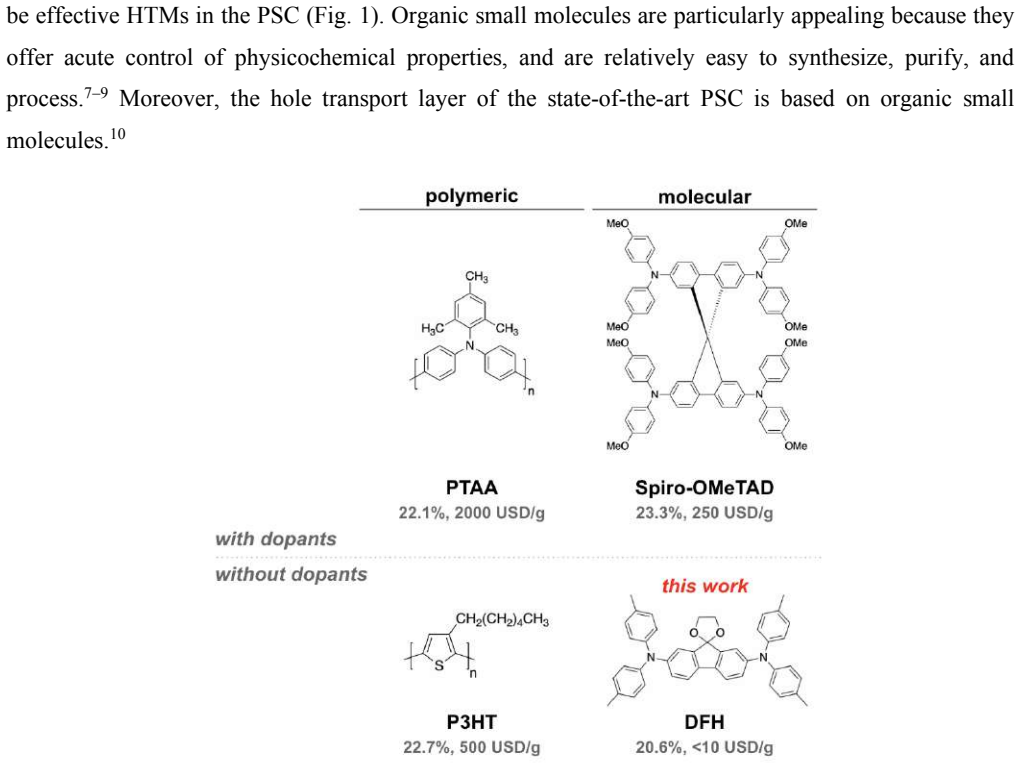
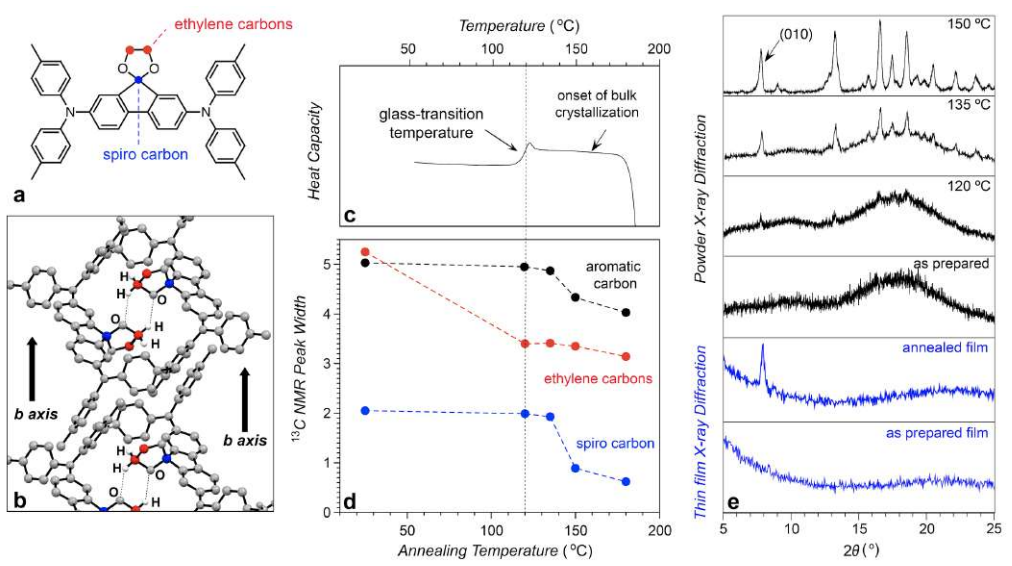
The central object is DFH, a spiro-linked small molecule built from two triphenylamine redox units and a 1,3-dioxolane ring. The mechanism that carries the argument is thermally activated paracrystalline dimer ordering: heating above the glass transition ($T_g\approx120$ °C) but below cold crystallization ($T_{cc}\approx160$ °C) lets the cyclic dioxane groups form directional C–H···O and C–H···π contacts (computed dimer interaction energy roughly 110 kJ/mol), stacking molecules into dimers aligned along the film normal without developing long-range crystallinity. The single GIXD peak assigned to (010) planes is the signature of this out-of-plane order, and the paper uses it to explain both the high measured hole mobility and the improved perovskite morphology grown on top.
What would settle it
Measure the hole mobility of annealed DFH films by a method independent of dielectric constant assumptions, such as time-of-flight or admittance spectroscopy; if the true mobility is an order of magnitude below the reported $10^{-3}\ \mathrm{cm^2\,V^{-1}\,s^{-1}}$, the transport mechanism is unsupported. Alternatively, find an annealing protocol that removes the (010) GIXD peak while preserving the 20% PCE, which would show the ordering is not necessary for the performance.
Extended reading notes
Core claim
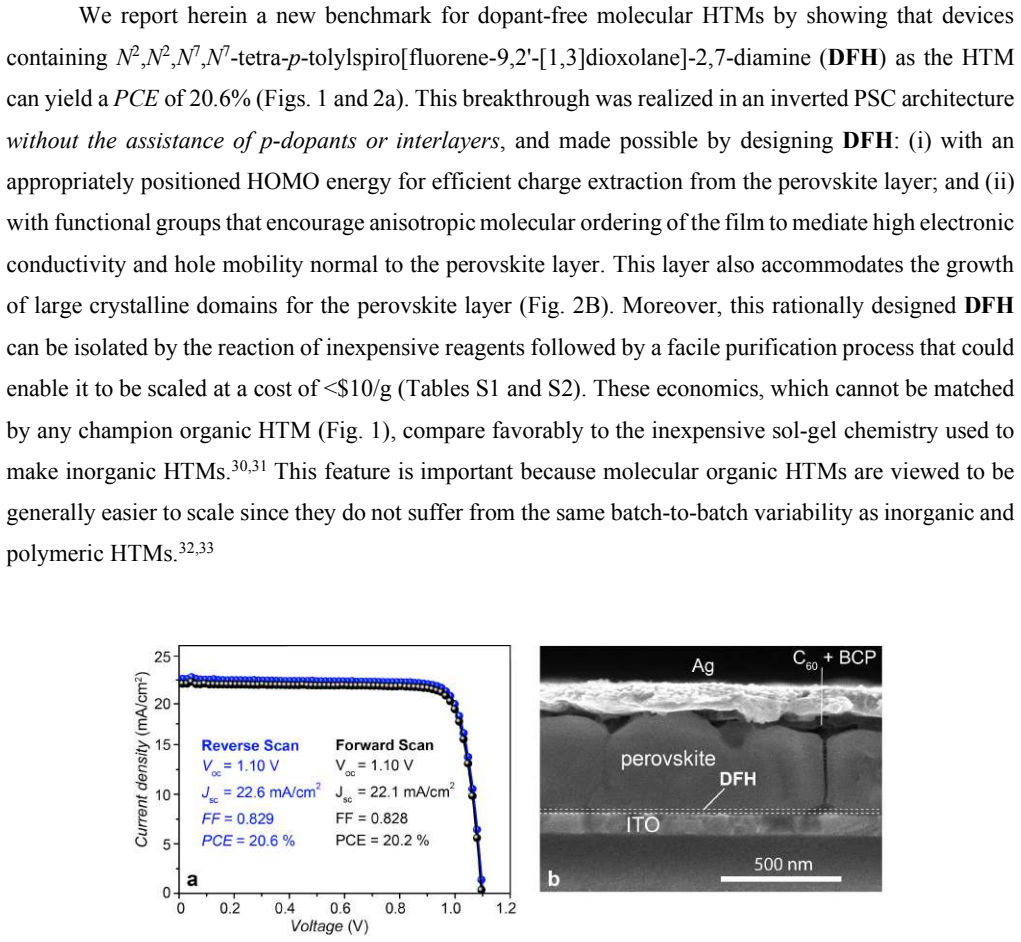
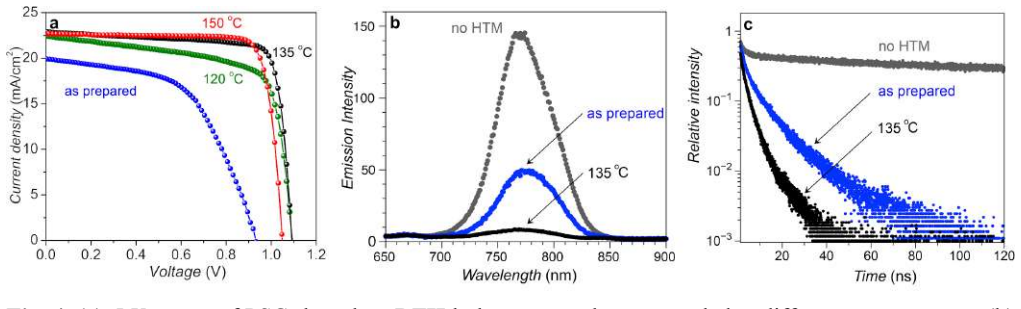
The paper's central claim is that DFH is the first dopant-free molecular hole-transport material to exceed 20% power conversion efficiency in a perovskite solar cell, reaching a champion PCE of 20.6% in an inverted p-i-n device with no dopants or interlayers. The authors ascribe this performance to two linked effects of annealing the DFH film at 135 °C: the molecules reorganize into dimer pairs bound by C–H···O and C–H···π interactions of the 1,3-dioxolane group, forming a paracrystalline texture with a single grazing-incidence X-ray reflection assigned to (010) planes and ordering normal to the substrate; and the annealed surface supports pinhole-free perovskite films with large grains (average 0.6 µm², up to 2 µm) that suppress recombination. The annealed layer extracts holes quickly, quenching more than 95% of perovskite photoluminescence and removing 99% of holes within 20 ns, with an SCLC hole mobility around $1.1\times10^{-3}\ \mathrm{cm^2\,V^{-1}\,s^{-1}}$ and doubled conductivity. The same devices with unannealed DFH give only about 10% PCE, while the 135 °C anneal yields $V_\mathrm{oc}\approx1.08$ V and fill factor 0.81, above the 19.2% best PCE measured on PTAA controls under the same conditions.
Load-bearing premise
The claim collapses if the annealing-induced order inferred from the single X-ray peak assigned to (010) planes is not actually what raises hole mobility and device performance, since the paper's design rationale rests on that causal link.
Editorial extensions
If this is right
- Dopant-free molecular HTMs can cross the 20% PCE threshold, so the common assumption that dopants or interlayers are required for high-efficiency inverted cells needs revision.
- The annealing window between $T_g$ and $T_{cc}$ is a practical processing handle: 135 °C annealing raises the best PCE from 10.2% to 20.6% in this system.
- Because DFH is purified by recrystallization and estimated to cost under $10 per gram, this architecture is compatible with scalable, low-cost manufacturing if the result reproduces.
- The design rule that dopant-free HTMs need large planar π-stacked or donor–acceptor frameworks is directly challenged by a small spiro molecule whose order comes from weak directional interactions.
- DFH provides a same-laboratory comparison point for PTAA: under identical fabrication, DFH's best 20.6% PCE exceeds the 19.2% measured for PTAA.
Reading between the lines
- If the causal story is right, other small molecules bearing polar cyclic groups such as dioxolane or dioxane should show the same annealing-dependent mobility enhancement, giving a general design screen independent of DFH.
- The paper's own data imply a fairly narrow processing window because full crystallization at 150 °C is slightly worse than 135 °C; a manufacturing-scale study would need to map how hotplate uniformity and annealing time shift the PCE distribution.
- Because the reported mobility assumes a dielectric constant of 3 in the SCLC fit, an independent transport measurement such as time-of-flight or admittance spectroscopy on the same annealed films would directly test whether the out-of-plane order is truly responsible for the high mobility.
- The templating of large perovskite grains by annealed DFH suggests that the HTM's surface energy, not just its energy levels, controls absorber quality; comparing DFH with a chemically similar molecule that cannot dimerize would separate electronic from morphological effects.
Signed reviews
Editorial analysis
A structured set of objections, weighed in public.
Referee Report
Summary. The manuscript reports a dopant-free molecular hole-transport material, DFH, a spiro-based compound with two triphenylamine units and a 1,3-dioxolane group, and claims a champion power conversion efficiency of 20.6% in an inverted (p-i-n) perovskite solar cell with ITO|DFH|perovskite|C60|BCP|Ag, with no dopants or interlayers. The authors attribute the performance to thermal annealing that induces paracrystalline dimer ordering, measured hole mobility of about 1e-3 cm2/V/s, and the growth of large perovskite grains. The paper includes synthesis and cost analysis, single-crystal X-ray diffraction, powder and grazing-incidence X-ray diffraction, solid-state NMR, DFT interaction energies, SCLC mobility and conductivity measurements, photoluminescence quenching, and device statistics comparing DFH with PTAA and the prior dopant-free molecular HTM KR321.
Significance. If the 20.6% PCE is a genuine stabilized operating efficiency, this is an important benchmark for dopant-free molecular HTMs: it would be the first molecular HTM to exceed the 20% PCE threshold without dopants or interlayers. The study is strengthened by direct comparison with PTAA under identical conditions, a reasonable number of devices (n=18 for the best condition), detailed structural characterization, a transparent cost model, and independent measurements of mobility, conductivity, and photoluminescence quenching. The central claim is a measured device output, not a model-derived quantity, so the circularity burden is low. However, the champion value is quoted only as a reverse-scan J-V result, and the mechanistic interpretation is explicitly hedged in the text.
major comments (3)
- [Fig. 2a, Table 1, and Fig. S17] The load-bearing claim of a 20.6% PCE benchmark rests on a champion value reported from reverse-scan J-V data at 160 mV/s. The main text never quotes a numeric stabilized maximum-power-point PCE for the champion device; Fig. S17 shows MPP tracking only graphically. Because the mean PCE for the 135 °C condition is 19.3 ± 0.7% and the champion lies 1.3 percentage points above the mean, transient reverse-scan effects could materially overstate the operating efficiency. Please report the stabilized champion PCE numerically and, ideally, the forward/reverse-scan parameters for all cells in the statistics, so that the benchmark claim is verifiable against standard practice in the perovskite solar cell field.
- [Table S5 and main text around Fig. 3] The paper's mechanistic premise is that annealing-induced paracrystalline ordering gives rise to the high hole mobility, which in turn enables the high PCE. However, the measured SCLC mobilities for as-prepared and 135 °C annealed DFH are 0.9 × 10^-3 and 1.1 × 10^-3 cm2/V/s, respectively, which are essentially indistinguishable given the method's typical uncertainty. The text itself uses hedged language ('We infer that this feature is responsible' and 'We assume that the large defect-free grain sizes play a critical role'). The PCE benchmark can stand independently, but the abstract's claim that the benchmark was 'made possible' by the annealing-induced ordering is not directly supported by the mobility data. Please either provide more rigorous evidence (e.g., replicated mobility measurements with error bars and a discussion of the assumed dielectric constant) or temper the causal claims to match the evidence.
- [Fig. 3e and Fig. S7] The assignment of the single low-angle GIXD peak from annealed DFH films to (010) planes is used to infer preferential out-of-plane molecular ordering. This assignment is supported only by comparison with simulated powder XRD from the single-crystal structure and a single 2θ scan; no reciprocal-space map or quantitative orientation analysis is provided. If the assignment is incorrect, the structural hypothesis is weakened, although the device results would be unaffected. Please add more complete GIXD data or explicitly qualify the structural interpretation as tentative.
minor comments (4)
- [Main text, paragraph after Fig. 3d] The text refers to the '1,3-dioxane group' when the compound contains a 1,3-dioxolane group; please correct this typo for consistency with the molecular structure.
- [SI, synthesis of P2] The HRMS calcd formula for P2 is given as [C43H38O2N2]+; the correct formula for the 9-fluorenone ethylene ketal is C15H12O2. Please correct this obvious typographical error.
- [Fig. S17 and Fig. S19] The MPP tracking and operational stability data are shown only graphically. Since the champion PCE is a central claim, please quote the stabilized PCE value in the main text or in the figure caption.
- [Cost analysis, Tables S1 and S2] The <$10/g cost estimate is based only on reagent costs at laboratory scale and does not include labor, purification losses beyond the stated yields, or capital. Please state this limitation explicitly in the text, as the current wording ('can be isolated at a fraction of the cost') is broader than the analysis supports.
Circularity Check
No significant circularity: the headline 20.6% PCE is a measured device result, and the supporting mobility, structural, and DFT analyses are independent measurements not fitted to that result.
full rationale
The paper's central claim is the champion PCE of 20.6%, which is presented as a direct measurement: J-V traces (Fig. 2a, Fig. 4a), tabulated device statistics (Table 1), and IPCE data (Fig. S13). No equation derives the PCE from the molecular or film properties, and no fitted parameter is relabeled as a prediction. The hole mobility is extracted from the standard SCLC Mott-Gurney law with an assumed dielectric constant of 3, but this extraction is independent of the device efficiency and is not used to predict the PCE numerically. The DFT dimer interaction energies are computed from crystallographic coordinates with counterpoise/BSSE corrections, not fitted to device data. The GIXD peak assignment to the (010) planes is a crystallographic interpretation, and the causal statements are explicitly hedged with 'We infer' and 'We assume,' so the performance claim does not reduce to those interpretations. The only self-citations (refs 38 and 47) are background design inspiration and a previously reported perovskite deposition method; neither is load-bearing in a way that forces the reported PCE or mobility. Overall, the measured benchmark stands independently of the structural mechanism, so there is no circularity by the paper's own derivation chain.
Assumptions & free parameters
free parameters (1)
- Relative dielectric constant epsilon of DFH =
3 (assumed, not measured)
assumptions (4)
- domain assumption SCLC Mott-Gurney model applies to the hole-only devices
- domain assumption The single GIXD reflection from annealed DFH films is the (010) plane and indicates out-of-plane ordering
- domain assumption DFT at omega-B97XD/6-311G** gives reliable reorganization energies and dimer interaction energies
- domain assumption Perovskite valence band maximum is -5.4 eV
Cite this review
Pith. "Pith review of Dopant-free molecular hole transport material that mediates a 20% power conversion efficiency in a perovskite solar cell." pith.science (2026). https://pith.science/paper/XJIGULGS
@misc{pith2026190804439,
  author       = {Pith},
  title        = {Pith review of: Dopant-free molecular hole transport material that mediates a 20% power conversion efficiency in a perovskite solar cell},
  year         = {2026},
  howpublished = {\url{https://pith.science/paper/XJIGULGS}},
  note         = {Machine review of arXiv:1908.04439}
}
read the original abstract
Organic molecular hole-transport materials (HTMs) are appealing for the scalable manufacture of perovskite solar cells (PSCs) because they are easier to reproducibly prepare in high purity than polymeric and inorganic HTMs. There is also a need to construct PSCs without dopants and additives to avoid formidable engineering and stability issues. We report here a power conversion efficiency (PCE) of 20.6% with a molecular HTM in an inverted (p-i-n) PSC without any dopants or interlayers. This new benchmark was made possible by the discovery that annealing a spiro-based dopant-free HTM (denoted DFH) containing redox-active triphenyl amine (TPA) units undergoes preferential molecular organization normal to the substrate. This structural order, governed by the strong intermolecular interactions of the DFH dioxane groups, affords high intrinsic hole mobility (1x10⁻³ cm2 V-1 s-1). Annealing films of DFH also enables the growth of large perovskite grains (up to 2 um) that minimize charge recombination in the PSC. DFH can also be isolated at a fraction of the cost of any other organic HTM.
Figures
Figures from the paper (1 more)
Reference graph
Works this paper leans on
-
[1]
Dopant-free molecular hole transport material that mediates a 20% power conversion efficiency in a perovskite solar cell Yang Cao1,4,†, Yunlong Li2,†, Thomas Morrissey1,4, Brian Lam1, Brian O. Patrick1, David J. Dvorak4, Zhicheng Xia1, Timothy L. Kelly2,*, Curtis P. Berlinguette1,3,4,* 1Department of Chemistry, The University of British Columbia, 2036 Mai...
-
[2]
determined by the XT structure solution program using Intrinsic Phasing and refined by Least Squares using version 2017/1 of XL. There is a small amount of disorder in the 1,3-dioxolane moiety that was modelled in two orientations. Table S4. Summary of the Structure Parameters of DFH Single Crystal. Chemical Formula C43H38N2O2 Density of Crystal, Dcalc. (...
work page 2017
-
[3]
Molecular properties such as molecular energies, HOMO levels and electrostatic surface potential mapping were modeled using long-range corrected ω-B97XD functional 4 with 6-311G** basis set. The reorganization energy λ (0.021 Hartree or 0.57 eV) of DFH was calculated the following equation: λ = E+*- E - E+ + E*, where E is the energy of the neutral state ...
-
[4]
(a) J-V curves of PSCs based on DFH hole transport layer annealed at different temperatures. (b) steady-state fluorescence quenching of perovskite thin films by the underlying DFH layers; (c) fluorescence decay kinetics of PMMA encapsulated perovskite thin films on different DFH thin films illuminated by a 553-nm laser. Conclusions We have demonstrated th...
work page 2012
-
[9]
Initial PCE = 19.3%, Voc = 1.09 V; FF = 0.79. 21 Fig. NMR1. 1H NMR spectrum of P1 in CDCl3. Fig. NMR2.13C{1H} NMR spectrum of P1 in CDCl3 22 Fig. NMR3.1H NMR spectrum of P2 in CD2Cl2. Fig. NMR4. 13C{1H} NMR spectrum of P2 in CD2Cl2. 23 Fig. NMR5.1H NMR spectrum of DFH in CD2Cl2. Fig. NMR6. 13C{1H} NMR spectrum of DFH in CD2Cl2. 24 References : 1 G. M. She...
work page 2015
-
[10]
6 J. B. Foresman and Æ. Frisch., Exploring Chemistry with Electronic Structure Methods, 3rd ed. (Gaussian, Inc., Wallingford, CT, 2015). 7 M. Stolterfoht, C. M. Wolff, Y. Amir, A. Paulke, L. Perdigón-Toro, P. Caprioglio and D. Neher, Energy Environ. Sci., 2017, 10, 1530–1539
work page 2015
-
[311]
9 33 H. K. H. Lee, Z. Li, I. Constantinou, F. So, S. W. Tsang and S. K. So, Adv. Energy Mater., 2014, 4, 1400768. 34 P. Ganesan, K. Fu, P. Gao, I. Raabe, K. Schenk, R. Scopelliti, J. Luo, L. H. Wong, M. Grätzel and M. K. Nazeeruddin, Energy Environ. Sci., 2015, 8, 1986–1991. 35 M. Saliba, S. Orlandi, T. Matsui, S. Aghazada, M. Cavazzini, J.-P. Correa-Baen...
work page 2014
-
[486]
3 J. Burschka, N. Pellet, S.-J. Moon, R. Humphry-Baker, P. Gao, M. K. Nazeeruddin and M. Grätzel, Nature, 8 2013, 499, 316–319. 4 H. Zhou, Q. Chen, G. Li, S. Luo, T.-B. Song, H.-S. Duan, Z. Hong, J. You, Y. Liu and Y. Yang, Science, 2014, 345, 542–546. 5 P. Kung, M. Li, P. Lin, Y. Chiang, C. Chan, T. Guo and P. Chen, Adv. Mater. Interfaces, 2018, 5, 18008...
work page 2013
Show all 10 references
-
[500]
11 N. J. Jeon, H. Na, E. H. Jung, T.-Y. Yang, Y. G. Lee, G. Kim, H.-W. Shin, S. Il Seok, J. Lee and J. Seo, Nature Energy, 2018, 3, 682–689. 12 T. H. Schloemer, J. A. Christians, J. M. Luther and A. Sellinger, Chem. Sci., 2019, 10, 1904–1935. 13 J. A. Christians, P. A. Miranda...
2018
-
[1070]
49 W. Chen, Y. Wu, J. Fan, A. B. Djurišić, F. Liu, H. W. Tam, A. Ng, C. Surya, W. K. Chan, D. Wang and Z.-B. He, Adv. Energy Mater., 2018, 8, 1703519. 50 D. Bi, C. Yi, J. Luo, J.-D. Décoppet, F. Zhang, S. M. Zakeeruddin, X. Li, A. Hagfeldt and M. Grätzel, Nature Energy, 2016, ...
2018
Reviewed August 14, 2026 · model on record in the stance chip above.
Discussion (0). Continue with ORCID to comment.