REVIEW 3 major objections 4 minor 47 references
Implementation of contact angles in the pseudopotential lattice Boltzmann simulations with curved boundaries
T0 review · 3 major / 4 minor · reviewed 2026-08-14 · deepseek-v4-flash
Pith's one-line read The paper proposes an improved virtual-density scheme that replaces the constant virtual wall density in pseudopotential lattice Boltzmann simulations with a locally averaged virtual density, eliminating the unphysical thick mass-transfer…
desk verdict A solid, incremental contribution to pseudopotential LB contact-angle modeling; the local virtual-density idea is genuinely new and clearly explained, but the paper leaves a real gap at very high contact angles where the improved scheme may quietly revert to the behavior it claims to fix. read the letter →
The pith
A machine-rendered reading of the paper's core claim, the machinery that carries it, and where it could break.
The reading
What carries the argument
The central object is the local virtual density $\rho_{\mathrm{ave}}(\mathbf{x})$ defined by Eq. (17): at each solid lattice point, the density assigned to the solid phase is a weighted average over neighboring fluid nodes, using the same weights as the pseudopotential interaction force. This local value is then scaled by $\varphi$ or reduced by $\Delta\rho$ through Eq. (16) to set the contact angle, and clipped to the liquid-gas density range. The local averaging is the mechanism that carries the argument: it makes the solid's pseudopotential respond to the local fluid distribution, so the boundary does not impose the artificial density jump that produces the mass-transfer layer, while the scheme keeps the simplicity and low spurious currents of the original virtual-density treatment.
What would settle it
Fix one value of $\varphi$ (or $\Delta\rho$), lattice resolution, and equation of state, and measure the static contact angle on cylindrical or spherical surfaces of several radii; if the angle drifts systematically with curvature, or a concave boundary redevelops a density layer thicker than one or two lattices near the wall, the local-average premise is insufficient.
Extended reading notes
Core claim
The central claim is that the thick mass-transfer layer seen with the virtual-density scheme comes from using a constant virtual density $\rho_w$ in the solid, and that replacing it with a local virtual density $\rho_w(\mathbf{x})$ built from the weighted average $\rho_{\mathrm{ave}}(\mathbf{x})$ of neighboring fluid densities removes the layer. The proposed update is Eq. (16): for decreasing contact angle, $\rho_w(\mathbf{x})=\varphi\rho_{\mathrm{ave}}(\mathbf{x})$ with $\varphi\ge 1$; for increasing contact angle, $\rho_w(\mathbf{x})=\rho_{\mathrm{ave}}(\mathbf{x})-\Delta\rho$ with $\Delta\rho\ge 0$, then the value is clipped to $[\rho_g,\rho_l]$. With $\varphi=1$ or $\Delta\rho=0$ the scheme reduces to the standard near-90-degree case. The paper validates the scheme with static contact angles on a circular cylinder and on a sphere, shows density profiles where the original scheme's layer is about four lattices thick and the improved one has no comparable layer, and reports maximum spurious currents below 0.006 for the virtual-density-based schemes versus about 0.1 for the solid-fluid interaction scheme. In a droplet-impact test at Reynolds number 600 and a 60-degree contact angle, the improved scheme matches the geometric-formulation scheme, which the paper also extends to curved pseudopotential boundaries but notes is complicated and not directly usable in three dimensions.
Load-bearing premise
The load-bearing premise is that a single scalar multiplier or offset applied to a weighted local average of neighboring fluid densities, Eqs. (16) and (17), is enough to represent the wetting condition at every point of a curved solid boundary, so the same parameter gives the same contact angle regardless of local curvature and surrounding flow.
Editorial extensions
If this is right
- Pseudopotential lattice Boltzmann simulations can impose contact angles on curved solids with a one-parameter local-density formula and without the thick mass-transfer layer near the boundary.
- The scheme works in three dimensions on a spherical surface, whereas the curved geometric-formulation scheme cannot be applied directly in three dimensions.
- Maximum spurious currents stay below 0.006 for the improved scheme, roughly two orders of magnitude below the order-0.1 values of the solid-fluid interaction scheme.
- In a droplet-impact test at Reynolds number 600 and a 60-degree contact angle, the improved scheme agrees with the geometric-formulation scheme, showing that removing the mass layer restores agreement for dynamic wetting.
- Because the improved scheme keeps the interaction-force structure of the original virtual-density scheme, it preserves ease of implementation and remains compatible with the thermodynamic-consistency forcing used by the model.
Reading between the lines
- Beyond the paper, the same local-average prescription could plausibly cure the fictitious-density mass-transfer artifact reported in color-gradient multiphase lattice Boltzmann schemes, since the mechanism of a constant wall density is common to both.
- Because the improved scheme only averages neighboring fluid densities with fixed weights, it should transfer naturally to moving or deformable solid boundaries, where the curved geometric-formulation scheme becomes impractical.
- The mapping from $\varphi$ or $\Delta\rho$ to the contact angle is demonstrated on one cylinder and one sphere; a systematic sweep over surface curvature would show whether the mapping is universal or needs recalibration.
- The heuristic scalar in Eq. (16) invites a derivation from a local force balance or Young's-law argument that would turn a calibrated parameter into a predictive one.
Signed reviews
Editorial analysis
A structured set of objections, weighed in public.
Referee Report
Summary. The paper investigates contact-angle implementation in pseudopotential lattice Boltzmann simulations with curved boundaries. It compares four schemes: the solid-fluid interaction scheme, the constant virtual-density scheme, a curved geometric-formulation scheme extended from the phase-field method, and a newly proposed improved virtual-density scheme. In the improved scheme, Eqs. (16)-(17), the virtual density at a solid point is obtained from a weighted average of neighboring fluid densities, multiplied by a factor phi or reduced by an offset DeltaRho, so that the virtual density is local rather than constant. The paper claims this improved scheme removes the thick mass-transfer layer produced by the constant virtual-density scheme while retaining its simplicity and low spurious currents. Validation is provided through static contact-angle tests on a cylindrical surface (Figs. 4-8), spurious-current comparisons (Figs. 9-10), density extrema comparisons (Fig. 11), Poiseuille flow between parallel plates (Fig. 12), droplet impact on a cylinder (Fig. 13), and static contact angles on a spherical surface in 3D (Fig. 14). The central claim is that the improved scheme is a simple, low-artifact contact-angle treatment that works in both 2D and 3D curved geometries.
Significance. If the central claim holds, this is a practically useful contribution to the pseudopotential LB community: it offers a simple local virtual-density formula that cures the mass-transfer-layer artifact of the standard virtual-density scheme without the implementation complexity of the geometric-formulation scheme and with much smaller spurious currents than the solid-fluid interaction scheme. The paper contains several direct quantitative comparisons that support the central claim, including density profiles showing the mass-transfer layer (Fig. 7), maximum spurious currents across a range of contact angles (Fig. 10), a Poiseuille-flow benchmark against the analytical solution (Fig. 12), and a 3D demonstration on a spherical surface (Fig. 14). The manuscript is clearly written and the numerical tests are reproducible from the description, although no code is provided. The main weakness is that the absence of the mass-transfer layer is not demonstrated with density diagnostics at high contact angles, where the improved scheme's local virtual density can degenerate to a constant value in uniform density regions, potentially reproducing the artifact it claims to eliminate.
major comments (3)
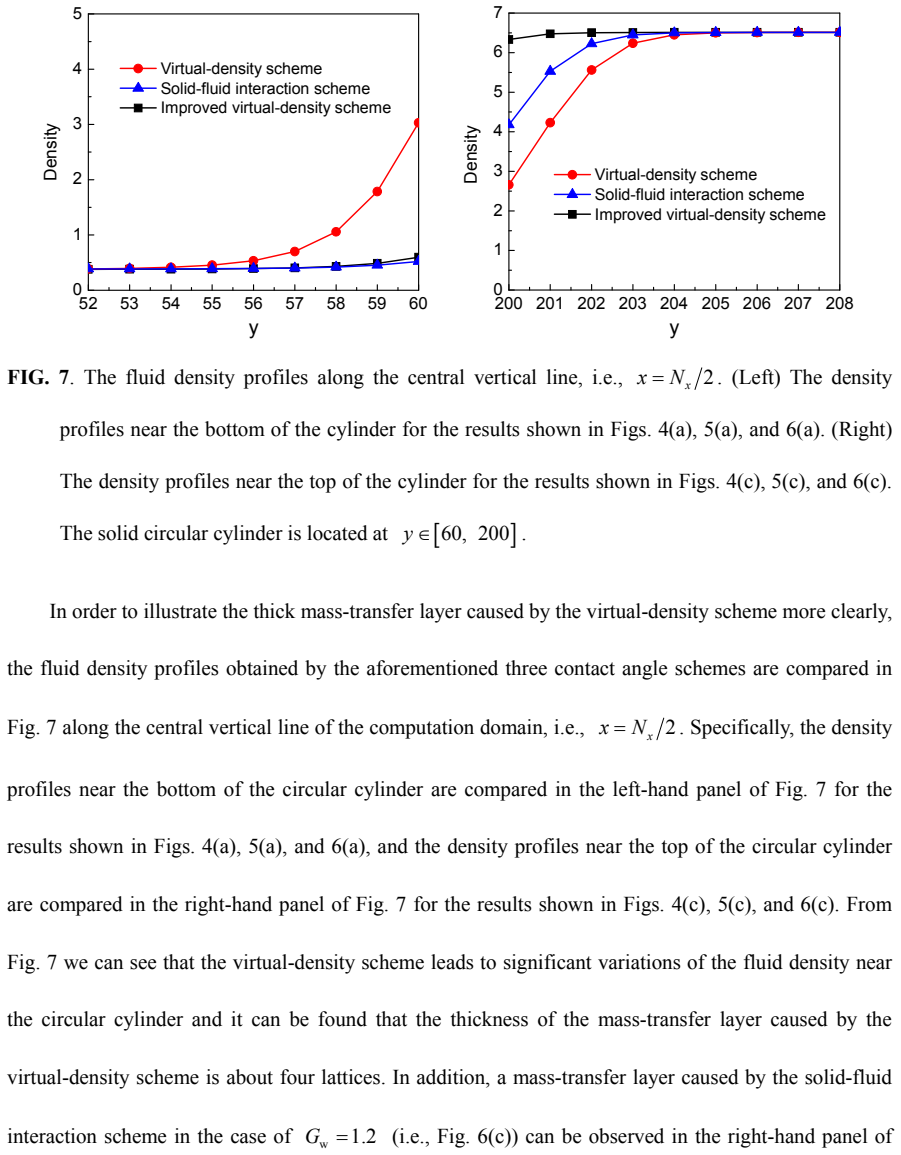
- [Sec. IV.B, Fig. 12] The Poiseuille-flow test shows that the improved virtual-density scheme matches the analytical solution for theta = 158 degrees, but no density profiles normal to the wall are reported for this high-contact-angle case. Because the mass-transfer layer is a density artifact, a velocity profile that matches the analytical solution is only indirect evidence of its absence: a thin low-density wall layer can in principle leave the bulk velocity nearly parabolic. The authors should provide density profiles for the improved scheme at theta around 145-158 degrees, for both the flat channel and the curved cylinder, to directly demonstrate the absence of the mass-transfer layer in the high-theta regime.
- [Sec. III.B, Eq. (16)] In a region where the fluid density is uniform, rho_ave in Eq. (17) is constant, so the improved virtual density rho_w = rho_ave - DeltaRho in Eq. (16) reduces to a constant value. For large positive contact angles, DeltaRho is large enough that rho_w approaches rho_g, which is exactly the condition under which the original virtual-density scheme produces the four-lattice mass-transfer layer shown in Fig. 7. The paper offers no mechanistic explanation for why the improved scheme suppresses the layer in this limiting case. The authors should either provide an analysis of this degeneracy or present numerical evidence (e.g., density profiles) showing that the local averaging prevents the artifact even when rho_w is effectively constant and close to rho_g.
- [Sec. IV.A, Figs. 5 and 7] The density-profile comparison in Fig. 7 covers only the improved scheme at theta approximately 34 and 125 degrees. The claim that the improved scheme 'does not suffer from a thick mass-transfer layer' is thereby established only for moderate contact angles. The high-contact-angle regime on a curved boundary, which is where the original scheme behaves worst, is not assessed with density diagnostics. The 3D test in Fig. 14(c) reaches theta approximately 145 degrees but shows only density contours, not a quantitative profile. The central claim of the abstract should be supported by density profiles for the improved scheme at high contact angles on the cylindrical surface.
minor comments (4)
- [Sec. III.B, Eq. (16)] The phrases 'for decreasing' and 'for increasing' in Eq. (16) are ambiguous; they should be clarified as decreasing or increasing the contact angle relative to 90 degrees, and the sign convention should be stated explicitly.
- [Captions of Figs. 4, 5, 6, 8, and 14] The contact angles are reported as approximate values, but no description is given of how they are measured from the simulation results. A brief statement of the measurement procedure (e.g., fitting the interface to a circle and measuring the tangent angle) would improve reproducibility.
- [Sec. IV.B, relative error definition] The relative error E_r for the Poiseuille flow is introduced in the text but the equation appears garbled in the typeset version; it should be presented in a clearly formatted equation.
- [Sec. IV.A, Fig. 10] The spurious-current comparison is made at contact angles that are only approximately matched across schemes (e.g., 119-125 degrees in Fig. 9). The authors should state whether the small differences in the target angle affect the quantitative comparison.
Circularity Check
No significant circularity: the proposed scheme is benchmarked against the analytical Poiseuille solution and against existing contact-angle schemes; the tuned constants are implementation parameters, not fitted predictions.
full rationale
The central claim is that the improved virtual-density scheme (Eqs. (16)-(17)) removes the thick mass-transfer layer while retaining simplicity and low spurious currents. This claim is supported by independent numerical tests: the density profiles in Fig. 7 compare the three schemes, the velocity profiles in Fig. 12 are checked against the analytical Poiseuille solution, and the spurious-current comparison in Fig. 10 is an external diagnostic. The constants phi and DeltaRho are not treated as predictions of the contact angle; the paper states that different contact angles can be realized by tuning them, and the resulting angles are read from the simulations. The geometric-formulation extension from Liu and Ding [26] is clearly attributed to prior work and is used as a comparison scheme, not as the source of the improved scheme's validity. Self-citations (e.g., Refs. [24,25,28,33,47]) concern baseline forcing schemes, flat-surface contact-angle implementations, the D3Q19 MRT model, and known curved-boundary mass leakage; none of these is invoked as an unverified uniqueness theorem or as the sole support for the main result. Therefore no step in the derivation chain reduces to its own inputs by construction.
Assumptions & free parameters
free parameters (2)
- phi =
1.4 (theta ~ 34 deg), 1.135 (theta ~ 60 deg), 1.2 (theta ~ 53 deg), 1.0 (theta ~ 88-90 deg)
- DeltaRho =
0.5 (theta ~ 125 deg), 0.55 (theta ~ 145 deg)
assumptions (4)
- domain assumption Peng-Robinson equation of state with omega = 0.344 and T = 0.86 T_c yields the stated coexisting densities rho_g ~ 0.38 and rho_l ~ 6.5.
- domain assumption The MRT forcing scheme of Ref. [28] achieves thermodynamic consistency for the pseudopotential model.
- domain assumption The halfway bounce-back scheme adequately represents curved solid walls for the tested flows.
- ad hoc to paper The local virtual-density formula, Eqs. (16)-(17), is an appropriate representation of wetting on arbitrary curved boundaries.
Cite this review
Pith. "Pith review of Implementation of contact angles in the pseudopotential lattice Boltzmann simulations with curved boundaries." pith.science (2026). https://pith.science/paper/YLNKCLPD
@misc{pith2026190804443,
  author       = {Pith},
  title        = {Pith review of: Implementation of contact angles in the pseudopotential lattice Boltzmann simulations with curved boundaries},
  year         = {2026},
  howpublished = {\url{https://pith.science/paper/YLNKCLPD}},
  note         = {Machine review of arXiv:1908.04443}
}
read the original abstract
The pseudopotential multiphase lattice Boltzmann (LB) model is a very popular model in the LB community for simulating multiphase flows. When the multiphase modeling involves a solid boundary, a numerical scheme is required to simulate the contact angle at the solid boundary. In this work, we aim at investigating the implementation of contact angles in the pseudopotential LB simulations with curved boundaries. In the pseudopotential LB model, the contact angle is usually realized by employing a solid-fluid interaction or specifying a constant virtual wall density. However, it is shown that the solid-fluid interaction scheme yields very large spurious currents in the simulations involving curved boundaries, while the virtual-density scheme produces an unphysical thick mass-transfer layer near the solid boundary although it gives much smaller spurious currents. We also extend the geometric-formulation scheme in the phase-field method to the pseudopotential LB model. Nevertheless, in comparison with the solid-fluid interaction scheme and the virtual-density scheme, the geometric-formulation scheme is relatively difficult to implement for curved boundaries and cannot be directly applied to three-dimensional space. By analyzing the features of these three schemes, we propose an improved virtual-density scheme to implement contact angles in the pseudopotential LB simulations with curved boundaries, which does not suffer from a thick mass-transfer layer near the solid boundary and retains the advantages of the original virtual-density scheme, i.e., simplicity, easiness for implementation, and low spurious currents.
Figures

Figures from the paper (1 more)
Reference graph
Works this paper leans on
- [1]
-
[2]
C. K. Aidun and J. R. Clausen, Annual Review of Fluid Mechanics 42, 439 (2010)
work page 2010
-
[3]
Q. Li, K. H. Luo, Q. J. Kang, Y . L. He, Q. Chen, and Q. Liu, Progress in Energy and Combustion Science 52, 62 (2016)
work page 2016
-
[4]
A. Xu, W. Shyy, and T. Zhao, Acta Mechanica Sinica 33, 555 (2017)
work page 2017
-
[5]
Succi, Europhysics Letters 109, 50001 (2015)
S. Succi, Europhysics Letters 109, 50001 (2015)
work page 2015
- [6]
- [7]
- [8]
Show all 47 references
-
[9]
Shan and H
X. Shan and H. Chen, Phys. Rev. E 47, 1815 (1993)
1993
-
[10]
Shan and H
X. Shan and H. Chen, Phys. Rev. E 49, 2941 (1994)
1994
-
[11]
Shan, Phys
X. Shan, Phys. Rev. E 77, 066702 (2008)
2008
-
[12]
N. S. Martys and H. Chen, Phys. Rev. E 53, 743 (1996)
1996
-
[13]
Raiskinmäki, A
P. Raiskinmäki, A. Koponen, J. Merikoski, and J. Timonen, Computational Materials Science 18, 7 (2000)
2000
-
[14]
Raiskinmäki, A
P. Raiskinmäki, A. Shakib-Manesh, A. Jäsberg, A. Koponen, J. Merikoski, and J. Timonen, Journal of Statistical Physics 107, 143 (2002)
2002
-
[15]
Q. Kang, D. Zhang, and S. Chen, Phys. Fluids 14, 3203 (2002)
2002
-
[16]
Q. Kang, D. Zhang, and S. Chen, Journal of Fluid Mechanics 545, 41 (2005). 25
2005
-
[17]
C. E. Colosqui, M. E. Kavousanakis, A. G. Papathanasiou, and I. G. Kevrekidis, Phys. Rev. E 87, 013302 (2013)
2013
-
[18]
Benzi, L
R. Benzi, L. Biferale, M. Sbragaglia, S. Succi, and F. Toschi, Phys. Rev. E 74, 021509 (2006)
2006
-
[19]
Latva-Kokko and D
M. Latva-Kokko and D. H. Rothman, Phys. Rev. E 72, 046701 (2005)
2005
-
[20]
T. Akai, B. Bijeljic, and M. J. Blunt, Advances in Water Resources 116, 56 (2018)
2018
-
[21]
Huang, Z
H. Huang, Z. Li, S. Liu, and X.-y. Lu, International Journal for Numerical Methods in Fluids 61, 341 (2009)
2009
-
[22]
Huang, D
H. Huang, D. T. Thorne, M. G. Schaap, and M. C. Sukop, Phys. Rev. E 76, 066701 (2007)
2007
-
[23]
Ding and P
H. Ding and P. D. M. Spelt, Phys. Rev. E 75, 046708 (2007)
2007
-
[24]
Q. Li, P. Zhou, and H. J. Yan, Langmuir 32, 9389 (2016)
2016
-
[25]
Y . Yu, Q. Li, C. Q. Zhou, P. Zhou, and H. J. Yan, Applied Thermal Engineering 127, 1346 (2017)
2017
-
[26]
Liu and H
H.-R. Liu and H. Ding, Journal of Computational Physics 294, 484 (2015)
2015
-
[27]
K. N. Premnath and J. Abraham, Journal of Computational Physics 224, 539 (2007)
2007
-
[28]
Q. Li, K. H. Luo, and X. J. Li, Phys. Rev. E 87, 053301 (2013)
2013
-
[29]
d'Humières, I
D. d'Humières, I. Ginzburg, M. Krafczyk, P. Lallemand, and L. S. Luo, Philosophical Transactions of the Royal Society of London, Series A 360, 437 (2002)
2002
-
[30]
M. E. McCracken and J. Abraham, Phys. Rev. E 71, 036701 (2005)
2005
-
[31]
L.-S. Luo, W. Liao, X. Chen, Y . Peng, and W. Zhang, Phys. Rev. E 83, 056710 (2011)
2011
-
[32]
A. Xu, T. S. Zhao, L. An, and L. Shi, International Journal of Heat and Fluid Flow 56, 261 (2015)
2015
-
[33]
Q. Li, D. H. Du, L. L. Fei, and K. H. Luo, Computers & Fluids 186, 128 (2019)
2019
-
[34]
Lallemand and L.-S
P. Lallemand and L.-S. Luo, Phys. Rev. E 61, 6546 (2000)
2000
-
[35]
Yuan and L
P. Yuan and L. Schaefer, Phys. Fluids 18, 042101 (2006)
2006
-
[36]
Huang, M
H. Huang, M. Krafczyk, and X. Lu, Phys. Rev. E 84, 046710 (2011)
2011
-
[37]
Q. Li, K. H. Luo, and X. J. Li, Phys. Rev. E 86, 016709 (2012)
2012
-
[38]
Sbragaglia, R
M. Sbragaglia, R. Benzi, L. Biferale, S. Succi, K. Sugiyama, and F. Toschi, Phys. Rev. E 75, 026702 (2007). 26
2007
-
[39]
Zhang, K
D. Zhang, K. Papadikis, and S. Gu, International Journal of Multiphase Flow 64, 11 (2014)
2014
-
[40]
Q. Li, K. H. Luo, Q. J. Kang, and Q. Chen, Phys. Rev. E 90, 053301 (2014)
2014
-
[41]
Z. Xu, H. Liu, and A. J. Valocchi, Water Resources Research 53 (2017)
2017
-
[42]
Q. Li, Q. J. Kang, M. M. Francois, Y . L. He, and K. H. Luo, Int. J. Heat Mass Transf. 85, 787 (2015)
2015
-
[43]
A. J. C. Ladd, Journal of Fluid Mechanics 271, 285 (1994)
1994
-
[44]
Mei, L.-S
R. Mei, L.-S. Luo, and W. Shyy, Journal of Computational Physics 155, 307 (1999)
1999
-
[45]
M. H. Bouzidi, M. Firdaouss, and P. Lallemand, Phys. Fluids 13, 3452 (2001)
2001
-
[46]
Zhao and W.-A
W. Zhao and W.-A. Yong, Journal of Computational Physics 329, 1 (2017)
2017
-
[47]
Y . Yu, Q. Li, and Z. X. Wen, arXiv: 1908.09235, (2019)
2019 arXiv
Reviewed August 14, 2026 · model on record in the stance chip above.
Discussion (0). Continue with ORCID to comment.