REVIEW 3 major objections 5 minor 15 references
Einconv: Exploring Unexplored Tensor Network Decompositions for Convolutional Neural Networks
T0 review · 3 major / 5 minor · reviewed 2026-08-14 · deepseek-v4-flash
Pith's one-line read By writing convolution filters as hypergraphs, the paper maps a space of tensor decompositions and reports unnamed variants that beat standard layers on accuracy at matched cost.
desk verdict Solid theoretical framework for CNN decompositions, but the headline empirical claim is undermined by test-set-overfit architecture search. read the letter →
The pith
A machine-rendered reading of the paper's core claim, the machinery that carries it, and where it could break.
The reading
What carries the argument
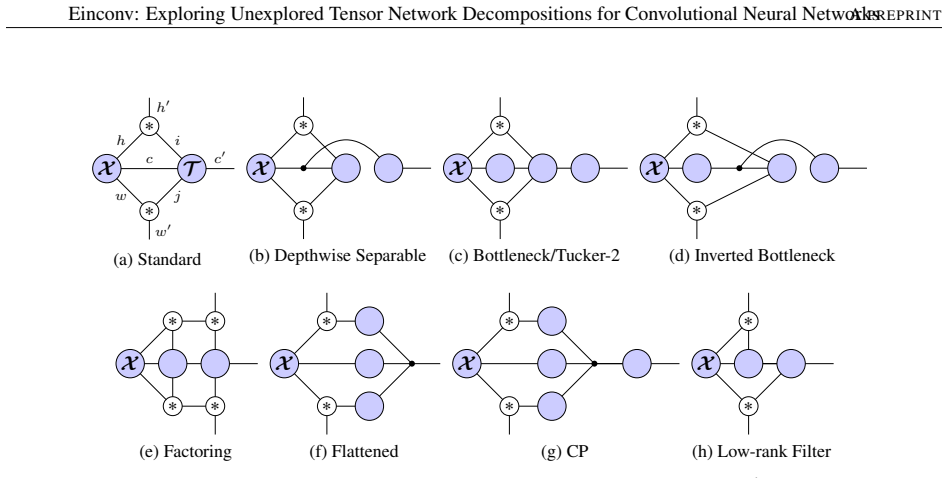
The carrying object is the Einconv hypergraph: each tensor in a decomposition is a vertex, each index shared by tensors for summation is a hyperedge, and outer indices for spatial height, width, and channels dangle from the diagram. Fixed binary tensors $P$ and $Q$ act as dummy vertices that encode the input-kernel index coupling defining a convolution, and summation over shared indices is exactly the Einstein summation convention. The machinery does two jobs: it subsumes the known light-weight layers as particular hypergraphs, and its redundancy-reduction propositions, which remove subset vertices, unit inner dimensions, and duplicated hyperedges, and count filter factorizations via the integer partition function, make the nonredundant space finite, which is what allows exhaustive enumeration for small cases and a mutation-based genetic search over the nonlinear extension.
What would settle it
Re-run the Section 6.2 genetic search with the test set fully held out, selecting on validation accuracy and never touching the test set during search, and train each finalist several times from different seeds. If the best Einconv layers no longer exceed about 0.91 test accuracy on LeNet-5/Fashion-MNIST, or the gap against standard convolution falls within seed-to-seed variance, the central outperformance claim is refuted.
Extended reading notes
Core claim
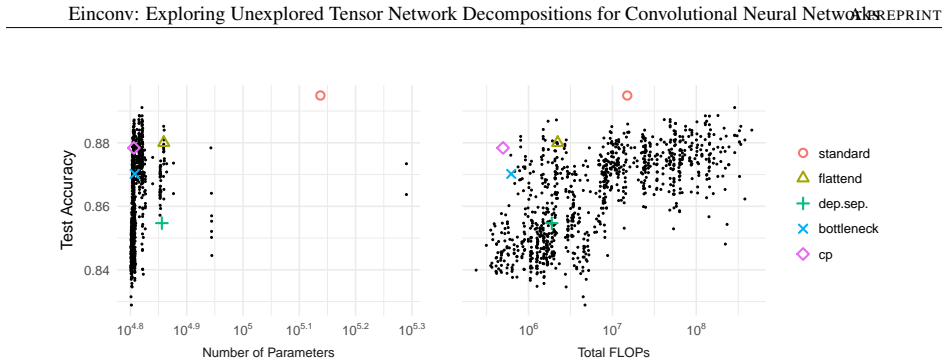
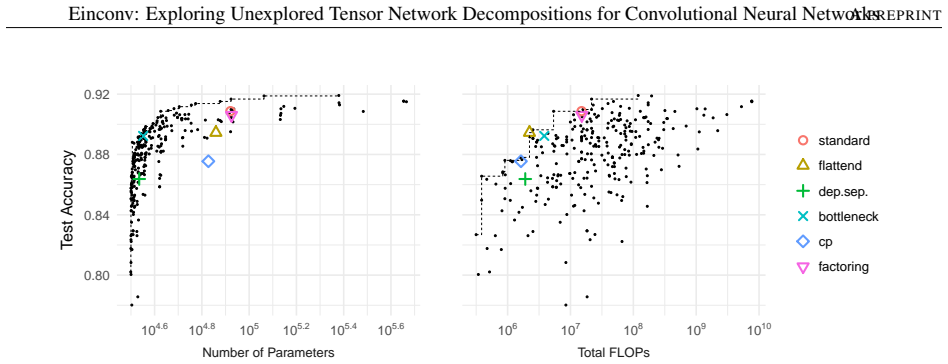
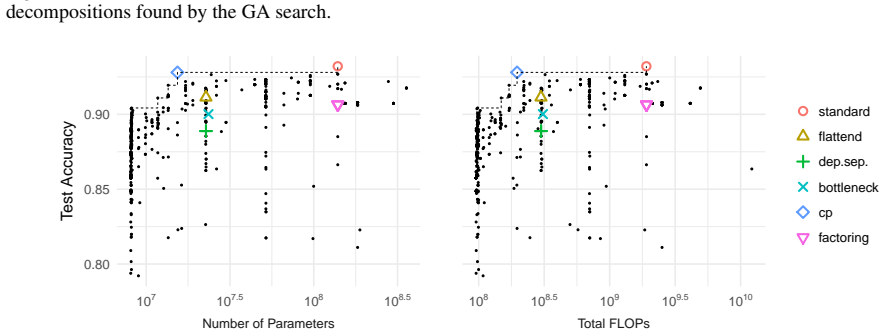
The paper's central claim is that every convolutional layer may be written as a sum-product of tensors over shared indices, and that the hypergraph recording which tensors share which indices determines the layer's cost and representational form. Known modules, including depthwise separable convolution, ResNet bottlenecks, MobileNet inverted bottlenecks, and CP and Tucker-2 decompositions, appear as particular hypergraphs, and the notation extends cleanly to 3D convolution. Using redundancy-reduction rules, the paper proves that the set of nonredundant hypergraphs realizing a fixed filter size is finite, so for a $3\times 3$ kernel with at most two inner indices it can enumerate all 901 nonredundant decompositions; training these on Fashion-MNIST with LeNet-5 shows unnamed Einconv layers filling the accuracy/FLOPs gap between standard convolution and CP decomposition. Since inserting nonlinear activations between tensors makes enumeration impossible, the paper searches the enlarged space with a multiobjective genetic algorithm and reports that unnamed Einconv layers beat standard convolution (about 0.92 versus about 0.91 test accuracy) on LeNet-5/Fashion-MNIST, and beat the named baselines other than standard and CP convolutions on ResNet-50/CIFAR-10.
Load-bearing premise
The load-bearing assumption is that the test accuracy of a single training run is an unbiased fitness signal for the search; the paper's Section 6.2 explicitly optimizes test accuracy and parameter count with NSGA-II, so if test-set contact steered the search or the single runs are noisy, the reported outperformance of Einconv layers over standard and CP convolutions is not established.
Editorial extensions
If this is right
- For any fixed filter size and inner-index budget, the set of nonredundant decompositions is finite, so the design space of linear light-weight convolution layers can in principle be exhausted rather than hand-curated.
- In the 2D enumeration, standard convolution and CP decomposition occupy the extreme accuracy/FLOPs points while unnamed Einconv layers fill the middle, so intermediate cost regimes have practical decompositions beyond the named ones.
- With nonlinear activations inserted between tensors, the genetic search finds unnamed Einconv layers whose best accuracy (about 0.92) exceeds standard convolution (about 0.91) on LeNet-5/Fashion-MNIST.
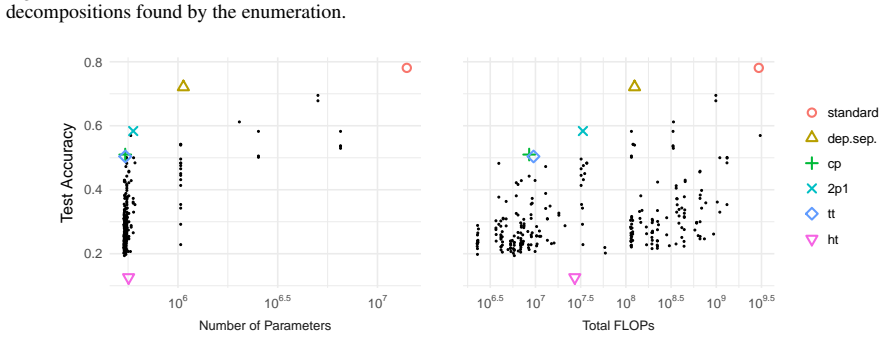
- On ResNet-50/CIFAR-10, Einconv layers achieve better accuracy/cost tradeoffs than the named baselines except standard and CP convolutions.
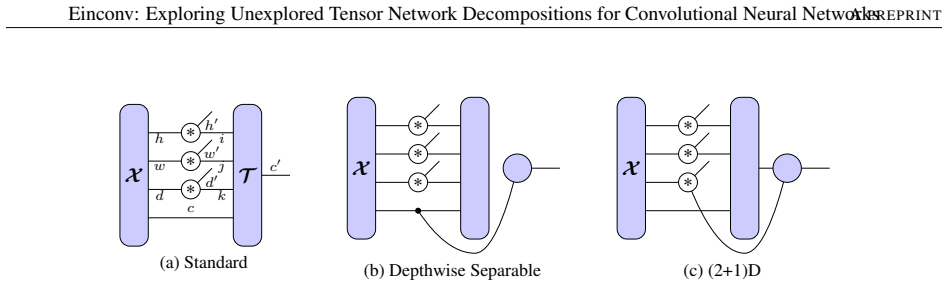
- The same hypergraph framework applies to 3D convolution, where depthwise separable and (2+1)D layers are particular hypergraphs, so the enumeration and search route extends to video models.
Reading between the lines
- A direct testable extension would be to run the search with validation accuracy as the fitness signal and multiple training seeds; the reported accuracy gap between the best Einconv layer and standard convolution is small enough (about 0.01) that its persistence under that protocol is the real question.
- The redundancy reduction of unit inner dimensions implies that low-rank structure in a decomposition can be read off the hypergraph, which suggests the enumeration counts could be connected to existing bounds on CP and Tucker ranks of convolution kernels.
- If the finiteness result holds, then any future light-weight layer that a designer proposes is either an enumerated Einconv hypergraph or a redundant parametrization of one, a completeness statement that could turn architecture design into a search-then-verify pipeline.
Signed reviews
Editorial analysis
A structured set of objections, weighed in public.
Referee Report
Summary. This paper introduces Einconv, a hypergraphical notation for representing a class of convolutional layers obtained by tensor-network decompositions. The notation subsumes standard convolution, depthwise separable convolution, bottleneck/Tucker-2 layers, and CP decomposition, and it can be extended to 3D convolutions. The authors prove redundancy-elimination propositions, enumerate nonredundant hypergraphs for 3x3 and 3x3x3 filters, and use NSGA2 to search over hypergraphs with nonlinear activations. They report that the enumerated modules fill gaps in the accuracy-versus-parameter/FLOPs tradeoff, and that nonlinear Einconv layers found by the GA achieve higher test accuracy than standard convolution (about 0.92 versus 0.91 on Fashion-MNIST).
Significance. The formal hypergraph framework, the finiteness/redundancy results, and the public implementation are useful contributions; they make the space of linear convolutional decompositions explicit and searchable. The paper also correctly builds on Ye and Lim for the rank-reduction propositions. However, the central empirical claim, namely that the newly discovered nonlinear Einconv layers outperform existing layers, is not established by the reported experiments, because the GA search was driven by test accuracy and the comparisons lack repeated runs and error bars. If the evaluation were redone with a proper validation protocol, the paper could make a valuable contribution.
major comments (3)
- [Section 6.2] The sentence 'We set test accuracy and the number of parameters as multiobjectives to be optimized by NSGA2' describes a serious methodological flaw. Using the test set as the fitness signal means the GA selects architectures based on test performance, so the reported best accuracy for Einconv is a selected maximum over the searched population. Such a maximum is expected to exceed the accuracy of a single fixed baseline even when no searched architecture is genuinely better. The comparison must be redone by optimizing a validation objective and then evaluating the final architectures on a held-out test set. If 'test accuracy' is a typo for 'validation accuracy', the text must be corrected; as written, it is data leakage.
- [Section 6, Figures 3-6] No experimental runs are repeated under different seeds, and no error bars, standard deviations, or significance tests are provided. A single-run difference of roughly 0.01 in test accuracy on Fashion-MNIST or CIFAR-10 is well within the range of run-to-run variation for CNNs, so the claimed outperformance is not statistically supported. The authors should report mean and variance over multiple seeds for both the searched and baseline architectures.
- [Section 6.2, ResNet-50] The text notes that a significant number of Einconv instances could not be trained because of insufficient GPU memory. This means the reported Pareto frontier is computed over the subset of candidates that survived the memory constraint, which can bias the frontier and the comparison with baselines. The paper should state how many candidates were discarded, and should check whether the surviving set is representative by comparing parameter counts or hypergraph complexity.
minor comments (5)
- [Section 6.1] The abstract and introduction say 'enumerating all possible decompositions', but the experiments enumerate only hypergraphs with at most two inner indices (2D) or at most one inner index (3D), with inner dimensions fixed to 2. The wording should be qualified to avoid overstating the coverage.
- [Figures 1 and 2] The diagrams are dense and the captions do not explain all symbols near the figures; the black hyperedge dot and the asterisk dummy notation are defined only in Section 3. A short caption reminder would help readability.
- [Figures 3 and 5] The label 'flattend' should be 'flattened'.
- [Section 6.2] Details of the NSGA2 configuration are missing from the main text, including population size, number of generations, mutation rates, and the number of independent runs. These should be reported for reproducibility.
- [Appendix B] The training recipes give optimizer settings and epochs, but do not state the exact validation split used for early stopping or model selection. This information is important for interpreting the reported accuracies.
Circularity Check
No significant circularity: the Einconv formalism and redundancy reductions follow from the definitions, and the empirical outperformance claim is an experimental search result rather than a fitted prediction.
full rationale
The paper's derivation chain is self-contained. The Einconv layer is defined through hypergraph vertices and hyperedges that encode sum-product contractions, with convolution represented by dummy tensors (Section 3). The redundancy Propositions 2–4 are proved in the appendix directly from the contraction and set-reduction definitions, and Proposition 1 is an external result of Ye and Lim. Theorem 1's finiteness conclusion follows from Proposition 4's partition argument, so no step re-uses its own conclusion as an input. The enumeration experiments train and compare each hypergraph's test accuracy, and the GA experiments search over structures; the reported ≈0.92 versus ≈0.91 accuracy is an observed selected result, not a quantity forced by the theory. The one methodological concern—Section 6.2 states "We set test accuracy and the number of parameters as multiobjectives to be optimized by NSGA2" and then reports the best test accuracy—is a selection-bias and statistical-validity issue, not a circular reduction by construction: the search's fitness value and the reported metric are the same number, but the outperformance conclusion is not derived from an equation that assumes it. There is also no load-bearing self-citation chain; the cited Ye and Lim result is independent prior work and is used only for one reduction rule. Therefore the paper has no significant circularity.
Assumptions & free parameters
free parameters (2)
- inner dimension R_a for enumerated hypergraphs =
2
- maximum number of inner indices =
2 (2D), 1 (3D)
assumptions (3)
- domain assumption A convolutional layer is exactly represented by the contraction of the input, kernel, and dummy tensors P and Q on the hypergraph
- domain assumption The redundancy removal rules in Propositions 1 through 3 are sufficient to leave a complete set of representability classes
- domain assumption Proposition 4 counting assumes size-invariant convolution (H=H' and W=W')
invented entities (1)
-
Einconv layer (hypergraphical convolution module class)
Cite this review
Pith. "Pith review of Einconv: Exploring Unexplored Tensor Network Decompositions for Convolutional Neural Networks." pith.science (2026). https://pith.science/paper/GHLIQLQD
@misc{pith2026190804471,
  author       = {Pith},
  title        = {Pith review of: Einconv: Exploring Unexplored Tensor Network Decompositions for Convolutional Neural Networks},
  year         = {2026},
  howpublished = {\url{https://pith.science/paper/GHLIQLQD}},
  note         = {Machine review of arXiv:1908.04471}
}
read the original abstract
Tensor decomposition methods are widely used for model compression and fast inference in convolutional neural networks (CNNs). Although many decompositions are conceivable, only CP decomposition and a few others have been applied in practice, and no extensive comparisons have been made between available methods. Previous studies have not determined how many decompositions are available, nor which of them is optimal. In this study, we first characterize a decomposition class specific to CNNs by adopting a flexible graphical notation. The class includes such well-known CNN modules as depthwise separable convolution layers and bottleneck layers, but also previously unknown modules with nonlinear activations. We also experimentally compare the tradeoff between prediction accuracy and time/space complexity for modules found by enumerating all possible decompositions, or by using a neural architecture search. We find some nonlinear decompositions outperform existing ones.
Figures
Figures from the paper (3 more)
Reference graph
Works this paper leans on
-
[4]
Y .-D. Kim, E. Park, S. Yoo, T. Choi, L. Yang, and D. Shin. Compression of deep convolutional neural networks for fast and low power mobile applications. arXiv preprint arXiv:1511.06530,
-
[5]
Resource Efficient 3D Convolutional Neural Networks
O. Köpüklü, N. Kose, A. Gunduz, and G. Rigoll. Resource efficient 3d convolutional neural networks. arXiv preprint arXiv:1904.02422,
work page Pith review arXiv 1904
-
[12]
learning spatiotemporal features with 3d convolutional networks,
D. Tran, L. Bourdev, R. Fergus, L. Torresani, and M. Paluri. “learning spatiotemporal features with 3d convolutional networks,”. arXiv preprint arXiv:1412.0767, 1177,
-
[13]
M. Wiebe. Numpy-discussion: einsum. https://mail.python.org/pipermail/numpy-discussion/ 2011-January/054586.html,
work page 2011
- [14]
-
[15]
B. Zoph and Q. V . Le. Neural architecture search with reinforcement learning.arXiv preprint arXiv:1611.01578,
-
[1927]
A. G. Howard, M. Zhu, B. Chen, D. Kalenichenko, W. Wang, T. Weyand, M. Andreetto, and H. Adam. Mobilenets: Efficient convolutional neural networks for mobile vision applications. arXiv preprint arXiv:1704.04861,
-
[1971]
H. Pham, M. Y . Guan, B. Zoph, Q. V . Le, and J. Dean. Efficient neural architecture search via parameter sharing.arXiv preprint arXiv:1802.03268,
Show all 15 references
-
[1998]
M. Lin, Q. Chen, and S. Yan. Network in network. arXiv preprint arXiv:1312.4400,
-
[2009]
K. He, X. Zhang, S. Ren, and J. Sun. Deep residual learning for image recognition. eprint. arXiv preprint arXiv:0706.1234,
-
[2015]
Tokui, R
S. Tokui, R. Okuta, T. Akiba, Y . Niitani, T. Ogawa, S. Saito, S. Suzuki, K. Uenishi, B. V ogel, and H. Yamazaki Vincent. Chainer: A deep learning framework for accelerating the research cycle. In Proceedings of the 25th ACM SIGKDD International Conference on Knowledge Discove...
2002
-
[2016]
C. Tai, T. Xiao, Y . Zhang, X. Wang, et al. Convolutional neural networks with low-rank regularization.arXiv preprint arXiv:1511.06067,
-
[2017]
F. Chollet. Xception: Deep learning with depthwise separable convolutions, corr abs/1610.02357. URL http://arxiv. org/abs/1610.02357,
-
[2018]
E. Real, A. Aggarwal, Y . Huang, and Q. V . Le. Regularized evolution for image classifier architecture search.arXiv preprint arXiv:1802.01548,
-
[2019]
Lebedev, Y
V . Lebedev, Y . Ganin, M. Rakhuba, I. Oseledets, and V . Lempitsky. Speeding-up convolutional neural networks using fine-tuned cp-decomposition. arXiv preprint arXiv:1412.6553,
Reviewed August 14, 2026 · model on record in the stance chip above.
Discussion (0). Continue with ORCID to comment.