REVIEW 3 major objections 4 minor 54 references
Private Rank Aggregation under Local Differential Privacy
T0 review · 3 major / 4 minor · reviewed 2026-08-14 · deepseek-v4-flash
Pith's one-line read This paper claims rank aggregation can be made locally differentially private without a trusted curator, with randomized pairwise answers and a provable error bound.
desk verdict First local-DP rank aggregation paper, but Algorithm 1 as printed never uses the agent's true answer, so the main utility theorem doesn't apply to it; fixable but load-bearing. read the letter →
The pith
A machine-rendered reading of the paper's core claim, the machinery that carries it, and where it could break.
The reading
What carries the argument
The machinery is KwikSort, an approximate rank aggregation algorithm that only needs the aggregate pairwise comparison profile $\mathrm{cmp}(L) = (C_{a_j a_l}(L) - C_{a_l a_j}(L))$ for each pair; the sign of each entry decides the relative order, and KwikSort sorts with a randomized pivot to get an $11/7$-approximation to the Kemeny optimal ranking. LDP-KwikSort perturbs each agent's pairwise answer with either Randomized Response or Laplace noise, then the curator estimates $\widehat{\mathrm{cmp}}(L)$ from the noisy counters and feeds it to KwikSort. The Mallows model provides the generative assumption under which the sign of $\widehat{\mathrm{cmp}}(L)$ matches $\mathrm{cmp}(L)$ with high probability, and Hoeffding and Chernoff bounds turn that per-pair probability into the global error bound.
What would settle it
Run LDP-KwikSort:RR on Mallows-generated rankings with $m=45$ alternatives, $n=5000$ agents, $\epsilon=2$, and $K=1$, and record the fraction of pairs $(a_j, a_l)$ with zero respondents and the empirical sign-error rate of $\widehat{\mathrm{cmp}}(L)$. If the fraction of unqueried pairs is substantial while the Theorem 2 bound predicts error below $6\mu$ with probability $1-2^{-6\mu}$, then the bound and protocol disagree in a way that would falsify the utility guarantee as stated.
Extended reading notes
Core claim
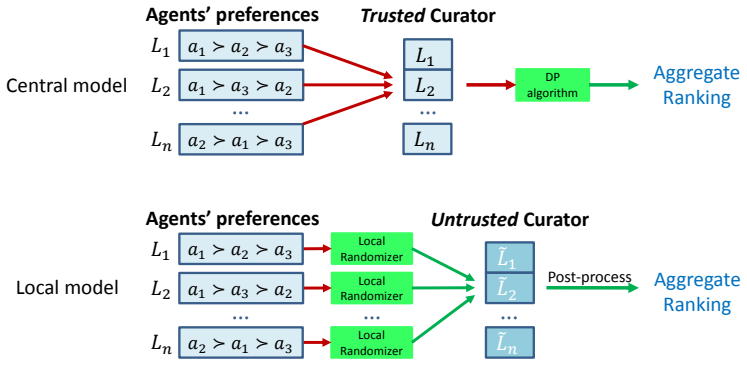
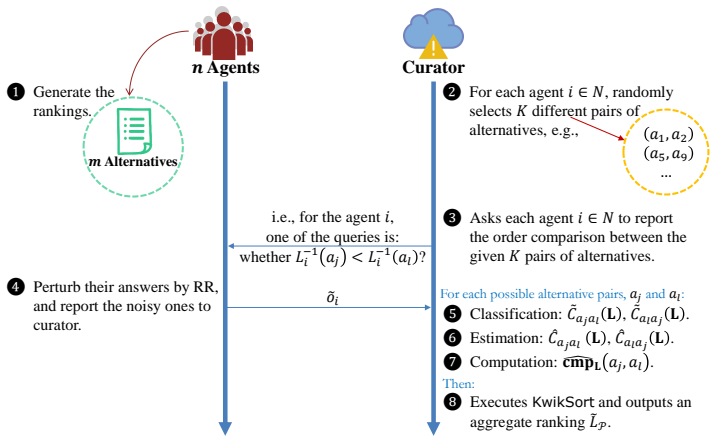
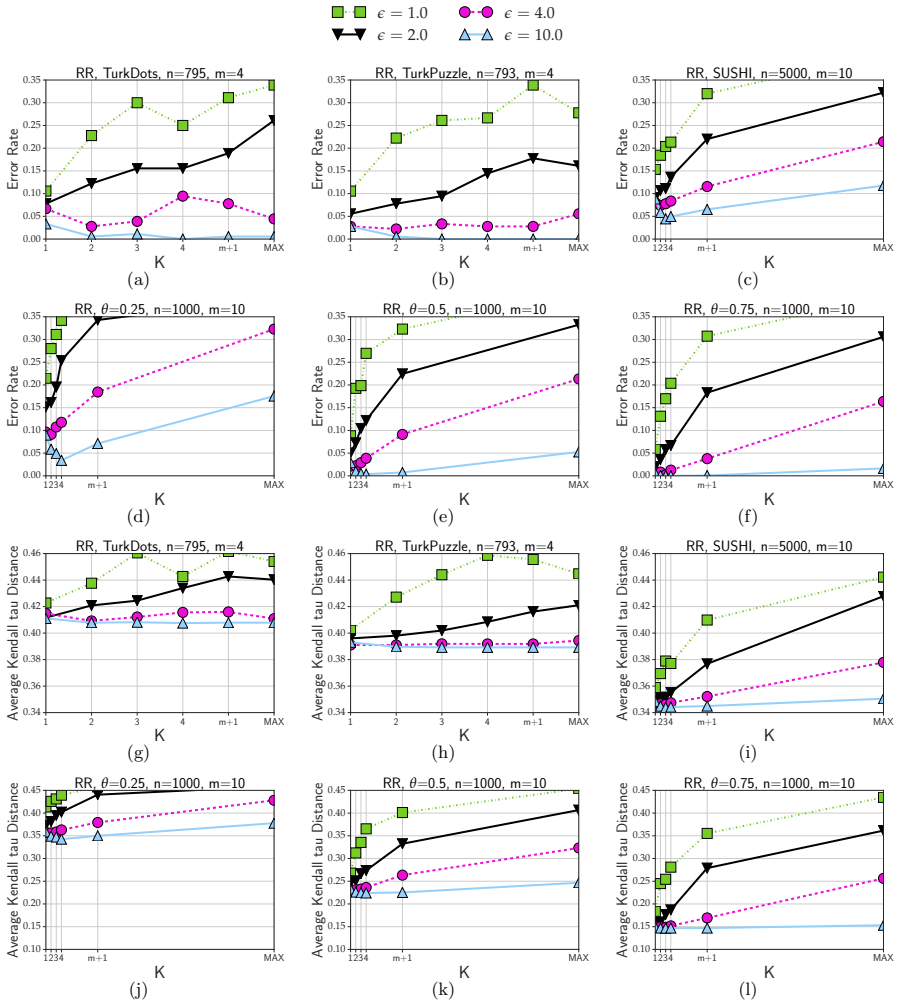
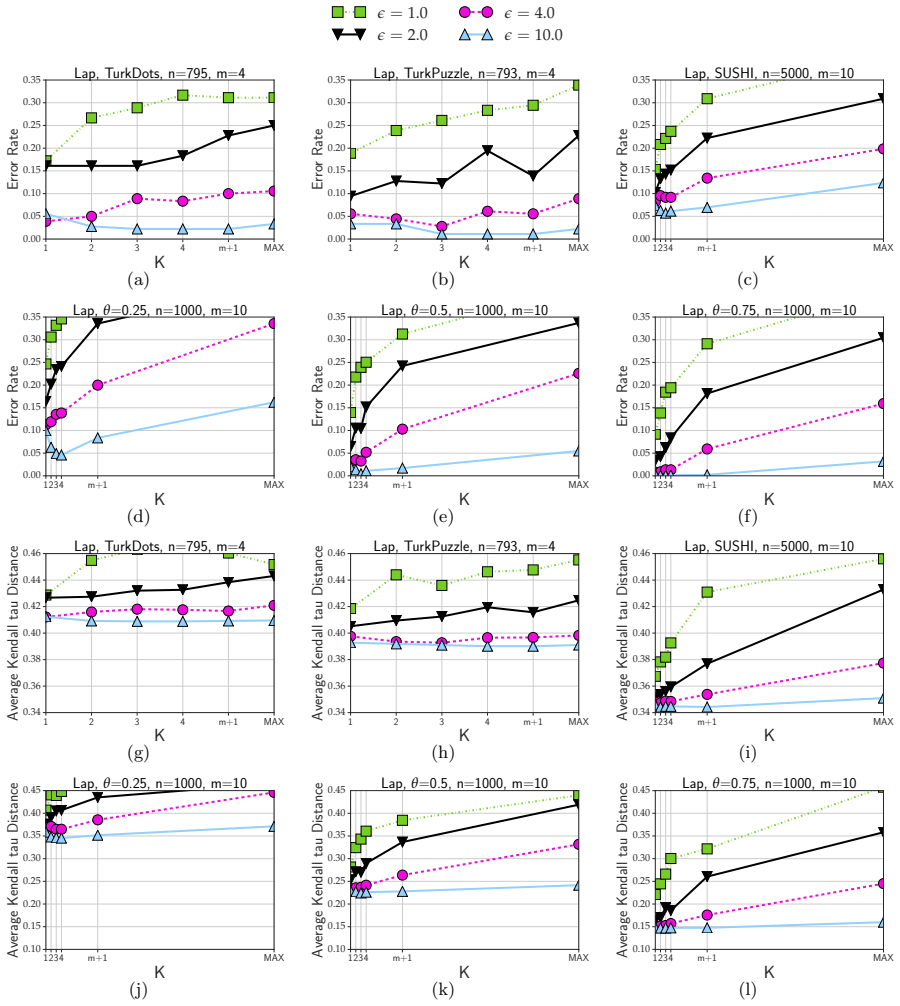
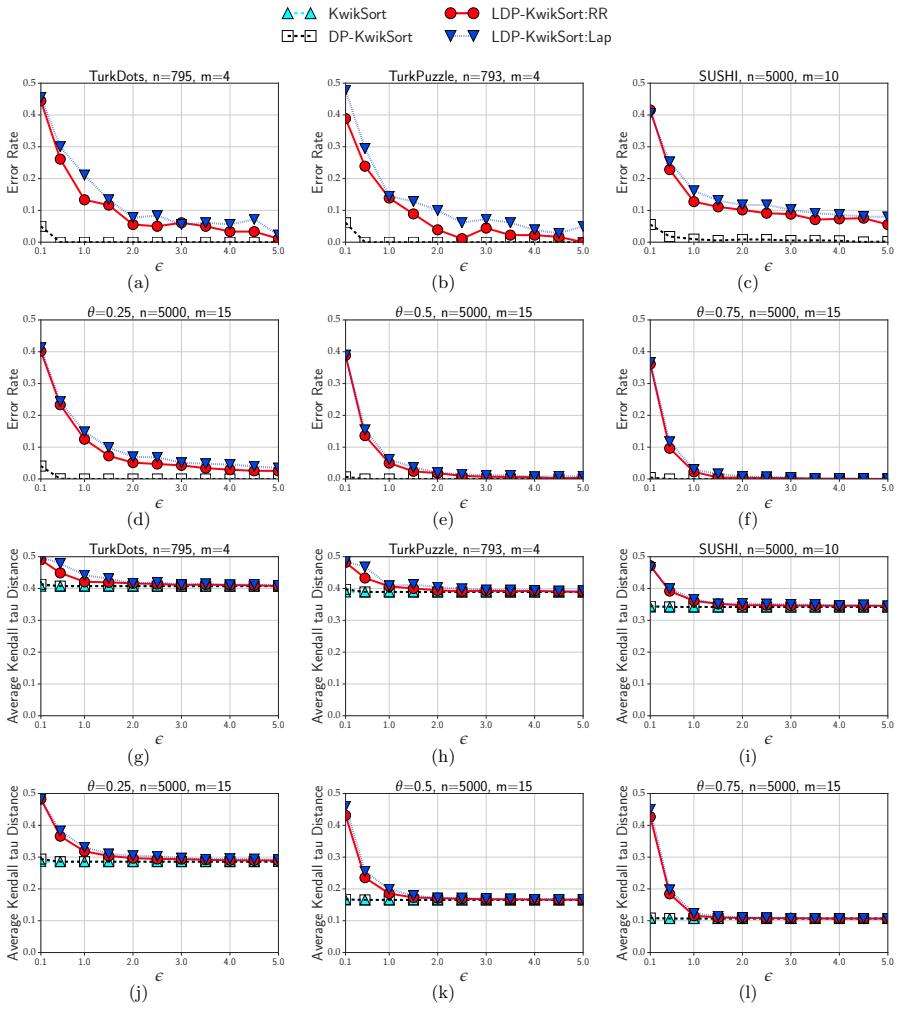
The paper's central claim is that locally private rank aggregation is feasible: instead of trusting the curator with full rankings, each agent answers K randomly chosen pairwise comparison queries with a locally randomized response. Theorem 1 states that LDP-KwikSort:RR satisfies epsilon-LDP and LDP-KwikSort:Lap satisfies epsilon-LiDP. Theorem 2 states that when rankings come from the Mallows model, the estimate of the aggregate pairwise comparison profile has error below $6\mu$ with probability at least $1 - 2^{-6\mu}$, where $\mu = 2\binom{m}{2} \exp\left(-\frac{\epsilon^2 K}{(\epsilon+2K)^2} \cdot \frac{{\theta^*}^2 n}{m(m-1)}\right)$ and $\theta^* = \frac{\theta}{2-\theta}$. The Laplace variant has an analogous bound with a different exponent. The paper further claims that the error is minimized near $K = \epsilon/2$, and that experiments on real and synthetic data show LDP-KwikSort:RR keeps aggregate ranking utility close to DP-KwikSort and non-private KwikSort.
Load-bearing premise
The load-bearing premise is that every pair of alternatives receives exactly $n^* = nK/\binom{m}{2}$ independent noisy answers, each with the same probability of being truthful; the actual protocol instead has each agent answer only $K$ random pairs, leaving many pairs unanswered and linking answers within an agent, so the proven error bound does not cover the protocol as run.
Editorial extensions
If this is right
- If the protocol works as claimed, crowdsourcing platforms can collect ranking preferences from agents who do not trust the platform, with each agent's pairwise comparisons protected by local differential privacy.
- The recommended operating point $K \approx \epsilon/2$ follows directly from the analysis, giving practitioners a concrete rule for setting the number of queries per agent.
- The randomized-response variant is the better of the two solutions in the experiments, so a practical deployment need not rely on Laplace noise to reach acceptable utility.
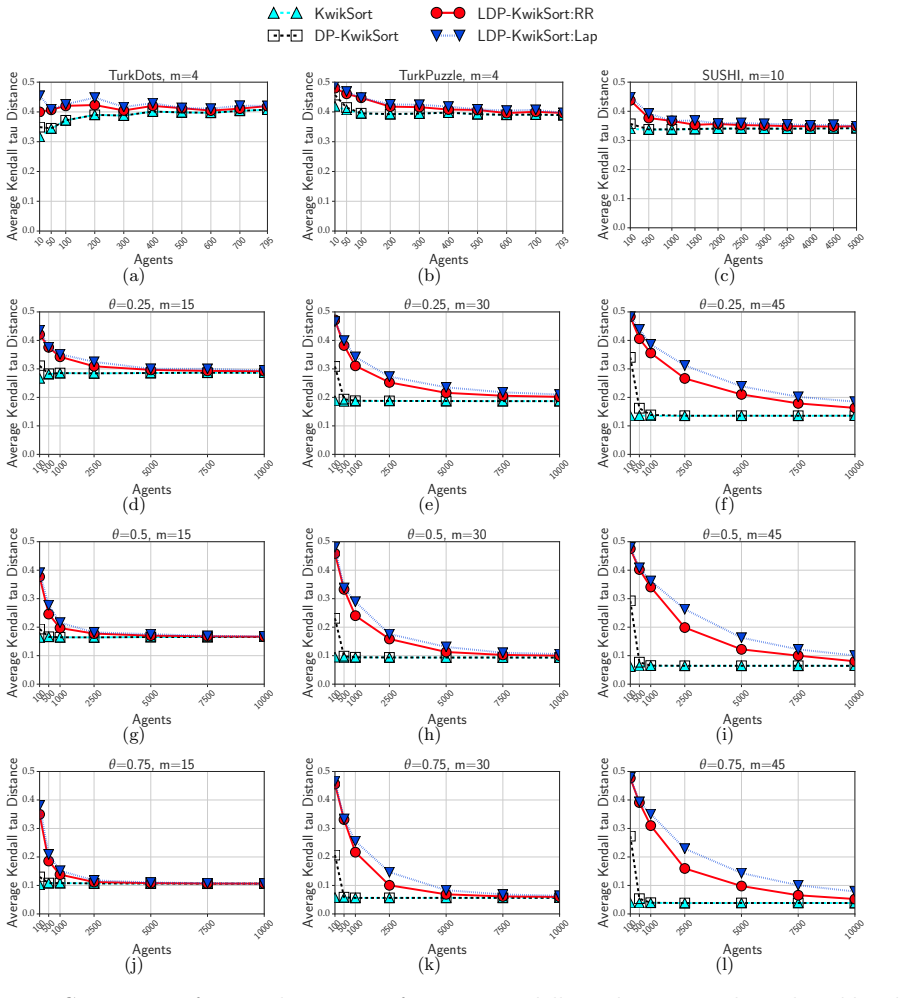
- Utility improves as the number of agents or the privacy budget grows, and degrades as the number of alternatives grows, matching the intuition that more information outweighs noise.
- Because KwikSort only needs pairwise comparisons, the protocol inherits a low per-agent cost of $O(K)$ computation and $O(\log K)$ communication.
Reading between the lines
- The paper's Theorem 2 assumes every pair is answered by exactly $n^* = nK/\binom{m}{2}$ independent agents, but Algorithm 1 has each agent answer only $K$ randomly chosen pairs; when $K$ is small relative to $\binom{m}{2}$, many pairs receive zero answers and the comparison is effectively a coin flip, so the bound may be optimistic in exactly the regime the paper recommends for large $m$ or small
- A direct extension would replace uniform random pair sampling with a covering design or repeated sampling so that every pair is queried at least once, which would make the theorem's assumption match the protocol and likely improve practical accuracy.
- The analysis could be tightened by accounting for the correlation among the $K$ answers from the same agent; treating all $nK$ answers as independent likely overstates the effective sample size.
- If the missing-data gap is closed, a similar protocol could be applied to other pairwise aggregation problems, such as tournament-style preference elicitation or peer grading, where an untrusted aggregator is the norm.
Signed reviews
Editorial analysis
A structured set of objections, weighed in public.
Referee Report
Summary. The paper introduces LDP-KwikSort, a protocol for rank aggregation under local differential privacy. The curator asks each agent K pairwise comparison queries; the agent perturbs each answer with randomized response (RR) or Laplace noise, and the curator estimates the aggregate pairwise comparison profile and runs the KwikSort algorithm to produce a ranking. The main theoretical claims are Theorem 1 (ε-LDP for the RR instantiation and ε-LiDP for the Laplace instantiation), Theorem 2 (a utility bound for LDP-KwikSort:RR under the Mallows model, with error below 6μ with high probability, where μ is minimized near K = ε/2), and Theorem 3 (an analogous bound for LDP-KwikSort:Lap). The paper also reports experiments on three real-world datasets and Mallows-generated synthetic data, comparing against non-private KwikSort and the central-model DP-KwikSort.
Significance. If the central claims were fully supported, the paper would make a useful contribution: it is, to my knowledge, the first to formulate rank aggregation under the local model of differential privacy, and the idea of leveraging KwikSort to reduce the number of pairwise queries per agent is natural and relevant. The privacy guarantee for the Laplace variant is standard and sound, and the experiments on real crowdsourcing datasets are a strength. However, the utility analysis as written does not apply to the RR algorithm actually specified, because that algorithm ignores the agent's true answer; the utility theorem also relies on assumptions about response counts and independence that the protocol does not satisfy. These issues are load-bearing rather than cosmetic.
major comments (3)
- [Section 4.3, Algorithm 1; Theorem 2 and Eq. (3)] Algorithm 1 as printed does not implement randomized response. In lines 2–8, the agent draws g uniformly from [0,1] and sets the reported bit to 1 if g ≤ p_rr and to 0 otherwise; the true answer o_ik never appears. Thus the reported bit is Bernoulli(p_rr) independent of the agent's preference. The proof of Theorem 2, however, assumes that each agent reports the true answer with probability p_rr and the false answer with probability q_rr, leading to p = p_M p_rr + q_M q_rr for agreement with the ground truth. Under the literal algorithm, p = p_rr, so p − q = 0, the exponent in Eq. (3) is zero, P_ι ≈ 1/2, and the sign of the estimated comparison is no better than random for every pair. Consequently, the utility guarantee of Theorem 2 does not hold for the described protocol, and K ≈ ε/2 as an optimal query count is unsupported by that argument. The privacy claim remains true because a data-independent output is private, but the central utility claim fails even if every pair were answered by exactly n* = nK/C(m,2) agents.
- [Section 5.2.1, Theorem 2 proof and Algorithm 2] The utility proof assumes that for each pair (a_j, a_l) there are exactly n* = nK/C(m,2) respondents and that the noisy per-pair counts are independent Bernoulli variables. The protocol in Section 4.2 and Algorithm 2 has each agent answer K randomly selected pairs, so the number of respondents per pair is random and can be zero; pairs with no respondents have ~C_{a_j a_l} = ~C_{a_l a_j} = 0, which corresponds to an effectively random sign. Moreover, if one agent answers several pairs, the resulting pairwise error indicators X_ι are correlated, so the Chernoff bound in Lemma 2, which requires independent Poisson trials, cannot be applied as written. These are first-order effects, not approximation artifacts: for large m or small n, a substantial fraction of pairs will receive no answers. The theorem must either analyze the actual random assignment of pairs to agents or explicitly state and justify a design in which every pair receives n* responses that are independent across pairs.
- [Section 5.2.1, Mallows model definition] The paper defines p_M as a single constant such that for every pair (a_j, a_l), the relative order of the pair agrees with the ground truth with probability p_M and disagrees with probability q_M = 1 − p_M, with θ = 1 − q_M/p_M. This is not a property of the standard Mallows model cited as [35]. In the Mallows model with Kendall-tau distance, the marginal probability that a given item precedes another item in the generated ranking is not constant across pairs; for example, for m = 3 and θ = 0.5 the probability that item 1 precedes item 2 differs from the probability that item 1 precedes item 3. Consequently, the expression for P_ι in Eq. (3) is not a valid per-pair error probability for all pairs under the Mallows model, and the subsequent bound μ = Σ P_ι ≤ 2(m choose 2) exp(...) requires an argument that either uses pair-specific probabilities and takes a maximum or justifies a different model. This issue affects the formal content of Theorem 2 and, through it, the theoretical rationale for the recommended choice K ≈ ε/2.
minor comments (4)
- [Section 5.1, Theorem 1 proof] The displayed ratio for the RR mechanism is written as 2 p_rr / (1 − p_rr) = e^{ε_k}; for standard randomized response the correct ratio is p_rr / (1 − p_rr) = e^{ε_k}. The theorem statement is unaffected, but the proof as written is algebraically incorrect.
- [Algorithm 2] The pseudocode does not record which pair each ~o_ik refers to; the classification loop increments ~C_{a_j a_l}(L) or ~C_{a_l a_j}(L) without specifying a mechanism for mapping the query index k to the pair (a_j, a_l). This is an implementation detail, but it should be made explicit because the protocol uses different random pairs for different agents.
- [Section 6.3] The text says DP-KwikSort is “based on the local model of DP,” but Section 6.1.1 and the central-model definition state that DP-KwikSort is a central-model algorithm. This appears to be a typographical error and should be corrected.
- [Lemma 2 usage] The Chernoff bound is stated for R ≥ 6μ, but the theorem applies it with R = 6μ; if R must be an integer, this requires a short justification or a ceiling on R. This is minor relative to the issues above but should be cleaned up.
Circularity Check
No circularity; the derivation is self-contained, and the noted Algorithm 1 defect is a correctness gap rather than a circular reduction.
full rationale
The paper's claimed derivation chain is self-contained against external benchmarks. KwikSort, randomized response, the Laplace mechanism, and the Mallows model are all prior external results, and the paper's contribution is a composition of them. The K = epsilon/2 recommendation comes from maximizing the analytic function g(K) = epsilon^2 K/(epsilon+2K)^2 in Theorem 2, not from fitting to experimental data; the experiments test the predicted trend, which is the opposite of circularity. The only relevant self-citation, reference [52] on weighted voting, appears in related work and is not load-bearing for the LDP-KwikSort privacy or utility theorems. The reviewer-noted defect in Algorithm 1 (the reported bit is generated independently of the true answer) is a correctness gap between the pseudocode and the randomized-response model assumed in Theorem 2's proof, not a circular reduction: it makes the utility bound inapplicable to the printed algorithm rather than making a conclusion equal to an input by construction. No equation or fitted parameter is reused as the predicted output, so no circularity is present.
Assumptions & free parameters
assumptions (5)
- domain assumption All agent rankings are generated by the Mallows model with a common dispersion parameter theta and a single ground-truth ranking.
- ad hoc to paper For every pair of alternatives, exactly n* = nK/C(m,2) agents respond to that pair.
- ad hoc to paper The noisy per-pair counts are independent Bernoulli variables and the pairwise error indicators X_iota are independent across pairs.
- standard math Sequential composition of K local randomizers each with budget epsilon/K yields the stated epsilon-LDP guarantee.
- standard math KwikSort achieves an 11/7 approximation on the true aggregate pairwise comparison profile.
Cite this review
Pith. "Pith review of Private Rank Aggregation under Local Differential Privacy." pith.science (2026). https://pith.science/paper/HPATTTAZ
@misc{pith2026190804486,
  author       = {Pith},
  title        = {Pith review of: Private Rank Aggregation under Local Differential Privacy},
  year         = {2026},
  howpublished = {\url{https://pith.science/paper/HPATTTAZ}},
  note         = {Machine review of arXiv:1908.04486}
}
read the original abstract
As a method for answer aggregation in crowdsourced data management, rank aggregation aims to combine different agents' answers or preferences over the given alternatives into an aggregate ranking which agrees the most with the preferences. However, since the aggregation procedure relies on a data curator, the privacy within the agents' preference data could be compromised when the curator is untrusted. Existing works that guarantee differential privacy in rank aggregation all assume that the data curator is trusted. In this paper, we formulate and address the problem of locally differentially private rank aggregation, in which the agents have no trust in the data curator. By leveraging the approximate rank aggregation algorithm KwikSort, the Randomized Response mechanism, and the Laplace mechanism, we propose an effective and efficient protocol LDP-KwikSort. Theoretical and empirical results show that the solution LDP-KwikSort:RR can achieve the acceptable trade-off between the utility of aggregate ranking and the privacy protection of agents' pairwise preferences.
Figures
Figures from the paper (3 more)
Reference graph
Works this paper leans on
-
[35]
Colin L Mallows. Non-null ranking models. Biometrika, 44(1/2):114–130, 1957
work page 1957
-
[1]
Aggregating inconsistent information: ranking and clustering
Nir Ailon, Moses Charikar, and Alantha Newman. Aggregating inconsistent information: ranking and clustering. In STOC, pages 684–693. ACM, 2005
work page 2005
-
[2]
Aggregating inconsistent information: Ranking and clustering
Nir Ailon, Moses Charikar, and Alantha Newman. Aggregating inconsistent information: Ranking and clustering. J. ACM, 55(5):23:1–23:27, 2008
2008
-
[3]
Crowdsourcing as a forensic psychology research tool
Melissa A Baker, Paul Fox, and T Wingrove. Crowdsourcing as a forensic psychology research tool. American Journal of Forensic Psychology , 34(1):37–50, 2016
work page 2016
-
[4]
Practical locally private heavy hitters
Raef Bassily, Kobbi Nissim, Uri Stemmer, and Abhradeep Guha Thakurta. Practical locally private heavy hitters. In NIPS, pages 2285–2293, 2017
work page 2017
-
[5]
Conducting psychology student research via the mechanical turk crowdsourcing service
John A Bates and Brian A Lanza. Conducting psychology student research via the mechanical turk crowdsourcing service. North American Journal of Psychology , 15(2), 2013
work page 2013
-
[6]
The viability of crowdsourcing for survey research
Tara S Behrend, David J Sharek, Adam W Meade, and Eric N Wiebe. The viability of crowdsourcing for survey research. Behavior Research Methods, 43(3):800, 2011
work page 2011
-
[7]
A Practical Guide to Averaging Functions, volume 329 of Studies in Fuzziness and Soft Computing
Gleb Beliakov, Humberto Bustince Sola, and Tomasa Calvo. A Practical Guide to Averaging Functions, volume 329 of Studies in Fuzziness and Soft Computing . Springer, 2016
work page 2016
Show all 54 references
-
[8]
Rank aggregation with ties: Experiments and analysis
Bryan Brancotte, Bo Yang, Guillaume Blin, Sarah Cohen Boulakia, Alain Denise, and Sylvie Hamel. Rank aggregation with ties: Experiments and analysis. PVLDB, 8(11):1202–1213, 2015
2015
-
[9]
Procaccia, editors
Felix Brandt, Vincent Conitzer, Ulle Endriss, J´ erˆ ome Lang, and Ariel D. Procaccia, editors. Handbook of Computational Social Choice . Cambridge University Press, 2016
2016
-
[10]
Randomized Response and Indirect Questioning Techniques in Surveys
Arijit Chaudhuri. Randomized Response and Indirect Questioning Techniques in Surveys . Chapman and Hall/CRC, 2016
2016
-
[11]
Kash, Tal Moran, and Salil P
Yiling Chen, Stephen Chong, Ian A. Kash, Tal Moran, and Salil P. Vadhan. Truthful mechanisms for agents that value privacy. In EC, pages 215–232. ACM, 2013
2013
-
[12]
Kash, Tal Moran, and Salil P
Yiling Chen, Stephen Chong, Ian A. Kash, Tal Moran, and Salil P. Vadhan. Truthful mechanisms for agents that value privacy. ACM Trans. Economics and Comput. , 4(3):13:1–13:30, 2016
2016
-
[13]
Ordering lists based on aggregated pairwise preferences, 2017
David Cortes. Ordering lists based on aggregated pairwise preferences, 2017. https://pypi.org/project/pwlistorder/
2017
-
[14]
Duchi, Michael I
John C. Duchi, Michael I. Jordan, and Martin J. Wainwright. Privacy aware learning. In NIPS, pages 1439–1447, 2012
2012
-
[15]
Duchi, Michael I
John C. Duchi, Michael I. Jordan, and Martin J. Wainwright. Local privacy and statistical minimax rates. In FOCS, pages 429–438. IEEE Computer Society, 2013
2013
-
[16]
Differential privacy
Cynthia Dwork. Differential privacy. In ICALP (2), volume 4052 of Lecture Notes in Computer Science, pages 1–12. Springer, 2006
2006
-
[17]
The algorithmic foundations of differential privacy.Foundations and Trends in Theoretical Computer Science , 9(3-4):211–407, 2014
Cynthia Dwork and Aaron Roth. The algorithmic foundations of differential privacy.Foundations and Trends in Theoretical Computer Science , 9(3-4):211–407, 2014. 24
2014
-
[18]
Instability vs anonymization in e pluribus hugo, 2015
David Eppstein. Instability vs anonymization in e pluribus hugo, 2015. https://11011110. github.io/blog/2015/09/09/instability-vs-anonymization.html
2015
-
[19]
Greenberg, Abdel-Latif A
Bernard G. Greenberg, Abdel-Latif A. Abul-Ela, Walt R. Simmons, and Daniel G. Horvitz. The unrelated question randomized response model: Theoretical framework. Journal of the American Statistical Association, 64(326):520–539, 1969
1969
-
[20]
Groat, Benjamin Edwards, James Horey, Wenbo He, and Stephanie Forrest
Michael M. Groat, Benjamin Edwards, James Horey, Wenbo He, and Stephanie Forrest. Appli- cation and analysis of multidimensional negative surveys in participatory sensing applications. Pervasive and Mobile Computing , 9(3):372–391, 2013
2013
-
[21]
Differentially private rank aggregation
Michael Hay, Liudmila Elagina, and Gerome Miklau. Differentially private rank aggregation. In SDM, pages 669–677. SIAM, 2017
2017
-
[22]
Leith, and Oliver Mason
Naoise Holohan, Douglas J. Leith, and Oliver Mason. Optimal differentially private mechanisms for randomised response. IEEE Trans. Information Forensics and Security , 12(11):2726–2735, 2017
2017
-
[23]
Optrr: Optimizing randomized response schemes for privacy- preserving data mining
Zhengli Huang and Wenliang Du. Optrr: Optimizing randomized response schemes for privacy- preserving data mining. In ICDE, pages 705–714. IEEE Computer Society, 2008
2008
-
[24]
Ekhine Irurozki, Borja Calvo, and Jose A. Lozano. Permallows: An r package for mallows and generalized mallows models. Journal of Statistical Software , 71(i12), 2016
2016
-
[25]
Nantonac collaborative filtering: recommendation based on order responses
Toshihiro Kamishima. Nantonac collaborative filtering: recommendation based on order responses. In KDD, pages 583–588. ACM, 2003
2003
-
[26]
Ruogu Kang, Stephanie Brown, Laura Dabbish, and Sara B. Kiesler. Privacy attitudes of mechanical turk workers and the U.S. public. In SOUPS, pages 37–49. USENIX Association, 2014
2014
-
[27]
Lee, Kobbi Nissim, Sofya Raskhodnikova, and Adam D
Shiva Prasad Kasiviswanathan, Homin K. Lee, Kobbi Nissim, Sofya Raskhodnikova, and Adam D. Smith. What can we learn privately? In FOCS, pages 531–540. IEEE Computer Society, 2008
2008
-
[28]
Mechanical turk is not anonymous
Matthew Lease, Jessica Hullman, Jeffrey Bigham, Michael Bernstein, Juho Kim, Walter Lasecki, Saeideh Bakhshi, Tanushree Mitra, and Robert Miller. Mechanical turk is not anonymous. Available at SSRN 2228728 , 2013
2013
-
[29]
Efficient, private, and eps-strategyproof elicitation of tournament voting rules
David Timothy Lee. Efficient, private, and eps-strategyproof elicitation of tournament voting rules. In IJCAI, pages 2026–2032. AAAI Press, 2015
2026
-
[30]
Franklin
Guoliang Li, Jiannan Wang, Yudian Zheng, and Michael J. Franklin. Crowdsourced data management: A survey. IEEE Trans. Knowl. Data Eng. , 28(9):2296–2319, 2016
2016
-
[31]
Differential Privacy: From Theory to Practice
Ninghui Li, Min Lyu, Dong Su, and Weining Yang. Differential Privacy: From Theory to Practice. Synthesis Lectures on Information Security, Privacy, & Trust. Morgan & Claypool Publishers, 2016. 25
2016
-
[32]
An efficient two-layer mechanism for privacy-preserving truth discovery
Yaliang Li, Chenglin Miao, Lu Su, Jing Gao, Qi Li, Bolin Ding, Zhan Qin, and Kui Ren. An efficient two-layer mechanism for privacy-preserving truth discovery. In KDD, pages 1705–1714. ACM, 2018
2018
-
[33]
Towards differentially private truth discovery for crowd sensing systems.CoRR, abs/1810.04760, 2018
Yaliang Li, Houping Xiao, Zhan Qin, Chenglin Miao, Lu Su, Jing Gao, Kui Ren, and Bolin Ding. Towards differentially private truth discovery for crowd sensing systems.CoRR, abs/1810.04760, 2018
2018 arXiv
-
[34]
How private is your voting? A framework for comparing the privacy of voting mechanisms
Ao Liu, Yun Lu, Lirong Xia, and Vassilis Zikas. How private is your voting? A framework for comparing the privacy of voting mechanisms. CoRR, abs/1805.05750, 2018
2018 arXiv
-
[36]
Procaccia, and Yiling Chen
Andrew Mao, Ariel D. Procaccia, and Yiling Chen. Better human computation through principled voting. In AAAI. AAAI Press, 2013
2013
-
[37]
Using online, crowdsourcing platforms for data collection in personality disorder research: The example of amazons mechanical turk
Joshua D Miller, Michael Crowe, Brandon Weiss, Jessica L Maples-Keller, and Donald R Lynam. Using online, crowdsourcing platforms for data collection in personality disorder research: The example of amazons mechanical turk. Personality Disorders: Theory, Research, and Treatmen...
2017
-
[38]
Kobbi Nissim, Sofya Raskhodnikova, and Adam D. Smith. Smooth sensitivity and sampling in private data analysis. In STOC, pages 75–84. ACM, 2007
2007
-
[39]
Beyond the turk: Alternative platforms for crowdsourcing behavioral research
Eyal Peer, Laura Brandimarte, Sonam Samat, and Alessandro Acquisti. Beyond the turk: Alternative platforms for crowdsourcing behavioral research. Journal of Experimental Social Psychology, 70:153–163, 2017
2017
-
[40]
Amazon mechanical turk crowdsourcing: A research tool in mobile internet era
Kaiping Peng, Shiqun Liu, and Shiguang Ni. Amazon mechanical turk crowdsourcing: A research tool in mobile internet era. Journal of Northwest Normal University (Social Sciences) , v.55No.259(3):115–125, 2018
2018
-
[41]
”it was a shady hit”: Navigating work-related privacy concerns on mturk
Shruti Sannon and Dan Cosley. ”it was a shady hit”: Navigating work-related privacy concerns on mturk. In CHI Extended Abstracts. ACM, 2018
2018
-
[42]
Differential private data collection and analysis based on randomized multiple dummies for untrusted mobile crowdsensing
Yuichi Sei and Akihiko Ohsuga. Differential private data collection and analysis based on randomized multiple dummies for untrusted mobile crowdsensing. IEEE Trans. Information Forensics and Security, 12(4):926–939, 2017
2017
-
[43]
Kulkarni
Shang Shang, Tiance Wang, Paul Cuff, and Sanjeev R. Kulkarni. The application of differential privacy for rank aggregation: Privacy and accuracy. In FUSION, pages 1–7. IEEE, 2014
2014
-
[44]
Using crowdsourcing websites for sociological research: The case of amazon mechanical turk
Daniel B Shank. Using crowdsourcing websites for sociological research: The case of amazon mechanical turk. The American Sociologist, 47(1):47–55, 2016
2016
-
[45]
Individual differential privacy: A utility-preserving formulation of differential privacy guarantees
Jordi Soria-Comas, Josep Domingo-Ferrer, David S´ anchez, and David Meg´ ıas. Individual differential privacy: A utility-preserving formulation of differential privacy guarantees. IEEE Trans. Information Forensics and Security, 12(6):1418–1429, 2017. 26
2017
-
[46]
Aggregating votes with local differential privacy: Usefulness, soundness vs
Shaowei Wang, Jiachun Du, Wei Yang, Xinrong Diao, Zichun Liu, Yiwen Nie, Liusheng Huang, and Hongli Xu. Aggregating votes with local differential privacy: Usefulness, soundness vs. indistinguishability. CoRR, abs/1908.04920, 2019
1908 arXiv
-
[47]
Locally differentially private protocols for frequency estimation
Tianhao Wang, Jeremiah Blocki, Ninghui Li, and Somesh Jha. Locally differentially private protocols for frequency estimation. In USENIX Security Symposium, pages 729–745. USENIX Association, 2017
2017
-
[48]
Using randomized response for differential privacy preserving data collection
Yue Wang, Xintao Wu, and Donghui Hu. Using randomized response for differential privacy preserving data collection. In EDBT/ICDT Workshops , volume 1558 of CEUR Workshop Proceedings. CEUR-WS.org, 2016
2016
-
[49]
Stanley L. Warner. Randomized response: A survey technique for eliminating evasive answer bias. Journal of the American Statistical Association , 60(309):63–69, 1965
1965
-
[50]
Hoeffding’s inequality, 2019
Wikipedia. Hoeffding’s inequality, 2019. https://en.wikipedia.org/wiki/Hoeffding’s˙inequality
2019
-
[51]
”our privacy needs to be protected at all costs”: Crowd workers’ privacy experiences on amazon mechanical turk
Huichuan Xia, Yang Wang, Yun Huang, and Anuj Shah. ”our privacy needs to be protected at all costs”: Crowd workers’ privacy experiences on amazon mechanical turk. PACMHCI, 1 (CSCW):113:1–113:22, 2017
2017
-
[52]
Dpwevote: Differentially private weighted voting protocol for cloud-based decision-making
Ziqi Yan, Jiqiang Liu, and Shaowu Liu. Dpwevote: Differentially private weighted voting protocol for cloud-based decision-making. Enterprise IS, 13(2):236–256, 2019
2019
-
[53]
Tianqing Zhu, Gang Li, Wanlei Zhou, and Philip S. Yu. Differentially private data publishing and analysis: A survey. IEEE Trans. Knowl. Data Eng. , 29(8):1619–1638, 2017
2017
-
[54]
Tianqing Zhu, Gang Li, Wanlei Zhou, and Philip S. Yu. Differential Privacy and Applications , volume 69 of Advances in Information Security . Springer, 2017. 27
2017
Reviewed August 14, 2026 · model on record in the stance chip above.
Discussion (0). Continue with ORCID to comment.