REVIEW 3 major objections 5 minor 69 references
uPredict: A User-Level Profiler-Based Predictive Framework for Single VM Applications in Multi-Tenant Clouds
T0 review · 3 major / 5 minor · reviewed 2026-08-14 · deepseek-v4-flash
Pith's one-line read A cloud user can forecast single-VM app runtimes under contention using only three user-level probes.
desk verdict A sensible user-level probe-based prediction idea backed by large experiments, but the reported error rates are inflated by a temporally leaky train/test split. read the letter →
The pith
A machine-rendered reading of the paper's core claim, the machinery that carries it, and where it could break.
The reading
What carries the argument
The object that carries the argument is the triple of micro-benchmark counters. The CPU probe runs one in-register increment loop per virtual CPU so its progress is unaffected by memory; the memory probe sweeps a 2GB array with 128-byte strides so every access goes off-chip rather than to cache; the disk probe reads a 256MB file with the OS file cache disabled. Each probe runs for a fixed window, about three seconds in most experiments, and returns the number of completed operations, which is meant to reflect how much of each resource the VM can actually get under current contention. These numbers become the input features of the model $f$ in $t_{app} = f(c_{cpu}, c_{mem}, c_{disk})$, trained per application and per VM; the model then converts a fresh set of probe readings into a predicted execution time. The neural-network version also relies on automated hyperparameter search over network depth and width, since a fixed large structure can be many times worse than an optimized one.
What would settle it
Run a benchmark under a controlled private cloud, profile contention, start the application, and then sharply change the co-located workload, such as launching or killing a CPU-bound VM, partway through the run. If uPredict's predicted execution time stays close to the stationary-contention value while the measured time shifts, that directly demonstrates the failure mode; repeating this across several benchmarks would show how often the stationary assumption breaks.
Extended reading notes
Core claim
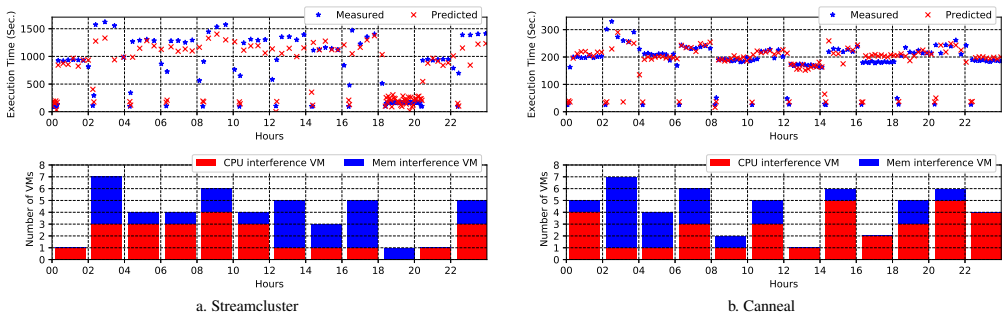
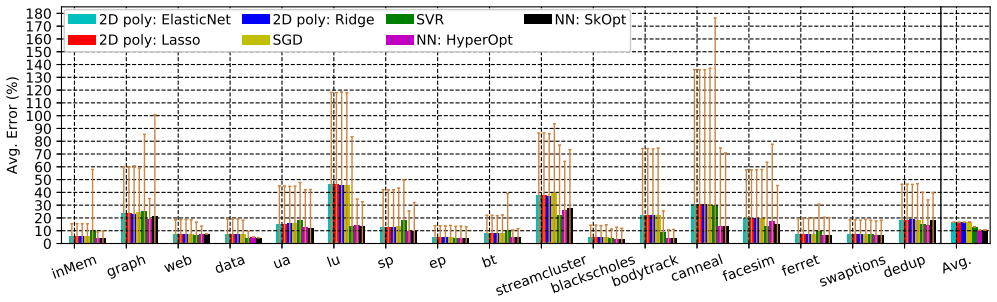
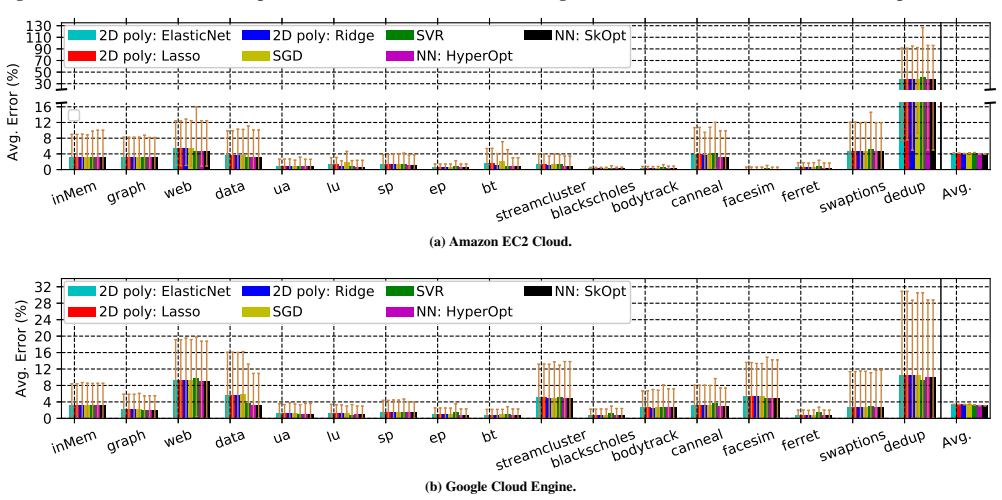
The central claim is that the impact of invisible multi-tenant contention on a single-VM application is captured, for that application and VM, by three user-level probe counters measured just before the run: the number of in-register increments completed by a CPU stress loop, the number of off-core memory accesses completed while striding through a 2GB array with 128-byte strides, and the number of uncached disk reads completed on a 256MB file. With enough training tuples of the form $(c_{cpu}, c_{mem}, c_{disk}, t_{app})$ collected while co-located workloads change, a regression or neural-network model learns the function in Equation (1), and at prediction time only the three counters need to be measured. In the paper's evaluation, the neural-network models achieve average errors around 9.8% even under high contention in a private cloud, and 3.8% and 3.4% on two public clouds, while simpler polynomial models land near 17% in the high-contention setting and roughly match the neural networks on lightly contended public clouds. The authors also show the predicted values track the pattern of measured run times as background VMs appear and disappear, which they take as evidence that the micro-benchmarks do assess the severity of contention experienced by user applications.
Load-bearing premise
The contention measured by the micro-benchmarks in the roughly nine seconds before an application starts is the same contention the application will experience for its entire run; if co-located workloads change during the run, the probe readings are stale and the prediction is unreliable.
Editorial extensions
If this is right
- Ordinary cloud users can obtain runtime performance forecasts for single-VM applications without any cooperation from the provider or access to hypervisor-level counters.
- In lightly contended public clouds, the cheapest models, such as 2-degree polynomial regression, are nearly as accurate as neural networks, so low-overhead prediction is sufficient in that regime.
- Under heavy contention, the accuracy gap between a cheap polynomial model and an optimized neural network is about 7 to 8 percentage points on average, and the gap is largest for memory-intensive applications whose access patterns differ from the memory probe's.
- Most large prediction errors occur when background VMs start or stop and the contention changes between profiling and execution; with stable contention the framework's predictions follow the measured pattern.
- A load balancer that routes requests by predicted completion time instead of queue length can reduce average application execution and turnaround times by up to 19% and 10%, with profiling overhead included in turnaround time.
Reading between the lines
- The same counter-to-performance learning could be extended to variable input sizes by adding an input-size feature to the model; the paper fixes input size and lists input variation as future work.
- The stationarity premise suggests that for long-running jobs uPredict would need periodic re-profiling mid-run, an extension the paper acknowledges but does not implement.
- A fourth micro-benchmark targeting network bandwidth would likely extend the framework to network-intensive single-VM applications, which the current probe set does not cover.
- Because the models are retrained per application and VM, they could be refreshed online as co-location patterns drift over days, turning the framework into a continuously adapting predictor; the paper only tests static training sets.
Signed reviews
Editorial analysis
A structured set of objections, weighed in public.
Referee Report
Summary. The paper proposes uPredict, a user-level profiling framework for predicting the execution time of single-VM applications in multi-tenant clouds. Three custom micro-benchmarks probe CPU, memory, and disk contention; the resulting counter values (c_cpu, c_mem, c_disk) are used as features in polynomial regression, SVR, and neural-network models to predict application execution time through the learned function in Eq. (1). The framework is evaluated on a private OpenStack cloud and on AWS and GCE using 17 benchmarks from PARSEC, NPB, and CloudSuite, with reported average prediction errors of 9.8% to 17% on the private cloud and below 4% on the public clouds. A load-balancing case study reports reductions in execution and turnaround times relative to queue-based balancing. The central claim is that an ordinary cloud user, without hypervisor or PMU access, can forecast in-situ single-VM application performance using only user-level probes.
Significance. If the quantitative claims hold, this is a valuable contribution: it addresses a practical gap by predicting in-situ performance from the user's perspective, uses only three user-level micro-benchmarks, and is validated over a large experimental campaign (roughly 70 days on the private cloud and 10 to 20 days on each public cloud). The qualitative trend-following evidence in Figure 2 provides initial support for the micro-benchmark probe hypothesis. The load-balancing case study is a useful demonstration of a concrete application. However, the reported accuracy numbers are currently the main quantitative support for the framework, and the evaluation protocol used to obtain them does not establish out-of-sample prediction error for future contention states. The core claims are therefore defensible but need re-analysis with a proper temporal evaluation protocol.
major comments (3)
- [Section 5.1, data split] The train/test split is temporally interleaved and does not measure out-of-sample prediction error for a future contention state. The paper states that 'for every 5 consecutive data points' the first 4 are training and the last is testing. Since the private-cloud background VMs change only every 2 hours (Section 5.1), and each iteration requires only about 9 seconds of profiling plus one application run, the four training neighbors of a given test point are, in most cases, collected under the same contention regime. The model can therefore interpolate or memorize local counter-to-time mappings rather than predict a new contention state. The reported 9.8%–17% private-cloud and sub-4% public-cloud errors thus estimate interpolation error. Please re-evaluate with a chronological split (e.g., train on the first 80% of each benchmark's time series and test on the last 20%) and report the resulting errors. Also report a persistence baseline that predicts the most recently observed execution time; this is especially important for the public clouds, where the paper reports execution-time fluctuations of at most 25%.
- [Section 4.2.3] NN hyperparameter optimization is performed on the training set itself, as the authors acknowledge. Because the model structure is selected on the same data used to fit the model, the reported neural-network errors are optimistically biased: the reported 9.8% private-cloud NN error and the corresponding public-cloud numbers may not reflect accuracy on unseen data. Please perform structure selection on a held-out validation set or with nested cross-validation, and report how the errors change when the structure is selected without access to the test portion.
- [Section 4.3] The framework's central assumption is that the contention measured by the roughly 9-second probe sequence immediately before an application run equals the contention the application will experience during its entire execution. This stationarity assumption is load-bearing for Eq. (1), since the probe counters are the only features used for prediction. The paper itself notes that accuracy degrades when contention changes during execution, such as during background VM startup or shutdown. The private-cloud evaluation appears to include such transitions (Figure 2 shows low-contention periods at the beginning of each 2-hour interval). Please quantify prediction error conditional on whether the contention regime was stable between profiling and execution, and state clearly the conditions under which the reported accuracy is expected to hold.
minor comments (5)
- [Section 5.6 and abstract] The abstract and conclusion state that the load-balancing scheme reduces execution and turnaround times by 19% and 10%, respectively, but Table 2 (high-load) shows uPredict-based turnaround time (1066 s) is worse than queue-based turnaround time (987 s). The claimed 10% turnaround improvement is supported only by Table 3 (low-load). Please qualify the claim to specify the load condition.
- [Throughout] There are several typos that should be corrected: 'Cannel' in the Figure 2 caption should be 'Canneal'; 'addtion' in Section 4.2.3 should be 'addition'; 'empolyed' in Section 5.1 should be 'employed'; and Section 5.3 contains 'the the prediction errors'.
- [Equation (2)] Equation (2) is garbled in the text ('/summationdisplay.1') and should be typeset as a standard summation so that the SVR form is readable.
- [Section 5.3] The paper states that fixed-structure NN models have an overall average error of 60% but does not show these results in any figure or table. Since this result motivates the hyperparameter-optimization step, it would be helpful to report it in a table or appendix.
- [Section 5.5] The sensitivity study of profiling length uses only 5 applications and does not include NAS or CloudSuite workloads. Please state whether these 5 applications are representative of the broader set and whether the 0.4-second and 3-second conclusions are expected to generalize.
Circularity Check
No significant circularity: uPredict is an empirical regression framework whose predictions are not equivalent to its inputs by construction.
full rationale
The paper's central claim is that a learned function f maps freshly measured micro-benchmark counter values to application execution time (Eq. 1). This is an empirical supervised-learning claim, not a first-principles derivation, and the mapping is learned from training tuples {c_cpu,c_mem,c_disk,t_app} collected in Section 4.1 and then evaluated on held-out tuples according to the Section 5.1 split. The prediction phase (Section 4.3) feeds newly profiled counter values into the trained model; this is the standard operation of a predictive model, not a definitional identity or a fitted parameter renamed as a prediction. There is no self-citation that carries a load-bearing argument: the only self-reference ([8]) motivates time-sensitive applications and is not used to justify the model or its uniqueness. The paper does not invoke any author-imported uniqueness theorem or ansatz disguised as an external result. The acknowledged limitations—stationarity of contention between profiling and execution (Section 4.3), hyperparameter optimization on the training set itself (Section 4.2.3), and the temporally interleaved train/test sampling (Section 5.1)—are evaluation-validity concerns that could affect how well the reported accuracies generalize to truly unseen contention regimes. They do not make the prediction equal to its inputs by construction, and they are not circularity in the sense of the derivation reducing to its own assumptions. Therefore no circular step is present, and the appropriate score is 0.
Assumptions & free parameters
free parameters (5)
- Profiling duration per micro-benchmark =
3 seconds
- Memory micro-benchmark working set and stride =
2 GB array, 128-byte stride
- Disk micro-benchmark parameters =
256 MB reads, 4 KB pages, 4 threads
- NN structure search space =
up to 5 layers, up to 35 neurons per layer
- SVR and regression hyperparameters =
C=1000 for SVR; alpha=1 for ElasticNet/Lasso/Ridge
assumptions (5)
- domain assumption Contention measured by the probes during the nine-second profiling window persists through the subsequent application run
- domain assumption For single-VM applications, contention in CPU, memory, and disk, with network contention negligible, fully accounts for performance variation
- domain assumption The application's input data size is fixed or similar across runs, so execution time depends only on contention
- standard math Regression, SVR, and neural network function approximation behaves as claimed for the mapping from probe counters to execution times
- domain assumption The private-cloud controlled contention (iBench background VMs changing every two hours) produces training data covering the contention space of interest
Cite this review
Pith. "Pith review of uPredict: A User-Level Profiler-Based Predictive Framework for Single VM Applications in Multi-Tenant Clouds." pith.science (2026). https://pith.science/paper/F556SW6U
@misc{pith2026190804491,
  author       = {Pith},
  title        = {Pith review of: uPredict: A User-Level Profiler-Based Predictive Framework for Single VM Applications in Multi-Tenant Clouds},
  year         = {2026},
  howpublished = {\url{https://pith.science/paper/F556SW6U}},
  note         = {Machine review of arXiv:1908.04491}
}
read the original abstract
Most existing studies on performance prediction for virtual machines (VMs) in multi-tenant clouds are at system level and generally require access to performance counters in Hypervisors. In this work, we propose uPredict, a user-level profiler-based performance predictive framework for single-VM applications in multi-tenant clouds. Here, three micro-benchmarks are specially devised to assess the contention of CPUs, memory and disks in a VM, respectively. Based on measured performance of an application and micro-benchmarks, the application and VM-specific predictive models can be derived by exploiting various regression and neural network based techniques. These models can then be used to predict the application's performance using the in-situ profiled resource contention with the micro-benchmarks. We evaluated uPredict extensively with representative benchmarks from PARSEC, NAS Parallel Benchmarks and CloudSuite, on both a private cloud and two public clouds. The results show that the average prediction errors are between 9.8% to 17% for various predictive models on the private cloud with high resource contention, while the errors are within 4% on public clouds. A smart load-balancing scheme powered by uPredict is presented and can effectively reduce the execution and turnaround times of the considered application by 19% and 10%, respectively.
Figures

Figures from the paper (3 more)


Reference graph
Works this paper leans on
-
[1]
Martín Abadi, Ashish Agarwal, Paul Barham, Eugene Brevd o, Zhifeng Chen, Craig Citro, Greg S. Corrado, Andy Davis, Jeffrey Dean, Matt hieu Devin, San- jay Ghemawat, Ian Goodfellow, Andrew Harp, Geoffrey Irving , Michael Isard, Y angqing Jia, Rafal Jozefowicz, Lukasz Kaiser, Manjunath K udlur, Josh Lev- enberg, Dandelion Mané, Rajat Monga, Sherry Moore, De...
work page 2015
-
[2]
Sameer Agarwal, Srikanth Kandula, Nico Bruno, Ming-Chu an Wu, Ion Stoica, and Jingren Zhou. 2012. Reoptimizing Data Parallel Computi ng. In USENIX Symposium on Networked Systems Design and Implementation
work page 2012
-
[3]
Omid Alipourfard, Hongqiang Harry Liu, Jianshu Chen, Sh ivaram V enkataraman, Minlan Y u, and Ming Zhang. 2017. CherryPick: Adaptively Une arthing the Best Cloud Configurations for Big Data Analytics. In USENIX Symp. on Networked Systems Design and Implementation . 469–482
work page 2017
- [4]
-
[5]
David H Bailey. 2011. Nas parallel benchmarks. In Encyclopedia of Parallel Computing. Springer, 1254–1259
work page 2011
-
[6]
Hitesh Ballani, Thomas Karagiannis, Ant Rowstron, and P aolo Costa. 2011. To- wards Predictable Datacenter Networks. In The ACM SIGCOMM Conference on Data Communication (SIGCOMM’11)
work page 2011
-
[7]
M. Baughman, R. Chard, L. Ward, J. Pitt, K. Chard, and I. Fo ster. 2018. Profiling and Predicting Application Performance on the Cloud. In Int’l Conf. on Utility and Cloud Computing
work page 2018
-
[8]
Rehana Begam, Hamidreza Moradi, Wei Wang, and Dakai Zhu. 2018. Flexible VM Provisioning for Time-Sensitive Applications with Mult iple Execution Op- tions. In Proc. of the IEEE Int’l Conference on Cloud Computing (CLOUD )
work page 2018
Show all 69 references
-
[9]
James Bergstra, Rémi Bardenet, Y oshua Bengio, and Baláz s Kégl. 2011. Al- gorithms for Hyper-parameter Optimization. In Proc. of Int’l Conf. on Neural Information Processing Systems. 2546–2554
2011
-
[10]
Christian Bienia. 2011. Benchmarking Modern Multiprocessors. Ph.D. Disserta- tion. Princeton University
2011
-
[11]
Christopher M Bishop. 1995. Neural networks for pattern recognition . Oxford university press
1995
-
[12]
F. J. Clemente-Castello, B. Nicolae, R. Mayo, and J. C. F ernandez. 2018. Perfor- mance Model of MapReduce Iterative Applications for Hybrid Cloud Bursting. IEEE Transactions on Parallel and Distributed Systems (2018)
2018
-
[13]
Jiang Dejun, Guillaume Pierre, and Chi-Hung Chi. 2011. Resource provisioning of web applications in heterogeneous clouds. In Proceedings of the 2nd USENIX conference on Web Application Development. USENIX Association
2011
-
[14]
Delimitrou and C
C. Delimitrou and C. Kozyrakis. 2013. iBench: Quantify ing interference for dat- acenter applications. In IEEE International Symposium on Workload Characteri- zation (IISWC)
2013
-
[15]
Christina Delimitrou and Christos Kozyrakis. 2013. Pa ragon: QoS-aware Sched- uling for Heterogeneous Datacenters. In Proceedings of International Conference on Architectural Support for Programming Languages and Ope rating Systems (ASPLOS)
2013
-
[16]
Christina Delimitrou and Christos Kozyrakis. 2014. Qu asar: Resource-efficient and QoS-aware Cluster Management. In Proc of Int’l Conf. on Architectural Sup- port for Programming Languages and Operating Systems
2014
-
[17]
Bowers, and Michael M
Benjamin Farley, Ari Juels, V enkatanathan V aradaraja n, Thomas Ristenpart, Kevin D. Bowers, and Michael M. Swift. 2012. More for Y our Money: Exploiting Performance Heterogeneity in Public Clouds. In Proceedings of the Third ACM Symposium on Cloud Computing
2012
-
[18]
Michael Ferdman, Almutaz Adileh, Onur Kocberber, Stav ros V olos, Mohammad Alisafaee, Djordje Jevdjic, Cansu Kaynak, Adrian Daniel Popescu, Anastasia Ail- amaki, and Babak Falsafi. 2012. Clearing the Clouds: A Study o f Emerging Scale-out Workloads on Modern Hardware. Proceedin...
2012
-
[19]
Ferguson, Peter Bodik, Srikanth Kandula, Eri c Boutin, and Rodrigo Fonseca
Andrew D. Ferguson, Peter Bodik, Srikanth Kandula, Eri c Boutin, and Rodrigo Fonseca. 2012. Jockey: Guaranteed Job Latency in Data Paral lel Clusters. In Proc. of ACM European Conf. on Computer Systems
2012
-
[20]
R. D. Friese, N. R. Tallent, A. Vishnu, D. J. Kerbyson, an d A. Hoisie. 2017. Gen- erating Performance Models for Irregular Applications. In Int’l Parallel and Dis- tributed Processing Symposium
2017
-
[21]
https://cloud.google.com/
Google Compute Engine. https://cloud.google.com/
-
[22]
Sriram Govindan, Jie Liu, Aman Kansal, and Anand Sivasu bramaniam. 2011. Cuanta: Quantifying Effects of Shared On-chip Resource Int erference for Con- solidated Virtual Machines. In Proc. of ACM Symposium on Cloud Computing
2011
-
[23]
Steve R Gunn et al. 1998. Support vector machines for cla ssification and regres- sion. University of Southampton technical report 14, 1 (1998), 5–16. 13
1998
-
[24]
Robert Hecht-Nielsen. 1992. Theory of the backpropaga tion neural network. In Neural Networks for Perception. Elsevier, 65–93
1992
-
[25]
Arthur E Hoerl and Robert W Kennard. 1970. Ridge regress ion: applications to nonorthogonal problems. Technometrics 12, 1 (1970), 69–82
1970
-
[26]
Kurt Hornik, Maxwell Stinchcombe, and Halbert White. 1 989. Multilayer Feed- forward Networks are Universal Approximators. Neural Networks 2, 5 (1989), 359 – 366
1989
-
[27]
Hwang, X
K. Hwang, X. Bai, Y . Shi, M. Li, W. Chen, and Y . Wu. 2016. Cl oud Performance Modeling with Benchmark Evaluation of Elastic Scaling Stra tegies. IEEE Trans- actions on Parallel and Distributed Systems 1 (2016), 130–143
2016
-
[28]
https://github.com/hyperopt/hyperopt
HyperOpt. https://github.com/hyperopt/hyperopt
-
[29]
https://software.intel.com/en-us/vtune/features/hpc-cloud
Intel VTune Amplifier. https://software.intel.com/en-us/vtune/features/hpc-cloud
-
[30]
Iosup, S
A. Iosup, S. Ostermann, M. N. Yigitbasi, R. Prodan, T. Fa hringer, and D. Epema
-
[31]
Iosup, N
A. Iosup, N. Yigitbasi, and D. Epema. 2011. On the Perfor mance V ariability of Production Cloud Services. In 2011 11th IEEE/ACM International Symposium on Cluster , Cloud and Grid Computing
2011
-
[32]
Philipp Leitner and Jürgen Cito. 2016. Patterns in the C haos&Mdash;A Study of Performance V ariation and Predictability in Public IaaS Cl ouds. ACM Transac- tions on Internet Technology (TOIT) 16, 3 (2016)
2016
-
[33]
H. Li, Y . Wu, Y . Chen, C. Wang, and Y . Huang. 2017. Applica tion Execution Time Prediction for Effective CPU Provisioning in Virtuali zation Environment. IEEE Transactions on Parallel and Distributed Systems 11 (2017), 3074–3088
2017
-
[34]
http://www.bitmover.com/lmbench/
LMbench. http://www.bitmover.com/lmbench/
-
[35]
Maciej Malawski, Gideon Juve, Ewa Deelman, and Jarek Na brzyski. 2012. Cost- and Deadline-constrained Provisioning for Scientific Work flow Ensembles in IaaS Clouds. In Proceedings of the International Conference on High Perfor - mance Computing, Networking, Storage and Analysis
2012
-
[36]
Ming Mao and Marty Humphrey. 2011. Auto-scaling to Mini mize Cost and Meet Application Deadlines in Cloud Workflows. In Proc. of Int’l Conf. for High Per- formance Computing, Networking, Storage and Analysis
2011
-
[37]
Mariani, A
G. Mariani, A. Anghel, R. Jongerius, and G. Dittmann. 20 17. Predicting Cloud Performance for HPC Applications: A User-Oriented Approac h. In Int’l Symp. on Cluster , Cloud and Grid Computing
-
[38]
Aleksander Maricq, Dmitry Duplyakin, Ivo Jimenez, Car los Maltzahn, Ryan Stutsman, and Robert Ricci. 2018. Taming Performance V aria bility. In 13th USENIX Symposium on Operating Systems Design and Implement ation (OSDI 18)
2018
-
[39]
Jason Mars, Lingjia Tang, Robert Hundt, Kevin Skadron, and Mary Lou Soffa
-
[40]
Mishra, J
N. Mishra, J. D. Lafferty, and H. Hoffmann. 2017. ESP: A M achine Learning Ap- proach to Predicting Application Interference. In IEEE International Conference on Autonomic Computing (ICAC)
2017
-
[41]
In Proceedings of Annual IEEE/ACM International Symposium on Microarchitecture
Bubble-Up: Increasing Utilization in Modern Warehou se Scale Computers via Sensible Co-locations. In Proceedings of Annual IEEE/ACM International Symposium on Microarchitecture
-
[42]
Dejan Novakovi ´c, Nedeljko V asi´c, Stanko Novakovi´c, Dejan Kosti´c, and Ricardo Bianchini. 2013. DeepDive: Transparently Identifying and Managing Perfor- mance Interference in Virtualized Environments. In USENIX Annual Technical Conference (USENIX ATC)
2013
-
[43]
Ripal Nathuji, Aman Kansal, and Alireza Ghaffarkhah. 2 010. Q-clouds: Manag- ing Performance Interference Effects for QoS-aware Clouds . In Proceedings of ACM European Conference on Computer Systems
-
[44]
Z. Ou, H. Zhuang, A. Lukyanenko, J. K. Nurminen, P . Hui, V . Mazalov, and A. Yla-Jaaski. 2013. Is the Same Instance Type Created Equal? E xploiting Hetero- geneity of Public Clouds. IEEE Transactions on Cloud Computing 2 (2013), 201–214
2013
-
[45]
Simon Ostermann, Alexandria Iosup, Nezih Yigitbasi, R adu Prodan, Thomas Fahringer, and Dick Epema. 2010. A Performance Analysis of E C2 Cloud Com- puting Services for Scientific Computing. In Cloud Computing. Springer Berlin Heidelberg
2010
-
[46]
Francisco Romero and Christina Delimitrou. 2018. Mage : Online and Interference-Aware Scheduling for Multi-Scale Heterogen eous Systems. In Pro- ceedings of International Conference on Parallel Architec tures and Compilation Techniques (PACT)
2018
-
[47]
RightScale. 2018. State of the Cloud Report
2018
-
[48]
Warren S. Sarle. Neural Network FAQ. ftp://ftp.sas.co m/pub/neural/FAQ.html
-
[49]
Ethan M Rudd, Lalit P Jain, Walter J Scheirer, and Terran ce E Boult. 2018. The Extreme V alue Machine. IEEE Transactions on Pattern Analysis and Machine Intelligence 40, 3 (2018), 762–768
2018
-
[50]
Scheuner and P
J. Scheuner and P . Leitner. 2018. Estimating Cloud Appl ication Performance Based on Micro-Benchmark Profiling. In IEEE International Conference on Cloud Computing
2018
-
[51]
Jörg Schad, Jens Dittrich, and Jorge-Arnulfo Quiané-R uiz. 2010. Runtime Mea- surements in the Cloud: Observing, Analyzing, and Reducing V ariance.Proceed- ings of VLDB Endowment 1-2 (2010), 460–471
2010
-
[52]
https://github.com/scikit-optim ize
Scikit-Optimize. https://github.com/scikit-optim ize
-
[53]
http://scikit-learn.org/stable/
Scikit-learn. http://scikit-learn.org/stable/
-
[54]
Jasper Snoek, Hugo Larochelle, and Ryan P Adams. 2012. P ractical Bayesian Optimization of Machine Learning Algorithms. In Advances in Neural Infor- mation Processing Systems 25 , F. Pereira, C. J. C. Burges, L. Bottou, and K. Q. Weinberger (Eds.). Curran Associates, Inc., 2951–2959
2012
-
[55]
A. J. Smola and B. Schölkopf. 1998. On a Kernel-Based Met hod for Pattern Recognition, Regression, Approximation, and Operator Inv ersion. Algorithmica 22, 1 (01 Sep 1998), 211–231
1998
-
[56]
D. F. Specht. 1991. A General Regression Neural Network . IEEE Transactions on Neural Networks 2, 6 (1991), 568–576
1991
-
[57]
E. D. Sontag. 1992. Feedback Stabilization using Two-h idden-layer Nets. IEEE Transactions on Neural Networks 3, 6 (Nov 1992), 981–990
1992
-
[58]
Robert Tibshirani. 1996. Regression shrinkage and sel ection via the lasso. Jour- nal of the Royal Statistical Society. Series B (Methodologi cal) (1996), 267–288
1996
-
[59]
Lingjia Tang, Jason Mars, Wei Wang, Tanima Dey, and Mary Lou Soffa. 2013. ReQoS: Reactive Static/Dynamic Compilation for QoS in Warehouse Scale Com- puters. In Proceedings of International Conference on Architectural Support for Programming Languages and Operating Systems
2013
-
[60]
Felix Wolf, Christian Bischof, Alexandru Calotoiu, To rsten Hoefler, Chris- tian Iwainsky, Grzegorz Kwasniewski, Bernd Mohr, Sergei Sh udler, Alexandre Strube, Andreas V ogel, and Gabriel Wittum. 2016. Automatic Performance Mod- eling of HPC Applications. In Software for Exasca...
2016
-
[61]
Shivaram V enkataraman, Zongheng Y ang, Michael Frankl in, Benjamin Recht, and Ion Stoica. 2016. Ernest: Efficient Performance Predict ion for Large-Scale Advanced Analytics. In USENIX Symposium on Networked Systems Design and Implementation (NSDI)
2016
-
[62]
Y adwadkar, Bharath Hariharan, Joseph E
Neeraja J. Y adwadkar, Bharath Hariharan, Joseph E. Gon zalez, Burton Smith, and Randy H. Katz. 2017. Selecting the Best VM Across Multipl e Public Clouds: A Data-driven Performance Modeling Approach. In Proceedings of ACM Sympo- sium on Cloud Computing (SoCC)
2017
-
[63]
Wyatt, II, Stephen Herbein, Todd Gamblin, Ad am Moody, Dong H
Michael R. Wyatt, II, Stephen Herbein, Todd Gamblin, Ad am Moody, Dong H. Ahn, and Michela Taufer. 2018. PRIONN: Predicting Runtime a nd IO Using Neural Networks. In Proc. of Int’l Conf. on Parallel Processing
2018
-
[64]
J. Zhai, W. Chen, W. Zheng, and K. Li. 2016. Performance P rediction for Large- Scale Parallel Applications Using Representative Replay. IEEE Trans. Comput. (2016)
2016
-
[65]
Hailong Y ang, Alex Breslow, Jason Mars, and Lingjia Tan g. 2013. Bubble-flux: Precise Online QoS Management for Increased Utilization in Warehouse Scale Computers. In Proc. of Int’l Symp on Computer Architecture
2013
-
[66]
Tong Zhang. 2004. Solving Large Scale Linear Predictio n Problems Using Sto- chastic Gradient Descent Algorithms. In Proceedings of International Confer- ence on Machine Learning
2004
-
[67]
G Peter Zhang, B Eddy Patuwo, and Michael Y Hu. 2001. A Sim ulation Study of Artificial Neural Networks for Nonlinear Time-series For ecasting. Computers & Operations Research 28, 4 (2001), 381–396
2001
-
[69]
Hui Zou and Trevor Hastie. 2005. Regularization and var iable selection via the elastic net. Journal of the Royal Statistical Society: Series B (Statist ical Method- ology) 67, 2 (2005), 301–320. 14
2005
-
[2011]
IEEE Transactions on Parallel and Distributed Systems 6 (2011), 931–945
Performance Analysis of Cloud Computing Services for Many-Tasks Sci- entific Computing. IEEE Transactions on Parallel and Distributed Systems 6 (2011), 931–945
2011
Reviewed August 14, 2026 · model on record in the stance chip above.
Discussion (0). Continue with ORCID to comment.