REVIEW 7 minor 58 references
Entanglement balance of quantum $(e,2e)$ scattering processes
T0 review · 0 major / 7 minor · reviewed 2026-08-14 · deepseek-v4-flash
Pith's one-line read Spin entanglement produced in an (e,2e) collision can be read off from measured cross sections, even for unpolarized electrons.
desk verdict A clean, internally consistent derivation of spin-entanglement measures from (e,2e) cross sections, with the main caveat being the effective-distinguishability assumption for the outgoing electrons. read the letter →
The pith
A machine-rendered reading of the paper's core claim, the machinery that carries it, and where it could break.
The reading
What carries the argument
The load-bearing object is the two-electron spin density matrix in the final channel, built from the direct and exchange scattering amplitudes $t_d$ and $t_e$; the ratio and relative phase of these two amplitudes decide how much singlet versus triplet character the outgoing pair carries. The paper analyzes it with the pair concurrence and entanglement of formation, and rewrites every entanglement criterion in terms of spin-resolved TDCS components $I_{\uparrow\uparrow}$, $I^{(\mathrm{d})}_{\uparrow\downarrow}$, and $I^{(\mathrm{e})}_{\uparrow\downarrow}$. The identity that carries the main result is the decomposition of the spin-averaged TDCS into singlet and triplet contributions $I_s$ and $I_t$, which turns the concurrence for unpolarized electrons into the simple positive part of $(I_s-I_t)/(I_s+I_t)$. Underpinning the whole construction is the time-dependent scattering formalism with localized wave packets, which prevents spurious entanglement from delocalized plane-wave states.
What would settle it
Measure the spin-resolved TDCS components $I_{\uparrow\uparrow}$, $I^{(\mathrm{d})}_{\uparrow\downarrow}$, and $I^{(\mathrm{e})}_{\uparrow\downarrow}$ for (e,2e) ionization of atomic hydrogen at equal energy sharing with unpolarized electrons, extract $I_s$ and $I_t$, and compare the inferred concurrence with a direct spin-correlation measurement on the outgoing pair. The paper's central formula predicts exactly $(I_s-I_t)/(I_s+I_t)$ when $I_s>I_t$ and zero otherwise; any regime showing $I_s>I_t$ with zero final entanglement, or nonzero entanglement with $I_s\le I_t$, would refute it.
Extended reading notes
Core claim
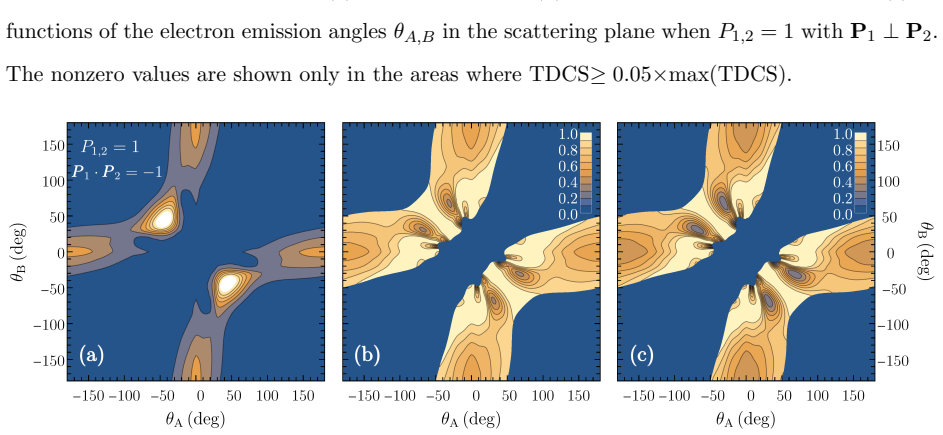
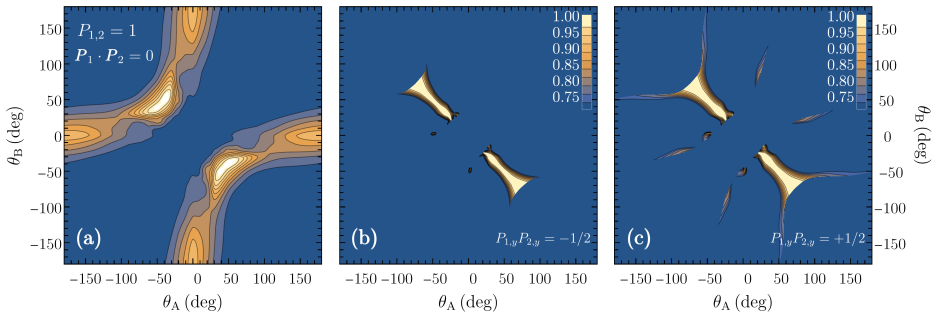
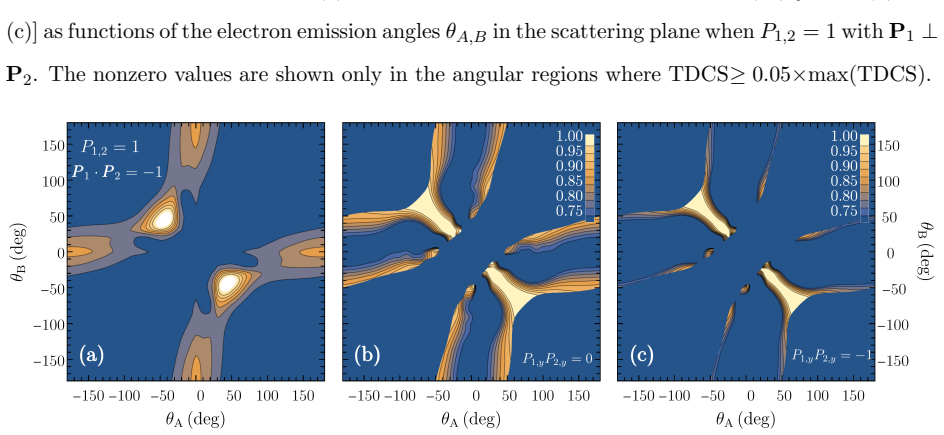
The paper's central claim is that the spin entanglement of the two outgoing electrons in a nonrelativistic (e,2e) ionization is fully determined by the spin-resolved triple differential cross sections, with no need to know the microscopic scattering amplitudes. Concretely, for a pure initial spin state the concurrence is $C_f = |t_d t_e|(1-\zeta_1\cdot\zeta_2)/(|t_d|^2+|t_e|^2-\mathrm{Re}(t_d t_e^*)(1+\zeta_1\cdot\zeta_2))$, and after ensemble averaging the unpolarized case reduces to $C_f(P_{1,2}=0)=\theta(I_s-I_t)(I_s-I_t)/(I_s+I_t)$, where $I_s$ and $I_t$ are the singlet and triplet components of the spin-averaged TDCS. Thus a nonzero final concurrence appears exactly when the singlet scattering channel dominates the triplet one, and it reaches unity when triplet scattering vanishes ($t_d=t_e$), a condition symmetry permits at equal energy sharing. The paper also formulates a Bell-inequality test purely in terms of the spin asymmetry $A=(I_{\uparrow\downarrow}-I_{\uparrow\uparrow})/(I_{\uparrow\downarrow}+I_{\uparrow\uparrow})$, with violation of $A\le 1/\sqrt{2}$ indicating entanglement. Numerical 3C-model results for atomic hydrogen show that these conditions are met in the same angular regions where the TDCS peaks, so the predicted entanglement should be observable.
Load-bearing premise
The two outgoing electrons are treated as effectively distinguishable because they are detected in separated detectors, so the usual two-qubit concurrence is applied without exchange corrections; if residual indistinguishability remains, the derived density matrix and every entanglement formula built on it would need revision.
Editorial extensions
If this is right
- A coincidence (e,2e) experiment that records spin-up/spin-down final channels can certify the produced spin entanglement without needing any model of the collision dynamics.
- Unpolarized electron beams and targets suffice to generate entangled outgoing pairs whenever the kinematics put the singlet channel above the triplet channel, so no spin-polarized source is required.
- Measuring the spin asymmetry $A=(I_{\uparrow\downarrow}-I_{\uparrow\uparrow})/(I_{\uparrow\downarrow}+I_{\uparrow\uparrow})$ gives a Bell-inequality test: $A>1/\sqrt{2}$ rules out local hidden-variable descriptions.
- In symmetric kinematics at equal energy sharing, target parity enforces $t_d=\pm t_e$, producing maximally entangled Bell states; atomic hydrogen is the concrete case where the paper computes this explicitly.
- Because the entanglement formulas are expressed through cross sections rather than amplitudes, they are independent of approximations such as the 3C model, which enters only in the illustrative numerical results.
Reading between the lines
- If the entanglement balance is genuinely measurable, (e,2e) collisions could serve as a practical source of spin-entangled electron pairs for quantum information, since the unpolarized case avoids delicate spin-state preparation.
- A direct experimental probe of the distinguishability assumption would be to tighten the detector solid angles or energy resolution: the two-qubit concurrence formula should hold only while the two outgoing electrons are cleanly separated, and exchange corrections should appear as the separation shrinks.
- The same cross-section-based formulas should transfer to electron–electron collisions in solids or plasmas, where an equivalent spin-entanglement diagnosis could be made without spin-resolved detection of both particles.
- The predicted overlap of TDCS maxima with entanglement maxima suggests a practical search strategy: locate the angular window of largest cross section and measure the spin asymmetry there, since maximal Bell violation is expected in the same window.
Signed reviews
Editorial analysis
A structured set of objections, weighed in public.
Referee Report
Summary. The paper develops a time-dependent, wave-packet treatment of nonrelativistic (e,2e) ionization and analyzes the spin state of the two detected outgoing electrons. Treating the electrons as effectively distinguishable because they are registered in separate detectors, the authors derive the two-qubit final spin density matrix in terms of the direct and exchange scattering amplitudes and express the concurrence, entanglement of formation, and Bell-inequality violation in terms of spin-resolved triple differential cross sections. The central results are Eq. (32) for pure initial spin states, Eqs. (36)-(39) for polarized initial electrons, Eqs. (53)-(54) for unpolarized initial electrons, and Eqs. (55)-(56) for Bell's inequality. Numerical 3C-model calculations for electron-impact ionization of atomic hydrogen at equal energy sharing show that maximal entanglement and Bell violation occur near the symmetric kinematics where the direct and exchange amplitudes coincide.
Significance. If the central claim is correct, the paper provides a model-independent way to infer the spin entanglement of the outgoing electron pair from measured spin-resolved cross sections, which is a substantive step beyond the usual pure-state or plane-wave treatments. The analytical derivations are internally consistent: I re-derived the pure-state concurrence (Eq. 32), the unpolarized mixed-state concurrence (Eq. 54), and the mixed-state Bell-asymmetry condition (Eq. 56), and found them algebraically correct. The limiting cases (td=te giving maximal concurrence, and ζ1=ζ2 giving zero) are reproduced correctly. The time-dependent formalism gives a principled resolution of the spurious-entanglement problem of delocalized plane waves, and the final formulas do not rely on the specific scattering model used for the numerics. The numerical 3C section is illustrative, but the main analytical results stand independently.
minor comments (7)
- [Sec. IV, Eq. (53)] The concurrence expression for the unpolarized initial state is stated without derivation. Since Eq. (54) is the headline result of the paper, please include the Wootters calculation from the averaged density matrix (Appendix B), or at least outline the steps connecting Eq. (53) to Eq. (54).
- [Appendix B] The statement that the unnormalized density matrices 'depend linearly' on ζ1 and ζ2 is imprecise: entries such as (1+ζ1xζ2x−ζ1yζ2y+ζ1zζ2z) are polynomial of degree two in the polarization components. The final replacement ζ→P is correct, but the explanation of the averaging should be revised.
- [Sec. IV, after Eq. (48)] The notation 'ζ1,2 = P1,2/P1,2' is a typo; it should read ζ1,2 = P1,2/|P1,2| or an equivalent definition of the unit vector along the polarization.
- [Sec. V.B, Eqs. (62)-(63)] The argument of the confluent hypergeometric function is garbled in the text ('−ikr−ikr' instead of e^{ik·r}1F1(iξ,1;−ikr−ik·r)); this should be corrected for readability.
- [Sec. II, after Eq. (20)] A brief discussion of when the two outgoing electrons are well separated in the detector basis would strengthen the effective-distinguishability assumption; the finite-detector-resolution case where the spatial modes overlap is not addressed, and a sentence acknowledging this limitation would be useful.
- [Throughout] There are several typos: 'infinum' should be 'infimum' (Sec. III.A), 'unpolzarized' should be 'unpolarized' (Sec. IV), and 'devises' should be 'devices' (Introduction).
- [Sec. VI] No numerical details are given for the evaluation of the six-dimensional integral (64) (quadrature method, grid, convergence criteria); a short description would improve reproducibility of the figures.
Circularity Check
No significant circularity: the entanglement measures are derived from first-principles scattering amplitudes and standard entanglement criteria, with no fitted input renamed as a prediction.
full rationale
The paper's derivation chain is self-contained and independent of its own conclusions. The final spinor (Eq. 17) follows from the time-dependent scattering formalism, the antisymmetrized in-asymptote, and the standard S-matrix reduction to direct and exchange T-matrix elements; no quantity is defined in terms of the target result. The pure-state concurrence (Eq. 32) is obtained by inserting the reduced density matrix (Eq. 28) into the standard pure-state formula (Eq. 31), and the unpolarized pair concurrence (Eqs. 53-54) is computed from the statistically averaged density matrix (Eqs. 50-51), whose trace is the spin-unresolved TDCS (Eq. 52). The final expressions in terms of spin-resolved TDCSs (Eqs. 37, 54, 55) are exact rewritings of independently derived scattering-amplitude formulas, not fitted parameters renamed as predictions. The numerical input, the 3C T-matrix, is an established external model cited as Ref. [54], and the paper explicitly notes that the TDCS-based entanglement formulas are free of uncertainties in the scattering-amplitude approximations. The only load-bearing physical assumption, that the outgoing electrons are effectively distinguishable because they are detected in spatially separated detectors (Sec. II after Eq. 20 and Sec. IV), is a stated modeling assumption rather than a circular reduction; the cited support [43-45] is external and the consequence is a well-defined operational basis for the two-qubit concurrence. No equation in the paper is equivalent by construction to an assumed input, and no self-citation is invoked to forbid alternatives or to justify the central claim.
Assumptions & free parameters
free parameters (1)
- TDCS measurability threshold =
0.05 x max(TDCS)
assumptions (7)
- standard math Standard nonrelativistic multichannel scattering theory with wave-packet in/out asymptotes and S/T matrices
- domain assumption The projectile-target interactions are spin independent (no spin-orbit coupling)
- domain assumption Outgoing electrons can be treated as effectively distinguishable due to spatial separation at the detectors
- domain assumption Initial wave packet is sharply peaked in momentum, justifying the on-shell replacement of T-matrices at p=k0
- domain assumption The 3C (BBK) model provides a valid approximation for the three-body Coulomb scattering state in (e,2e) on atomic hydrogen at 54.4 eV
- domain assumption Target is infinitely heavy and at rest
- standard math Entanglement of formation and concurrence correctly quantify bipartite entanglement for mixed states
Cite this review
Pith. "Pith review of Entanglement balance of quantum $(e,2e)$ scattering processes." pith.science (2026). https://pith.science/paper/JHCOWC57
@misc{pith2026190804508,
  author       = {Pith},
  title        = {Pith review of: Entanglement balance of quantum $(e,2e)$ scattering processes},
  year         = {2026},
  howpublished = {\url{https://pith.science/paper/JHCOWC57}},
  note         = {Machine review of arXiv:1908.04508}
}
abstract
The theory of quantum information constitutes the functional value of the quantum entanglement, i.e., quantum entanglement is essential for high fidelity of quantum protocols, while fundamental physical processes behind the formation of quantum entanglement are less relevant for practical purposes. In the present work, we explore physical mechanisms leading to the emergence of quantum entanglement in the initially disentangled system. In particular, we analyze spin entanglement of outgoing electrons in a nonrelativistic quantum $(e,2e)$ collision on a target with one active electron. Our description exploits the time-dependent scattering formalism for typical conditions of scattering experiments, and contrary to the customary stationary formalism operates with realistic scattering states. We quantify the spin entanglement in the final scattering channel through the pair concurrence and express it in terms of the experimentally measurable spin-resolved $(e,2e)$ triple differential cross sections. Besides, we consider Bell's inequality and inspect the regimes of its violation in the final channel. We address both the pure and the mixed initial spin state cases and uncover kinematical conditions of the maximal entanglement of the outgoing electron pair. The numerical results for the pair concurrence, entanglement of formation, and violation of Bell's inequality obtained for the $(e,2e)$ ionization process of atomic hydrogen show that the entangled electron pairs indeed can be formed in the $(e,2e)$ collisions even with spin-unpolarized projectile and target electrons in the initial channel. The positive entanglement balance---the difference between entanglements of the initial and final electron pairs---can be measured in the experiment.
Figures


Figures from the paper (3 more)

Reference graph
Works this paper leans on
-
[1]
In contrast, in the case of the entangled pure state, the reduced density matrix ˆ ρ1 appears to be always mixed, i.e., Tr ˆρ2 1 < 1, and hence has a nonzero linear entropy SL = 1− Tr ˆρ2 1 > 0, which is a lower approximation to the customary von Neumann entropy S =−Tr(ˆρ1 log2 ˆρ1)≥ SL. Thus, if the bipartite quantum state is pure, mixedness of the reduc...
-
[2]
(43) The advantage of this representation is that the quantities I↑↑ and I↑↓ are in principle measurable with polarized initial electrons without invoking spin resolution of the outgoing electrons. Moreover, it is also not necessary to carry out absolute measurements, for the knowledge of the I↑↑ and I↑↓ intensities on a relative scale suffices. Finally, we...
-
[3]
(55) It is identical to Eq. (43), except for the replacement of the unit vectors ζ1,2 with the polarization vectors P1,2. When at least one of the electrons is unpolarized ( P1 = 0 and/or P2 = 0) the inequality takes the form A≤ 1√ 2, A = I↑↓−I↑↑ I↑↓ +I↑↑ , (56) whereA is the so-called spin asymmetry for ( e, 2e) scattering. Measuring A > 1/ √ 2 thus prov...
work page 2018
-
[4]
Einstein, B
A. Einstein, B. Podolsky, and N. Rosen, Phys. Rev. 47, 777 (1935)
1935
- [5]
-
[6]
J. Stolze and D. Suter, Quantum Computing: A short course from Theory to Experiment (Wiley-VCH, 2007)
work page 2007
-
[7]
S. L. Braunstein and P. van Loock, Rev. Mod. Phys. 77, 513 (2005)
2005
-
[8]
Horodecki, P
R. Horodecki, P. Horodecki, M. Horodecki, and K. Horodecki, Rev. Mod. Phys. 81, 865 (2009)
2009
Show all 58 references
-
[9]
Vidal and R
G. Vidal and R. F. Werner, Phys. Rev. A 65, 032314 (2002)
2002
-
[10]
Ollivier and W
H. Ollivier and W. H. Zurek, Phys. Rev. Lett. 88, 017901 (2001)
2001
-
[11]
Amico, R
L. Amico, R. Fazio, A. Osterloh, and V. Vedral Rev. Mod. Phys. 80, 517 (2008)
2008
-
[12]
Molnar, J
A. Molnar, J. Garre-Rubio, D. Perez-Garcia, N, Schuch, and J. I. Cirac, New J. Phys. 20, 113017 (2018 )
2018
-
[13]
Vedral, M
V. Vedral, M. B. Plenio, M. A. Rippin, and P. L. Knight, Phys. Rev. Lett. 78, 2275 (1997)
1997
-
[14]
Yu-Ran Zhang, Yu Zeng, Heng Fan, J. Q. You, and F. Nori, Phys. Rev. Lett. 120, 250501 (2018)
2018
-
[15]
Budroni, A
Huan-Yu Ku, Shin-Liang Chen, C. Budroni, A. Miranowicz, Yueh-Nan Chen, and F. Nori, Phys. Rev. A 97, 022338 (2018)
2018
-
[16]
Marty, M
O. Marty, M. Cramer, and M. B. Plenio, Phys. Rev. Lett. 116, 105301 (2016)
2016
-
[17]
Das Sarma, Phys
Dong-Ling Deng, Xiaopeng Li, and S. Das Sarma, Phys. Rev. X 7, 021021 (2017)
2017
-
[18]
K. Wang, X. Wang, X. Zhan, Z. Bian, J. Li, B. C. Sanders, and P. Xue, Phys. Rev. A 97, 042112 (2018)
2018
-
[19]
Regula, M
B. Regula, M. Piani, M. Cianciaruso, T. R. Bromley, A. Streltsov, G. Adesso New J. Phys. 20, 033012 (2018)
2018
-
[20]
del Campo, J
A. del Campo, J. Molina-Vilaplana, and J. Sonner, Phys. Rev. D 95, 126008 (2017)
2017
-
[21]
Wilde Phys
Mark M. Wilde Phys. Rev. A 98, 042338 (2018). 29
2018
-
[22]
Blattmann, H
R. Blattmann, H. J. Krenner, S. Kohler, and P. H¨ anggi, Phys. Rev. A 89, 012327 (2014)
2014
-
[23]
Galve, Leonardo A
F. Galve, Leonardo A. Pachn, and D. Zueco, Phys. Rev. Lett. 105, 180501 (2010)
2010
-
[24]
W. H. Zurek Physics Reports 755, 1 ( 2018)
2018
-
[25]
Yang, Chen-Hsuan Hsu, P.Stano, J
G. Yang, Chen-Hsuan Hsu, P.Stano, J. Klinovaja, and D. Loss, Phys. Rev. B 93, 075301 (2016)
2016
-
[26]
Kajari, A
E. Kajari, A. Wolf, E. Lutz, and G. Morigi, Phys. Rev. A 85, 042318 (2012)
2012
-
[27]
M. Melz, J. W¨ atzel, L. Chotorlishvili, and J. Berakdar, Phys. Rev. B 98, 104407 (2018)
2018
-
[28]
Chotorlishvili, P
L. Chotorlishvili, P. Schwab, Z. Toklikishvili, V. Skrinnikov Phys. Lett. A 374, 1642 (2010)
2010
-
[29]
Chotorlishvili J
L. Chotorlishvili J. Berakdar, Z. Toklikishvili, J. Phys. A 44, 165303 (2011)
2011
-
[30]
Bose, Phys
S. Bose, Phys. Rev. Lett. 91, 207901 (2003)
2003
-
[31]
Y.-X. Liu, A. Miranowicz, Y. B. Gao, J. Bajer, C. P. Sun, and F. Nori, Phys. Rev. A 82, 032101 (2010)
2010
-
[32]
Azimi, M
M. Azimi, M. Sekania, S. M. Mishra, L. Chotorlishvili, Z. Toklikishvili, and J. Berakdar Phys. Rev. B 94, 064423 (2016)
2016
-
[33]
Zueco, G
D. Zueco, G. M. Reuther, S. Kohler, and P. H¨ anggi, Phys. Rev. A 80, 033846 (2009)
2009
-
[34]
P. Rabl, P. Cappellaro, M. V. Gurudev Dutt, L. Jiang, J. R. Maze, and M. D. Lukin, Phys. Rev. B 79, 041302(R) (2009)
2009
-
[35]
C. T. Whelan, H. R. J. Walters, A. Lahmam-Bennani, and H. Ehrhardt (Eds.), ( e, 2e) & Related Processes (Springer Netherlands, 1993)
1993
-
[36]
M. A. Coplan, J. H. Moore, and J. P. Doering, Rev. Mod. Phys. 66, 985 (1994)
1994
-
[37]
J. R. Taylor, Scattering Theory: The Quantum Theory of Nonrelativistic Collisions (Dover, New York, 2006)
2006
-
[38]
M. L. Goldberger and K. M. Watson, Collision Theory (Dover, New York, 2004)
2004
-
[39]
Lamata and J
L. Lamata and J. Le´ on, Phys. Rev. A 73, 052322 (2006)
2006
-
[40]
Feder, F
R. Feder, F. Giebels, and H. Gollisch, Phys. Rev. B 92, 075420 (2015)
2015
-
[41]
Vasilyev, F
D. Vasilyev, F. O. Schumann, F. Giebels, H. Gollisch, J. Kirschner, and R. Feder, Phys. Rev. B 95, 115134 (2017)
2017
-
[42]
Schliemann, J
J. Schliemann, J. I. Cirac, M. Kus, M. Lewenstein, and D. Loss, Phys. Rev. A 64, 022303 (2001)
2001
-
[43]
G. C. Ghirardi and L. Marinatto, Phys. Rev. A 70, 012109 (2004)
2004
-
[44]
Kessler, Polarized Electrons, 2nd Ed
J. Kessler, Polarized Electrons, 2nd Ed. (Springer-Verlag, Berlin, 1985). 30
1985
-
[45]
W. K. Wootters, Phys. Rev. Lett. 80, 2245 (1998)
1998
-
[46]
M. C. Tichy, F. Mintert, and A. Buchleitner, J. Phys. B: At. Mol. Opt. Phys., 44, 192001 (2011)
2011
-
[47]
M. C. Tichy, F. de Melo, M. Ku´ s, F. Mintert, and A. Buchleitner, Fortschr. Phys. 61, 225 (2013)
2013
-
[48]
R. L. Franco and G. Compagno, Sci. Rep. 6, 20603 (2016)
2016
-
[49]
V. L. Shablov, P. S. Vinitsky, Yu. V. Popov, O. Chuluunbaatar, and K. A. Kouzakov, Phys. Part. Nucl. 41, 335 (2010)
2010
-
[50]
C. J. Joachain, Quantum Collision Theory (North-Holland, Amsterdam, 1975)
1975
-
[51]
Mintert, A
F. Mintert, A. R.R. Carvalho, M. Ku´ s, and A. Buchleitner, Phys. Rep. 415, 207 (2005)
2005
-
[52]
Rungta, V
P. Rungta, V. Buˆ zek, C. M. Caves, M. Hillery, and G. J. Milburn, Phys. Rev. A 64, 042315 (2001)
2001
-
[53]
Bell, Physics 1, 195 (1964)
J. Bell, Physics 1, 195 (1964)
1964
-
[54]
B. S. Cirel’son, Lett. Math. Phys. 4, 93 (1980)
1980
-
[55]
Mitchell, S
P. Mitchell, S. Popescu, and D. Roberts, Phys. Rev. A 70, 060101(R) (2004)
2004
-
[56]
Weigold and I
E. Weigold and I. E. McCarrthy, Electron Momentum Spectroscopy(Kluwer Academic/Plenum Publishers, New York, 1999)
1999
-
[57]
Brauner, J
M. Brauner, J. S. Briggs, and H. Klar, J. Phys. B: At. Mol. Opt. Phys. 22, 2265 (1989)
1989
-
[58]
Ehrhardt, K
H. Ehrhardt, K. Jung, G. Knoth, and P. Schlemmer, Z. Phys. D 1, 3 (1986). 31
1986
Reviewed August 14, 2026 · model on record in the stance chip above.
Discussion (0). Continue with ORCID to comment.