REVIEW 4 major objections 6 minor 21 references
Fourier transform, Schr\"odinger representation, and Heisenberg modules
T0 review · 4 major / 6 minor · reviewed 2026-08-14 · deepseek-v4-flash
Pith's one-line read The Fourier transform turns self-dual solitons on noncommutative tori into anti-self-dual solitons, via a dual Schrödinger representation and a dual Heisenberg equivalence bimodule.
desk verdict A correct but modest dual-bimodule construction in Sections 1-2, with the advertised soliton duality in Section 3 resting on an unproved and imprecisely stated commutation assumption that must be justified or explicitly declared conditional. read the letter →
The pith
A machine-rendered reading of the paper's core claim, the machinery that carries it, and where it could break.
The reading
What carries the argument
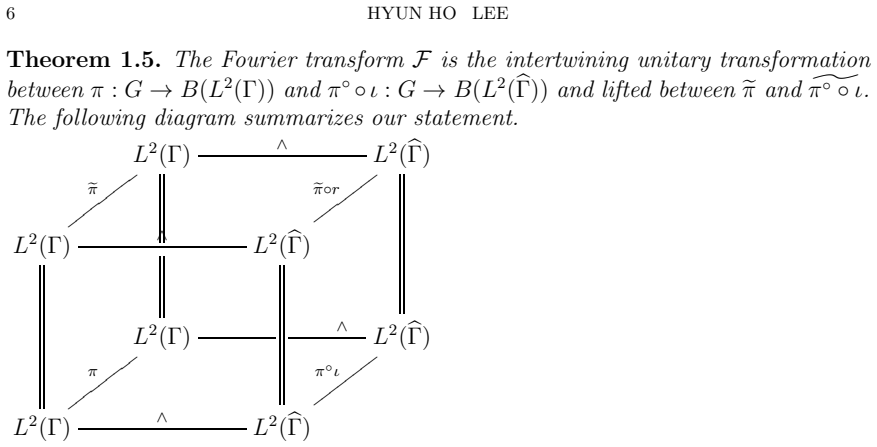
The load-bearing object is the dual Schrödinger representation $\pi^\circ\iota$, defined on the phase space $G=\hat\Gamma\times\Gamma$ by $\pi^\circ\iota(\gamma,t)=T_\gamma M_{-t}$ (translation first, then modulation), together with the Fourier intertwining identity $F\,\pi(\gamma,t)=\pi^\circ\iota(\gamma,t)\,F$, which is Theorem 1.5. This identity makes the Fourier transform a unitary equivalence between the original and dual projective representations, and it converts the Heisenberg module $S(\Gamma)$ into the dual module $S(\hat\Gamma)$: $F({}_A\langle\xi,\eta\rangle\cdot\psi)={}_{A^\circ}\langle\hat\xi,\hat\eta\rangle\cdot\hat\psi$, with the right action transported by $\pi^*\mapsto(\pi^\circ\iota)^*$. On the soliton side, the same intertwining is assumed to hold for the covariant derivatives as equation (25), $F\circ\nabla_i\equiv\nabla_{i+1}\circ F \pmod 2$ for $i=1,2$; this is what flips $\bar\nabla=\nabla_1+i\nabla_2$ into $\nabla=\nabla_1-i\nabla_2$ up to a scalar $-i$, thereby reversing duality and reversing the curvature $F_{12}\hat\psi=-F(F_{12}\psi)$, which drives the sign change of the topological charge.
What would settle it
Compute both sides of equation (25) for an explicit tight Gabor atom, for instance $\psi(t)=e^{-\pi t^2}$ on $\Gamma=\mathbb R$ with the standard noncommutative torus connection, using the paper's formulas for $\nabla_1,\nabla_2$; if $F(\nabla_i\psi)$ and $\nabla_{i+1}(F\psi)$ are not equal as specified, then Proposition 3.3 and Theorem 3.4 collapse.
Extended reading notes
Core claim
On the paper's own terms, the central claim is Theorem 3.4: for a lattice $\Lambda$ in $G=\hat\Gamma\times\Gamma$, let $A_\infty$, $A_\infty^\circ$, $B_\infty$, and $B_\infty^\circ$ be the smooth noncommutative torus algebras defined by the Schrödinger representation $\pi$ and its dual $\pi^\circ\iota$. If $\psi\in S(\Gamma)$ is a tight Gabor frame, so that $\langle\psi,\psi\rangle_B=1_B$, and the associated projection $p_\psi={}_A\langle\psi,\psi\rangle$ satisfies the self-duality equation $(\bar\partial p_\psi)p_\psi=0$, then $\hat\psi=F(\psi)$ satisfies $\langle\hat\psi,\hat\psi\rangle_{B^\circ}=1_{B^\circ}$ and the anti-self-duality equation $(\partial p_{\hat\psi})p_{\hat\psi}=0$. Thus the Fourier transform sends the soliton condition 'self-dual' to its mirror 'anti-self-dual'. In the continuous case (Proposition 3.3) the same transfer holds with the right algebra $\mathbb C$, and Theorem 3.10 says that being a generalized eigenvector of the anti-holomorphic connection is preserved under Fourier transform. The topological charge of the projection is reversed, $c_1(p_\psi)=-c_1(p_{\hat\psi})$ (Proposition 3.13).
Load-bearing premise
The load-bearing premise is equation (25), assumed without proof, that the Fourier transform intertwines the two covariant derivatives up to a swap and a scalar, $F\circ\nabla_i \equiv \nabla_{i+1}\circ F \pmod{2}$; if this intertwining fails for the standard Heisenberg modules over noncommutative tori, the self-dual-to-anti-self-dual soliton transfer does not follow.
Editorial extensions
If this is right
- If Theorem 3.4 is right, every tight Gabor frame satisfying the self-duality equation produces, by Fourier transform, a tight Gabor frame satisfying the anti-self-duality equation, so soliton solutions come in Fourier-paired dual pairs.
- The sign reversal $c_1(p_\psi)=-c_1(p_{\hat\psi})$ means the Fourier transform is a duality that exchanges positive and negative topological charge, so a soliton and its Fourier image live in opposite instanton sectors.
- The dual Heisenberg module $S(\hat\Gamma)$ gives a second Morita equivalence between the dual noncommutative torus algebras, so projective modules and their gauge-theoretic data have Fourier-dual counterparts.
- In Gabor analysis, the Riesz-sequence property for the dual lattice is preserved under Fourier transform (Proposition 3.7), so frame duality and Fourier duality are compatible.
- When $\Gamma\cong\hat\Gamma$ and $\psi=\hat\psi$ is a self-dual tight frame, Corollary 3.11 forces $\langle\nabla_j\psi,\psi\rangle=0$, a concrete constraint on any Fourier-invariant soliton.
Reading between the lines
- An extension the paper leaves implicit: one could verify equation (25) for $\Gamma=\mathbb R^n$ with arbitrary symplectic lattices, turning the assumed intertwining into a theorem and widening the result to higher-rank noncommutative tori.
- Because the proof only needs the intertwining of $\nabla$ and $\bar\nabla$, the same mechanism likely works for any pair of dual representations linked by a unitary that shifts the connection index, not only the Fourier transform; this suggests a broader 'duality of solitons' under other unitary transforms.
- The sign flip in the topological charge may have a physical reading in noncommutative sigma models: the Fourier transform acts like a charge-conjugation symmetry, exchanging instantons and anti-instantons. This is not stated in the paper and would need a separate analysis of the action functional.
- One could use Theorem 3.10 as a solution-generating technique: starting from a known generalized eigenvector of $\nabla$, its Fourier transform solves the same equation in the dual module, yielding new examples of Gabor frames and projections.
Signed reviews
Editorial analysis
A structured set of objections, weighed in public.
Referee Report
Summary. The paper studies the Fourier transform as an intertwiner between the Schrödinger representation π of the twisted group algebra L^1(Γ̂×Γ,σ) and a dual representation π∘∘ι on L^2(Γ̂). It proves several representation-theoretic identities (Theorem 1.5, Propositions 1.9, 1.13) and uses them to construct a Fourier-dual Heisenberg equivalence bimodule (Theorems 2.3 and 2.5). In the final section, the paper claims that, under a commutation relation between Fourier transform and covariant derivatives (Eq. (25)), a self-dual noncommutative soliton ψ maps to an anti-self-dual soliton ψ̂, that the relevant generalized eigenvector conditions are preserved (Theorem 3.10), and that the Connes–Chern number changes sign (Proposition 3.13). The advertised soliton results, however, rest on Eq. (25), which is assumed without proof or an explicit verification in the standard examples.
Significance. If the main results hold, the paper provides a clean account of the Fourier-transformed Schrödinger representation and a useful dictionary between Gabor frames over a lattice Λ and the dual lattice Λ∘. The explicit proof of Theorem 1.5 and the Moyal-type identities in Section 1 are genuine strengths, as are the careful statements of the associativity conditions for the dual equivalence bimodule. The potential significance of Section 3 is high: a Fourier duality for noncommutative solitons would connect Gabor analysis with noncommutative geometry and reproduce known soliton phenomena in a more conceptual way. However, the central soliton conclusions are conditional on an unproved commutation relation, Eq. (25), which is introduced immediately before the applications. That relation is load-bearing for Propositions 3.3, Theorems 3.4, 3.9, 3.10, and Proposition 3.13. Until it is either proved for the standard Heisenberg modules or explicitly identified as an additional hypothesis that is checked in examples, the paper's advertised claim about Fourier transforms of solitons is not established.
major comments (4)
- [Section 3, Theorem 3.4] Equation (25), F∘∇i ≡ ∇_{i+1}∘F (mod 2) for i=1,2, is the central assumption of the soliton section, but it is neither proved nor derived from the bimodule structure of Section 2. The symbol ≡ is not defined: Proposition 3.3 and Theorem 3.4 require equalities of the form F∘∇1 = ∇2∘F and F∘∇2 = ∇1∘F with the same scalar factors for the complex structure to transfer. If instead F∘∇1 = c1∇2∘F and F∘∇2 = c2∇1∘F with c1 ≠ c2, then the displayed computation in Proposition 3.3 is invalid and the self-dual/anti-self-dual correspondence can fail. Moreover, the connections ∇1 and ∇2 on S(Γ) and S(Γ̂) are never defined, so the reader cannot check (25) or the Leibniz compatibility conditions (26)–(27). Since Propositions 3.3, Theorem 3.4, Proposition 3.8, Theorem 3.9, Theorem 3.10, and Proposition 3.13 all use (25), the advertised soliton results are conditional on a nontrivial geometric fact that must be stated as an explicit hypothesis of those results and verified for the standard Heisenberg modules over noncommutative tori or the Moyal plane.
- [Section 3, Theorem 3.4] The proof of Theorem 3.4 is not a complete derivation. The displayed chain F(A⟨ψ,ψ⟩·∇ψ) = A∘⟨ψhat,ψhat⟩·(F∘∇ψ) requires that ∇ψ lie in the Schwartz space S(Γ) and that Proposition 2.1 extend from ψ to ∇ψ; this is not stated. More importantly, the notation ∇ changes between the anti-holomorphic connection used in the hypothesis and the holomorphic connection on the Fourier side; without an explicit index-by-index application of (25), the equality of the resulting operators cannot be checked. The proof should spell out which of ∇1 and ∇2 appears at each step and should state the scalar factors in (25) that make the two equalities hold with the same sign.
- [Section 3, Theorem 3.10] Theorem 3.10 is presented as a proof that ψ is a generalized eigenvector for ∇ if and only if ψhat is a generalized eigenvector for ∇, but the proof passes from F(∇ψ) to ∇(ψhat) by invoking the same unproved commutation relation (25) without quantifying the scalars. The map J is defined, but the key identity J(⟨ψ,ψ⟩B) = ⟨ψhat,ψhat⟩B∘ is asserted rather than proved from the definitions (22)–(23). As written, this theorem is largely a restatement of the assumptions encoded in (25), not an independent result.
- [Section 3, Proposition 3.13] Proposition 3.13 derives the sign change of the Connes–Chern number from the computation F12ψhat = ∇1∇2Fψ − ∇2∇1Fψ = −F(F12ψ). This computation again uses (25) with equal scalar factors, which is not established. If the scalar constants in the two parts of (25) differ, the conclusion c1(pψhat) = −c1(pψ) can fail. The displayed formula also contains a typographical error, `−∇2∇2`, which should read `−∇2∇1`; after that correction the argument is still conditional on the unproved commutation relation.
minor comments (6)
- [Section 2, Theorem 2.5] The last sentence of Theorem 2.5 says that S(Γ) is an equivalence bimodule between A∘∞ and B∘∞, but the first sentence of the theorem and the actions (14)–(15) and (22)–(23) are defined on S(Γ̂); the domain should be S(Γ̂), not S(Γ).
- [Section 3, Eq. (24)] Equation (24) is written as Tr_A(∂_i K) = 0, j = 1,2; the index on the left is i while the tag says j. This should be ∂_j for j=1,2.
- [Section 3, Proposition 3.13] The notation ci(pψ) in the proposition statement should be c1(pψ), matching the definition in the same section.
- [Section 3 (soliton equations)] The symbols ∇, ∇̅, ∂, and ∂̅ are used with inconsistent descriptions of holomorphic versus anti-holomorphic connections, and Proposition 3.1 mixes them in a way that makes it hard to determine which equation (28) or (29) is being transferred in Theorem 3.4. A consistent convention should be fixed throughout the section.
- [Section 2, Eq. (20)] The notation π∗(λ∘) is used for the right action of the dual lattice before it is defined; the authors should explicitly state that π∗(g) = π(g)^* or give the representation of Λ∘ used to define B and B∘.
- [Throughout] The paper uses S(Γ) and S(Γ̂) as Schwartz spaces for a general locally compact abelian group Γ, but such spaces are not defined for arbitrary LCA groups. The text should specify the class of groups (for example, elementary groups in the sense of Bruhat, or Γ = R^n × Z^q) or define the relevant rapidly decreasing functions explicitly.
Circularity Check
No significant circularity: the soliton transfer is conditional on the explicit intertwining assumption (25), but that assumption is an unproved premise rather than a disguised input.
full rationale
The derivation chain is not circular. Theorem 1.5 is proved by direct computation, so the dual Schrödinger representation is genuinely intertwining rather than merely renamed. Theorem 2.5 reduces the associativity of the Fourier-transported bimodule to Rieffel's Theorem 2.4 via the isometry of the Fourier transform, so the equivalence-bimodule claims have independent content. In Section 3, equation (25) is introduced explicitly as an assumption: 'we assume that on the equivalence bimodule S(Γ) and S(ˆΓ) there is a connection via covariant derivatives ∇1 and ∇2 which commute with Fourier transform up to a scalar; (25) F ◦ ∇i ≡ ∇i+1 ◦ F (mod 2) for i = 1, 2.' The proofs of Proposition 3.3, Theorem 3.4, Theorem 3.10 and Proposition 3.13 do depend on (25); however, this is a logical dependence on a stated hypothesis, not an equivalence-by-construction or a fitted parameter relabelled as a prediction. Moreover, the symbol '≡' in (25) is not made precise, and Proposition 3.3's proof needs consistent scalars in F∘∇1=∇2∘F and F∘∇2=∇1∘F; this is a rigor or correctness gap, not circularity. If (25) is not verified for the standard Heisenberg modules, the soliton conclusions are merely conditional. The self-citations [15,16] support only peripheral normalization and characterization facts (Proposition 3.2 and equation (32)); they are not the load-bearing step of the main equivalence-bimodule or Fourier-duality argument.
Assumptions & free parameters
assumptions (8)
- standard math Gamma is a second countable locally compact abelian group, with Haar measures normalized so that the Plancherel theorem holds.
- standard math The 2-cocycle sigma on G = hat Gamma times Gamma is the canonical one: sigma((gamma1,t1),(gamma2,t2)) = gamma2(t1).
- standard math Rieffel's theorem (Theorem 2.4) that S(Gamma) is an equivalence bimodule between A(Lambda,sigma) and A(Lambda^circ,sigma*).
- standard math The duality principle for Gabor frames (Theorem 3.5), cited from [14].
- domain assumption There is an infinitesimal T^2-action on A and A^circ with derivations del_1, del_2, and the trace Tr_A is invariant under the action, i.e., Tr_A(del_i K) = 0.
- domain assumption The Heisenberg module S(Gamma) (and S(hat Gamma)) carry covariant derivatives nabla_1, nabla_2 compatible with the derivations and hermitian structures, and integration by parts holds.
- ad hoc to paper The covariant derivatives commute with the Fourier transform up to a scalar: F circ nabla_i equiv nabla_{i+1} circ F (mod 2) for i = 1,2.
- standard math The trace on A and B satisfies Tr(k natural l) = Tr(l natural k), with Tr_A(a) = a(0) and Tr_B(b) = s(Lambda) b(0).
Cite this review
Pith. "Pith review of Fourier transform, Schr\"odinger representation, and Heisenberg modules." pith.science (2026). https://pith.science/paper/3DFNORAX
@misc{pith2026190804514,
  author       = {Pith},
  title        = {Pith review of: Fourier transform, Schr\"odinger representation, and Heisenberg modules},
  year         = {2026},
  howpublished = {\url{https://pith.science/paper/3DFNORAX}},
  note         = {Machine review of arXiv:1908.04514}
}
abstract
We investigate and review how Fourier transform is involved in the analysis of a twisted group algebra $L^1(G, \sigma)$ for $G=\widehat{\Gamma}\times \Gamma$ and $\sigma:G\times G \to \mathbb{T}$ 2- cocycle where $\Gamma$ is a locally compact abelian group and $\widehat{\Gamma}$ its Pontryagin dual. By weaving the Schr\"{o}dinger representation and Fourier transform, we construct the dual equivalence bimodule of the Heisenberg bimodule generated by the dual Schr\"{o}dinger representation and observe several relations between them including the application of noncommutative solitons.
Figures
Reference graph
Works this paper leans on
-
[1]
Connes, C∗ -alg` ebres et g´ eometrie diff´ erentille, C.R
A. Connes, C∗ -alg` ebres et g´ eometrie diff´ erentille, C.R. Acad. Sci. Paris S´ er. A 290 (1980), no. 13, 599–604.MR1690050(81c:46053)
work page 1980
-
[2]
Boca, Projections in rotation algebras and theta functions , Comm
F. Boca, Projections in rotation algebras and theta functions , Comm. Math. Phys. 202 (1999), no. 2, 325–357.MR1690050(2000j:46101)
work page 1999
-
[3]
A. Connes and M. Rieffel, Yang-Mills for noncommutative two-tori , Contemp. Math. 62 (1987), 335–348. MR454645 (56#:12894) 20 HYUN HO LEE
work page 1987
-
[4]
L. Dabrowski, T. Krajewski, and G. Landi, Some properties of Non-linear σ -models in noncom- mutative geometry, Int. J. Mod. Phys. B14 (2000), 2367–2382. MR0470685 (57 #10431)
work page 2000
-
[5]
, Non-linear σ -models in noncommutative geometry: fields with values in fin ite spaces, Mod. Physics Lett. A 18 (2003), 2371–2379
work page 2003
-
[6]
Landi, and F Luef, Sigma-model solitons on noncommutative spaces , Lett
L Dabrowski, G. Landi, and F Luef, Sigma-model solitons on noncommutative spaces , Lett. Math. Phys. 105 (2015), no. 12, 1633–1688, DOI 10.1007/s11005-015-0790-x. MR3420593
-
[7]
Solitons of general topological charge over noncommutative tori
L. Dabrowski, M. Jakobsen, G. Landi, and F. Luef, Solitons of general topological charge over noncommutative tori, arXiv:1801.08596
-
[8]
H Feichtinger and Strohmer, Gabor analysis and Algorithms , Springer Science+Business Media, LLC, 1998
work page 1998
Show all 21 references
-
[9]
Frank and D
M. Frank and D. Larson, Frames in Hilbert C∗ -modules and C∗ -algebras, J. Operator Theory (2002), 273–314
2002
-
[10]
Gr¨ ochenig and Y
K. Gr¨ ochenig and Y. Lyubarskii, Gabor(super) frames with Hermite functions , Math. Ann. 345 (2009), 267–286
2009
-
[11]
Gr¨ ochenig and J St¨ ockler,Gabor frames and totally positive functions , Duke Math
K. Gr¨ ochenig and J St¨ ockler,Gabor frames and totally positive functions , Duke Math. J 162 (2013), no. 5, 1003–1031
2013
-
[12]
Howe, On the role of the Heisenberg group in harmonic analysis , Bull
R. Howe, On the role of the Heisenberg group in harmonic analysis , Bull. Amer. Math. Soc. 3 (1980), no. 2, 821–843
1980
-
[13]
Jacobsen, On a New Segal Algebra:A Review of the Feichtinger Algebra , J
M. Jacobsen, On a New Segal Algebra:A Review of the Feichtinger Algebra , J. Fourier Anal. Appl. 24 (2018), 1579–1660
2018
-
[14]
Jakobsen and J
M. Jakobsen and J. Lemvig, Density and duality theorems for regular Gabor frames , J. Funct. Anal. 270 (2016), no. 1, 229–263
2016
-
[15]
Lee, A note on nonlinear σ -models in noncommutative geometry , IDAQP 19 (2016), no
H. Lee, A note on nonlinear σ -models in noncommutative geometry , IDAQP 19 (2016), no. 1, DOI 10.1142/S0239025716500065. MR2733573 (2011k:46079)
2016 doi
-
[16]
2, DOI 10.1142/S023902571850008X
, On a gauge action on sigma model solitons , IDAQP 21 (2018), no. 2, DOI 10.1142/S023902571850008X
2018 doi
-
[17]
Luef, Projections in noncommutative tori and Gabor frames , Proc
F. Luef, Projections in noncommutative tori and Gabor frames , Proc. A.M.S. 139 (2010), no. 2, 571–582
2010
-
[18]
, Projective modules over noncommutative tori are multi-win dow Gabor frames for mod- ulation spaces, J. Funct. Anal. 257 (2009), no. 6, 1921–1946. MR2540994
2009
-
[19]
Mathai and J
V. Mathai and J. Rosenberg, A noncommutative sigma-model , J. Noncommut. Geom. 5 (2011), 265–294
2011
-
[20]
Polishchuck, Analogues of the exponential map associated with complex st ructures on non- commutative two-tori , Pacific J
P. Polishchuck, Analogues of the exponential map associated with complex st ructures on non- commutative two-tori , Pacific J. Math. 226 (2006), no. 1, 153–178
2006
-
[21]
Rieffel, Projective modules over higher-dimensional non-commutat ive tori , Canad
M. Rieffel, Projective modules over higher-dimensional non-commutat ive tori , Canad. J. Math. XL (1988), no. 2, 257–338. Department of Mathematics, University of Ulsan, Ulsan, Sou th Korea 44610 E-mail address : hadamard@ulsan.ac.kr
1988
Reviewed August 14, 2026 · model on record in the stance chip above.
Discussion (0). Continue with ORCID to comment.