REVIEW 3 major objections 5 minor 13 references
Random Pilot and Data Access for Massive MIMO Spatially Correlated Rayleigh Fading Channels
T0 review · 3 major / 5 minor · reviewed 2026-08-14 · deepseek-v4-flash
Pith's one-line read Channel-aware grouping cuts pilot-collision errors in massive MIMO systems with spatially correlated fading.
desk verdict The grouping idea is sensible and the per-device estimation is standard, but the ensemble averaging in Eqs. (13)-(15) is not a valid expectation under the stated random pilot selection, so the analytic performance claims are unsupported as written. read the letter →
The pith
A machine-rendered reading of the paper's core claim, the machinery that carries it, and where it could break.
The reading
What carries the argument
The carrying object is the angle between two channel covariance matrices, defined as $\theta(\mathbf{R}_i,\mathbf{R}_j)=\arccos\bigl(\operatorname{tr}\{\mathbf{R}_i\mathbf{R}_j\}/(\|\mathbf{R}_i\|_F\|\mathbf{R}_j\|_F)\bigr)$, which measures how much two devices' spatial channels overlap. The DGPSA algorithm uses this angle to place devices with nearly orthogonal covariance matrices (angles near $\pi/2$) into the same group and to assign each group a separate pilot set, so that whatever pilot collisions occur involve devices with non-overlapping angle-of-arrival intervals. The MMSE channel estimator and its error expression then carry the performance analysis: when colliding covariance matrices are exactly orthogonal, the interference term $\sum_{f\in\mathcal{F}^n_{l,m}}\mathbf{R}_f$ vanishes, and the theoretical lower bound $\epsilon_{\min}=p_a[\mathbb{E}_{U,K_a,\mathcal{F}}(\varepsilon)]_{\min}$ is attained. The random pilot-hopping pattern with correlation decoding over $L$ slots is the mechanism that lets the base station identify devices despite collisions.
What would settle it
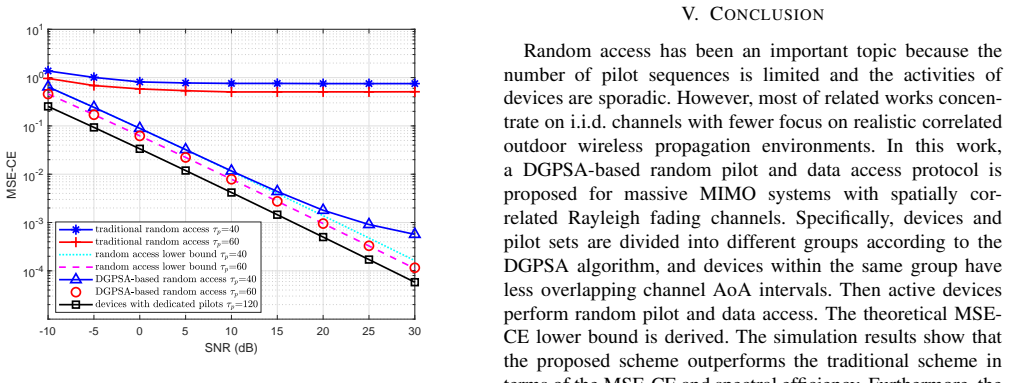
Take 120 devices with mean AoAs uniformly distributed in $[-\pi/3,\pi/3]$, angular spread $1^\circ$, activation probability $p_a=1/3$, and pilot length $\tau_p=60$; run the DGPSA grouping and measure the MSE-CE at SNR $=30$ dB. If the measured MSE-CE does not come close to the theoretical lower bound $\epsilon_{\min}$ while the ungrouped scheme remains far above it, the claim that grouping yields near-orthogonal colliders fails.
Extended reading notes
Core claim
The central claim is that exploiting the angular structure of spatially correlated channels turns the largest weakness of random pilot access, collisions, into a nearly harmless event. In the proposed protocol, the base station first divides devices into groups so that, within each group, channel covariance matrices are approximately orthogonal, and assigns each group a dedicated set of pilot sequences; active devices then follow the random pilot and data access process. For a device whose colliders have orthogonal covariance matrices, the interfering covariance sum $\sum_{f\in\mathcal{F}^n_{l,m}} \mathbf{R}_f$ in the MMSE estimator vanishes, and the expected MSE-CE collapses to the device's no-interference estimation error, giving the theoretical minimum $\epsilon_{\min}=p_a[\mathbb{E}_{U,K_a,\mathcal{F}}(\varepsilon)]_{\min}$. Because the grouping makes colliding devices' angle-of-arrival intervals mostly disjoint, the actual MSE-CE stays close to this lower bound over a wide SNR range, and the resulting spectral efficiency exceeds that of the traditional ungrouped scheme.
Load-bearing premise
The base station must have accurate and current channel covariance matrices for every device, and devices' angular statistics must remain stable long enough for the grouping to stay valid during random access.
Editorial extensions
If this is right
- In strongly correlated channels with small angular spread, the MSE-CE gain over traditional ungrouped random access is largest, so the protocol pays off exactly where spatial correlation is most pronounced.
- As pilot length grows, the number of groups grows and the expected number of colliders per device falls, so the MSE-CE approaches the no-interference lower bound over a wide SNR range.
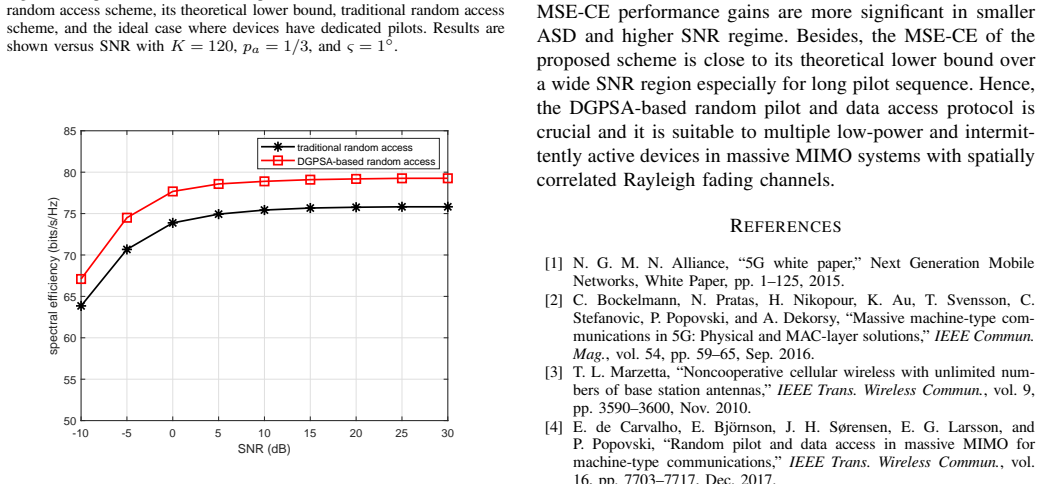
- The derived spectral efficiency of the proposed scheme exceeds that of the ungrouped baseline at all simulated SNR values for the simulated $K=120$, $\tau_p=30$, $\tau_u=128$, and $2^\circ$ angular spread setup.
- The protocol suits delay-tolerant, low-rate massive machine-type traffic, because identifying devices requires long pilot-hopping patterns across many slots.
- If devices that reuse a pilot have exactly orthogonal channel covariance matrices, the expected MSE-CE attains the theoretical minimum and becomes independent of the specific collision statistics.
Reading between the lines
- A natural testable extension is periodic regrouping triggered by device mobility: the paper assumes static covariance matrices, and the grouping quality will degrade as angular statistics drift.
- The orthogonality condition suggests that angular-domain scheduling, assigning pilots according to estimated angle-of-arrival intervals, could achieve similar gains without explicit covariance exchange from devices.
- The analysis is single-cell; in a multi-cell deployment, inter-cell pilot contamination would add covariance terms across cells, so grouping would need to account for interference from devices in neighbouring cells.
- Scaling the pairwise covariance-angle comparisons to very large device populations may require approximate or hierarchical clustering, a computation cost the paper does not address.
Signed reviews
Editorial analysis
A structured set of objections, weighed in public.
Referee Report
Summary. The paper proposes a device grouping and pilot set allocation (DGPSA) algorithm for uplink massive MIMO random access under spatially correlated Rayleigh fading. Devices are partitioned into groups whose channel covariance matrices are approximately orthogonal, each group is assigned a dedicated pilot set, and active devices then perform random pilot and data access following the protocol of [4]. The authors derive expressions for the mean square error of channel estimation (MSE-CE) and spectral efficiency, identify a theoretical lower bound achieved when colliding devices have orthogonal covariances (i.e., non-overlapping AoA intervals), and provide simulations showing that the proposed scheme outperforms the traditional ungrouped random access scheme, especially at high SNR and small angular spread.
Significance. If the analytical results were correct, the paper would offer a useful way to exploit spatial correlation in massive MIMO random access, a relevant and timely problem. The per-device MMSE expressions in Eqs. (8)–(9) and (12) are standard, and the lower bound per device in (16) is correctly identified as the error with no pilot interference. The proposed algorithm is intuitive, and the simulation comparisons appear consistent with the qualitative claims. However, the central analytical derivations of the expected MSE-CE and spectral efficiency contain a load-bearing averaging error that makes the general closed-form expressions (15) and (22) unsupported as written. The paper needs a major revision of Section III before its analytical claims can be accepted.
major comments (3)
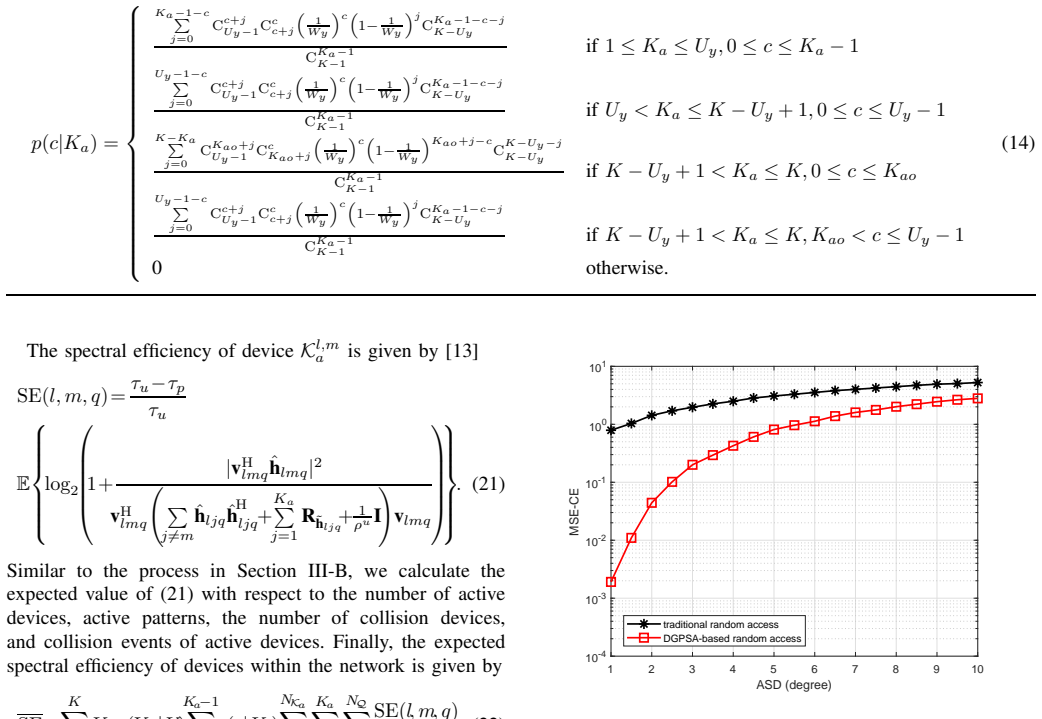
- [§III-C, Eq. (22)] The expectation in Eq. (13) is not the expectation under the stated random pilot selection model. It averages uniformly over all possible collision sets n, with weight 1/N_{l,m}, without regard to the collision-set size c. Under the model in which each active device in group y chooses one of W_y pilots uniformly, a collision set of size c has probability (1/W_y)^c(1-1/W_y)^{U_y-1-c}; this equals 1/N_{l,m} only when W_y=2. Moreover, E_{U,K_a,F}(ε) in (13) is not conditioned on c, so multiplying it by p(c|K_a) in (15) and summing over c is not a conditional expectation; the true dependence of the MSE on c is discarded. Consequently, Eq. (15) does not establish the claimed closed-form MSE-CE for the general W_y>2 case, even though the special case W_y=2 used in the simulations would make the uniform collision-set average correct.
- [§III-C] The spectral-efficiency average in Eq. (22) inherits the same defect as Eq. (15): SE(l,m,q) is averaged uniformly over all possible collision events q with weight 1/N_Q, and this c-independent quantity is then multiplied by p(c|K_a) and summed over c. Since a given collision event under random pilot selection occurs with probability (1/W_y)^c(1-1/W_y)^{U_y-1-c} rather than 1/N_Q, Eq. (22) is not the expected spectral efficiency of the proposed scheme except when W_y=2. The derivation therefore does not support the spectral-efficiency results as a general analytical statement.
- [§III-B] The probability p(c|K_a) in Eq. (14) is defined for a single group y with parameters U_y and W_y, but the expectation in Eqs. (13) and (15) is an average over all devices in all groups. Unless every group has identical size and pilot count (which is not guaranteed by Algorithm 1), the group-specific p(c|K_a) cannot be used in a device-level average without weighting by U_y/K. In addition, while the value p_a[E_{U,K_a,F}(ε)]_{min} in Eq. (18) is a valid lower bound on the true expected MSE, its derivation through Eq. (15) is invalid for the reasons above; the lower bound should be derived directly as the average over devices of the per-device no-interference MMSE.
minor comments (5)
- There are frequent typos and inconsistent notation, e.g., 'matrixes' should be 'matrices', and the combinatorial notation in Eq. (14) (e.g., the terms involving C_{c}^{c+j}) is difficult to parse; please rewrite for clarity.
- The quantities N_{l,m} in Eq. (13) and N_Q in Eq. (22) are not explicitly defined; please provide precise definitions of these counts.
- In Algorithm 1, Step 4 selects the device with maximum sum of cosine similarities to already grouped devices; the rationale for this choice (rather than a minimum or random selection) is not explained, and the heuristic nature of the algorithm could be stated more clearly.
- The sentence 'Since long pilot hopping patterns are used as identifiers, this protocol should be applied to delay-tolerant and low-rate applications' is a useful caveat, but the paper does not discuss how the pattern length L affects the derived MSE and spectral efficiency; a remark would help the reader understand the scope of the results.
- In Eq. (21), the expectation is written without specifying the underlying random variables; please state explicitly that it is over channel realizations, pilot selections, and possibly data symbols.
Circularity Check
No significant circularity: the MMSE derivation and lower bound are self-contained and no fitted parameter is repackaged as a prediction.
full rationale
The paper's central claims are derived from standard estimation theory rather than from the quantities they purport to predict. Equation (9) is the standard MMSE error covariance R_k - τ_p R_k(Σ τ_p R_l + I/ρ_p)^{-1} R_k, and Eq. (12) is the corresponding trace; the DFT approximation of covariance matrices is imported from the external reference [8], not from the authors' own prior work. The 'theoretical lower bound' in Eqs. (16)-(18) is obtained by the positive-semidefinite argument that deleting the interference term Σ R_f minimizes the MMSE error, giving R_k - R_k(R_k + I/(ρ_p τ_p))^{-1} R_k, which is an analytic extremum rather than a fitted target. No parameter is fit to simulation output and then called a prediction: Algorithm 1 groups devices by cosine similarity of covariance matrices, a geometric criterion distinct from the MSE objective, and the compared MSE curves are evaluated under the model assumptions stated in Section IV. The paper contains no load-bearing self-citation chain; all cited prior work is external. The reviewer's concern about Eqs. (13)-(15), that the unweighted average over collision sets may not match the random-pilot distribution, is a potential error in the derivation of the expected MSE, not a circularity, because the claimed result is not defined in terms of the input or obtained by renaming a fitted quantity. The assumption that channel covariance matrices are available to the BS is a practical limitation, but it is an input to the algorithm, not a disguised form of the output.
Assumptions & free parameters
assumptions (5)
- domain assumption Channel vectors follow spatially correlated Rayleigh fading with covariance R_k as in (1)-(3), using a truncated Laplacian power azimuth spectrum.
- domain assumption The covariance matrix eigenbasis is approximated by the DFT matrix when M is large, as in (4)-(5).
- domain assumption The base station knows all device covariance matrices, which are wide-sense stationary.
- domain assumption Random pilot and data access protocol from [4] with large L ensures ergodicity and device identification.
- standard math MMSE estimation and the orthogonality principle are valid.
Cite this review
Pith. "Pith review of Random Pilot and Data Access for Massive MIMO Spatially Correlated Rayleigh Fading Channels." pith.science (2026). https://pith.science/paper/NBPQXEYH
@misc{pith2026190804541,
  author       = {Pith},
  title        = {Pith review of: Random Pilot and Data Access for Massive MIMO Spatially Correlated Rayleigh Fading Channels},
  year         = {2026},
  howpublished = {\url{https://pith.science/paper/NBPQXEYH}},
  note         = {Machine review of arXiv:1908.04541}
}
read the original abstract
Random access is necessary in crowded scenarios due to the limitation of pilot sequences and the intermittent pattern of device activity. Nowadays, most of the related works are based on independent and identically distributed (i.i.d.) channels. However, massive multiple-input multiple-output (MIMO) channels are not always i.i.d. in realistic outdoor wireless propagation environments. In this paper, a device grouping and pilot set allocation algorithm is proposed for the uplink massive MIMO systems over spatially correlated Rayleigh fading channels. Firstly, devices are divided into multiple groups, and the channel covariance matrixes of devices within the same group are approximately orthogonal. In each group, a dedicated pilot set is assigned. Then active devices perform random pilot and data access process. The mean square error of channel estimation (MSE-CE) and the spectral efficiency of this scheme are derived, and the MSE-CE can be minimized when collision devices have non-overlapping angle of arrival (AoA) intervals. Simulation results indicate that the MSE-CE and spectral efficiency of this protocol are improved compared with the traditional scheme. The MSE-CE of the proposed scheme is close to the theoretical lower bound over a wide signal-to-noise ratio (SNR) region especially for long pilot sequence. Furthermore, the MSE-CE performance gains are significant in high SNR and strongly correlated scenarios.
Figures

Figures from the paper (1 more)
Reference graph
Works this paper leans on
-
[4]
Random pilot and data access in massive MIMO fo r machine-type communications,
E. de Carvalho, E. Bj¨ ornson, J. H. Sørensen, E. G. Larsso n, and P . Popovski, “Random pilot and data access in massive MIMO fo r machine-type communications,” IEEE Trans. Wireless Commun. , vol. 16, pp. 7703–7717, Dec. 2017
work page 2017
-
[1]
N. G. M. N. Alliance, “5G white paper,” Next Generation Mo bile Networks, White Paper, pp. 1–125, 2015
work page 2015
-
[2]
Massive machine- type com- munications in 5G: Physical and MAC-layer solutions,
C. Bockelmann, N. Pratas, H. Nikopour, K. Au, T. Svensson , C. Stefanovic, P . Popovski, and A. Dekorsy, “Massive machine- type com- munications in 5G: Physical and MAC-layer solutions,” IEEE Commun. Mag., vol. 54, pp. 59–65, Sep. 2016
work page 2016
-
[3]
Noncooperative cellular wireless with unlimited num- bers of base station antennas,
T. L. Marzetta, “Noncooperative cellular wireless with unlimited num- bers of base station antennas,” IEEE Trans. Wireless Commun. , vol. 9, pp. 3590–3600, Nov. 2010
work page 2010
-
[5]
Random access protocols for massive MIMO
E. de Carvalho, E. Bj¨ ornson, J. H. Sørensen, P . Popovski , and E. G. Larsson, “Random access protocols for massive MIMO”, IEEE Commun. Mag. , vol. 55, pp. 216–222, May 2017
work page 2017
-
[6]
Massive MIMO for crowd scenarios: A solution based on random access,
J. H. Sørensen, E. de Carvalho, and P . Popovski, “Massive MIMO for crowd scenarios: A solution based on random access,” in IEEE Globecom W orkshops (GC Wkshps ), Austin: Academic, Dec. 2014, pp. 352–357
work page 2014
-
[7]
A random access protocol for pilot allocation in crowded massive MIMO systems,
E. Bj¨ ornson, E. de Carvalho, J. H. Sørensen, E. G. Larsso n, and P . Popovski, “A random access protocol for pilot allocation in crowded massive MIMO systems,” IEEE Trans. Wireless Commun. , vol. 16, pp. 2220–2234, Apr. 2016
work page 2016
-
[8]
Pilot reuse for massive MIMO transmission over spatially correlated Rayle igh fading channels,
L. Y ou, X. Q. Gao, X. G. Xia, N. Ma, and Y . Peng, “Pilot reuse for massive MIMO transmission over spatially correlated Rayle igh fading channels,” IEEE Trans. Wireless Commun., vol. 14, pp. 3352–3366, Feb. 2015
work page 2015
Show all 13 references
-
[9]
Omnidirectional precod ing based transmission in massive MIMO systems,
X. Meng, X. Q. Gao, and X. G. Xia, “Omnidirectional precod ing based transmission in massive MIMO systems,” IEEE Trans. Commun. , vol. 64, pp.174–186, Nov. 2016
2016
-
[10]
A stoch astic model of the temporal and azimuthal dispersion seen at the base sta tion in outdoor propagation environments,
K. I. Pedersen, P . E. Mogensen, and B. H. Fleury, “A stoch astic model of the temporal and azimuthal dispersion seen at the base sta tion in outdoor propagation environments,” IEEE Trans. V eh. Technol., vol. 49, pp. 437–447, Mar. 2000
2000
-
[11]
Clerckx, and C
B. Clerckx, and C. Oestges, MIMO Wireless Networks: Channels, Techniques and Standards for Multi-Antenna, Multi-User an d Multi- Cell Systems , 2nd ed. Oxford, UK: Academic Press, 2013
2013
-
[12]
A coord inated ap- proach to channel estimation in large-scale multiple-ante nna systems,
H. F. Yin, D. Gesbert, M. Filippou, and Y . Z. Liu, “A coord inated ap- proach to channel estimation in large-scale multiple-ante nna systems,” IEEE J. Sel. Area Commun. , vol. 31, pp. 264–273, Feb. 2013
2013
-
[13]
Bj¨ ornson, J
E. Bj¨ ornson, J. Hoydis, and L. Sanguinetti, Massive MIMO Networks: Spectral, Energy, and Hardware Efficiency , Foundations and Trends R© in Signal Processing: vol. 11, pp. 154–655, Nov. 2017
2017
Reviewed August 14, 2026 · model on record in the stance chip above.
Discussion (0). Continue with ORCID to comment.