REVIEW 3 major objections 3 minor 33 references
Superlattice design for optimal thermoelectric generator performance
T0 review · 3 major / 3 minor · reviewed 2026-08-14 · deepseek-v4-flash
Pith's one-line read This paper establishes that, among the superlattice designs considered, a stack with Gaussian-distributed barrier thickness is the best thermoelectric generator structure, reaching $0.46\,\mathrm{MW/m^2}$ at $43\%$ of Carnot efficiency…
desk verdict Solid comparative simulation study; the abstract's 'device variability' robustness claim overreaches because no disorder is ever simulated. read the letter →
The pith
A machine-rendered reading of the paper's core claim, the machinery that carries it, and where it could break.
The reading
What carries the argument
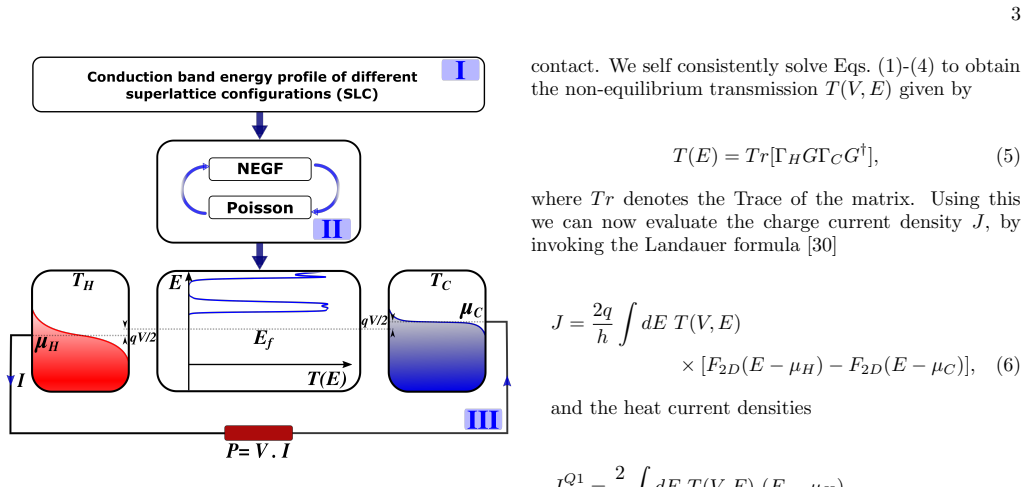
The governing object is the energy-resolved transmission function $T(E)$ of the superlattice, computed from a one-band, nearest-neighbor tight-binding Hamiltonian using the non-equilibrium Green's function formalism coupled self-consistently to the Poisson equation. The argument is that a boxcar-shaped $T(E)$ with finite spectral width is the optimal transmission profile for efficiency at a given output power, so each configuration is judged by how closely and how robustly it produces that lineshape under charging. SLC-IV's Gaussian thickness profile is the specific mechanism that preserves near-unity transmission across the miniband while keeping the bandpass edges sharp.
What would settle it
Sweep the Gaussian variance in $b_k=b_{\max}\exp[(k-6)^2/2]$ and repeat the self-consistent power-efficiency calculation; if another width, or randomly fluctuating barrier thicknesses, pushes another configuration above SLC-IV in maximum power or efficiency at maximum power, the claimed optimality fails.
Extended reading notes
Core claim
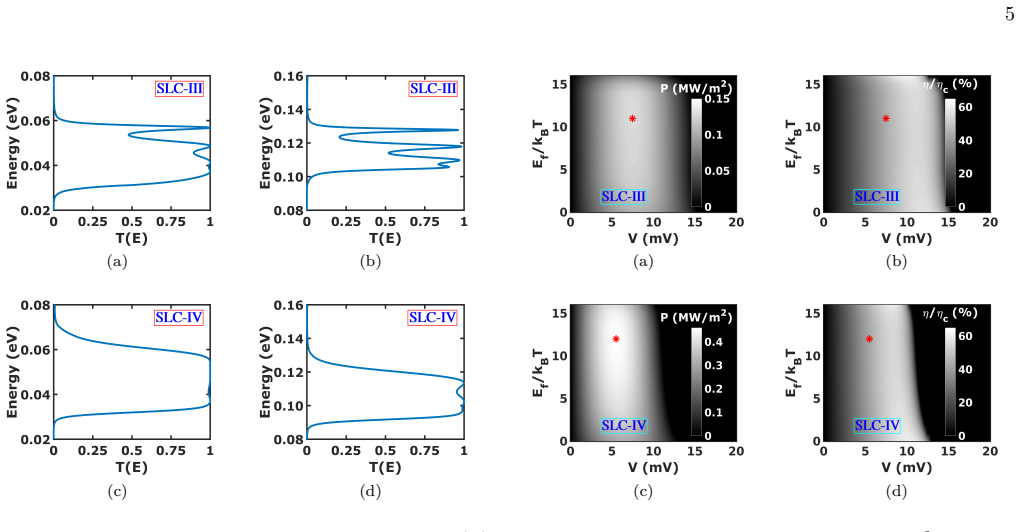
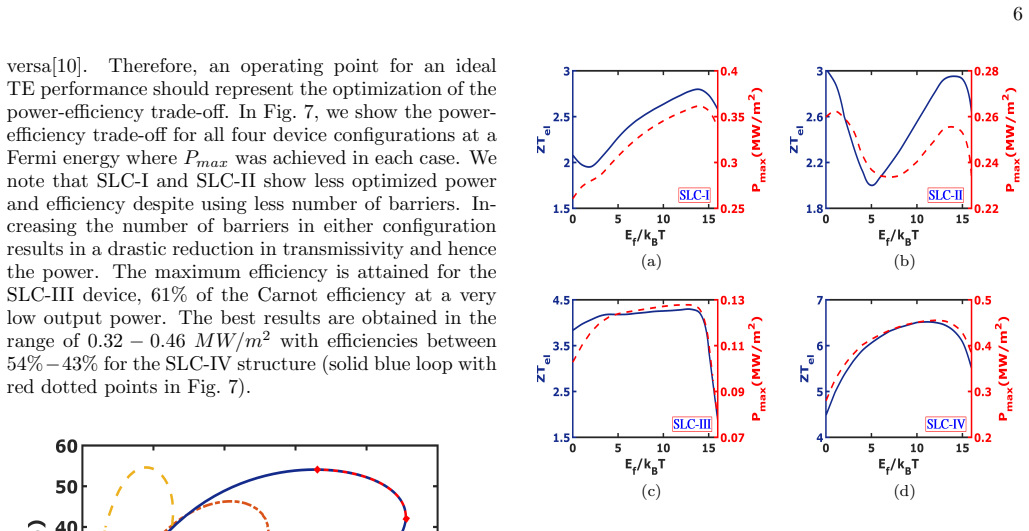
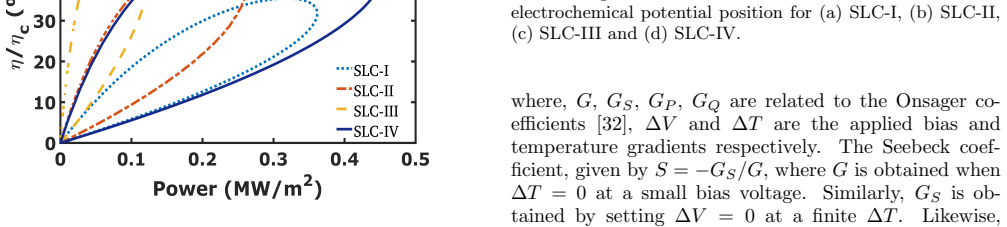
The central claim is that a superlattice whose barrier thicknesses follow the Gaussian profile $b_k=b_{\max}\exp[(k-6)^2/2]$ for 11 barriers produces a transmission function closest to the ideal boxcar after self-consistent Poisson charging is included. This configuration is claimed to be the best thermoelectric generator among the studied superlattices: in the NEGF-Poisson transport model it yields $P_{\max}=0.46\,\mathrm{MW/m^2}$ at $43\%$ of Carnot efficiency, and it keeps most of the boxcar transmission shape under charging, whereas the regular and anti-reflection superlattices lose their desirable lineshapes. The authors also show that for this structure alone the electronic figure of merit $zT_{\mathrm{el}}$ peaks where output power is maximized, so the conventional figure of merit remains a valid predictor for this design. The quoted efficiencies are electronic-only; the paper notes that phonon heat conduction, outside the scope of the model, would reduce real device performance.
Load-bearing premise
The ranking depends on one fixed Gaussian width in the barrier-thickness profile, perfectly coherent and ordered superlattice layers, and electronic-only heat transport; if real thickness fluctuations or phonon conduction substantially reshape the transmission, the ranking of configurations could change.
Editorial extensions
If this is right
- Engineers can target a Gaussian barrier-thickness profile, rather than regular or anti-reflection superlattices, to obtain a boxcar-like transmission that survives self-consistent charging.
- The maximum electronic power density of $0.46\,\mathrm{MW/m^2}$ at $43\%$ of Carnot efficiency marks the expected operating point for a GaAs/AlGaAs superlattice generator of this design.
- For the Gaussian-thickness superlattice, the electronic figure of merit can be used to locate the maximum-power operating point, which is not true for the other configurations studied.
- The regular and anti-reflection alternatives are less suitable for power generation under realistic charging, either because transmissivity collapses or because the anti-reflection effect is destroyed by Poisson charging.
Reading between the lines
- Inference: The paper fixes a single Gaussian width, so re-optimizing the variance could push SLC-IV's power and efficiency above the reported values; the quoted numbers are for one member of the design family.
- Inference: The same boxcar-plus-charging criterion could be used to search a wider family of aperiodic superlattice profiles, such as chirped or error-function barrier distributions, for still better immunity to electrostatic charging.
- Inference: The claim of immunity to device variability, presented deterministically, could be stress-tested by simulating an ensemble of structures with random monolayer-scale thickness fluctuations and measuring when the boxcar lineshape degrades.
- Inference: Adding phonon thermal conductivity and interface roughness scattering to the model would convert the electronic design ranking into a full-device prediction; the paper explicitly leaves that extension outside its scope.
Signed reviews
Editorial analysis
A structured set of objections, weighed in public.
Referee Report
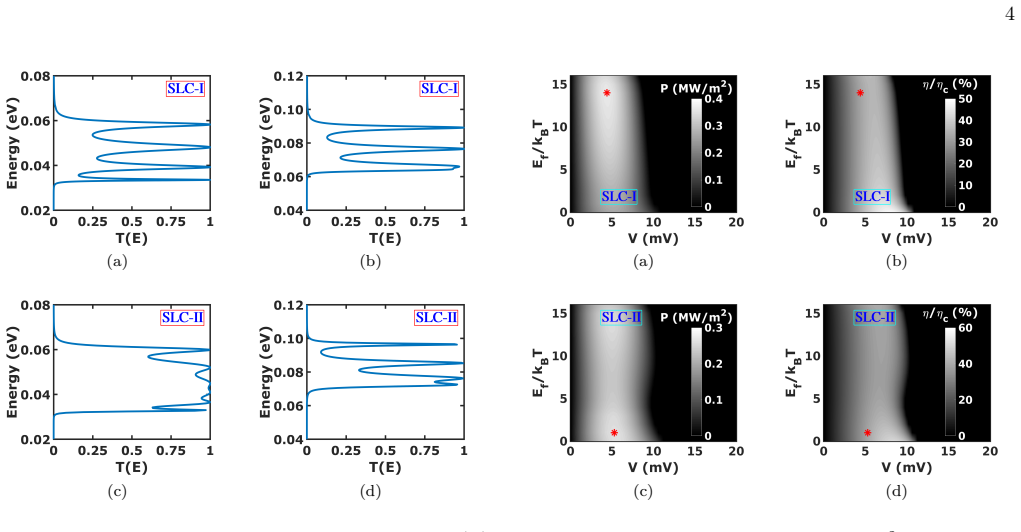
Summary. The paper uses a coherent one-band NEGF-Poisson transport model to simulate four GaAs/AlGaAs superlattice thermoelectric generator configurations: a regular superlattice (SLC-I), an anti-reflection-enabled superlattice (SLC-II), a superlattice with a Gaussian distribution of barrier heights (SLC-III), and a superlattice with a Gaussian distribution of barrier thicknesses (SLC-IV). The authors evaluate the transmission function, output power density, efficiency normalized to Carnot, and the electronic figure of merit zT_el. They conclude that SLC-IV best approximates Whitney's boxcar transmission, delivers the highest power density at maximum power (0.46 MW/m^2 at 43% of Carnot efficiency), and yields zT_el = 6, while being almost immune to self-consistent charging and device variability.
Significance. If the central design claim holds, the paper offers a useful and concrete design principle: a thickness-graded, Gaussian-shaped superlattice can produce a near-boxcar transmission with high transmissivity, improving the power-efficiency trade-off in nanoscale thermoelectric generators. The work has clear strengths: it uses a standard self-consistent NEGF-Poisson framework, compares several structurally distinct designs, reports transmission and performance data consistently, and connects the results to the Whitney boxcar bound and the Onsager-based figure-of-merit analysis. The comparison across configurations is a valuable step beyond idealized boxcar models. The main limitations are the missing specification of the contact temperatures used for Carnot normalization and the absence of any simulated disorder ensemble, which leaves the device-variability robustness claim unsupported. The electronic-only treatment is acknowledged by the authors and is a reasonable scope for this study.
major comments (3)
- [Abstract and Sec. III.B] The abstract and Sec. III.B claim that SLC-IV is 'almost immune to the deleterious effect of self-consistent charging and device variability,' but the manuscript contains no simulation of random structural fluctuations. The thickness profile bk = bmax exp[(k-6)^2/2] is a single deterministic grading, and Figs. 5(c,d) and 6(c,d) compare only the effect of self-consistent charging at one geometry. No ensemble of disordered barrier thicknesses is generated or analyzed, so the device-variability part of the headline claim is not supported by the presented evidence.
- [Sec. II and Sec. III] The paper never specifies the hot and cold contact temperatures TH and TC, even though all quantitative results depend on them. The efficiency is reported as a fraction of Carnot efficiency, and quantities such as Ef = 12 kBT and Tavg in Eq. (11) require a thermal energy scale, but no temperature value is given anywhere in the simulation setup. Because of this omission, the absolute power densities and the efficiency percentages in Table I and Fig. 7 cannot be reproduced or meaningfully compared with other work.
- [Sec. III.B] The optimality of SLC-IV is established for a single Gaussian variance value (denominator 2 in the exponent for barrier thickness, and denominator 0.125 for SLC-III barrier heights), with no sensitivity sweep over the variance and no comparison against other distributions or against a disordered ensemble. The conclusion that the Gaussian thickness distribution is optimal therefore applies only to the specific deterministic parameter set chosen, and it is unclear whether the ranking would be robust to variation of this parameter.
minor comments (3)
- [Equations (6)-(10)] The notation in Eqs. (7)-(10) is unclear: F2D and G2D are defined with a single energy argument, but they appear as F2D(E - mu_H) and G2D(E - mu_H) in the integrands; the integration over the transverse energy E_perp in Eq. (10) should be spelled out explicitly to allow the reader to reproduce the transverse mode summation.
- [Figs. 4 and 6] The figures labeled 'bar plot' are heatmaps of power and efficiency as functions of bias and Fermi level; the caption and text should use a term such as 'color map' or 'intensity plot' to avoid confusion.
- [Sec. III.C] In Fig. 7, the SLC-IV loop corresponding to the power range 0.32-0.46 MW/m^2 at efficiencies between 54% and 43% is described qualitatively; labeling the individual operating points on the loop with their Fermi-level or bias values would make the trade-off claim easier to verify.
Circularity Check
No significant circularity: the computed power, efficiency, and zT_el values are outputs of a self-contained NEGF-Poisson simulation, not restatements of the input design parameters or of the paper's own prior claims.
full rationale
The derivation chain is input-to-output. Section II defines the device Hamiltonian from the conduction-band profile [delta Ec(z)], solves Eqs. (1)-(5) self-consistently with Poisson's equation to obtain T(E), and then feeds T(E) into the Landauer integrals, Eqs. (6)-(10), to obtain current, heat current, power density, and efficiency. The superlattice configurations SLC-I through SLC-IV are specified as fixed structural inputs (e.g., bk = bmax exp[(k-6)^2/2] in Sec. III.B), and their comparative performance in Table I is a computed result, not a fitted parameter or a quantity defined by the performance metric. The zT_el analysis in Sec. III.D is an internal cross-check using the same transmission spectrum to extract Onsager coefficients; it corroborates but does not define the power-efficiency ranking. The paper's citations of earlier work by the same group are background on the power-efficiency tradeoff, not the basis for the optimality of SLC-IV; the external benchmarks are Whitney's boxcar limit and standard NEGF/Landauer theory. One nonsupport, but noncircular, feature is the abstract's claim that SLC-IV is 'almost immune to ... device variability': no statistical disorder ensemble is defined or simulated, since the Gaussian profile is deterministic and only charging effects are tested in Figs. 5-6. That is a support gap for the robustness part of the headline claim, not a reduction of the derivation to its own inputs. No circular step can be exhibited from the paper's equations or citations.
Assumptions & free parameters
free parameters (6)
- well width w =
6 nm
- barrier thickness b (regular) =
4 nm
- barrier height delta_Ec =
0.1 eV
- Gaussian variance for SLC-III (barrier heights) =
denominator 0.125 in exp[(k-6)^2/0.125]
- Gaussian variance for SLC-IV (barrier thicknesses) =
denominator 2 in exp[(k-6)^2/2]
- contact temperatures TH and TC =
not reported
assumptions (6)
- domain assumption Coherent one-band effective-mass NEGF captures the relevant electronic transport in the superlattice.
- domain assumption Transverse modes are treated as a 2D continuum with parabolic dispersion, neglecting transverse confinement effects.
- domain assumption Phonon heat conduction can be neglected when comparing configurations.
- domain assumption Whitney's boxcar transmission is the appropriate optimal design target.
- domain assumption The Poisson equation with no explicit fixed charge (doping) describes the device electrostatics.
- ad hoc to paper The chosen Gaussian profiles are representative of the class of Gaussian-distributed superlattices.
Cite this review
Pith. "Pith review of Superlattice design for optimal thermoelectric generator performance." pith.science (2026). https://pith.science/paper/4PTWL6ZW
@misc{pith2026190804547,
  author       = {Pith},
  title        = {Pith review of: Superlattice design for optimal thermoelectric generator performance},
  year         = {2026},
  howpublished = {\url{https://pith.science/paper/4PTWL6ZW}},
  note         = {Machine review of arXiv:1908.04547}
}
abstract
We consider the design of an optimal superlattice thermoelectric generator via the energy bandpass filter approach. Various configurations of superlattice structures are explored to obtain a bandpass transmission spectrum that approaches the ideal ``boxcar'' form, which is now well known to manifest the largest efficiency at a given output power. Using the non-equilibrium Green's function formalism coupled self-consistently with the Poisson's equation, we identify such an ideal structure and also demonstrate that it is almost immune to the deleterious effect of self-consistent charging and device variability. Analyzing various superlattice designs, we conclude that superlattices with a Gaussian distribution of the barrier thickness offers the best thermoelectric efficiency at maximum power. It is observed that the best operating regime of this device design provides a maximum power in the range of 0.32-0.46 $MW/m^2$ at efficiencies between 54\%-43\% of Carnot efficiency. We also analyze our device designs with the conventional figure of merit approach to counter support the results so obtained. We note a high $zT_{el}=6$ value in the case of Gaussian distribution of the barrier thickness. With the existing advanced thin-film growth technology, the suggested superlattice structures can be achieved, and such optimized thermoelectric performances can be realized.
Figures

Figures from the paper (3 more)
Reference graph
Works this paper leans on
-
[1]
L. D. Hicks and M. S. Dresselhaus, Physical Review B 47, 727 (1993)
work page 1993
-
[2]
L. D. Hicks and M. S. Dresselhaus, Physical Review B 47, 8 (1993)
work page 1993
-
[3]
L. D. Hicks, T. C. Harman, X. Sun, and M. S. Dressel- haus, Physical Review B 53, R10493 (1996)
work page 1996
-
[4]
J. P. Heremans, M. S. Dresselhaus, L. E. Bell, and D. T. Morelli, Nature Nanotechnology 8, 471 (2013)
work page 2013
-
[5]
Majumdar, Science 303, 777 (2004)
A. Majumdar, Science 303, 777 (2004)
2004
-
[6]
G. J. Snyder and E. S. Toberer, Nature Materials 7, 105 (2008)
2008
- [7]
-
[8]
J. Mao, Z. Liu, and Z. Ren, npj Quantum Materials 1, 16028 (2016)
work page 2016
Show all 33 references
-
[9]
Nakpathomkun, H
N. Nakpathomkun, H. Q. Xu, and H. Linke, Physical Review B 82 (2010)
2010
-
[10]
Muralidharan and M
B. Muralidharan and M. Grifoni, Physical Review B 85, 1 (2012)
2012
-
[11]
Sothmann, R
B. Sothmann, R. Snchez, A. N. Jordan, and M. Bttiker, New Journal of Physics 15, 095021 (2013)
2013
-
[12]
Agarwal and B
A. Agarwal and B. Muralidharan, Applied Physics Let- ters 105, 013104 (2014)
2014
-
[13]
G. D. Mahan and J. O. Sofo, Proceedings of the National Academy of Sciences 93, 7436 (1996)
1996
-
[14]
T. E. Humphrey and H. Linke, Physical Review Letters 94, 3 (2005)
2005
-
[15]
A. H. Barajas-Aguilar, K. A. Rodriguez-Magdaleno, J. C. Martinez-Orozco, A. Enciso-Munoz, and D. A. Contreras-Solorio, IOP Conference Series: Materials Sci- ence and Engineering 45 (2013)
2013
-
[16]
De and B
B. De and B. Muralidharan, Phys. Rev. B 94, 165416 (2016)
2016
-
[17]
R. S. Whitney, Physical Review Letters 112, 1 (2014)
2014
-
[18]
R. S. Whitney, Physical Review B 91, 1 (2015)
2015
-
[19]
H. H. Tung and C. P. Lee, IEEE Journal of Quantum Electronics 32, 507 (1996)
1996
-
[20]
Pacher, C
C. Pacher, C. Rauch, G. Strasser, E. Gornik, F. Elsholz, A. Wacker, G. Kießlich, and E. Sch¨ oll, Applied Physics Letters 79, 1486 (2001)
2001
-
[21]
G. V. Morozov, D. W. L. Sprung, and J. Martorell, J. Phys. D 335, 3052 (2002)
2002
-
[22]
G´ omez, F
I. G´ omez, F. Domnguez-Adame, E. Diez, and V. Bellani, Journal of Applied Physics 85, 3916 (1999)
1999
-
[23]
J. O. Sofo and G. D. Mahan, Applied Physics Letters 65, 2690 (1994)
1994
-
[24]
D. A. Broido and T. L. Reinecke, Physical Review B 51, 13797 (1995)
1995
-
[25]
A. A. Balandin and O. L. Lazarenkova, Applied Physics Letters 82, 415 (2003)
2003
-
[26]
Tsu, Superlattice to Nanoelectronics (Elsevier, 2010)
R. Tsu, Superlattice to Nanoelectronics (Elsevier, 2010)
2010
-
[27]
Karbaschi, J
H. Karbaschi, J. Lov´ en, K. Courteaut, A. Wacker, and M. Leijnse, Physical Review B 94, 1 (2016)
2016
-
[28]
Zebarjadi, K
M. Zebarjadi, K. Esfarjani, M. S. Dresselhaus, Z. F. Ren, and G. Chen, Energy Environ. Sci. 5, 5147 (2012)
2012
-
[29]
LeBlanc, Sustainable Materials and Technologies 1, 26 (2014)
S. LeBlanc, Sustainable Materials and Technologies 1, 26 (2014)
2014
-
[30]
Datta, Quantum Transport: Atom to Transistor (Cambridge University Press, 2005)
S. Datta, Quantum Transport: Atom to Transistor (Cambridge University Press, 2005)
2005
-
[31]
Kim and M
R. Kim and M. Lundstrom, Journal of Applied Physics 110, 034511 (2011)
2011
-
[32]
Datta, Lessons from Nanoelectronics: A New Perspec- tive on Transport , Lecture notes series (World Scientific Publishing Company, 2012)
S. Datta, Lessons from Nanoelectronics: A New Perspec- tive on Transport , Lecture notes series (World Scientific Publishing Company, 2012)
2012
-
[33]
A. J. Minnich, H. Lee, X. W. Wang, G. Joshi, M. S. Dres- selhaus, Z. F. Ren, G. Chen, and D. Vashaee, Physical Review B 80, 1 (2009)
2009
Reviewed August 14, 2026 · model on record in the stance chip above.
Discussion (0). Continue with ORCID to comment.