REVIEW 4 major objections 4 minor 33 references
Anomalous electrical magnetochiral effect by chiral spin fluctuation
T0 review · 4 major / 4 minor · reviewed 2026-08-14 · deepseek-v4-flash
Pith's one-line read Chiral spin fluctuations drive nonreciprocal current in MnSi
desk verdict A clean first-order asymmetric scattering mechanism for eMChE, with the MnSi comparison resting on an unproven identification of localized and itinerant magnetizations. read the letter →
The pith
A machine-rendered reading of the paper's core claim, the machinery that carries it, and where it could break.
The reading
What carries the argument
The load-bearing object is the antisymmetric spin-flip scattering rate $W^{-}_{\mathbf{k}\sigma,\mathbf{k}'\sigma'}$ of Eq. (5), obtained in first Born approximation from the exchange coupling to a two-spin cluster. Its asymmetric part is $4\pi J^2/N^2\, \sigma\, \delta_{\sigma,\bar{\sigma}'} \sin((\mathbf{k}-\mathbf{k}')\cdot\mathbf{r}_{12})(\mathbf{S}_1\times\mathbf{S}_2)_z\, \delta(\varepsilon_{\mathbf{k}\sigma}-\varepsilon_{\mathbf{k}'\sigma'})$, so the vector spin chirality of the local moments acts as a momentum-dependent, spin-dependent scattering potential. In the long-wavelength, nearest-neighbor limit this reduces to $W^{-}=2\pi\sigma c(k_z-k'_z)\delta(\varepsilon_{\mathbf{k}}-\varepsilon_{\mathbf{k}'})$ with $c=J^2\chi_z$, which the Boltzmann calculation uses to produce the nonreciprocal current of Eq. (8).
What would settle it
Measure the second-harmonic resistance of MnSi (or another clean chiral helimagnet) through the paramagnetic phase in fields where $\chi_z$ has a maximum: the theory requires the nonreciprocal coefficient $\gamma(B)$ to track $M\chi_z$, so the signal must vanish as $M\to0$ and must peak where $M\chi_z$ peaks. A temperature or field sweep whose shape disagrees with that product, or a magnitude off by more than the stated prefactor, would rule out this scattering mechanism; detecting the predicted field-direction spin current in a zero-magnetization chiral paramagnet would directly confirm it.
Extended reading notes
Core claim
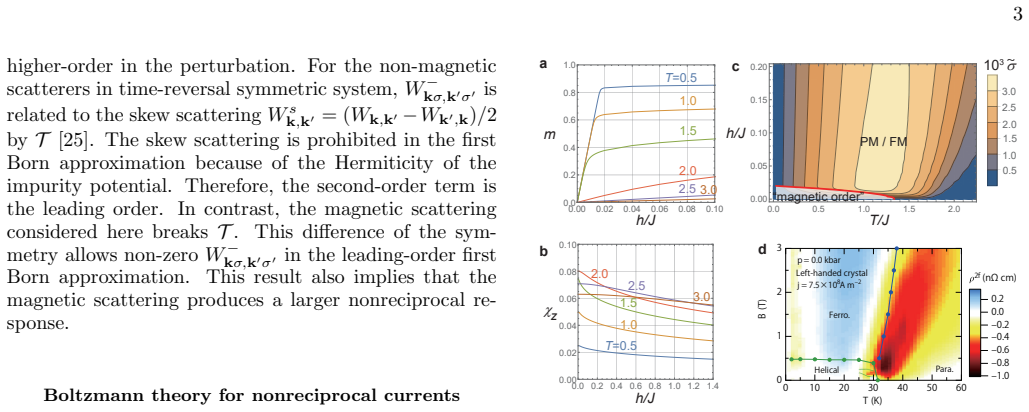
The central claim is that spin fluctuations carrying vector spin chirality $\chi_{ij} = \mathbf{S}_i \times \mathbf{S}_j$ scatter electrons asymmetrically with respect to momentum reversal, and that this asymmetric scattering is the leading-order (first Born) scattering mechanism in chiral magnets. For a two-spin cluster with noncollinear spins, the antisymmetric part of the scattering rate is proportional to $(\mathbf{k}-\mathbf{k}')\cdot\mathbf{r}_{12}$ times $(\mathbf{S}_1\times\mathbf{S}_2)_z$ and flips the electron spin, so it is nonzero only when both magnetization and vector chirality are present. Feeding this rate into a semiclassical Boltzmann equation yields a second-order nonreciprocal current $J_z^{(2)} = -\frac{144\pi}{5}\frac{\tau m}{e\mu^2} c M \sigma_0^2 E^2$, with $c=J^2\chi_z$, and a spin current that survives even at zero magnetization. The resulting temperature and field dependence of $\sigma^{(2)}\propto M\chi_z$ has a maximum near the magnetic ordering temperature and grows with field, matching the electrical magnetochiral effect measured in MnSi.
Load-bearing premise
The argument assumes that the simple two-spin scattering rule used in the Boltzmann equation, one constant $c$ times the momentum difference with $c$ set by the nearest-neighbor vector chirality, remains valid throughout the paramagnetic phase and near the ordering temperature, and that the relaxation time and other transport coefficients do not change with temperature or field when comparing with MnSi.
Editorial extensions
If this is right
- The nonreciprocal current appears at first order in the exchange coupling rather than at second order, so eMChE from magnetic fluctuations should be substantially larger than the skew-scattering estimates for nonmagnetic impurities.
- Because the signal scales as $M\chi_z$, the effect must vanish when magnetization or vector chirality disappears; this fixes where in the temperature-field plane a nonreciprocal response should be observable.
- A paramagnet with chiral spin fluctuations but zero net magnetization should still convert a charge current into a spin current, giving a way to generate spin currents without ferromagnetic order.
- The mechanism reproduces the nonmonotonic temperature dependence and the maximum near the ordering temperature seen in MnSi, and it offers a natural explanation for similar behavior reported in CrNb$_3$S$_6$.
- Since the prefactor involves the relaxation time and density of states, the magnitude of the effect is tied to sample quality and Fermi-surface details, so clean and dirty samples should show the same temperature and field dependence but different overall strength.
Reading between the lines
- A testable extension is to compare the nonlinear coefficient in samples with different disorder: this scattering mechanism predicts $\sigma^{(2)}\propto \sigma_0^2$, so the ratio $\gamma(B)$ should scale with conductivity, while intrinsic band-structure mechanisms would not show that scaling.
- If the first-Born asymmetry is generic, then any metal with short-range chiral correlations, not only helimagnets, should display eMChE in the paramagnetic phase, with magnitude tracking the chiral correlation length.
- The predicted spin current suggests a nonlocal spin-transport experiment: put a chiral paramagnet in series with a normal-metal spin detector and look for spin accumulation generated by a charge current in zero magnetization.
- At finite frequency, the same asymmetric scattering should contribute to higher-order nonlinear responses beyond the dc $I^2V$ term, such as third-harmonic generation, providing a separate experimental signature.
Signed reviews
Editorial analysis
A structured set of objections, weighed in public.
Referee Report
Summary. The paper proposes a microscopic mechanism for the electrical magnetochiral effect (eMChE) in chiral magnets. The authors consider a Kondo-lattice model of itinerant electrons coupled to localized spins and show, within the first Born approximation, that the asymmetric scattering rate is proportional to the vector spin chirality of two-spin clusters (Eqs. 4 and 5). Using a simplified global form of the asymmetric scattering rate (Eq. 7), they solve the Boltzmann equation to second order in the electric field and linear order in the chirality, obtaining a nonreciprocal current proportional to the product of the vector spin chirality and the itinerant-electron spin polarization (Eq. 8). They also predict a nonreciprocal spin current (Eq. 9). The temperature and magnetic-field dependence of the nonreciprocal conductivity is then computed for a classical chiral Heisenberg model using Onsager's reaction-field theory, and the results are compared with the MnSi experiment of Yokouchi et al., finding qualitative agreement in the nonmonotonic field and temperature dependence.
Significance. If the central claim holds, the paper identifies a new leading-order asymmetry mechanism for electron scattering by chiral spin fluctuations, which is a conceptually important step beyond second-order skew-scattering mechanisms. The derivation of Eq. (8) is self-contained and yields a closed-form expression, and the prediction of a spin current in the paramagnetic phase is a falsifiable consequence that should stimulate further experiments. The comparison with MnSi, although qualitative, suggests the mechanism may be relevant to a broad class of chiral magnets, including CrNb3S6. The work also demonstrates a clear route to estimating the magnitude of the effect from microscopic parameters. However, the load-bearing connection between the Boltzmann result and the MnSi comparison involves an unvalidated identification of the itinerant-electron polarization with the localized-spin magnetization, and the assumed global form of the asymmetric scattering rate requires justification beyond the two-spin, long-wavelength limit.
major comments (4)
- [Nonreciprocal charge current in chiral magnets; Eq. (8) and Fig. 2(c)] Equation (8) is derived with M defined as the itinerant-electron spin splitting in the band dispersion ε_kσ = k^2/2m - σM - μ, and the text states that the nonreciprocal current is proportional to the magnetic polarization of the itinerant electrons. In contrast, the comparison with MnSi in Fig. 2(c) plots σ~ = M χ_z with M taken from the localized-spin magnetization m_z = -h/(2λ) of the classical model H_cm in Eq. (10). The paper never derives the temperature and field dependence of the itinerant-electron spin polarization from the Kondo-lattice coupling, nor does it justify replacing M by m. Since the claimed reproduction of the MnSi data concerns precisely the nonmonotonic T and h dependence, substituting m for M without a self-consistent derivation can shift the predicted ridge or even change its sign, so this identification is a load-bearing gap in the argument.
- [Boltzmann theory; Eq. (7) and the Methods] The global form W^-_{kσ,k'σ'} = 2πσc(k_z - k'_z)δ(ε_kσ - ε_k'σ') is assumed for all spin-flip processes and for the entire paramagnetic phase, but it is derived explicitly only for a two-spin cluster in the k≪1 and nearest-neighbor-only limit. The justification in the Methods, that the correlation length is 'similar or less than the lattice spacing' in the paramagnetic phase, is stated without quantitative support; near the magnetic ordering temperature, where the experimental signal is maximal, spin correlations are typically not short-ranged. Because Eq. (8) follows analytically from this assumed form, the validity of the central transport prediction in the experimentally relevant regime is not established.
- [Boltzmann theory and Methods; definition of c] The constant c that enters the asymmetric scattering rate and Eq. (8) is defined inconsistently. In the main text (Eq. (7)) c is written as c = J^2/N χ_v (or J^2 χ_v / N, depending on typography), while the Methods state that c = J^2 χ_z with no factor of 1/N. Since the magnitude estimate and the Boltzmann solution depend directly on c, this ambiguity affects the quantitative claim, including the estimate γIB ~ 10^-4-10^-5, and should be resolved with a clear derivation of c from the lattice sum in Eq. (3).
- [Methods, Magnetic phase diagram] The reaction-field calculation explicitly does not produce a phase transition for D ≠ 0, and the 'phase boundary' in Fig. 2(c) is defined by the ad hoc criterion λ + D^2/(4J) < -10^-4. The experimental curve in Fig. 2(d) shows a pronounced feature near the actual magnetic transition, so the comparison depends on this proxy. The limitation is acknowledged in the Methods, but its impact on the claimed reproduction of the experimental T-H dependence is not discussed; the authors should at least show that the qualitative shape of σ~ is insensitive to the specific threshold value and to the absence of a true transition.
minor comments (4)
- [Eq. (4)] There is a typographical error in the definition of the asymmetric scattering rate: 'W^-_{kσ,k'σ'}≡= (W_{kσ,k'σ}-W_{-kσ,-k'σ})/2' contains a double equals sign; it should read 'W^-_{kσ,k'σ'} = (W_{kσ,k'σ}-W_{-kσ,-k'σ})/2'.
- [Eq. (7) and Methods] The notation for the vector spin chirality is inconsistent: it is denoted χ_v in the main text and χ_z in the Methods; please use a single symbol consistently.
- [Methods, Boltzmann theory] The presentation of the Boltzmann expansion states that the g(2,1) term vanishes and that the nonreciprocal current comes from g(2,2), but the equations for J_z^(2) in the Methods appear to include contributions with different notation; the derivation would benefit from a clearer step-by-step identification of which terms survive and why.
- [Fig. 2(d)] The color scale of the reproduced experimental panel in Fig. 2(d) is not defined in the caption, making it difficult for the reader to compare the magnitude and sign of the experimental σ~(2) with the theoretical panel; a minimal color-bar label should be added.
Circularity Check
No material circularity: the eMChE calculation is self-contained and the MnSi comparison is an independent model prediction; the only flagged issues are a possible M/m identification gap and minor technique self-citations, neither of which is a circular reduction.
full rationale
The paper's central derivation is self-contained. Equation (4) is obtained by taking the asymmetric part of the first-Born scattering rate from Hamiltonian (2); Eqs. (5) and (7) specialize it to a two-spin cluster and then to the k<<1, nearest-neighbor form with c = J^2 chi_v. The Boltzmann solution is carried out in the Methods, giving J_z^(2) ~ c M sigma_0^2 E^2 (Eq. (8)); this is a calculation, not a restatement of the eMChE data. The temperature and field dependence is then obtained by computing chi_z and m_z from the classical chiral magnet H_cm (Eq. (10)) using Onsager reaction-field theory. None of these quantities is fitted to the Yokouchi et al. eMChE data; the comparison in Fig. 2(c) versus 2(d) is a shape comparison of an independent model product. The Methods itself flags a limitation: the model has no true phase transition, so 'ordered' is defined by the ad hoc criterion lambda + D^2/(4J) < -10^-4. The skeptical concern that the itinerant-electron polarization M in Eq. (8) is replaced by localized m_z in Fig. 2(c) is a genuine identification gap: the paper does not derive M's T,h dependence from the Kondo-lattice coupling. However, a gap or unjustified substitution is not circularity; m_z and chi_z are computed independently of the transport observable, so the claimed reproduction is not forced by construction. Similarly, the magnitude estimate uses M = g mu_B H as a constant while the figure uses a strongly T/h-dependent m_z, which again weakens the quantitative claim but is not a circular reduction. The only self-citations (Refs. 7, 31, 32) support the relaxation-time approximation technique, not the load-bearing asymmetry, which is derived here in first-Born approximation without invoking those papers. No uniqueness theorem or ansatz is imported from the authors' prior work. Hence no specific equation reduces to its own input, and the circularity score is low.
Assumptions & free parameters
free parameters (7)
- D/J ratio =
0.2
- Kondo coupling J =
10 meV
- Relaxation time tau =
10^-13 s
- Chemical potential mu_F =
0.5 eV
- Electron spin polarization M =
100 meV
- Lattice constant a0 =
4 Å
- Magnetic order threshold =
-10^-4
assumptions (7)
- domain assumption Spin fluctuations are classical and static.
- domain assumption Weak-coupling Born approximation for electron-spin scattering.
- domain assumption Relaxation time approximation for the symmetric part of the collision integral.
- ad hoc to paper Simplified form of the asymmetric scattering rate in Eq. (7).
- domain assumption Chemical potential much larger than spin splitting (mu much greater than M).
- domain assumption Onsager reaction field theory (spherical model) describes the chiral magnet thermodynamics.
- ad hoc to paper Ordered-phase threshold lambda + D^2/(4J) < -10^-4.
Cite this review
Pith. "Pith review of Anomalous electrical magnetochiral effect by chiral spin fluctuation." pith.science (2026). https://pith.science/paper/WWKZIWA2
@misc{pith2026190804557,
  author       = {Pith},
  title        = {Pith review of: Anomalous electrical magnetochiral effect by chiral spin fluctuation},
  year         = {2026},
  howpublished = {\url{https://pith.science/paper/WWKZIWA2}},
  note         = {Machine review of arXiv:1908.04557}
}
abstract
The non-collinear spin configurations cause many nontrivial phenomena related to the Berry phase. They are described by the vector spin chirality $\chi_{ij} ={\bf S}_i\times{\bf S}_j$ or scalar spin chirality $\chi_{ijk}=({\bf S}_i \times {\bf S}_j) \cdot {\bf S}_k$, which are related to the spin current and effective magnetic field, respectively. The scalar spin chirality leads to the topological Hall effect in metals, while the vector spin chirality to the ferroelectricity of spin origin, i.e., multiferroics in insulators. However, the role of the vector spin chirality in conducting systems has not yet elucidated. Here we show theoretically that the spin fluctuation with vector spin chirality in chiral magnets scatters electrons asymmetrically, resulting in a nonreciprocal transport phenomena, i.e., electrical magnetochiral effect (eMChE). This asymmetric scattering appears in the leading-order scattering term, implying a large nonreciprocity in the charge and spin currents. We find that the temperature and magnetic field dependence of the eMChE reproduces that observed in MnSi. Our results reveal the microscopic mechanism of eMChE and its potential in producing a large nonreciprocal response.
Figures

Reference graph
Works this paper leans on
-
[1]
∼ 1039 J−1cm−3, and τ = 10−13 s. We use µF = 0 .5 eV and M(= gµBH) = 100 meV because the bandwidth is∼ 1 eV [29] and the spin polarization is in the order of 10% [30]. Using these values, we findσ(2)I/σ 2∼ 2×10⁻⁵. Therefore, the result is roughly comparable with that ob- served in MnSi. METHOD Boltzmann theory We used the semiclassical Boltzmann theory to ...
-
[2]
Ye, J., Kim, Y. B., Millis, A. J., Shraiman, B. I., Ma- jumdar, P., & Teˇ sanovi´ c, Z. Berry phase theory of the anomalous Hall effect: Application to colossal magne- toresistance manganites. Phys. Rev. Lett. 83, 3737-3740 (1999)
work page 1999
-
[3]
Ohgushi, K., Murakami, S., & Nagaosa, N. Spin anisotropy and quantum Hall effect in the kagom´ e lat- tice: Chiral spin state based on a ferromagnet. Phys. Rev. B 62, R6065-R6068 (2000)
work page 2000
-
[4]
Katsura, H., Nagaosa, N., & Balatsky, A. V. Spin current and magnetoelectric effect in noncollinear magnets. Phys. Rev. Lett. 95, 057205 (2005)
work page 2005
-
[5]
Rikken, G. L. J. A., Folling, J., & Wyder, P. Electrical magnetochiral anisotropy. Phys. Rev. Lett. 87, 236602 (2001)
work page 2001
-
[6]
Electrical magnetochiral effect induced by chiral spin fluctuations
Yokouchi, T., Kanazawa, N., Kikkawa, A., Morikawa, D., Shibata, K., Arima, T., Taguchi, Y., Kagawa, F., & Tokura, Y. Electrical magnetochiral effect induced by chiral spin fluctuations. Nat. Commun. 8, 866 (2017)
work page 2017
-
[7]
Tatara, G. & Kawamura, H. Chirality-driven anomalous Hall effect in weak coupling regime. J. Phys. Soc. Jpn. 71, 2613-2616 (2002)
work page 2002
-
[8]
Ishizuka, H. & Nagaosa, N. Spin chirality induced skew scattering and anomalous Hall effect in chiral magnets. Sci. Adv. 4, eaap9962 (2018)
work page 2018
Show all 33 references
-
[9]
H., & Ong, N
Nagaosa, N., Sinova, J., Onoda, S., MacDonald, A. H., & Ong, N. P. Anomalous Hall effect. Rev. Mod. Phys. 82, 1539-1592 (2010)
2010
-
[10]
Rikken, G. L.J. A., & Wyder, P. Magnetoelectric anisotropy in diffusive transport. Phys. Rev. Lett. 94, 016601 (2005)
2005
-
[11]
Nonreciprocal responses from non-centrosymmetric quantum materials
Tokura, Y., & Nagaosa, N. Nonreciprocal responses from non-centrosymmetric quantum materials. Nat. Commun. 9, 3740 (2018)
2018
-
[12]
Reciprocal relations in irreversible process
Onsager, L. Reciprocal relations in irreversible process. I. Phys. Rev. 37, 405-426 (1931)
1931
-
[13]
Statistical-mechanical theory of irreversible process
Kubo, R. Statistical-mechanical theory of irreversible process. I. General theory and simple applications to magnetic and conduction problems. J. Phys. Soc. Jpn. 1¯2, 570-586 (1957)
1957
-
[14]
S., & Lee, P
Fisher, D. S., & Lee, P. A. Relation between conductivity and transmission matrix. Phys. Rev. B 23, 6851-6854 (1981)
1981
-
[15]
Pop, F., Auban-Senzier, P., Canadell, E., Rikken, G. L. J. A., & Avarvari, N. Electrical magnetochiral anisotropy in a bulk chiral molecular conductor. Nat. Commun. 5, 3757 (2014)
2014
-
[16]
Bulk rectification effect in a polar semiconduc- tor
Ideue, T., Hamamoto, K., Koshikawa, S., Ezawa, M., Shimizu, S., Kaneko, Y., Tokura, Y., Nagaosa, N., & Iwasa, Y. Bulk rectification effect in a polar semiconduc- tor. Nat. Phys. 13, 578-583 (2017)
2017
-
[17]
M., Ideue, T., Ezawa, M., Iwasa, Y., & Nagaosa, N
Wakatsuki, R., Saito, Y., Hoshino, S., Itahashi, Y. M., Ideue, T., Ezawa, M., Iwasa, Y., & Nagaosa, N. Nonre- ciprocal charge transport in noncentrosymmetric super- conductor. Sci. Adv. 3, e1602390 (2017)
2017
-
[18]
O., Garello, K., Ghosh, A., Gabureac, M., Al- varado, S
Avci, A. O., Garello, K., Ghosh, A., Gabureac, M., Al- varado, S. F., & Gambardella, P. Unidirectional spin Hall magnetoresistance in ferromagnet/normal metal bilayers. Nat. Phys. 11, 570-575 (2015)
2015
-
[19]
S., Kawasaki, M., & Tokura Y
Yasuda, K., Tsukazaki, A., Yoshimi, R., Takahashi, K. S., Kawasaki, M., & Tokura Y. Large unidirectional mag- netoresistance in a magnetic topological insulator. Phys. Rev. Lett. 117, 159903 (2019)
2019
-
[20]
Anomalous Nonre- ciprocal Electrical Transport on Chiral Magnetic Order, Phys
Aoki, R., Kousaka, Y., & Togawa, Y. Anomalous Nonre- ciprocal Electrical Transport on Chiral Magnetic Order, Phys. Rev. Lett. 122, 057206 (2019)
2019
-
[21]
Ishikawa, Y., Tajima, K., Bloch, D., & Roth, M., Heli- cal spin structure in manganese silicide MnSi. Sol. Stat. Commun. 19, 525-528 (1976)
1976
-
[22]
Bak, P., & Jensen, M. H. Theory of helival magnetic structures and phase transition in MnSi and FeGe. J. Phys. C: Sol. Stat. Phys. 13, L881-885 (1980)
1980
-
[23]
K., Bogdanov, A
R¨ oßler, U. K., Bogdanov, A. N., & Pfleiderer, C. Sponta- neous skyrmion ground states in magnetic metals. Nature 442, 797-801 (2006)
2006
-
[24]
Skyrmion lattice in a chiral magnet
M¨ uhlbauer, S., Binz, B., Jonietz, F., Pfleiderer, C., Rosch, A., Nuebauer, A., Goergii, R., & B¨ oni, P. Skyrmion lattice in a chiral magnet. Science 323, 915- 919 (2009)
2009
-
[25]
Z., Onose, Y., Kanazawa, N., Park, J
Yu, X. Z., Onose, Y., Kanazawa, N., Park, J. H., Han, J. H., Matsui, Y., Nagaosa, N., & Tokura, Y. Real-space observation of a two-dimensional skyrmion crystal. Na- ture 465, 901-904 (2010)
2010
-
[26]
Isobe, H. & Fu, L. High-frequency rectification via chiral Bloch electrons. preprint (arXiv:1812.08162) (2018)
2018 arXiv
-
[27]
Electric moments of molecules in liquids
Onsager, L. Electric moments of molecules in liquids. J. Am. Chem. Soc. 58, 1486-1493 (1936)
1936
-
[28]
Molecular field theory, the On- sager reaction field and the spherical model
Brout, R., & Thomas, H. Molecular field theory, the On- sager reaction field and the spherical model. Physics 3, 317-329 (1967)
1967
-
[29]
S., Nagaosa, N
Matsuura, M., Endoh, Y., Hiraka, H., Yamada, K., Mishchenko, A. S., Nagaosa, N. & Solovyev, I. V. Clas- sical and quantum spin dynamics in the fcc antiferro- magnet NiS 2 with frustration. Phys. Rev. B 68, 094409 (2003)
2003
-
[30]
& Pickett, W
Jeong, T. & Pickett, W. E. Implications of the B20 crys- tal structure for the magnetoelectronic structure of MnSi. Phys. Rev. B 70, 075114 (2004)
2004
-
[31]
& Ong, N
Lee, M., Onose, Y., Tokura, Y. & Ong, N. P. Hidden con- stant in the anomalous Hall effect of high-purity magnet MnSi. Phys. Rev. B 75, 172403 (2007)
2007
-
[32]
& Nagaosa, N
Ishizuka, H. & Nagaosa, N. Noncommutative quantum mechanics and skew scattering in ferromganetic metals. Phys. Rev. B 96, 165202 (2017)
2017
-
[33]
& Nagaosa, N
Ishizuka, H. & Nagaosa, N. Impurity-induced spin chiral- ity and skew scattering in magnetic metals. New J. Phys. 20, 123027 (2018)
2018
Reviewed August 14, 2026 · model on record in the stance chip above.
Discussion (0). Continue with ORCID to comment.