REVIEW 2 major objections 4 minor 17 references
On Steane-Enlargement of Quantum Codes from Cartesian Product Point Sets
T0 review · 2 major / 4 minor · reviewed 2026-08-14 · deepseek-v4-flash
Pith's one-line read Steane enlargement of Cartesian-product codes is shown to raise quantum-code dimension by an exactly computable amount, with tables of codes matching or beating known bounds.
desk verdict Steane enlargement for Cartesian-product codes: a solid, useful construction with fixable presentation bugs and one unproven self-orthogonality assumption in the tables. read the letter →
The pith
A machine-rendered reading of the paper's core claim, the machinery that carries it, and where it could break.
The reading
What carries the argument
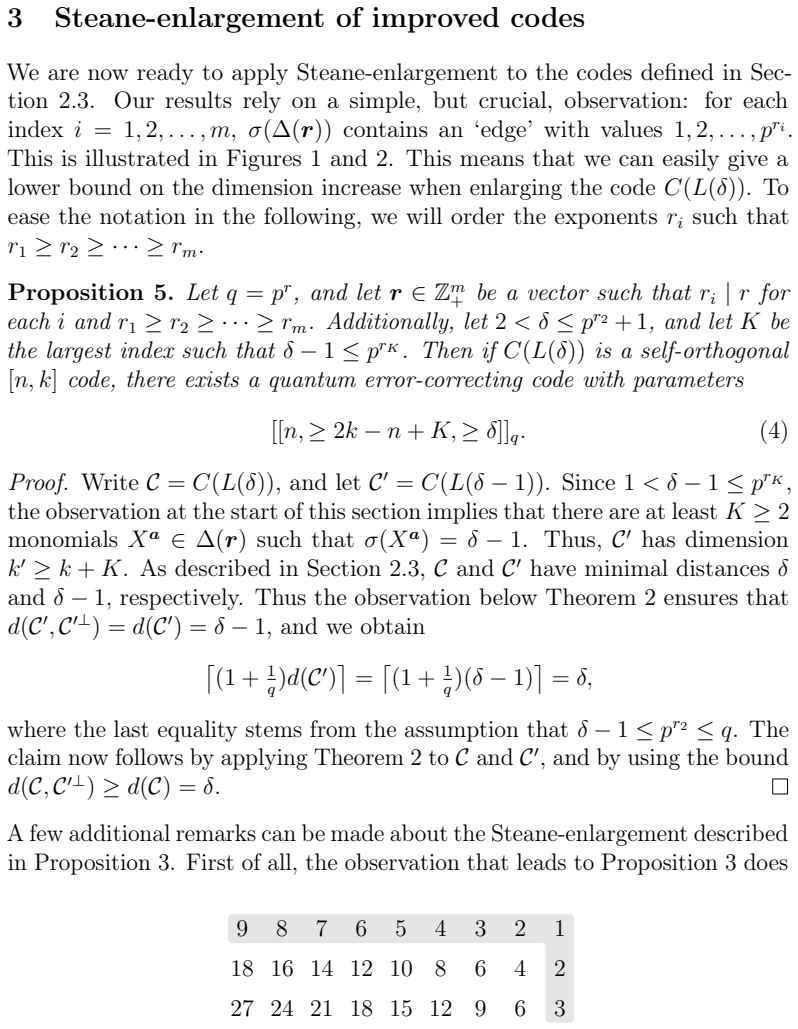
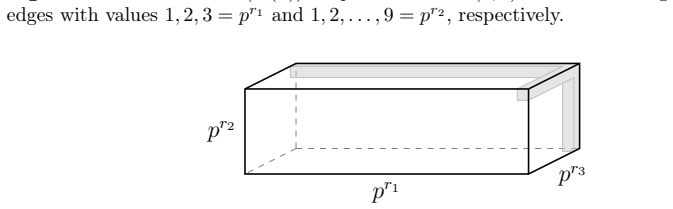
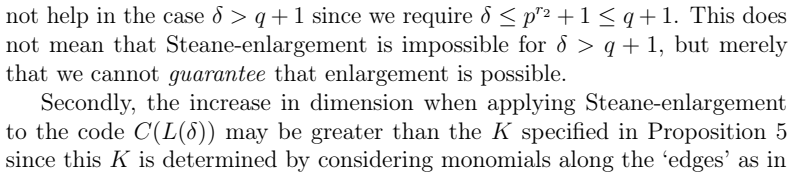
The load-bearing object is the $\sigma$-map on monomials, $\sigma(X^a)=\prod_{j=1}^m (p^{r_j}-a_j)$, which orders the exponent set $\Delta(r)$ by designed distance: $C(L(\delta))$, the span of evaluations of monomials with $\sigma\ge\delta$, has true distance $\delta$. Steane enlargement works because the nested code $C(L(\delta-1))$ differs from $C(L(\delta))$ exactly on the monomials with $\sigma=\delta-1$, and the number of such monomials is the arithmetic count $\tau^{(r)}(\delta-1)$ of factorisations $\delta-1=\prod_i d_i$ with $1\le d_i\le p^{r_i}$. This count is what Proposition 5 lower-bounds by $K$ via the edge values $1,2,\dots,p^{r_i}$, what Corollary 9 refines by factoring $\delta-1$, and what Algorithm 1 computes recursively by divisibility. The code pair's relative distances collapse to the usual minimal distances $d(C)=\delta$ and $d(C')=\delta-1$, so the enlargement theorem applies with the designed distance still at least $\delta$.
What would settle it
For any row of the tables, compute the Euclidean dual $C(L(\delta))^\perp$ and check whether it is contained in $C(L(\delta))$; the claimed enlarged quantum code exists only if containment holds. Alternatively, enumerate all exponent tuples with $\sigma$-value $\delta-1$ and compare the count with the output of Algorithm 1.
Extended reading notes
Core claim
The central claim is Proposition 5: in the family of improved codes $C(L(\delta))$ obtained by evaluating monomials whose $\sigma$-value is at least $\delta$, if $C(L(\delta))$ is self-orthogonal and $2<\delta\le p^{r_2}+1$, then the pair $C(L(\delta))\subset C(L(\delta-1))$ satisfies the hypotheses of the $q$-ary Steane-enlargement theorem. The enlargement therefore yields a quantum code with parameters $[[n, \ge 2k-n+K, \ge \delta]]_q$, where $K$ is the largest index with $\delta-1\le p^{r_K}$. The proof exploits the edges of the exponent set, where $\sigma$-values run through $1,2,\dots,p^{r_i}$. Corollary 9 sharpens the dimension statement: the true gain is the number $\tau^{(r)}(\delta-1)$ of tuples $(d_1,\dots,d_m)$ with $1\le d_i\le p^{r_i}$ and $\prod_i d_i=\delta-1$, so the guaranteed bound is exact exactly when $\delta-1$ is prime; otherwise the gain is at least $K+\binom{K}{2}$ for square $\delta-1$ and at least $K^2$ otherwise. Algorithm 1 computes $\tau^{(r)}$ recursively in $O(n/p^{r_m})$ operations, giving the true enlarged dimension in the examples.
Load-bearing premise
The whole construction rests on the unproved assumption, carried over from prior work, that each listed $C(L(\delta))$ is self-orthogonal with the quoted $[n,k,d]$ parameters; if that fails for a row, the enlarged quantum code does not exist as claimed.
Editorial extensions
If this is right
- Every self-orthogonal $C(L(\delta))$ with $2<\delta\le p^{r_2}+1$ can be Steane-enlarged to a quantum code with dimension at least $2k-n+K$ and distance at least $\delta$, so the designed distance is never reduced.
- The dimension increase is exactly $\tau^{(r)}(\delta-1)$; in particular it is exactly $K$ when $\delta-1$ is prime, and at least $K+\binom{K}{2}$ or $K^2$ when $\delta-1$ is square or neither.
- Algorithm 1 computes the true dimension increase in $O(n/p^{r_m})$ operations, which is a factor $p^{r_m}$ faster than enumerating all $n$ monomials.
- Several of the enlarged codes match or exceed the finite Gilbert-Varshamov bound for stabilizer quantum codes, and the codes $[[27,23,3]]_9$ and $[[64,60,3]]_8$ meet the quantum Singleton bound, hence are optimal.
Reading between the lines
- Inference: the same $\tau$-counting argument should transfer to any code family whose distance function factors over coordinates as a product of bounded ranges, such as other monomial-Cartesian or hyperbolic codes, whenever the dual description and self-orthogonality condition hold.
- Inference: because the exact gain depends only on the arithmetic of $\delta-1$ and the field sizes, Steane enlargement here is insensitive to finer geometry of the point set; a testable prediction is that codes from different Cartesian products with the same $r$-vector and same $\delta$ have identical enlargement gains.
- Inference: the examples suggest that small-distance enlargements outperform comparison constructions while larger-distance enlargements reverse the trend; systematically locating the threshold where the comparison flips would be a natural next step.
- Inference: for $\delta>p^{r_2}+1$, Proposition 5 cannot guarantee enlargement, yet the examples show that enlargement still succeeds in some cases, so a full characterisation of the success region is left open.
Signed reviews
Editorial analysis
A structured set of objections, weighed in public.
Referee Report
Summary. The paper studies Steane enlargement of the Cartesian-product codes C(L(δ)) previously considered by Galindo et al. The authors observe that C(L(δ−1)) contains C(L(δ)) and gains at least K monomials, where K is the largest index with δ−1 ≤ p^{r_K}. Proposition 5 converts this into a quantum code [[n, ≥2k−n+K, ≥δ]]_q whenever C(L(δ)) contains its Euclidean dual and δ ≤ p^{r_2}+1. Section 3.1 defines τ^{(r)}(s), the number of exponent tuples with σ-value s, and uses it to compute the exact dimension increase; Proposition 7 and Corollary 9 give lower bounds and characterize when Proposition 5 is sharp. Algorithm 1 is proposed for computing τ. The final section gives tables of enlarged codes for q = 5, 8, 9, 16, compares them with the Gilbert–Varshamov and Singleton bounds, and identifies two MDS codes.
Significance. Conditional on the dual-containment hypothesis, the main inequality is correct: the relative-distance reduction d(C′,C′⊥) = d(C′) = δ−1 is justified by the nesting in Theorem 2, and the ceiling identity holds for δ−1 ≤ q. The paper gives a useful exact-counting method for the dimension increase and supplies concrete tables that exhibit codes at or above the Gilbert–Varshamov bound, including two Singleton-optimal codes over smaller fields than earlier constructions. These are concrete, checkable contributions. However, the tables’ validity depends on a self-orthogonality property that is asserted rather than proved or precisely cited, and the printed Algorithm 1 and Proposition 10 contain errors that affect reproducibility. The central idea is sound and the flaws are local, so major revision is appropriate.
major comments (2)
- [Section 3.2, Tables 1–4; Proposition 5] The tables and the numerical examples apply Proposition 5 to C(L(δ)) under the assumption that C(L(δ)) contains its Euclidean dual, but this dual-containment is never proved in the manuscript. By Proposition 4, C(L(δ))⊥ = C(L⊥(δ)), so the required inclusion is equivalent to L⊥(δ) ⊆ L(δ), i.e. μ(a) < δ ⇒ σ(a) ≥ δ for all a ∈ Δ(r). This condition is not automatic: for q = 2, r = (1,1), δ = 3, the monomial a = (1,0) satisfies μ(a) = 2 < 3 but σ(a) = 2 < 3, so L⊥(3) ⊄ L(3) and C(L(3)) does not contain its dual. Since the first column of each table and the subsequent enlargement both depend on this property, the paper must either prove L⊥(δ) ⊆ L(δ) for every row, cite the exact statement in [4] or [13] that establishes it, or explicitly mark the examples as conditional on an external verification. As written, a single failing row would invalidate that row's enlarged code and its comparison with the Gilbert–Varshamov bound.
- [Section 3.1, Proposition 10 and Algorithm 1] Proposition 10 states that Algorithm 1 computes τ^{(r)}(δ) = K, but this is false as written. Algorithm 1 computes τ^{(r)}(s) for arbitrary s; the quantity relevant to Steane enlargement is τ^{(r)}(δ−1), not τ^{(r)}(δ), and it is not generally equal to K. For example, the δ = 5 row of Table 1 has K = 2 but actual increase 3, so τ^{(r)}(4) = 3 ≠ K. The statement should say that Algorithm 1 computes the exact dimension increase τ^{(r)}(δ−1), and the column header 'Prop. 10' must be interpreted accordingly. In addition, the base case of Algorithm 1 says 'return 1 if s ≤ r1' but should be 's ≤ p^{r1}'; otherwise the algorithm gives wrong answers whenever p^{r1} > s > r1. These are not merely cosmetic because the 'actual increase' column is the paper's main computational output.
minor comments (4)
- [Section 3.1, proof of Proposition 7] The sentence 'we may also split s in two factors s = f1f2 such that f1f2 < s ≤ p^{r_K}' is impossible; it should state that s has a nontrivial factorization s = f1f2 with 1 < f1, f2 < s, with f1 = f2 possible when s is a square. The intended counting is clear, but the printed argument needs correction.
- [Section 3, remark after Proposition 5] The text 'the Steane-enlargement described in Proposition 3' should refer to Proposition 5.
- [Example 2] The sentence 'Proposition 5 gave the true minimal distance' should read 'true dimension increase'; the minimal distance was not in question.
- [Section 3.1, complexity statement before Proposition 10] The claim that the number of d's considered in Algorithm 1 is ∏_{i=1}^{m−1} p^{r_i} = n/p^{r_m} is inconsistent with the loop condition d|s; the actual number of leaves is at most τ^{(r)}(s), and the stated O(n/p^{r_m}) bound needs justification or correction. This does not affect the correctness of the returned value.
Circularity Check
No significant circularity: the dimension-increase bounds are derived from the definitions of L(δ) and σ, while the tables import self-orthogonality and classical parameters from external prior work.
full rationale
The paper's central claims are self-contained derivations from the definitions it introduces. Proposition 5 is explicitly conditional: it assumes C(L(δ)) is a self-orthogonal [n,k] code and then derives a lower bound on the Steane-enlarged dimension using C' = C(L(δ-1)). The dimension increase is computed from the number of monomials with σ-value δ-1, which is exactly what τ^{(r)}(δ-1) counts; this is a direct combinatorial enumeration, not a fitted parameter renamed as a prediction. Proposition 7 and Corollary 9 are internal counting statements, and Algorithm 1 computes τ by definition. The tables apply Proposition 5 to specific parameters and self-orthogonality claims taken from Galindo et al. [4]; this is an external (though partly overlapping-author) source, and any gap in verifying self-orthogonality would be a correctness or verification issue rather than circular reasoning, because the main theorems do not assume the conclusions they derive. The only self-citation, [2], supplies the τ-map idea that is generalized here and is not the target result. The comparisons against the Gilbert-Varshamov and Singleton bounds are external benchmarks, not inputs to the derivation. No step in the claimed derivation chain reduces to its own inputs by construction.
Assumptions & free parameters
assumptions (4)
- standard math CSS construction and q-ary Steane enlargement theorems (Thms. 1 and 2) transform nested classical codes into quantum codes with the stated parameters.
- domain assumption Dual of C(L(δ)) is C(L⊥(δ)), using the monomial non-orthogonality criterion from Galindo-Hernando-Ruano [5, Prop.1].
- domain assumption The classical codes C(L(δ)) used in the examples are self-orthogonal with the listed [n,k,d] parameters.
- standard math Feng-Ma Gilbert-Varshamov bound for pure stabilizer quantum codes (Theorem 11).
Cite this review
Pith. "Pith review of On Steane-Enlargement of Quantum Codes from Cartesian Product Point Sets." pith.science (2026). https://pith.science/paper/QW4ZDUCR
@misc{pith2026190804560,
  author       = {Pith},
  title        = {Pith review of: On Steane-Enlargement of Quantum Codes from Cartesian Product Point Sets},
  year         = {2026},
  howpublished = {\url{https://pith.science/paper/QW4ZDUCR}},
  note         = {Machine review of arXiv:1908.04560}
}
read the original abstract
In this work, we study quantum error-correcting codes obtained by using Steane-enlargement. We apply this technique to certain codes defined from Cartesian products previously considered by Galindo et al. in [4]. We give bounds on the dimension increase obtained via enlargement, and additionally give an algorithm to compute the true increase. A number of examples of codes are provided, and their parameters are compared to relevant codes in the literature, which shows that the parameters of the enlarged codes are advantageous. Furthermore, comparison with the Gilbert-Varshamov bound for stabilizer quantum codes shows that several of the enlarged codes match or exceed the parameters promised by the bound.
Figures
Reference graph
Works this paper leans on
-
[4]
Galindo, C., Geil, O., Hernando, F., Ruano, D.: Improved constructions of nested code pairs. IEEE Trans. Inf. Theory 64(4), 2444–2459 (2018). DOI 10.1109/TIT.2017.2755682
-
[2]
Steane-Enlargement of Quantum Codes from the Hermitian Curve
Christensen, R.B., Geil, O.: Steane-enlargement of quantum codes from the Hermitian curve. CoRR abs/1904.10007 (2019). URL http://arxiv.org/abs/1904.10007
work page Pith review arXiv 2019
-
[13]
López, H.H., Matthews, G.L., Soprunov, I.: Monomial-Cartesian codes and their duals, with applications to LCD codes, quantum codes, and locally recoverable codes. CoRR abs/1907.11812 (2019). URL http://arxiv.org/abs/1907.11812
work page Pith review arXiv 2019
-
[1]
Calderbank, A.R., Shor, P.W.: Good quantum error-correcting codes exist. Phys. Rev. A 54, 1098–1105 (1996). DOI 10.1103/PhysRevA.54.1098
-
[3]
Feng, K., Ma, Z.: A finite Gilbert-Varshamov bound for pure stabilizer quantum codes. IEEE Trans. Inf. Theory50(12), 3323–3325 (2004). DOI 10.1109/TIT.2004.838088
arXiv 2004
-
[5]
Galindo, C., Hernando, F., Ruano, D.: Stabilizer quantum codes from J-affine variety codes and a new Steane-like enlargement. Quantum Inf. Process.14(9), 3211–3231 (2015). DOI 10.1007/s11128-015-1057-2
-
[6]
Geil, O., Høholdt, T.: On hyperbolic codes. In: Applied Algebra, Algebraic Algorithms and Error-Correcting Codes, 14th International Symposium, AAECC-14, Melbourne, Australia November 26-30, 2001, Proceedings, pp. 159–171 (2001). DOI 10.1007/3- 540-45624-4_17
doi:10.1007/3- 2001
-
[7]
Guardia, G.G.L., Alves, M.M.: On cyclotomic cosets and code constructions. Linear Algebra Appl. 488, 302 – 319 (2016). DOI 10.1016/j.laa.2015.09.034
Show all 17 references
-
[8]
Discrete Mathematics 310(21), 2935 – 2945 (2010)
Guardia, G.G.L., Palazzo, R.: Constructions of new families of nonbinary CSS codes. Discrete Mathematics 310(21), 2935 – 2945 (2010). DOI 10.1016/j.disc.2010.06.043
2010 doi
-
[9]
IEEE Trans
Hamada, M.: Concatenated quantum codes constructible in polynomial time: Efficient decoding and error correction. IEEE Trans. Inf. Theory54(12), 5689–5704 (2008). DOI 10.1109/TIT.2008.2006416
2008
-
[10]
In: 2011 IEEE International Symposium on Information Theory Proceedings, pp
Jin, L., Xing, C.: Quantum Gilbert-Varshamov bound through symplectic self- orthogonal codes. In: 2011 IEEE International Symposium on Information Theory Proceedings, pp. 455–458 (2011). DOI 10.1109/ISIT.2011.6034167 11
2011
-
[11]
Knill, E., Laflamme, R.: Theory of quantum error-correcting codes. Phys. Rev. A55, 900–911 (1997). DOI 10.1103/PhysRevA.55.900
1997 doi
-
[12]
IEEE Trans
Ling, S., Luo, J., Xing, C.: Generalization of Steane’s enlargement construction of quantum codes and applications. IEEE Trans. Inf. Theory56(8), 4080–4084 (2010). DOI 10.1109/TIT.2010.2050828
2010
-
[14]
Quantum Inf
Munuera, C., Tenório, W., Torres, F.: Quantum error-correcting codes from algebraic geometry codes of Castle type. Quantum Inf. Process. 15(10), 4071–4088 (2016). DOI 10.1007/s11128-016-1378-9
2016 doi
-
[15]
IEEE Transactions on Information Theory 45(6), 1827–1832 (1999)
Rains, E.M.: Nonbinary quantum codes. IEEE Transactions on Information Theory 45(6), 1827–1832 (1999). DOI 10.1109/18.782103
1999 doi
-
[16]
Steane, A.: Multiple-particle interference and quantum error correction. Proc. R. Soc. Lond. Ser. A: Math. Phys. Eng. Sci.452(1954), 2551–2577 (1996)
1954
-
[17]
IEEE Trans
Steane, A.M.: Enlargement of Calderbank-Shor-Steane quantum codes. IEEE Trans. Inf. Theory 45(7), 2492–2495 (1999). DOI 10.1109/18.796388 12
1999 doi
Reviewed August 14, 2026 · model on record in the stance chip above.
Discussion (0). Continue with ORCID to comment.