REVIEW 3 major objections 5 minor 29 references
Molecular dissociation in few-cycle laser pulses: From attosecond to femtosecond pulse duration
T0 review · 3 major / 5 minor · reviewed 2026-08-14 · deepseek-v4-flash
Pith's one-line read The paper establishes a quantitative regime map for laser-induced dissociation of a model diatomic molecule: sudden vertical electronic excitation (VED) governs pulses shorter than about 1 fs, bond softening (BSD) governs pulses of about…
desk verdict A careful numerical regime map for H2+ dissociation across pulse durations, with VED and BSD models that are not fitted, though the unquantified ionization assumption deserves scrutiny. read the letter →
The pith
A machine-rendered reading of the paper's core claim, the machinery that carries it, and where it could break.
The reading
What carries the argument
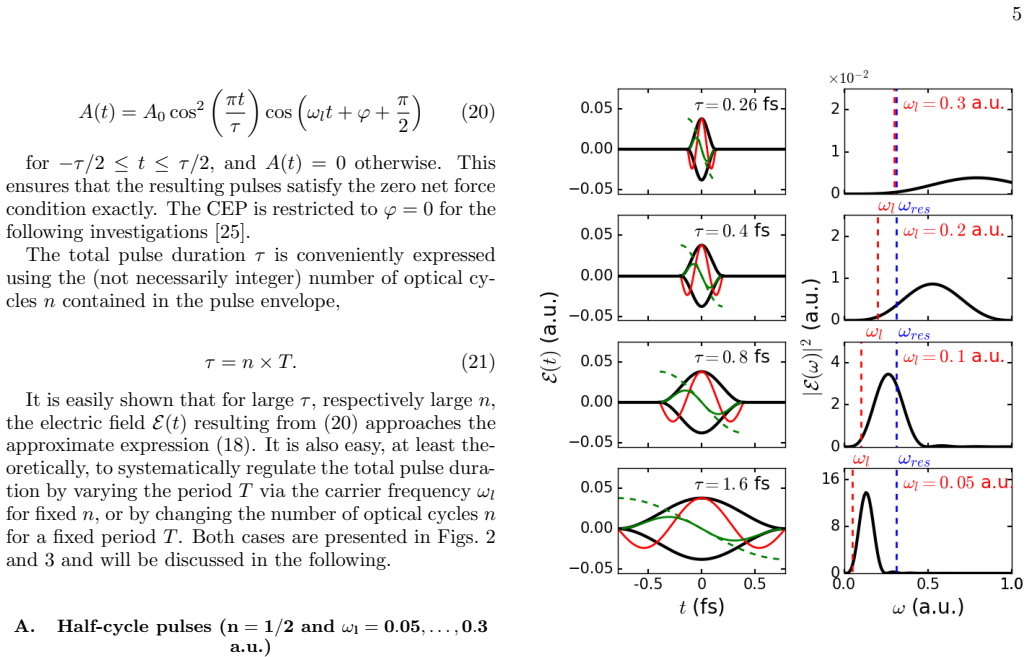
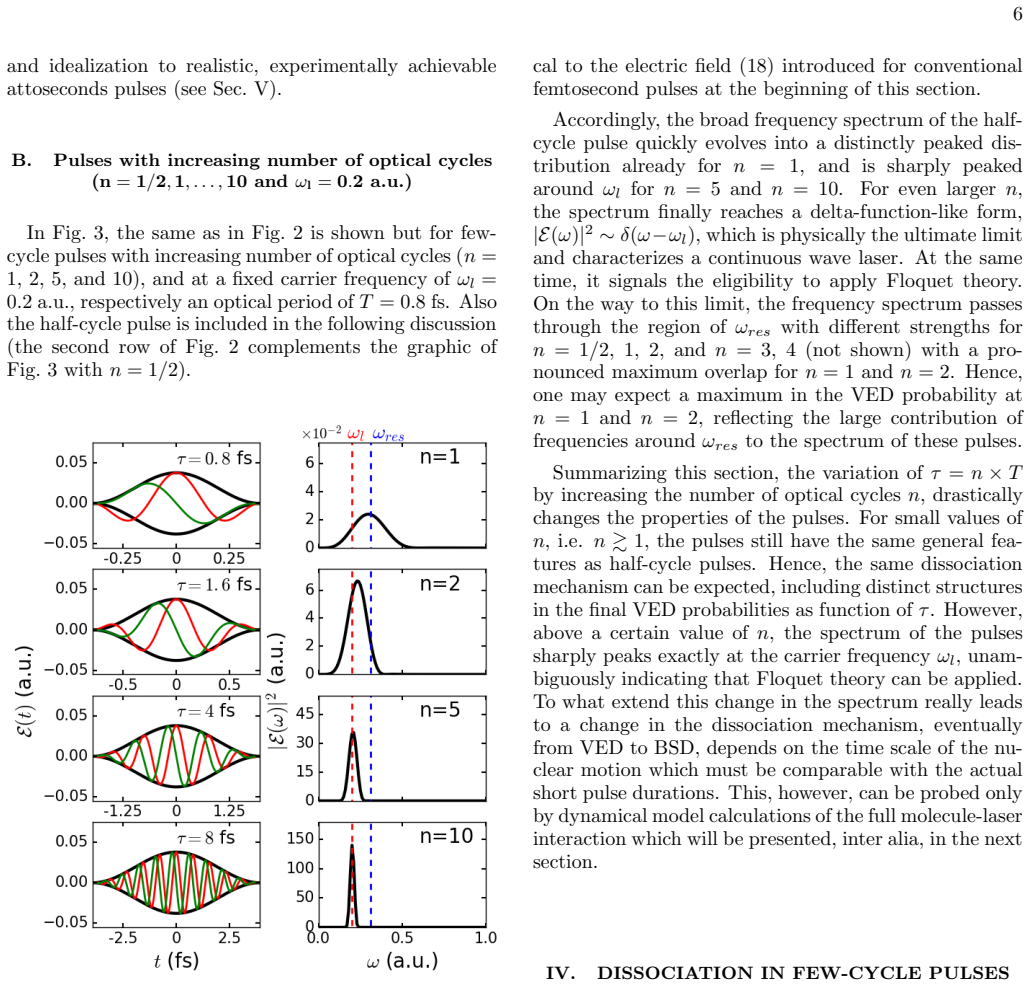
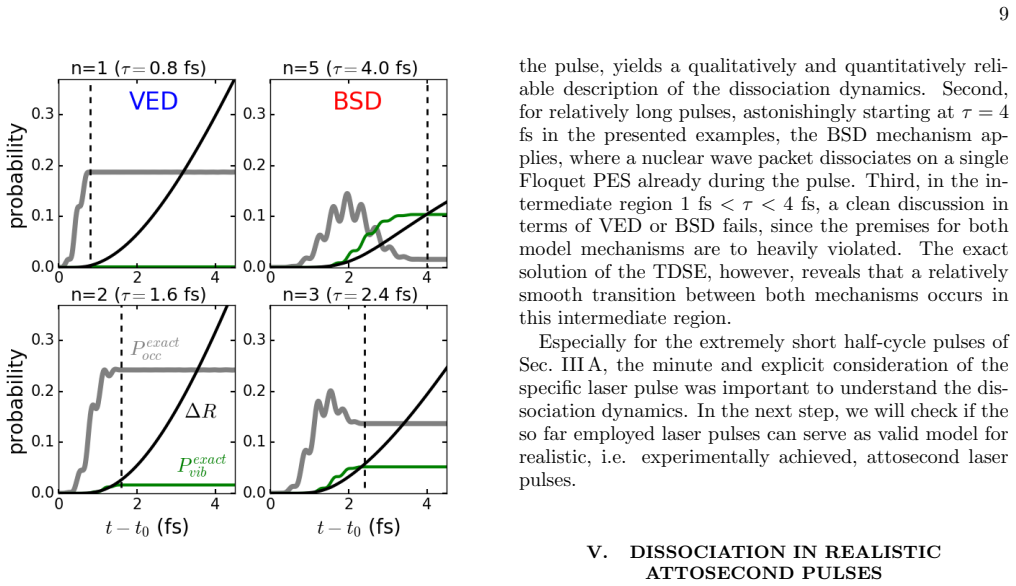
The central object is the electric field $E(t) = -\partial_t A(t)$ built from a vector potential $A(t) = A_0 \cos^2(\pi t/\tau) \cos(\omega_l t + \varphi + \pi/2)$, which satisfies the zero-net-force condition and defines all pulses; pulse duration is varied either through the carrier frequency (half-cycle pulses) or through the number of optical cycles $n$ at fixed $\omega_l$. Against the exact time-dependent Schrödinger equation benchmark, the paper tests two simplified mechanisms: VED, computed by first-order perturbation theory with frozen nuclei, and BSD, computed by nuclear wave-packet propagation on a single time-dependent bond-softening Floquet surface. The discriminating diagnostics are the time-dependent occupation probability of the first excited Born-Oppenheimer state and the vibrational excitation probability: they show whether electronic excitation precedes nuclear motion (VED), is converted into nuclear motion while the laser is on (BSD), or proceeds simultaneously (transition region).
What would settle it
Re-run the same TDSE propagations with an ionization flux recorded at the grid boundary (or a norm-loss monitor) for all pulse parameters with $n \le 40$; if the integrated ionization probability reaches more than a few percent for any of these pulses, the reported dissociation probabilities and the claimed VED/BSD boundaries would be contaminated.
Extended reading notes
Core claim
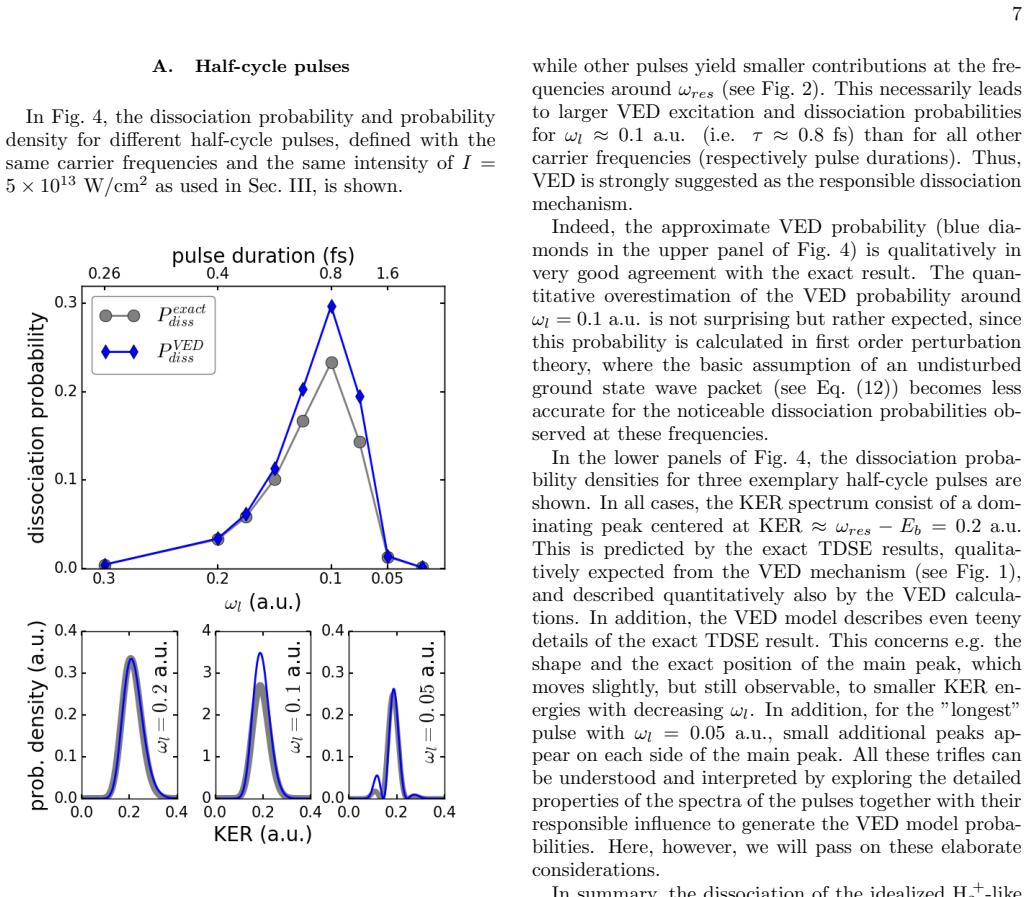
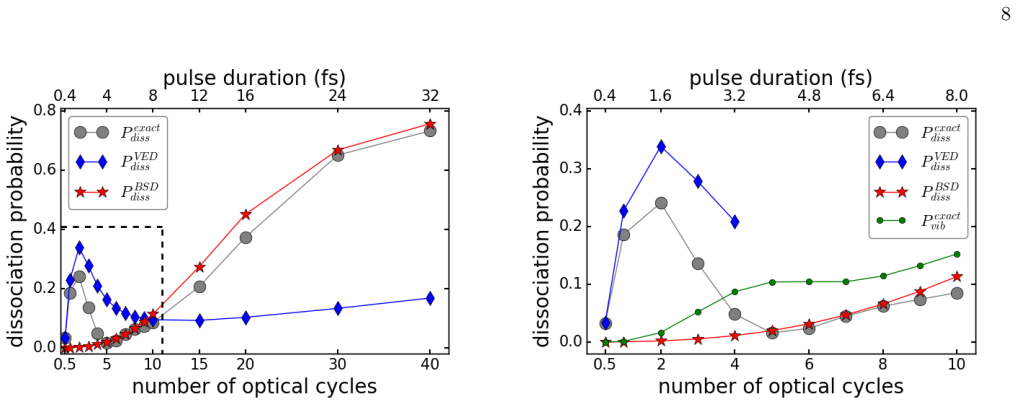
The central discovery is that the dissociation mechanism of an H2+-like molecule in a few-cycle laser pulse is selected by the pulse duration relative to the nuclear time scale. For pulses up to about one femtosecond, the exact dissociation probabilities and kinetic-energy-release spectra are reproduced by first-order perturbation theory with fixed nuclei, the vertically excited dissociation (VED) mechanism, provided the pulse spectrum covers the molecular resonance frequencies. For pulses of four femtoseconds and longer, the same observables are reproduced almost exactly by propagating the nuclear wave packet on a single bond-softening Floquet surface (BSD), even though Floquet theory is in principle exact only for continuous-wave lasers. Between one and four femtoseconds, neither model works: the laser drives electronic excitation and nuclear motion simultaneously, and the exact solution shows a smooth crossover. In the attosecond regime, the detailed time dependence of the electric field is essential: a half-cycle model pulse captures the total dissociation probability and the main KER peak of a realistic 380-attosecond pulse, but the fine structure of the KER spectrum requires the experimentally measured field.
Load-bearing premise
The regime map rests on the assumption, stated in Section II A, that ionization is negligible for every pulse and intensity used, but the paper reports no quantitative ionization probabilities or convergence tests to support this.
Editorial extensions
If this is right
- For pulses shorter than about 1 fs, the VED mechanism is quantitatively reliable: first-order perturbation theory with the exact pulse reproduces the dissociation probability and the kinetic-energy-release spectrum.
- For pulses of 4 fs and longer, propagation on a single bond-softening Floquet surface reproduces the exact dissociation probability, so Floquet-based pictures remain useful far below the continuous-wave limit.
- In the 1–4 fs window, neither VED nor BSD applies; the exact TDSE shows a smooth crossover with coupled electronic and nuclear motion during the pulse.
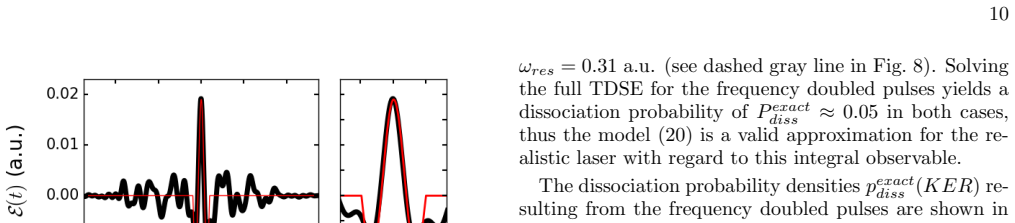
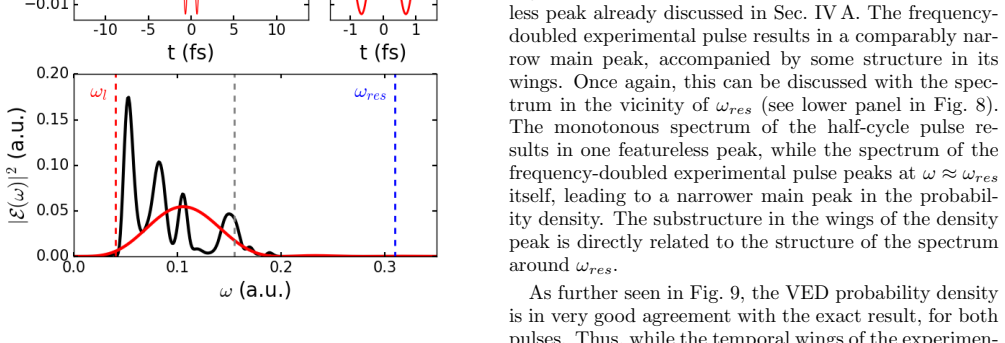
- In the attosecond regime, the detailed temporal shape of the electric field is decisive: a half-cycle model pulse reproduces the total dissociation probability and gross KER spectrum of a realistic 380-as pulse, but reproducing fine KER structure requires the measured field.
- An attosecond pulse whose spectrum does not cover the molecular resonance frequencies produces essentially no dissociation, despite a peak intensity that would otherwise be sufficient; frequency-doubling the spectrum restores dissociation.
Reading between the lines
- If the nuclear mass is increased, as in D2+ versus H2+, the VED regime should extend to longer pulse durations because the nuclei move more slowly; the paper raises this as an open question but does not test it.
- The failure of both simple models in the 1–4 fs window suggests that few-cycle control schemes will need to treat electron-nuclear correlation explicitly rather than assuming a single potential surface, a prediction that could be checked with multi-surface Floquet calculations.
- A direct experimental test of the regime map would be to measure the kinetic-energy-release spectrum of H2+ as a function of pulse duration and look for the predicted switch from a broad VED peak to a BSD peak between 1 and 4 fs.
Signed reviews
Editorial analysis
A structured set of objections, weighed in public.
Referee Report
Summary. This paper studies dissociation of a two-dimensional H2+-like model in few-cycle laser pulses with durations from 250 as to 32 fs. Using a split-operator solution of the full TDSE and surface-flux analysis, it compares the exact dissociation probabilities and KER spectra with two simple models: vertical excited dissociation (VED), a first-order perturbative vertical transition to the first excited BO surface, and bond-softening dissociation (BSD), a single-surface Floquet wave-packet propagation. The central result is a three-regime map: VED for pulses shorter than about 1 fs, BSD for pulses from about 4 fs upward, and a smooth transition region in between in which neither model applies. The paper also compares an idealized half-cycle pulse with an experimentally realized 380-as pulse and finds that after frequency doubling both produce similar VED-dominated dissociation.
Significance. If the results hold, the paper provides a clear and quantitative regime map for dissociation dynamics that can guide interpretation of experiments and validate approximation methods. The strong points are the exact TDSE backbone, the careful construction of zero-net-force few-cycle pulses, and the fact that the VED and BSD model calculations are not fitted to the TDSE data but use the same input parameters, making their agreement informative. The main caveats are the absence of quantitative ionization checks and the unquantified field-free correction in the BSD model, as detailed below.
major comments (3)
- [Secs. II A and IV B] The central claim depends on the TDSE dissociation probabilities in Figs. 5 and 6, but the paper does not report any quantitative measure of ionization for the pulses actually used. The text asserts that "we use only moderate laser intensities and ensured that ionization plays a negligible role" and later excludes n>40 because "the rising ionization probability starts to suppress the dissociation," yet no norm loss, ionization probability, or electron flux is given for any n in the range used. If ionization is non-negligible for n=20-40, or already for n>=5, the exact dissociation probabilities are suppressed, which would shift the apparent regime boundary and the BSD agreement. Please add a quantitative ionization check (e.g., norm loss or R-boundary flux) for every pulse parameter shown in Figs. 5 and 6, and state the threshold used for "negligible."
- [Sec. II D, Eq. (16)] The BSD model is corrected by subtracting the unphysical field-free dissociation probability, stated to range from 0.3% to 7% depending on the pulse duration. The text calls this "slightly correct," but no values are given for the individual n shown in Figs. 5 and 6, and the correction can be comparable to the exact dissociation probability in the vicinity of the n=5 minimum. Because the BSD regime is claimed to begin at n=5, the quantitative agreement at the boundary depends on this correction. Please report the raw and corrected BSD probabilities, give the correction magnitude at each n, and justify that the subtraction does not remove a physical contribution.
- [Sec. II B] The TDSE calculations are described as "practically exact," but no convergence tests are provided for the time step dt=0.05 a.u., the 512x256 grid, the absorber, or the surface-flux parameters Rs and rs. Since the regime boundaries in Sec. IV B are quantitative statements based on these dissociation probabilities, please add convergence checks (e.g., decreasing dt, increasing grid, varying Rs and rs) for at least the representative pulses in Figs. 4-6.
minor comments (5)
- [Secs. III A and III B] Expressions like "n & 1" and "n & 10" should use standard inequality symbols (e.g., n ≲ 1 and n ≳ 10) to avoid ambiguity.
- [Introduction] The phrase "to what extend" should read "to what extent."
- [Sec. IV B] The statement that the first excited BO state "strongly dominates" the dissociation is not quantified; a brief measure of contributions from other BO states would substantiate the neglect of i≠1 in Eq. (7).
- [Sec. V] The frequency-doubling procedure is introduced to shift the spectrum onto the molecular resonance, but it is not stated whether the peak intensity is held fixed when the frequencies are doubled; please clarify.
- [Sec. II D] The values of the field-free correction (0.3%-7%) are given without specifying the corresponding pulse durations or n values; a table or figure would make the correction transparent.
Circularity Check
No significant circularity: the VED and BSD models are parameter-free cross-checks against the exact TDSE, so the regime map is not forced by construction.
full rationale
The paper's central claim—three pulse-duration regimes (VED, transition, BSD)—is anchored in the exact TDSE dissociation probabilities (Eqs. 7-8), which are computed from the full electron-nuclear Hamiltonian (Eq. 2) with no model assumption. The VED probability (Eqs. 12-15) is a first-order perturbative expression using the same laser field and field-free BO states/dipole moments as inputs; no coefficient is fitted to the TDSE data. The agreement with the exact peak at omega_l = 0.1 a.u. is therefore a genuine mechanistic test, not a self-consistency check. The BSD model (Eq. 16) propagates the initial state on a single Floquet PES; the subtraction of the unphysical field-free dissociation probability (0.3%-7%) is a computed artifact correction, not a fit to the exact dissociation data. Self-citations [18,19] only document the time-dependent Floquet-envelope method and the single-surface idealization; the Floquet framework itself is standard external theory, so these citations are not load-bearing. The paper's regime boundaries follow from the exact TDSE results and are not defined by the model equations. The unverified ionization-negligibility assumption is a correctness risk, not a circularity. Hence no circular step is exhibited.
Assumptions & free parameters
free parameters (1)
- frequency doubling factor =
2
assumptions (7)
- standard math The time-dependent Schrödinger equation (1) with Hamiltonian (2) exactly governs the electron-nuclear dynamics of the model molecule.
- domain assumption The two-dimensional H2+ model with one active electron and soft-core Coulomb potentials (Eq. (2)) captures the essential dissociation physics of a real diatomic molecule.
- domain assumption Ionization is negligible at the intensities used, so the computed dissociation probabilities are uncontaminated.
- domain assumption The laser field is described in dipole approximation and length gauge, with the electric field constructed from the vector potential (20) to satisfy the zero net force condition.
- domain assumption First-order perturbation theory with an undisturbed nuclear wave packet (Eq. (12)) is valid for the VED probability in the short-pulse, moderate-intensity regime.
- domain assumption A single Floquet surface (the bond-softening surface) suffices to describe BSD, with a corrective subtraction of unphysical field-free dissociation.
- standard math The surface flux method (Eq. (7)) with field-free BO states is valid for extracting dissociation probabilities when the laser pulse is over before the flux reaches the analysis surface.
Cite this review
Pith. "Pith review of Molecular dissociation in few-cycle laser pulses: From attosecond to femtosecond pulse duration." pith.science (2026). https://pith.science/paper/LTRKBYQ3
@misc{pith2026190804586,
  author       = {Pith},
  title        = {Pith review of: Molecular dissociation in few-cycle laser pulses: From attosecond to femtosecond pulse duration},
  year         = {2026},
  howpublished = {\url{https://pith.science/paper/LTRKBYQ3}},
  note         = {Machine review of arXiv:1908.04586}
}
read the original abstract
The dissociation dynamics of diatomic molecules interacting with (near) optical laser pulses of different duration is investigated by an elaborate discussion of the electric field of the laser and by a direct solution of the time-dependent molecular Schr\"odinger equation. The systematic variation of the pulse duration from the electronic time scale (attoseconds) to the nuclear time scale (femtoseconds) shows that the employed few-cycle laser pulses lead to well-known but quite different dissociation mechanisms. A comparative calculation with a model pulse and an experimentally realized attosecond pulse emphasizes that, and to what extent, a realistic modeling of the electric field is of central importance in the attosecond regime.
Figures

Figures from the paper (5 more)
Reference graph
Works this paper leans on
-
[1]
Krausz and M
F. Krausz and M. Ivanov, Rev. Mod. Phys. 81, 163 (2009)
2009
- [2]
-
[3]
R. Schinke, Photodissociation Dynamics: Spectroscopy and Fragmentation of Small Polyatomic Molecules , Cam- bridge Monographs on Atomic, Molecular and Chemical Physics (Cambridge University Press, Cambridge, 1993)
work page 1993
-
[4]
H. Ibrahim, C. Lefebvre, A. D. Bandrauk, A. Staudte, and F. L´ egar´ e, Journal of Physics B: Atomic, Molecular and Optical Physics 51, 042002 (2018)
work page 2018
-
[5]
P. H. Bucksbaum, A. Zavriyev, H. G. Muller, and D. W. Schumacher, Phys. Rev. Lett. 64, 1883 (1990)
work page 1990
-
[6]
For longer pulses, n >40, the rising ionization prob- ability starts to suppress the dissociation. Thus, Fig. 5 contains the whole relevant range of pulse durations for pure dissociation of the employed model system. The exact dissociation probability shows a significant 8 FIG. 5. Dissociation in pulses with increasing number of optical cycles. The dissoci...
- [7]
-
[8]
A. Giusti-Suzor, X. He, O. Atabek, and F. H. Mies, Phys. Rev. Lett. 64, 515 (1990)
work page 1990
Show all 29 references
-
[9]
J. H. Posthumus, J. Plumridge, L. J. Frasinski, K. Codling, E. J. Divall, A. J. Langley, and P. F. Taday, J. Phys. B: At. Mol. Opt. Phys. 33, L536 (2000)
2000
-
[10]
Charron, A
E. Charron, A. Giusti-Suzor, and F. H. Mies, Phys. Rev. A 49, R641 (1994)
1994
-
[11]
Uhlmann, T
M. Uhlmann, T. Kunert, and R. Schmidt, Phys. Rev. A 72, 045402 (2005)
2005
-
[12]
L. J. Frasinski, J. Plumridge, J. H. Posthumus, K. Codling, P. F. Taday, E. J. Divall, and A. J. Langley, Phys. Rev. Lett. 86, 2541 (2001)
2001
-
[13]
Fischer, U
M. Fischer, U. Lorenz, B. Schmidt, and R. Schmidt, Phys. Rev. A 84, 033422 (2011)
2011
-
[14]
J. H. Shirley, Physical Review 138, 979 (1965)
1965
-
[15]
Sambe, Phys
H. Sambe, Phys. Rev. A 7, 2203 (1973)
1973
-
[16]
A. D. Bandrauk and M. L. Sink, The Journal of Chemical Physics 74, 1110 (1981)
1981
-
[17]
Guerin, F
S. Guerin, F. Monti, J.-M. Dupont, and H. R. Jauslin, J. Phys. A: Math. Gen. 30, 7193 (1997)
1997
-
[18]
Chu and D
S.-I. Chu and D. A. Telnov, Physics Reports 390, 1 (2004)
2004
-
[19]
Fiedlschuster, J
T. Fiedlschuster, J. Handt, and R. Schmidt, Phys. Rev. A 93, 053409 (2016)
2016
-
[20]
Fiedlschuster, J
T. Fiedlschuster, J. Handt, E. K. U. Gross, and R. Schmidt, Phys. Rev. A 95, 063424 (2017)
2017
-
[21]
M. T. Hassan, T. T. Luu, A. Moulet, O. Raskazovskaya, P. Zhokhov, M. Garg, N. Karpowicz, A. M. Zheltikov, V. Pervak, F. Krausz, and E. Goulielmakis, Nature 530, 66 (2016)
2016
-
[22]
Yue and L
L. Yue and L. B. Madsen, Phys. Rev. A 88, 063420 (2013)
2013
-
[23]
We note that the discrete sum is appropriate even for 12 in principle continuous scattering energies, since all our calculations are performed on finite grids anyways
-
[24]
This is not the case in this work
As soon as multi-photon effects play a role, the full (com- plex) Fourier transformE(ω), or a combination of ampli- tude spectrum and phase spectrum, has to be considered. This is not the case in this work
-
[25]
L. B. Madsen, Phys. Rev. A 65, 053417 (2002)
2002
-
[26]
We have checked that the main conclusions drawn in this work also hold for other values of the CEP
-
[27]
For lucidity, we intentionally pass on an extensive anal- ysis of the electron-nuclear dynamics in the Floquet pic- ture
-
[28]
P. M. Paul, E. S. Toma, P. Breger, G. Mullot, F. Aug´ e, P. Balcou, H. G. Muller, and P. Agostini, Science 292, 1689 (2001)
2001
-
[29]
S. R. Leone and D. M. Neumark, Faraday Discuss. 194, 15 (2016)
2016
Reviewed August 14, 2026 · model on record in the stance chip above.
Discussion (0). Continue with ORCID to comment.