REVIEW 3 major objections 4 minor 23 references
Real spinors and real Dirac equation
T0 review · 3 major / 4 minor · reviewed 2026-08-14 · deepseek-v4-flash
Pith's one-line read Real spinors force a non-Abelian extension of electromagnetism
desk verdict A clean geometric-algebra derivation of a right-action bivector gauge field, but the physical claim rests on the optional real-spinor identification and the extra components fail the current-conservation test. read the letter →
The pith
A machine-rendered reading of the paper's core claim, the machinery that carries it, and where it could break.
The reading
What carries the argument
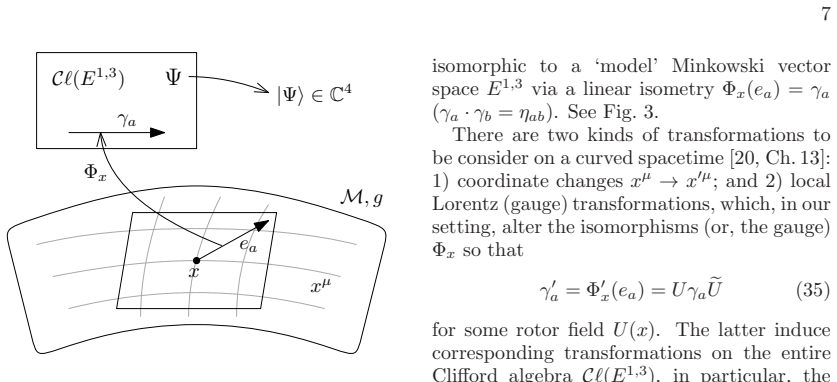
The load-bearing object is the identification of real spinors with the even subalgebra $\mathrm{C}\ell_{\text{even}}(E^{1,3})$ of the real spacetime Clifford algebra, together with the two-sided transformation rule $\Psi' = U\Psi\tilde U$ under a local Lorentz rotor $U$. This rule treats a spinor as a genuine multivector polynomial in the frame vectors, so the frame rotation induces the same two-sided action on spinors. The right side of the covariant derivative, $D_\mu\Psi = \partial_\mu\Psi - \omega_\mu\Psi + \Psi A_\mu$, then requires a new bivector-valued connection $A_\mu$ with the same gauge transformation as $\omega_\mu$; its $\gamma_2\gamma_1$ component is the electromagnetic potential via the dictionary (27f), and its other components correspond to chirality and charge-conjugation operations. The field strength and kinetic term follow from the commutator of the right-acting covariant derivatives.
What would settle it
Compute or measure the observable consequences of the non-electromagnetic components of $A_\mu$: for instance, Eq. (48) predicts a non-conserved Dirac current whenever $A_\mu$ has non-spatial bivector components, so a high-precision search for charge non-conservation in electron scattering would constrain or rule out these components. Alternatively, a direct calculation showing that a one-sided spinor transformation is forced by the complex-spinor representation (24) would remove the need for $A_\mu$ entirely.
Extended reading notes
Core claim
The central claim is that the real formulation of the Dirac equation, in which spinors are even elements of $\mathrm{C}\ell(1,3)$, naturally produces a non-Abelian generalization of the electromagnetic gauge potential. Starting from the requirement of local Lorentz invariance on a curved spacetime with tetrads, and assuming that Lorentz transformations act two-sidedly on all Clifford elements — including spinors — the covariant derivative must contain a right-acting connection $A_\mu$ taking values in spacetime bivectors, isomorphic to $\mathfrak{so}(1,3)$. Writing the real Dirac equation in the gauge where the frame vectors are constant converts $A_\mu$'s $\gamma_2\gamma_1$ component into the standard electromagnetic potential $eA_\mu$, while the remaining components couple to chirality and charge conjugation. The author proposes the resulting field strength $F_{\mu\nu} = \partial_\mu A_\nu - \partial_\nu A_\mu - [A_\mu, A_\nu]$ and a Yang–Mills-type kinetic term as the starting point for a non-Abelian extension beyond electrodynamics.
Load-bearing premise
The whole construction rests on the choice to transform real spinors two-sidedly, $\Psi' = U\Psi\tilde U$, rather than by the standard one-sided rule; the paper motivates this by saying spinors are multivectors, but that is a modeling decision, and the one-sided rule is equally compatible with the formalism and would not introduce $A_\mu$.
Editorial extensions
If this is right
- If the paper is correct, the textbook one-sided spinor transformation rule is replaced by a two-sided rule once spinors are identified with even Clifford elements.
- The electromagnetic potential becomes one component of an $\mathfrak{so}(1,3)$-valued connection, embedding Maxwell theory in a larger non-Abelian gauge theory.
- The Dirac current is not conserved when $A_\mu$ has non-spatial bivector components, giving a concrete observable signature to search for.
- The equations of motion for $A_\mu$ (Eq. 46) are of Yang–Mills type and reduce to the Maxwell equations when only the $\gamma_2\gamma_1$ component is present.
- The imaginary unit $i$ of the Dirac equation is reinterpreted as right multiplication by $\gamma_2\gamma_1$, giving a geometric origin for the complex structure of Dirac spinors.
Reading between the lines
- Because Eq. (48) makes the Dirac current non-conserved whenever $A_\mu$ has non-spatial bivector components, precision searches for charge non-conservation could bound those components; this is a direct test the paper does not pursue.
- Applying the same two-sided logic to three-dimensional Pauli spinors would gauge the right action of the quaternionic bivectors, yielding a non-Abelian connection in $\mathfrak{su}(2)$ with the electromagnetic $B_3$ component; the paper only hints at the spacetime analogue.
- If one takes seriously the paper's observation that $\omega_\mu$ and $A_\mu$ could be identified, the same formalism would merge the spin connection and the generalized electromagnetic potential into a single $\mathfrak{so}(1,3)$ connection, a route the author leaves unexplored.
Signed reviews
Editorial analysis
A structured set of objections, weighed in public.
Referee Report
Summary. The paper reexamines the Hestenes geometric-algebra formulation of the Dirac equation, in which spinors are identified with the even elements of the real Clifford algebra of spacetime. After reviewing real Clifford algebras and the correspondence between real and complex (Pauli/Dirac) spinors, the paper considers the real Dirac equation on curved backgrounds with tetrad fields. Its central proposal is that local Lorentz transformations act two-sidedly on all Clifford-algebra elements, including real spinors (Ψ′ = U Ψ Ũ, Eq. (36)). This forces the introduction of a bivector-valued right-action connection Aμ alongside the ordinary left-action spin connection ωμ. The γ2γ1 component of Aμ is identified with the electromagnetic potential, and the other components are suggested to constitute a non-Abelian generalization of electrodynamics. The paper derives the corresponding covariant derivative, field strengths, and a Yang–Mills-type kinetic term, and it notes the resulting non-conservation of the Dirac current for non-spatial parts of Aμ.
Significance. If the two-sided transformation rule for spinors were physically correct, the paper would offer a novel geometric derivation of a non-Abelian extension of electromagnetism from the real Dirac equation. The paper is internally consistent: the algebraic manipulations in Secs. III and IV are correct, the correspondence between real and complex spinors is clearly presented, and the derivation of Eqs. (37)–(45) is sound. The identification of the γ2γ1 component with the electromagnetic potential follows from Eq. (27f). The paper is also honest in acknowledging that the physical interpretation of the other components of Aμ remains unclear. However, the significance is conditional: the central claim rests entirely on the non-standard two-sided action, which is an added postulate rather than a consequence of local Lorentz invariance. Under the standard one-sided spinor transformation, no right-action gauge field appears. Thus the paper provides a coherent mathematical exploration, but it does not establish that the real Dirac equation naturally yields a non-Abelian gauge field.
major comments (3)
- [§IV.B, Eq. (36)] The two-sided transformation rule Ψ′ = U Ψ Ũ is the sole source of the non-Abelian connection Aμ. This rule is assumed, not derived from local Lorentz invariance. The standard one-sided action (34), which is equally compatible with the geometric-algebra formalism and is used in the standard tetrad formulation of the Dirac equation, produces no right-acting Aμ. The paper's justification—that spinors, as even multivectors, are polynomials in the basis vectors and therefore must transform by the induced automorphism—conflates the passive transformation of a frame with the active transformation of a spinor field. In the standard formalism the spinor transforms under the spin representation U Ψ while the frame transforms under the vector representation U γ_a Ũ; there is no requirement that every Clifford-algebra element transform by the same two-sided rule. The central claim is therefore conditional on a non-standard postulate that needs a physical justification, which the paper does not provide.
- [§IV.B, Eqs. (38)–(42)] The identification of the γ2γ1 component of Aμ with the electromagnetic potential is internally consistent, but it is meaningful only inside the two-sided formalism. Under the standard one-sided transformation rule, minimal electromagnetic coupling is completely described by the ordinary gauge potential in the Dirac equation without any right-acting bivector field. Thus Eq. (42) is a re-interpretation of standard electromagnetism within a non-standard framework, not a derivation of a new physical field from the real Dirac equation itself. The paper should state this explicitly to avoid the impression that the non-Abelian field is forced by the geometry alone.
- [§V, Conclusion] The conclusion acknowledges that the non-electromagnetic components of Aμ have no clear interpretation and that further analysis is needed. This is a load-bearing limitation: the claimed non-Abelian generalization of electrodynamics is not experimentally motivated, and its presence is entirely controlled by the choice of transformation law. The abstract's statement that the formalism 'leads naturally' to a non-Abelian generalization overstates the result. The paper should be reframed as a conditional mathematical possibility, with the two-sided rule identified as an assumption, rather than as the natural outcome of the real Dirac equation.
minor comments (4)
- [Abstract and Introduction] There are typographical errors, including 'eve n' in the abstract and '1-t o-1' in Sec. II.A; these should be corrected.
- [§II.C, footnote 5] The footnote states that the two-sided action acts on a generic multivector by transforming each vector constituent according to Eq. (15). This is helpful, but it should be reconciled with the later claim that the one-sided action (12) is the natural spinor action; the distinction between the two actions and their physical roles is central to the paper and deserves more explicit discussion.
- [§IV.B, Eq. (39)] The transformation laws for ωμ and Aμ are identical in form. The paper notes that they could be identified while preserving invariance; this observation is interesting but could be clarified: identifying them would remove the distinction between left and right connections and would not affect the current discussion. A comment on why the identification is not adopted would be useful.
- [§IV.C, Remark 2] The non-conservation of the Dirac current unless Aμ is purely spatial is a potentially testable consequence. The paper only mentions it in passing; an expanded discussion of its physical implications would strengthen the presentation.
Circularity Check
No significant circularity: the non-Abelian connection is a stated conditional consequence of an explicit two-sided spinor transformation postulate, not a fitted prediction or self-citation chain.
full rationale
The paper's central construction is a gauge-covariantization argument. Eq. (36) postulates Psi' = U Psi U-tilde for local Lorentz transformations; demanding invariance of the real Dirac equation under this rule forces the right-acting connection A_mu in Eq. (38), D_mu Psi = partial_mu Psi - omega_mu Psi + Psi A_mu. This is not circular: A_mu is introduced to compensate the right-action, and the paper explicitly labels the two-sided rule as an assumption ("...the assumption that Lorentz transformations act in the same way on all elements of the Clifford algebra, including the vectors gamma_a and the real spinors Psi," Conclusion). The paper also acknowledges the alternative one-sided rule (34) and notes that the literature commonly adopts it. The identification of the electromagnetic potential as the gamma2 gamma1 component of A_mu follows from the dictionary in Eq. (27f), |Psi gamma2 gamma1> = i|Psi>, a fixed mathematical correspondence, not from fitting. No parameters are fitted to data, no 'prediction' is a renamed input, and no load-bearing claim relies on a self-citation by the author. The physical significance of the non-electromagnetic components is explicitly left open ("Interpretation of the other parts of A_mu is, however, not very clear"), which further militates against a disguised-input reading. If the two-sided law is physically unjustified, that is an assumption-risk/correctness concern, not circularity under the definitions used here.
Assumptions & free parameters
assumptions (3)
- ad hoc to paper Local Lorentz transformations act on real spinors via the two-sided action Ψ' = U Ψ Ũ (Eq. 36).
- domain assumption Real spinors are faithfully represented by the even subalgebra of the real Clifford algebra.
- ad hoc to paper The right-action gauge field Aμ is permitted to take values in the full bivector algebra so(1,3), without restriction to the subgroup that preserves the Dirac current.
invented entities (1)
-
Non-Abelian gauge field Aμ (bivector-valued one-form)
Cite this review
Pith. "Pith review of Real spinors and real Dirac equation." pith.science (2026). https://pith.science/paper/IEYRSHXD
@misc{pith2026190804590,
  author       = {Pith},
  title        = {Pith review of: Real spinors and real Dirac equation},
  year         = {2026},
  howpublished = {\url{https://pith.science/paper/IEYRSHXD}},
  note         = {Machine review of arXiv:1908.04590}
}
read the original abstract
We reexamine the minimal coupling procedure in the Hestenes' geometric algebra formulation of the Dirac equation, where spinors are identified with the even elements of the real Clifford algebra of spacetime. This point of view, as we argue, leads naturally to a non-Abelian generalisation of the electromagnetic gauge potential.
Figures
Reference graph
Works this paper leans on
-
[1]
coordinate changes xµ → x′µ ; and 2) local Lorentz (gauge) transformations, which, in our setting, alter the isomorphisms (or, the gauge) Φ x so that γ′ a = Φ ′ x(ea) = Uγ a ~U (35) for some rotor field U (x). The latter induce corresponding transformations on the entire Clifford algebra Cℓ(E1, 3), in particular, the real spinor fields Ψ( x) transform as Ψ ′...
-
[2]
W. K. Clifford, Applications of Grassmann ’s extensive algebra, Am. J. Math. 1 4, 350–358, (1878)
-
[3]
Hestenes, Space-Time Algebra , 2nd Ed., Springer (2015)
D. Hestenes, Space-Time Algebra , 2nd Ed., Springer (2015)
work page 2015
-
[4]
D. Hestenes and G. Sobczyk, Clifford Algebra to Geometric Calculus , Springer (1987)
work page 1987
-
[5]
C. Doran and A. Lasenby, Geometric Algebra for Physicists, Cambridge Univ. Press (2007)
work page 2007
-
[6]
Hestenes, Real Spinor Fields , J
D. Hestenes, Real Spinor Fields , J. Math. Phys. 8 No. 4, 798–808 (1967)
work page 1967
-
[7]
M. R. Francis and A. Kosowski, The construction of spinors in geometric alge- bra, Ann. Phys. 317 2, 383–409 (2005). [arXiv:math-ph/0403040]
work page Pith review arXiv 2005
-
[8]
Hestenes, Observables, operators, and complex numbers in the Dirac theory , J
D. Hestenes, Observables, operators, and complex numbers in the Dirac theory , J. Math. Phys. 16, 556–572 (1975)
work page 1975
Show all 23 references
-
[9]
Chevalley, The Algebraic Theory of Spinors, Columbia Univ
C. Chevalley, The Algebraic Theory of Spinors, Columbia Univ. Press (1954). 10
1954
-
[10]
W. R. Hamilton, On quaternions, or on a new system of imaginaries in algebra , Philosophi- cal Magazine 25 3, 489–495 (1844)
-
[11]
Lounesto, Clifford Algebras and Spinors , 2nd Ed., Cambridge Univ
P. Lounesto, Clifford Algebras and Spinors , 2nd Ed., Cambridge Univ. Press (2001)
2001
-
[12]
Doran, A
C. Doran, A. Lasenby, and S. Gull, States and operators in the spacetime algebra , Found. Phys. 23 9, 1239–1264 (1993)
1993
-
[13]
Itzykson and J.-B
C. Itzykson and J.-B. Zuber, Quantum Field Theory, McGraw-Hill (1980)
1980
-
[14]
P. A. M. Dirac, The Quantum Theory of the Electron, in Proceedings of the Royal Society A: Mathematical, Physical and Engineering Sciences 117 778, 610–624 (1928)
1928
-
[15]
Hestenes, Spacetime Physics with Geomet- ric Algebra, Am
D. Hestenes, Spacetime Physics with Geomet- ric Algebra, Am. J. Phys. 71 6 (2003)
2003
-
[16]
Hestenes, Space-Time Structure of Weak and Electromagnetic Interactions , Found
D. Hestenes, Space-Time Structure of Weak and Electromagnetic Interactions , Found. Phys. 12, 153–168 (1982)
1982
-
[17]
Hestenes, Gauge gravity and electroweak theory, in Proceeding of the 11th Mar- cel Grossmann Meeting on General Rela- tivity (Ed
D. Hestenes, Gauge gravity and electroweak theory, in Proceeding of the 11th Mar- cel Grossmann Meeting on General Rela- tivity (Ed. by H. Kleinert, R. T. Jantzen, and R. Ruffini, World Scientific, 2008). [arXiv:0807.0060]
2008 arXiv
-
[18]
Doran, A
C. Doran, A. Lasenby, S. Gull, S. Soma- roo, and A. Challinor, Spacetime algebra and electron physics , Advances in Imaging and Electron Physics 95, 271–386 (1996). [arXiv:quant-ph/0509178]
1996 arXiv
-
[19]
Greiner, Relativistic Quantum Mechanics
W. Greiner, Relativistic Quantum Mechanics. Wave Equations , Springer (2000)
2000
-
[20]
R. P. Feynman, Quantum Electrodynam- ics (Frontiers in Physics) , Westview Press (1998)
1998
-
[21]
R. M. Wald, General Relativity , Univ. of Chicago Press (1984)
1984
-
[22]
C. J. Radford, Localized solutions of the Dirac-Maxwell equations , J. Math. Phys. 37, 4418 (1996). [arXiv:hep-th/9510065]
1996 arXiv
-
[23]
Hestenes, Local Observables in Quantum Theory, Am
D. Hestenes, Local Observables in Quantum Theory, Am. J. Phys. 39, 1028–1038 (1971)
1971
Reviewed August 14, 2026 · model on record in the stance chip above.
Discussion (0). Continue with ORCID to comment.