REVIEW 3 major objections 3 minor 22 references
The Beam Balance -- Measuring Binary Systems via Relativistic Beaming Signals from Stars and their Companions
T0 review · 3 major / 3 minor · reviewed 2026-08-14 · deepseek-v4-flash
Pith's one-line read A dim, fast-moving companion can dominate a binary's relativistic beaming signal at long wavelengths, and multi-band photometry can recover its temperature and mass-radius ratio.
desk verdict Solid extension of beaming to companions with a genuinely useful long-wavelength idea, but the zero-crossing formula is missing a square root and the case-study equilibrium temperature uses the wrong radius, so the advertised parameter recovery is not yet right. read the letter →
The pith
A machine-rendered reading of the paper's core claim, the machinery that carries it, and where it could break.
The reading
What carries the argument
The argument rests on approximating each object's spectrum as a single-temperature blackbody and expressing the beaming factor β in terms of two integrals, μ and κ, which contain all temperature and filter dependence. For a blackbody, β = Λκ/μ, with Λ = hc/kT the characteristic wavelength. The paper evaluates this for delta-function and narrow box filters, then derives the ratio of companion-to-star beaming amplitude (Eq. 28) and the total signal (Eq. 32). These formulas turn a complicated special-relativistic radiative transfer problem into a simple algebraic function of wavelength, temperature, and the mass and radius ratios.
What would settle it
Observe the phase-curve beaming amplitude of a known non-transiting hot Jupiter across a wide wavelength range (e.g., 1–10 μm) and compare the zero-crossing wavelength and the asymptotic long-wavelength ratio to the predictions of Eqs. (33)–(35). If the measured values deviate from the blackbody-based prediction by more than the atmospheric-model uncertainty, the single-temperature assumption—and the parameter recovery it enables—is falsified.
Extended reading notes
Core claim
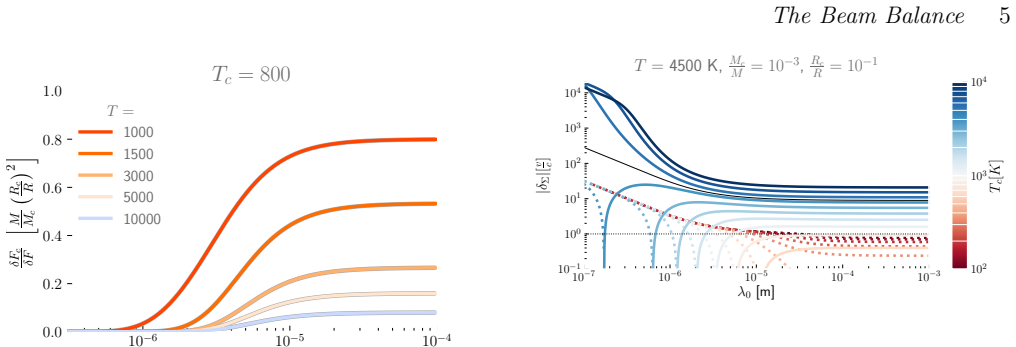
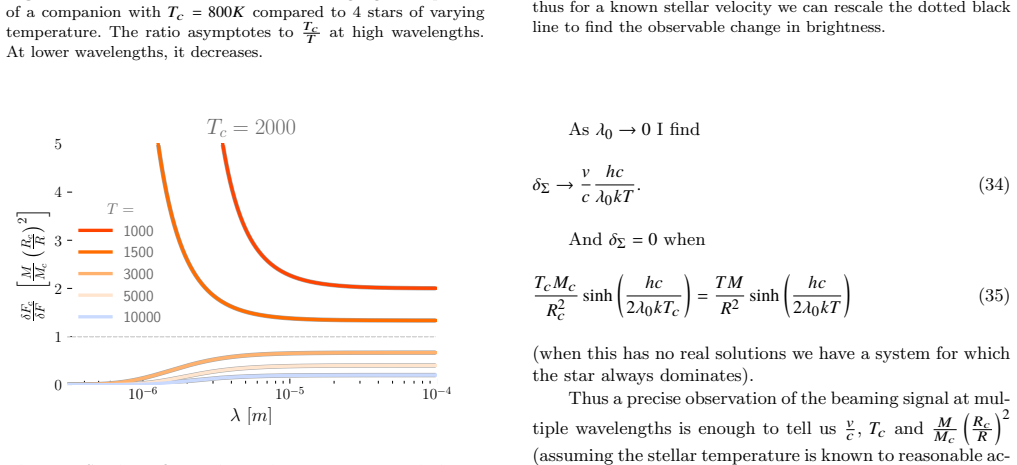
The central discovery is that the wavelength dependence of the combined relativistic beaming signal of a star and its companion acts as a 'beam balance': at short wavelengths the star's beaming dominates, at long wavelengths the companion's beaming can dominate, and the two cancel at a characteristic wavelength. The paper derives a closed-form expression, Eq. (32), for the total amplitude δΣ as a function of wavelength, and shows that in the long-wavelength limit δΣ→ (v/c)|1 − (M/Mc)(Rc/R)^2 (Tc/T)| , in the short-wavelength limit δΣ→ (v/c)(hc/λ0kT), and the zero-crossing obeys an equation involving the temperatures and the mass-radius ratio. Thus a precise observation of the beaming signal over a range of wavelengths allows one to independently constrain the line-of-sight orbital velocity v sinθv, the companion's temperature Tc, and the combination (M/Mc)(Rc/R)^2, assuming the stellar temperature is known.
Load-bearing premise
The companion is assumed to radiate as a single-temperature blackbody, so that its entire spectrum is described by one temperature, but real companions have atmospheres, clouds, reflected starlight, and day–night temperature differences that make the effective temperature depend on wavelength.
Editorial extensions
If this is right
- Non-transiting binary systems, including star–planet systems, could be characterized without requiring a transit or eclipse, vastly increasing the number of systems amenable to study.
- Infrared multi-band photometry from instruments like JWST could recover the companion's temperature and the mass-radius ratio, providing a direct probe of a planet's thermal emission independent of secondary-eclipse spectroscopy.
- The zero-crossing wavelength of the beaming signal is a sensitive function of the companion's temperature, offering a new way to measure atmospheric properties of hot Jupiters and other close-in companions.
- Because the beaming amplitude is nearly distance-independent, the method remains viable for relatively distant systems where direct imaging is impossible.
- If the signals can be measured with sufficient precision, the substructure of δΣ(λ) could reveal wavelength-dependent deviations from a blackbody, encoding atmospheric composition and day-night temperature contrasts.
Reading between the lines
- The same wavelength-scanning technique could be applied to other pairs of luminous bodies, such as brown dwarfs or white dwarfs in binaries, where the companion may be hotter and the signal would reverse its wavelength dependence.
- The derived parameter degeneracy — measuring Tc and (M/Mc)(Rc/R)^2 — could be broken further if the companion's radius is independently known from transit or asteroseismic constraints, converting the measurement into a direct mass determination.
- If the single-temperature blackbody assumption fails, the asymptotic relations (Eqs. 33–35) may still hold in Rayleigh-Jeans and Wien limits, but the zero-crossing would shift in a way that could be used to infer the presence of an atmosphere or cloud layer.
- The method's sensitivity to the companion's temperature could make it a powerful tool for measuring heat redistribution in tidally locked planets, as the day-night contrast would alter the effective beaming amplitude at partial orbital phases.
Signed reviews
Editorial analysis
A structured set of objections, weighed in public.
Referee Report
Summary. This paper extends the relativistic beaming formalism to include both the primary star and a secondary companion in a binary or planet system. Starting from the special-relativistic transformation of the specific flux and the Doppler shift of the filter, the author derives a general first-order expression for the beaming amplitude, then specializes to blackbody spectra and to delta-function and box filters, recovering the Loeb-Gaudi result in the delta-function limit. The central result is Eq. (32), the wavelength-dependent total beaming amplitude, with asymptotic limits (Eqs. 33–34) and a zero-crossing condition (Eq. 35) that are proposed as observables to constrain the companion temperature and the mass/radius ratio. A case study using known exoplanets suggests that the companion can dominate the beaming signal at infrared wavelengths and that the signal may be detectable with JWST-class photometry.
Significance. If the derived relations are correct, the paper offers a conceptually new way to characterize non-transiting binaries and exoplanets: multi-band photometry of the beaming signal could measure the companion temperature and the mass/radius ratio without requiring transits. The first-order derivation is internally consistent, the delta-function limit correctly recovers the Loeb-Gaudi amplitude, and the paper is clearly written with instructive figures. The main analytical claims, however, are undermined by an algebraic error in the zero-crossing condition and by a wrong equilibrium-temperature formula in the observational case study, so the quantitative predictions need revision before the claimed constraining power is supported.
major comments (3)
- [Section 2.6, Eq. (35)] Setting the numerator of Eq. (32) to zero and using the delta-function filter expressions (16)-(17) yields the zero-crossing condition sinh(Λ_c/(2λ0))/sinh(Λ/(2λ0)) = [(M/M_c)(R_c/R)^2 (T/T_c)]^{1/2}, not the first power of the same factor as written in Eq. (35). For a representative hot-Jupiter system (M/M_c=10^3, R_c/R=0.1, T/T_c=5), Eq. (35) places the cancellation near 2 μm while the corrected condition places it near 7 μm, and for 1 < (M/M_c)(R_c/R)^2 < T/T_c Eq. (35) predicts a cancellation that does not actually occur. Because Sec. 2.6 and the abstract advertise the zero-crossing as one of the three observables that constrain T_c and (M/M_c)(R_c/R)^2, the recovery recipe as written is not quantitatively supported.
- [Section 3, Eq. (36)] The equilibrium temperature for a companion heated by its host star is T_eq = T sqrt(R/(2a)), with R the stellar radius; the companion radius R_c cancels in the derivation because both absorption and re-emission scale as R_c^2 for a blackbody. The formula as written uses R_c, which underestimates T_eq by a factor sqrt(R/R_c), typically about 3 for hot Jupiters. Since the case study in Sec. 3 and Figs. 5-7 use Eq. (36) to predict companion beaming amplitudes, the detectability predictions need to be recomputed with the corrected formula.
- [Sections 2.2.2 and 3.1] The parameter-recovery claims in Sec. 2.6 rely on the companion emitting as a single-temperature blackbody (Eq. 11). Sec. 3.1 lists physical complications (day-night temperature differences, atmospheric opacity, clouds, reflected light) but does not quantify how they bias the recovered T_c and (M/M_c)(R_c/R)^2 derived from the asymptotic amplitudes and zero-crossing. Given that the abstract states these quantities can be independently constrained, the paper should either model these effects or state explicitly that the recovered values are effective blackbody parameters rather than physical temperatures.
minor comments (3)
- [Section 2.6] The symbol for the total beaming amplitude is written as δΣ at most places but as δσ in the sentence 'observations must be taken over a number of wavelengths to find where δσ→0'; please make the notation consistent.
- [Appendix A, Eq. (A3)] The ad hoc correction σ has a singularity when log10(Λ/30)=log10(λ0), where the denominator of Eq. (A3) vanishes; if this point is within the parameter range of interest, the approximation is undefined, so the author should either restrict the range, choose a different functional form, or add a caveat.
- [Acknowledgements] There is a typo in the acknowledgements: 'acknowldeges' should be 'acknowledges'.
Circularity Check
No significant circularity: the beaming equations are derived from first principles, not fitted to targets or imported from self-citations.
full rationale
The derivation chain is self-contained and non-circular. Sections 2.1 and 2.2 derive the single-object beaming amplitude from special relativity and a blackbody spectrum, reducing the temperature dependence to the integrals mu and kappa in Eqs. 13-14. The star and companion amplitudes are then combined algebraically in Eqs. 27-32, producing the wavelength-dependent total signal deltaSigma(lambda_0) whose asymptotic forms and zero-crossing condition (Eqs. 33-35) are the basis of the claimed parameter recovery. The quantities claimed recoverable (v/c, T_c, and (M/M_c)(R_c/R)^2) enter as coefficients and cancellation conditions of a derived formula, not as fitted inputs or as conclusions assumed by construction. The reproduction of the Loeb & Gaudi (2003) delta-function result is obtained by evaluating the derived integrals, not by importing it as an assumption. Self-citations to Penoyre & Stone (2019) and Penoyre & Sandford (2019) appear only as context for detectability and competing phase variations and are not load-bearing for the derivation. The hand-picked sigma correction in Appendix A is explicitly an approximation to a numerical integral, not a fit to observed data, and Section 3.1 explicitly acknowledges that blackbody assumptions and competing signals limit realism; those are correctness or feasibility concerns, not circularity. Any algebraic question about the zero-crossing condition is a potential error in the derived equation, not a case of the result reducing to its own inputs.
Assumptions & free parameters
free parameters (1)
- σ correction coefficients =
5 and 30 in Eq. A3
assumptions (6)
- domain assumption Emitting objects are single-temperature blackbodies (Eq. 11)
- domain assumption v/c << 1 and only first-order terms are kept
- domain assumption The companion has lower luminosity, mass, and temperature than the star (Sec. 1)
- ad hoc to paper Equilibrium temperature formula Tc,eq = T sqrt(Rc/(2a)) (Eq. 36)
- standard math Window function vanishes at λ → 0 and λ → ∞
- domain assumption Instrument precision figures from the literature are representative for the proposed observations
Cite this review
Pith. "Pith review of The Beam Balance -- Measuring Binary Systems via Relativistic Beaming Signals from Stars and their Companions." pith.science (2026). https://pith.science/paper/RVFO66F3
@misc{pith2026190804602,
  author       = {Pith},
  title        = {Pith review of: The Beam Balance -- Measuring Binary Systems via Relativistic Beaming Signals from Stars and their Companions},
  year         = {2026},
  howpublished = {\url{https://pith.science/paper/RVFO66F3}},
  note         = {Machine review of arXiv:1908.04602}
}
read the original abstract
In this paper I show that the concept of relativistic beaming -- the process by which light emitted by a fast moving sources is lensed towards the direction of motion -- can be easily extended to model the signal from both the star and any secondary companions. Most companions will be cooler and less massive than their host star. Their lower mass leads to faster orbital velocities, and thus a potentially larger beaming effect. The lower temperature will mean that most of their light is emitted at longer wavelengths, where the relative photometric dominance of the primary is reduced. Thus for some systems, the secondary companion can be the main contributor to observed relativistic beaming signals at long wavelengths. Furthermore, if the system is observed over a range of wavelengths we can independently constrain the temperature of the companion, and the mass and radius ratio of the binary. To conclude I discuss the current and future observational prospects of this signal, using the properties of known exoplanets to show that such a signal may be observable by upcoming surveys.
Figures

Figures from the paper (2 more)


Reference graph
Works this paper leans on
-
[1]
write newline
" write newline "" before.all 'output.state := FUNCTION fin.entry write newline FUNCTION new.block output.state before.all = 'skip after.block 'output.state := if FUNCTION new.sentence output.state after.block = 'skip output.state before.all = 'skip after.sentence 'output.state := if if FUNCTION not #0 #1 if FUNCTION and 'skip pop #0 if FUNCTION or pop #1...
-
[2]
Aigrain S., Parviainen H., Roberts S., Reece S., Evans T., 2017, @doi [ ] 10.1093/mnras/stx1422 , https://ui.adsabs.harvard.edu/abs/2017MNRAS.471..759A 471, 759
-
[3]
Bayliss D., et al., 2018, @doi [ ] 10.1093/mnras/stx2778 , https://ui.adsabs.harvard.edu/abs/2018MNRAS.475.4467B 475, 4467
-
[4]
Beichman C., et al., 2014, @doi [Publications of the Astronomical Society of the Pacific] 10.1086/679566 , https://ui.adsabs.harvard.edu/#abs/2014PASP..126.1134B 126, 1134
doi:10.1086/679566 2014
-
[5]
Bloemen S., et al., 2011, @doi [ ] 10.1111/j.1365-2966.2010.17559.x , https://ui.adsabs.harvard.edu/abs/2011MNRAS.410.1787B 410, 1787
arXiv 2011
-
[6]
Gandhi S., Madhusudhan N., 2019, @doi [ ] 10.1093/mnras/stz751 , https://ui.adsabs.harvard.edu/abs/2019MNRAS.485.5817G 485, 5817
-
[7]
Wotan: Comprehensive time-series de-trending in Python
Hippke M., David T. J., Mulders G. D., Heller R., 2019, arXiv e-prints, https://ui.adsabs.harvard.edu/abs/2019arXiv190600966H p. arXiv:1906.00966
work page Pith review arXiv 2019
-
[8]
Jansen T., Kipping D., 2018, @doi [ ] 10.1093/mnras/sty1149 , https://ui.adsabs.harvard.edu/abs/2018MNRAS.478.3025J 478, 3025
Show all 22 references
-
[9]
Lillo-Box J., Ribas A., Barrado D., Mer \' n B., Bouy H., 2016, @doi [ ] 10.1051/0004-6361/201528002 , https://ui.adsabs.harvard.edu/abs/2016A&A...592A..32L 592, A32
2016 doi
-
[10]
S., 2003, @doi [ ] 10.1086/375551 , https://ui.adsabs.harvard.edu/#abs/2003ApJ...588L.117L 588, L117
Loeb A., Gaudi B. S., 2003, @doi [ ] 10.1086/375551 , https://ui.adsabs.harvard.edu/#abs/2003ApJ...588L.117L 588, L117
2003 doi
-
[11]
arXiv:1808.10856
Masuda K., Hotokezaka K., 2018, arXiv e-prints, https://ui.adsabs.harvard.edu/abs/2018arXiv180810856M p. arXiv:1808.10856
2018 arXiv
-
[12]
Mazeh T., Nachmani G., Sokol G., Faigler S., Zucker S., 2012, @doi [ ] 10.1051/0004-6361/201117908 , https://ui.adsabs.harvard.edu/#abs/2012A&A...541A..56M 541, A56
2012 doi
-
[13]
Penoyre Z., Sandford E., 2019, @doi [ ] 10.1093/mnras/stz1941 , https://ui.adsabs.harvard.edu/abs/2019MNRAS.488.4181P 488, 4181
2019 doi
-
[14]
C., 2019, @doi [ ] 10.3847/1538-3881/aaf965 , https://ui.adsabs.harvard.edu/abs/2019AJ....157...60P 157, 60
Penoyre Z., Stone N. C., 2019, @doi [ ] 10.3847/1538-3881/aaf965 , https://ui.adsabs.harvard.edu/abs/2019AJ....157...60P 157, 60
2019 doi
-
[15]
Pr s a A., Zhang M., Wells M., 2019, @doi [ ] 10.1088/1538-3873/ab0f41 , https://ui.adsabs.harvard.edu/abs/2019PASP..131f8001P 131, 068001
2019 doi
-
[16]
Rauer H., et al., 2014, @doi [Experimental Astronomy] 10.1007/s10686-014-9383-4 , https://ui.adsabs.harvard.edu/abs/2014ExA....38..249R 38, 249
2014 doi
-
[17]
R., et al., 2015, @doi [Journal of Astronomical Telescopes, Instruments, and Systems] 10.1117/1.JATIS.1.1.014003 , https://ui.adsabs.harvard.edu/\#abs/2015JATIS...1a4003R 1, 014003
Ricker G. R., et al., 2015, @doi [Journal of Astronomical Telescopes, Instruments, and Systems] 10.1117/1.JATIS.1.1.014003 , https://ui.adsabs.harvard.edu/\#abs/2015JATIS...1a4003R 1, 014003
2015 doi
-
[18]
B., Lightman A
Rybicki G. B., Lightman A. P., 1986, Radiative Processes in Astrophysics
1986
-
[19]
Shporer A., 2017, @doi [ ] 10.1088/1538-3873/aa7112 , https://ui.adsabs.harvard.edu/abs/2017PASP..129g2001S 129, 072001
2017 doi
-
[20]
Wheeler A., Kipping D., 2019, @doi [ ] 10.1093/mnras/stz775 , https://ui.adsabs.harvard.edu/abs/2019MNRAS.485.5498W 485, 5498
2019 doi
-
[21]
H., Rappaport S
van Kerkwijk M. H., Rappaport S. A., Breton R. P., Justham S., Podsiadlowski P., Han Z., 2010, @doi [ ] 10.1088/0004-637X/715/1/51 , https://ui.adsabs.harvard.edu/abs/2010ApJ...715...51V 715, 51
2010 doi
-
[22]
write newline
" write newline "" before.all 'output.state := FUNCTION fin.entry write newline FUNCTION new.block output.state before.all = 'skip after.block 'output.state := if FUNCTION new.sentence output.state after.block = 'skip output.state before.all = 'skip after.sentence 'output.stat...
Reviewed August 14, 2026 · model on record in the stance chip above.
Discussion (0). Continue with ORCID to comment.