REVIEW 4 major objections 5 minor 27 references
Evaluation of a Recommender System for Assisting Novice Game Designers
T0 review · 4 major / 5 minor · reviewed 2026-08-14 · deepseek-v4-flash
Pith's one-line read This paper reports a controlled human-subjects study showing that a recommender system suggesting game elements and interactions improves novice designers' accuracy and positive affect while reducing perceived workload.
desk verdict A solid user study of a game-design recommender, but the paper never rules out that the target game Space Invaders is in the recommender's own training set, which would make the headline accuracy gain a retrieval effect rather than evidence of general design assistance. read the letter →
The pith
A machine-rendered reading of the paper's core claim, the machinery that carries it, and where it could break.
The reading
What carries the argument
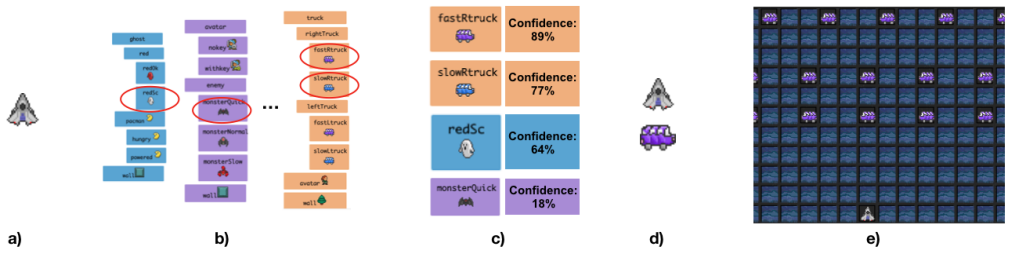
The mechanism is the Pitako recommender system, which uses the Apriori frequent-itemset mining algorithm over a catalog built from every game element set and interaction set in the GVGAI framework's games. The catalog is formatted as transaction lists; mining yields association rules of the form 'if element A is present, element B appears with confidence c.' When a designer adds or removes an element, the user's element set is matched against these rules and suggestions are returned sorted by confidence. The same process applies to interaction rules, and the user chooses which suggestions to adopt.
What would settle it
Check whether the GVGAI catalog used to mine the association rules contains Space Invaders (or a game whose element and interaction sets coincide with it); if it does, rerun the study with a target game absent from the catalog and see whether the accuracy advantage persists. Alternatively, inspect the mined rules to see whether the exact interaction set needed for Space Invaders appears with high confidence.
Extended reading notes
Core claim
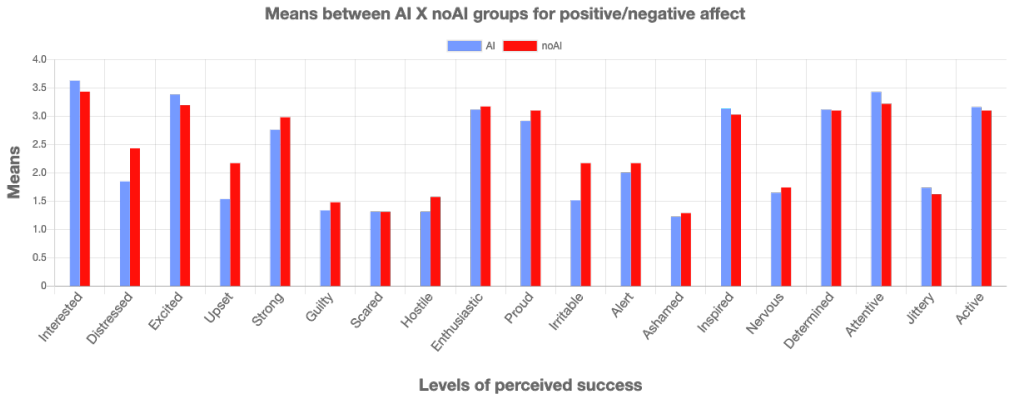
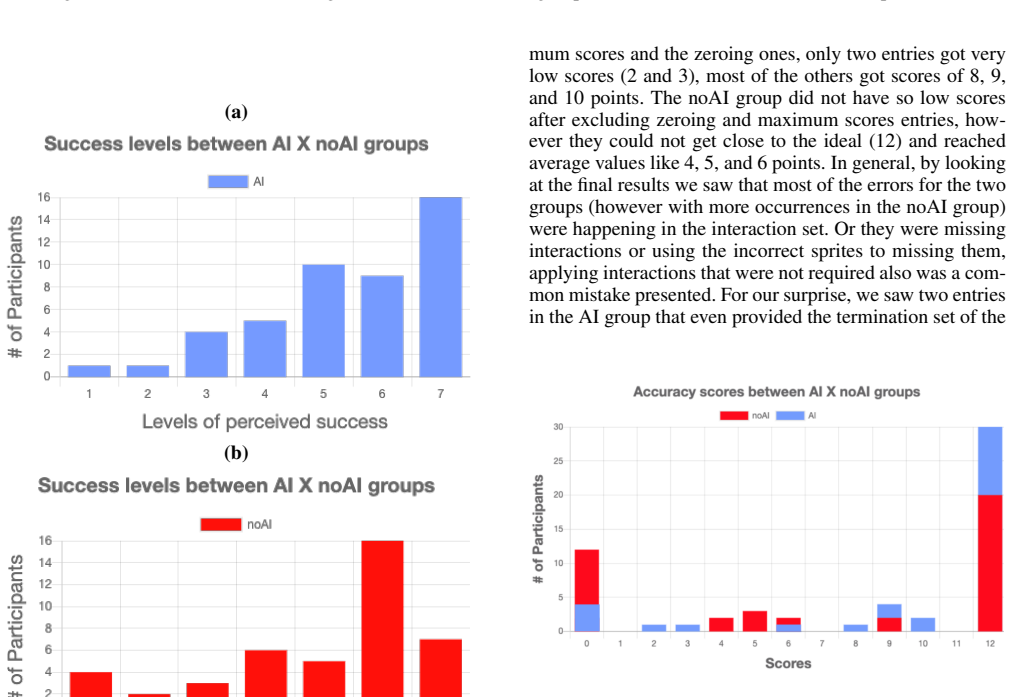
The central claim is that a recommender built on association rules mined from a catalog of existing games can improve novice game designers' performance and experience. On the version of the task studied, users with the recommender delivered more complete, runnable game descriptions (30 of 45 reached the maximum score versus 20 of 42), reported lower mental effort and insecurity, and scored higher on positive affect. The authors emphasize this is an empirical evaluation of human factors, not just a technical demo, and that no significant effect appeared for self-efficacy.
Load-bearing premise
The load-bearing premise is that the accuracy benefit reflects general design assistance rather than the recommender having direct access to the target game's exact elements and interactions in its training catalog; if Space Invaders is in the catalog, the system can effectively retrieve the answer.
Editorial extensions
If this is right
- Novice designers can produce more accurate game descriptions with less perceived effort when an AI recommender handles element and interaction matching.
- Reducing workload without sacrificing accuracy suggests AI assistance can let designers focus on higher-level choices rather than syntax and lookup.
- The lack of self-efficacy gains implies the tool helps performance without inflating users' confidence in their own skills, which could be read as a realistic calibration.
- The affect results suggest that automated suggestions make the design experience more pleasant, which could encourage longer or more frequent design sessions.
Reading between the lines
- Because the target game, Space Invaders, may be represented in the GVGAI catalog from which rules were mined, part of the accuracy gain could come from direct retrieval of the exact required elements and interactions rather than from general design support; the paper does not state whether the target is in the catalog.
- The observation that unassisted users felt prouder suggests AI assistance may reduce ownership or pride; this could be tested directly by asking users about perceived authorship.
- A stronger test of general assistance would repeat the study with a target game deliberately absent from the catalog, or with a novel hybrid design, to separate retrieval from creative support.
Signed reviews
Editorial analysis
A structured set of objections, weighed in public.
Referee Report
Summary. The paper presents Pitako, a recommender system that suggests game elements and interactions to novice game designers, built on the GVGAI framework and Apriori frequent-itemset mining. It reports a human-subjects study with 87 participants divided into an AI-assisted group and a no-AI control group, both asked to design the game Space Invaders in 30 minutes. The authors test four hypotheses: reduced workload, increased positive/negative affect (PANAS), increased accuracy (measured by an author-built grader), and increased self-efficacy. They report statistically significant effects for workload, affect, and accuracy, but not for self-efficacy, and they supplement these findings with qualitative comments from participants. The central claim is that the recommender improves novice designers' accuracy and experience on this design task.
Significance. If the results hold, the paper would make a useful contribution to the emerging literature on AI-driven game design assistance by providing a quantitative, controlled evaluation of a recommender system with human participants. The use of a standardized affect measure (PANAS), a concrete design task, and a comparison condition are strengths. The main scientific risk is that the recommender's training catalog may contain the target game or a close variant, which would make the accuracy result a retrieval effect rather than evidence of general design assistance. The workload instrument also appears to be a nonstandard variant of NASA-TLX. Because the central accuracy, workload, and affect claims all depend on resolving these issues, the paper needs substantial revision before the results can be interpreted as claimed.
major comments (4)
- [System Design (Catalog); Results (Hypothesis 3)] The recommender catalog is built from every game element set and every interaction set in GVGAI, and GVGAI is described as containing more than a hundred games in genres including space shooters. The experimental task is to design Space Invaders, and the accuracy grader awards points only for rules that exactly match the required Space Invaders element and interaction sets. The manuscript does not state whether Space Invaders or a close VGDL variant is in the catalog, nor does it provide any holdout analysis. If the target game is in the catalog, the system can directly recommend the exact elements and interactions needed for a perfect score, and the observed accuracy gap (67% vs 47% maximum scores) becomes largely a retrieval effect rather than evidence of improved general design ability. The authors should disclose whether the target is in the catalog and, if so, reanalyze the results with all target-derived transactions and rules excluded, or otherwise demonstrate that the recommended rules for the target were not available from catalog entries.
- [Results (Hypothesis 1)] The workload instrument is described as NASA-TLX, but the results report statistical significance on four out of five questions with dimensions labeled mental effort, insecurity, rushed, hard work, and perceived success. The standard NASA-TLX has six subscales and does not contain an insecurity dimension, so the administered questionnaire appears to be a five-item ad hoc variant. The manuscript provides no item wording, scoring procedure, or reliability information for this variant. Because the workload reduction claim (H1) rests entirely on this instrument, please report the actual questionnaire, its validation status, and effect sizes for each subscale.
- [User Study (Procedure); Results (Hypothesis 3)] The accuracy comparison depends on an author-built grader, but the manuscript does not describe how the grader was validated against the instructions given to participants, whether the scoring rules were fixed before examining the submissions, or whether the grader and the submitted games are available for inspection. Without this information, the reader cannot assess whether the scoring criteria are fair or whether the correct rule set is simply the set retrievable from the catalog. Please provide the grader, a detailed scoring rubric, and any calibration or validation of the grader against human judgment.
- [Results (all hypotheses)] No randomization or allocation procedure for the two groups is reported, and no baseline comparison of the groups (e.g., prior game-design experience, video-game familiarity) is given. In addition, all results are reported only as p-values; there are no effect sizes or confidence intervals for workload, affect, or accuracy. Given the multiple one-sided tests and the modest sample size, please report allocation details, group demographics, effect sizes with confidence intervals, and account for multiple comparisons in the interpretations.
minor comments (5)
- [Introduction; Results] The hypothesis numbering is inconsistent: the Introduction lists H2 as self-efficacy, H3 as affect, and H4 as accuracy, while the Results section uses H2 for affect, H3 for accuracy, and H4 for self-efficacy. Please align the numbering throughout.
- [Abstract; Sources of Data] The term 'computational affect' is used without a definition or a supporting citation; it is unclear whether this is the same as 'computer affect' or 'affect' as measured by PANAS. The abstract also contains the typo 'computtional affect'.
- [Results (Hypothesis 3)] The description of common errors, such as 'applying interactions that were not required also was a common mistake,' is grammatically unclear and would benefit from a concrete example or a more precise categorization.
- [Figures] Figures 2 and 3 lack axis labels and error bars; please provide descriptive captions and consider plotting individual data points or distributions rather than only means or histograms.
- [Qualitative Analysis] The qualitative analysis uses Atlas.ti but does not report inter-coder agreement, the coding scheme, or how the categories 'effort' and 'positive/negative impact' were defined; please provide this information or treat the quotes as anecdotal rather than as confirmatory evidence.
Circularity Check
No demonstrated circularity: the user study is an independent empirical evaluation, with only a potential catalog-leakage threat that the paper does not establish.
full rationale
The paper's central claims are empirical outcomes of a user study, not quantities derived from the recommender's mining algorithm. The recommender's association rules are computed offline from the GVGAI catalog before the experiment; the outcome measures (NASA-TLX, PANAS, self-efficacy scales, and the independent rule-based grader) are external to the mining procedure. No parameter is fitted to the study data and then renamed as a prediction. The only potentially problematic step would be if the target game Space Invaders were itself in the recommender's catalog, because then high-confidence association rules could directly supply the exact sprites and interactions needed for a perfect score. The paper states that the catalog contains 'every game element set and every interaction set' from GVGAI and that GVGAI includes 'space shooters,' but it never states that Space Invaders is among those games, and the review cannot assume the unstated fact. That is a missing holdout control and a validity threat, not a demonstrated by-construction equivalence. Self-citations to Pitako (Machado et al. 2019) and Cicero (Machado et al. 2018) are ordinary descriptions of the system being evaluated; the empirical claim does not rest on those citations for its evidence. No definitional circularity, fitted-input-as-prediction, or self-citation load-bearing step is exhibited. Score is therefore 0.
Assumptions & free parameters
free parameters (3)
- Apriori minimum support
- Apriori minimum confidence
- Grader scoring weights =
12 total points, one per rule
assumptions (4)
- domain assumption The GVGAI catalog used for mining recommendations is representative of game design tasks and contains the game elements needed for the experimental task.
- domain assumption The five-question workload measure, the PANAS, and the computer self-efficacy scale validly measure the intended constructs.
- ad hoc to paper The author-built grader correctly implements the instructions given to participants and fairly scores designs.
- domain assumption The recruited students are representative of novice game designers.
Cite this review
Pith. "Pith review of Evaluation of a Recommender System for Assisting Novice Game Designers." pith.science (2026). https://pith.science/paper/REJ6MG2M
@misc{pith2026190804629,
  author       = {Pith},
  title        = {Pith review of: Evaluation of a Recommender System for Assisting Novice Game Designers},
  year         = {2026},
  howpublished = {\url{https://pith.science/paper/REJ6MG2M}},
  note         = {Machine review of arXiv:1908.04629}
}
read the original abstract
Game development is a complex task involving multiple disciplines and technologies. Developers and researchers alike have suggested that AI-driven game design assistants may improve developer workflow. We present a recommender system for assisting humans in game design as well as a rigorous human subjects study to validate it. The AI-driven game design assistance system suggests game mechanics to designers based on characteristics of the game being developed. We believe this method can bring creative insights and increase users' productivity. We conducted quantitative studies that showed the recommender system increases users' levels of accuracy and computational affect, and decreases their levels of workload.
Figures
Reference graph
Works this paper leans on
-
[1]
write newline
" write newline "" before.all 'output.state := FUNCTION fin.entry add.period write newline FUNCTION new.block output.state before.all = 'skip after.block 'output.state := if FUNCTION new.sentence output.state after.block = 'skip output.state before.all = 'skip after.sentence 'output.state := if if FUNCTION not #0 #1 if FUNCTION and 'skip pop #0 if FUNCTIO...
-
[2]
Agrawal, R.; Imieli \'n ski, T.; and Swami, A. 1993. Mining association rules between sets of items in large databases. In Acm sigmod record , volume 22, 207--216. ACM
work page 1993
-
[3]
Alvarez, A.; Dahlskog, S.; Font, J.; Holmberg, J.; Nolasco, C.; and \"O sterman, A. 2018. Fostering creativity in the mixed-initiative evolutionary dungeon designer. In Proceedings of the 13th International Conference on the Foundations of Digital Games , 50. ACM
work page 2018
-
[4]
Blow, J. 2004. Game development: Harder than you think. Queue 1(10):28--37
work page 2004
-
[5]
Brin, S.; Motwani, R.; Ullman, J. D.; and Tsur, S. 1997. Dynamic itemset counting and implication rules for market basket data. Acm Sigmod Record 26(2):255--264
work page 1997
-
[6]
Crawford, J. R., and Henry, J. D. 2004. The positive and negative affect schedule (panas): Construct validity, measurement properties and normative data in a large non-clinical sample. British journal of clinical psychology 43(3):245--265
work page 2004
-
[7]
M.; Schaul, T.; Thompson, T.; and Togelius, J
Ebner, M.; Levine, J.; Lucas, S. M.; Schaul, T.; Thompson, T.; and Togelius, J. 2013. Towards a video game description language
work page 2013
-
[8]
Fraser , S., and Mancl , D. 2008. No silver bullet: Software engineering reloaded. IEEE Software 25(1):91--94
work page 2008
Show all 27 references
-
[9]
Guo, Y.; Wang, M.; and Li, X. 2017. Application of an improved apriori algorithm in a mobile e-commerce recommendation system. Industrial Management & Data Systems 117(2):287--303
2017
-
[10]
Guzdial, M.; Liao, N.; Chen, J.; Chen, S.-Y.; Shah, S.; Shah, V.; Reno, J.; Smith, G.; and Riedl, M. O. 2019. Friend, collaborator, student, manager: How design of an ai-driven game level editor affects creators. In Proceedings of the 2019 CHI Conference on Human Factors in Co...
2019
-
[11]
G., and Staveland, L
Hart, S. G., and Staveland, L. E. 1988. Development of nasa-tlx (task load index): Results of empirical and theoretical research. In Advances in psychology , volume 52. Elsevier. 139--183
1988
-
[12]
Kasurinen, J.; Strand \'e n, J.-P.; and Smolander, K. 2013. What do game developers expect from development and design tools? In Proceedings of the 17th International Conference on Evaluation and Assessment in Software Engineering , EASE '13, 36--41. New York, NY, USA: ACM
2013
-
[13]
N.; and Togelius , J
Liapis , A.; Yannakakis , G. N.; and Togelius , J. 2012. Adapting models of visual aesthetics for personalized content creation. IEEE Transactions on Computational Intelligence and AI in Games 4(3):213--228
2012
-
[14]
N.; and Togelius, J
Liapis, A.; Yannakakis, G. N.; and Togelius, J. 2013. Sentient sketchbook: Computer-aided game level authoring. In FDG , 213--220
2013
-
[15]
Machado, T.; Gopstein, D.; Nealen, A.; Nov, O.; and Togelius, J. 2018. Ai-assisted game debugging with cicero. 2018 IEEE Congress on Evolutionary Computation (CEC) 1--8
2018
-
[16]
Machado, T.; Gopstein, D.; Nealen, A.; and Togelius, J. 2019. Pitako - recommending game design elements in cicero. In IEEE Conference on Games
2019
-
[17]
M.; Yi, M
Marakas, G. M.; Yi, M. Y.; and Johnson, R. D. 1998. The multilevel and multifaceted character of computer self-efficacy: Toward clarification of the construct and an integrative framework for research. Information systems research 9(2):126--163
1998
-
[18]
Murphy-Hill, E.; Zimmermann, T.; and Nagappan, N. 2014. Cowboys, ankle sprains, and keepers of quality: How is video game development different from software development? In Proceedings of the 36th International Conference on Software Engineering , 1--11. ACM
2014
-
[19]
Oh, C.; Lee, T.; Kim, Y.; Park, S.; Kwon, S.; and Suh, B. 2017. Us vs. them: Understanding artificial intelligence technophobia over the google deepmind challenge match. In Proceedings of the 2017 CHI Conference on Human Factors in Computing Systems , CHI '17, 2523--2534. New ...
2017
-
[20]
O'Neil, C. 2017. Weapons of math destruction: How big data increases inequality and threatens democracy . Broadway Books
2017
-
[21]
M.; Cou \"e toux, A.; Lee, J.; Lim, C.-U.; and Thompson, T
Perez-Liebana, D.; Samothrakis, S.; Togelius, J.; Schaul, T.; Lucas, S. M.; Cou \"e toux, A.; Lee, J.; Lim, C.-U.; and Thompson, T. 2016. The 2014 general video game playing competition. IEEE Transactions on Computational Intelligence and AI in Games 8(3):229--243
2016
-
[22]
Petrillo, F.; Pimenta, M.; Trindade, F.; and Dietrich, C. 2009. What went wrong? a survey of problems in game development. Computers in Entertainment (CIE) 7(1):13
2009
-
[23]
Schaul, T. 2013. A video game description language for model-based or interactive learning. In Computational Intelligence in Games (CIG), 2013 IEEE Conference on , 1--8. IEEE
2013
-
[24]
Shaker, N.; Shaker, M.; and Togelius, J. 2013. Ropossum: An authoring tool for designing, optimizing and solving cut the rope levels. In AIIDE
2013
-
[25]
Shneiderman, B. 2007. Creativity support tools: Accelerating discovery and innovation. Commun. ACM 50(12):20--32
2007
-
[26]
Smith, G.; Whitehead, J.; and Mateas, M. 2010. Tanagra: A mixed-initiative level design tool. In Proceedings of the Fifth International Conference on the Foundations of Digital Games , 209--216. ACM
2010
-
[27]
Washburn Jr, M.; Sathiyanarayanan, P.; Nagappan, M.; Zimmermann, T.; and Bird, C. 2016. What went right and what went wrong: an analysis of 155 postmortems from game development. In Proceedings of the 38th International Conference on Software Engineering Companion , 280--289. ACM
2016
Reviewed August 14, 2026 · model on record in the stance chip above.
Discussion (0). Continue with ORCID to comment.