REVIEW 3 major objections 4 minor 22 references
Mid-rapidity dependence of hadron production in $p-p$ and $A-A$ collisions
T0 review · 3 major / 4 minor · reviewed 2026-08-14 · deepseek-v4-flash
Pith's one-line read The paper derives an analytic self-similarity parameter for small nonzero rapidity that reproduces pion rapidity spectra in pp and AA collisions to better than 10% at |y|≤0.3 with universal energy scaling.
desk verdict Extends a self-similarity parameter to nonzero rapidity, but the printed central formula has an inverted δ that makes the integrand imaginary at the lower limit, so the data fits are unsupported as written. read the letter →
The pith
A machine-rendered reading of the paper's core claim, the machinery that carries it, and where it could break.
The reading
What carries the argument
The central object is the self-similarity parameter $\Pi$, defined as the minimum, over the fractions $N_A,N_B$ of four-momenta transmitted by the colliding nuclei, of half the norm of the weighted sum of the initial four-velocities $u_A,u_B$ (Eq. 3). The mechanism that carries the argument is the small-$y$ symmetrisation: replacing $(u_A\cdot u_1)$ and $(u_B\cdot u_1)$ by their common form $(m_{1t}/m_1)\cosh(y)\cosh(Y)$ turns $\Phi_A$ and $\Phi_B$ into a single $\Phi$, so the known $y=0$ algebraic solution for $N$ can be reused with only $\cosh(y)$ modifications. This yields Eq. (14), a parameter-free analytic $\Pi(s,m_{1t},y)$. All subsequent results follow from inserting this $\Pi$ into the previously fitted universal spectrum $F(\Pi)$, whose gluon and quark terms carry the constants and the energy scaling $(s/s_0)^{\Delta}$.
What would settle it
Compute the exact minimisation of Eq. (3) using the full scalar products $(u_A\cdot u_1)=(m_{1t}/m_1)\cosh(Y+y)$ and $(u_B\cdot u_1)=(m_{1t}/m_1)\cosh(Y-y)$, and compare the resulting $\Pi$ with Eq. (14) at $y=0.3$ over the transverse-mass range that dominates the integral in Eq. (16). A difference exceeding about 10% would show that the symmetrised analytic form, not the exact kinematics, is responsible for the reported data agreement.
Extended reading notes
Core claim
The paper's central claim is that at small but nonzero rapidity the self-similarity parameter takes the closed form $\Pi(s,m_{1t},y)\simeq \frac{m_{1t}\cosh(y)}{2m_0\delta}\left[1+\sqrt{1+\frac{M^2-m_1^2}{m_{1t}^2\cosh^2(y)\delta}}\right]$ with $\delta=1-4m_0^2/s$, and that this single expression, inserted into the universal function $F(\Pi)$ of Eq. (5), accounts for the pion rapidity spectra in $pp$ and $AA$ collisions at $|y|\le 0.3$ with a claimed precision better than 10%. The derivation reuses the zero-rapidity solution for the minimising fraction $N$, because at $y\ll 1$ the two scalar products $(u_A\cdot u_1)$ and $(u_B\cdot u_1)$ are both replaced by $(m_{1t}/m_1)\cosh(y)\cosh(Y)$, making the invariant functions $\Phi_A$ and $\Phi_B$ equal. The paper further claims that the integrated rapidity distribution inherits a universal energy dependence of the form $(s/s_0)^{\Delta}$ with $\Delta\simeq 0.12$, the excess of the subcritical Pomeron intercept over unity. A simplified low-$y$ closed form for $d\sigma/dy$ is also given, Eq. (17), and is compared with the thermal-model form containing longitudinal and transverse flow.
Load-bearing premise
The derivation's load-bearing premise is that for $|y|\le 0.3$ the two scalar products $(u_A\cdot u_1)$ and $(u_B\cdot u_1)$ may be replaced by their symmetric average $(m_{1t}/m_1)\cosh(y)\cosh(Y)$; if the omitted $\sinh(y)$ terms shift $\Pi$ by more than the claimed 10%, the data comparison and the universal energy scaling lose their support.
Editorial extensions
If this is right
- At $|y|\le 0.3$, pion rapidity spectra can be computed with no additional parameters; the $y$-dependence enters only through $\cosh(y)$ in $\Pi(s,m_{1t},y)$.
- The integrated rapidity distribution inherits a universal energy scaling $(s/s_0)^{\Delta}$ with $\Delta\simeq 0.12$, so spectra at different collision energies should collapse onto one curve.
- The simplified closed form Eq. (17) gives an analytic approximation for $d\sigma/dy$ at small $y$, structurally similar to thermal-model results with longitudinal and transverse flow.
- The same $\Pi$ can describe projectile mesons and any hadronic species, because the scalar-product identity Eq. (13) does not depend on the projectile mass.
- Deviations from this description are expected to appear mainly at $|y|>0.3$, where the asymmetric terms and nuclear thermal effects enter.
Reading between the lines
- Because the symmetrisation error grows like $\sinh(y)$, one can compute the exact $\Pi$ numerically to map where the 10% band fails; this would replace the empirical $|y|\le 0.3$ window with a quantitative boundary.
- Eq. (17) is structurally identical to a thermal-model rapidity distribution with longitudinal and transverse flow, so the fitted constant $C_q$ can be converted into an effective inverse slope in rapidity; comparing it with independently extracted flow velocities would separate geometric from collective-flow contributions to the mid-rapidity plateau.
- The derivation is species-blind apart from $m_1$ and $M$, so the same $\Pi$ should describe kaon and antiproton spectra at $|y|\le 0.3$; those data would test whether the universal function $F(\Pi)$ is truly universal or tuned to pions.
- If the $(s/s_0)^{\Delta}$ scaling holds across energies, it provides a parameter-free baseline that other mid-rapidity signals, such as broadening or enhancement, would have to be measured against.
Signed reviews
Editorial analysis
A structured set of objections, weighed in public.
Referee Report
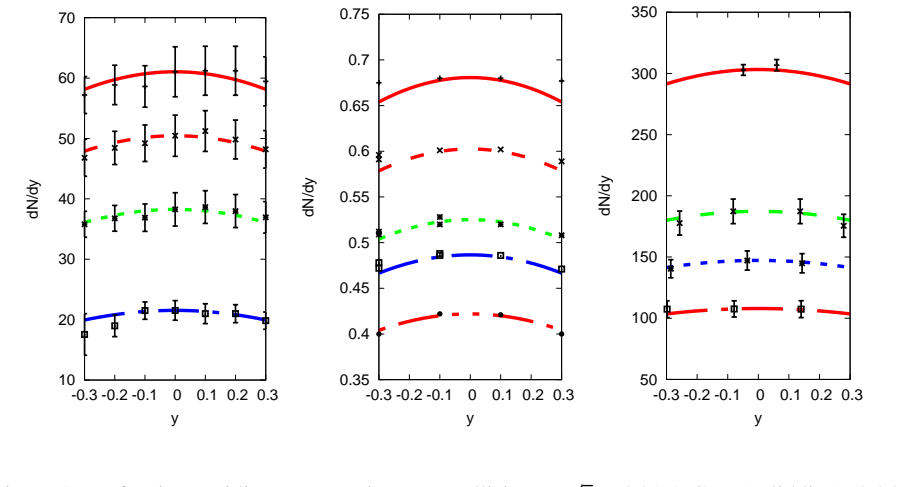
Summary. The manuscript extends the self-similarity description of inclusive hadron production from y=0 to small nonzero rapidity. From four-momentum conservation (Eq. 2) and the minimization condition, the authors derive an analytic expression for the self-similarity parameter Π(s, m_1t, y), Eq. (14), claimed to be valid for |y| ≲ 0.3. Inserting this Π into the previously constructed universal function F(Π) of Eq. (5) with constants taken from earlier papers, they compute pion rapidity spectra via Eq. (16) for pp, AuAu, and PbPb collisions and compare with AGS, RHIC, SPS, and NA61/SHINE data in Fig. 1. They claim a satisfactory description with precision better than 10% and a universal energy dependence of the form (s/s0)^Δ.
Significance. If the corrected version of Eq. (14) holds, the paper would provide a parameter-free analytic dependence of the self-similarity parameter on rapidity, obtained from conservation laws rather than from fitting the y-dependent data. That would be a useful extension of the previous y=0 formalism. The constants in F(Π) are fixed from earlier analyses, so the y-dependence is in principle predictive. However, the central formula as printed contains an algebraic error that makes it inconsistent with the derivation and yields imaginary values at the lower integration boundary, and the claimed 10% precision is not quantitatively demonstrated. The significance of the paper therefore depends on a substantial revision and re-analysis, not merely on presentation changes.
major comments (3)
- [Section 4, Eq. (14)] At y=0 and M=0 (pions), Eq. (14) reduces to Π = [m_1t/(2m_0 δ)] [1 + sqrt(1 - m_1²/(m_1t² δ))], with δ = 1 - 4m_0²/s. However, substituting Eqs. (10)-(12) into Π = N chY gives Π = [m_1t/(2m_0 δ)] [1 + sqrt(1 - δ m_1²/m_1t²)]. The factor δ appears inverted inside the square root in the printed equation. Since δ < 1 for any finite s, the printed expression becomes imaginary at m_1t = m_π, e.g., at √s = 5 GeV, so the integrand in Eq. (16) is not a real function and Fig. 1 cannot have been produced from Eq. (14) as written. This is a load-bearing algebraic error that must be corrected before the data comparison can be assessed.
- [Section 3, Eqs. (9)-(12)] The derivation replaces (u_A·u_1) and (u_B·u_1) with the symmetric expression (m_1t/m_1) ch(y) ch(Y), dropping terms proportional to sh(Y) sh(y). At the claimed boundary |y| = 0.3, sh(y)/ch(y) ≈ 0.29, and for the AGS energies chY is of order 2, so thY ≈ 0.9; the dropped terms are not numerically small. The manuscript provides no estimate of the resulting error in Π, so the stated validity range |y| ≤ 0.3 is not justified by the derivation as presented.
- [Section 4, after Eq. (16) and Fig. 1] The claim of 'a precision less than 10%' is not supported by any residual plot, uncertainty band, chi-square value, or numerical comparison table. Fig. 1 displays curves and data points but no quantitative agreement measure. Similarly, the universal energy dependence (s/s0)^Δ rests on the unquantified assertion that the first term of Eq. (5) dominates at low y; without quantitative evidence, the central claims of the paper are not verifiable from the material presented.
minor comments (4)
- [Abstract] The phrase 'at not large rapiditiesy' contains a typographical error and should read 'at not large rapidities y'; the wording 'is illustrated within a good agreement' is awkward and should be rephrased.
- [Section 2, Eq. (4)] The notation Aα(NA_A · Aα(NB_B is typeset incorrectly; it should presumably read A^{α(N_A)} A^{α(N_B)} F(Π), with the exponents and parentheses clearly displayed.
- [Fig. 1 caption] The caption contains 'shirt dash line', which should be 'short dash line'.
- [Section 4, Eqs. (15)-(16)] Eq. (16) defines dσ/dy as a differential cross section, while Fig. 1 is labeled dN/dy; the conversion between cross section and yield, and the overall normalization used for the curves, are not specified and should be stated for reproducibility.
Circularity Check
No significant circularity: the new y-dependent form of Pi is derived from four-momentum conservation and compared with external data, not fitted to it.
full rationale
The new element in the paper is Eq. (14), an analytical expression for Pi(s,m_1t,y). The derivation in Sec. 3 starts from the conservation law Eq. (2), introduces the scalar products (u_A.u_1) and (u_B.u_1), and at small y replaces them by (m_1t/m_1) cosh(y) cosh(Y), Eq. (9). Equations (10)-(12) are then algebraic developments written out in the paper rather than imported as a black box. The y-dependence therefore does not reduce to a fit parameter: no constant is adjusted to the |y|<=0.3 data, and the comparisons with AGS, RHIC/SPS, and NA61/SHINE data are external checks. Self-citations to [7-9] supply the starting model and the previously fixed constants in F(Pi), Eq. (5), but those are inputs whose values are not re-derived from the y data; hence the central y-dependent prediction is not equivalent to its inputs by construction. The energy factor (s/s0)^Delta is contained in F(Pi) and is explicitly presented as a known input; the paper says it is used and confirmed, not newly derived. No circular step satisfying the hard-evidence requirement was found. A separate observation that the printed Eq. (14) may be algebraically inconsistent with the y=0 limit of Eqs. (10)-(12) would be a correctness or consistency concern, not a circularity. Because the result is not forced by a self-citation chain or by identifying the input with the output, the circularity score is 0.
Assumptions & free parameters
free parameters (7)
- Aq =
3.68 (GeV/c)^-2
- Cq =
0.147
- Ag =
1.7249 (GeV/c)^-2
- Cg =
0.289
- g =
21 mb
- Delta =
0.12
- s0 =
not specified in text
assumptions (5)
- domain assumption Four-momentum conservation takes the form (N_A P_A + N_B P_B - p_1)^2 = (N_A m0 + N_B m0 + M)^2, with fractions N_A, N_B and a bookkeeping mass M for quantum number conservation (Eq. 2).
- domain assumption The self-similarity parameter is Π = min over N_A, N_B of (1/2)[(u_A N_A + u_B N_B)^2]^{1/2}, following the minimization principle of ref. [7] (Eq. 3).
- domain assumption The inclusive spectrum is a universal function F(Π) of the form in Eq. (5), combining quark and gluon exponentials and a Pomeron factor.
- domain assumption For y<<1, the scalar products obey (u_A·u_1) ≈ (u_B·u_1) ≈ (m_1t/m_1) ch(y) ch(Y), so terms with sh(y) are dropped (Eqs. 9-10).
- domain assumption The Mandelstam-variable representation of Π from ref. [9] remains valid at small nonzero y and is used to write Eq. (14).
Cite this review
Pith. "Pith review of Mid-rapidity dependence of hadron production in $p-p$ and $A-A$ collisions." pith.science (2026). https://pith.science/paper/X3TGXU6V
@misc{pith2026190804639,
  author       = {Pith},
  title        = {Pith review of: Mid-rapidity dependence of hadron production in $p-p$ and $A-A$ collisions},
  year         = {2026},
  howpublished = {\url{https://pith.science/paper/X3TGXU6V}},
  note         = {Machine review of arXiv:1908.04639}
}
abstract
The calculation of inclusive spectra of pions produced in $pp$ and $AA$ collisions as a function of rapidity $y$ is presented within the self-similarity approach. It is shown that at not large rapidities $y$ one can obtain the analytical form of the self-similarity function $\Pi(y,p_t)$ dependent of $y$ and hadron transverse momentum $p_t$. A satisfactory description of data on the rapidity spectra at $|y|\leq$ 0.3 is illustrated within a good agreement. The universal energy dependence of these spectra is also shown.
Figures
Reference graph
Works this paper leans on
- [1]
-
[2]
I. Ya. Pomeranchuk, Izv. Dokl. Akad. Nauk Ser.Fiz. 78, 889 (1951)
work page 1951
- [3]
-
[4]
Hagedorn, Supplemento al Nuovo Cimento 3, 147 (1965)
R. Hagedorn, Supplemento al Nuovo Cimento 3, 147 (1965)
work page 1965
- [5]
-
[6]
A.M. Baldin, A.I. Malakhov, and A. N. Sissakian, Phys. Part. Nucl.29 (Suppl. 1), 4 (2001)
work page 2001
-
[7]
A. M.Baldin, A. A. Baldin. Phys. Particles and Nuclei, 29 No3, 232 (1998)
work page 1998
- [8]
Show all 22 references
-
[9]
Lykasov, A.I
G.I. Lykasov, A.I. Malakhov, Eur. Phys. J. A 54, 187 (2018)
2018
-
[10]
Lykasov, A
G. Lykasov, A. Malakhov, Eur. Phys. J. (Web of Conf.) 204, 01022 (2019)
2019
-
[11]
Malakhov, G
A. Malakhov, G. Lykasov, Eur. Phys. J. (Web of Conf.) 204, 01021 (2019)
2019
-
[12]
Schnedermann, J
E. Schnedermann, J. Sollfrank, U. Heinz, Phys.Rev.C48,2462 (1993)
1993
-
[13]
G. Wilk, Z. Wlodarczyk, Phys.Lett. 84, 2770 (2000)
2000
-
[14]
Bugaev, J.Phys.G:Nucl.Phys., 28, 1981 (2002)
K.A. Bugaev, J.Phys.G:Nucl.Phys., 28, 1981 (2002)
2002
-
[15]
Bugaev, M
K.A. Bugaev, M. Gadzicki, M.I. Gorenstein, Phys.Lett. B 544, 127 (2002)
2002
-
[16]
Cleymans, G.I
J. Cleymans, G.I. Lykasov, A.S. Parvan, et al., Phys.Lett. B 723, 351 (2013)
2013
-
[17]
Kley, et al., E895 Collaboration, Phys.Rev
J.L. Kley, et al., E895 Collaboration, Phys.Rev. C 68, 054905 (2003)
2003
-
[18]
Abgrall, et al., NA61 /SHINE Collaboration, Eur
N. Abgrall, et al., NA61 /SHINE Collaboration, Eur. Phys. J. C 74, 2794 (2014)
2014
-
[19]
Cleymans, J
J. Cleymans, J. Struempfer, L. Tirko, Phys.Rev. C 78, 017901 (2008)
2008
-
[20]
Ter-Martirosyan, Sov.J.Nucl.Phys., 44, (1986) 817
K.A. Ter-Martirosyan, Sov.J.Nucl.Phys., 44, (1986) 817
1986
-
[21]
Grinyuk, G.I
A.A. Grinyuk, G.I. Lykasov, A.V . Lipatov, N.P. Zotov, Phys.Rev.D87, (2013) 074017
2013
-
[22]
Artemenkov, G.I
D.A. Artemenkov, G.I. Lykasov, A.I. Malakhov, Int.J.Mod.Phys. A30 (2015) 1550127. 6
2015
Reviewed August 14, 2026 · model on record in the stance chip above.
Discussion (0). Continue with ORCID to comment.