REVIEW 4 major objections 5 minor 58 references
Spin-1/2 Ising-Heisenberg Cairo pentagonal model in the presence of an external magnetic field: Effect of Land\'e g-factors
T0 review · 4 major / 5 minor · reviewed 2026-08-14 · deepseek-v4-flash
Pith's one-line read An exact transfer-matrix solution shows that the spin-1/2 Ising-Heisenberg Cairo pentagonal model in a magnetic field has magnetization plateaux at rational fractions of saturation, and that each magnetization jump coincides with the…
desk verdict A useful extension of an exact zero-field solution, but the eigenenergy formulas in the printed paper don't match the stated Hamiltonian—fixable, but the central derivation needs a careful re-check. read the letter →
The pith
A machine-rendered reading of the paper's core claim, the machinery that carries it, and where it could break.
The reading
What carries the argument
The central object is a $4\times4$ transfer matrix $W = T_{ab}T_{cd}$ formed from two cell transfer matrices, one for each pentagonal cell type. The argument works because the block Hamiltonians for different cells commute, so the partition function factorizes into products of single-block Boltzmann weights; the free energy per block is then $f = -\beta^{-1}\ln\Lambda_{\max}$, where $\Lambda_{\max}$ is the largest eigenvalue of $W$. The entries of $W$ are built from the four eigenenergies of each dimer cell, which contain the exchange couplings $J$, $\Delta$, $J_0$, the field $B$, and the two $g$-factors, and the pattern of level crossings among these eigenenergies is what produces the magnetization plateaux and the specific-heat double-peak correspondence.
What would settle it
Take a finite chain with the full Hamiltonian, write out every bond between neighboring blocks, and compare exact diagonalization of that chain with the transfer-matrix predictions for the plateau positions and specific-heat peak merging; alternatively, compute the commutator $[H_i, H_{i+1}]$ directly and check that it vanishes for the lattice geometry shown in Fig. 1.
Extended reading notes
Core claim
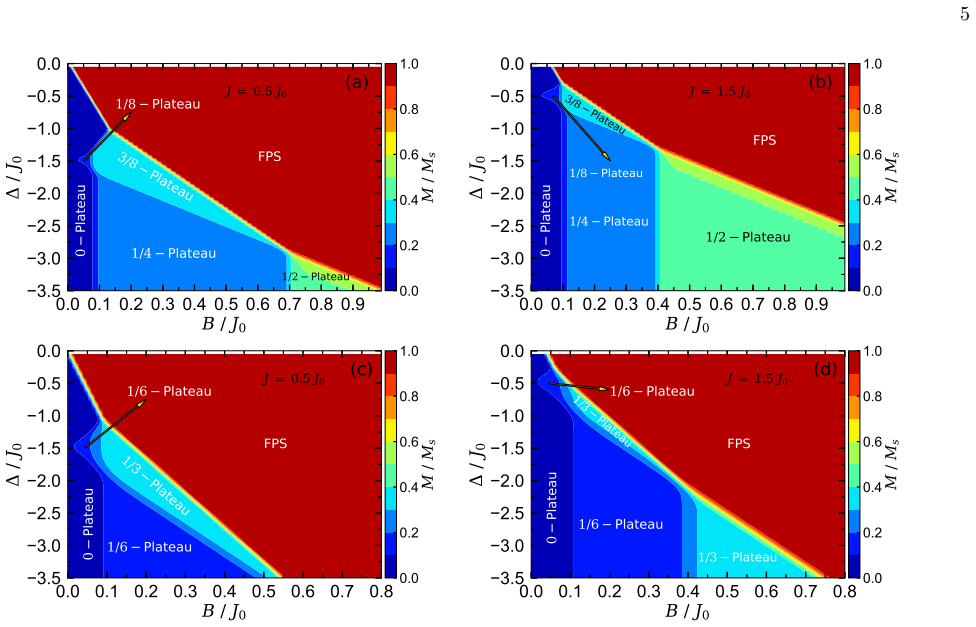
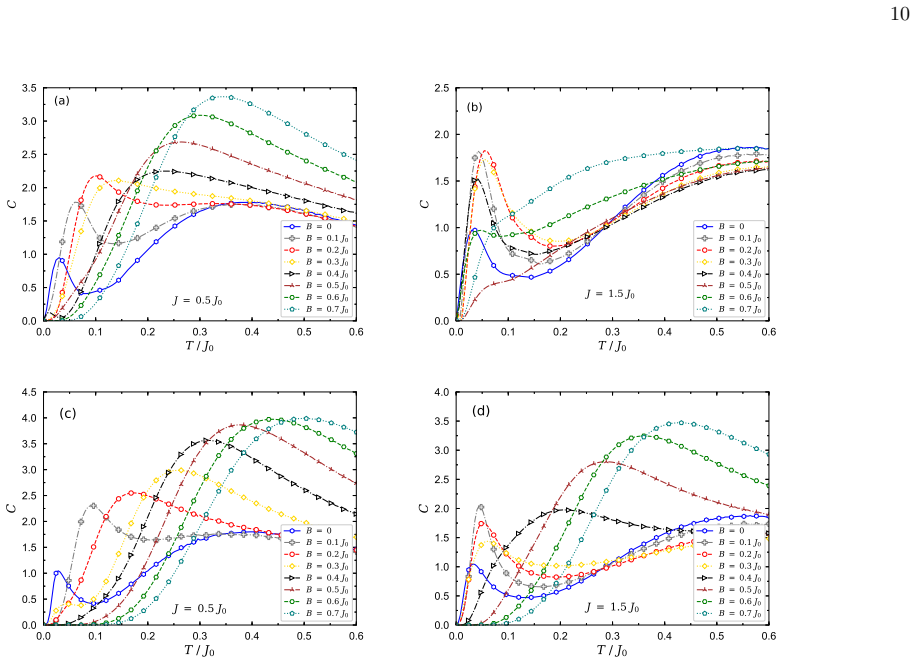
On the paper's own terms, the central discovery is that an external magnetic field organizes the ground states of the Cairo pentagonal Ising-Heisenberg chain into a sequence of magnetization plateaux whose rational values are controlled by the ratio of the two Landé $g$-factors. For $g_1=g_2$ the plateau sequence is $M/M_s = 0, 1/8, 1/4, 3/8, 1/2, 1$; for $g_2=2g_1$ it becomes $0, 1/6, 1/3, 1$; for $g_2=3g_1$ it becomes $0, 1/8, 3/16, 5/16, 1$. The same exact solution shows that the low-temperature specific heat has a double peak in the antiferromagnetic plateau phases and a single Schottky peak once the system is fully polarized, with the height of the first peak rising and falling as the field drives the magnetization from one plateau to the next. Increasing the isotropic dimer coupling $J$ widens the one-half plateau and pushes the Schottky peak to larger fields.
Load-bearing premise
The whole exact solution rests on the premise, stated without proof before Eq. (5), that the interaction in one pentagonal block does not reach into the next block; if adjacent block Hamiltonians do not commute, the partition function does not factorize and the transfer-matrix result would not hold.
Editorial extensions
If this is right
- For equal $g$-factors the ground-state phase diagram in the $(B, \Delta)$ plane contains plateaux at $0$, $1/8$, $1/4$, $3/8$, and $1/2$ of saturation, with the one-half plateau widening as $J/J_0$ increases.
- The double-peaked specific heat marks the antiferromagnetic plateau phase, and the merging of the two peaks into a single Schottky peak signals the fully polarized state; each magnetization jump is accompanied by a change in the height of the low-temperature peak.
- Choosing $g_2/g_1 = 2$ replaces the equal-$g$ plateau sequence with plateaux at $1/6$ and $1/3$, and choosing $g_2/g_1 = 3$ yields plateaux at $1/8$, $3/16$, and $5/16$.
- At zero field and $J = 0.5 J_0$ the residual entropy is $\ln 3$; a weak field suppresses it, while fields above roughly $0.2 J_0$ drive the low-temperature entropy to zero in the plateau phases.
- Larger $J/J_0$ shifts the field at which the single Schottky peak appears, so the specific heat can be used to read off the width of the intermediate plateaux.
Reading between the lines
- The rational plateau values for integer ratios $g_2/g_1 = 1, 2, 3$ follow a pattern set by $g_1$ and $g_1+g_2$; extending the same transfer matrix to rational or incommensurate $g$-factor ratios, which the authors flag as future work, would likely produce additional or irrational plateau fractions.
- If the commuting-block assumption is tested and holds, the same transfer-matrix construction could be applied to connected Cairo pentagonal chains, such as the Y-junction geometry the authors mention; any geometry that introduces inter-block dimer couplings would break the exact factorization and could destroy the plateaux.
- The specific-heat signature suggests a practical route for experiments on Cairo-pentagonal materials: sweeping the field while measuring specific heat could reveal hidden magnetization plateaux even when direct magnetization measurements are difficult.
- The paper's scheme with $g_2 = n g_1$ implies that the saturation magnetization is not the only scale; the Zeeman energies of the two spin species set different effective fields, so plateau fractions are set by the ratio of $g$-factors rather than by the lattice geometry alone.
Signed reviews
Editorial analysis
A structured set of objections, weighed in public.
Referee Report
Summary. The paper studies a spin-1/2 Ising-Heisenberg model on a Cairo pentagonal stripe in an external magnetic field, with different Landé g-factors for the nodal Ising spins and the Heisenberg dimers. The authors claim an exact transfer-matrix solution, from which they compute the ground-state phase diagram, magnetization plateaus, entropy, internal energy, and specific heat. The central claims are that intermediate magnetization plateaus appear (e.g., 1/8, 1/4, 3/8, 1/2 for g1=g2, and 1/6, 1/3 for g1=1, g2=2) and that the position of magnetization jumps coincides with merging or separation of two specific-heat peaks. The paper extends Ref. [34] by adding a magnetic field and unequal g-factors, and it emphasizes the effect of the integer ratio g2/g1 on the plateau structure.
Significance. If the exact solution were correct as written, the paper would be a useful addition to the literature on exactly solvable decorated Ising-Heisenberg lattices, since it provides analytic expressions for thermodynamic quantities and makes a falsifiable connection between magnetization jumps and specific-heat peak merging. The exploration of different g-factors is also of physical interest. However, the central derivation is internally inconsistent: the eigenvalues used to construct the transfer matrix do not follow from the Hamiltonian as displayed. Because all results (phase diagrams, magnetization, specific heat) are computed from that transfer matrix, the claims are not supported in the current form. The inconsistency is checkable and likely fixable by clarifying the operator convention, so I regard it as a major-revision issue rather than an unresolvable error.
major comments (4)
- [Sec. II, Eqs. (2), (7), (8)] The eigenenergies in Eqs. (7)-(8) are not those of the Hamiltonian in Eq. (2). A simple check is the single-dimer limit with J0=0, Delta=0, B=0. With the Pauli operators defined in Eq. (2), the dimer term -J(sigma^x_a sigma^x_b + sigma^y_a sigma^y_b) has eigenvalues 0, 0, +2J, -2J, independent of the surrounding Ising spins. Equation (7) instead gives, for configurations with s1+s2+s3+s4=0, eigenvalues 0, 0, +J/2, -J/2, and for configurations with nonzero Ising sum it gives a J-dependent splitting in the parallel sector, which is impossible when J0=0 because there is then no dimer-Ising coupling. More generally, the coefficient of Delta in Eq. (2) is -Delta sigma^z_a sigma^z_b, while Eq. (7) contains -Delta/4, and the Zeeman and Ising terms also have incompatible coefficients. Consequently the 4x4 transfer matrix W built from Eqs. (6)-(8) is not the partition function of the model in Eq. (2), and the magnetization plateaus, double-peak specific heat, and their correlation are not supported by the printed derivation. The authors should either rewrite the Hamiltonian using spin-1/2 operators (with consistent Zeeman terms) so that Eqs. (7)-(8) are its eigenvalues, or correct Eqs. (7)-(8) to the actual eigenvalues of Eq. (2), and they should show the eigenvalue derivation explicitly.
- [Sec. II, Eq. (6)] The definition W = Tab Tcd is not well defined with the stated row and column assignments. The text says that Tab has rows (s1,i-1, s2,i-1) and columns (s4,i, s3,i), while Tcd has rows (s1,i, s4,i) and columns (s2,i, s3,i). In a matrix product, the column index of the left factor is summed with the row index of the right factor, which here would force (s4,i, s3,i) = (s1,i, s4,i) and would not produce a transfer matrix that propagates the pair (s1,i-1, s2,i-1) to (s1,i, s2,i). Since the thermodynamic limit and all computed quantities rely on the largest eigenvalue of W, the index contraction must be written out explicitly so that the transfer matrix can be checked.
- [Sec. III.A, Eq. (11)] The plateau fractions for general integer g2/g1 = n are stated 'by inspection' without a derivation. The quantity alpha = 2 + [1 + (-1)^{g1+g2}] is unexplained, and the claimed fractions (e.g., 1/8, 5/16, 3/16 for g1=1, g2=3) are not derived from a comparison of ground-state energies. Because the g-factor dependence of the plateaus is one of the paper's main results, this needs a systematic derivation or at least an explicit enumeration for general n using the corrected Hamiltonian.
- [Secs. III.B-III.C] The claims connecting residual entropy, internal energy, and specific-heat peaks to magnetization plateaus are all computed from the same transfer matrix as the magnetization. Once the eigenvalue mismatch in Eqs. (7)-(8) is resolved, the authors should verify whether the reported entropy, internal energy, and specific-heat curves remain unchanged, since those figures depend on the same W.
minor comments (5)
- [Throughout] There are numerous typographical errors, including 'transfear' in the Section II title, 'plateuax' and 'exhbits' in the abstract/conclusions, 'wiht' in the conclusions, 'the the ratio' in the caption of Fig. 6, and an empty 'PACS numbers:' line. These should be corrected.
- [Figs. 3-4 captions] Several values in the figure captions appear corrupted, e.g., '0⟶2 J0' instead of '0.2 J0' and '/uni0394' in place of 'Delta'. The legends and axis labels should be regenerated so that all symbols and numbers are readable.
- [Sec. II, Eqs. (3)-(4)] The notation J(sigma_a·sigma_b)_Delta is immediately followed by the explicit expansion, which is helpful, but the subscript Delta in the left-hand side is not defined as an operator index. Consider writing the XXZ exchange term as -J(sigma^x_a sigma^x_b + sigma^y_a sigma^y_b) - Delta sigma^z_a sigma^z_b directly in Eq. (2) to avoid confusion with the Pauli-matrix vs spin-1/2 convention issue.
- [Sec. III.A, Eq. (11)] The display of Eq. (11) is very difficult to parse: the braces and fractions are not aligned, and the relation between the left-hand columns and the right-hand expressions is unclear. The cases for different g-factors should be separated into numbered sub-equations with a clear definition of the normalization M/Ms.
- [References] Reference [53] lists 'J. J. Strecka' while other references to the same author use 'J. Strecka'; please check the author list. Also, several cited papers (e.g., Refs. [20], [54]) appear to be recent preprints; ensure all bibliographic details are complete.
Circularity Check
No significant circularity: the transfer-matrix solution is derived from the stated Hamiltonian with no fitted parameters, and the cited external results are not load-bearing.
full rationale
The paper's derivation chain starts from the Hamiltonian in Eqs. (1)-(4), assumes block commutativity, builds the 4x4 transfer matrix from the block eigenenergies in Eqs. (6)-(8), and obtains all thermodynamic quantities from the largest eigenvalue in Eqs. (9)-(10). No parameter is fitted to the magnetization or specific-heat data; the plateaux and double-peak structures are outputs of this exact solution, not inputs used to set J, J0, Δ, or the g-factors. The plateau classification in Eq. (11) is explicitly found 'by inspection' of the computed magnetization curves and is used only as a descriptive summary, validated against the same curves; it is not an independently fitted parameter that feeds back into the central thermodynamic derivation. The only notable external input, the zero-field residual entropy ln(3) attributed to Ref. [34], comes from a different group's paper and is not needed for the main magnetization-plateau/specific-heat correspondence. The unproved commutativity statement before Eq. (5) is an omitted justification for the exact solution, but it is an assumption about the model, not a circular step. The skeptic's observation that the eigenenergies in Eqs. (7)-(8) appear not to match Hamiltonian (2) in the single-dimer limit is a potential internal inconsistency; however, a mismatch between a claimed derivation and its input is not a circular equivalence, because the output is not forced by the input by construction. Under the hard rules, such a correctness concern does not raise the circularity score.
Assumptions & free parameters
assumptions (5)
- domain assumption [H_i, H_j] = 0 for different block Hamiltonians
- standard math Largest eigenvalue of transfer matrix determines thermodynamics in the N to infinity limit
- domain assumption Ising nodal spins are classical variables taking values +/- 1
- ad hoc to paper Reduced parameters J' = J and Delta' = Delta
- ad hoc to paper Landé g-factor ratio g2/g1 is a positive integer n
Cite this review
Pith. "Pith review of Spin-1/2 Ising-Heisenberg Cairo pentagonal model in the presence of an external magnetic field: Effect of Land\'e g-factors." pith.science (2026). https://pith.science/paper/WWKAQKT7
@misc{pith2026190804676,
  author       = {Pith},
  title        = {Pith review of: Spin-1/2 Ising-Heisenberg Cairo pentagonal model in the presence of an external magnetic field: Effect of Land\'e g-factors},
  year         = {2026},
  howpublished = {\url{https://pith.science/paper/WWKAQKT7}},
  note         = {Machine review of arXiv:1908.04676}
}
read the original abstract
In the present paper, a study of the magnetic properties of a spin-1/2 Ising-Heisenberg Cairo pentagonal structure is presented. The model has been investigated in Ref. [34] in the absence of external magnetic field. Here, we consider the effects of an external tunable magnetic field. By using the transfer matrix approach, we investigate the magnetic ground-state phase transition, the low-temperature magnetization process, and how the magnetic field influences the various thermodynamic parameters such as entropy, internal energy and specific heat. It is shown that the model exhibits intermediate magnetization plateaux accompanied by a double-peak in the specific heat curve versus temperature. The position of each magnetization jump is in accordance with the merging and/or separation of the two peaks in the specific heat curve. Considering different g-factors for the nodal Ising spins and spin dimers also results in arising different intermediate plateaux and to remarkable alterations of the thermodynamic properties of the model.
Figures


Figures from the paper (4 more)


Reference graph
Works this paper leans on
-
[34]
F. C. Rodrigues, S. M. de Souza and O. Rojas, Annals of Phys. 379, 1 (2017)
work page 2017
-
[1]
Vidal, J
G. Vidal, J. I. Latorre, E. Rico and A. Kitaev, Phys. Rev. Lett. 90, 227902 (2003)
2003
-
[2]
Gu and G
B. Gu and G. Su, Phys. Rev. B 75, 174437 (2007)
2007
-
[3]
Dillenschneider, Phys
R. Dillenschneider, Phys. Rev. B 78, 224413 (2008)
2008
-
[4]
N. B. Ivanov, J. Richter and J. Schulenburg, Phys. Rev. B 79, 104412 (2009)
work page 2009
-
[5]
Werlang, C
T. Werlang, C. Trippe, G. A. P. Ribeiro and G. Rigolin, Phys. Rev. Lett. 105, 095702 (2010)
2010
-
[6]
Sachdev, Quantum Phase Transitions (Cambridge University Press, Cambridge, 2011)
S. Sachdev, Quantum Phase Transitions (Cambridge University Press, Cambridge, 2011)
2011
- [7]
Show all 58 references
-
[8]
Torrico, M
J. Torrico, M. Rojas, S. M. de Souza, O. Rojas and N. S. Ananikian, Europhys. Lett. 108, 50007 (2014)
2014
-
[9]
Streˇ cka, R
J. Streˇ cka, R. C. Al´ ecio, M. Lyra and O. Rojas,J. Magn. Magn. Mater. 409, 124 (2016)
2016
-
[10]
A. Koga, S. Kumada, N. Kawakami and T. Fukui, J. Phys. Soc. Jpn. 67, 622 (1998)
1998
-
[11]
Okamoto, N
K. Okamoto, N. Okazaki and T. Sakai, J. Phys. Soc. Jpn. 71, 196 (2002)
2002
-
[12]
M¨ uller, T
M. M¨ uller, T. Vekua and H.-J. Mikeska,Phys. Rev. B 66, 134423 (2002)
2002
-
[13]
Vuleti´ c, B
T. Vuleti´ c, B. Korin-Hamzi´ c, T. Ivek, S. Tomi´ c, B. Gorshunov, M. Dressel and J. Akimitsu,Phys. Rep. 428, 169 (2006)
2006
-
[14]
Notbohm, Spin Dynamics of Quantum Spin-Ladders and Chains , PhD thesis (University of St
S. Notbohm, Spin Dynamics of Quantum Spin-Ladders and Chains , PhD thesis (University of St. Andrews, 2007)
2007
-
[15]
S. Chen, H. B¨ uttner and J. Voit,Phys. Rev. B 67, 054412 (2003)
2003
-
[16]
S. A. Blundell and M. D. N´ u˜ nez-Regueiro,Eur. Phys. J. B 31, 453 (2003)
2003
-
[17]
Le Bacq, A
O. Le Bacq, A. Pasturel, C. Lacroix and M. D. N´ u˜ nez-Regueiro,Phys. Rev. B 71, 014432 (2005)
2005
-
[18]
Arian Zad and N
H. Arian Zad and N. Ananikian, J. Phys. Condens. Matt. 29, 455402 (2017)
2017
-
[19]
X. Y. Feng, G. M. Zhang and T. Xiang, Phys. Rev. Lett. 98, 087204 (2007)
2007
-
[20]
Ghelli, G
G. Ghelli, G. Magnifico, C. Degli E. Boschi and E. Ercolessi, Phys. Rev. B 101, 085124 (2020)
2020
-
[21]
A. M. L¨ auchli, J. Sudan and R. Moessner, Phys. Rev. B 100, 155142 (2019)
2019
-
[22]
Schnack, J.Schulenburg and J
J. Schnack, J.Schulenburg and J. Richter, Phys. Rev. B 98, 094423 (2018). 12
2018
-
[23]
S. Yan, D. A. Huse and S. R. White, Science 332, 1173 (2011)
2011
-
[24]
Kolley, S
F. Kolley, S. Depenbrock, I. P. McCulloch, U. Schollw¨ ock and V. Alba, Phys. Rev. B 91, 104418 (2015)
2015
-
[25]
Drillon, M
M. Drillon, M. Belaiche, P. Legoll, J. Aride, A. Boukhari and A. Moqine, J. Magn. Magn. Mater. 128, 83 (1993)
1993
-
[26]
Okamoto, T
K. Okamoto, T. Tonegawa, M. Kaburagi and M. Kaburagi, J. Phys.: Condens. Matter. 11, 10485 (1999)
1999
-
[27]
Okamoto, T
K. Okamoto, T. Tonegawa and M. Kaburagi, J. Phys.: Condens. Matter. 15, 5979 (2003)
2003
-
[28]
Uematsu and M
D. Uematsu and M. Sato, J. Phys. Soc. Jpn. 76, 084712 (2007)
2007
-
[29]
Kikuchi, Y
H. Kikuchi, Y. Fujii, M. Chiba, S. Mitsudo, T. Idehara and T. Kuwai, J. Magn. Magn. Mater. 272, 900 (2004)
2004
-
[30]
Kikuchi, Y
H. Kikuchi, Y. Fujii, M. Chiba, S. Mitsudo, T. Idehara, T. Tonegawa, K. Okamoto, T. Sakai, T. Kuwai and H. Ohta, Phys. Rev. Lett. 94, 227201 (2005)
2005
-
[31]
Baniodeh, N
A. Baniodeh, N. Magnani, Y. Lan, G. Buth, C. E. Anson, J. Richter, M. Affronte, J. Schnack and A. K. Powell, npj Quant. Mater 3, 10 (2018)
2018
-
[32]
Rojas, O
M. Rojas, O. Rojas and S. M. de Souza, Phys. Rev. E 86, 051116 (2012)
2012
-
[33]
Rousochatzakis, A
I. Rousochatzakis, A. M. L¨ auchli, and R. Moessner, Phys. Rev. B 85, 104415 (2012)
2012
-
[35]
S. N. Saadatmand, B. J. Powell and I. P. McCulloch, Phys. Rev. B 91, 245119 (2015)
2015
-
[36]
J. S. Valverde, O. Rojas and S. M. de Souza, J. Phys.: Condens. Matt. 20, 345208 (2008)
2008
-
[37]
N. S. Ananikian, L. N. Ananikyan, L. A. Chakhmakhchyan and O. Rojas, J. Phys.: Condens. Matt. 24, 256001 (2012)
2012
-
[38]
V. S. Abgaryan, N. S. Ananikian, L. N. Ananikyan and V. Hovhannisyan,Solid State Comm. 203, 5 (2015); V. S. Abgaryan, N. S. Ananikian, L. N. Ananikyan and V. Hovhannisyan, Solid State Comm. 224, 15 (2015)
2015
-
[39]
Rojas, M
O. Rojas, M. Rojas, S. M. de Souza, J. Torrico, J. Streˇ cka and M. L. Lyra, Physica A 486, 367 (2017)
2017
-
[40]
Arian Zad and N
H. Arian Zad and N. Ananikian, J. Phys. Condens. Matt. 30, 165403 (2018)
2018
-
[41]
Campa, G
A. Campa, G. Gori, V. Hovhannisyan, S. Ruffo and A. Trombettoni, J. Phys. A 52, 344002 (2019)
2019
-
[42]
V. M. L. D. Prasad Goli, S. Sahoo, S. Ramasesha and D. Sen, J. Phys.: Condens. Matt. 25, 125603 (2013)
2013
-
[43]
Sahoo, V
S. Sahoo, V. M. L. D. Prasad Goli, D.Sen and S. Ramasesha, J. Phys.: Condens. Matt. 26, 276002 (2014)
2014
-
[44]
G. Giri, D. Dey, M. Kumar, S. Ramasesha and Z. G. Soos, Phys. Rev. B 95, 224408 (2017)
2017
-
[45]
Hovhannisyan, J
V. Hovhannisyan, J. Streˇ cka and N. Ananikian,J. Phys.: Condens. Matt. 28, 085401 (2016)
2016
-
[46]
K. Hida, J. Phys. Soc. Jpn. 63, 2514 (1994)
1994
-
[47]
Verkholyak, J
T. Verkholyak, J. Streˇ cka, M. Jaˇ sˇ cur and J. Richter,Eur. Phys. J. B 80, 433 (2011)
2011
-
[48]
D. C. Cabra, A. Honecker and P. Pujol, Phys. Rev. Lett. 79, 5126 (1997)
1997
-
[49]
Karˇlov´ a, J
K. Karˇlov´ a, J. Streˇ cka and T. Madaras,Physica B 488, 49 (2016)
2016
-
[50]
Misguich and B
G. Misguich and B. Bernu, Phys. Rev. B 71, 014417 (2005)
2005
-
[51]
Misguich and P
G. Misguich and P. Sindzingre, Eur. Phys. J. B 59, 305 (2007)
2007
-
[52]
J. S. Helton, K. Matan, M. P. Shores, E. A. Nytko, B. M. Bartlett, Y. Yoshida, Y. Takano, A. Suslov, Y. Qiu, J.-H. Chung, D. G. Nocera and Y. S. Lee, Phys. Rev. Lett. 98, 107204 (2007)
2007
-
[53]
Ohanyan, O
V. Ohanyan, O. Rojas, J. J. Streˇ cka and S. Bellucci, Phys. Rev. B 92, 214423 (2015)
2015
-
[54]
Krokhmalskii, T
T. Krokhmalskii, T. Verkholyak, O. Baran, V. Ohanyan and O. Derzhko, arXiv:2001.04159
2001 arXiv
-
[55]
Yeomans, Statistical mechanics of phase transitions (Clarendon, Oxford, 1992)
J. Yeomans, Statistical mechanics of phase transitions (Clarendon, Oxford, 1992)
1992
-
[56]
Cramp´ e and A
N. Cramp´ e and A. Trombettoni,Nucl. Phys. B 871, 526 (2013)
2013
-
[57]
A. M. Tsvelik, Phys. Rev. Lett. 110, 147202 (2013)
2013
-
[58]
Giuliano, P
D. Giuliano, P. Sodano, A. Tagliacozzo and A. Trombettoni, Nucl. Phys. B 909, 135 (2016)
2016
Reviewed August 14, 2026 · model on record in the stance chip above.
Discussion (0). Continue with ORCID to comment.