REVIEW 4 major objections 5 minor 38 references
Learn to Compress CSI and Allocate Resources in Vehicular Networks
T0 review · 4 major / 5 minor · reviewed 2026-08-14 · deepseek-v4-flash
Pith's one-line read Learned 3-value feedback reaches 97% of optimal V2X spectrum sharing
desk verdict Solid small-scenario DRL compression paper, but the 'learn to compress' claim needs a fixed-feedback control to be believed. read the letter →
The pith
A machine-rendered reading of the paper's core claim, the machinery that carries it, and where it could break.
The reading
What carries the argument
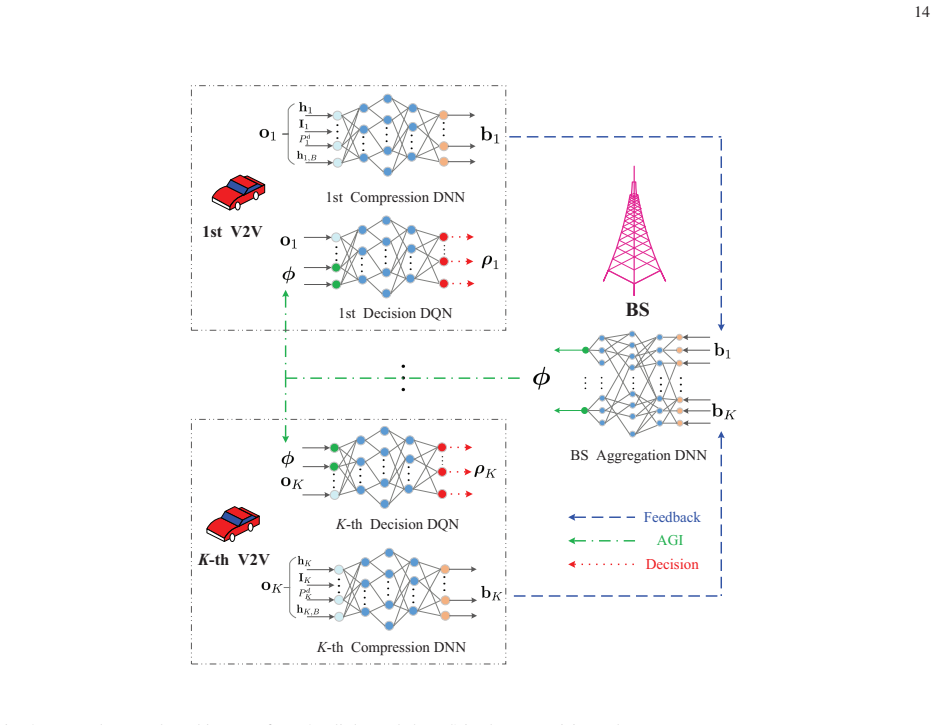
The load-bearing object is the jointly trained compression-and-allocation chain: a per-vehicle compression DNN with a quantized feedback layer, feeding a base-station deep Q-network (C-Decision), or a base-station aggregation DNN feeding per-link decision DQNs (D-Decision). The mechanism is that the compression DNN and the Q-network are trained end-to-end by Q-learning updates, so the learned feedback is optimized for the downstream allocation task rather than for reconstructing CSI. The quantization layer uses tanh to map values to $[-1,1]$, the sign function to binarize, and the straight-through estimator to supply gradients through the nondifferentiable sign. The action space is the set of all channel assignments, encoded by the indicator vector $\rho_k[n]$, and the reward is the weighted sum of V2I and V2V rates.
What would settle it
Compute, for the trained C-Decision scheme, the fraction of testing steps in which the action chosen coincides with the brute-force optimal action, alongside the 97% return ratio. If the exact-match rate is far below the return ratio, the near-optimal return is carried by many near-tied actions with similar rates, and the claim would not transfer to scenarios where suboptimal allocations are sharply worse.
Extended reading notes
Core claim
The central claim is that the information bottleneck is not the bottleneck: a handful of learned feedback values per link is enough for near-optimal centralized resource allocation in V2X spectrum sharing, provided the feedback is trained jointly with the allocation policy rather than hand-designed. Each V2V link compresses its local observation $o_k = \{h_k, I_k, P_k^d, h_{k,B}\}$ through a DNN into $b_k$, and the base station's DQN treats the concatenated compressed vector as the state and outputs one of all $K^N$ joint channel allocations. The reward couples V2I and V2V throughput through a weighted sum rate; adjusting the weight shifts V2I quality of service. Binary feedback is obtained by a learned pre-binary tanh layer followed by a sign function trained with the straight-through estimator, so quantization is learned rather than fixed. The same training mechanism, with a base-station aggregation DNN producing a compact global summary $\varphi$, yields the distributed D-Decision scheme with only about 2-4% performance loss relative to C-Decision.
Load-bearing premise
The scheme assumes the base station's deep Q-network can enumerate every joint channel allocation of all V2V links in its output layer, which is only feasible for tiny networks; in the simulations this is 4 channels and 4 links, giving 256 actions.
Editorial extensions
If this is right
- With only 3 real-valued feedback numbers per V2V link, the C-Decision scheme attains about 97% of the brute-force optimal average return; adding more feedback values does not improve it.
- Quantizing the 3 values to 36 bits keeps performance at about 94% of optimal, and binary feedback is more robust to feedback noise than real-valued feedback.
- The D-Decision scheme reaches about 96% of optimal with 16 real-valued aggregated global information values, and about 90% with 80 aggregated bits, at the cost of fully distributed local decisions.
- The learned allocation is robust: performance degrades only slowly with feedback interval up to large intervals, and the scheme retains about 60% of optimal even under very large input noise, still above random action.
- The V2I/V2V weight $\lambda_c$ gives a practical knob: raising it shifts the V2I sum-rate CDF rightward while V2V sum rate stays close to optimal.
Reading between the lines
- Because the feedback vector is trained jointly with the Q-network, the same architecture should extend to other resource-allocation tasks, such as joint power control and channel selection, by changing the action space and reward; the paper names joint power control as future work, but the compression mechanism itself is task-agnostic.
- The enumeration of all $K^N$ allocations in the DQN output layer limits the claim to very small networks; a testable extension is replacing the flat action layer with a factored or sequential action decomposition to keep the learned-feedback advantage at realistic scales.
- The robustness to input and feedback noise suggests the learned feedback encodes allocation-relevant structure rather than raw channel values; one could test this by measuring how much of the optimal action's variance is explained by the three feedback values under noisy observations.
- Comparing the 97% C-Decision figure with random action's 55% suggests most of the gain comes from the base station's global view rather than from per-link rate-maximizing choices, which is consistent with the paper's motivation but is not separately ablated in the paper.
Signed reviews
Editorial analysis
A structured set of objections, weighed in public.
Referee Report
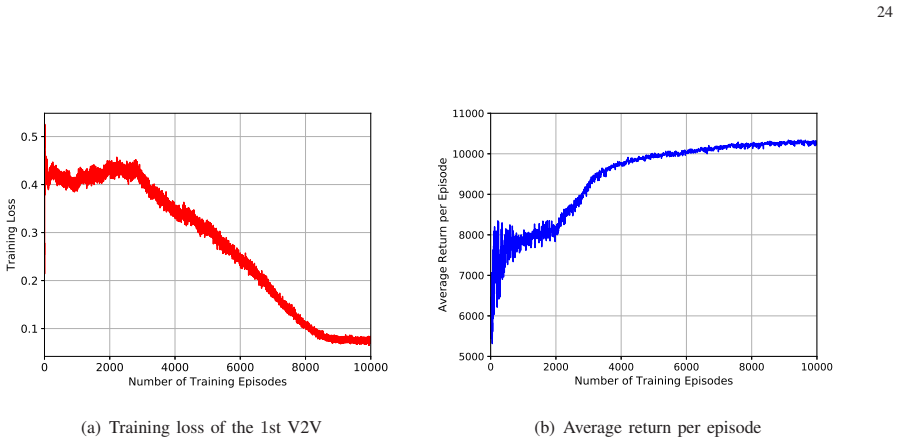
Summary. The paper proposes two deep-reinforcement-learning-based architectures for spectrum sharing in a vehicular (V2X) network. In the C-Decision scheme, each V2V link compresses its local observation with a DNN, feeds a few real-valued numbers (or their quantized bits) back to a base station, and a DQN at the base station performs centralized channel allocation. In the D-Decision scheme, each V2V link also uses a local DQN to make decisions, while the base station aggregates compressed feedback into a small global message (AGI). A binary quantization layer based on the straight-through estimator is added for signaling reduction. Simulations with N=4 V2I links and K=4 V2V links show that the C-Decision scheme achieves about 97% of the brute-force optimal average return with 3 real-valued feedback values and about 94% with 36 feedback bits, while the D-Decision scheme reaches about 96% with 16 real-valued AGI and 90% with 80 AGI bits. The paper also reports robustness to feedback interval, input noise, and feedback noise.
Significance. If the central claim is established, the paper would demonstrate an attractive design: each V2V link needs only a handful of learned real values (or tens of bits) to support near-optimal centralized scheduling in a V2X network, and a similarly compact aggregated message for distributed scheduling. The authors deserve credit for evaluating against a brute-force exhaustive-search optimum computed on the same realizations, which avoids circularity of the near-optimality claim, and for showing convergence curves from multiple seeds in the training phase. The quantization-layer approach is a reasonable and clearly described extension. However, the core 'learn to compress' claim is not yet convincingly supported because no fixed/non-learned feedback baseline is compared, the headline hyperparameters are selected from the same testing curves used for performance reporting, and the evaluation is confined to a 4-by-4 network whose joint action space (256) is enumerated in the DQN output layer. These issues are fixable but require additional experiments and careful qualification.
major comments (4)
- [V-C and V-D (Figs. 4 and 5)] The central claim that each V2V link 'learns' what to compress is not tested against a non-learned fixed feedback baseline with the same feedback budget. For example, a control scheme could send the indices of the strongest 3 channels (or 36 bits of quantized local CSI) from each link and then let the BS apply the same exhaustive-search allocation. Without such a control, the near-optimal ARP at Nk=3 and 36 bits could reflect the small 4-link, 4-channel problem being easy, rather than the learned feedback encoding the right information. This missing control directly targets the main contribution advertised in the title and abstract.
- [V-C and V-D (Figs. 4(b) and 5)] The choices Nk=3 and 36 feedback bits appear to be made by inspecting the testing ARP curves and are then reported as the operating points in the abstract and conclusion. Selecting hyperparameters on the same data used to report final performance introduces optimistic bias. The authors should either use a separate validation set for tuning, use cross-validation, or clearly state that the reported numbers are post-selection and provide a correction or hold-out evaluation.
- [III-B and Table III] The centralized DQN enumerates all K^N channel allocations in its output layer (256 outputs for N=K=4). The paper claims 'near-optimal performance' without qualification, but the architecture is only feasible at this toy scale; for realistic numbers of V2V links and channels the action space grows exponentially. The claims of near-optimality and the title's general promise should be explicitly restricted to the evaluated small network, or the authors should provide evidence that the method scales, for instance via a factorized action representation or a larger-scale experiment.
- [V-C through V-G] All headline quantitative results (97%, 94%, 96%, 90%, etc.) are reported as single averages with no confidence intervals, standard deviations, or number of seeds for the testing phase. Given that training is stochastic, the reader cannot assess whether the differences between schemes or between feedback sizes are statistically significant. Reporting multiple seeds with error bars or confidence intervals is necessary to support the quantitative comparisons.
minor comments (5)
- [V-F, Fig. 7] The vertical axis label reads 'Noramlized Average Return' and should be corrected to 'Normalized Average Return'.
- [V-G and Fig. 10] The notation for the number of real-valued AGI and binary AGI is inconsistent between the text (N_r^g, N_b^g' around Fig. 10) and the figure captions. Please define these symbols where they are first introduced.
- [V-G] In several sentences the text says 'the APR reaches 90%' and 'the APR nearly achieves its maximal value', but the metric is elsewhere called ARP (Average Return Percentage). Please use one consistent acronym.
- [III-A and Table III] In Table III, the BS DQN input dimension is written as 'K × Nk'; it would be clearer to write 'K·Nk' or 'K N_k' to indicate product rather than a 2D structure.
- [V-B] Fig. 3(b) is said to be computed under 10 different random seeds with epsilon=0, but the paper does not state whether the final reported ARP values in later figures are also averaged over seeds; please clarify the test-phase averaging procedure.
Circularity Check
No significant circularity: the near-optimality claim is checked against an external brute-force optimum, and no load-bearing derivation reduces to its own inputs.
full rationale
The central performance claim is not circular. The C-Decision and D-Decision schemes are evaluated by comparing their achieved return against a brute-force exhaustive search over all channel allocations (Section V-C, Fig. 4(a)), where the optimal scheme is computed from the same channel realizations independently of the learned feedback. This is an external benchmark, not a fitted parameter or a self-referential construction. The learned feedback dimension Nk and the number of feedback bits are varied in Figs. 4(b) and 5, and the paper reports the values that reach near-optimal ARP; while this introduces a selection-bias risk, it is not a circularity because the reported performance is still measured against the brute-force optimum rather than being defined to match it. The DQN update equations (10)-(14) are standard Q-learning with function approximation, and the binary quantization layer uses the external straight-through estimator [35]; no uniqueness theorem or prior result by the same authors is invoked to forbid alternatives or to justify the core architecture. Self-citations such as [23], [26], and [27] appear as related work or as sources for system assumptions (e.g., broadcasting h_k,B from the BS), but they do not carry the derivation of near-optimal performance. The paper is self-contained against an external optimal baseline for its main claim, so no circular step can be exhibited.
Assumptions & free parameters
free parameters (6)
- Reward weights lambda_c, lambda_d =
lambda_c = 0.1, lambda_d = 1
- Discount factor gamma =
0.05
- Number of real-valued feedback per V2V Nk =
3
- Number of binary feedback bits per V2V =
36
- Number of real-valued AGI Ng =
16
- Number of AGI bits =
80
assumptions (6)
- domain assumption All V2I links are assigned orthogonal radio resources.
- domain assumption Each V2V link transmits on at most one channel.
- domain assumption Perfect channel estimation at receivers and delay-free feedback to transmitters.
- domain assumption The BS can estimate and broadcast hk,B to all V2V links with negligible overhead.
- standard math Q-learning with function approximation converges to a good policy under the chosen exploration schedule.
- domain assumption The straight-through estimator yields usable gradients for the sign binarization layer.
Cite this review
Pith. "Pith review of Learn to Compress CSI and Allocate Resources in Vehicular Networks." pith.science (2026). https://pith.science/paper/KYCFMKME
@misc{pith2026190804685,
  author       = {Pith},
  title        = {Pith review of: Learn to Compress CSI and Allocate Resources in Vehicular Networks},
  year         = {2026},
  howpublished = {\url{https://pith.science/paper/KYCFMKME}},
  note         = {Machine review of arXiv:1908.04685}
}
read the original abstract
Resource allocation has a direct and profound impact on the performance of vehicle-to-everything (V2X) networks. In this paper, we develop a hybrid architecture consisting of centralized decision making and distributed resource sharing (the C-Decision scheme) to maximize the long-term sum rate of all vehicles. To reduce the network signaling overhead, each vehicle uses a deep neural network to compress its observed information that is thereafter fed back to the centralized decision making unit. The centralized decision unit employs a deep Q-network to allocate resources and then sends the decision results to all vehicles. We further adopt a quantization layer for each vehicle that learns to quantize the continuous feedback. In addition, we devise a mechanism to balance the transmission of vehicle-to-vehicle (V2V) links and vehicle-to-infrastructure (V2I) links. To further facilitate distributed spectrum sharing, we also propose a distributed decision making and spectrum sharing architecture (the D-Decision scheme) for each V2V link. Through extensive simulation results, we demonstrate that the proposed C-Decision and D-Decision schemes can both achieve near-optimal performance and are robust to feedback interval variations, input noise, and feedback noise.
Figures


Figures from the paper (7 more)



Reference graph
Works this paper leans on
-
[26]
Deep reinforcement lear ning based resource allocation for V2V communications,
H. Ye, G. Y . Li, and B. F. Juang, “Deep reinforcement lear ning based resource allocation for V2V communications,” IEEE Trans. V eh. Technol., vol. 68, no. 4, pp. 3163–3173, Apr. 2019
work page 2019
-
[27]
Spectrum sharing in vehicu lar networks based on multi-agent reinforcement learning,
L. Liang, H. Ye, and G. Y . Li, “Spectrum sharing in vehicu lar networks based on multi-agent reinforcement learning, ” to appear in IEEE J. Sel. Areas Commun. , 2019
work page 2019
-
[1]
LTE e volution for vehicle-to-everything services,
H. Seo, K. Lee, S. Yasukawa, Y . Peng, and P . Sartori, “LTE e volution for vehicle-to-everything services,” IEEE Commun. Mag., vol. 54, no. 6, pp. 22–28, Jun. 2016
work page 2016
-
[2]
V ehicle-to-everything (V2X) services supported by LTE-based systems and 5G,
S. Chen, J. Hu, Y . Shi, Y . Peng, J. Fang, R. Zhao, and L. Zhao , “V ehicle-to-everything (V2X) services supported by LTE-based systems and 5G,” IEEE Commun. Standards Mag. , vol. 1, no. 2, pp. 70–76, 2017
work page 2017
-
[3]
V ehicular commun ications: A physical layer perspective,
L. Liang, H. Peng, G. Y . Li, and X. Shen, “V ehicular commun ications: A physical layer perspective,” IEEE Trans. V eh. Technol., vol. 66, no. 12, pp. 10 647–10 659, Dec. 2017
work page 2017
-
[4]
V ehicular com munications: A network layer perspective,
H. Peng and L. Liang and X. Shen and G. Y . Li, “V ehicular com munications: A network layer perspective,” IEEE Trans. V eh. Technol., vol. 68, no. 2, pp. 1064–1078, Feb. 2019
work page 2019
-
[5]
Technical spefica tion group radio access network: Study on LTE-based V2X serv ices,
3rd Generation Partnership Project, “Technical spefica tion group radio access network: Study on LTE-based V2X serv ices,” 3GPP , TR 36.885 V14.0.0 , Jun. 2016
work page 2016
-
[6]
Study on enhancement of 3GPP support for 5G V2X servi ces,
——, “Study on enhancement of 3GPP support for 5G V2X servi ces,” 3GPP , TR 22.886 V15.1.0 , Mar. 2017
work page 2017
Show all 38 references
-
[7]
Resource allocation for lo w-latency vehicular communications: An effective capacit y perspective,
C. Guo, L. Liang, and G. Y . Li, “Resource allocation for lo w-latency vehicular communications: An effective capacit y perspective,” IEEE J. Sel. Areas Commun. , vol. 37, no. 4, pp. 905–917, Apr. 2019
2019
-
[8]
Resource allocation for D2D -enabled vehicular communications,
L. Liang, G. Y . Li, and W. Xu, “Resource allocation for D2D -enabled vehicular communications,” IEEE Trans. Commun. , vol. 65, no. 7, pp. 3186–3197, Jul. 2017
2017
-
[9]
Graph-based resource sharing in vehicular communication,
L. Liang, S. Xie, G. Y . Li, Z. Ding, and X. Y u, “Graph-based resource sharing in vehicular communication,” IEEE Trans. Wireless Commun., vol. 17, no. 7, pp. 4579–4592, Jul. 2018
2018
-
[10]
Interference hypergrap h-based resource allocation (IHG-RA) for NOMA-integrated V2X networks,
C. Chen, B. Wang, and R. Zhang, “Interference hypergrap h-based resource allocation (IHG-RA) for NOMA-integrated V2X networks,” IEEE Internet Things J. , vol. 6, no. 1, pp. 161–170, Feb. 2019
2019
-
[11]
Adaptive network segmentation and channel allocatio n in large-scale V2X communication networks,
C. Han, M. Dianati, Y . Cao, F. Mccullough, and A. Mouzaki tis, “Adaptive network segmentation and channel allocatio n in large-scale V2X communication networks,” IEEE Trans. Commun. , vol. 67, no. 1, pp. 405–416, Jan. 2019
2019
-
[12]
Low complexit y outage optimal distributed channel allocation for vehicl e- to-vehicle communications,
B. Bai, W. Chen, K. B. Letaief, and Z. Cao, “Low complexit y outage optimal distributed channel allocation for vehicl e- to-vehicle communications,” IEEE J. Sel. Areas Commun. , vol. 29, no. 1, pp. 161–172, Jan. 2011
2011
-
[13]
Dynam ic proximity-aware resource allocation in vehicle-to-veh icle (V2V) communications,
M. I. Ashraf, M. Bennis, C. Perfecto, and W. Saad, “Dynam ic proximity-aware resource allocation in vehicle-to-veh icle (V2V) communications,” in Proc. IEEE Globecom W orkshops (GC Wkshps) , Dec. 2016, pp. 1–6
2016
-
[14]
Mastering the game of Go with deep neural networks and tree search,
D. Silver, A. Huang, C. J. Maddison, A. Guez, L. Sifre, G. V an Den Driessche, J. Schrittwieser, I. Antonoglou, V . Panneershelvam, M. Lanctot et al. , “Mastering the game of Go with deep neural networks and tree search,” Nature, vol. 529, no. 7587, p. 484, 2016
2016
-
[15]
An introduction to deep learni ng for the physical layer,
T. O’Shea and J. Hoydis, “An introduction to deep learni ng for the physical layer,” IEEE Trans. Cogn. Commun. Netw. , vol. 3, no. 4, pp. 563–575, Dec. 2017
2017
-
[16]
Deep learning in p hysical layer communications,
Z. Qin, H. Ye, G. Y . Li, and B. F. Juang, “Deep learning in p hysical layer communications,” IEEE Wireless Commun. , vol. 26, no. 2, pp. 93–99, Apr. 2019
2019
-
[17]
Power of deep learning for c hannel estimation and signal detection in OFDM systems,
H. Ye, G. Y . Li, and B. Juang, “Power of deep learning for c hannel estimation and signal detection in OFDM systems,” IEEE Wireless Commun. Lett. , vol. 7, no. 1, pp. 114–117, Feb. 2018. 27
2018
-
[18]
End-to-end learning of comm unications systems without a channel model,
F. A. Aoudia and J. Hoydis, “End-to-end learning of comm unications systems without a channel model,” arXiv preprint arXiv:1804.02276, 2018
2018 arXiv
-
[19]
Machine learning paradigms for next-generation wireless networks,
C. Jiang, H. Zhang, Y . Ren, Z. Han, K. Chen, and L. Hanzo, “ Machine learning paradigms for next-generation wireless networks,” IEEE Wireless Commun. , vol. 24, no. 2, pp. 98–105, Apr. 2017
2017
-
[20]
Intelligent 5G: When cellular networks meet artificia l intelligence,
R. Li, Z. Zhao, X. Zhou, G. Ding, Y . Chen, Z. Wang, and H. Zh ang, “Intelligent 5G: When cellular networks meet artificia l intelligence,” IEEE Wireless Commun. , vol. 24, no. 5, pp. 175–183, Oct. 2017
2017
-
[21]
Dee p reinforcement learning for dynamic multichannel access i n wireless networks,
S. Wang, H. Liu, P . H. Gomes, and B. Krishnamachari, “Dee p reinforcement learning for dynamic multichannel access i n wireless networks,” IEEE Trans. Cogn. Commun. Netw. , vol. 4, no. 2, pp. 257–265, Jun. 2018
2018
-
[22]
Deep reinforcement learnin g based mode selection and resource management for green fog radio access networks,
Y . Sun, M. Peng, and S. Mao, “Deep reinforcement learnin g based mode selection and resource management for green fog radio access networks,” IEEE Internet Things J. , vol. 6, no. 2, pp. 1960–1971, Apr. 2019
1960
-
[23]
Deep learning based w ireless resource allocation with application to vehicular networks,
L. Liang, H. Ye, G. Y u, and G. Y . Li, “Deep learning based w ireless resource allocation with application to vehicular networks,” arXiv preprint arXiv:1907.03289 , 2019
1907 arXiv
-
[24]
Machine learning for vehicular networks: Recent advances and application examples,
H. Ye, L. Liang, G. Y . Li, J. Kim, L. Lu, and M. Wu, “Machine learning for vehicular networks: Recent advances and application examples,” IEEE V eh. Technol. Mag., vol. 13, no. 2, pp. 94–101, Jun. 2018
2018
-
[25]
Toward intelligent vehicu lar networks: A machine learning framework,
L. Liang, H. Ye, and G. Y . Li, “Toward intelligent vehicu lar networks: A machine learning framework,” IEEE Internet Things J. , vol. 6, no. 1, pp. 124–135, Feb. 2019
2019
-
[28]
Traf fic and computation co-offloading with reinforcement learni ng in fog computing for industrial applications,
Y . Wang, K. Wang, H. Huang, T. Miyazaki, and S. Guo, “Traf fic and computation co-offloading with reinforcement learni ng in fog computing for industrial applications,” IEEE Trans. Ind. Informat. , vol. 15, no. 2, pp. 976–986, Feb. 2019
2019
-
[29]
Deep reinforcement learning for distributed dynamic power allocation in wireless networks ,
Y . S. Nasir and D. Guo, “Deep reinforcement learning for distributed dynamic power allocation in wireless networks ,” arXiv preprint arXiv:1808.00490 , 2018
2018 arXiv
-
[30]
Q-learning,
C. J. Watkins and P . Dayan, “Q-learning,” Machine Learning , vol. 8, no. 3-4, pp. 279–292, Feb. 1992
1992
-
[31]
R. S. Sutton and A. G. Barto, Reinforcement Learning: An Introduction . Cambridge, MA, USA: MIT Press, 2018
2018
-
[32]
Human-level control through deep reinforcement learnin g,
V . Mnih et al. , “Human-level control through deep reinforcement learnin g,” Nature, vol. 518, no. 7540, pp. 529–533, Feb. 2015
2015
-
[33]
Deep reinforcem ent learning with double Q-learning,
H. V an Hasselt, A. Guez, and D. Silver, “Deep reinforcem ent learning with double Q-learning,” in Proc. 30th AAAI Conf. , Feb. 2016, pp. 2094–2100
2016
-
[34]
V ariable rate image compression with recurrent neural networks,
G. Toderici, S. M. O’Malley, S. J. Hwang, D. Vincent, D. M innen, S. Baluja, M. Covell, and R. Sukthankar, “V ariable rate image compression with recurrent neural networks,” arXiv preprint arXiv:1511.06085 , 2015
2015 arXiv
-
[35]
Estimating o r propagating gradients through stochastic neurons for con ditional computation,
Y . Bengio, N. L´ eonard, and A. Courville, “Estimating o r propagating gradients through stochastic neurons for con ditional computation,” arXiv preprint arXiv:1308.3432 , 2013
2013 arXiv
-
[36]
IST-4-027756 WINNER I I d1. 1.2 v1. 2 WINNER II channel models
Y . Bultitude and T. Rautiainen, “IST-4-027756 WINNER I I d1. 1.2 v1. 2 WINNER II channel models.”
-
[37]
An overview of gradient descent optimizatio n algorithms,
S. Ruder, “An overview of gradient descent optimizatio n algorithms,” arXiv preprint arXiv:1609.04747 , 2016
2016 arXiv
-
[38]
Hastie, R
T. Hastie, R. Tibshirani, and J. Friedman, The Elements of Statistical Learning: Data Mining, Inferen ce, and Prediction . New Y ork, NY , USA: Springer Science & Business Media, 2009
2009
Reviewed August 14, 2026 · model on record in the stance chip above.
Discussion (0). Continue with ORCID to comment.